What Is a PEO? Understanding Professional Employer Organizations in India

TL;DR
Expanding your business into India is often described as "high risk, high reward." In 2026, that’s an understatement.
With the full implementation of the Four New Labor Codes, India has essentially hit the "reset" button on employment law. For a foreign founder or CFO, the reward is access to the world’s most dynamic talent pool; the risk is a bureaucratic minefield that has become significantly more sophisticated.
If you are looking at this market, you’ve likely encountered the term What is a PEO in India? and wondered if it’s just another layer of middleman fees or a genuine lifeline.
We won't tell you that India is an easy market to navigate. It’s not. It’s a jurisdiction where a single mistake in a Provident Fund (PF) calculation or a missing "Appointment Letter" can lead to audits that haunt your balance sheet for years.
A Professional Employer Organisation (PEO) is your local ground crew, the ones who ensure your flight into the Indian market doesn't end in a compliance crash.
Table of contents
- TL;DR
- The "Marmite" Truth About the Indian Market in 2026
- How the PEO "Co-Employment" Model Works in India
- What a professional employer organisation actually is
- PEO vs Employer of Record (EOR) in India
- How a PEO works in India step by step
- The "Hidden" compliance of India’s 2026 statutory mandates
- Termination & The "Right to Disconnect" (2026 Update)
- The verdict: Is a PEO your best move in India?
- Ready to hire in India without learning compliance the hard way?
- Frequently asked questions
The "Marmite" Truth About the Indian Market in 2026
There is a certain type of masochism required to set up a full Indian subsidiary (Private Limited Company) from scratch in 2026. It takes 4–6 months, requires local directors, and ties you into a tax system that is moving toward a "digital-first" audit model.
You either love the idea of total structural control and are willing to endure the "Registration Tax" of months-long delays, or you hate the red tape and want a faster way to get your engineers and sales teams working.
That is the honest role of a PEO. In India, a PEO acts as your co-employment partner. They take the administrative weight of the 29 consolidated labour laws off your shoulders, while you keep the focus on building your product.
The Reality Check: Under the 2026 Labour Codes, the definition of a "worker" has expanded to include gig and platform workers.
Compliance is no longer a "best effort" activity; it is a system-enforced requirement. If you aren't using a PEO or an EOR, you aren't just "outsourcing HR", you're gambling with the Indian Ministry of Labour.

How the PEO "Co-Employment" Model Works in India
In India, the PEO relationship is built on shared responsibility. You are the Worksite Employer (strategy, culture, daily output), while the PEO is the Administrative Employer (payroll, statutory filings, benefits).
1. The "50% wage rule" (The CFO’s nightmare)
This is the biggest change in 2026. Under the Code on Wages, your employees' Basic Pay must be at least 50% of their total CTC (Cost to Company).
The Old Way: Companies kept "Basic" low to minimise Social Security contributions.
The 2026 Way: The law has killed this practice. A PEO automatically restructures your Indian pay packets to meet this 50% threshold, ensuring your Provident Fund and Gratuity calculations are bulletproof from day one.
2. Fixed-term Parity
India has officially brought Fixed-Term Employment (FTE) into the mainstream. In 2026, an FTE must receive the same wages and benefits as a permanent employee. More importantly, they are now entitled to pro-rata gratuity after just one year of service, not the traditional five years. Your PEO handles these accruals, so you don’t get a surprise bill when a contract ends.
3. State-specific Nuances
India is a federal union, and labour is a "concurrent" subject. This means while the Central Codes provide the framework, states like Karnataka (Bangalore) or Maharashtra (Mumbai) have their own "Shops and Establishments" rules and Professional Tax brackets. A PEO manages these localised variations, so you don't have to hire a consultant for every city you hire in.
What a professional employer organisation actually is
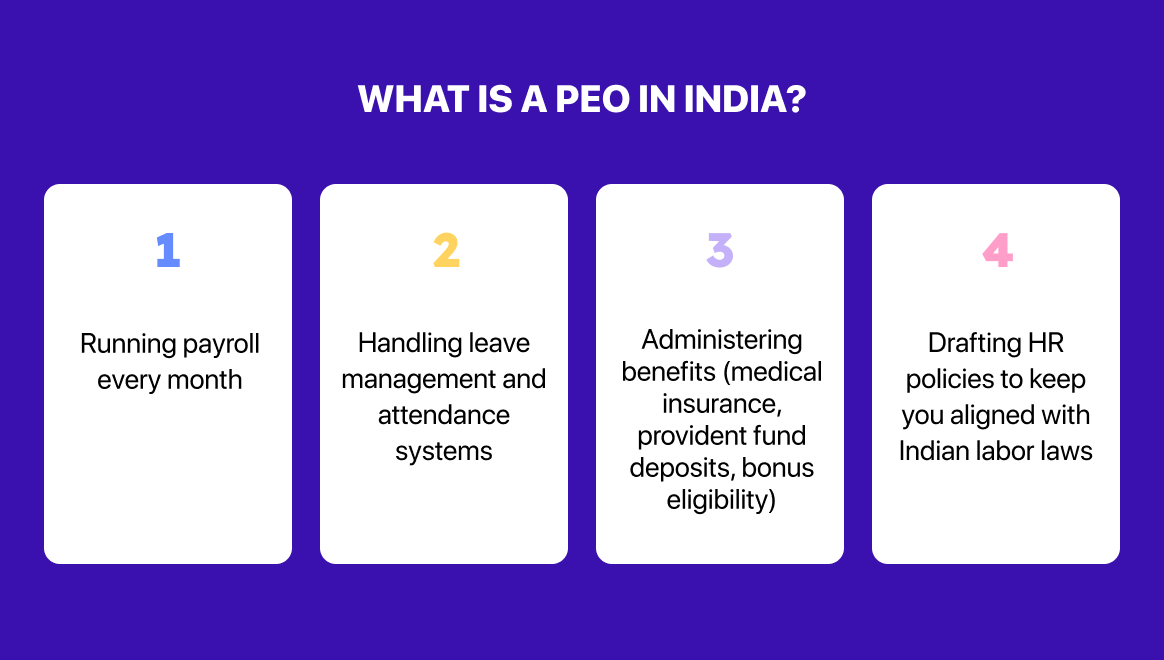
PEO stands for Professional Employer Organisation.
In HR terms, it’s a co-employment model.
That phrase gets abused, so here’s what it means without the fog.
- You employ the worker
- Your company signs the contract
- Your company is the legal employer
- The PEO supports HR and payroll administration
Globally, that definition holds.In India, the consequences are sharper.
When regulators ask who the employer is, they don’t care who runs payroll software. They care whose name is on the registrations.
That name is yours.
This is the core of the professional employer organisation definition in India. Administrative support. Not a legal substitution.
PEO vs Employer of Record (EOR) in India

This is the fork in the road where most companies make a quiet but expensive mistake.
PEO and EOR get bundled together because both “handle HR.”
That’s like saying a CFO and a bookkeeper do the same job. They don’t. And India will punish you for pretending they do.
Here’s the clean distinction, grounded in how India actually enforces employment law.
The one question that matters
Who is the legal employer?
Everything else. Payroll. Taxes. Termination risk. Audits. Hangs off that answer.
- PEO in India
- You are the legal employer
- You must have an Indian entity
- Compliance risk stays with you
- The EOR is the legal employer
- No Indian entity required
- Compliance risk shifts away from you
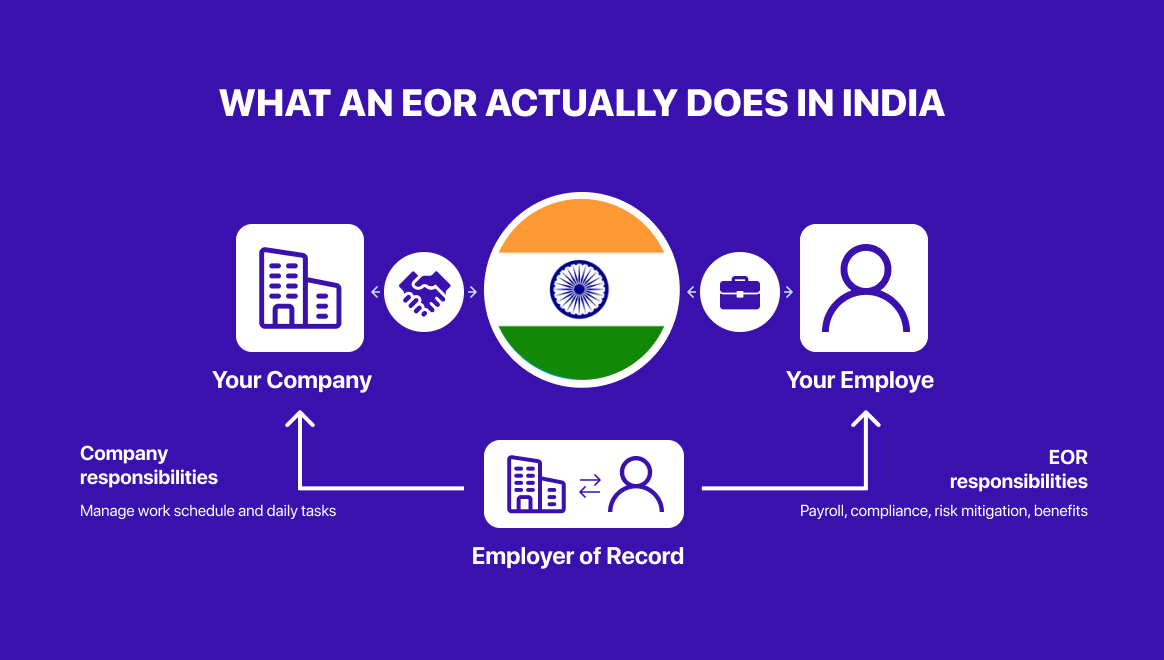
That’s it. That’s the difference.
Why is this distinction sharper in India
India doesn’t care about intentions. It cares about registrations.
PF. ESIC. TDS. State labour filings.
If your company is the employer on paper, you own the exposure. Even if a third party runs payroll.
That’s why employer of record vs PEO in India is not a theoretical debate. It’s a risk decision.
What a PEO really means in the Indian context
This is where global explanations fall apart.
In India, employment compliance is built around:
- Entity registration
- Statutory deductions
- Monthly filings
- Audit trails that go back years
A PEO in India means:
- Help with administering payroll
- Support with HR documentation
- Assistance with filings
It does not mean:
- Hiring without an entity
- Avoiding PF or ESIC exposure
- Transferring audit risk
Think of a PEO as an operations multiplier, not a legal shield.
That distinction matters because Indian authorities do not negotiate over “intent.” They enforce structure.
How a PEO works in India step by step
Let’s walk through the real flow. The one thing founders don’t see in sales decks.
Step 1. You must already have an Indian entity
Before a PEO can touch anything, you need:
- An Indian Private Limited Company or LLP
- PAN and TAN
- Registration under the applicable state Shops and Establishments Act
- EPFO registration
- ESIC registration, if applicable
- Professional Tax registration, state by state
No entity. No PEO. There is no legal workaround here.
This alone takes time. And money. And patience.
Step 2. You hire employees under your company
With a PEO:
- Employment contracts are issued by your Indian entity
- Contracts must align with:
- Central Labour Codes
- State-level employment rules
- Wage structures tied to PF and ESIC thresholds
The PEO may help draft documents.
But legally, the employer is you.
If an employee disputes termination or benefits, your company name is on the notice.
Step 3. The PEO administers payroll
This is where PEO payroll in India actually adds value.
A PEO typically handles:
- Monthly payroll calculations
- TDS deductions and reporting
- Provident Fund contributions
- ESIC filings, where applicable
- Professional Tax deductions
- Payslips and payroll reports
Important line you should not skip:
If payroll is filed incorrectly or late, the notice does not go to the PEO.
It goes to your company.
Step 4. Compliance and audits stay with you
Even with a PEO:
- Labour inspectors audit your entity
- PF authorities audit your filings
- ESIC audits hit your registration
- Tax notices name your company
The PEO supports.
It does not shield.
This is why experienced operators treat PEOs as an efficiency play, not a risk transfer.
The "Hidden" compliance of India’s 2026 statutory mandates
If you thought managing the 50% wage restructuring was the peak of the mountain, welcome to the second half of the climb. India’s 2026 labour landscape is a high-tech ecosystem where worker welfare isn't just a suggestion; it’s baked into the code of the law.
1. The 26-week maternity standard & childcare
India now offers one of the most progressive maternity benefits in the world. Under the 2026 refined mandates:
- Duration: 26 weeks of fully paid leave for the first two children (with 8 weeks permissible before the expected delivery).
- Adoption & Commissioning: 12 weeks of paid leave for mothers adopting a child under three months or for commissioning (surrogate) mothers.
- The "Crèche" Mandate: If your Indian team grows beyond 50 employees (including those hired via PEO), you are legally required to provide a crèche (childcare) facility within a specific distance from the office, including four mandatory visits daily for the mother.
- The PEO value: Your PEO manages the "Maternity Benefit" payouts and ensures you’re not caught off guard by the specialised "Work from Home" provisions that the law now encourages for new mothers.
2. Mandatory health checks: The "over 40" rule
In a move to prioritise preventive healthcare, the 2026 Occupational Safety, Health and Working Conditions Code introduced a specific requirement:
- The Rule: Employers must provide a free annual health check-up for every worker above the age of 40.
- Not an Option: The law says "provide," not "offer." This means you must ensure the check-up actually happens.
- The PEO value: A local PEO integrates these check-ups into your benefits package, tracking employee ages and partnering with diagnostic chains to ensure 100% compliance without your HR team making a single phone call.
3. POSH compliance: The 10-employee threshold
The Prevention of Sexual Harassment (POSH) Act is the most strictly enforced "non-payroll" law in India.
- Internal Committee (IC): If you have 10 or more employees, you must form an IC chaired by a senior female employee.
- External Member: You are legally required to have one external member (typically a lawyer or NGO representative) to ensure an unbiased inquiry.
- Annual Filings: You must file a POSH annual report with the District Officer detailing the number of cases received and resolved. Failure to do so can result in the cancellation of your business license.
4. The new gratuity timeline for fixed-term workers
Traditionally, "Gratuity" (a statutory loyalty bonus) was only paid after five years of service. That changed in late 2025.
- The 2026 Shift: For Fixed-Term Employees (FTE), gratuity is now payable on a pro-rata basis after just one year of continuous service.
- The Calculation: $Gratuity = \frac 15 \times \text Last Drawn Basic Salary \times \text Years of Service 26 $.
- The PEO value: Your PEO tracks these "accrued liabilities" on your monthly invoices so you don't face a massive, unbudgeted severance bill when a contract expires.
Termination & The "Right to Disconnect" (2026 Update)
Firing in India has never been "at-will," but 2026 has added two new layers:
- Final Settlement in 48 Hours: Under the new codes, when an employee is terminated or resigns, their full and final settlement (wages) must be paid within two working days. The old "45-day cycle" is illegal.
- The Right to Disconnect: 2026 has seen the rise of "Right to Disconnect" protocols. While still maturing, courts are increasingly looking at after-hours pings as "Overtime," which must be paid at double the normal wage rate.
The verdict: Is a PEO your best move in India?
You have two paths into the Indian market:
- The DIY Path: Spend $15k on legal setup, wait 4 months for your PAN/TAN numbers, hire a local compliance officer to manage the 29 consolidated codes, and hope you don't miss a 48-hour final settlement window.
- The Team Up Path: Leverage our 2026-ready infrastructure. You hire the talent; we handle the 50% Wage Rule, the POSH filings, and the Social Security uploads.
India is a powerhouse, but its bureaucracy doesn't sleep. Don't let a "fart joke" of a compliance error ruin your expansion. Stay self-aware, stay honest with the local laws, and use a partner who knows the difference between "Marmite" and a solid business plan.
Ready to hire in India without learning compliance the hard way?
Here’s the part most providers avoid saying out loud.
If you choose the wrong hiring model in India, you don’t just lose time.
You inherit permanent compliance baggage.
PF issues don’t expire quietly.
ESIC mistakes compound.
Termination errors resurface years later, usually during an audit, a funding round, or an acquisition.
That’s why companies don’t come to Team Up asking for “a PEO” or “an EOR.”
They come asking one question:
“What’s the safest way to hire in India without screwing this up?”
What working with Team Up actually gives you
- A clear recommendation. PEO, EOR, or neither. Based on your situation, not a pricing tier.
- A compliant hiring structure from day one. No entity shortcuts. No contractor gray zones.
- Real local execution. Payroll, PF, ESIC, TDS, state compliance. Done properly.
- A clean growth path. Start with EOR. Move to an entity. Add a PEO only when it makes sense.
We don’t sell optimism. We sell structures that survive audits.
If you’re hiring in India now
Before you:
- Register a company you might regret
- Sign a PEO contract that doesn’t do what you think
- Let “we’ll fix it later” become a line item
Talk to Team Up.
We’ll look at:
- Your headcount plan
- Your timeline
- Your risk tolerance
- Your long-term India strategy
And we’ll tell you, clearly, what works. And what doesn’t.
No pressure.
No sales fog.
Just the right structure, from the start.
Frequently asked questions
What is a PEO in India?
A PEO in India (Professional Employer Organization) is an HR and payroll outsourcing partner that supports companies that already have an Indian legal entity.
A PEO helps with:
- Payroll administration
- HR operations
- Statutory filings support
A PEO does not:
- Hire employees for you
- Replace your Indian entity
- Become the legal employer
In India, you remain fully responsible for labour law, tax, and compliance.
What does PEO stand for in HR?
In HR, PEO stands for Professional Employer Organisation.
It refers to a co-employment model, where:
- Your company employs the worker
- The PEO supports HR and payroll administration
In India, this model is administrative only. Legal responsibility stays with the company that owns the entity.
What is the PEO meaning in HR for India?
The PEO meaning in HR in India is narrower than in the US or Europe.
It means:
- Outsourced payroll processing
- HR administration support
- Compliance assistance
It does not mean:
- Legal employer substitution
- Compliance risk transfer
- Hiring without an entity
India enforces structure, not intent.
What is a professional employer organisation definition in India?
A professional employer organisation definition in India is:
A third-party provider that assists an Indian entity with HR and payroll administration under a co-employment model, while the entity remains the legal employer.
Anything beyond that is marketing, not law.
What is the difference between PEO and EOR in India?
The difference between PEO and EOR in India comes down to one thing.
Who is the legal employer.
- PEO India
- You are the legal employer
- Indian entity required
- Compliance risk stays with you
- EOR India
- EOR is the legal employer
- No entity required
- Compliance risk shifts to the EOR
They solve very different problems.
PEO vs EOR India. Which one should I use?
PEO vs EOR in India depends on your stage.
Use a PEO if:
- You already have an Indian entity
- You employ 15–20+ people
- You want HR efficiency
Use an EOR if:
- You don’t have an entity
- You’re hiring 1–10 people
- You want fast, compliant market entry
Most foreign companies should start with EOR, not PEO.
Employer of record vs PEO India. Which is safer?
From a compliance standpoint, employer of record vs PEO in India is not close.
An EOR is safer for:
- Foreign companies
- Startups testing the market
- Investor-backed teams
- Audit-sensitive businesses
A PEO assumes you already accept Indian compliance risk.
How does PEO payroll work in India?
PEO payroll in India means the PEO helps administer payroll, including:
- Salary calculations
- TDS deductions
- Provident Fund contributions
- ESIC filings, where applicable
- Professional Tax
But the payroll is filed under your entity.
If something is wrong, the authorities contact your company. Not the PEO.
What is the PEO payroll meaning in India?
The PEO payroll meaning in India refers to:
- Payroll execution support
- Statutory deduction processing
- Payslip and reporting administration
It does not mean payroll liability transfer.
Execution and liability are not the same thing in India.
Are there PEO services in India for foreign companies?
Yes. With a condition.
PEO services in India for foreign companies only work after you set up a local Indian entity.
Without an entity:
- A PEO cannot hire
- A PEO cannot run compliant payroll
- A PEO cannot protect you legally
Foreign companies without entities need an EOR, not a PEO.
.svg)