PEO vs Employer of Record (EOR) in India: Which is right for your organization?
Introduction
Global hiring is booming, but the alphabet soup of HR models, PEO, EOR, and even the occasional PEO-EOR hybrid is enough to confuse anyone.
You’re trying to build a team, not decode acronyms that sound like rejected band names.
Yet, if you’re expanding into new markets, these models matter.
So here’s the real question: what’s the actual difference between PEO vs EOR, and which one works best for your organization?
This guide breaks it down without the fluff, so you can pick the model that fits your hiring goals, compliance needs, and budget, and get back to growing your team.
What is a PEO in India?
Hiring in India is obviously NOT only signing an offer letter. You need to navigate a patchwork of central and state laws, payroll regulations, and compliance deadlines.
That’s where the Professional Employer Organization (PEO) model enters the conversation.
But what exactly does a PEO do in India, and why is it often confused with an EOR?
Let’s unpack it.
1. The Core Definition
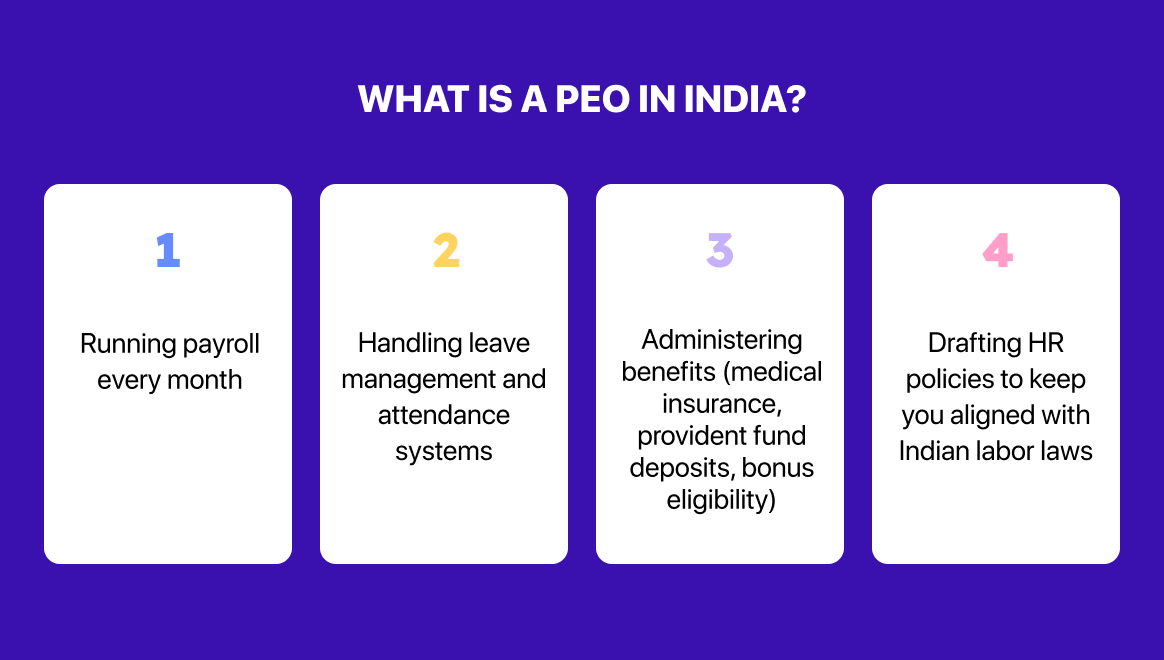
A Professional Employer Organization (PEO) in India acts as a co-employer. In practice, this means the PEO takes over many administrative HR functions on your behalf:
- Running payroll every month
- Handling leave management and attendance systems
- Administering benefits (medical insurance, provident fund deposits, bonus eligibility)
- Drafting HR policies to keep you aligned with Indian labor laws
But, and this is the key difference from an EOR, your company remains the legal employer. The employees are on your entity’s payroll, not the PEO’s.
2. Entity requirement
To use a PEO in India, you must first have:
- A registered Indian entity (usually a Private Limited company or LLP)
- Local tax registrations such as PAN, TAN, GST, and Professional Tax
- A bank account in India to disburse salaries
- Compliance set up under the state Shops and Establishments Acts or the Factories Act
Without these, a PEO cannot engage employees for you. This is why PEOs are often compared with EORs, because, unlike EORs, they do not solve the “no entity” problem.
3. Liability and compliance risk
One of the most misunderstood aspects of PEOs is liability. With a PEO:
- Compliance responsibility sits with you. If the labor inspector shows up or a payroll error happens, your company’s name is on the official records.
- The PEO provides administrative support and expertise, but cannot shield you from penalties.
- Legal obligations like Employees’ Provident Fund (EPF) contributions, Employee State Insurance (ESI) filings, and maintaining statutory registers remain your responsibility as the employer.
A 2024 Deloitte survey on global HR outsourcing noted that while 74% of companies using PEOs in India reduced HR admin costs, 61% still faced compliance issues tied to their legal entity status. This underlines the core trade-off: efficiency vs. liability.
4. When a PEO works best in India
PEOs are not for everyone. They tend to work best when:
- You’ve already invested in setting up a subsidiary and want to scale headcount quickly.
- You need day-to-day HR administration support, but your legal and finance teams still own compliance.
- You want localized HR expertise to ensure policies match Indian expectations (leave entitlements, maternity benefits, statutory bonuses).
In short, a PEO is a good fit for scaling operations in India, not for market entry.
5. Why PEOs are often misunderstood
Many global leaders confuse PEOs with EORs because both provide HR outsourcing. But the distinction matters:
- EOR = legal employer. They hire on your behalf under their entity.
- PEO = HR co-employer. They manage admin, but you remain the employer of record.
This confusion leads some companies to choose a PEO when what they really needed was an EOR. The result? Months wasted on entity setup before hiring even begins.
What is an Employer of Record (EOR) in India?
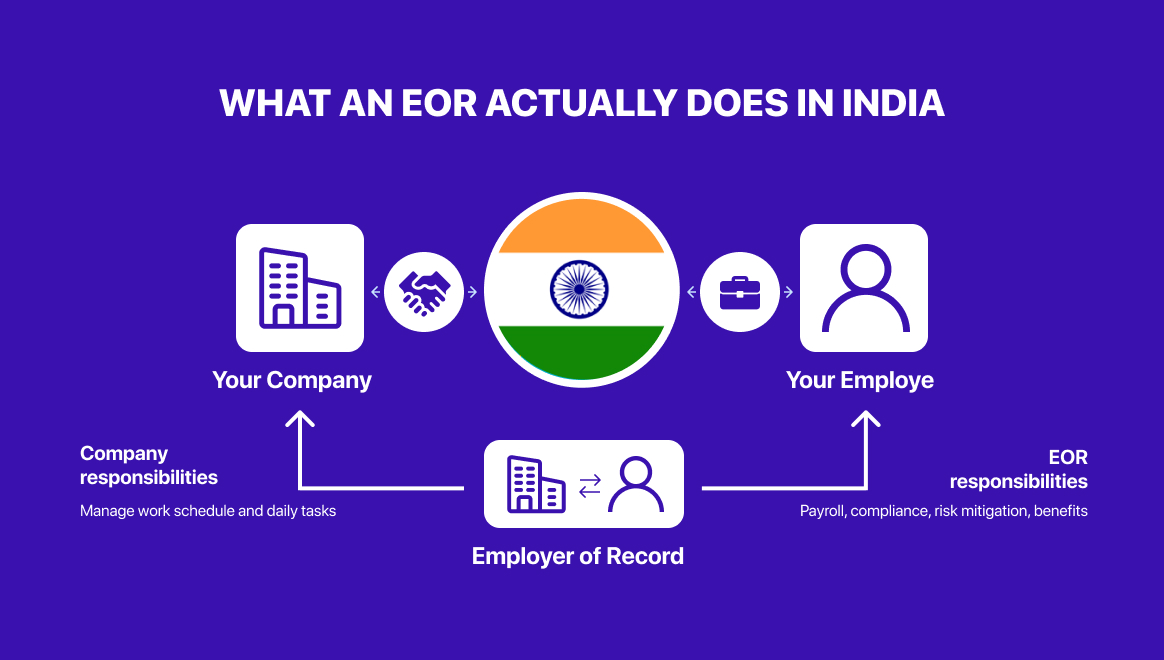
Expanding into India means unlocking access to one of the largest and most skilled talent pools in the world. But it also means navigating a maze of regulations from labor codes and tax registrations to state-specific compliance rules. That’s where an Employer of Record (EOR) comes in.
1. The core definition of Employer of Record (EOR) in India
An Employer of Record is a third-party company that becomes the legal employer of your workforce in India. The EOR:
- Drafts and issues compliant contracts
- Runs payroll and deducts taxes at source
- Handles social security (PF, ESI) contributions
- Provides statutory benefits such as gratuity and maternity leave
- Ensures filings are correct and on time
Meanwhile, you stay in control of operations: managing projects, performance, and culture. The division of responsibility is simple: the EOR handles the legal side, you handle the business side.
2. Why it matters in India
India’s employment landscape is complex:
- Over 40 central labor laws and 200+ state-specific rules can apply depending on where your employees are based.
- Setting up a local entity can take 2–3 months, plus ongoing costs for tax filings, audits, and HR compliance.
- Failing to comply can trigger penalties under acts like the Shops and Establishments Act or the Employees’ Provident Fund Act.
An EOR reduces this burden. Instead of building an in-house compliance engine, you hire through the EOR’s already registered Indian entity and start onboarding in weeks.
3. The strategic advantage
Why companies choose EOR in India:
- No entity required – skip company incorporation, banking, and tax IDs.
- Speed to hire – onboard in 10–14 days instead of months.
- Reduced risk – the EOR is on the hook for compliance mistakes.
- Scalability – test small teams before committing to a full legal setup.
A 2023 People Managing People report noted that global firms using EORs in India saved 20–30% on expansion timelines, with faster access to engineering and customer support talent compared to companies waiting for entity setup.
4. How it differs from other models
It’s easy to confuse an EOR with a PEO or a staffing agency, but the distinction matters:
- EOR = legal employer → employees sit on the EOR’s entity, full compliance transferred.
- PEO = HR co-employer → requires your own Indian entity; liability remains with you.
- Staffing agency = talent provider → often short-term or contract-based, not suitable for long-term teams.
In short, if you don’t have an entity in India, an EOR is your only compliant shortcut.
5. When to use an EOR in India
EOR isn’t a permanent solution for every company. It works best when:
- You’re testing a new market with a small team.
- You want to hire specialists quickly without waiting for incorporation.
- You’re hiring across multiple states with varying compliance rules.
- You’re scaling globally and need a single partner to manage India alongside other regions.
Once your Indian team grows past 20–30 employees in a single state, many companies consider setting up their own entity, but until then, the EOR is the leanest option.

Key differences between PEO vs Employer of Record (EOR) in India
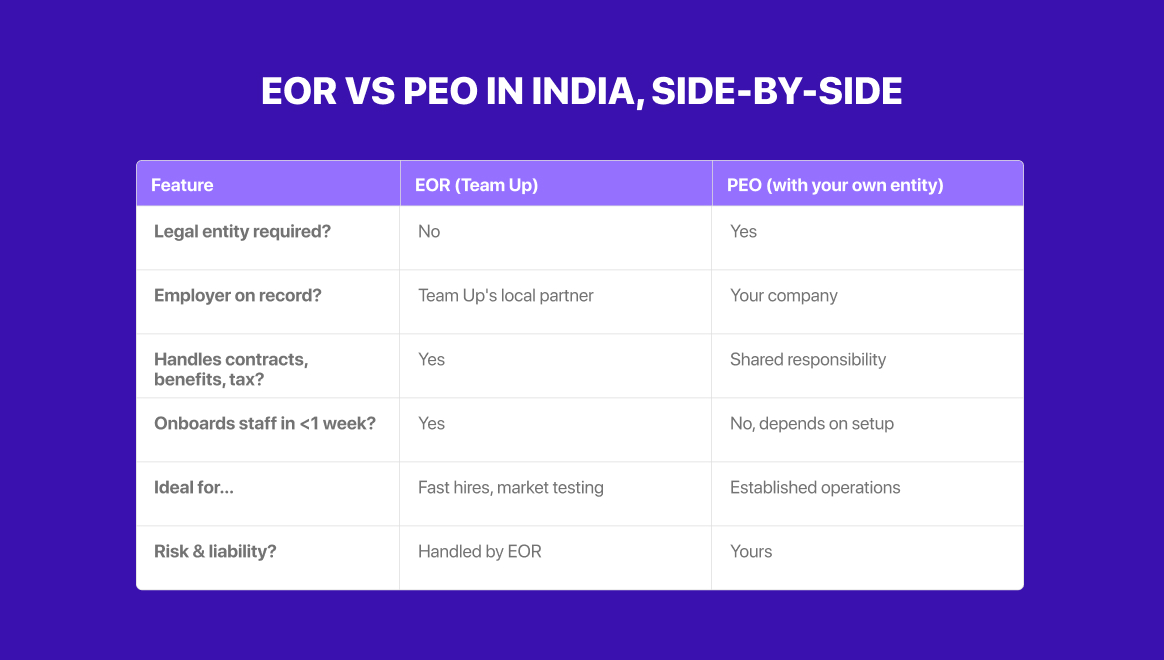
At first glance, PEOs and EORs sound interchangeable; both handle HR tasks, payroll, and benefits.
But when you dig into the details, the models are very different. And in India, those differences can make or break your expansion strategy.
To make it simple, here’s a side-by-side view of how they compare:
PEO vs EOR in India: Quick comparison
| Category | Employer of Record (EOR) | Professional Employer Organization (PEO) |
| Entity requirement | No entity needed. You hire through the EOR’s Indian entity. | Requires you to set up and maintain your own Indian entity. |
| Legal employer | The EOR is the legal employer of record. | Your company is the legal employer of record. |
| Compliance liability | Managed entirely by the EOR. | Shared — but ultimate responsibility sits with your company. |
| Speed to hire | 10–14 days; contracts and payroll are ready almost immediately. | 2–3 months, after entity registration, banking, and tax setup. |
| Costs | One bundled, per-employee fee (salary + statutory + provider). | Payroll + HR admin costs, plus the overhead of entity upkeep. |
| Scalability | Ideal for pilot teams, market entry, or testing in India quickly. | Best for larger operations once you’ve already invested in India. |
| Immigration support | Limited but possible via EOR sponsorship. | Dependent on your own entity’s ability to sponsor visas. |
Real-world examples
Scenario A: The scaling startup
A US-based SaaS startup wants to hire five developers in Bengaluru. They don’t have an Indian entity and can’t afford months of setup delays. By using an EOR, they onboard their engineers in two weeks, get payroll handled locally, and test the market with minimal risk.
Scenario B: The established multinational
A German automotive company already has a registered subsidiary in Pune. They’re hiring 100+ staff across engineering and customer service. Instead of adding HR headcount, they partner with a PEO to streamline payroll and benefits while keeping full compliance responsibility in-house.
Scenario C: The cautious market explorer
A UK fintech isn’t sure if India will be a long-term market. They use an EOR to hire three compliance analysts. After a year, once performance proves strong and headcount crosses 30, they open their own entity and later switch to a PEO to co-manage HR.
Pros and cons of EOR and PEO in India
Neither PEOs nor EORs are one-size-fits-all. Each has strengths that make sense in certain stages of growth, and trade-offs that could slow you down if you pick the wrong fit.
Here’s the breakdown.
Employer of Record (EOR)
Pros
- Fast setup: Onboard employees in 10–14 days without waiting on registrations.
- No local entity required: Hire through the EOR’s Indian entity, skipping the paperwork and costs of incorporation.
- Compliance risk managed externally: The EOR handles payroll taxes, benefits filings, and legal obligations, shielding you from day-to-day liability.
Cons
- Higher monthly cost per employee: The bundled fee includes compliance and admin, which can feel heavy once teams scale past dozens of staff.
- Less flexible at large scale: If you’re hiring hundreds of employees in one market, maintaining your own entity often becomes more cost-efficient.
Professional Employer Organization (PEO)
Pros
- More control once the entity is set up: You keep ownership of the employment relationship and filings, with the PEO supporting daily HR.
- Tighter integration with in-house systems: PEOs can plug into your existing HR and payroll platforms for smoother workflows.
Cons
- Entity setup required: You need to incorporate locally, open bank accounts, and register for taxes before hiring.
- Compliance risk sits with you: PEOs advise and co-manage, but they don’t take the heat if regulators find issues.
- Slower to first hire: Entity setup and registrations can stretch timelines by months.
Which should you choose, EOR or PEO?
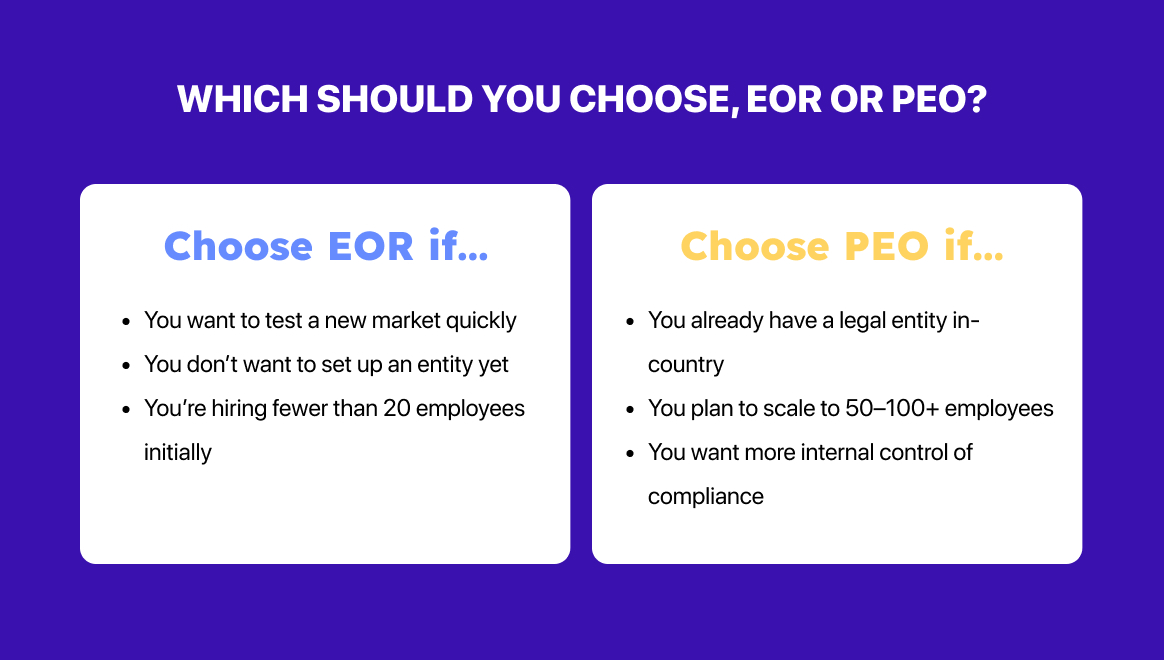
The choice between an EOR and a PEO comes down to your stage of growth, your appetite for compliance risk, and how quickly you need people on the ground.
Think of it less as “which is better” and more as “which is better for you right now.”
Choose EOR if…
- You want to test a new market quickly. Speed matters — an EOR can get your first hire on payroll in 10–14 days.
- You don’t want to set up an entity yet. Skip incorporation, banking, and tax registrations until you’re sure the market fits.
- You’re hiring fewer than 20 employees initially. Lean teams don’t justify entity setup, but they still need airtight compliance.
Choose PEO if…
- You already have a legal entity in-country. A PEO won’t save you from the setup process — you’ll need that entity in place first.
- You plan to scale to 50–100+ employees. At scale, a local entity + PEO support often makes more financial sense than paying per-employee EOR fees.
- You want more internal control of compliance. A PEO co-manages HR but leaves the ultimate liability with you, giving you more visibility and direct oversight.
How much do PEO and EOR costs in India
Let’s talk numbers, because budgets make or break expansion decisions. Both PEO and EOR services in India carry very different cost structures, and understanding them early helps you avoid surprises.
EOR costs in India
An Employer of Record (EOR) usually charges a per-employee, per-month fee, which covers:
- Salary administration and payroll processing
- Social security contributions (Provident Fund, ESI)
- Statutory benefits (gratuity, bonus)
- Tax filings and compliance oversight
Team Up charges 199 euros per employee per month, depending on role seniority, benefits package, and headcount.
EOR is more expensive on a per-head basis, but you save months of entity setup costs and ongoing compliance overhead. For lean or pilot teams, the math often works out in your favor.
PEO costs in India
A Professional Employer Organization (PEO) generally charges a smaller admin fee per employee, but requires you to cover:
- Local entity setup and incorporation fees (~USD $3,000–$5,000 upfront)
- Banking and tax registration costs
- Ongoing statutory filings, audits, and compliance obligations
- PEO service fee (usually 2–5% of payroll)
Over time, PEO is cheaper if you’re scaling to 50+ employees and already have a legal entity. But for smaller headcounts, the upfront entity costs can outweigh the savings.
The trade-off
- EOR = higher monthly fees, zero setup hassle. Perfect for testing the market or running teams under 20–30 employees.
- PEO = lower monthly fees, but entity overhead. Better suited for companies scaling larger operations with an established Indian subsidiary.
Conclusion
At the end of the day, PEO vs EOR isn’t about which model is “better”; it’s about which one matches your company’s current stage, compliance appetite, and hiring goals. If speed to market and low risk are top priorities, an EOR gets you moving fast without the paperwork. If you’ve already invested in an Indian entity and want to scale bigger with tighter HR control, a PEO may be the smarter route.
Either way, the choice should support your growth, not slow it down.
Team Up helps companies hire compliantly in India, the Caucasus, Eastern Europe, and beyond.
Talk to us to see whether EOR or PEO is right for your next market entry.
.svg)