Legal Compliance Requirements for EOR Services in France: What Employers Must Know

Table of Contents
- Employment Contract Rules the EOR Must Follow
- Social Security and Payroll Tax Obligations
- Working Time, Leave, and Collective Agreement Compliance
- Data Protection and Employee Privacy Rules
- FAQs
- What to Monitor Next
Our compliance checklist for EOR services in France maps the full landscape of risks, costs, and provider selection. This child article goes deeper on one critical piece: the specific legal compliance requirements that an EOR must satisfy to employ workers lawfully in France.
France layers statutory labor law with sector-specific collective bargaining agreements, mandatory social contributions to multiple funds, and strict data protection rules under both GDPR and the French CNIL. Missing any single obligation can trigger penalties, back-pay claims, or reclassification of the employment relationship.
This article breaks down the contract requirements, social contribution mechanics, working time rules, and data protection duties that define compliant EOR employment in France.
Employment Contract Rules the EOR Must Follow
Written Contract Requirements Under French Law
French labor law requires a written employment contract for every employee. The Code du travail mandates specific clauses depending on whether the contract is a CDI (contrat à durée indéterminée) or a CDD (contrat à durée déterminée). An EOR acting as the legal employer must draft contracts that satisfy both statutory minimums and the applicable collective bargaining agreement.
A CDI is the default form of employment. Fixed-term CDD contracts require a specific justification written into the contract itself. Valid justifications include replacing an absent employee, handling a temporary increase in activity, or covering seasonal work. Without a written justification, French courts reclassify the CDD as a CDI. That reclassification exposes the EOR to indefinite employment obligations retroactively.
Every contract must state the job title, classification level under the relevant convention collective, gross salary, working hours, trial period duration, and workplace location. The trial period itself has statutory caps. For non-managerial employees (cadres), the maximum initial trial is typically two to four months depending on the classification. Renewal requires explicit contractual provision and employee consent.
Language and Delivery Rules
French law requires employment contracts to be written in French. If the employee is a foreign national, the EOR may provide a bilingual version. The French text prevails in any dispute. This rule catches foreign companies off guard when they attempt to use English-language templates.
A London-based fintech that hired two French engineers through an employer of record in France discovered this requirement during its first audit. The EOR had to reissue contracts in compliant bilingual format before payroll processing could begin. Delivery must happen before or on the first day of work. Late delivery of a CDD contract triggers automatic reclassification to CDI under Article L1242-13 of the Code du travail.
Social Security and Payroll Tax Obligations
The DSN Reporting System
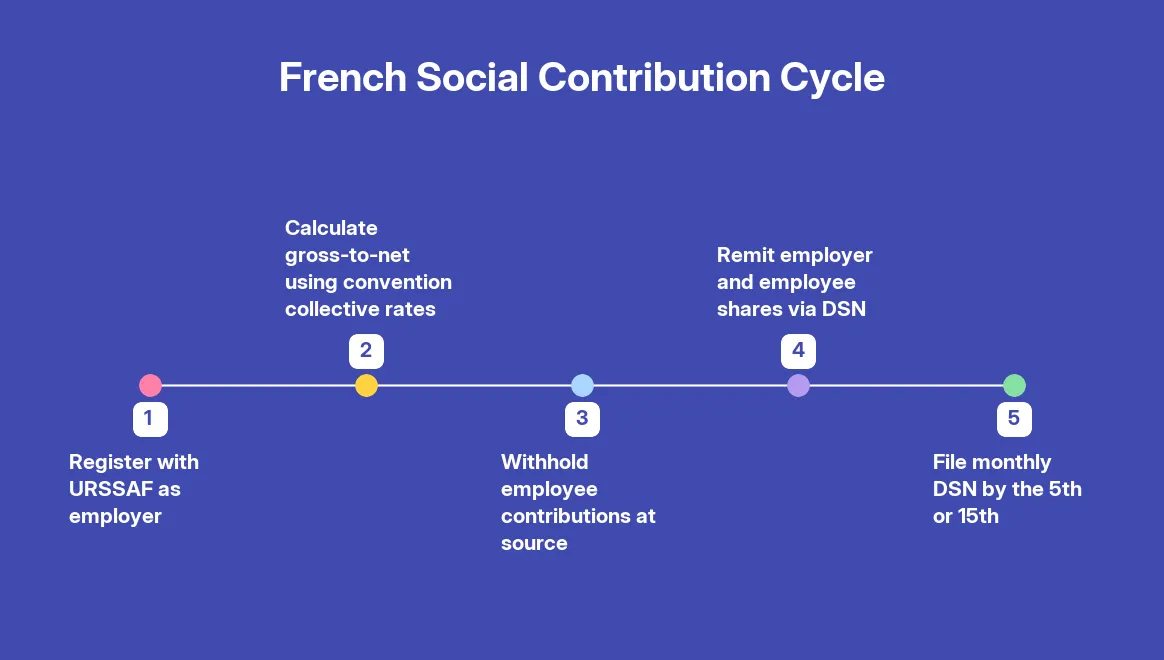
France consolidates payroll reporting through the Déclaration Sociale Nominative (DSN). The EOR submits this electronic filing monthly to URSSAF, the central social security collection body. The DSN replaces over a dozen legacy declarations. It covers health insurance, pension, unemployment, family allowances, and supplementary retirement contributions in a single transmission.
Filing deadlines depend on company size. Employers with 50 or more employees file by the 5th of the following month. Smaller employers file by the 15th. Late filing triggers penalties starting at a percentage of the contributions due. The DSN also feeds data to pension funds, Pôle emploi, and complementary health insurers automatically.
Employer and Employee Contribution Mechanics
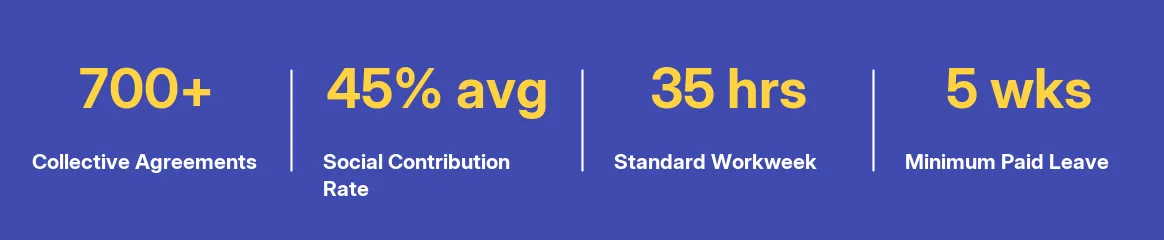
French social contributions rank among the highest in the EU. The employer's share alone typically represents roughly 40 to 45 percent of gross salary. Employee contributions add another 20 to 25 percent. The exact rates vary by convention collective and employee classification level.
Key contribution categories include:
- Assurance maladie (health insurance) paid primarily by the employer
- Assurance vieillesse (pension) split between employer and employee
- Allocations familiales (family allowances) paid by the employer
- Contribution sociale généralisée (CSG) and CRDS deducted from the employee's gross
- Complémentaire santé (mandatory supplementary health coverage) co-funded under the ANI agreement
- Unemployment insurance contributions to UNEDIC
The employer must also fund a mandatory supplementary pension through AGIRC-ARRCO. This obligation applies to all private-sector employees regardless of salary level. The risks of EOR non-compliance in France include personal liability for unpaid contributions, so accurate calculation matters.
Contribution CategoryPaid ByApproximate Share of GrossHealth insurance (maladie)Employer (primarily)7–13% employer sideBase pension (vieillesse)Both6–8% each sideUnemployment (UNEDIC)Employer4–5%Family allowancesEmployer3–5%CSG/CRDSEmployee~9.7% of 98.25% of grossAGIRC-ARRCO pensionBothVaries by tranche
Watch out: CSG and CRDS are calculated on 98.25% of gross salary, not 100%. Applying the rate to full gross overstates the deduction and creates reconciliation problems in DSN filings.
Working Time, Leave, and Collective Agreement Compliance
The 35-Hour Framework and Overtime Rules
France's standard legal workweek is 35 hours under the Aubry laws. This does not mean employees cannot work more. It means hours beyond 35 trigger overtime rates. The first eight overtime hours (hours 36 through 43) carry a minimum 25% premium. Hours beyond 43 carry a 50% premium.
These are statutory minimums. Many collective agreements set higher premiums. The convention collective applicable to the employee's sector overrides the statutory floor whenever it offers more favorable terms. An EOR must identify the correct agreement before setting pay structures.
Annual overtime is capped at a statutory contingent. The standard contingent is 220 hours per year per employee unless the collective agreement specifies a different figure. Exceeding this cap without authorization from labor authorities creates legal exposure.
Paid Leave and Public Holidays
Every employee in France accrues a minimum of five weeks of paid annual leave. This equals 2.5 working days per month worked. The accrual period runs from June 1 to May 31 the following year.
France observes 11 public holidays annually. Only May 1 (Labour Day) carries a mandatory paid day off by statute. The remaining 10 depend on the collective agreement and employer policy. Most agreements treat all 11 as paid.
Sick leave follows a specific structure. After a three-day waiting period (carence), the Assurance maladie pays daily allowances. The employer supplements these payments to maintain salary levels. The supplementation rate and duration depend on seniority and the applicable collective agreement. A company hiring its first French employee through EOR services must map these obligations before the employee's start date.
Collective Agreement Identification
France has over 700 active collective bargaining agreements (conventions collectives). The correct agreement depends on the employer's principal activity, not the employee's job title. An EOR registered under one NAF code may need to apply a different convention if the client company's activity falls under a separate classification.
Misapplying the convention collective affects minimum salary grids, overtime premiums, notice periods, severance calculations, and supplementary benefit obligations. Comparing EOR providers in France should include verifying that the provider correctly identifies and applies the relevant agreement.
Data Protection and Employee Privacy Rules

GDPR and CNIL Requirements for Employee Data
The EOR processes sensitive personal data as the legal employer. This includes identity documents, salary information, health data from sick leave certificates, and bank details for payroll. Under GDPR, the EOR is the data controller for employment-related processing.
French data protection authority CNIL enforces additional rules specific to workplace data. The EOR must maintain a record of processing activities (registre des traitements) covering every category of employee data collected. Employees have the right to access, rectify, and request deletion of their personal data under Articles 15 through 17 of GDPR.
Monitoring and Surveillance Limits
French law restricts employee monitoring more than many other EU jurisdictions. CNIL requires proportionality in any surveillance. Keystroke logging, continuous screen capture, and systematic email monitoring are generally considered disproportionate.
If the EOR or client company uses monitoring tools, they must inform employees in advance. The works council (CSE) must also be consulted before implementing any monitoring system. The information obligation applies even when employees work remotely. Failing to follow this process exposes the employer to claims before the Conseil de prud'hommes and CNIL sanctions.
Data transfers outside the EU require appropriate safeguards under GDPR Chapter V. When the client company sits in the United States, the EOR must verify that standard contractual clauses or an adequacy decision covers the transfer. This applies to any employee data shared with the client for management purposes.

FAQs
Does an EOR in France need to set up a CSE (works council)?
CSE establishment becomes mandatory once the employer reaches 11 employees for 12 consecutive months. If the EOR employs 11 or more workers across all its clients in France, it must organize CSE elections. Some EOR providers structure separate legal entities per client to stay below this threshold. Failure to organize elections when required triggers the délit d'entrave, a criminal offense carrying fines and potential imprisonment for the legal representative.
Can an EOR use a forfait jours (lump-sum days) agreement instead of hourly tracking?
Forfait jours agreements exempt certain autonomous employees from the 35-hour framework. The employee works a set number of days per year instead of tracked hours. This requires authorization in the applicable collective agreement and individual written consent. The statutory cap is 218 working days per year. The EOR must conduct annual workload interviews and monitor rest periods. Not every convention collective permits forfait jours, so the EOR must verify eligibility before offering this arrangement.
What happens if the EOR applies the wrong convention collective?
The employee can claim the benefit of the correct agreement retroactively. This includes recalculation of minimum salary, overtime premiums, seniority bonuses, and supplementary health coverage. French labor courts (Conseil de prud'hommes) consistently rule in the employee's favor in misclassification disputes. Back-pay liability can accumulate over the entire employment period. URSSAF may also reassess social contributions based on the correct salary grid, adding penalties and interest.
Are non-compete clauses enforceable through a French EOR arrangement?
French courts enforce non-compete clauses only when they include a financial counterpart (contrepartie financière) paid after termination. The payment must be reasonable relative to the restriction. Courts regularly strike down clauses that lack this payment or impose disproportionate geographic or duration limits. The EOR must draft the clause in compliance with both statute and the applicable collective agreement, which may set minimum compensation percentages. If the client company wants a non-compete, the EOR must budget for post-termination payments in advance.
What to Monitor Next
French labor law reforms arrive frequently. The government periodically adjusts social contribution rates, overtime incentive schemes, and DSN reporting requirements. Monitor URSSAF circulars and CNIL guidance updates quarterly. Collective agreement renegotiations can also change minimum salary grids and benefit obligations mid-year. If your EOR provider does not track these changes proactively, compliance gaps accumulate silently. Build a review cadence with your provider that covers DSN accuracy, convention collective verification, and data processing records at least twice per year.
If you need help mapping French compliance obligations for your first hire, TeamUp can walk you through the requirements. Schedule a compliance consultation.
Written by TeamUp — people-first EOR and nearshoring partner, helping companies hire compliantly across 20+ countries since 2020.
.svg)