EOR Providers in France: Comparing the Top 5 Companies
EOR providers in France let foreign companies hire French employees without setting up a local entity. A Toronto fintech company wanted to hire two product designers in Lyon last year. The founders estimated that establishing a French subsidiary would take four to six months and cost upward of €15,000 in legal and registration fees. They used an employer of record in France instead and had both designers on payroll within 12 days.
France is the eurozone's second-largest economy and a deep talent pool for engineering, design, and life sciences. It is also one of Europe's most regulated employment markets. The Code du Travail runs thousands of pages. Employer social contributions are among the highest in Western Europe. Collective bargaining agreements cover the vast majority of workers. Getting any of this wrong exposes a foreign company to penalties, back-taxes, and labor court claims.
This article compares five EOR providers operating in France across contract handling, payroll infrastructure, onboarding speed, and cost structure. It also covers how EOR pricing works in this market and the specific legal risks that French labor protections create for companies relying on third-party employers.
What Is an Employer of Record?

The Legal Employer Relationship Explained
An EOR acts as the legal employer on behalf of a client company in a target country. The client directs the employee's daily work, sets deliverables, and manages performance. The EOR holds the employment contract, runs payroll, withholds taxes, and remits statutory contributions.
This creates a triangular relationship. The employee works for the client in practice. On paper, the EOR employs them. The client pays the EOR a service fee plus the total cost of employment. The EOR assumes liability for labor law compliance in the target jurisdiction.
In France, this means the EOR signs either a contrat à durée indéterminée (CDI) or a contrat à durée déterminée (CDD) with the worker. The CDI is the default permanent contract under French law. Using the wrong contract type can trigger automatic reclassification by French labor courts.
EOR vs PEO: Key Structural Differences
A Professional Employer Organization (PEO) operates through co-employment. The client company and the PEO share employer responsibilities. This model requires the client to already have a legal entity in the country.
An EOR removes that requirement entirely. The client needs no French entity, no registration with URSSAF, and no local corporate structure. The EOR's own entity bears the full legal employer burden.
In France, the PEO model is less common than in the United States. French labor law does not recognize co-employment in the same way US law does. The portage salarial framework exists as a partial equivalent, but it carries specific restrictions on eligible activities and contract duration. For most foreign companies entering France without a subsidiary, the EOR model is the structurally cleaner path.
How an EOR Works in Practice
The operational cycle is straightforward. The client selects a candidate. The EOR drafts a compliant employment contract under French law. The EOR registers the employee with French social security bodies, processes monthly payroll, and files employer declarations.
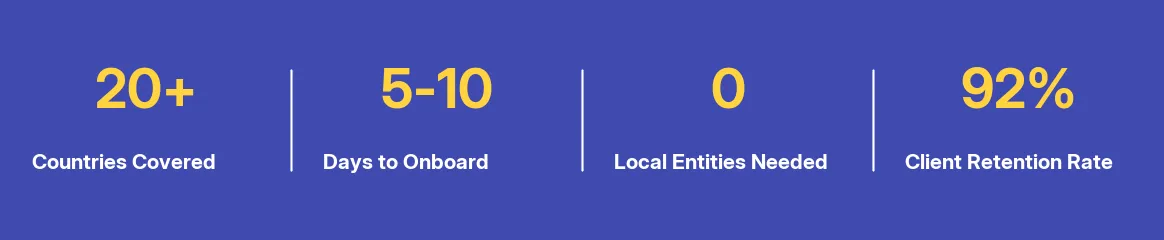
Onboarding through an EOR typically completes in 5 to 10 business days. The client retains full operational control over the employee's work. The EOR handles everything on the employer-of-record side: pay, benefits, leave administration, and eventual offboarding.
Why Use an EOR in France?

Hiring in France Without a Legal Entity
Setting up a société par actions simplifiée (SAS) or a société à responsabilité limitée (SARL) in France takes three to six months when accounting for registration, bank account opening, and social security enrollment. Legal and accounting fees for the first year can reach five figures in euros.
A Singapore logistics company needed three French-speaking operations managers in Marseille to support a Mediterranean shipping route. Entity setup would have delayed hiring by at least four months. The company hired through an EOR and had all three employees onboarded within two weeks. Eighteen months later, they still operate through the EOR with no plans to incorporate locally.
Using an EOR allows companies to hire in France without establishing a local legal entity. That removes the fixed overhead of maintaining a subsidiary for a small team.
How French Labour Law Creates Compliance Complexity
The Code du Travail is France's primary employment legislation. It is one of the most detailed labor codes in Europe. Several layers of regulation stack on top of it.
The standard working week in France is legally capped at 35 hours. Overtime triggers mandatory surcharges. French employees are entitled to a statutory minimum of 5 weeks of paid annual leave. Employers must contribute to social security, health insurance, pension, and unemployment schemes. Those contribution rates are among the highest in Western Europe, significantly above the EU average.
Beyond the Code du Travail, most French employees fall under a convention collective (collective bargaining agreement) tied to their industry sector. These agreements set additional rules on minimum pay scales, bonus structures, notice periods, and classification levels. An employer who fails to apply the correct CBA risks labor court penalties.
When a Global EOR Makes Strategic Sense
An EOR makes sense in three situations. First, when a company is testing the French market with a small team and does not want entity costs. Second, when speed matters and entity setup would delay a critical hire by months. Third, when the company already operates through a global employer of record in multiple countries and wants France under the same umbrella.
A Berlin-based SaaS company with 40 employees across four countries added two senior engineers in Paris through their existing EOR relationship. The total time from offer letter to first payroll was nine business days. No new legal structure was required.
Top 5 EOR Providers in France
| Criteria | Deel | Remote | Papaya Global | Velocity Global | Team Up |
|---|---|---|---|---|---|
| Entity model in France | Partner network | Owned entity | Partner network | Partner network | Covered market |
| CDI/CDD contract handling | Both | Both | Both | Both | Both |
| CBA expertise | Platform-guided | In-house legal | Platform-guided | Dedicated support | In-country teams |
| Onboarding speed | 3-7 days (claimed) | 5-10 days | 5-10 days | 5-10 days | Direct onboarding |
| French-language HR support | Limited | Available | Limited | Available | Regional support |
| Best fit | Scale across many countries | Owned-entity compliance | Enterprise payroll analytics | Mid-market expansion | Cost-optimized regional hiring |
What to Look for in a France-Focused EOR
France demands more from an EOR than most European markets. The provider must identify the correct convention collective for each employee. It must calculate employer contributions accurately across multiple social security bodies. It must draft contracts that comply with both the Code du Travail and the applicable CBA.
Five evaluation criteria matter most for France:
- CDI/CDD contract drafting that reflects current labor code requirements and CBA classification levels
- Accurate monthly payroll processing with proper social contribution calculations across URSSAF, retirement funds, and supplementary schemes
- Convention collective identification and ongoing compliance monitoring
- French-language support for employee queries on pay slips, benefits, and leave
- Termination expertise, including rupture conventionnelle procedures and legally required severance calculations
Provider Profiles: Capabilities and Positioning
Deel covers France through a partner entity network and targets companies hiring across many countries simultaneously. Its platform handles CDI and CDD contracts with automated compliance guidance.
Remote operates through its own legal entity in France. That gives it direct control over payroll filings and social security registrations. Owned-entity providers carry the compliance liability themselves rather than routing it through a local partner.
Papaya Global positions itself as an enterprise payroll analytics platform. It fits large organizations managing existing global payrolls who need France added to a multi-country structure.
Velocity Global serves mid-market companies expanding into France with moderate team sizes. It provides dedicated account support for CBA compliance.
Team Up operates across 20+ countries with owned legal entities in its core markets. For companies already hiring in the Caucasus, Central Asia, Turkey, or Eastern Europe, Team Up adds France coverage through a single relationship. Its EOR pricing starts at €199 per employee per month in its core markets, making it one of the most cost-competitive owned-entity providers in the broader region.
How to Match a Provider to Your Hiring Scenario
The right provider depends on your team size, contract complexity, and geographic spread. A US company hiring one remote marketer in Paris has different needs than a German manufacturer building a 15-person engineering team in Toulouse under an industrial CBA.
For single-country, small-team hires, an owned-entity provider reduces compliance intermediary risk. For multi-country rollouts, a platform with broad coverage and standardized workflows may offer more operational consistency. For companies already working with Team Up in other markets, adding France keeps payroll, contracts, and HR administration under one provider.
EOR Costs and Pricing in France
How EOR Pricing Structures Work
EOR providers use two main pricing models. The first is a flat per-employee monthly fee. The second is a percentage of the employee's gross salary. Some providers blend both, charging a base fee plus a percentage for higher-salary employees.
| Cost Component | What It Covers | Billing Model |
|---|---|---|
| Monthly EOR fee | Payroll processing, compliance, HR admin | Flat fee or % of salary |
| Employer social contributions | URSSAF, pension, unemployment, health | Passed through at cost |
| Onboarding fee | Contract drafting, registration | One-time (some providers) |
| Benefits administration | Mutuelle, meal vouchers, transport | Included or add-on |
| Offboarding / termination | Severance calculation, legal process | Often billed separately |
EOR fees across Western Europe typically fall between $400 and $700 per employee per month. France sits at the higher end of that range because of the administrative complexity of its payroll system.
What Drives the Total Cost of Employment in France
The EOR service fee is only one component. The larger cost is the statutory employer burden. France's mandatory employer contributions to social security, health insurance, pension, and unemployment schemes make it one of the most expensive countries in Europe to employ someone.
These contributions are calculated as a percentage of the employee's gross salary. The combined rate is substantial. The URSSAF publishes current rates and thresholds on its portal. Confirm the exact figures before budgeting, as contribution rates shift with annual social security financing laws.
Beyond contributions, French law requires employers to fund a mutuelle (supplementary health insurance) covering at least 50% of the premium. Meal vouchers, transport subsidies, and a 13th-month bonus are common in many CBAs. These are not optional extras. They are contractual obligations once the applicable CBA mandates them.
Hidden Costs to Budget For
Three cost categories catch first-time employers in France off guard. First, the cost of terminating a CDI. French law provides strong dismissal protections. Severance under a rupture conventionnelle involves negotiated compensation, and contested dismissals can lead to labor court awards. Some EOR providers charge separately for managing the termination process.
Second, currency conversion. If you pay the EOR in dollars or pounds, the provider applies an exchange rate margin. These markups typically range from 0.5% to 2% and compound over monthly payroll cycles.
Third, CBA-mandated benefits you did not anticipate. A UK recruitment agency hiring its first French employee discovered that the applicable convention collective required an annual profit-sharing mechanism. The EOR flagged it during onboarding, but the cost added roughly 3% to the total employment budget.
How to Choose and Onboard Through an EOR in France
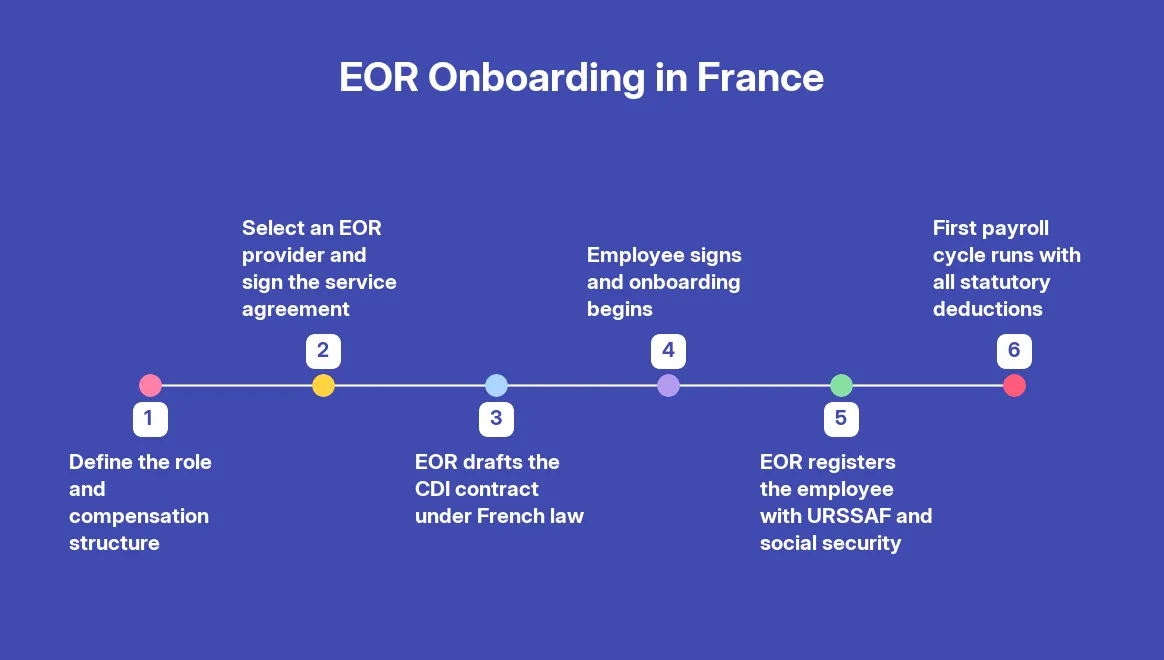
Selecting an employer of record in France starts well before the contract is signed. You need to confirm that the provider's NAF code aligns with the convention collective that governs your employee's actual work. A mismatch here creates benefit entitlement gaps that surface months later.
Once you sign the service agreement, the EOR drafts a CDI employment contract. This contract must comply with the Code du Travail and reference the applicable collective bargaining agreement. It specifies gross salary, working hours capped at the statutory 35-hour week, and all mandatory benefits including the five weeks of paid annual leave.
The EOR then registers the employee with URSSAF, France's social security collection body. This registration triggers employer contributions to health insurance, pension, unemployment insurance, and complementary retirement schemes. A Munich fintech company onboarding two compliance analysts in Paris through an EOR completed the full process in 11 business days. Both analysts were fully registered and on payroll before the third week.
During the first payroll cycle, the EOR withholds income tax under France's pay-as-you-earn system and remits all employer-side social charges. Your role as the client is limited to approving the gross salary and any variable compensation. The EOR handles every filing, every declaration, every payment to French authorities. If you need global payroll management across multiple countries alongside France, consolidating through one provider reduces reconciliation overhead.
EOR vs Setting Up a Local Entity in France
The decision between an EOR and incorporating a French subsidiary depends on headcount, timeline, and how long you plan to operate in the market.
| Factor | EOR in France | French Subsidiary (SAS or SARL) |
|---|---|---|
| Setup timeline | 5 to 15 business days | 2 to 4 months minimum |
| Upfront legal costs | None or minimal | Notary fees, registration fees, share capital deposit |
| Ongoing compliance burden | Handled by EOR | Your responsibility: annual accounts, audit, tax filings |
| Headcount sweet spot | 1 to 20 employees | 15+ employees with long-term commitment |
| Payroll and social charges | EOR manages all filings | In-house or outsourced payroll team required |
| IP and contract control | Client directs work; EOR holds employment relationship | Full direct control |
| Exit complexity | Standard EOR offboarding | Liquidation or dormancy process |
A Stockholm e-commerce company used an EOR to hire its first three customer support agents in Lyon. After 18 months, the team grew to 12. At that point, the cost differential narrowed enough to justify incorporating a SARL. The EOR managed the transition, transferring employment contracts to the new entity under French rules on employer substitution.
For teams under 10, incorporating rarely makes financial sense. The fixed costs of maintaining a French entity, including annual accounting, statutory audit thresholds, and local benefits administration, absorb budget that could fund additional hires. TeamUp's EOR service covers France through a model that eliminates setup costs entirely. Companies that want co-employment rather than full outsourcing can also explore PEO arrangements once they have an existing French entity.
Watch out: If your French employee habitually negotiates and concludes contracts on behalf of your company, French tax authorities may assert a permanent establishment regardless of the EOR structure. An EOR solves employment compliance, not corporate tax exposure.
FAQs
Can an EOR in France issue a fixed-term contract (CDD) instead of a permanent CDI?
Legally, yes, but only under specific circumstances enumerated in the Code du Travail. Valid CDD grounds include replacing an absent employee, handling a temporary increase in activity, or seasonal work. If the EOR issues a CDD outside these grounds, a French labour court can re-characterize it as a CDI. That re-characterization triggers back-pay obligations, statutory notice periods, and severance. Most EOR providers default to CDI contracts precisely to avoid this risk. Ask your provider to document the legal basis before agreeing to any CDD.
What happens to my French employee if the EOR provider goes out of business?
The EOR is the legal employer, so its insolvency directly affects the employment relationship. French law protects employees through the AGS (Association pour la gestion du régime de garantie des créances des salariés), a salary guarantee fund that covers unpaid wages, notice pay, and severance up to statutory ceilings. Your employee can file claims against the liquidation estate. You face operational disruption unless your EOR contract includes a substitution clause allowing transfer to another provider. Review this clause before signing with any EOR.
Does using an EOR in France trigger any permanent establishment risk for my company?
An EOR eliminates employment law risk but does not automatically resolve corporate tax exposure. If your French-based employee operates from a fixed location, habitually concludes contracts on your behalf, or performs core revenue-generating activities, French tax authorities can assert a permanent establishment under French domestic law and applicable tax treaties. This risk increases with senior roles like country managers or sales directors. Companies deploying high-value roles in France for extended periods should engage separate tax counsel alongside the EOR engagement.
Are French collective bargaining agreements (conventions collectives) binding on an EOR arrangement?
They are binding. France applies CBAs automatically based on the employer's principal activity, determined by the NAF code registered with INSEE. Because the EOR is the legal employer, the applicable CBA depends on the EOR's own NAF code, not your company's industry. This can create mismatches. Your employee might be entitled to sector-specific benefits, extra leave days, bonus structures, or longer notice periods that neither you nor the EOR anticipated. Before signing, ask the EOR which CBA applies and compare it against the role's actual sector.
How long does it take to terminate a permanent (CDI) employee in France through an EOR?
CDI termination in France takes one to three months minimum, regardless of how efficient the EOR is. A rupture conventionnelle (mutual termination) requires a mandatory 15-business-day cooling-off period followed by DREETS homologation, which adds another 15 business days. Formal dismissal requires a preliminary interview, a written notification respecting minimum notice periods under the applicable CBA, and the employee's right to challenge the dismissal before the conseil de prud'hommes. The EOR manages the process, but French statute governs every timeline.
Can I hire independent contractors in France through an EOR instead of employees?
An EOR specifically creates an employment relationship. It does not manage contractor engagements. If you need to engage a French independent contractor, you would use a separate contractor management service. France applies strict criteria for distinguishing employees from contractors. The key test is subordination: if you control the contractor's schedule, tools, or methods, French authorities can re-classify the relationship as employment. Re-classification triggers retroactive social security contributions, penalties, and potential criminal liability for concealed employment (travail dissimulé).
What employee benefits beyond statutory minimums should I expect an EOR to provide in France?
French law mandates a mutuelle (complementary health insurance) with at least 50% employer contribution. The applicable CBA may require additional benefits: extra paid leave beyond the statutory five weeks, a thirteenth-month salary, seniority bonuses, or profit-sharing (participation and intéressement) once headcount thresholds are met. Some EOR providers include a standard benefits package; others charge separately for CBA-mandated extras. Ask for a written breakdown before onboarding. TeamUp's local benefits management covers both statutory and CBA-required benefits from the first payroll cycle.
What to Watch Next

France's employment framework evolves through both legislation and CBA renegotiations. Watch for upcoming revisions to social security contribution ceilings and any reform to the rupture conventionnelle process, which has been under political scrutiny. The EU's proposed directive on platform work may also affect how French authorities evaluate EOR arrangements, particularly around the subordination test.
Your concrete next step: request a draft CDI contract and CBA mapping from any EOR provider you are evaluating. Compare the CBA that would apply under their NAF code against the one that governs your employee's actual sector. That single comparison reveals more about a provider's operational depth than any pricing table.
.svg)