Work Permits & Visas: Employer Guide to Types & Sponsorship
TL;DR
Most companies entering new markets think about talent first and immigration second. That order creates problems.
A work permit is not an administrative formality you sort out after the hire is confirmed. In most of the markets that matter for emerging-hub expansion, Georgia, Armenia, Azerbaijan, Turkey, India, Kazakhstan, Uzbekistan, work authorization must be secured before the employee starts working. Sometimes, before the employment contract is signed. And always by an employer with legal standing in the target country.
This guide is written for the employer, not the applicant. It covers what work permits exist across these seven markets, what employer sponsorship actually requires, what changed in 2025 and 2026, and where the process breaks down.
If you are hiring foreign nationals or relocating existing team members into any of these markets, this is the compliance foundation you need before anything else.
What "Employer Sponsorship" Actually Means
When a job posting says a candidate will need "sponsorship for employment," it means the employer must formally authorize that person's right to work in the target country. That authorization, the permit, the visa, the residency registration, is what employment sponsorship provides.
More specifically, it means the sponsoring employer must be recognized as a legal employer in the jurisdiction where the work will be performed. That recognition requires either:
A locally registered entity: a company incorporated and tax-registered in the target country, with active payroll infrastructure and compliance history.
Or an Employer of Record (EOR) with an owned entity — a third party that already holds the legal employer registration and can sponsor on your behalf, without requiring you to incorporate a subsidiary.
The second option is the mechanism most companies entering new markets use. The EOR's entity becomes the sponsoring employer. The work permit or visa is issued to an employee of that entity. Your company directs the work. The EOR owns the immigration relationship.
What employment sponsorship does NOT mean:
- Paying the visa fee on the employee's behalf (that is, a financial arrangement, not legal sponsorship)
- Having a "partner" or "contractor" relationship in the target country
- Registering a representative office (which, in most countries, cannot employ people directly)
The legal employer question is binary. Either the sponsoring party has registered employer status in the country, with all associated tax, payroll, and labor law compliance, or they do not. If they do not, they cannot sponsor.
For a full breakdown of how EOR-sponsored visas work across these markets, see our guide on EOR-sponsored visas for enterprise businesses.

What Every Employer Needs Before Sponsoring a Work Permit
Regardless of which country you are entering, work permit sponsorship requires a consistent set of foundations on the employer side. Get these in place before you start the application clock.
- Registered legal entity (or EOR) The employer must be registered with the relevant labor or tax authority in the target country. In India, this means registration with the Ministry of Home Affairs and active EPF/ESIC compliance. In Kazakhstan, it means a registered Kazakhstani entity or EOR. In Georgia, from March 2026, it means a registered employer with access to the government permit portal.
- Employment contract: A formal, signed employment contract that specifies the role, salary, location, duration, and employment terms in accordance with local labor law. This document is required in every market covered in this guide. It must typically be in the local language or bilingual.
- Role justification. In most markets, the employer must demonstrate that the role requires a foreign national — either because the skill is specialized, the position is senior, or a local labor market test has been conducted, and no suitable domestic candidate was found. This requirement has tightened significantly across the region in 2025–2026.
- Salary threshold compliance: Several markets have minimum salary requirements for work authorization. India requires a minimum of USD 25,000/year for Employment Visa eligibility (with narrow exceptions). Kazakhstan requires salary documentation as part of the permit application. Turkey requires salary alignment with local benchmark standards.
- Clean compliance record: Employers with outstanding tax liabilities, unresolved labor violations, or pending enforcement actions in the target country face complications or outright refusal in permit applications.
Georgia Work Permit (2026 — Major Change)
Georgia's immigration system for foreign workers underwent a fundamental transformation in 2025–2026. If your understanding of Georgian work authorization is more than twelve months old, it is likely wrong.
The old system: Georgia had no formal work permit requirement. Foreign nationals from dozens of countries could enter visa-free for up to 365 days and, in practice, work without formal authorization. Many companies operated on this informality, hiring professionals on "freelancer" or "tourist" arrangements. That system is over.
The new system (effective March 1, 2026): Following parliamentary amendments in June 2025, entering into force in phases from September 2025 through March 2026, most foreign workers in Georgia now require a Special Labour Permit before starting employment or entrepreneurial activities.
Who Needs a Work Permit in Georgia:
- Foreign nationals working for a Georgian employer
- Self-employed foreign nationals earning income in Georgia
- Individual entrepreneurs without permanent residence
Who is Exempt from a Work Permit in Georgia:
- Permanent residence holders
- Refugees and asylum seekers
- Employees of diplomatic missions
- Journalists of foreign media
- Individuals with investment residence permits
- Foreign nationals registered in the Ministry of Labor's unified database before March 1, 2025 (transition period until January 1, 2027)
The labor market test: As of February 25, 2026, employers must post the job vacancy on a government portal for 10 business days before submitting a work permit application. This is a significant addition that extends the pre-application timeline.
How the work permit process works in Georgia
- Employer posts vacancy on the government portal (10 business days)
- Employer applies to the Ministry of Labor for the Special Labour Permit
- Processing: up to 30 calendar days
- Fee: up to GEL 500 (~$185)
- Once the permit is approved, the employee applies for a D1 visa or residence permit
Fines for non-compliance: GEL 2,000 per employer and per employee for working without a permit. Repeat offenses carry double or triple penalties.
The transition period: Foreign nationals already working in Georgia before March 1, 2026, who were registered in the Ministry of Labor's database before March 1, 2025, have until January 1, 2027, to regularize their status. Everyone else: the requirement applies immediately.
This is the single most consequential change in Georgian work authorization in the country's modern history. Companies that have operated through informal arrangements need to act now.
For information on relocation support and legal requirements for employees moving to Georgia, see our guide on relocation legal requirements for Georgia.
Armenia Work Permit
Armenia has historically operated a work permit system tied to a labor market test, employers were required to notify the Ministry of Labor about a vacancy before hiring a foreign national. In practice, out of 18,314 work permit applications filed between January 2022 and August 2025, only 10 resulted in a local Armenian candidate applying. The test was essentially administrative, not a real barrier.
The changes in the Armenia Work Permit in November 2026
The 2026 shift: Armenia is replacing the labor market notification process with an annual quota system. The government will set an annual cap on work-based residence permits. Once the quota is exhausted, new applications will not be accepted until the following year.
The practical implication: There is a window right now, before August 2026, where applications can still be filed under the more straightforward current system. Companies planning to hire foreign nationals in Armenia should move before the quota system takes full effect, not after.
Current process (until November 2026):
- Employer notifies the Ministry of Labor (MLSA) about the vacancy
- Ministry reviews and may refer local candidates (rarely active in practice)
- Employer files work and residence permit application through the Migration and Citizenship Service's digital platform (workpermit.am)
- Processing: approximately 4–8 weeks
- From August 2026: employee must enter on a Work Visa — switching from tourist status will no longer be permitted
Key exemptions: Citizens of EAEU member states — Russia, Belarus, Kazakhstan, and Kyrgyzstan — are fully exempt from work permit requirements under international treaty. They still require a compliant employment contract and registration, but not a permit.
2026 contract compliance change: As of January 1, 2026, all new employment contracts must be executed through the State Revenue Committee's digital platform. Paper contracts are not valid for new hires from this date.
For a detailed guide on what employer sponsorship involves in Armenia, see our article on employer sponsorship in Georgia and Armenia.
Azerbaijan Work Permit
Azerbaijan operates the most stringent work authorization regime in the Caucasus. There are no informal workarounds, no grace periods, and no tourist-status exceptions. Every foreign national working in Azerbaijan without prior authorization is in violation, and enforcement is active.
The non-negotiable rule: No foreign national can work in Azerbaijan without a valid work permit AND a residence permit, obtained in that order, before employment begins.
How the Azerbaijan Work Permit Process Works:
- Employer applies for a work permit through the State Migration Service (İDP)
- A work permit is employer-specific and role-specific
- Once the work permit is approved, the employee applies for a residence permit
- DSMF (State Social Protection Fund) registration is required before payroll begins
- Short-term assignments (under certain thresholds) still require authorization
Employer payroll contributions: Approximately 17–24.5% on top of gross salary. Azerbaijan's employer-side social contribution rate is the highest in the Caucasus.
No entity, no sponsorship: Because Azerbaijan requires prior authorization through the registered employer, a company without an Azerbaijani entity cannot initiate the permit process. There is no alternative route. An Employer of Record (EOR) service with an owned Azerbaijani entity is the only compliant path for companies without local incorporation.
EAEU exemption does not apply here: Unlike Armenia and Kazakhstan, Azerbaijan is not an EAEU member. No EAEU reciprocity exemption exists for Azerbaijani work authorization.
Turkey Work Permit
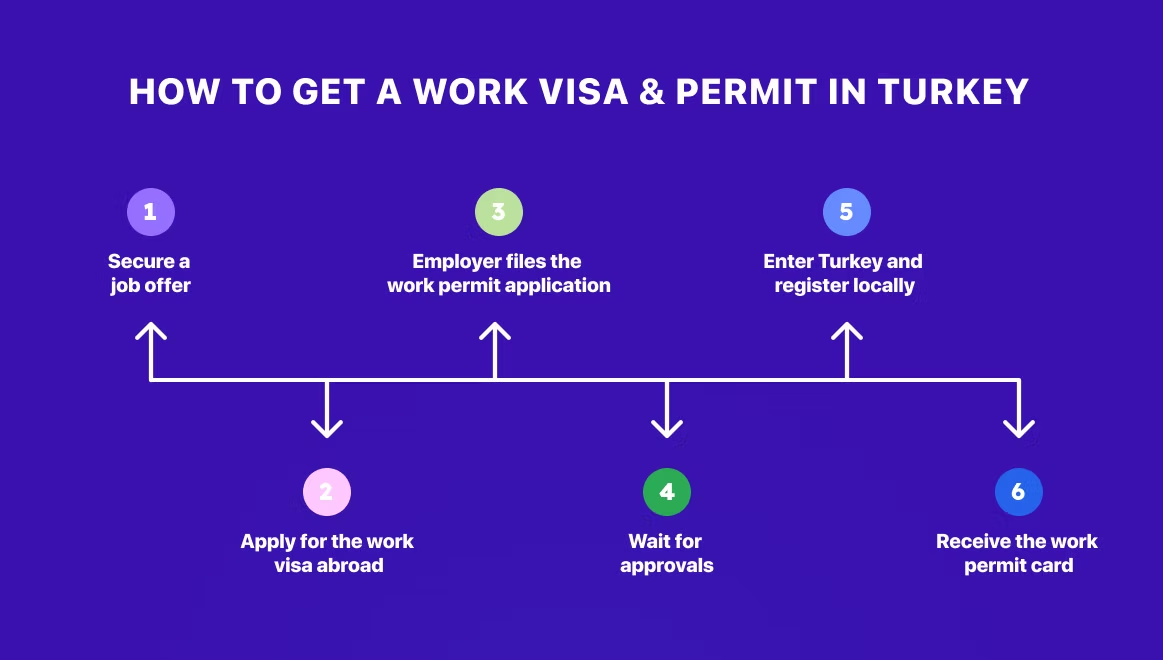
Turkey's work permit system is managed by the Ministry of Family and Social Services, with applications submitted through the İŞKUR (Turkish Employment Agency) framework. Since 2016, applications have been submitted online through the Ministry's e-permit portal.
Key employer requirements for the Turkey Work Permit
- The Turkish employer must be registered and in good standing with SGK (Social Security Institution)
- The employer-to-foreign-worker ratio: generally one foreign worker for every five Turkish employees (with a minimum of one Turkish employee required where the company has fewer than five total)
- This ratio limitation can be a real constraint for small teams
Common work permit types in Turkey
- Ordinary work permit: For standard employment relationships. Valid for one year initially, extendable to two years, then three years. The most common route for foreign professionals relocating to Turkey.
- Turquoise Card (Türkiye Mavi Kart): The equivalent of permanent work authorization for exceptional talent — highly qualified scientists, researchers, investors, or professionals with demonstrated contribution to Turkish industry. Requires Ministry-level approval and is relatively rare.
- Intra-company transfer permit: For employees transferring from a foreign entity to a Turkish subsidiary. The Turkish entity must be registered, and the transfer must be documented.
- C-suite limitation under EOR: Senior executive titles — CEO, CFO, General Manager — are generally not possible under the EOR model in Turkey. For senior leadership roles that require Turkish corporate authority, the client company typically needs its own registered entity. This is a well-documented structural limitation of EOR employment in Turkey.
Processing: Approximately 4–6 weeks from application submission. The employer submits the application through the e-permit system; the employee collects the permit from the consulate.
Payroll context: Turkey's employer-side social security contribution is 20.75% of gross salary, plus 2% unemployment insurance. Combined with the progressive income tax (15–40%), Turkey's total cost-of-employment overhead is among the highest in the region.
Kazakhstan Work Permit (2025 — Significant Reform)
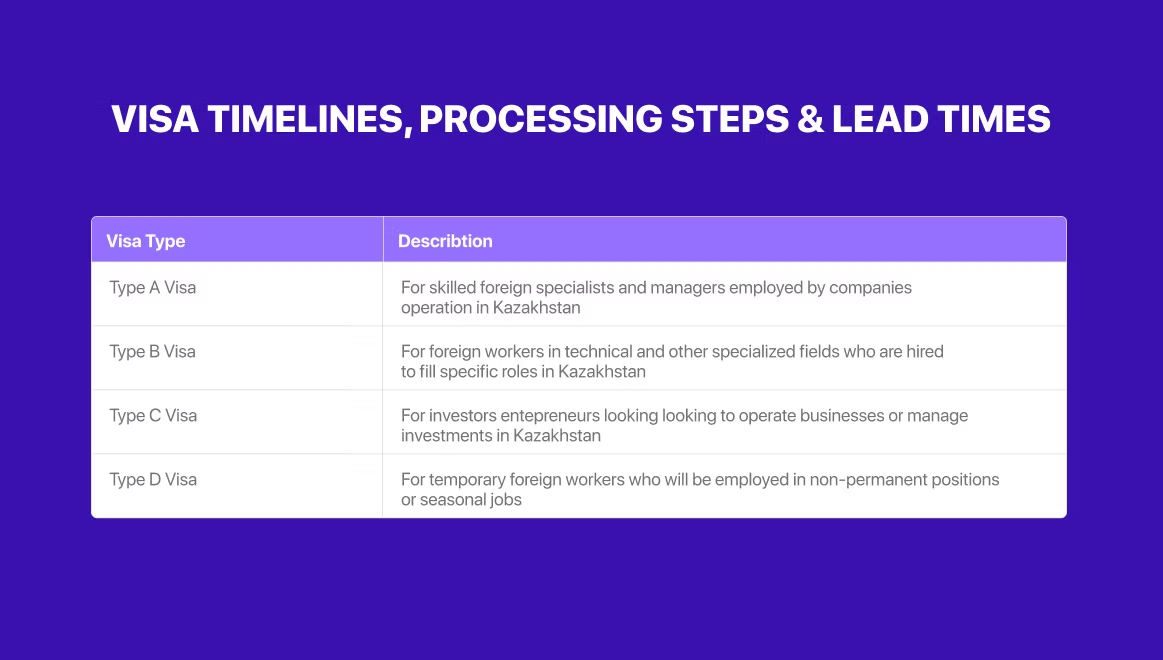
Kazakhstan overhauled its foreign labor permit system in September 2025. The changes are significant and affect every employer planning to hire foreign nationals in the country.
The quota system: Kazakhstan's work permit system is pre-approved and quota-bounded. You cannot simply decide in January to hire a foreign national in March. You need quota headroom that was approved the previous year.
Annual quota applications must be submitted to the regional Akimat (local executive authority) by approximately September 30 of the preceding year. For 2026, the general quota is set at 0.25% of the total labour force in each region. Companies that did not apply for quota headroom cannot easily obtain work permits until the next cycle.
The September 2025 changes in the Kazakhstan Work Permit
- New: mandatory labor market test. Effective September 1, 2025, employers must post the job vacancy on the Electronic Labor Exchange (enbek.kz) for 15 calendar days before submitting a work permit application. This is the most substantial change to Kazakhstani immigration in recent years.
- New: contract registration in ULCRS Employment contracts with foreign nationals must be registered in the Unified Labor Contract Registration System before the permit application.
- New: IIN at application stage. Employees must obtain their Individual Identification Number (IIN) at the permit application stage, not post-arrival.
Key exemptions:
- EAEU nationals (Russia, Belarus, Kyrgyzstan, Armenia): fully exempt from work permit requirements. They still require a compliant employment contract registered in ULCRS, an IIN, and payroll under the Kazakhstani Labour Code.
- ICT (intra-company transfer) hires: exempt from the quota system but still require permit applications.
- Neo Nomad visa holders: this visa allows remote work for an overseas employer but does NOT authorize work for a local Kazakhstani entity. Using it as a de facto work authorization is an immigration violation.
The 90/10 ratio rule: At least 90% of an employer's specialists and skilled workers must be Kazakhstani nationals. This applies to companies with more than 20 employees. Small enterprises (under 20 employees) are exempt.
Permit types:
- Standard work permit (linked to quota)
- ICT permit (quota-exempt)
- Highly Qualified Specialist permit (expedited process)
- Temporary work permit (up to 365 days, non-renewable for seasonal workers)
Processing: 2–6 weeks after quota approval and labor market test completion.
For how an EOR handles Kazakhstan's quota compliance and labor market test, see our guide on EOR-sponsored visas and work permit sponsorship.
Uzbekistan Work Permit
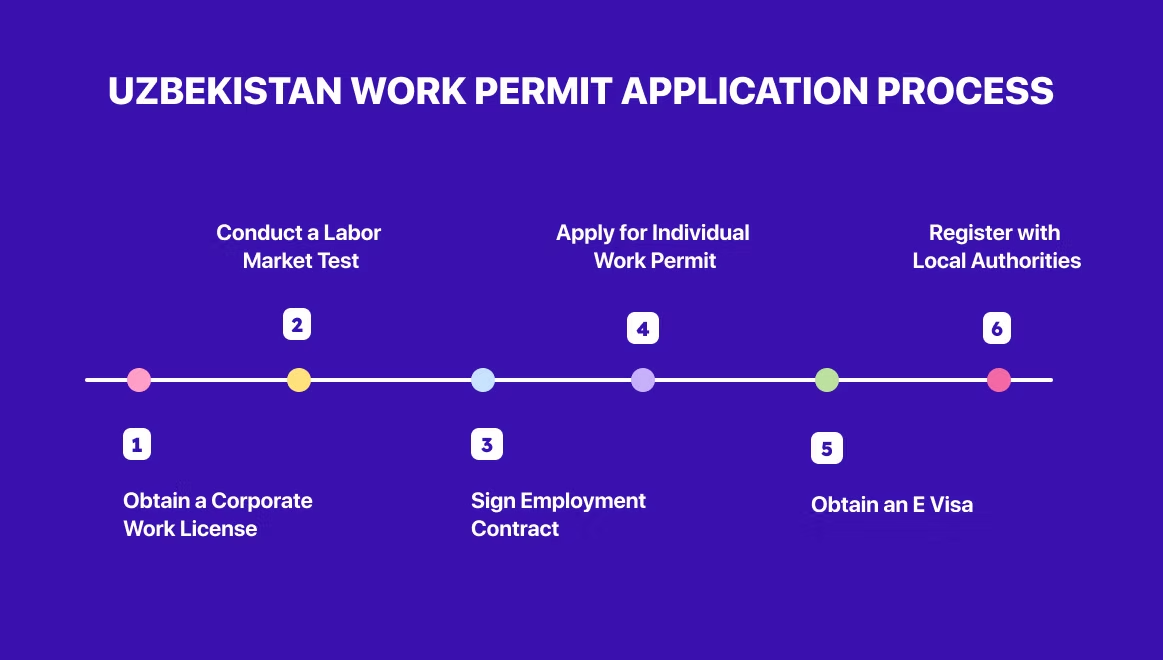
Uzbekistan's work permit system is structured around two sequential requirements: the Corporate Work License (for the employer) and the E Visa (for the employee). Both must be in place before work begins.
Step 1: Corporate Work License: The employer obtains a Corporate Work License from the relevant labor authority. This license:
- Is valid for 6–12 months
- Covers a specific number of foreign hires
- Must be renewed before expiry if employment continues
Step 2: Labor market test: The employer must demonstrate that no qualified local candidate is available for the role. This involves posting the vacancy and documenting the search.
Step 3: Work permit and E Visa application: Once the Corporate Work License is in place and the market test is completed, the employer files for the individual work permit. The employee simultaneously applies for an E Visa.
Processing time: Up to 3 months from start to finish.
Fees:
- Work permit: approximately $810
- E Visa: approximately $161
- Corporate Work License: approximately $30
EAEU nationals: Citizens of Russia, Belarus, Kazakhstan, Kyrgyzstan, Armenia, Azerbaijan, Georgia, Moldova, and Ukraine have unlimited stays in Uzbekistan without a visa. However, they still require a work permit and a compliant employment contract to be legally employed.
2026 compliance context: Uzbekistan's new State Social Insurance Law, effective January 1, 2026, restructured how benefit payments are processed through the State Fund for Social Insurance. All leave registration must now go through the my.mehnat government portal. These changes affect payroll alongside work authorization — meaning the employer's compliance obligations extend well beyond the permit itself.
India Work Permit (Employment Visa)
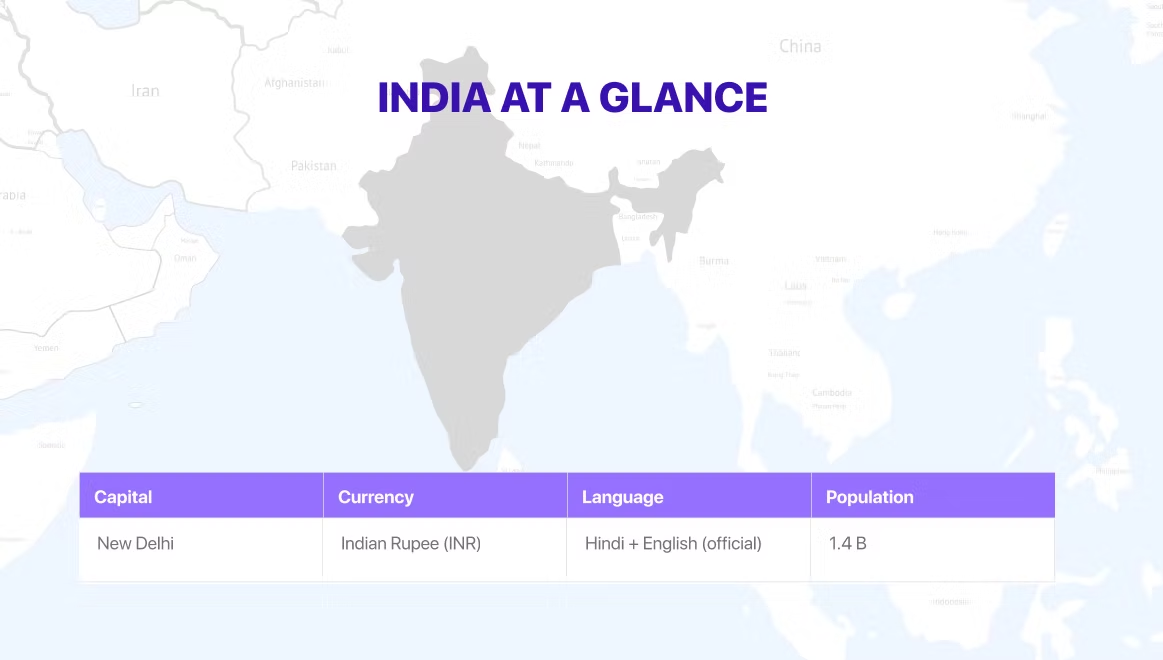
India does not issue a standalone "work permit" card. The primary authorization for foreign nationals to work in India is the Employment (E) Visa — a visa category that functions as the de facto work permit.
Minimum salary threshold: As of 2026, most foreign employees must earn a minimum of approximately INR 16.25 lakhs (USD ~25,000) per year to qualify for an Employment Visa. Benefits in kind do not count toward this threshold. The exemptions are narrow: certain language teachers, ethnic cooks at diplomatic missions, NGO workers in some categories.
Employment Visa Types in India:
- E Visa (Direct Employment): The standard route for foreign professionals employed by a registered Indian entity. Valid for one year initially, extendable year-by-year up to 5 years. Multiple entry typically allowed.
- Project Visa: Tied to specific infrastructure or industrial projects (historically, power and steel sectors). Valid for the project duration. The employee must be employed by the foreign company awarded the project contract.
- Intra-Company Transfer: Multinational companies transferring employees from overseas offices to Indian operations. The Indian entity must be registered and the transfer documented.
- Research and Intern Visa: For academic researchers and pre-arranged internships. Lower salary thresholds apply in some cases.
The FRRO requirement: Foreign nationals whose Employment Visa is valid for more than 180 days must register with the Foreigners Regional Registration Office (FRRO) or Foreigners Registration Office (FRO) within 14 days of arrival using the e-FRRO portal. Missing this deadline creates legal exposure for both the employee and the sponsoring employer.
Employer obligations:
- Sponsoring employer must be a registered Indian entity (or EOR)
- Employment contract must specify role, salary, location, and duration in compliance with Indian immigration policy
- Employers must maintain records of the employee's visa status and renewal dates
- TDS (Tax Deducted at Source) must be correctly calculated and remitted from the employee's first paycheck
- EPF (Employees' Provident Fund) obligations for "International Workers" apply in some cases, check Social Security Agreement (SSA) applicability with the employee's home country
Common mistakes:
- Applying for a Business Visa when an Employment Visa is required
- Missing the FRRO registration window
- Offering a salary below the USD 25,000 threshold and having the application refused
- Not registering with FRRO after a visa extension is granted
For a practical guide on what employer sponsorship means in the Indian context, see our article on what employer sponsorship means and how it works.
The Employer's Step-by-Step Sponsorship Process
Across all seven markets, the sponsorship sequence follows a broadly consistent structure. Here is the universal framework, with market-specific variations noted.
Step 1: Confirm entity status
Does your company have a registered legal entity in the target country? If yes, proceed. If no, engage an EOR with an owned entity in that market before any other step.
Step 2: Conduct the labor market test (where required)
Georgia (10 business days from March 2026), Kazakhstan (15 calendar days from September 2025), and Uzbekistan all require a domestic vacancy posting before the permit application can be filed. Do not skip this step or start it late — it is a prerequisite, not a formality.
Step 3: Prepare employment documentation
Employment contract (in local language where required), job description, salary confirmation, role justification. In India, add educational credentials and proof of specialized qualifications.
Step 4: Submit the employer's application
The employer files the permit application with the relevant authority. This is the employer's action — not the employee's. Authorities: Ministry of Labor (Georgia, Armenia, Kazakhstan, Uzbekistan), State Migration Service (Azerbaijan), Ministry of Family and Social Services (Turkey), Ministry of Home Affairs/sponsoring entity (India).
Step 5: Receive permit approval
Processing timelines by country:
- Georgia: up to 30 calendar days
- Armenia: 4–8 weeks
- Azerbaijan: variable (State Migration Service)
- Turkey: approximately 4–6 weeks
- Kazakhstan: 2–6 weeks (after quota and market test)
- Uzbekistan: up to 3 months
- India: approximately 1–6 weeks (varies by consulate)
Step 6: Employee applies for a visa/residence permit:
Once the employer's permit is approved, the employee applies for the associated entry visa or residence permit at the relevant embassy or consulate. In Georgia, this is the D1 visa. In Kazakhstan, the C3 work visa. In India, the E Visa through the Indian mission.
Step 7: Post-arrival compliance
Registration with local authorities upon arrival (FRRO in India within 14 days, migration registration in Kazakhstan, IIN acquisition). DSMF registration in Azerbaijan before payroll begins. Payroll enrollment under local labor codes in all markets.
Why Most Companies Get This Wrong
The same mistakes appear across market after market. Knowing them in advance is cheaper than learning them through enforcement.
Starting work before the permit is approved
This is the most common and most expensive error. In Azerbaijan, it is a violation with no tolerance. In Georgia, from March 2026, it carries a GEL 2,000 fine per person. In Kazakhstan, unauthorized employment carries fines of 60–150 MCI (~$500–$1,200) per unauthorized worker. Every market requires authorization before work begins — not after.
Assuming the business visa covers employment
A business visa authorizes attendance at meetings, negotiations, and business activities. It does not authorize employment or salary receipt in the target country. Using a tourist or business visa for what is functionally employment is misclassification — a category of violation that attracts back-taxes, penalties, and in some cases deportation of the employee.
Contractor arrangements as a workaround
Many companies attempt to engage workers as independent contractors to avoid the permit process. In markets with active enforcement — Azerbaijan, Kazakhstan post-September 2025 — this creates misclassification exposure. If the relationship walks and talks like employment, authorities will treat it as employment.
Not having an entity (and not knowing EOR solves it)
A company without a local entity cannot sponsor a work permit in any of these markets. This is not a policy gap that can be navigated around; it is a structural requirement. The solution is not to spend six months and $50,000 on entity setup. It is to engage an EOR with an owned entity in the target market, which assumes the sponsorship role immediately.
Missing the quota window in Kazakhstan
Kazakhstan's quota applications must be filed by approximately September 30 of the preceding year. A company that wants to hire a foreign national in March 2026 but did not file for a quota in September 2025 faces a very difficult process. This is a planning failure, not a compliance failure, but the consequences are the same.
How EOR Handles Work Permit Sponsorship
An EOR with owned entities in the target market eliminates the entity requirement and takes on the sponsorship obligations directly.
Here is what that looks like in practice across Team Up's markets:
Georgia: Team Up's Tbilisi entity files the Special Labour Permit application with the Ministry of Labor as the registered employer. The 10-business-day vacancy posting is managed by Team Up's in-country team. Processing is tracked against the 30-day window.
Armenia: Team Up's Yerevan entity submits applications through the Migration and Citizenship Service's digital platform. Pre-August 2026, the current process applies; the transition to the quota system is tracked and clients are notified with lead time.
Azerbaijan: Team Up's Azerbaijan entity is registered with the State Migration Service and DSMF. Work permit applications are filed directly. No client entity required.
Kazakhstan: Team Up's Almaty entity manages the September 30 quota application on behalf of clients — meaning clients do not need to know the annual deadline. The 15-day Electronic Labor Exchange posting is handled as part of standard onboarding. ULCRS contract registration and IIN acquisition are coordinated before the permit application is submitted.
Uzbekistan: Team Up's Tashkent entity obtains and maintains the Corporate Work License. Labor market testing, work permit applications, and E Visa coordination are managed end-to-end.
India: Team Up's India entity holds registration with the Ministry of Home Affairs and active EPF/ESIC compliance history — the prerequisites for Employment Visa sponsorship. Applications are coordinated with the employee's relevant Indian mission. FRRO registration is managed post-arrival.
Team Up is trusted by 200+ businesses and has built a workforce of 4,000+ talent across 20+ countries since 2020. A 92% client retention rate over five years reflects a model where the immigration complexity is absorbed by people who have done it dozens of times — not by your HR team doing it for the first time.
Build Your Immigration-Ready Hiring Infrastructure
Work permits are the point where talent strategy meets legal reality. Getting them right requires knowing the rules in each market, managing the timelines, and having a registered employer entity to sponsor, before the hire is confirmed.
Team Up operates owned legal entities in Georgia, Armenia, Azerbaijan, Turkey, Kazakhstan, Uzbekistan, and India. In-country teams in Tbilisi, Yerevan, Istanbul, Almaty, and Tashkent handle work permit applications, labor market tests, quota management, and post-arrival compliance as standard workflow, not as edge cases.
200+ businesses. 4,000+ talent. 92% retention over 5+ years.
If you are planning your first hire in any of these markets, the immigration step does not have to be the blocker.
Frequently Asked Questions
What does it mean to require sponsorship for employment?
It means the employer must formally provide the employee's authorization to work in the target country. This includes filing the permit application, serving as the registered employer on immigration documents, and maintaining compliance with local labor and payroll obligations. An EOR with an owned entity in the target country can provide this sponsorship without the client needing their own local registration.
Can a company sponsor a work permit without a local entity?
Not directly. Work permit sponsorship requires the sponsoring party to be a registered legal employer in the target country, with active tax registration, payroll compliance history, and standing with local labor authorities. An EOR with an owned entity already holds this status and sponsors on behalf of the client company. This is the core mechanism that makes EOR-based market entry without entity setup possible.
Do EAEU nationals need work permits in Armenia and Kazakhstan?
No. Citizens of Russia, Belarus, Kazakhstan (for Armenia), Kyrgyzstan, and Armenia (for Kazakhstan) are exempt from work permit requirements under the Eurasian Economic Union treaty. However, they still require compliant employment contracts, IIN registration in Kazakhstan, and payroll under the local labor code. The permit is waived; the employment compliance is not.
What is the minimum salary for an India Employment Visa?
As of 2026, most foreign professionals require a minimum annual salary of approximately USD 25,000 (INR 16.25 lakhs) to qualify for an India Employment Visa. Benefits in kind do not count toward this threshold. Narrow exemptions exist for specific categories including certain language teachers and NGO workers. The sponsoring employer must be a registered Indian entity with active corporate and tax compliance.
How long does work permit processing take across these markets?
Processing times as of 2026: Georgia up to 30 calendar days; Armenia 4–8 weeks; Azerbaijan variable (State Migration Service); Turkey approximately 4–6 weeks; Kazakhstan 2–6 weeks after quota and labor market test; Uzbekistan up to 3 months; India approximately 1–6 weeks depending on consulate. Budget additional lead time for the pre-application steps (labor market tests in Georgia, Kazakhstan, Uzbekistan) that must be completed before the application clock starts.
What happens if an employee works before the permit is approved?
Fines, back taxes, potential deportation of the employee, and reputational damage with local authorities. In Georgia: GEL 2,000 per employer and employee. In Kazakhstan: 60–150 MCI (~$500–$1,200) per unauthorized worker, with a 12-month ban on hiring foreign nationals for repeat violations. In Azerbaijan, enforcement is active and penalties compound. In India, violations fall under the Foreigners Act of 1946, which carries severe penalties, including fines and possible imprisonment. The message across every market in this guide is the same: do not start work before authorization is confirmed.
.svg)