Employer of Record (EOR) Compliance: Legal Checklist for Business owners
Quick Introduction
Employer of record services exist because international employment compliance is hard. That is the whole value proposition. The EOR becomes the legal employer so you do not have to navigate labor codes, payroll tax systems, and immigration requirements in every country where you hire.
Yet 38% of organizations face compliance issues in global HR outsourcing. 85% of executives say compliance requirements have grown more complex in the last three years. And when something goes wrong — a missed payroll filing, an unauthorized employee working before a permit is approved, a misclassified contractor — the consequences compound: back taxes, fines, reputational damage, and in some markets, a ban on hiring foreign nationals.
The checklist below is designed for three moments: before you sign with an EOR provider, during an ongoing engagement that needs a compliance audit, and when you are evaluating whether your current provider is actually delivering what they promised.
Work through it section by section with your HR, legal, and finance leads. Every item represents a real compliance risk that has materialized at real companies in the markets Team Up serves.
How to Use EOR Compliance Checklist
This checklist has twelve parts. Not every part applies to every hire or every country. Here is how to calibrate it.
- Pre-engagement due diligence (before signing): Parts 1, 9, and 10. These cover what you need to verify about the provider before you commit.
- New hire onboarding compliance: Parts 2, 3, 4, 5, 6, and 7. Work through these for every new employee, adapted to the specific country.
- Ongoing engagement audit: Parts 5, 6, 11, and 12. Run these quarterly.
- Relocation or immigration cases: Parts 3, 4, 7, and 8. Required for every foreign national being moved into a new country.
- Country calibration: The checklist flags country-specific requirements where they differ materially. Chapters for Georgia, Armenia, Azerbaijan, Turkey, Kazakhstan, Uzbekistan, and India are the primary references. Adjust for any additional markets in your hiring footprint.

Part 1 — EOR Provider Due Diligence Checklist
Before you sign a contract with any EOR provider, verify the following. This is the foundation. Everything downstream depends on whether the EOR is genuinely equipped to be the legal employer in your target markets.
Entity status:
- Does the EOR own registered legal entities in each country where you plan to hire? (Not partnerships, not affiliates — registered entities with active tax and payroll compliance.)
- Can the EOR provide the corporate registration number and tax ID for their entity in your target country? (Verify independently on the relevant government portal.)
- If the EOR uses local partners in any of your target markets, what is their vetting process for those partners?
Compliance monitoring:
- How does the EOR track regulatory changes in each target country? (In-country team? Automated platform? External legal counsel?)
- Can the EOR document how they communicated and implemented the following 2026 changes to clients: Georgia's Special Labour Permit requirement (March 2026), Armenia's mandatory health insurance withholding (January 2026), Uzbekistan's State Social Insurance Law restructure (January 2026)?
- What is their SLA for updating employment terms when a labor law change takes effect?
Liability and accountability:
- Who bears financial liability for compliance errors caused by the EOR's processing mistakes — the EOR or the client?
- Is this liability documented in the master service agreement?
- Does the EOR carry professional indemnity insurance for employment liability?
Pricing transparency:
- Is the total cost of employment disclosed before signing? (Service fee + statutory employer contributions + any setup fees, security deposits, FX markups, or termination fees.)
- Are there any fees that are not itemized on standard invoices?
Data protection:
- Does the EOR hold any data protection certifications relevant to your jurisdiction? (ISO 27001, SOC 2, GDPR compliance documentation.)
- Is a Data Processing Agreement (DPA) available as part of the standard contract?
Part 2 — Employment Contract Compliance Checklist
The employment contract is the foundational legal document. A non-compliant contract does not just create a compliance violation — in some countries, non-compliant clauses are void while the rest of the agreement remains in force, creating asymmetric obligations that favor the employee.
Contract Language and Format Requirements
- Is the contract issued in the local language where required? (Armenia: Armenian; Turkey: Turkish; Kazakhstan: Kazakh/Russian; India: English is standard, but some states require local language supplements.)
- Is the contract in a bilingual format where the local-language version is the legally controlling version?
- In Armenia, from January 1, 2026, is the contract executed through the SRC digital platform with an electronic signature? (Paper contracts are no longer valid for new hires from this date.)
- In Uzbekistan, from January 1, 2026, is the contract registered through the my.mehnat government portal?
Mandatory Contract Clauses by Country
- Probation period within legal limits: Georgia (up to 6 months), Armenia (up to 3 months), Turkey (2 months standard, 4 months maximum by collective agreement), India (typically 3–6 months, industry-specific), Kazakhstan (up to 3 months).
- Working hours and overtime provisions compliant with local caps: Turkey (45 hours/week maximum), Kazakhstan (40 hours/week), India (varies by state and industry).
- Notice period meets or exceeds statutory minimum.
- Termination conditions comply with the local labor code.
IP Rights and Confidentiality Clauses
- An IP assignment clause is included and enforceable under local law. (Note: IP clause enforceability varies significantly — India and Turkey have well-developed IP assignment frameworks; Caucasus markets are evolving.)
- The confidentiality clause is not broader than local law permits for post-employment restrictions.
- Non-compete clauses are reviewed for local enforceability. (Non-competes are generally unenforceable or limited in Armenia and Georgia; Turkey has narrow enforceability standards.)
Employment Contract Type Requirements
- Fixed-term contracts reviewed for maximum duration limits: Turkey (fixed-term contracts are capped at one year and convert to indefinite after two renewals), India (Fixed-term employment rules under the Code on Industrial Relations apply in some sectors).
- Indefinite contracts are the default where no valid fixed-term justification exists.
Part 3 — Work Permit and Visa Sponsorship for Employment Checklist

Work authorization must be secured before the employee starts work. This is not a step to complete in parallel with onboarding — it is a prerequisite. In markets with active enforcement, starting work before authorization is in place creates fines, back taxes, and, in some cases, a prohibition on hiring foreign nationals for up to 12 months.
Pre-Employment Work Authorization Requirements
- Has the work permit been approved and received before the employee's first working day? (Required in all markets covered in this guide.)
- Is the permit type matched correctly to the employee's role and nationality?
Labor Market Tests by Country (Where Required)
- Georgia (from March 2026): Has the employer posted the vacancy on the government portal for 10 business days before filing the permit application?
- Kazakhstan (from September 2025): Has the employer posted the vacancy on enbek.kz for 15 calendar days before filing? Is the contract registered in the ULCRS?
- Uzbekistan: Has the employer completed the labor market test documentation before the Corporate Work License application?
- Armenia (until August 2026): Has the Ministry of Labor notification been completed?
EAEU Work Permit Exemptions
- For employees who are citizens of EAEU member states (Russia, Belarus, Kazakhstan, Kyrgyzstan, Armenia): work permit requirement is waived for most Caucasus and Central Asian markets.
- Even for EAEU nationals, an employment contract, IIN registration (Kazakhstan), and compliant payroll are still required.
- EAEU exemptions are documented in the employee file.
Work Permit Administration and Tracking
- Permit renewal tracked and initiated at least 30 days before expiration.
- Post-arrival registration completed: FRRO/FRO in India within 14 days (for stays over 180 days), migration registration in Kazakhstan, residence permit application in Georgia after work permit approval.
- Permit is role-specific and employer-specific: a permit issued for Company A / Role A does not authorize work for Company B or a different role. Any changes require a new application.
For country-by-country permit types and processing timelines, see our comprehensive guide on work permits and employer registration requirements.
Part 4 — Immigration Sponsorship for Employment Compliance
When an employee's right to work depends on employer sponsorship — what constitutes "sponsorship for an immigration-related employment benefit” — the sponsoring employer must meet specific legal requirements. This section applies to all foreign national hires and any relocation involving a new work authorization.
Verifying the Sponsoring Entity's Eligibility
- The sponsoring entity is a registered legal employer with active payroll and tax compliance in the target country.
- The EOR's entity — not a partner or affiliate — is the registered sponsor on the permit application.
- The sponsoring entity has been in compliance for the required minimum period (some countries require 3–12 months of active payroll compliance before sponsoring a first permit).
Immigration Sponsorship Application Documentation
- Employer sponsorship letter issued on EOR letterhead with role, salary, and employment terms.
- Corporate registration documentation supporting the sponsorship.
- Employment contract issued and signed before the permit application is filed.
- Role justification statement demonstrating the need for a foreign national.
Country-Specific Sponsorship Requirements
- Azerbaijan: work permit application submitted to the State Migration Service before employment starts. Zero-tolerance enforcement. No exceptions for short-term or trial periods.
- Georgia: Special Labour Permit application submitted to the Ministry of Labor after the 10-day vacancy posting. GEL 500 (~$185) fee. 30-day processing window.
- India: Employment Visa applicant earns a minimum of USD 25,000/year. Sponsoring entity registered with the Ministry of Home Affairs. FRRO registration post-arrival.
- Kazakhstan: Quota headroom confirmed before application. A C3 work visa is applied for by an employee after permit approval.
Monitoring Work Permit Conditions and Visa Status
- Employee is working in the role, location, and for the employer specified on the permit. Material changes require a new application.
- Permit expiry dates are calendared with a 60-day renewal notice.
- Any employment changes (role, salary, location) are reviewed against permit conditions before implementation.
Part 5 — Payroll Tax and Statutory Contributions Checklist

Payroll tax errors compound. A missed filing in month one accrues daily penalty interest through to the date it is corrected. In Armenia, that is 0.075% per day. In Turkey, late social security contributions trigger interest charges and regulatory exposure. In India, missed TDS filings start at INR 200/day with no accrual cap.
Employer Payroll Registration and Setup
- EOR's employer registration with the local tax authority is confirmed active.
- Employee enrolled in the national social insurance system before first payroll.
- IIN obtained (Kazakhstan) or PAN registered (India), before payroll processing begins.
Withholding accuracy:
- Employee income tax withheld at the correct applicable rate: Georgia (flat 20%), Armenia (flat 20%), Turkey (progressive 15–40%), Kazakhstan (flat 10%), Uzbekistan (flat 12%), India (graduated slab under 2026 tax regime), Azerbaijan (0–14% non-oil sector; 20% for non-residents).
- Employee-side social contributions correctly deducted: Armenia pension (4.5–10%, capped at AMD 1,125,000), Turkey social security (14% + 1% unemployment), India EPF (12% of basic).
Employer-side contributions:
- Employer statutory contributions calculated and budgeted: Georgia (~2%), Armenia (minimal), Azerbaijan (17–24.5%), Turkey (20.75% + 2% unemployment), India (12% EPF + 3.25% ESI where applicable + 4.81% Gratuity accrual), Kazakhstan (15–20% combined), Uzbekistan (~12.1%).
- 2026 updates applied: Armenia mandatory health insurance (AMD 10,800/month per employee from January 1, 2026) withheld and remitted. Uzbekistan social insurance payments are routed through the State Fund for Social Insurance (from January 1, 2026).
Filing compliance:
- Monthly payroll returns filed by the correct deadline: Armenia (20th of the following month), Turkey (end of the following month), Uzbekistan (15th of the following month), India (monthly TDS).
- Year-end employee income statements filed on schedule.
- Payslips are issued in the local required format. Armenia payslips registered through the SRC digital platform. Uzbekistan leave registration through my.mehnat portal.
Part 6 — Statutory Employee Benefits Compliance Checklist

Statutory benefits are legal obligations. They are not optional, not waivable by the employee, and not substitutable with a cash equivalent unless the local labor code explicitly permits it.
Annual leave:
- Minimum annual leave entitlement applied: Georgia (24 working days), Armenia (28 calendar days), Azerbaijan (21 calendar days), Turkey (14–26 days depending on tenure), Kazakhstan (24 calendar days), Uzbekistan (21 working days), India (varies by state/sector, typically 12–15 days).
- Leave accruals are tracked from the employee's start date.
- Unused leave payout rules applied on termination per local code.
Sick leave:
- Sick leave entitlement confirmed: Georgia (unpaid by default, employer supplements optional), Armenia (paid through the State Social Insurance Fund), Turkey (covered by social security for employer-registered employees).
- Medical certificate requirements understood and communicated to employees.
Maternity and parental leave:
- Maternity leave duration applied correctly: Georgia (730 days total, 183 paid), Armenia (140 days paid), Azerbaijan (126 days), Turkey (16 weeks), India (26 weeks for first two children), Kazakhstan (calendar-based entitlement).
- State maternity benefit claim process understood — in most markets, the benefit is partially paid by the state social insurance fund, not entirely by the employer.
Overtime:
- Overtime cap respected: Turkey (45h/week maximum, overtime at 150% or time off in lieu), Kazakhstan (2 hours/day overtime maximum in most categories), Uzbekistan (1.5x for the first 2 hours, 2x beyond from the November 2025 amendment).
- Night-shift and public holiday premiums applied where legally required.
Part 7 — Relocation and Expatriate Compliance Checklist
Relocating an existing employee to a new country, or hiring a foreign national who has recently relocated, creates additional compliance layers beyond standard employment.
Tax residency:
- Employee's tax residency determined for the target country. Standard trigger: 183 days of physical presence in most markets creates local tax residency.
- Double taxation treaty (DTT) between the employee's home country and the target country is reviewed. Applicable treaty provisions documented. Tax Residency Certificate from the home country, where a reduced withholding rate applies.
- Social Security Totalization Agreement reviewed. EAEU member state employees have coordinated social security arrangements for moves within the EAEU bloc.
Relocation benefit tax treatment:
- Housing allowance structured correctly for local tax treatment. An incorrectly structured housing allowance becomes taxable income with withholding obligations.
- One-time relocation payment classified correctly as expense reimbursement or taxable allowance per local rules.
- Dependent support and education allowances were reviewed for applicable tax treatment.
Post-arrival compliance:
- FRRO/FRO registration completed within 14 days of arrival in India (for Employment Visa holders staying over 180 days).
- IIN registration completed on arrival in Kazakhstan.
- Residence permit application initiated after work permit approval in Georgia.
- DSMF registration completed in Azerbaijan before payroll begins.
Part 8 — Employer Sponsorship Obligations Checklist
Employer sponsorship is not a one-time filing. It is an ongoing obligation. The sponsoring employer — in EOR arrangements, this is the EOR's entity — remains responsible for the employee's compliance with permit conditions throughout the employment.
Ongoing monitoring:
- Employee is working in the approved role, location, and organization specified on the permit. Changes require a new application or amendment.
- Salary remains at or above the level specified on the permit application (India: minimum USD 25,000/year).
- Permit renewal initiated proactively — not reactively. Renewals in most markets require the same documentation sequence as the original application.
Employer obligations when employment ends:
- Permit cancellation filed with the relevant immigration authority when employment terminates.
- In India, the employer must notify FRRO/FRO of employee departure and permit cancellation.
- In Kazakhstan, employment contract de-registration from ULCRS on termination.
- In Azerbaijan, residence permit cancellation is coordinated with the State Migration Service.
Documentation retention:
- Copies of all permits, visas, and immigration filings are retained for the minimum statutory period (typically 3–5 years in most markets).
- Employment authorization verification records are maintained.
Part 9 — Data Privacy and Employee Data Checklist
Your EOR processes sensitive personal data for every employee: name, identification numbers, salary, tax information, bank details, and employment history. In 2025, GDPR cumulative fines exceeded €7.1 billion, with €1.2 billion levied in 2025 alone — and enforcement is accelerating, not decelerating.
Data Processing Agreement:
- A signed Data Processing Agreement (DPA) or Data Processing Addendum is in place with the EOR before any employee data is shared. This is a legal requirement under GDPR Article 28 for EU-based clients.
- The DPA specifies categories of data processed, processing purposes, retention periods, sub-processor arrangements, and breach notification timelines.
Data minimization:
- Employee data shared with the EOR is limited to what is strictly necessary for employment purposes. Excessive data sharing creates regulatory exposure.
- Data flows between the client company and the EOR are documented.
Cross-border data transfers:
- If employee data is transferred between the EU and a third country, the legal transfer mechanism is confirmed: EU-US Data Privacy Framework (renewed for US transfers), Standard Contractual Clauses (SCCs) for other destinations.
- For EU clients employing in the Caucasus or Central Asia: data transfer mechanisms for Armenia, Georgia, Azerbaijan, Kazakhstan, and Uzbekistan are confirmed. These countries are not EU adequacy decision countries — SCCs or binding corporate rules are required.
Employee data rights:
- Process for handling employee data access requests (DSAR) is documented and can be fulfilled within 30 days (GDPR requirement).
- Employee data deletion process confirmed on offboarding, subject to statutory retention requirements.
Retention and deletion:
- Payroll records retained per local requirements: typically 5–10 years across all markets in this guide.
- Data is deleted or anonymized after the statutory retention period.
Part 10 — Permanent Establishment Risk Checklist
Permanent establishment (PE) risk is the corporate tax issue that most EOR guides treat as a footnote. It should be assessed before every hire, not discovered during a tax audit.
Role assessment:
- The employee's role has been reviewed against PE trigger criteria: does the employee conclude contracts, make strategic purchasing decisions, or have binding authority to commit the parent company?
- If yes, corporate tax advice from a local specialist has been obtained before the hire is confirmed.
- If the employee's role is execution-oriented (development, operations, support, delivery), PE risk is lower — document this classification.
Structural safeguards:
- The employment contract is with the EOR entity — not the parent company. This is the standard EOR structure and reduces direct employer PE exposure.
- The EOR services agreement is reviewed for language that could imply a permanent business presence of the client company in the target country.
- No fixed, dedicated office space is provided exclusively to the employee in the target country. Shared coworking or home office arrangements are lower risk.
Corporate tax registration:
- The parent company has confirmed with its tax advisors that no PE has been triggered in any market where EOR employees operate.
- If PE has been determined to exist, local corporate tax registration has been initiated.
Part 11 — Termination and Offboarding Compliance Checklist
Termination is where compliance failures are most visible — and most expensive. An incorrectly handled termination in Turkey, India, or Armenia can result in reinstatement orders, court-awarded compensation, and multi-year back-pay liability.
Notice period
- Notice period calculated per local labor code, not per the employment contract if the contract specifies less than the statutory minimum.
- Notice period obligations: Georgia (as specified in contract, minimum 30 days typically), Armenia (minimum 14 days for employer-initiated termination), Turkey (2–8 weeks depending on tenure), India (varies by state and sector), Kazakhstan (1 month).
Severance calculation:
- Statutory severance calculated where applicable: Turkey (1 month gross per year of service for employees with 1+ year tenure), Azerbaijan (tiered by service length), India (Gratuity payable after 5 years: 15 days' wages per year of service).
- Final payroll processed on the schedule required by local law (Turkey: within the notice period; India: full and final settlement within 2 days typically; Kazakhstan: day of termination or next working day).
Process documentation:
- Termination reason documented correctly for the applicable local ground: mutual agreement, redundancy, performance, etc.
- Termination notice issued in writing, signed by the employee where required.
- Employee's statutory rights on termination communicated (COBRA equivalent where applicable, pension transfer options, leave payout).
Immigration offboarding:
- Work permit cancellation filed with the relevant authority.
- FRRO/FRO notification in India.
- IIN and ULCRS contract de-registration in Kazakhstan.
- Residence permit deregistration in Azerbaijan.
- Employee's home-country tax obligations on termination payment reviewed.
Part 12 — Ongoing Compliance Monitoring Checklist
Compliance is not a one-time setup. The Caucasus, Central Asia, Turkey, and India all saw significant regulatory changes in 2025–2026. The employers who were caught off-guard by Armenia's health insurance mandate, Georgia's Special Labour Permit requirement, or Uzbekistan's social insurance restructure were companies without proactive compliance monitoring.
Regulatory tracking:
- EOR has a confirmed process for tracking labor law changes in every country where you have employees.
- You receive proactive notification of changes — not just reactive support when something breaks.
- Employment contracts are updated when regulations change, without waiting for the employee to flag the discrepancy.
Regular internal reviews:
- Leave accruals are audited quarterly to confirm they match entitlement calculations.
- Payroll reconciliation is reviewed quarterly to confirm statutory contribution rates are current.
- Permit renewals tracked with a 90-day advance notice, not a 30-day.
- Employment contracts are reviewed annually against current local labor codes.
Provider performance:
- EOR invoices are reviewed monthly for consistency with agreed pricing.
- Any unannounced fee changes are flagged and escalated immediately.
- Customer support SLA tracked: Are compliance questions answered within 24 hours?
Audit readiness:
- Payroll records are maintained in an audit-ready format for the statutory retention period.
- All permits, visas, and immigration documents are stored centrally and accessible.
- Employment contracts accessible and version-controlled.
Red Flags: When Your EOR Is Failing the Compliance Test
These eight warning signs require immediate attention. Each has materialized in real client situations across the markets Team Up serves.
- The EOR cannot provide their corporate registration number in your target country. This means they are operating through a local partner whose compliance you cannot verify. Ask immediately.
- The EOR learned about a 2026 regulatory change from you, not the other way around. If you had to tell your EOR about Armenia's health insurance mandate or Georgia's Special Labour Permit, their compliance monitoring is not functional.
- Payslips do not itemize all statutory deductions. In Armenia, Azerbaijan, Turkey, India, and Kazakhstan, a generic payslip without line-item deductions for each contribution type is non-compliant.
- The EOR cannot tell you the filing deadline for payroll returns in your target country. Filing deadlines are the most basic compliance data point. If they cannot answer immediately, the filing is probably late.
- Employment contracts have not been updated since 2024. If your EOR-issued contracts have not been reviewed and updated to reflect 2026 regulatory changes, you are operating under non-compliant agreements.
- Permit renewals are flagged to you after the current permit has expired. Renewal should be initiated 60–90 days before expiry. If you are receiving renewal notices at 30 days or less, the process is reactive rather than managed.
- The EOR cannot explain the data transfer mechanism for employee data leaving the EU. For EU-headquartered clients with employees in the Caucasus or Central Asia, this is a GDPR requirement. Vagueness here is a regulatory risk.
- Termination cost estimates arrive after the termination decision has been made. A proactive EOR provides severance estimates before you make an offboarding decision. Receiving them afterward means you are making expensive decisions without the full cost picture.
How Team Up Manages This Checklist for You
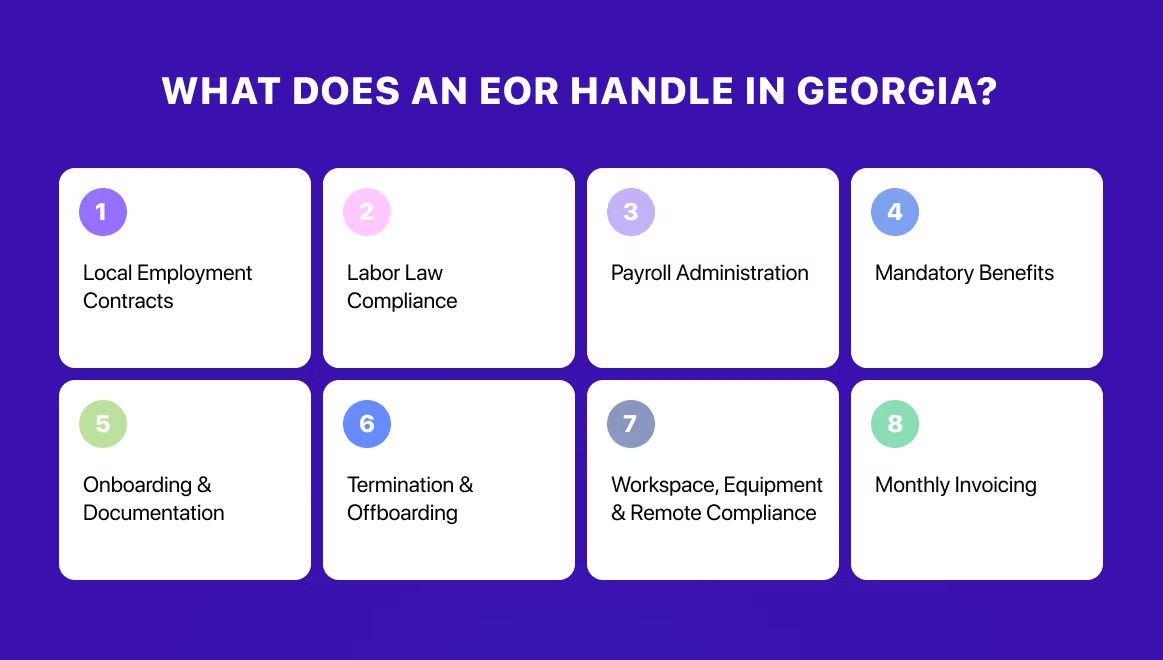
The twelve-part checklist above represents the full scope of what a quality EOR should handle as standard practice. Team Up's owned-entity model is built to cover every item — not because it makes a good checklist, but because 200+ businesses over five years have surfaced exactly these compliance requirements across Georgia, Armenia, Azerbaijan, Turkey, Kazakhstan, Uzbekistan, and India.
Entity verification: Team Up's corporate registration numbers in each market are publicly verifiable. Ask and we will provide them.
Proactive regulatory monitoring: When Armenia's mandatory health insurance withholding took effect on January 1, 2026, Team Up's Yerevan payroll team updated client calculations on that date. When Georgia's Special Labour Permit requirement was announced, Team Up's Tbilisi team communicated the changes to affected clients before March 1, 2026 and managed the transition to the new system.
Immigration sponsorship: Team Up's owned entities hold the legal employer status required to sponsor work permits and visas in all eight core markets — directly, without routing through a local partner.
Data protection: Team Up operates with Data Processing Agreements as standard, consistent with GDPR requirements for EU-based clients and applicable local data protection frameworks in each target market.
Proactive termination management: Severance estimates, notice period calculations, and exit immigration compliance are provided before the termination decision, not after.
92% client retention over 5+ years. The companies that stay do so because the compliance is handled proactively, specifically, and by people who know the market.
Start With a Compliance Foundation That Holds
Compliance is not a feature of the contract. It is the operating reality of what happens every month, in every country, for every employee on your payroll.
Team Up provides employer of record services through owned legal entities in Georgia, Armenia, Azerbaijan, Turkey, Kazakhstan, Uzbekistan, and India. In-country teams manage every item on this checklist as standard workflow — not as an add-on service.
200+ businesses served. 4,000+ talent placed. 92% client retention over five years.
If you want a compliance review of your current EOR setup or a pre-engagement checklist session before entering a new market, Team Up's in-country teams are the people to talk to.
Frequently Asked Questions
What is the most common EOR compliance failure in emerging markets?
Starting work before the work permit is approved. In Azerbaijan, this creates immediate State Migration Service violations with no tolerance. In Georgia from March 2026, it triggers a GEL 2,000 fine per employer and employee. In Kazakhstan, unauthorized employment carries fines of 60–150 MCI (~$500–$1,200) per unauthorized worker. The fix is simple: the permit must be approved before day one, not applied for on day one.
Does an EOR eliminate all of my company's legal compliance obligations?
No. An EOR eliminates the employee-level compliance obligations — employment contracts, payroll taxes, statutory benefits, work permits. Your company retains corporate income tax obligations, permanent establishment exposure if employees make business decisions or conclude contracts, and VAT/GST on EOR service fees. These corporate-level obligations require separate advice and management.
What should I check in a Data Processing Agreement with an EOR?
The DPA should specify: the categories of employee data being processed, the legal basis for processing, the purposes for which data is used, the names of any sub-processors (including local partners the EOR uses), the retention period, the mechanism for cross-border transfers if applicable, and the breach notification timeline. For EU-based clients, the DPA must comply with GDPR Article 28. Request a draft before signing the main EOR agreement.
How do I verify that my EOR is keeping employment contracts up to date with regulatory changes?
Ask for the version date on the employment contract template for each target country, and cross-reference it against significant 2026 regulatory events. For Armenia, was the mandatory health insurance clause added from January 2026? For Georgia: Does the contract reflect the Special Labour Permit employer obligation from March 2026? For Uzbekistan, is the social insurance contribution routed through the State Fund for Social Insurance? An EOR with in-country compliance teams will be able to answer immediately. An EOR relying on remote platform updates may have missed one or more of these.
What is "sponsorship for an immigration-related employment benefit," and how does it appear in EOR contracts?
This phrase refers to any authorization the employer must provide to enable an employee's right to work in a target country — work permits, sponsored visas, or residence permit applications. In EOR contracts, this appears as the EOR's obligation to "act as the legal sponsor on immigration filings" using the EOR entity's registered employer status. It means the EOR files the permit application, appears on the immigration documentation as the employer, and is responsible for ongoing compliance with permit conditions. For country-by-country details on what this involves, see our guide on work permit compliance and employer sponsorship requirements.
.svg)