


Turkey Work Permits & Visas: Employer Guide to Types & Sponsorship
TL;DR
Planning to hire in Turkey?
Understanding Turkey’s work permit and visa framework is non-negotiable if you want to hire legally and avoid fines, delays, or rejected applications.
This guide gives decision-makers a compliance-first overview of everything that matters, including:
- The types of work permits available in Turkey
- How work permits, visas, and residence rights fit together
- Direct hiring vs. Employer of Record (EOR) sponsorship models
- Hiring Turkish citizens vs. foreign nationals
- Step-by-step immigration and renewal timelines
- Required documents, employer responsibilities, and common mistakes to avoid
By the end, you’ll clearly understand how Turkey’s employment immigration system works, and how it compares with other MENA and Eastern Europe hiring hubs.
Quick navigation
- TL;DR
- Work Permit Basics in Turkey
- Types of Work Permits in Turkey
- Hiring Turkish Citizens vs. Foreign Nationals
- Sponsorship Models in Turkey: Direct Hiring vs. Employer of Record (EOR)
- Work Permit Application Process in Turkey: Step-by-Step
- Step-by-Step: Sponsoring a Foreign Employee via an EOR
- EOR vs. Your Own Entity: Compliance Comparison
- Conclusion
- Frequently asked questions
Work Permit Basics in Turkey
Who Needs a Work Permit?
In Turkey, any foreign national must obtain a work permit (Çalışma İzni) before starting work.
Key points:
- This applies to almost all nationalities
- The main exception is citizens of Northern Cyprus
- Employing a foreigner without a work permit is illegal
- Penalties include heavy fines, employment bans, and possible deportation
Whether you’re hiring:
- A software developer for a short project
- A senior executive relocating long-term, you must secure a work permit before employment begins.
The sponsoring employer (or EOR) must also meet legal eligibility criteria.
Work Permit vs. Visa vs. Residence Permit
These terms are often confused, so let’s clarify:
| Item | What it does |
| Work Visa | An entry visa issued by a Turkish consulate allowing travel for employment |
| Work Permit | Issued by the Ministry of Labor. Grants the right to work |
| Residence Right | Automatically included in the work permit |
Important: In Turkey, the work permit doubles as a residence permit. Once approved and activated, the employee does not need to apply separately for residence.
What does not allow work?
- Tourist visas
- E-visas (90-day stay)
- Business visit visas
If a foreigner will:
- Stay longer than 90 days, or
- Perform any productive work. A work permit is mandatory.

Types of Work Permits in Turkey
1. Temporary Work Permit (Definite-Term)
This is the most common permit for first-time foreign hires.
Key features:
- Initial validity: up to 1 year
- Tied to a specific employer and role
- First renewal: up to 2 years
- Second renewal: up to 3 years
- Valid only as long as employment continues with the same employer
Most foreign employees start here.
2. Permanent Work Permit (Indefinite-Term)
Available after long-term lawful presence.
Eligibility:
- At least 8 years of continuous legal work or residence in Turkey
Benefits:
- No renewal required
- Unlimited right to work and reside
- Similar employment rights to Turkish citizens (without citizenship)
3. Independent Work Permit
Designed for self-employed foreigners and entrepreneurs.
Typical applicants:
- Business owners
- Independent professionals
- Consultants operating in Turkey
Approval depends on:
- Education and professional background
- Economic contribution
- Job creation potential
This route is assessed case-by-case under Turkey’s international labor policy.
4. Turquoise Card
Turkey’s equivalent of a “talent green card.”
Who it’s for:
- Highly qualified professionals
- Investors
- Scientists, academics, athletes, artists
Structure:
- Initial 3-year conditional period
- Converts to indefinite status if criteria are met
Extras:
- Spouses and dependents receive residence rights
- No need for standard work permit renewals
This option is powerful but selective.
5. Special Employment Categories
Some permits are labeled by profession or sector, such as:
- Academics and lecturers
- Professional athletes
- Journalists
- Free zone workers
These labels reflect job type, not a different legal framework. All still require work permit approval, often with extra documentation.
Long-term Stay Considerations
- Foreign employees working legally in Turkey do not need a separate long-term visa
- The work permit covers residence
- Long-term residence permits may be considered later (after 8 years)
Compliance watch-outs:
- Extended time outside Turkey can invalidate the status
- Unemployment periods may affect permit validity
- Renewals must be filed on time to avoid gaps
Hiring Turkish Citizens vs. Foreign Nationals

When building a team in Turkey, it’s essential to distinguish between hiring Turkish citizens and hiring foreign nationals. The legal requirements, timelines, and complexity differ significantly.
Hiring Turkish Citizens (Local Hires)
Hiring Turkish nationals is immigration-free and administratively straightforward.
What’s required:
- A compliant Turkish employment contract
- Registration with the Social Security Institution (SGK)
- Payroll tax and social security withholding
- Compliance with Turkish labor law (working hours, leave, termination rules)
What’s not required:
- Work permit
- Visa
- Government immigration approval
Once the contract is signed, a Turkish employee can usually be onboarded within days.
For foreign companies without a Turkish entity, using an Employer of Record (EOR) is often the fastest way to hire local talent. Since no visa is involved, the EOR’s role is purely payroll, tax, and employment compliance.
Hiring Foreign Employees in Turkey
Hiring non-Turkish nationals is more complex and always requires a work permit.
Key differences vs. local hires:
- A foreign employee cannot start work until the Ministry of Labor approves the work permit
- Expect several weeks of lead time
- Additional compliance rules apply to employers
The 5:1 Rule (Localization Requirement)
Turkey enforces a strict localization ratio:
For every 1 foreign employee, the employer must employ at least 5 Turkish citizens.
Example:
- 1 foreign worker → 5 Turkish employees required
- 2 foreign workers → 10 Turkish employees required
This ratio is checked during the work permit application.
Important note: Some strategic investments, free zones, or special programs may qualify for exemptions, but most standard businesses must comply.
Minimum Salary Thresholds for Foreigners
Foreign employees must be paid above specific minimum salary multiples, depending on role:
- Engineers / specialists: ~4× minimum wage
- Managers: ~5× minimum wage
- Executives: ~6.5× minimum wage

This prevents undercutting local labor and means low-paid foreign roles are rarely approved.
Role Restrictions
Certain professions are restricted or require special licensing, such as:
- Legal professions
- Medical roles
- Maritime positions
Always verify role eligibility before proceeding.
Sponsorship Models in Turkey: Direct Hiring vs. Employer of Record (EOR)
When hiring in Turkey, you have two legal paths:
- Direct hiring via your own Turkish entity
- Hiring through an Employer of Record (EOR)
Both are valid, but they differ greatly in speed, cost, and operational burden.
Option 1: Direct Sponsorship (Setting Up Your Own Entity)
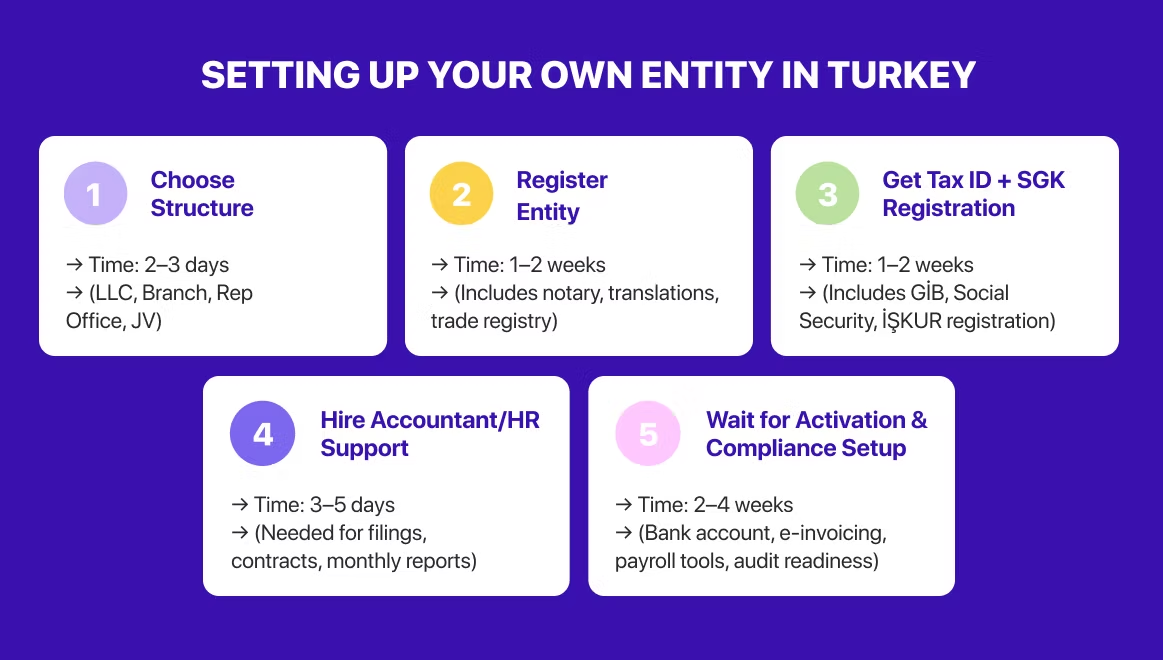
What This Involves
You establish a Turkish legal entity (subsidiary or branch) and become the direct employer.
Setup Timeline & Requirements
Setting up a Turkish company typically takes 6–8 weeks and includes:
- Company incorporation and notarized documents
- Turkish tax ID and Chamber of Commerce registration
- Local bank account
- Physical office address
- Minimum capital (commonly TRY 100,000 for an LLC)
Only after this can you hire employees or sponsor work permits.
Your Compliance Responsibilities
With your own entity, everything is on you:
Employment & HR
- Turkish-language contracts with mandatory clauses
- Managing probation, leave, overtime, and termination
- Statutory severance and notice obligations
Payroll & Taxes
- Monthly payroll processing in TRY
- Progressive income tax (15–40%)
- Employer contributions (~22% + unemployment fund)
- Monthly filings with SGK and Revenue Administration
Immigration
- Sponsoring work permits
- Maintaining the 5:1 ratio
- Proving financial viability for foreign hires
Operational Reality You’ll likely need:
- Local HR support
- Local accountants
- Ongoing legal guidance
Fines for non-compliance can be substantial.
When Direct Hiring Makes Sense
- Long-term, large-scale operations
- Dozens of employees
- Need for commercial activity beyond employment
- Strategic market commitment
For most early-stage expansions, this route is slow and heavy.
Option 2: Hiring Through an Employer of Record (EOR)
What an EOR Is
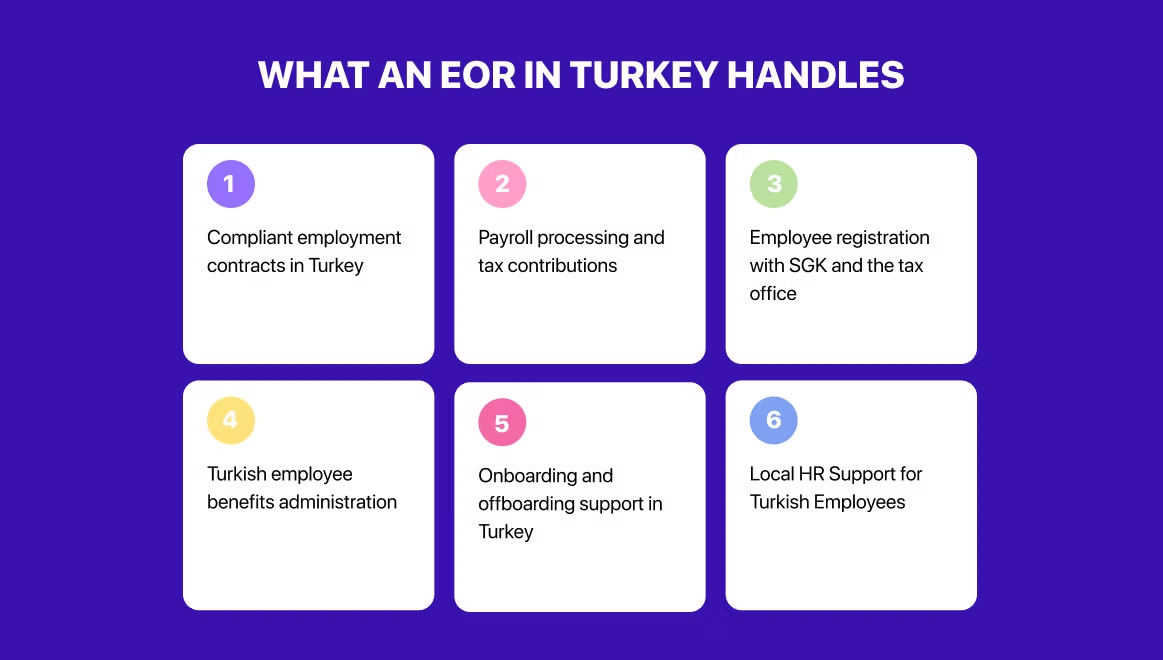
An EOR is a third-party company with a pre-existing Turkish entity that legally employs workers on your behalf.
- The EOR is the legal employer
- You manage the employee’s day-to-day work
- The EOR handles payroll, taxes, HR, and visas
Why Companies Choose EOR in Turkey

Speed
- No entity setup
- Local hires onboarded in 1–2 days
- Foreign hires processed immediately through EOR sponsorship
Full Compliance
The EOR handles:
- Turkish-compliant contracts (bilingual if needed)
- SGK and tax registration
- Monthly payroll, filings, and payments
- Severance, notice, and termination procedures
Work Permits Made Practical
For foreign hires:
- The EOR sponsors the work permit
- Maintains the 5:1 ratio across its entire workforce
- Handles Ministry filings, renewals, and residence compliance
This avoids a major blocker for small or foreign companies.
Simplified Payroll
You receive one invoice covering:
- Salary
- Taxes
- Contributions
- EOR service fee
The EOR pays employees and authorities locally.
Flexibility
- Scale up or down easily
- No sunk incorporation costs
- Easy exit or later transition to your own entity
Cost Considerations
While EORs charge a monthly fee, this often replaces:
- Accounting firms
- Legal retainers
- Payroll systems
- HR staff
- Compliance risk
For small-to-mid teams, an EOR service provider is frequently more cost-effective than running an entity.
Work Permit Application Process in Turkey: Step-by-Step
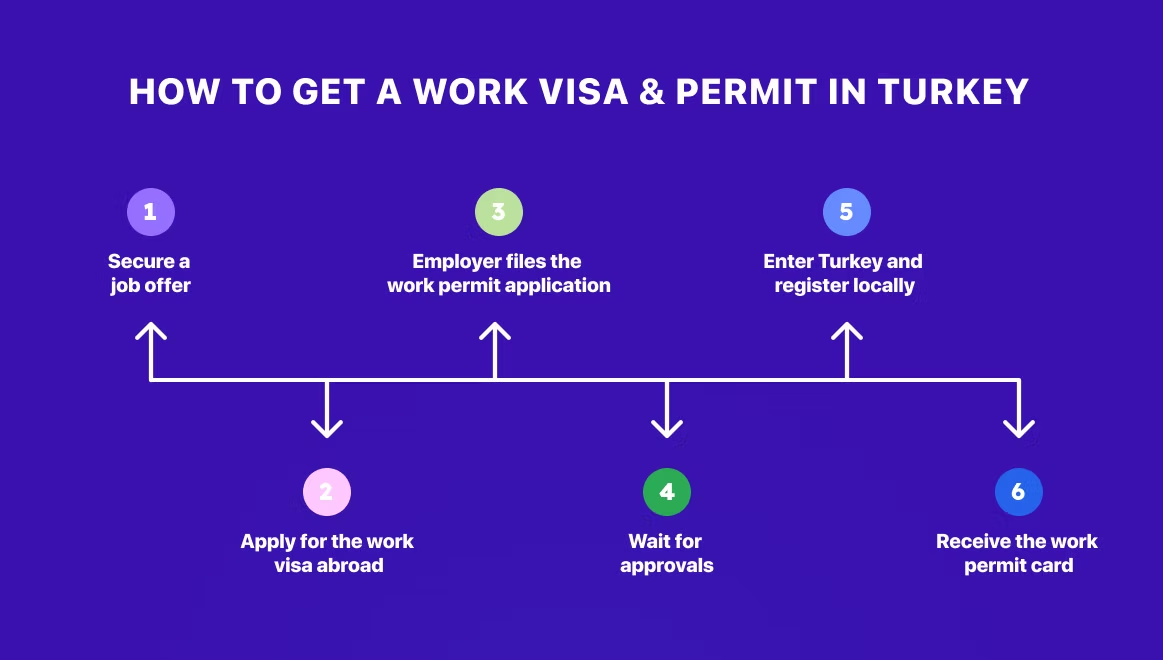
Once you decide to hire a foreign national, whether directly or through an Employer of Record (EOR) in Turkey, the work permit process must be followed precisely. Turkey’s system is digital but highly procedural, and small missteps can cause weeks of delay or outright rejection.
Below is a clear, end-to-end walkthrough of the process, including timelines, documents, and employer responsibilities at each stage.
Step 1. Preliminary Checks and Job Offer Preparation
Before any application is submitted, confirm that both the employee and the employer meet eligibility requirements.
Employee Readiness Checklist
- Valid passport (minimum 6 months validity beyond intended start date)
- Relevant qualifications for the role
- Willingness to apply at a Turkish consulate (if outside Turkey)
Employer Readiness Checklist
- Drafted employment contract or job offer
- Salary meets legal minimum thresholds for the role
- Ability to meet the 5:1 Turkish-to-foreigner ratio
- Company documents prepared for upload
Documents to Prepare Early
- Employment contract/job offer
- Turkish Tax Registration Certificate
- Trade Registry Gazette
- Latest balance sheet and profit/loss statement
Tip: If this is your first foreign hire or you’re a small entity, check whether any exemptions apply. Otherwise, assume standard rules apply.
Step 2. Employee Applies for Work Visa (Outside Turkey)
If the candidate is outside Turkey, the process starts at a Turkish embassy or consulate.
What the Employee Submits
- Work visa application form
- Passport and photos
- Job offer or signed employment contract
- Diplomas or professional certificates
- Visa application fee
Critical Output
- 16-digit reference number issued by the consulate
Important timing rule: Once the consular application is submitted, the employer must file the online work permit application within 10 business days. Missing this window means starting over.
In-country Exception
If the employee is already in Turkey with a valid residence permit (6+ months) for purposes like family or study (not tourism), the consulate step can be skipped. The employer applies directly online.
Step 3. Employer Submits Online Work Permit Application
The employer (or EOR) submits the application through the Ministry of Labor’s e-İzin system.
Employer Documents
- Trade Registry Gazette
- Tax certificate
- Balance sheet & profit/loss statement
- Power of attorney (if a representative is filing)
Employee Documents
- Signed employment contract
- Passport copy (with sworn Turkish translation if needed)
- Biometric photo
- Diplomas/certificates (translated if required)
Key Inputs
- Job title, salary, work location
- Consulate reference number (if an overseas application)
The entire process is digital. No hard copies are required.
Missing the 10-day submission window after the consular application invalidates the process.
Step 4. Government Review and Evaluation
The Ministry of Labor and Social Security reviews the application.
What Authorities Check
- Consistency between consular and employer submissions
- Completeness and validity of documents
- Compliance with the 5:1 employment ratio
- Adequate company capital or turnover
- Salary compliance with minimum wage multipliers
- Role eligibility and sector rules
Processing Time
- Typical: 4–8 weeks
- Fast cases: 3–4 weeks
- Delayed cases: Missing documents or peak periods
Authorities may request additional documents electronically. Prompt response is essential.
Step 5. Work Visa Issuance and Entry to Turkey
Once approved, the employee receives authorization to enter Turkey.
If the employee is outside Turkey
The
- Turkish consulate issues a work visa (usually valid for 90 days)
- The employee must enter Turkey within the visa validity
- Work permit validity usually starts from the approval date
Best practice: Avoid delays between approval and entry, as unused permit time is lost.
If the employee is already in Turkey
- No exit/re-entry required
- The employee may start work immediately after approval
Step 6. Post-Arrival Registration and Onboarding
After arrival, several administrative steps finalize compliance.
Mandatory Employer Actions
- Register the employee with the Social Security Institution (SGK)
- Add employee to payroll system
- Ensure tax withholding setup
Employee Actions
- Register residential address via e-Devlet or Nüfus office
- Receive physical work permit ID card (also serves as residence permit)
Note: The digital approval is legally sufficient even before the card arrives.
Healthcare
- SGK registration provides access to public healthcare
- Optional private insurance may be added as a benefit
Step 7. Work Permit Renewals and Updates
Work permits are time-limited and must be renewed.
Renewal Timeline
- Apply up to 60 days before expiry
- Must be filed before the permit expires
Renewal Durations
- Initial permit: 1 year
- First extension: up to 2 years
- Subsequent extensions: up to 3 years
- After 8 years: permanent work permit eligibility
Work permits are employer-specific. Changing employers requires a new application.
Step 8. Payroll, Taxes, and Ongoing Compliance

Immigration compliance doesn’t end with permit approval.
Payroll & Taxes
- Income tax: 15–40% progressive
- Stamp tax: ~0.759%
- Employer SGK: ~22.5%
- Employee SGK: 15% withheld
Ongoing Obligations
- Monthly tax and SGK filings
- Annual reconciliations
- Statutory leave tracking
- Overtime and severance compliance
Travel & Residency
- Extended absences may affect renewal eligibility
- Work permits are intended for active residence and employment
Step-by-Step: Sponsoring a Foreign Employee via an EOR
1. Client & Candidate Onboarding
You begin by engaging an EOR providerand confirming the foreign candidate you want to hire in Turkey.
At this stage, the EOR will:
- Validate that the role is eligible for a work permit
- Confirm salary thresholds and compliance requirements
- Collect candidate documents (CV, passport, diplomas, etc.)
- Draft a Turkish-compliant employment contract
- The EOR’s Turkish entity is the legal employer
- Your company is listed as the end client
- The contract specifies that the employee works under your direction
This contract becomes the foundation for the work permit application.
2. Initiating the Work Permit Process
The EOR’s immigration specialists take over the process coordination.
They will:
- Instruct the candidate on consulate application steps
- Provide visa invitation letters or templates if required
- Guide the candidate through appointment scheduling and form completion
- Ensure all documents required by the consulate are prepared correctly
At the same time, the EOR prepares the employer-side documentation:
- Turkish company registration
- Tax records
- Payroll data demonstrating compliance with quotas
- Financial standing documentation
Because EORs do this routinely, both sides of the process run in parallel with minimal delays.
3. Employer Application Filed by the EOR
Once the candidate applies at the Turkish consulate and receives the reference number, the EOR files the electronic work permit application in Turkey.
Key advantages here:
- The EOR already meets local employer eligibility rules
- The 5:1 Turkish-to-foreigner ratio is typically satisfied at the EOR entity level
- Applications don’t fail due to weak financials or missing registrations
- The EOR knows the e-Devlet system well and avoids common technical errors
From your side, no government portals or filings are required.
4. Government Review, Approval, and Entry Visa
The Ministry of Labor reviews the application.
During this phase:
- The EOR monitors status updates
- Responds immediately to requests for clarification or extra documents
- Communicates progress to you and the candidate
Once approved:
- The candidate receives their work visa
- Travels to Turkey legally to begin employment
5. Arrival and Local Formalities Handled by the EOR
When the employee arrives in Turkey, the EOR manages all mandatory registrations.
This includes:
- Registering the employee with SGK (Social Security)
- Activating health insurance coverage
- Coordinating issuance and delivery of the work permit ID card
- Assisting with:
- Local bank account setup
- Address registration
- Tax number (if needed)
At this point, the employee is fully compliant and can start work immediately.
You manage the employee’s day-to-day tasks. The EOR remains responsible for legal employment and compliance.
6. Payroll and Ongoing HR Support
Once employment begins, the EOR runs payroll and compliance on an ongoing basis.
They handle:
- Monthly payroll calculations (gross-to-net)
- Tax and social security deductions
- Payslip issuance in Turkish format
- Statutory benefits administration
- Special leave events (maternity, military service, etc.)
You receive one consolidated invoice covering:
- Salary
- Employer contributions
- EOR service fee
The employee is paid locally. Authorities are paid on time. No manual intervention needed.
7. Renewals, Monitoring, and Legal Updates
Work permits are time-limited, and EOR compliance is ongoing.
The EOR:
- Tracks permit expiration dates
- Initiates renewals well in advance
- Handles all renewal filings
- Monitors law changes (tax, labor, immigration)
- Updates payroll and contracts automatically when regulations change
You are informed, but not burdened.
8. Termination or Transition Scenarios
If employment ends, the EOR manages the full offboarding process:
- Legal notices
- Final payroll
- Severance (if applicable)
- Deregistration from SGK and authorities
If you later open your own Turkish entity:
- The EOR can support a clean transition
- Employment moves from EOR to your entity compliantly
- New work permit sponsorship is coordinated
EOR vs. Your Own Entity: Compliance Comparison

| Area | Using an EOR | Your Own Entity |
| Labor law expertise | Built-in local HR & legal teams | Must hire or outsource |
| Immigration filings | Fully handled | Fully your responsibility |
| Payroll & tax reporting | Automated and included | Requires systems & accountants |
| Legal liability | Largely borne by EOR | Fully on your company |
| Scalability | Easy from 1 to 100+ employees | Requires growing HR infrastructure |
| Market exit | Simple contract termination | Entity liquidation required |
Conclusion
Turkey offers significant opportunities for companies looking to hire skilled professionals in a fast-growing, strategically positioned market. At the same time, it operates under a well-defined regulatory framework that requires employers to approach hiring with care. As this guide has shown, success in Turkey depends on understanding and respecting the work permit process, sponsorship rules, tax obligations, and labor law requirements from day one.
Your choice of sponsorship model has a direct impact on how smooth this journey will be. If you have a long-term strategy and the internal resources to manage compliance, setting up a local entity can make sense. Turkey’s business environment is generally welcoming, but this path requires time, upfront investment, and ongoing attention to legal and administrative detail.
If speed, flexibility, and risk reduction are higher priorities, working with a trusted Employer of Record is often the more practical option. An EOR allows you to hire in Turkey within days, not months, while remaining fully compliant. The EOR takes care of work permits, payroll, onboarding, renewals, and ongoing HR compliance, freeing you to focus on managing performance and building your team.
Regardless of the route you choose, one principle is non-negotiable: compliance must come first. Turkey has modernized its systems and made the rules clear, but enforcement is strict for employers who cut corners or overlook requirements. The upside is that when you follow the rules, or partner with experts who do, you can operate confidently.
With the right approach, Turkey becomes not a regulatory obstacle, but a competitive advantage. You gain access to a deep talent pool, a strong regional position, and a scalable hiring model that supports growth without unnecessary risk.
Frequently asked questions
1. What are the primary types of work permits in Turkey?
There are four main categories:
- Temporary Work Permit: The most common type. It is tied to a specific employer and typically issued for one year initially, extendable to two and then three years.
- Indefinite Work Permit: Available to foreigners who have held a legal work permit for at least eight continuous years.
- Independent Work Permit: For entrepreneurs who have lived in Turkey for at least five years and contribute significantly to the economy.
- Turquoise Card: A "high-skilled" permit for investors, scientists, or artists, providing permanent residency and work rights for the holder and their family.
2. Can an employee apply for a work permit on their own?
No. In Turkey, work permits are employer-sponsored. While an employee initiates the "Work Visa" process at a consulate abroad, the employer must complete the actual "Work Permit" application via the Ministry's electronic system (e-Permit) within 10 days of the employee’s filing.
3. What is the "5-to-1" employment ratio?
One of the strictest requirements for Turkish employers is the employment quota. For every one foreign employee you hire, your company must employ at least five Turkish citizens.
Note: There are exemptions for "high-revenue" companies (net sales over 50,000,000 TL) for their first five foreign hires.
4. Are there minimum capital requirements for the sponsoring company?
Yes. To sponsor a foreigner, a company must generally meet one of these financial thresholds:
- Paid-in Capital: At least 500,000 TL.
- Annual Sales: At least 8,000,000 TL.
- Export Volume: At least $150,000 USD.
5. How much should I pay my foreign employees?
Turkey uses a "multiplied" minimum wage system based on the job role. As of 2026, typical thresholds include:
- Senior Managers/Pilots: 5x the gross minimum wage.
- Engineers/Architects: 4x the gross minimum wage.
- Department Managers: 3x the gross minimum wage.
- Experts/Specialists: 2x the gross minimum wage.
6. Does the work permit also act as a residence permit?
Yes. Since 2016, a valid Turkish work permit serves as a residence permit. Once the permit is issued, the employee does not need to apply for a separate residency card from the Migration Office.
7. What is the difference between an In-Country and Out-of-Country application?
- Out-of-Country: The employee applies at a Turkish consulate in their home country. They receive a reference number, which the employer uses to finish the application in Turkey.
- In-Country: Only possible if the candidate already holds a valid Turkish residence permit with at least six months of validity remaining. Note: Tourist visas do not qualify for in-country transitions.
8. What documents must the employer provide?
The employer must submit:
- An official work permit application letter.
- The Turkish Trade Registry Gazette (showing current capital/partnership).
- The balance sheet and profit/loss statement for the previous year (certified).
- A specific employment contract signed by both parties.
9. How long does the approval process take?
Once all documents are submitted to the MLSS, the legal processing time is 30 days. However, including the initial consulate stage and document preparation, employers should plan for a total timeline of 6 to 10 weeks.
10. What are the employer's post-approval obligations?
Once the permit is granted:
- Social Security (SGK): The employer must register the employee with the Social Security Institution within a specific timeframe (usually 15-30 days of the start date).
- Fees: The employer is responsible for paying the work permit and visa fees.
- Address Registration: The employee must register their local address in Turkey within 20 working days of arrival.
.svg)


