


5 Things to Know About EOR-Sponsored Visas in India: Enterprise Guide
Introduction
India is one of the world's most compelling talent markets, and one of the most complex to navigate as a foreign employer. With a talent acquisition market projected to grow from roughly $4.2 billion in 2024 to nearly $8 billion by 2030, enterprises that want to access India's deep pools of engineering, finance, and technology expertise cannot afford to wait. The challenge, invariably, is not finding the right people. It is getting them legally authorized to work.
That is where EOR-sponsored visas in India enter the picture.
An Employer of Record (EOR) is a third-party organization that legally employs workers on behalf of a client company, handling payroll, statutory compliance, benefits administration, and, critically, visa and immigration sponsorship. For global enterprises that do not yet have a registered Indian entity, partnering with an employer of record in India is often the fastest, most compliant path to building a local workforce.
But India's immigration and labor framework comes with real complexity. Understanding what employer sponsorship in India actually means, what it requires, what it restricts, and where an EOR fits in, is essential before your enterprise extends a single offer letter.
This guide breaks down the five most important things every global HR leader and enterprise decision-maker needs to know about EOR-sponsored visas in India.
What Is Employer Sponsorship for Employment in India?
Before diving into the five key points, it helps to define the core concept clearly.
Employer sponsorship in India is the legal process by which a registered Indian company petitions the government to authorize a foreign national to work within India's borders. The sponsor, your Indian entity or EOR partner, issues a formal employment contract, provides documentary evidence of the role's legitimacy, and assumes legal responsibility for the foreign hire's compliance with visa conditions throughout their stay.
When people ask "what is sponsorship for employment?" in the Indian context, the answer has a specific and consequential meaning: it means an Indian-registered organization is putting its legal standing behind a foreign national's presence in the country.
For enterprises without a local entity, the question becomes: "Can an EOR provide that sponsorship?" In India, the answer is yes, with important caveats.

Thing 1: India Allows EOR Employment, But Restricts Certain Visa Categories
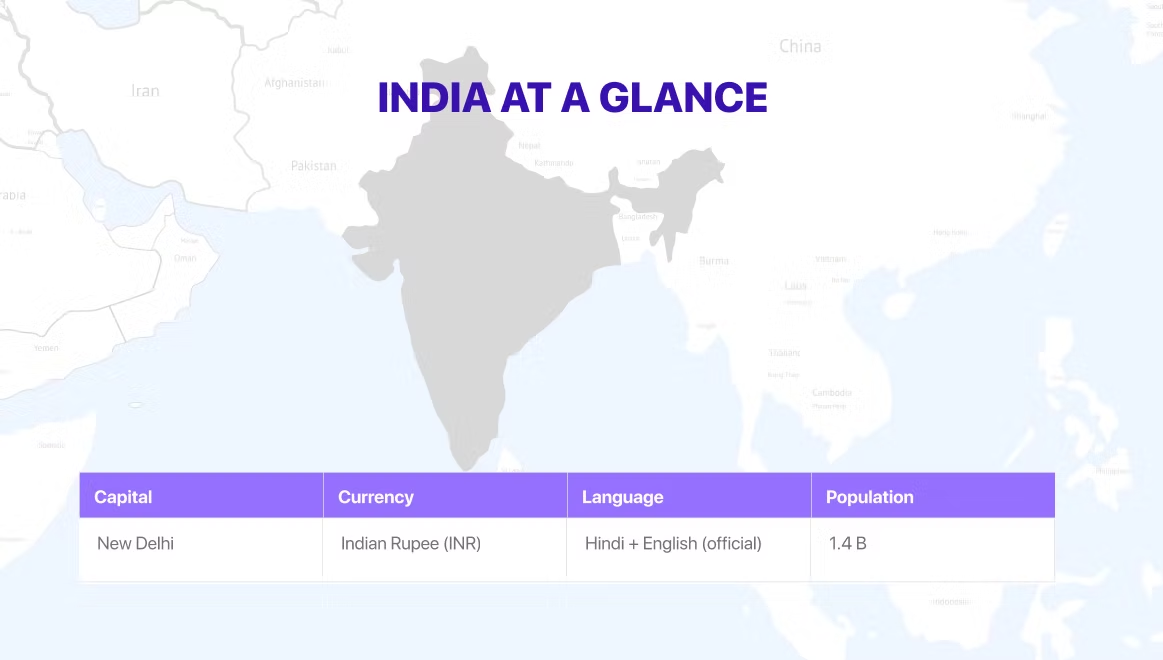
This is the single most important fact for enterprise buyers to understand upfront: India allows EOR-based employment, but not all visa categories can be sponsored through a third-party employer of record.
The General Rule
India's primary work authorization for foreign nationals is the Employment Visa (E Visa). This visa requires sponsorship from a registered Indian company, which an EOR with a wholly-owned Indian entity can provide. Unlike some jurisdictions (notably Singapore, which as of 2024 does not permit EORs to sponsor work visas), India does permit a qualified EOR to act as the legal employer and visa sponsor for eligible foreign nationals.
The E Visa Categories Where EORs Can Operate
A qualified employer of record in India, one with its own registered Indian legal entity, can sponsor Employment Visas for foreign professionals assigned to work in India for a client company. This is the standard mechanism for international intra-company transfers, senior placements, and specialized technical deployments.
Where Restrictions Apply
However, India's Ministry of Home Affairs (MHA) imposes important category-level restrictions:
- Project Visas (for power and steel sector projects) must be tied to specific projects and specific employer entities. These are not transferable to a generic EOR structure.
- Intra-Company Transfer Visas (E-2 category) require documented organizational relationships between the foreign national's overseas employer and the Indian sponsoring entity.
- Business Visas (B Visa) do not permit salaried employment of any kind. A foreign national on a Business Visa cannot legally receive an Indian salary or engage in ongoing work for an Indian employer, EOR, or otherwise.
The Key Enterprise Takeaway
Before relying on an EOR for visa sponsorship in India, enterprises must conduct proper due diligence:
- Verify that the EOR holds a wholly-owned, legally registered Indian entity (not a third-party subcontractor arrangement).
- Confirm the EOR has prior immigration approval records in India, not just a generic global presence.
- Establish that the specific visa category your hire requires is compatible with EOR sponsorship.
Generic global EOR platforms that rely on local subcontractors in India introduce a layer of legal complexity that can undermine both timelines and compliance standing.
Thing 2: The Employment Visa Has Non-Negotiable Eligibility Thresholds

Understanding what it means to require sponsorship for employment in India means understanding that India's Employment Visa is not available to all foreign workers; it is explicitly reserved for skilled, senior, or specialized roles that meet minimum compensation standards.
Minimum Salary Requirement
The Employment Visa carries a mandatory minimum salary threshold of USD $25,000 per annum (approximately INR 16.25 lakhs per year as of current exchange rates). This is a hard floor, not a guideline. Allowances, in-kind benefits, and non-cash perquisites may be counted toward this threshold in certain circumstances, but the base cash salary component must generally meet or approach this level.

Exceptions to the salary floor include:
- Ethnic cooks
- Foreign language teachers and interpreters (excluding English teachers)
- Volunteers working with registered NGOs
- Certain embassy and high commission staff
- Teaching faculty at the level of Assistant Professor and above at designated central higher education institutions (IITs, IIMs, NITs, Central Universities, IISERs), for whom a reduced threshold of INR 9.10 lakhs per annum applies
For most enterprise hires, engineers, IT architects, senior managers, and finance professionals, the $25,000 USD threshold is the operative benchmark.
Skilled Role Requirement
Beyond salary, India's Employment Visa framework requires that the sponsored role be demonstrably skilled. Routine, clerical, or administrative positions do not qualify, regardless of the candidate's qualifications or the employer's preferences. The Indian government's baseline expectation is that a foreign national being brought into the country for work is filling a position that could not be readily filled by an Indian national.
This means enterprise HR teams must:
- Document the specialized nature of the role in precise detail
- Confirm that the compensation package meets the threshold (including clarity on perquisites)
- Avoid using Employment Visas for roles that are essentially administrative, clerical, or entry-level in nature
What "Require Sponsorship for Employment" Means in Practice
When a candidate's profile indicates they "require sponsorship for employment" in India, it means they are a foreign national who needs an Indian entity to formally petition the MHA on their behalf, issue a compliant employment contract, and assume ongoing legal responsibility for their status. An EOR that operates through a registered Indian entity can fulfill all of these functions, provided the role and the compensation qualify.
Thing 3: EOR Visa Sponsorship in India Is a Structured, Multi-Stage Process

EOR-sponsored visa processes are not single-step transactions. They follow a structured lifecycle, and enterprises that underestimate the timeline and documentation requirements are routinely caught off guard. Understanding the full process is essential for workforce planning and offer letter management.
Stage 1: Pre-Hire Feasibility Assessment
Before any offer is extended, a competent employer of record services in India provider will conduct a visa feasibility check. This involves verifying:
- Whether the candidate's role and compensation qualify for an Employment Visa
- Whether the candidate's nationality presents any additional documentary requirements or processing delays
- Whether the engagement model (project-based, long-term, intra-company transfer) aligns with available visa categories
Skipping this step is one of the most common and costly mistakes enterprise buyers make.
Stage 2: Employer-Side Document Preparation
The EOR, as the legal employer, must prepare and gather a substantial documentation set, typically including:
- Certificate of Incorporation of the Indian sponsoring entity
- PAN (Permanent Account Number) registration details
- Proof of active business operations (financial records, sector-specific licenses)
- A formal employment contract or appointment letter detailing role, compensation, location, and duration
- A sponsorship undertaking letter confirming the employer's obligations under Indian immigration law
- A repatriation guarantee, a commitment to bear the cost of the employee's return if they violate visa conditions
Stage 3: Employee-Side Document Submission
The foreign national must independently compile and submit:
- Valid passport (minimum six months' validity beyond intended stay)
- Completed visa application form submitted to the Indian Embassy or Consulate in their home country
- Educational qualifications and professional certificates (often requiring apostille verification)
- Resume/CV detailing relevant experience aligned to the sponsored role
- Photographs meeting Indian consulate specifications
Stage 4: Embassy or Consulate Processing
The visa application is submitted at the Indian Embassy or Consulate in the applicant's home country. Indian immigration authorities then verify the employer's credentials, confirm the role's legitimacy, and assess the candidate's qualifications. Standard processing time, when documentation is complete and in order, is approximately one week, though timelines vary by nationality, diplomatic mission, and application volume.
Stage 5: FRRO Registration Post-Arrival
This is where many enterprises, and their employees, fall down. Foreign nationals who receive an Employment Visa valid for more than 180 days are legally required to register with the Foreigners Regional Registration Office (FRRO) within 14 days of arrival in India. As of late 2025, this process is primarily conducted through India's e-FRRO portal, which integrates with the Bureau of Immigration's Integrated Immigration Management System.
FRRO registration is not optional, and the consequences of non-compliance are severe, including fines, visa cancellation, and restrictions on future entry. The registration certificate is also a practical necessity: it is required to open a bank account, obtain a PAN card, and establish a local mobile connection.
An EOR providing employer of record services in India should manage FRRO coordination as part of its immigration support package, including tracking renewal deadlines and filing obligations as employment continues.
Stage 6: Ongoing Compliance Management
Once the foreign national is in India, the sponsoring employer's obligations do not end. Key ongoing duties include:
- Withholding and remitting Tax Deducted at Source (TDS) in accordance with Indian income tax law
- Reporting any change in the employee's job title, salary, or residential address to the FRRO within 14 days
- Managing Employment Visa renewals (initial validity is up to one year; renewals can be granted annually by the FRRO for up to five years from initial issue)
- Monitoring EPF (Employees' Provident Fund) obligations for international workers, including checking for applicable Social Security Agreements (SSAs) to avoid double contributions
Thing 4: EOR Services in India Deliver Distinct Compliance and Speed Advantages Over Direct Sponsorship
For enterprises evaluating whether to establish a direct Indian entity or use an EOR provider in India for visa sponsorship, the comparison comes down to three dimensions: speed, compliance burden, and risk exposure.
Speed-to-Market
Incorporating a subsidiary in India through the Ministry of Corporate Affairs typically takes two to six weeks for the registration process alone, before any visa sponsorship activities can begin. An EOR with an established Indian entity can begin onboarding and immigration proceedings within days of candidate acceptance. For enterprises deploying talent on a project timeline, this difference is material.
Compliance Architecture
India's employment law is not a single federal framework. It is a layered system of national labor codes (including the four major Labor Codes currently being phased in), state-specific regulations, the Shops and Establishments Acts (which vary by state), and sector-specific requirements. A reputable employer of record services provider in India maintains in-market legal counsel and compliance expertise across this full regulatory landscape.
This matters especially for visa compliance, where:
- Salary payments must consistently meet the Employment Visa minimum threshold
- Changes in role, title, or compensation must be reported to immigration authorities
- The employer must maintain ongoing documentation of the foreign national's work activities as they relate to the visa category
Non-compliance carries serious consequences: fines and penalties for the employer, visa cancellation and deportation risk for the employee, and, critically, blacklisting of the company from future visa sponsorship, which can permanently impair an enterprise's ability to hire foreign talent in India.
Risk Allocation
When an enterprise sponsors an Employment Visa directly, it assumes all immigration liability. When an enterprise engages an employer of record in India, the EOR assumes legal employer status and the associated compliance liability. The enterprise retains operational direction of the employee's work, but the legal and regulatory obligations rest with the EOR.
This risk allocation model is particularly valuable in a jurisdiction like India, where regulatory complexity and enforcement intensity are high and growing.
EOR vs. Direct Entity: A Decision Framework
| Factor | Direct Indian Entity | EOR India |
| Setup Timeline | 2–6 weeks (entity only) | Days (if EOR already registered) |
| Upfront Cost | High (legal, registration, compliance infrastructure) | Subscription-based; typically $199–$599/employee/month |
| Visa Sponsorship Capability | Full (once registered) | Full (for eligible visa categories) |
| Ongoing Compliance Burden | High (requires local legal counsel) | Managed by EOR |
| Risk Exposure | Enterprise bears all liability | Split; EOR bears employment compliance liability |
| Ideal For | Long-term India presence; 10+ employees; entity economics justify | Market entry; project-based; 1–10 employees; testing India |
Thing 5: India's Visa Framework Is Evolving, and Enterprise Buyers Must Stay Current
India's immigration and employment law landscape is undergoing significant modernization, and EOR services in India must evolve alongside it. Enterprise buyers who rely on outdated frameworks risk compliance failures in a regulatory environment that is tightening, not loosening.
The 2025 Immigration and Foreigners Act
Effective in late 2025, India consolidated over a century of overlapping immigration statutes, including the colonial-era Foreigners Act, into a single, unified framework under the Immigration and Foreigners Act. This legislation centralized entry, stay, movement, and enforcement rules under one mandate, replacing the fragmented prior system.
The practical impact for enterprise employers:
- Digital compliance is now mandatory. The e-Arrival Card, operational from October 1, 2025, replaced all paper-based arrival forms. Foreign nationals are required to complete this digital protocol within 72 hours before departure to India.
- Real-time residence monitoring has intensified. The e-FRRO system now enables more proactive tracking of foreign nationals' registration status.
- Enforcement activity has increased. The unified framework gives Indian immigration authorities clearer statutory grounds for enforcement action against non-compliant employers.
The e-B-4 Visa: A New Category for Production-Led Investment
In December 2025, the Government of India operationalized a dedicated online module for the e-B-4 Visa (Production Investment Business Visa), enabling eligible Indian companies to digitally generate sponsorship letters for foreign professionals involved in production-linked activities — including installation and commissioning of plant and machinery, quality assurance, testing, and essential maintenance.
This reform replaced the prior e-PLI business visa and reflects India's broader industrial policy ambitions. For enterprises in manufacturing, infrastructure, and supply chain sectors, this new category creates additional options for short- to medium-term technical deployments that previously had to route through the standard Employment Visa framework.
An EOR with deep India expertise should be fluent in this new category and capable of advising enterprises on when it applies and how to use it.
The 2026 Labor Codes
India's four consolidated Labor Codes, on Wages, Industrial Relations, Social Security, and Occupational Safety, are being operationalized progressively, with 2026 marking a critical implementation period. Key provisions affecting enterprise employers include:
- A 50% basic wage requirement: At least 50% of an employee's total compensation must be structured as basic wage, which directly impacts the calculation of PF contributions, gratuity accruals, and other statutory benefits
- Expanded social security liabilities: The new framework broadens the categories of workers entitled to ESI and EPF coverage, potentially including some categories of foreign nationals or contractors previously outside the scheme
These changes require a total recalibration of compensation structures for anyone operating in India, and they affect the total employer cost model for enterprises using EOR services.
DACA Employer Sponsorship: A Note on Jurisdictional Boundaries
One question that sometimes arises in U.S.-headquartered enterprises is whether DACA employer sponsorship dynamics apply in the Indian context. They do not; DACA is a U.S.-specific immigration program for individuals brought to the United States as children. It has no parallel in India's immigration framework. However, the underlying concept, that employers assume formal legal responsibility for a foreign national's authorization to work, maps directly onto India's Employment Visa sponsorship model, making EOR expertise all the more valuable for enterprises navigating both geographies.
How to Choose the Right EOR Partner for India Visa Sponsorship
Not all EOR services in India are equal. For enterprises making this decision, the following criteria distinguish credible providers from generic platforms:
- Wholly-owned Indian legal entity. Some global EOR platforms use local subcontractors to manage employment in India. This model introduces additional legal risk and slower processing. Confirm that your EOR operates through its own registered Indian subsidiary.
- Active immigration legal counsel in-market. EOR-sponsored visa processes require real expertise in Indian immigration law — not just a compliance checklist. Your EOR should maintain immigration counsel who engage directly with Indian consulates, the FRRO, and the MHA.
- State-level compliance coverage. India's labor regulations vary significantly across its 28 states and 8 Union Territories. An EOR that handles payroll compliance only in major metropolitan areas may create exposure for talent placed in other locations.
- Documented immigration approval history. Before committing, ask for the EOR's Employment Visa approval rate and average processing timeline in India. Past performance is a meaningful indicator of capability.
- End-to-end immigration lifecycle management. The best employer of record services India providers handle not just initial visa applications but ongoing renewals, FRRO coordination, address change reporting, and proactive alerts ahead of expiry dates.
- Labor Code transition readiness. Given India's ongoing consolidation of labor law under the four new Codes, your EOR must demonstrate that its payroll and compliance infrastructure is aligned with both current requirements and upcoming obligations.
Conclusion
EOR-sponsored visas in India offer global enterprises a legitimate, efficient, and compliant pathway to deploying foreign talent, without the months-long process of incorporating a local subsidiary. But India is not a jurisdiction where a generic global EOR platform and a template compliance approach will suffice.
To recap the five critical things to know:
- India allows EOR employment, but restricts specific visa categories. Due diligence on your EOR's entity structure and visa category compatibility is essential.
- The Employment Visa has non-negotiable eligibility thresholds, a minimum salary of $25,000 USD per year and a demonstrably skilled role are both mandatory.
- The sponsorship process is structured and multi-stage, from pre-hire feasibility through FRRO registration and ongoing compliance; each step carries real obligations.
- EOR services deliver genuine speed and compliance advantages over direct entity sponsorship, particularly for enterprises testing the market or deploying small, specialized teams.
- India's visa and labor framework is actively evolving; the 2025 Immigration Act, the e-B-4 Visa, and the 2026 Labor Codes all require partners with current, in-market expertise.
Enterprises that choose their employer of record services India partner carefully, verifying entity structure, immigration track record, and regulatory fluency, will find that EOR-sponsored visa sponsorship is not just a workaround. It is a strategic foundation for compliant, scalable growth in one of the world's most consequential talent markets.
Frequently Asked Questions
Can an EOR sponsor an Employment Visa in India?
Yes. An EOR with a wholly-owned, legally registered Indian entity can sponsor an Employment Visa on behalf of a foreign national hired by a client enterprise. The EOR acts as the legal employer on all official documentation, including the visa application.
What is sponsorship for employment in India?
It is the formal legal process by which a registered Indian employer petitions immigration authorities to authorize a foreign national to work in India. The sponsoring employer issues a compliant employment contract, assumes legal responsibility for the employee's compliance with visa conditions, and guarantees repatriation if necessary.
What does it mean when a candidate "requires sponsorship for employment"?
It means the candidate is a foreign national who cannot legally work in India without a registered Indian employer petitioning for an Employment Visa on their behalf. The employer, or an EOR acting as the legal employer, must initiate and support the visa application process.
What is the minimum salary for an Employment Visa in India?
The minimum salary threshold is USD $25,000 per annum (approximately INR 16.25 lakhs), with limited exceptions for specific roles including NGO volunteers, foreign language teachers, and ethnic cooks.
How long does EOR-sponsored visa processing take in India?
When documentation is complete, the Employment Visa typically processes in approximately one week at the Indian Embassy or Consulate. End-to-end timelines, from candidate acceptance to work commencement, typically range from two to six weeks, depending on nationality, documentation readiness, and diplomatic mission workload.
What happens if FRRO registration is missed?
Non-registration is a serious compliance violation. Consequences include fines for both the employer and employee, potential visa cancellation, deportation risk, and restrictions on future visa applications. An EOR managing immigration compliance should proactively track and support FRRO registration for all sponsored employees.
How much do EOR services in India cost?
EOR pricing in India typically starts at approximately $199 per employee per month for standard services, rising to $599 or more for comprehensive enterprise packages. High-end bespoke solutions may reach $800+ per employee per month. These fees do not include statutory employer contributions such as PF (12%), ESI, and gratuity accruals, which are mandatory regardless of the employment model.
.svg)


