


Employer of Record (EOR) in 2026: The Complete Hiring Guide
TL;DR
The way companies build international teams has changed. Permanently.
If you are planning to hire talent in Georgia, Armenia, Turkey, India, or Kazakhstan, you already know the challenge: you need people fast, local compliance is complex, and setting up a legal entity in each country takes months and costs a lot. That is exactly why employer of record services have gone from a niche workaround to the default hiring infrastructure for expansion-minded companies worldwide.
This guide explains exactly how EOR works in 2026, what it costs, what it covers, and what you need to know market by market before you make your next hire.
Tabe of contents:
- TL;DR
- What Is an Employer of Record? The EOR Meaning, Explained
- How an Employer of Record Works: The Full Hiring and Compliance Model
- EOR vs Setting Up a Local Entity: Cost, Time, and Compliance Comparison
- What EOR Covers: Payroll, Compliance, and Visa Sponsorship
- Why Emerging Markets Are Driving EOR Growth in 2026
- EOR by Region: What You Need to Know Before You Hire
- EOR vs. PEO vs. Contractor: Picking the Right Model
- How to Choose an EOR Service Provider
- Frequently Asked Questions
- Ready to Hire in Your Target Market?
What Is an Employer of Record? The EOR Meaning, Explained
An Employer of Record (EOR) is a third-party company that becomes the legal employer of your staff in a given country. Your employee works for you in every practical sense, you set their tasks, manage their time, and drive their performance. The EOR handles everything on the legal and administrative side: employment contracts, payroll, tax filings, benefits, and compliance with local labour law.
You do not need to open a subsidiary. You do not need a local bank account or a registered entity. The EOR already has all of that. They absorb the legal employer status, so you can focus on actually running your team.
Here is why 2026 is a turning point. According to a March 2026 survey by Atlas HXM of 425 senior HR, legal, and finance leaders, 54% of organisations now use or plan to use an EOR, surpassing both fully owned entities and independent contractor arrangements as the preferred hiring model. The EOR market itself is valued at roughly $5.97 billion this year and is projected to reach over $10 billion by 2035.
The numbers tell a clear story. 65% of companies use EOR to reduce compliance risk. 63% use it to cut the cost of market entry. And 51% cite access to global talent as the core driver.
The model has moved into the mainstream. If you are building an international team and you are not already thinking about EOR, your competitors probably are.

How an Employer of Record Works: The Full Hiring and Compliance Model
A lot of confusion around EOR comes from mixing up who controls what. Here is the clean version.
What the EOR owns:
- The employment contract (signed between the EOR and your employee)
- Payroll processing and tax remittances in local currency
- Statutory benefits (annual leave, sick pay, pension contributions)
- Work permit and visa sponsorship, where applicable
- Compliance with local labour codes and mandatory filings
What you keep:
- Day-to-day management of the employee
- Role definition, performance targets, and project direction
- Hiring decisions (you select the candidate; the EOR formalises the hire)
- Offboarding decisions (with EOR guidance on local notice and severance rules)
When you hire through an EOR, the typical timeline looks like this: you identify the candidate, agree on compensation, share the details with your EOR, and the EOR issues a compliant employment contract within days. Payroll starts immediately. The employee is covered from day one.
One distinction worth knowing: there are two types of EOR models in the market. The aggregator model (about 68% of the market) uses local affiliate partners in each country. The wholly owned infrastructure model means the EOR operates its own registered entity in every market it covers. For high-stakes compliance work, especially in markets like Azerbaijan or Kazakhstan, where immigration rules are strict, the wholly owned model is significantly more reliable. You are dealing directly with one accountable legal entity, not a chain of local subcontractors.
EOR vs Setting Up a Local Entity: Cost, Time, and Compliance Comparison
This is where most founders and HR leaders underestimate the gap.
Entity Setup Costs vs EOR Pricing
Setting up a legal entity in a new country typically costs between $20,000 and $250,000, depending on the jurisdiction, accounting for registration fees, legal counsel, capital requirements, local director mandates, and bank account setup. That is before you account for ongoing annual compliance costs of $30,000–$80,000 per country, per year.
The timeline is just as punishing. Entity registration in most markets takes three to nine months. In some countries,, Indonesia, for example, it can stretch further due to multiple Ministry approvals.
EOR flips both of those numbers.
| Factor | Entity Setup | EOR |
| Upfront cost | $20,000–$250,000+ | $0 |
| Ongoing annual compliance | $30,000–$80,000 | Included in per-employee fee |
| Time to first hire | 3–9 months | 1–4 weeks |
| Legal liability | Yours entirely | Shared/absorbed by EOR |
| Exit flexibility | High cost, 6–12 months to wind down | Cancel with standard notice |
| EOR monthly fee per employee | — | $200–$600 (regional variation) |
The crossover point, where entity setup becomes more economical than EOR, is typically around 10 or more employees in a single country, and only when you have a long-term, committed presence in that market. Below that threshold, EOR wins on cost, speed, and risk almost every time.
What EOR Covers: Payroll, Compliance, and Visa Sponsorship
A strong EOR is not just a payroll processor. Here is the full scope of what a quality employer of record service handles.
Employer of record payroll
Salaries paid in local currency on the correct local cycle. Tax withholdings are calculated and remitted to the relevant tax authority. Pension, social security, and statutory deductions are handled automatically. Currency risk managed by the EOR, not by you.
Employment contracts
Drafted in the local language where required. Compliant with the country's labour code, including mandatory clauses for probation, notice periods, overtime, and termination. Updated automatically when laws change.
Statutory benefits
Annual leave, sick pay, maternity/paternity leave, and mandatory health insurance are administered according to local law. In markets like Armenia, for example, mandatory health insurance contributions of approximately $28 per employee per month became legally required from 2026, a requirement many foreign companies would miss without local expertise.
Work permit and visa sponsorship
This is where EOR creates real leverage for companies without a local entity. To sponsor a work visa in most countries, the sponsoring company must be a registered legal employer. An EOR already is. They can act as the legal sponsor on immigration filings — handling the paperwork, tracking renewals, and managing compliance with immigration authorities directly.
For a detailed breakdown of how this works country by country, see our guide on work permits and visa sponsorship by region and our dedicated article on EOR-sponsored visas for enterprise businesses.

Why Emerging Markets Are Driving EOR Growth in 2026
The traditional EOR story was about North America and Western Europe, mature markets with established compliance frameworks and high contractor misclassification risk. That story is changing.
Emerging economies accounted for 50% of cross-border hires in 2025, a trend accelerating into 2026. Companies are moving toward Southeast Asia, Eastern Europe, India, and the MENA region to access talent pools that are deep, technically skilled, and significantly more cost-competitive than Western markets.
The Asia-Pacific region is growing at an 11.3% CAGR in EOR adoption through 2035. India alone has 5.4 million technology professionals. The Caucasus — Georgia, Armenia, Azerbaijan, is emerging as a high-value tech and operations hub. Kazakhstan and Uzbekistan are opening up to international investment and bringing talent markets with them.
There is a second driver: compliance complexity. Cross-border employment compliance concerns increased by 29% year-over-year as countries tighten immigration frameworks, update labour codes, and introduce digital reporting requirements. The complexity is not an obstacle to EOR adoption, it is the engine behind it. 86% of HR leaders cite international labour-law compliance as their top challenge. EOR is the direct answer.
One more thing worth saying plainly: immigration uncertainty is not slowing expansion down. According to Atlas HXM's 2026 report, 68% of organisations say changing immigration policies is accelerating their hiring decisions, not delaying them. Companies are moving faster, not slower, precisely because the rules keep shifting and they need a partner who keeps up.
EOR by Region: What You Need to Know Before You Hire
This is where generic EOR guides fall short. What works in one country does not transfer to the next. Here is what decision-makers actually need to know, market by market.
Employer of Record Georgia

Georgia has historically been one of the most accessible entry points for foreign companies in the Caucasus, no work permit was required for most foreign workers, and visa-free entry covered many nationalities for extended stays.
That changed in 2026. Starting March 1, 2026, a Special Labour Permit is now mandatory for foreign workers before they can apply for a residence permit or D1 visa. Employers who skip this step face a 2,000 GEL fine per employee and per employer. Working under a tourist visa is no longer a legitimate path to employment.
For foreign companies hiring remote or relocated employees in Georgia, the process now requires the hiring entity to be registered and active in the country. An EOR with an owned Georgia entity takes care of the full sequence: work permit sponsorship, residence permit applications, and payroll from day one.
Team Up's Georgia EOR service starts at €199 per employee per month, covering payroll, employment contracts, and compliance infrastructure. Compared to the cost of a missed permit filing or a delayed hire, that is straightforward math.
For companies thinking about relocating employees to Georgia, see also our guide on relocation legal requirements in Georgia and what employer sponsorship in Georgia actually involves, step by step.
Employer of Record Armenia

Armenia is becoming a go-to destination for tech hiring, with a growing GDP, a well-educated workforce, and a fast-expanding startup ecosystem. The labour environment is structured and manageable, but 2026 brought meaningful changes.
From January 1, 2026, all new employment contracts, amendments, and terminations must be executed through the State Revenue Committee's (SRC) unified digital platform using electronic signatures. Paper contracts must be digitised by the end of the year.
Payroll in Armenia involves a flat 20% income tax, tiered pension contributions (5%–10%, capped at AMD 87,500 monthly), and, new from 2026, mandatory health insurance withholding of approximately $28 per employee per month. Minimum wage is AMD 75,000, rising to AMD 85,000 in 2026.
Work permits for foreign nationals require a combined work and residence permit through the Migration and Citizenship Service's digital platform. Key exemptions exist for EAEU nationals (Russia, Belarus, Kazakhstan, Kyrgyzstan) and certain highly skilled specialists. From August 2026, employees must enter on a Work Visa to apply for residence, switching status from tourist entry is no longer permitted.
Employer of Record Azerbaijan

Azerbaijan has the most stringent work authorisation regime in the Caucasus. No foreigner can work here without prior authorisation, full stop. Even short-term assignments require both a work permit and a residence permit.
There are no informal workarounds. Companies that attempt to use contractor arrangements or tourist-status employment will face enforcement, not just fines. The government actively audits foreign worker compliance.
The practical answer for companies that want to hire in Azerbaijan without owning a local entity is an EOR provider in Azerbaijan with an active, registered presence in the country. The EOR acts as the legal sponsor, handles the full permit sequence, and owns the compliance exposure. For more on this, see our relocation and legal requirements guide for Azerbaijan.
Employer of Record Turkey

Turkey is a high-potential market, the largest economy in the region, a young and technically capable workforce, and strong connectivity to both European and MENA markets.
Hiring through an EOR in Turkey means operating within a labour code that caps working hours at 45 per week, mandates 14 public holidays, and requires severance pay of one month's gross salary per year of service for employees with at least one year of tenure. Fixed-term contracts are capped at roughly one year and convert to indefinite contracts after two renewals.
One notable constraint: C-suite titles (CEO, CFO, and equivalents) are generally not possible through the EOR model in Turkey. For senior leadership roles, you will need a local entity or an alternative structure.
Employer sponsorship in Turkey for foreign employees requires a registered entity to act as a sponsor. See our guide on employer sponsorship in Turkey for the full process.
Employer of Record India

India is one of the most important EOR markets in the world. The talent pool is enormous, 5.4 million technology professionals, with dominant hubs in Bengaluru, Hyderabad, Pune, and Chennai. For U.S. and European companies, hiring in India through an EOR has become the direct alternative to the H1B visa route, faster, cheaper, and with zero lottery risk.
The numbers make the case clearly. H1B sponsorship costs $12,000–$20,000 per employee in filing and legal fees, with a 12–18 month timeline and a sub-25% lottery selection rate. EOR in India typically runs $500–$700 per employee per month in management fees, with a senior engineer fully onboarded within days, earning $2,000–$3,500 per month at local market rates.
Payroll compliance in India involves Provident Fund (PF) and ESIC contributions, gratuity accrual, leave and attendance management, and statutory reporting to Indian authorities. For companies hiring more than a handful of engineers, the full HR outsourcing overlay, background verification, onboarding support, and HR policy documentation are typically bundled with the EOR engagement.
For foreign nationals working in India, the government requires a minimum annual salary of approximately $25,000 to qualify for a work visa.
Employer of Record Kazakhstan
Kazakhstan is an underappreciated market. A growing technology sector, strong education system, and competitive salaries make it an increasingly attractive option for companies building Central Asian teams.
The compliance environment, though, rewards preparation. Kazakhstan operates a quota system for foreign workers, known informally as the 90/10 rule, requiring that for every foreign employee, approximately nine local employees are on the payroll in relevant categories. Before a work permit can be requested, the employer must advertise the vacancy domestically for 15 days to demonstrate that no qualified local candidate was available.
These are not insurmountable requirements. They are planning requirements. An EOR in Kazakhstan handles the local job posting, quota documentation, and permit applications as a standard part of their process. A company without that local infrastructure would not know the sequence until it had already lost weeks.
Employer of Record Uzbekistan

Uzbekistan is earlier in its opening to foreign investment, but it is moving. The labour market is young and growing, and the government is actively attracting international business.
Work authorisation for foreign nationals requires the employer to first obtain a Corporate Work License (valid 6–12 months), conduct a labour market test, and then apply for work permits and E Visas. Processing can take up to three months. Fees include approximately $810 for the work permit, $161 for the E Visa, and $30 for the Corporate Work License.
Without a registered entity in Uzbekistan, a company cannot sponsor this process. An EOR absorbs that entity requirement and manages the full sequence. For companies testing the market with initial hires, EOR is the only realistic path to legal, compliant employment.
EOR vs. PEO vs. Contractor: Picking the Right Model
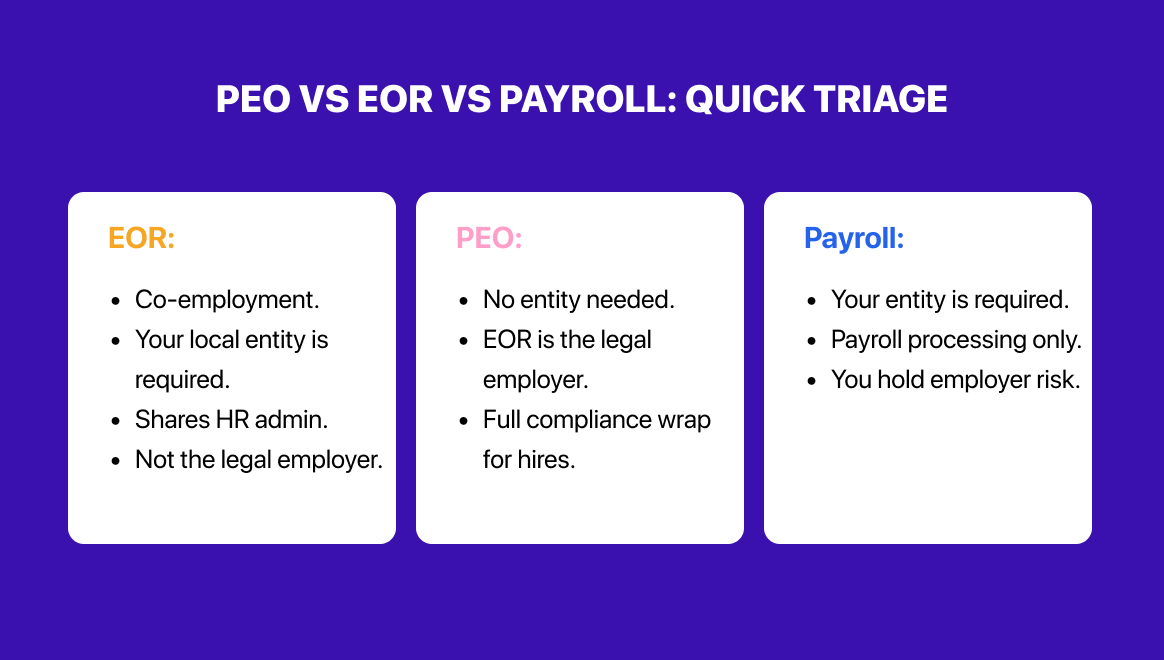
Three models dominate international hiring conversations. Here is how to think about each one clearly.
Employer Of Record Services
The EOR is the legal employer. You do not need your own entity in the country. The EOR holds the employment contract, runs payroll, and is legally responsible for compliance. Best for: market testing, fast expansion, countries where you have fewer than 10 employees, and anywhere compliance complexity is high.
What Is A PEO
A PEO co-employs your workers. You share the employer status with the PEO, but critically, you must already have a registered entity in the country. The PEO cannot replace that requirement. Best for: companies that already have a local entity and want to outsource HR administration without relinquishing control.
Independent Contractors
Contractors are self-employed. No benefits, no employer payroll taxes, and faster to engage. The risk: misclassification. If the relationship looks like employment, ongoing work, set hours, exclusive relationship, tax authorities in most countries will treat it as employment, and you will face back taxes, penalties, and legal exposure. An EOR eliminates misclassification risk entirely because the employment relationship is properly established from day one.
The right path usually depends on three questions: Do you already have an entity there? How many people are you hiring? And how long do you plan to stay?
How to Choose an EOR Service Provider

The EOR market has over 150 active providers globally. Not all of them are equivalent. Here is what to look at before you sign anything.
Owned entities vs. aggregator model
Ask directly: Does the provider own a registered entity in the countries you care about, or do they use local partners? Aggregators can cover more countries on paper, but if your Kazakhstan hire is managed by an affiliate you have never met, your compliance exposure is real. An EOR with owned entities has full accountability and direct relationships with local immigration authorities.
In-country legal and HR expertise
Does the team in that country speak the language, bureaucratically, not just literally? Can they tell you what changed in Georgia's labour law in March 2026? Can they walk you through Armenia's SRC digital contract platform? Local expertise is not a marketing point. It is a compliance requirement.
Proactive compliance planning
Labour laws change. Immigration requirements update. A good EOR does not wait for you to ask; they flag changes before they affect your employees. Ask any provider: how did you communicate Georgia's new Special Labour Permit requirement to clients? The answer will tell you a lot.
Transparent pricing
EOR fees across the market range from roughly $199 to $800+ per employee per month, depending on the country and service scope. Premium pricing is not always better. What you want is a provider that can tell you exactly what is included, what is not, and what triggers additional costs.
Visa sponsorship capability
If you are hiring foreign nationals or planning employee relocation, not every EOR can sponsor visas in every country. Verify their immigration track record in your specific markets. For enterprise-level expansion involving multiple relocations.
Frequently Asked Questions
What does it mean to require sponsorship for employment?
When a job posting says it requires sponsorship for employment, it means the candidate needs the employer to formally sponsor their work visa or permit. Without a registered legal entity in the country, or an EOR acting as that entity, a company cannot provide this sponsorship.
What is employer sponsorship, and how does it work through an EOR?
Employer sponsorship means a company takes legal responsibility for a foreign national's right to work in a country. Through an EOR, this works because the EOR already holds a registered entity and active tax and payroll presence in the target country. The EOR files the permit application, acts as the legal sponsor on immigration documents, and remains responsible for ongoing compliance.
Do I need sponsorship for employment if I hire through an EOR?
If your employee is a local national in the country where you are hiring, no work permit sponsorship is typically required. If you are relocating a foreign national to that country, yes, work authorisation is needed, and the EOR handles the sponsorship process on your behalf.
What is the difference between global EOR services and local EOR?
A global EOR operates across multiple countries under one platform, making it easier to manage distributed teams. A local EOR specialises in one or a few markets and often offers deeper compliance expertise in those specific countries. For expansion into complex emerging markets, Caucasus, Central Asia, MENA, a regional specialist with owned entities consistently outperforms a global aggregator on compliance quality and response time.
How much do employer of record services cost?
Regional EOR services typically start at $199–$300 per employee per month for markets like Georgia. Global platforms tend to run $400–$800+ per employee per month. Entity setup, by comparison, costs $20,000–$250,000 upfront and $30,000–$80,000 annually in ongoing compliance. For companies with fewer than 10 employees in a given market, EOR is almost always more cost-effective.
Ready to Hire in Your Target Market?
Team Up operates owned legal entities across Georgia, Armenia, Azerbaijan, Turkey, India, Kazakhstan, Uzbekistan, and Egypt, giving you direct, reliable access to compliant hiring in the markets that matter most for your expansion.
No aggregator model. No guessing at local compliance. A real team, in-country, who knows the rules and keeps you ahead of them.
.svg)


