


5 Things to Know About EOR-Sponsored Visas in Eastern Europe: Enterprise Guide
Introduction
Warsaw. Bucharest. Prague. Krakow. Cluj-Napoca. These aren't just emerging cities on a travel map, they're active global hiring hubs where enterprise teams are building engineering squads, shared services centers, and regional headquarters.
Eastern Europe's value proposition for international employers is compelling: deep talent pools, strong STEM education systems, competitive costs relative to Western Europe, and time zones that work with both the US and Asia. Poland alone is home to over 300,000 software developers. Romania ranks among Europe's fastest-growing tech markets. The Czech Republic has one of the lowest unemployment rates in the entire EU, under 3%, which tells you something about the quality of its workforce.
But here's the nuance most enterprise teams miss until it slows them down: EOR-sponsored visas in Eastern Europe are not plug-and-play. Hiring a non-EU national to work in Poland is a fundamentally different legal process from hiring one in Romania, which differs again from the Czech Republic. The countries share a region and some cultural touchpoints. Their immigration frameworks are distinct, and right now, several are in active reform.
If you're planning to hire in Eastern Europe and you need to bring in foreign talent — whether that's a US national moving to Warsaw, a Georgian engineer relocated to Bucharest, or a specialist from outside the EU deployed to Prague, you need a clear picture of what employer sponsorship actually means in each country, what's changing, and what an EOR can and cannot do on your behalf.
This is that picture. No padding. All signal.

What Is EOR Visa Sponsorship, and Why Does It Matter Here?
Let's nail the definition before we go country-by-country.
What is sponsorship for employment? In Eastern Europe, it means a legally registered local company — either your own subsidiary or an Employer of Record acting on your behalf- formally petitions immigration authorities to authorize a foreign national to work in that country. The sponsor issues the employment contract, takes legal responsibility for the employee's compliance with visa and residency conditions, and assumes ongoing obligations: payroll tax compliance, reporting changes, and permit renewals.
What does it mean when a candidate says they "require sponsorship for employment"? It means they are a non-EU national who cannot legally work in Poland, Romania, the Czech Republic, or any other EU member state without an employer filing for authorization on their behalf. Many EU countries allow non-EU nationals to enter visa-free for 90 days, but entering and having the right to work are two completely different legal statuses.
Here's the fundamental challenge for international enterprises: you need a local legal entity to sponsor. If you don't have a registered company in Poland, you can't apply for a Polish work permit. If you don't have a Romanian entity, you can't initiate a Romanian work authorization. The immigration system is built around local employers.
That's exactly where an Employer of Record (EOR) enters the picture.
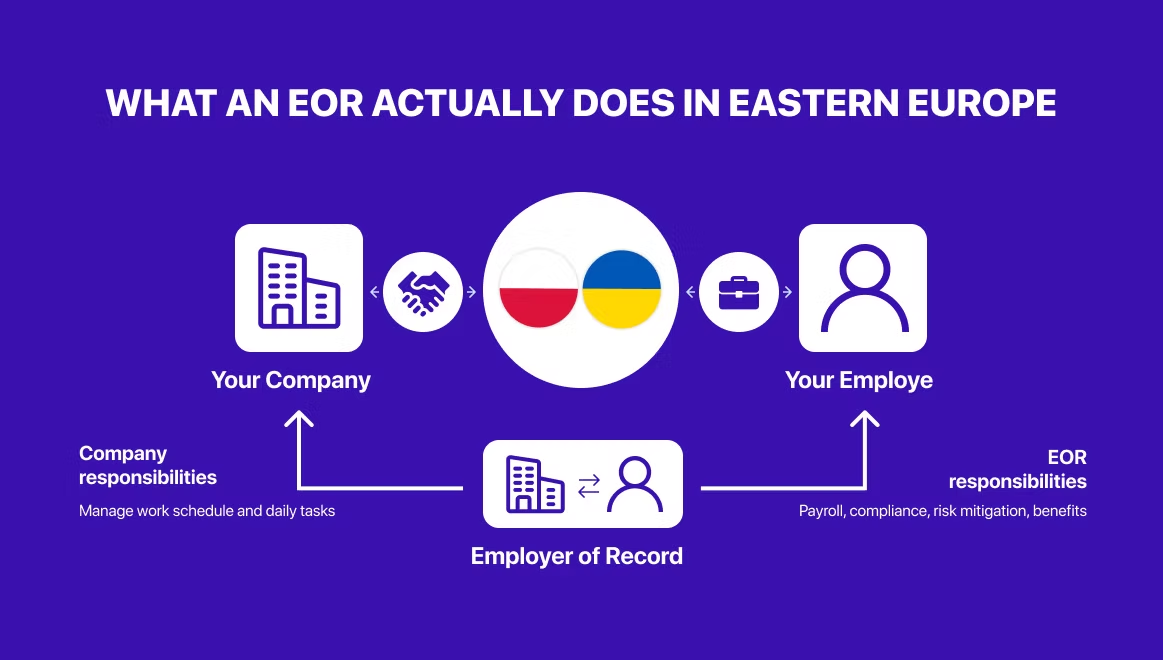
An EOR is a third-party company with a registered legal entity in-country that legally employs workers on your behalf. They handle payroll, statutory contributions, employment contracts, and visa sponsorship — all under their own entity registration. You direct the work. They carry the legal employer liability.
For enterprises expanding into Eastern Europe without a subsidiary yet, an EOR is typically the fastest and most compliance-sound path to getting foreign talent legally authorized to work. Setting up a foreign entity just to sponsor one or two visas is a costly, time-consuming venture. With an EOR in Eastern Europe, you already have a local entity ready to go, meaning your hire's visa can begin processing in weeks instead of months.
But, and this is critical, not all EORs are equipped to handle immigration in Eastern Europe. Some platforms claim regional coverage but rely on subcontractors. Some handle payroll but do not permit. Some have entities in Prague but not in Warsaw. The gap between claiming coverage and actually having it matters enormously when the clock is running on a candidate's start date.
Thing 1: Eastern Europe is not one immigration system; it's Many
This sounds obvious. It isn't treated as obvious nearly often enough.
Enterprise HR teams that attempt to apply a single playbook to hiring in Eastern Europe — because "it's all in the EU" — consistently run into problems. Yes, most Eastern European countries are EU member states. Yes, the EU Blue Card provides a pan-European pathway for highly skilled workers. But the day-to-day reality of work permit sponsorship varies enormously from one country to the next. Here's the breakdown on the three most active markets for enterprise hiring.
Poland: Europe's Fastest-Rising Hiring Hub With a Newly Reformed Permit System
Poland is the largest labor market in Central and Eastern Europe, and it has seen extraordinary growth in foreign worker intake over the past five years. The main driver: a booming economy with persistent labor shortages, particularly in IT, manufacturing, logistics, healthcare, and construction. Poland's demand for foreign talent is not a temporary trend; it's structural.
The core permit for non-EU workers is the Type A Work Permit, which authorizes a foreign national to work for a specific Polish employer. The employer applies on the employee's behalf to the local Voivodeship Office (regional administrative authority). The work permit is location-specific and employer-specific: if the employee changes roles or companies, a new permit is required.
The major change in 2025: As of June 1, 2025, Poland replaced its mandatory labour market test with a Protected Professions System. Under the old system, employers had to advertise the position with the local Labour Office and wait 15–21 days before hiring a foreigner. Under the new system, local authorities can create lists of professions for which work permits for foreigners will not be issued, effectively giving priority to Polish citizens in designated roles, rather than requiring case-by-case testing for every hire.
Other significant 2025 changes include:
- Contract submission requirement: Employers must submit a copy of the employment contract via an official online portal before the foreign worker starts. Failure to do so carries a fine of PLN 1,000–3,000 (~€235–705).
- Stricter enforcement: Labour and border authorities can now conduct unannounced inspections. Fines for violations can reach PLN 10,000 (~€2,350), up from PLN 2,000.
- Higher penalties for illegal employment and an expanded list of immigration-related offenses.
- Fast-track processing for certain designated strategic employers.
Poland's practical advantage for some nationalities: Poland offers a unique, simplified pathway for citizens of Ukraine, Belarus, Georgia, Armenia, and Moldova. Employers can hire these nationals via a simple "Declaration of Entrusting Work" rather than a full work permit, a significant time and cost saving for enterprises hiring talent from these specific origins.
Processing timelines: work permits take approximately 4–10 weeks; visa applications take 15–30 days. Build in extra time if you're submitting in Q4, when Voivodeship Offices process the highest volumes.
Romania: Open to Talent, Running a Quota System You Need to Plan Around
Romania has established itself as one of the most active talent markets in Southeast Europe. Bucharest, Cluj-Napoca, and Timișoara are thriving technology and services hubs, with major multinationals operating development centers and shared services operations across the country.
Romania's work authorization system requires non-EU workers to obtain both a work permit from the General Inspectorate for Immigration (IGI) and a long-stay visa (D/AM) from a Romanian diplomatic mission. The sequence matters: the IGI must approve the work permit first, then the employee applies for the visa, then applies for the Temporary Residence Card (TRC) after arrival. This two-document, multi-stage structure extends the total timeline to 30–45 days for the IGI approval, plus additional time for the visa and TRC.
Before applying, the employer must demonstrate that no suitable Romanian or EU/EEA national was available for the role, a labor market test requirement that adds a documentation layer to the process.
The quota issue, and it's a serious one: Romania has maintained an annual work permit quota of 100,000 non-EU permits for four consecutive years. This sounds large. In practice, it fills up faster than most enterprise planners expect. In 2025, from a cap of 100,000, over 71,000 permits had already been issued by October 1, with estimates suggesting the quota would be exhausted in December 2025. The 2026 quota is set at 90,000, a slight reduction.
What this means in practice: if you're planning to hire in Romania and your hire is non-EU, your timeline is constrained by the quota calendar, not just the processing timeline. Applications submitted in Q4 risk rejection if the quota has been reached. Applications filed in Q1 under the fresh annual quota are substantially more likely to succeed.
Romania became a full Schengen member for air and sea borders on March 31, 2024. This simplifies travel between Romania and other Schengen countries once residence is established, a meaningful practical benefit for mobile enterprise employees.
Czech Republic: Structured, Demand-Driven, and Digitising Fast
The Czech Republic is a high-demand market with one of the EU's lowest unemployment rates (~2.8%). Labor shortages are acute across manufacturing, engineering, healthcare, and IT. The country issues 70,000+ Employee Cards annually, with projections pointing toward 85,000+ in 2026, given continued labor shortages.
The primary work authorization instrument for non-EU workers is the Employee Card — a combined work and residence permit valid for up to 2 years. The application process involves:
- The employer advertises the position through the Czech Labor Office for 30 days (labor market test)
- The employee applies at a Czech embassy or consulate in their home country
- Processing takes 60–90 days (with digital systems expected to reduce this to 30–90 days in 2026)
- Upon arrival, the employee must register their address within 3 business days
The Czech Republic is also implementing major digital infrastructure upgrades in 2026, a fully integrated online portal for all permit types, with real-time application tracking. This will meaningfully change (and likely streamline) the application experience.
For employers: EOR providers must be registered with the Czech Ministry of the Interior to sponsor foreign workers. This is a prerequisite that not all EOR platforms have in place.
Thing 2: Labour Market Tests Are Transforming. Know the New Rules
Labour market tests, the requirement that employers demonstrate no suitable local candidate exists before hiring a foreigner, have historically been one of the most friction-heavy elements of work permit processes in Eastern Europe. They're changing. The direction is mixed. Some countries are removing them; some are restructuring them.
Understanding the current state in each country is not optional. It determines how you document your application, how long you wait, and whether you'll encounter a refusal that could have been avoided.
Poland: Replaced the traditional labour market test as of June 1, 2025. Employers no longer need to obtain a statement from the local labour office confirming a lack of Polish workers. Instead, local authorities maintain lists of professions for which foreign work permits will not be issued. If your role is on the protected list, you cannot hire a foreign national. If it's not, you proceed without the waiting period. This is a genuine improvement for most enterprise roles in tech, finance, and professional services — but it requires knowing the current protected professions list in your Voivodeship.
Romania: The labor market test remains in effect. Employers must demonstrate that the position cannot be filled by a Romanian citizen or EU/EEA national. This is a documentation requirement at the IGI application stage — not an open-ended vacancy posting period, but it still requires deliberate preparation.
Czech Republic: The 30-day Labor Office advertising requirement remains the standard pathway for Employee Cards. Some roles may qualify for the accelerated Blue Card process (see Thing 4), which reduces this friction for highly qualified candidates.
The broader pattern across Eastern Europe: The shift away from case-by-case labor market testing toward shortage occupation lists and protected profession lists is a regional trend, not a one-country experiment. It reflects a pragmatic acknowledgment that labor shortages in key sectors make prescriptive market testing counterproductive. For enterprise buyers, this means you need an EOR partner who actively tracks which professions are listed, exempt, or accelerated in each target country, because that determines your entire application strategy.
Thing 3: Quotas Are Real, They Fill Up, and They Don't Wait for You
Annual immigration quotas are one of the most underappreciated compliance risks in Eastern Europe. They don't make headlines. They don't come with alerts. They just close mid-year, and your pending application gets rejected.
Romania is the clearest example, but it's not the only one.
Romania: 100,000 permits in 2025 (reduced to 90,000 in 2026). By October 1, 2025, 71,668 had already been issued. Immigration advisors were sending urgent alerts in Q4 2025, warning employers to file immediately or risk rejection until the 2026 quota reset. The Romanian government has maintained this annual cap consistently since 2022. It is not a temporary measure; it is policy.

Hungary: Maintains a strict "Guest Worker" quota of 35,000 permits for 2026 to prioritize the local workforce. This is one of the more restrictive quota regimes in the region.

Lithuania and Latvia: Often set quotas as a percentage of their permanent population — approximately 1.4% — which translates to a small absolute number given their population sizes. These are markets where hiring foreign nationals feels straightforward until you hit a quota ceiling.
Poland: Does not have a nationwide annual quota in the same way, but the Protected Professions System creates de facto category-level restrictions in designated roles.
Czech Republic: Issues 70,000+ Employee Cards annually, with high demand across manufacturing and IT. The volume is substantial, but so is the demand — application timing relative to the calendar year still matters.
The strategic implication: Your Eastern Europe hiring plan needs a quota calendar built into it. That means:
- Identify which countries your target hires are subject to quota before extending offers
- File early in the annual cycle — Q1 applications operate under a fresh quota; Q4 applications face a depleted one
- Work with an EOR that monitors quota consumption in real time — not just at submission
- Have a contingency plan if a quota closes mid-process: can the employee work remotely until the next quota period? Can the role be restructured for a local or EU candidate in the interim?
Missing a quota window doesn't just delay a hire. It can mean losing the candidate entirely.
Thing 4: The EU Blue Card Is a Strategic Tool Most Enterprise Teams Underuse
If you're hiring highly skilled non-EU professionals into Eastern Europe, the EU Blue Card should be part of your toolkit. Most enterprise teams either don't know how it works in CEE markets or default to standard work permits without evaluating whether Blue Card eligibility applies.
Here's why that's a missed opportunity.
What the EU Blue Card is: A combined work and residence permit for highly qualified non-EU nationals, available across EU member states. It was created to be Europe's answer to the US Green Card, designed specifically to attract specialist talent into the EU labor market. The revised EU Blue Card Directive, implemented in November 2021, expanded eligibility and streamlined procedures significantly.
Why it matters for Eastern Europe specifically:
- Validity: Blue Cards are often issued for up to 3 years, compared to 1–2 years for standard permits. Fewer renewals. Less administrative overhead.
- Intra-EU mobility: After 12 months of work under a Blue Card in one EU country (say, Poland), the employee can move to another EU country (say, the Czech Republic) for a new highly-skilled role with simplified procedures. This is a meaningful advantage for enterprise teams managing multi-country deployments.
- IT professionals without degrees: The revised 2021 Directive expanded eligibility to include IT professionals with at least three years of demonstrated experience, even without a formal university degree. This is significant for enterprise tech hiring, where top talent often doesn't follow traditional academic paths.
- Family reunification: Blue Card holders benefit from fast-tracked family reunification, spouses, minor children, and in some countries, dependent adult children can join them with simplified procedures.
Country-specific thresholds:
The salary minimum for a Blue Card varies by country and is recalculated regularly based on national average wages. Examples:
- Czech Republic: Minimum threshold of CZK 69,248/month (~$3,293 USD) for the May 2025–April 2026 period — calculated as 1.5x the national average gross salary of CZK 46,165/month.
- Hungary: 2026 Blue Card minimum salary is approximately 1,001,048 HUF/month.
- Poland: Threshold set at approximately 1.5x the national average wage; consult current IGI guidance for exact figures.
How an EOR fits into Blue Card sponsorship: The EOR's local entity acts as the sponsoring employer on the Blue Card application, the same way it would for a standard work permit. The advantage is that the EOR's established payroll infrastructure and salary compliance records strengthen the application's credibility. Immigration authorities reviewing a Blue Card application from a well-established registered employer with a clean compliance record are substantially more likely to approve it smoothly.
The Blue Card is not the right fit for every hire. Roles below the salary threshold, positions that don't require a degree or equivalent experience, and short-term deployments are better served by standard permits. But for senior engineers, architects, finance specialists, and tech leads, the Blue Card is almost always worth evaluating as the primary route.
Thing 5: Your EOR Must Be a Real Legal Employer, Not a Platform With a Subcontractor
This is the compliance risk that trips up more enterprise teams in Eastern Europe than any specific visa rule.
The EOR market has grown rapidly. Many platforms now claim to cover dozens of countries — including Poland, Romania, and the Czech Republic — on a single dashboard. The pitch is seamless: onboard in 48 hours, compliant in 150+ countries, one invoice for everything.
The reality of what happens when you try to sponsor a work permit tells a different story.
Work permit applications in Eastern Europe require the legal employer, the entity whose name appears on the contract, to be registered with the relevant immigration authority in-country. In Poland, that's the Office for Foreigners (Urząd do Spraw Cudzoziemców). In the Czech Republic, that's the Ministry of the Interior. In Romania, the General Inspectorate for Immigration. These aren't formalities. Unregistered or improperly structured employer relationships are grounds for application refusal.
Some global EOR platforms use local third-party subcontractors to manage employment in smaller or more complex markets. This model looks fine in a sales presentation. It creates real problems when:
- The subcontractor is not properly registered as an immigration sponsor
- Document requirements from the immigration authority name the registered entity, not the subcontractor
- An inspection or compliance check surfaces the gap between the named employer and the actual entity managing the relationship
- The subcontractor relationship introduces additional processing delay because the EOR has no direct relationship with the immigration authority
The test is simple: Does your EOR have a wholly-owned, directly registered legal entity in the specific Eastern European country where you need to sponsor the permit? Not a partner. Not an affiliate. Not a local firm they "work with." Their own entity, on their own balance sheet, with their own registration as an employer of foreign nationals.
For permit-specific requirements: in Poland, EOR providers must register with the Polish Office for Foreigners to sponsor foreign workers. In the Czech Republic, EOR providers must be registered with the Czech Ministry of the Interior. These registrations take time to establish and require active compliance maintenance. An EOR that hasn't done this groundwork cannot sponsor your hire, regardless of what their platform claims.
The other dimension: payroll compliance feeds permit compliance. In Poland, the 2025 reforms link permit standing directly to employer compliance behavior. Under the new rules, the employer must submit the employment contract before the foreign worker starts, which means the EOR's payroll and HR systems must be synchronized with the immigration workflow. An EOR that manages payroll and immigration in separate silos creates coordination risk that falls on your candidate's legal status.
A useful real-world reference: a U.S. tech firm needed to relocate a specialist to Eastern Europe for a project. Establishing a company locally would have taken over six months, plus ongoing audits and compliance upkeep. Instead, they engaged an EOR with a local entity already in place. The EOR's local team sponsored the work permit immediately, and the employee was on the ground and legally working within a few weeks. That outcome depends entirely on the EOR already having the legal infrastructure in place, not building it after you ask.
The Full EOR Visa Sponsorship Process in Eastern Europe
Enterprise teams that model their Eastern Europe hiring timelines around "we'll sort the visa when the offer is accepted" consistently lose candidates to delays. Here's what the end-to-end process actually looks like, from the moment you decide to hire to the moment your employee is compliant and working.
Stage 1: Pre-Hire Feasibility Assessment (Before the Offer)
Before you extend an offer to a non-EU national, your EOR should assess:
- Which visa or permit category applies to this specific role, salary level, and candidate nationality
- Whether the role qualifies for Blue Card fast-track or falls under a protected professions restriction
- What the current quota status is in the target country, especially critical for Romania and Hungary
- Whether the candidate's nationality benefits from simplified pathways (e.g., Ukrainian, Georgian, Armenian nationals in Poland)
- Realistic timeline from offer acceptance to legal work commencement
This step takes hours, not weeks. Skipping it takes weeks you don't have.
Stage 2: Labour Market Test Compliance (Where Required)
Poland: No longer required for most roles under the Protected Professions System (June 2025). The EOR checks whether the role falls on the current protected list in your Voivodeship.
Romania: Required. The EOR documents the employer's attempt to fill the role locally, typically involving a job posting on the Romanian Labour Market portal.
Czech Republic: Required. The Labour Office advertising period is 30 days and cannot be shortened for standard Employee Card applications.
Build the labour market test period into your hiring timeline. It is not a formality — it is a sequential prerequisite that must be completed before the permit application can be filed.
Stage 3: Employer Document Preparation
The EOR as a legal employer must compile:
- Certificate of entity registration (the EOR's own entity, not the client company's)
- Tax compliance certificates confirming the employer is in good standing
- Proof of immigration sponsor registration with the relevant authority
- Employment contract drafted in compliance with local labor law — this must match the permit application exactly. Any discrepancy between the contract and the permit is a common rejection ground
- For Poland post-June 2025: the contract must be submitted to the government portal before the employee starts work
Stage 4: Employee Document Preparation
The candidate needs:
- Valid passport (typically with a minimum 12 months' validity)
- Educational certificates and professional qualifications — these often require an apostille and a certified translation into Polish, Romanian, or Czech
- CV and professional background documentation
- Clean criminal record certificate (from home country and any country of residence in the past 3 years)
- Proof of health insurance (particularly for Czech Employee Card and Blue Card applications)
- In some countries, proof of accommodation
Translation and apostille processes are a consistent source of delay. Start them in parallel with the employer-side documentation, not after.
Stage 5: Permit Application Submission
Poland: Submitted to the local Voivodeship Office. Processed in 4–10 weeks. Digital application portals are being rolled out, but paper submissions remain accepted during the transition period.
Romania: Submitted to the IGI. Processed in 30 days (extendable by 15 days for additional verification). Once the work permit is issued, the employee applies for the D/AM visa at a Romanian consulate within 60 days.
Czech Republic: Submitted at the Czech embassy or consulate in the employee's home country. Processed in 60–90 days (expected to reduce under the 2026 digital upgrade). The Employee Card serves as both work authorization and a residence permit.
Total end-to-end timeline across Eastern Europe: Employers should account for 3–5 months from initial job posting to physical arrival. Build this into offer letters and onboarding plans.
Stage 6: Arrival, Registration, and Ongoing Compliance
Poland: The employee must register their address with local authorities after arrival. The employer must inform the voivode within 15 business days if the foreign worker's employment terminates.
Romania: The employee applies for the Temporary Residence Card (TRC) after arrival. The TRC is valid for 1 year and renewable annually.
Czech Republic: Address registration is mandatory within 3 business days of arrival — one of the strictest requirements in the region. Missing this window triggers fines.
Across the region: Any change in the employee's job title, location, salary, or employer must be reported to the relevant authority. The permit is employer-specific and role-specific in most categories. A promotion, a restructuring, or even a formal job title change may trigger a permit amendment or re-application requirement. Your EOR should flag these events proactively, not reactively.

Eastern Europe EOR Visa Sponsorship at a Glance
| Factor | Poland | Romania | Czech Republic |
| Main Permit Type | Type A Work Permit | Work Permit (IGI) + D/AM Visa + TRC | Employee Card |
| EOR Sponsorship Permitted | Yes | Yes | Yes |
| Labour Market Test | Replaced by Protected Professions System (June 2025) | Required | 30-day Labour Office advertisement |
| Annual Quota | No nationwide quota | 90,000 for 2026 (reduced from 100,000) | No fixed national quota |
| EU Blue Card Available | Yes | Yes | Yes |
| Processing Timeline | 4–10 weeks (permit) + 15–30 days (visa) | 30–45 days (permit) + visa + TRC | 60–90 days (Employee Card) |
| EOR Must Register With | Office for Foreigners | General Inspectorate for Immigration | Ministry of the Interior |
| Fast-Track for Some Nationalities | Yes (UA, BY, GE, AM, MD — Declaration pathway) | Not applicable | Not applicable |
| Post-Arrival Registration Deadline | Promptly after arrival | On the TRC application | Within 3 business days |
| Permit Validity | Up to 3 years (Type B up to 3 years) | 1 year (TRC), renewable | Up to 2 years (Employee Card) |
How to Choose the Right EOR Partner for Eastern Europe
The Eastern European EOR market is large, and the quality varies enormously. Here's a specific, no-fluff checklist for evaluating partners.
- Own legal entities in your target countries. Ask directly: Do you have a wholly-owned registered entity in Poland, Romania, and the Czech Republic? Not a partner network — your own entity. If the answer is unclear or qualified, that's your answer.
- Active registration as an immigration sponsor. In Poland, that's registration with the Office for Foreigners. In the Czech Republic, it's registration with the Ministry of the Interior. Ask for confirmation of these registrations by name and date. An EOR operating without sponsor registration cannot legally file work permit applications on your behalf.
- In-country legal and HR teams who track quota calendars. Romania's quota is filled to 72% by October 2025. An EOR whose Bucharest team isn't monitoring this in real time and alerting clients to file early is not doing its job. Ask specifically: how do you monitor and communicate quota consumption in Romania and Hungary?
- Payroll systems synchronized with permit workflows. The 2025 Poland reform requires the employment contract to be submitted to a government portal before the employee starts. This requires the EOR's payroll and immigration teams to be coordinated, not siloed. Ask how their processes are integrated across HR, payroll, and immigration.
- Realistic, specific timelines by country. A credible EOR will give you the actual processing windows by country: 4–10 weeks in Poland, 3–4 months in the Czech Republic, 30–45 days just for the IGI stage in Romania before visa and TRC. Any EOR promising faster-than-realistic outcomes is overpromising. Any EOR that can't give you country-specific timelines hasn't done enough volume there.
- Track record in Blue Card applications. Blue Card sponsorship is more documentation-intensive than standard permits and requires salary threshold compliance at the application stage. Ask how many Blue Cards the EOR has successfully sponsored in each of your target countries in the past 12 months.
- Post-permit lifecycle management. The job isn't done at issuance. Renewal tracking, change notification obligations, and address registration requirements continue throughout employment. Your EOR should have systems for this, calendar alerts, proactive renewal filings, and defined SLAs for compliance events.
Conclusion
Eastern Europe is one of the world's most compelling talent regions for enterprise hiring, great skills, competitive costs, EU legal frameworks, and improving infrastructure. It's also a region where the immigration rules are country-specific, quota-constrained, and actively evolving.
Here are the five things to carry into your planning:
- Eastern Europe is not one immigration system. Poland, Romania, and the Czech Republic each have distinct permit types, application processes, authority registration requirements, and compliance obligations. Applying a single playbook across the region creates compliance gaps in every country.
- Labour market tests are transforming. Poland eliminated its test in June 2025 and replaced it with a Protected Professions System. Romania's test remains. The Czech Republic's 30-day advertising requirement is the norm. Know the current rule in your target country before you file — the strategy changes based on it.
- Quotas are real, they fill up mid-year, and they don't give warnings. Romania's 2025 quota was 72% consumed by October. Hungary's Guest Worker quota is strict at 35,000. File early in the annual cycle. It's not optional.
- The EU Blue Card is underused. For senior, highly qualified hires, it offers longer validity, intra-EU mobility rights after 12 months, and expanded eligibility for IT professionals without degrees. Most enterprise teams default to standard permits when Blue Card eligibility would serve them better.
- Your EOR must have a real local entity and real immigration sponsor registration. Subcontractor arrangements fail at the permit application stage. Verify entity structure and sponsor registration directly, by country, before you commit.
Done right, EOR-sponsored visas in Eastern Europe are how enterprise teams get top non-EU talent legally working in Warsaw, Bucharest, and Prague without months of entity setup and without the legal exposure of doing it wrong.
The talent is there. The compliance path is clear. The only question is whether your EOR partner is equipped to walk it with you.
FAQs
Can an EOR sponsor a work visa in Eastern Europe?
Yes, in Poland, Romania, the Czech Republic, and most other Eastern European countries, a qualified EOR with a registered local entity can act as the legal employer and sponsor work permits on behalf of non-EU national employees. The key prerequisite: the EOR must be registered as an immigration sponsor with the relevant national authority. This registration varies by country and is not universal across all EOR platforms.
What does it mean when a candidate "requires sponsorship for employment" in Eastern Europe?
It means the candidate is a non-EU national who cannot legally work in Poland, Romania, the Czech Republic, or any EU member state without a registered local employer initiating a work permit application on their behalf. EU/EEA/Swiss nationals can work freely under freedom of movement rules; this requirement applies specifically to non-EU nationals.
What is sponsorship for employment visa status?
It refers to the formal legal relationship in which a registered employer takes on immigration-related responsibility for a foreign worker. The employer's entity name appears on the permit, the employer is responsible for contract compliance, and the employer must notify authorities of changes in the employment relationship throughout the permit period.
Is there a salary minimum for work permits in Eastern Europe?
Standard work permits generally require a salary at or above local minimums and national averages. Poland's threshold is approximately 7,500 PLN gross/month; Romania and the Czech Republic have sector-specific thresholds. The EU Blue Card sets salary floors explicitly at 1.5x the national average gross wage in each country.
How long does EOR-sponsored visa processing take in Eastern Europe?
End-to-end timelines, from initial job posting through legal work commencement, typically run 3–5 months across Eastern Europe. Poland is the fastest at the permit stage (4–10 weeks). Czech Republic Employee Cards take 60–90 days. Romania adds sequential layers: IGI (30–45 days) + visa application + TRC. Build this into your hiring plans before extending offers.
Do Romania's annual quotas apply to Blue Card applicants?
Yes. Romania's annual quota of 90,000 (2026) applies to all non-EU/EEA work and secondment permits, including Blue Cards. If the quota is exhausted before your application is processed, it will be rejected until the following year's quota opens. Filing early in the annual cycle is not optional — it's a strategic necessity.
What happened to Poland's labour market test?
Poland eliminated the traditional labour market test as of June 1, 2025. The old system required employers to post a vacancy and wait for the Labour Office to confirm no local candidate was available (typically 15–21 days). The new system uses a Protected Professions List; if a role appears on the list, foreign nationals cannot be hired for it. If the role is not on the list, the employer proceeds to the permit application without waiting.
What is DACA employer sponsorship, and does it apply in Eastern Europe?
DACA (Deferred Action for Childhood Arrivals) is a US-specific immigration program for individuals brought to the US as children. It has no equivalent in Eastern Europe. DACA recipients are US residents but not US citizens, if they seek to work in Poland, Romania, or the Czech Republic, they require standard non-EU national employer sponsorship for employment, subject to the same permit requirements as any other foreign national.
.svg)


