


5 Things to Know About EOR-Sponsored Visas in Uzbekistan: Enterprise Guide
TL;DR: Uzbekistan Work Permits and EOR Visa Sponsorship Explained
Uzbekistan is moving faster than almost anyone in the global enterprise community expected. Early-stage startup funding soared from $0.3 million in 2020 to $69.5 million in 2024 — a more than 230-fold increase in four years. According to StartupBlink, Uzbekistan ranks first in Central Asia and second globally in ecosystem growth rate, with Tashkent recognized as the fastest-growing startup city in the region at 132% growth. Over 12 active venture capital funds now operate with combined assets exceeding $136 million — a tenfold increase in five years. The Digital Uzbekistan 2030 strategy targets $5 billion in IT service exports and 300,000 new tech jobs by decade's end.
IT Park Uzbekistan — a national innovation hub with full tax exemptions until 2040 — operates 14 branches nationwide and has attracted over 1,500 active startups. Webster University, Arizona State University, and Amity have campuses here. Stanford, MIT, and Google hold formal ecosystem partnerships. This is not an emerging market in the traditional sense. It is an ecosystem in the middle of a structural step-change.
But the moment you want to bring a foreign specialist into Uzbekistan, you are stepping into a work permit framework that is dual-document, requires a company-level license before any individual permit can be issued, has three specialist tiers with salary thresholds and university ranking requirements, and mandates a 15-day labour market test unless your hire meets specific qualification criteria. EOR-sponsored visas in Uzbekistan are the right path, but only when you understand how this system is actually built.
This guide gives you that understanding. Five things. No fluff. Founder-level clarity.
Why Hire in Uzbekistan: The Enterprise Case for Expansion in 2025
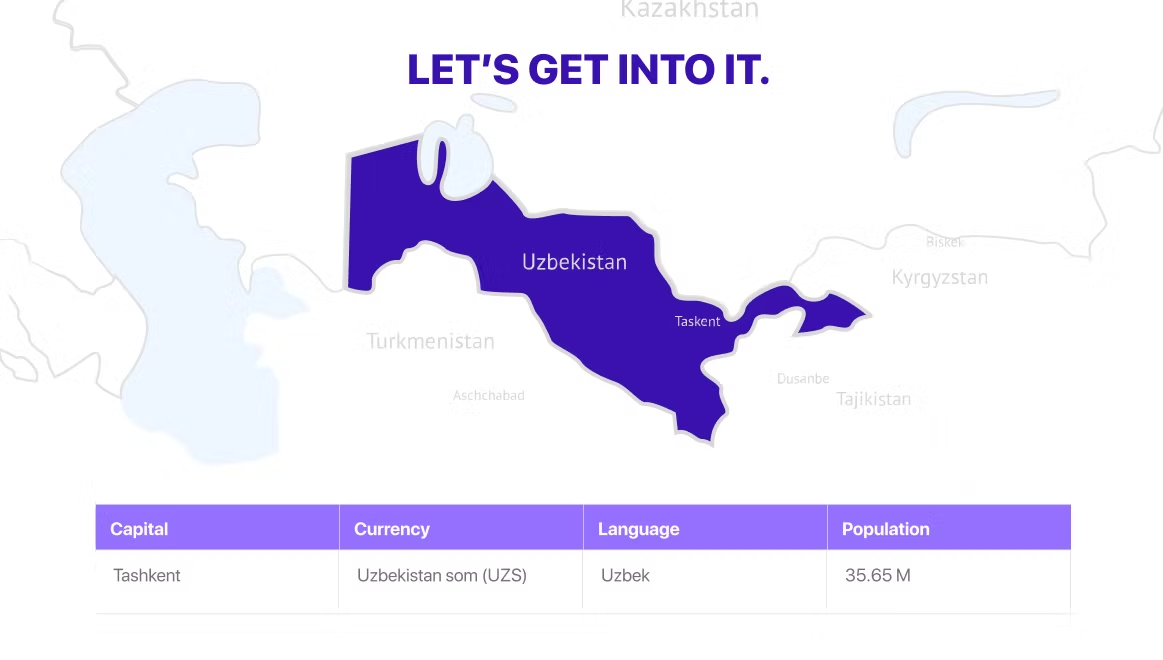
The numbers above are not the headline. The headline is what's behind them.
Uzbekistan has 21 million working-age citizens with a national average age of 29. The country graduates 125,000 university students annually, over 60,000 in ICT and business services. 210 universities and 30 international institutions, including Webster University, American University of Technology by Arizona State University, and Amity, are creating a talent pipeline increasingly competitive at an international level. Senior software developers, data engineers, and cloud architects in Tashkent work at 45–65% below Western European compensation levels. Real GDP growth is projected at 5–6% annually through 2025–2026.
The IT Park advantage is structural, not promotional.
IT Park members are fully exempt from corporate and personal income taxes, VAT, property tax, land tax, and customs duties until 2040. This is not a temporary incentive subject to annual review. The President of Uzbekistan has stated explicitly that legislative changes affecting these benefits will not occur for international partners during this period. IT Park member companies can save between €500,000 to €2 million annually, depending on team size, compared to Western European cost bases.
IT Park's SoftLanding "One Stop Shop" initiative enables foreign companies to register their businesses in Uzbekistan within just three working days with support for incorporation, office selection, HR processes, personnel testing, and the issuance of IT visas that grant foreign specialists equal social rights with Uzbekistani citizens. The Zero Risk Program provides up to 12 months of free office space, free technical equipment, and payroll compensation support.
For enterprise teams building Central Asian operations hubs, IT delivery centers targeting European and Gulf markets, or regional engineering clusters, Uzbekistan offers a combination of talent quality, cost structure, legal clarity, and government backing that is genuinely rare in this part of the world.
The challenge is the immigration framework. It is structured, dual-document, category-dependent, and requires an employer-first process that most global HR teams haven't encountered before. Without a registered Uzbekistani entity, an EOR with real in-country operations is the only compliant sponsorship path.

Uzbekistan Work Permit System: Dual-Document Process
This is the foundational architecture of Uzbekistan's foreign labour system, and the one that trips up enterprise teams most consistently on first entry into this market.
Uzbekistan operates a dual-document system. Two separate authorisations are required before a foreign national can legally work here. They are issued to different parties, by different authorities, at different stages of the process. Getting the sequence wrong means either the application is rejected or the employee is technically working illegally while you wait.
Document 1: Work Permit Issued to the Employer
The Permit, formally the Corporate Work License, is the government's authorisation for a company to hire a specific number of foreign nationals. Before a foreign national can apply for a permit to work in Uzbekistan, the employer must first obtain a Corporate Work License, typically valid for six months to a year, allowing the company to hire a fixed number of foreign nationals.
The Permit is issued by the Agency for External Labour Migration (AELM) under the Ministry of Employment and Poverty Reduction. It is company-specific and headcount-specific; the license specifies how many foreign nationals the company is authorised to employ. If you want to hire three foreign specialists, you need a Corporate Work License approved for at least three positions.
This document is yours to obtain. The employee does nothing at this stage. The EOR, as the registered Uzbekistani employer, files the Corporate Work License application, conducts or coordinates the required labour market test, and only after receiving approval, moves to the second document.
Document 2: Work Confirmation Issued to the Employee
The Confirmation is the individual foreign national's personal right to perform labour activities in Uzbekistan. It is prohibited for foreigners to work without a Confirmation, just as it is prohibited for employers to hire foreign workers without a Permit. The Confirmation is issued by the AELM for the duration of the employment contract, up to a maximum of three years for highly qualified and qualified specialists, one year for general specialists, and is renewable without a fixed limit.
Why This Dual Structure Matters for EOR-Sponsored Hiring
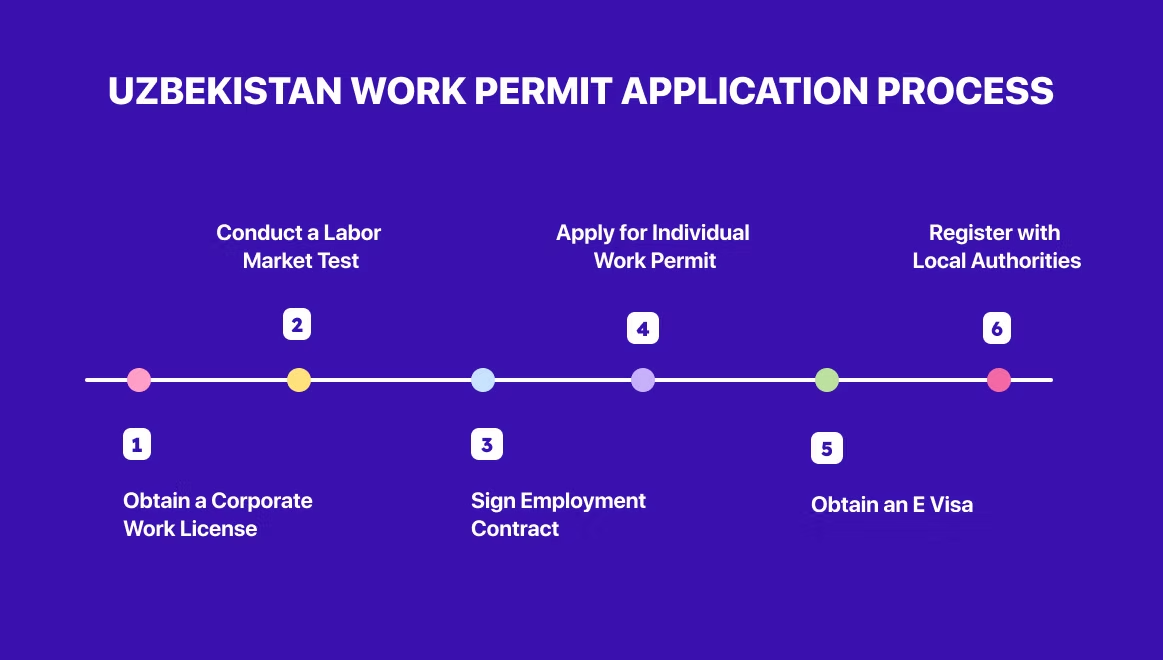
The sequence is rigid. The employer must have a Corporate Work License before the Confirmation can be issued. The Confirmation must be issued before the employee can apply for their E Visa. The E Visa must be granted before the employee can travel to Uzbekistan. There is no parallel processing. There is no shortcut.
An EOR that runs this correctly prepares the Corporate Work License application as Phase 1, the Confirmation application as Phase 2, and the E Visa coordination as Phase 3 — each sequentially, each with documentation prepared in advance so there's no dead time between phases.
This is what visa sponsorship for employment actually means in Uzbekistan. Not a letter. Not a promise. A staged, employer-initiated, government-regulated process where the employer's obligations precede the employee's by design.
Uzbekistan Specialist Tiers Explained: Salary Thresholds and Hiring Strategy
This is Uzbekistan's most powerful and most misread immigration feature. The country has codified a three-tier specialist classification system that applies to every foreign work permit application. The tier your hire falls into determines the permit validity period, whether the labour market test is required, and how fast the process moves.
Get the tier right, and you can skip the 15-day labour market test entirely and receive a three-year Confirmation on the first application. Get it wrong and you're in the general specialist track with a one-year permit and a mandatory 15-day waiting period before anything can be submitted.
Tier 1: Highly Qualified Specialist
A Highly Qualified Specialist is a foreign citizen who:
- Graduated from a university in the top 1,000 internationally recognised rankings
- Has at least 5 years of work experience in the declared speciality
- Is offered a job in Uzbekistan at a salary of at least $60,000 USD per year
If all three criteria are met, the Corporate Work License (Permit) is waived entirely. The Confirmation is issued for up to 3 years. It is renewable an unlimited number of times for up to 1 year per extension. Work visa renewals can be done without leaving Uzbekistan. Highly qualified specialists and their family members can receive a residence permit at will.
The university ranking requirement is verified by the AELM against recognised international indices, QS World University Rankings and Times Higher Education. A degree from a nationally strong but globally unranked institution does not satisfy the Tier 1 criterion.
Tier 2: Qualified Specialist
A Qualified Specialist is a foreign citizen who:
- Has a university degree from any accredited institution
- Has at least 5 years of work experience in the declared speciality
- Is offered a job in Uzbekistan at a salary of at least $30,000 USD per year
If the criteria are met, the Corporate Work License is required, but no labour market test is needed. The Confirmation is issued for up to 3 years. Unlimited annual extensions. Work visa renewal without leaving Uzbekistan is permitted.
This tier is the most strategically relevant for most enterprise teams. Senior professionals with five or more years of experience earning above $30,000/year qualify without needing a top-1,000 university credential.
Tier 3: General Specialist
Any foreign national who does not meet the Qualified or Highly Qualified criteria:
- Full Corporate Work License required
- Labour market test mandatory — 15 calendar days
- Confirmation issued for 1 year, renewable annually without limit
The salary structuring trap:
The salary threshold applies to base salary only under the employment contract. Benefits, bonuses, housing allowances, and in-kind compensation do not count toward the threshold. A $26,000 base with $6,000 housing support and $4,000 performance bonus is Tier 3 on paper — regardless of total compensation value.
Structure the base correctly before the contract is drafted. A good EOR flags this before the offer letter goes out, not after the Corporate Work License application is submitted.
Real Example of Tier Misclassification and Its Impact
A German software company wanted to bring in a React developer from India to its Tashkent engineering hub. The candidate had 6 years of experience and a degree from Bangalore University. The company initially offered a $28,500/year base. At that figure, the candidate was Tier 3: labour market test required, 1-year permit, slower track. Team Up's Tashkent compliance team identified the issue before the contract was signed, adjusted the offer to $30,500, and moved the application directly into the Qualified Specialist track — saving 15 days on the timeline and issuing a 3-year Confirmation on the first application. No games. Just correct the structuring.
Uzbekistan Labour Market Test: 15-Day Rule and Key Exemptions
For General Specialist track hires, Uzbekistan requires a formal labour market test before the Corporate Work License can be issued.
Before sponsoring a foreign worker, you must list the vacancy on the National Job Vacancy Database for at least 15 days. The employer must conduct a local labour market search to determine whether there are any eligible job seekers in Uzbekistan to fill the position. Only after the 15-day window closes, with documented evidence that no suitable Uzbekistani candidate was identified, can the Corporate Work License application proceed.
The 15 days are calendar days, not business days. If the vacancy is posted on a Thursday, the window includes both weekends. Plan this into the hiring calendar from the first conversation with your candidate.
How the Labour Market Test Works in Practice
The AELM does not apply a rigid standard for what constitutes a "suitable" local candidate. In practice, if the vacancy is for a role with genuinely specialised requirements — specific fintech infrastructure experience, AI/ML deployment at scale, domain expertise in an underrepresented industry — the 15-day window passes without qualified applicants and the process moves forward.
The risk is in the vacancy description. A vacancy posted as "Software Engineer, 5+ years" will attract applicants. A vacancy posted as "Senior Software Engineer specialising in high-frequency trading infrastructure on FPGA platforms with production deployment experience in regulated financial environments" reflects genuine role requirements that the Uzbekistani market cannot currently supply at that level. The second description is not dishonest — it is precise. Precision is what clears the labour market test cleanly.
Exemption for Qualified and Highly Qualified Specialists
For Qualified Specialists ($30,000+ salary, 5+ years' experience, university degree), no labour market test is required. The Corporate Work License application proceeds directly. For Highly Qualified Specialists ($60,000+, top-1,000 university), the Corporate Work License itself is waived.
This means that for any foreign hire who meets Tier 2 criteria, you are saving 15 calendar days from the timeline before the first document is even filed. Over a 10–14 week overall process, this is meaningful compression.
IT Park Exception to Labour Market Testing
For companies registered at IT Park, the labour market test requirements for IT-sector roles may be processed within IT Park's administrative framework rather than through the general AELM process. Verify the current pathway with your EOR's in-country team before assuming the standard process applies.
Uzbekistan IT Park Visa: The Fastest Route for Foreign Tech Talent
IT Park Uzbekistan is widely known for its tax exemptions. What is less understood, even among experienced global mobility professionals, is that IT Park residency creates a separate, streamlined immigration pathway for foreign specialists that operates outside the standard AELM work permit process.
What the IT Visa Is and How It Works
IT Park issues a dedicated IT Visa for foreign citizens working in the field of information technology at companies registered as IT Park residents. This is distinct from the standard E Visa. IT Park supports member companies not only with incorporation and office selection, but also with HR-related processes, personnel testing, and the issuance of IT visas — these visas grant foreign specialists equal social rights with Uzbek citizens.
The IT Visa can be issued for up to three years, coordinated through IT Park's administrative infrastructure rather than through the standard AELM and Ministry of Employment track.
Who Qualifies for the IT Park Visa in Uzbekistan
IT professionals employed by IT Park resident companies, working in IT Park's defined scope: software development, data processing, automated management systems, multimedia and design services, e-sports services, and related technology disciplines.
How IT Park Residency Impacts Hiring and Expansion Strategy
For companies with IT Park registration, or using an EOR with IT Park registration, foreign IT hires benefit from:
- Reduced personal income tax of 7.5% versus the standard 12%
- Zero social contribution obligations for the employer and employee
- Zero VAT, corporate tax, property tax, and customs duty for the entity
- IT Visa track with up to 3-year validity and simplified processing
- IT Park administrative support for immigration coordination
IT Park member companies can save between €500,000 to €2 million annually, depending on team size. That is not a rounding error. It is a structural cost advantage that makes Uzbekistan one of the most fiscally attractive IT hiring destinations in the entire Eurasia region.
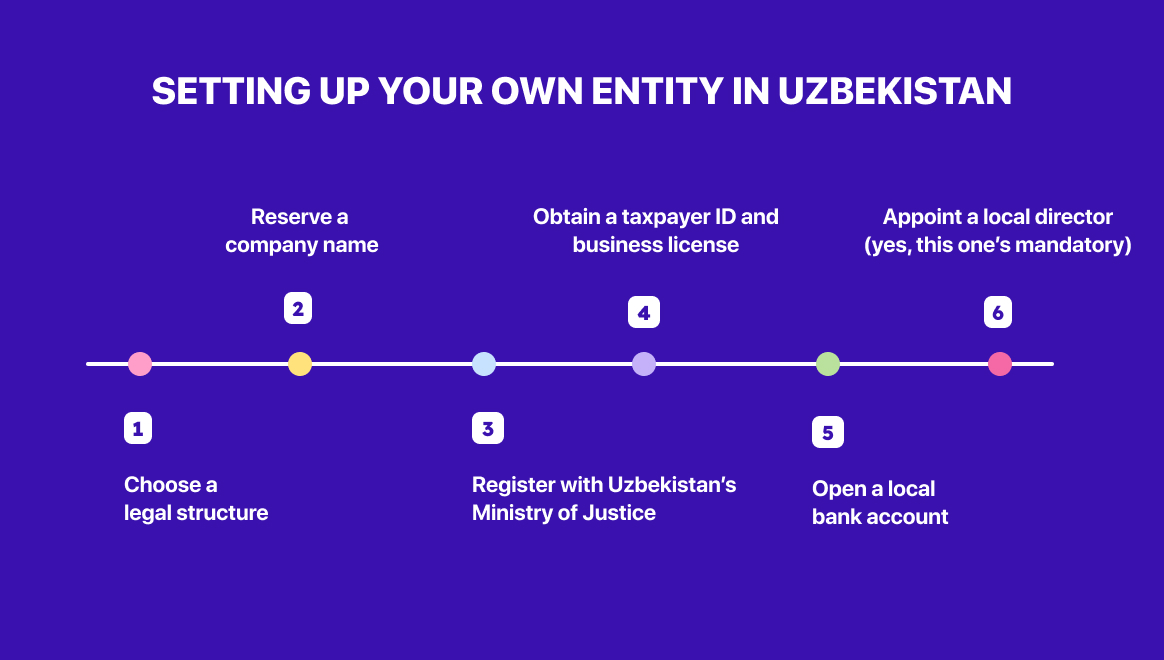
Business Registration Speed and Operational Advantages
IT Park's One Stop Shop enables foreign companies to register their businesses within just three working days. For companies confident in their long-term Uzbekistan commitment, this makes IT Park entity formation genuinely competitive with the EOR model. For most enterprise teams testing the market with their first 3–10 hires, the EOR remains the right starting point — particularly an EOR with IT Park registration that can provide the IT Visa benefit to your hires without requiring you to set up your own entity.
Uzbekistan Compliance Rules: 3-Day Registration and ULCRS Contract Requirements
These are the two post-arrival compliance requirements that most enterprise teams, even those with solid EOR support, discover too late. Neither is complex. Both are non-negotiable. And the consequences of missing either one are immediate.
The 3-Day Residential Registration Rule Explained
When you arrive in Uzbekistan, you must register your place of residence within three days. Some employers handle this on behalf of their employees, but failing to register can lead to legal penalties.
The registration is done at the local district authority where the foreign national will be residing. It requires the passport, visa, and confirmation of accommodation address. The three-day window starts from the date of arrival, not from the start of work, not from the permit effective date. Arrival. Three calendar days. If the employee arrives on a Friday evening, registration must be completed by Monday.
An EOR that treats this as optional or something the employee manages independently is creating compliance exposure from day one. This step must be built into the onboarding workflow as a confirmed deliverable before the employee's first day of work.
ULCRS Employment Contract Registration Requirement
As of the 2025 labour law updates, all organisations operating in Uzbekistan, including foreign-owned companies and EOR entities, are required to use the national Labour Records Information System (ULCRS, also referred to as the "Mehnat" platform) to register employment contracts. Employees hired under official employment contracts must be registered by their employer within 5 working days of hiring. This includes foreign (expatriate) employees, whose contracts must also be registered as part of the work permit compliance process.
What this means operationally:
- The EOR must register the foreign national's employment contract in ULCRS within 5 working days of the employment start date
- The contract registered must match the terms of the Corporate Work License and Confirmation, same role title, same employer entity, same employment location
- Changes to employment terms, role changes, salary adjustments, location changes — require ULCRS update within the same 5-working-day window
Mandatory Employer Termination Notification Rules
If a foreign specialist is terminated before the expiration of a work permit, the local employer must notify the Agency of External Labor Migration of Uzbekistan within a week. Missing this means the foreign national's Confirmation remains technically active in government records — creating a compliance discrepancy that surfaces during the next Corporate Work License application or renewal.
These three post-arrival and post-hiring obligations, 3-day residence registration, 5-day ULCRS contract registration, and 7-day termination notification, are the most commonly missed compliance steps in Uzbekistan EOR arrangements. They're not part of the permit or visa process, so EOR platforms that focus their workflows primarily on immigration documentation don't always build them into onboarding and offboarding sequences.
A compliance-first EOR builds all three into its standard delivery model as confirmed deliverables. Anything less is leaving your hire and your entity exposed.
How to Hire in Uzbekistan With an Employer of Record: Step-by-Step Process
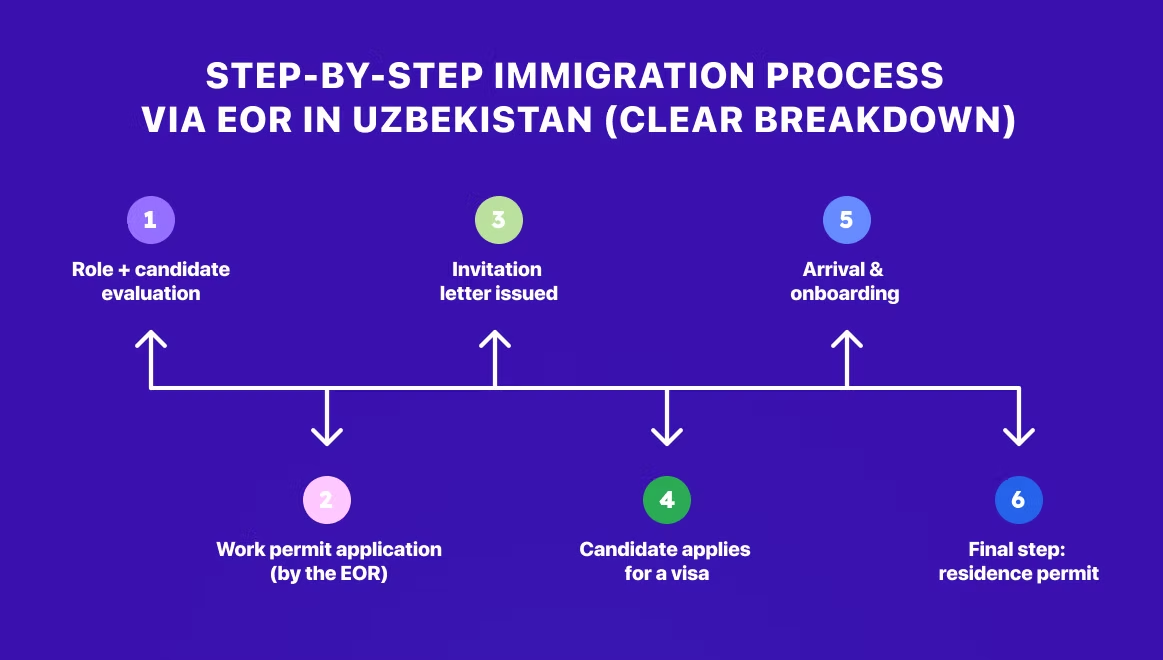
Here is the complete sequenced playbook, from first engagement to a fully authorised, registered, payroll-active foreign employee in Uzbekistan.
Phase 1: Pre-check and tier classification (Days 1–5)
Your EOR's Uzbekistan legal team reviews:
- Candidate's nationality and applicable visa category
- Tier classification: Highly Qualified ($60k+ salary, top-1,000 university, 5+ years), Qualified ($30k+ salary, university, 5+ years), or General
- Whether IT Park registration applies — enabling the IT Visa pathway and 7.5% PIT
- Personal exemptions: investors at the 8,500× minimum wage investment threshold, founders of foreign joint ventures (initial 3-month exemption), NGO employees, accredited press, presidential school teachers, and others
- Correct salary structure: confirming the base meets the applicable tier threshold before the contract is drafted
- ULCRS registration status: confirming no outstanding contract registration gaps on the EOR entity
Phase 2: Corporate Work License application (Days 5–25)
The EOR applies to the Agency for External Labor Migration for the Corporate Work License.
Documents submitted:
- Company registration certificate
- Tax identification documentation
- Confirmation of staffing structure
- Justification for hiring a foreign national
- For the General Specialist track: vacancy publication on the National Job Vacancy Database begins — 15 calendar days
For Qualified and Highly Qualified Specialist tracks, the labour market test is skipped. Application proceeds directly with the candidate's salary, qualification, and experience documentation attached.
Standard Corporate Work License processing: 15–30 working days.
Phase 3: Confirmation application (Days 25–50)
With the Corporate Work License approved, the EOR applies to the AELM for the individual Confirmation.
Documents submitted:
- Completed application form
- Foreign national's passport (valid for at least 3 months beyond intended stay)
- Educational qualifications and professional certificates — apostilled or legalised at the Uzbekistani embassy in the employee's home country
- CV demonstrating relevant experience (particularly important for Qualified and Highly Qualified tracks)
- Employment contract (draft or signed)
- Medical certificate (HIV testing removed as of March 2022)
- Police clearance certificate from the home country
- State fee payment confirmation
The relevant regional labour department informs the Ministry of Foreign Affairs (MFA) after the licence and Confirmation are issued. The MFA then reviews and decides on visa support.
Confirmation processing: 15–30 working days.
Phase 4: E Visa / IT Visa application and entry (Days 50–70)
With MFA visa support confirmed, the foreign national applies for the E Visa (Employment Visa) at the Uzbekistani embassy or consulate in their home country. For IT Park hires, the IT Visa is applied for through IT Park's streamlined channel. Upon approval, the foreign national has 30 days to travel to Uzbekistan. The E Visa is issued for a single entry. Consulate processing: 5–10 business days.
Phase 5: Post-arrival registration (within 3 days of arrival)
The EOR coordinates immediate post-arrival registration at the local district authority. Passport, visa, and confirmed accommodation address are submitted. Registration is confirmed complete before the employee's first day of work. Non-negotiable.
Phase 6: ULCRS registration and payroll activation (within 5 working days of hire)
The Employer of Record services in Uzbekistan include registering the signed employment contract in the ULCRS within 5 working days of the employment start date.
Payroll activated in Uzbekistani Som (UZS):
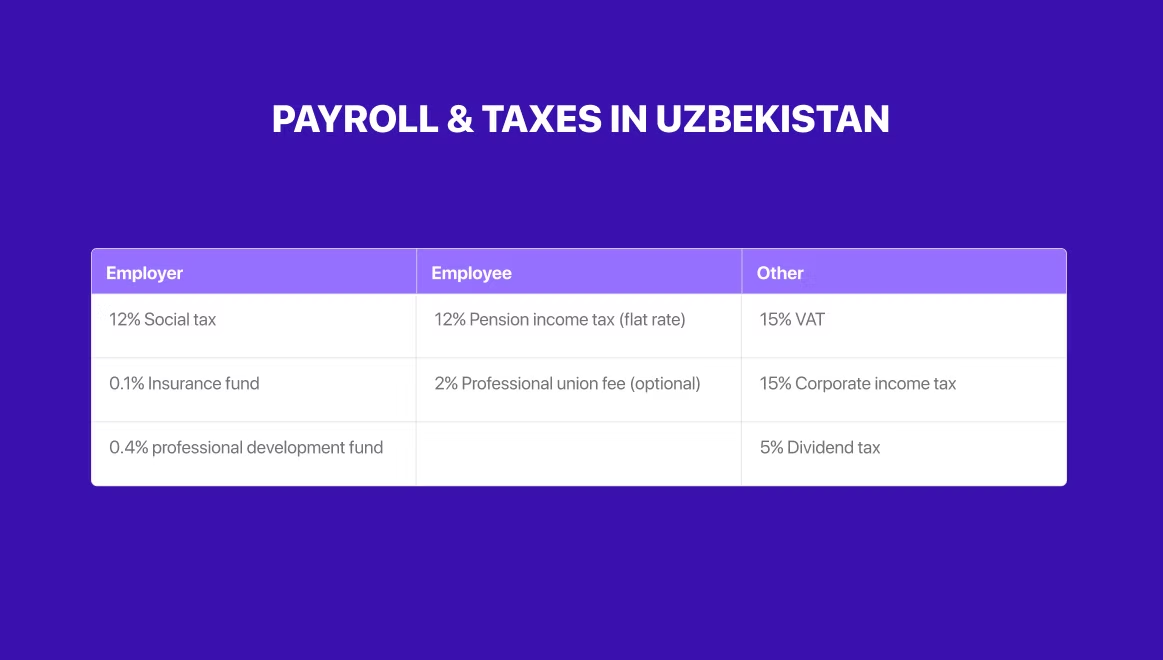
- Standard PIT: 12% withheld at source
- IT Park residents: 7.5% PIT, zero social contributions
- Minimum monthly wage as of August 2025: UZS 1,271,000
- No statutory medical insurance obligation
Total timeline: 10–14 weeks from EOR engagement to legally working, registered employee on compliant payroll. The Highly Qualified Specialist track is faster (Corporate Work License waived). IT Park IT Visa track compresses the process further for qualifying roles. The General Specialist track adds 15 calendar days for the labour market test.
Work permit validity: Highly Qualified and Qualified: up to 3 years, unlimited 1-year extensions. General: 1 year, unlimited annual renewals.
Compliance Risks in Uzbekistan: Work Permit and Immigration Violations
Uzbekistan's compliance enforcement has strengthened as the government has scaled its digital labour monitoring infrastructure. The ULCRS platform, the AELM's permit tracking systems, and Ministry of Internal Affairs migration records are increasingly integrated — creating real-time visibility into employer compliance status.
Risks for Foreign Employees Without Proper Authorization
- Working without a valid Confirmation: immediate violation, deportation risk, potential re-entry ban
- Missing the 3-day post-arrival registration: administrative fines and migration status complications even if the work permit is otherwise valid
- Tourist or visa-free entry followed by employment: any work performed in Uzbekistan without a valid Confirmation is an immigration and labour violation. Foreign nationals cannot convert a tourist visa into a work visa while in the country
- Changing employers without a new permit: the Confirmation is employer-specific. Unauthorised employer changes create immigration violations affecting both the employee and the former sponsoring entity
Risks for Employers and EOR Sponsors
- Fines for employing a foreign national without a valid Corporate Work License or Confirmation
- Fines for delayed ULCRS registration of employment contracts
- Failure to notify the AELM within 7 days of termination: the Confirmation remains active in government records, creating a discrepancy that surfaces on the next Corporate Work License application
- Tax penalties for non-compliant payroll — particularly relevant for IT Park entities where the 7.5% PIT rate must be correctly applied and documented
The Tourist Visa Trap in Uzbekistan Explained
Nationals of over 85 countries can enter Uzbekistan visa-free, including unlimited-stay entry for citizens of Azerbaijan, Armenia, Belarus, Georgia, Kazakhstan, Russia, and Ukraine. The ease of entry creates a genuine temptation to have someone "start working" while the permit process runs in the background. The AELM tracks employment through registration records and employer reporting obligations. Discoveries typically surface at the permit renewal stage, when the employment history doesn't match the permit issuance date. The risk is not theoretical, it is a documented enforcement pattern.
Employer of Record Uzbekistan: Why Local Infrastructure in Tashkent Matters
Uzbekistan's immigration framework rewards precision. The tier classification determines your timeline and permit duration. The salary threshold must sit in the base, not total compensation. The ULCRS registration must happen within 5 working days. The 3-day arrival registration must be confirmed before the first day of work. The 7-day termination notification to the AELM that most EOR providers miss entirely.
These are not things a global EOR platform learns from reading the regulation. They are things an in-country team learns by processing hundreds of applications through the Agency for External Labour Migration, maintaining active IT Park relationships, and being present when the August 2025 payroll updates and ULCRS registration mandates took effect.
Team Up operates with directly owned entities across Central Asia and beyond, including Uzbekistan, Kazakhstan, Georgia, Armenia, Azerbaijan, Turkey, India, and Egypt. In Uzbekistan specifically, this means:
- Tier classification before the offer is extended. Team Up's Tashkent compliance team assesses every hire against the Qualified and Highly Qualified Specialist thresholds before the contract is drafted. If the salary structure needs adjustment to hit Tier 2 — avoiding the 15-day labour market test and enabling a 3-year permit — Team Up flags this before the offer letter goes out.
- IT Park registration and IT Visa access. Team Up's Uzbekistan entity maintains IT Park registration, enabling the IT Visa pathway and the 7.5% PIT rate for qualifying tech hires. If your role falls within IT Park's defined scope, Team Up can activate the faster immigration track without you needing your own IT Park entity.
- Post-arrival compliance is standard delivery. The 3-day registration is confirmed before day one of work. The ULCRS contract registration is filed within the first week. The AELM is notified of any employment changes within the required window. These are the standard delivery model — not exceptions, not optional add-ons.
- Payroll in UZS with current-rate compliance. The August 2025 minimum wage update, the 7.5% IT Park PIT rate, and the standard 12% PIT rate are all correctly applied from the first payroll cycle. If rates change, the adjustment happens automatically.
For enterprise teams building IT delivery centers in Tashkent, regional operations hubs, or specialist engineering functions targeting European and Gulf markets, Team Up is the EOR that knows Uzbekistan's immigration framework at the level of operational precision that keeps your permits clean, your compliance record unblemished, and your hiring plans executable.
Conclusion: How to Hire Employees in Uzbekistan Without Compliance Risk
Uzbekistan's transformation from a closed Soviet-era economy to one of the fastest-growing startup ecosystems globally is not a story that finished in 2024. It is in active progress. The talent pipeline is growing. The government is structurally committed, with zero-tax regimes locked until 2040, a functioning IT Park with 14 branches and over 1,500 active startups, and a presidential mandate for $5 billion in IT service exports by 2030.
For enterprise teams building in Central Asia, Uzbekistan is no longer the experimental option. It is increasingly the strategic anchor.
But the immigration framework demands the same precision that the market rewards. The dual-document structure has its employer-first sequence. The three specialist tiers are where a $30,000 base salary saves you 15 days and doubles your permit duration. The IT Park pathway creates a faster, cheaper immigration track for tech hires. The 3-day arrival registration is treated by most EOR providers as an afterthought. The ULCRS contract registration is now mandatory and actively monitored.
EOR-sponsored visas in Uzbekistan work reliably, compliantly, and efficiently when the EOR has the Tashkent entity, the IT Park relationship, the updated 2025 compliance workflows, and the in-country legal team to execute each stage without gaps.
That is Team Up. And that is the only way we do this.
Talk to Team Up about your Uzbekistan hiring plans.
FAQ: EOR-Sponsored Visas in Uzbekistan
What is visa sponsorship for employment in Uzbekistan?
Employer sponsorship in Uzbekistan means a company takes on the legal responsibility to sponsor a foreign individual's right to work in the country. This involves the employer obtaining the Corporate Work License (the Permit) and then helping the individual secure the Confirmation (individual work authorisation) and an E Visa. The sponsor is accountable to the government for that worker's status throughout the employment relationship.
What are the two documents required for foreign nationals to work in Uzbekistan?
The Permit (Corporate Work License), issued to the employer, authorising the company to hire foreign nationals. And the Confirmation, issued to the individual, granting the specific foreign national the right to perform labour activities in Uzbekistan. Both are mandatory. It is prohibited for foreigners to work without a Confirmation, and prohibited for employers to hire without a Permit.
What are the three specialist tiers in Uzbekistan?
Highly Qualified Specialists: top-1,000 university degree, 5+ years' experience, $60,000+/year salary, Corporate Work License waived, Confirmation up to 3 years. Qualified Specialists: any university degree, 5+ years' experience, $30,000+/year salary, labour market test waived, Confirmation up to 3 years. General Specialists: all others, full labour market test required, 1-year Confirmation.
Does the $30,000 salary threshold include bonuses and benefits?
No. The salary threshold applies to the base salary under the employment contract only. Benefits, bonuses, housing allowances, and in-kind compensation do not count toward the threshold.
What is the labour market test in Uzbekistan?
Employers must post the vacancy on the National Job Vacancy Database for at least 15 calendar days before applying for a Corporate Work License. This demonstrates that no suitable local candidate was available. Qualified and Highly Qualified Specialists are exempt from this requirement.
What is the IT Visa and who can use it?
The IT Visa is a dedicated employment visa for foreign IT specialists employed by IT Park resident companies. It offers up to 3-year validity, streamlined processing through IT Park's administrative infrastructure, and grants equal social rights with Uzbekistani citizens. It is faster than the standard E-Visa track for qualifying IT-sector hires.
What are the post-arrival compliance requirements?
Foreign nationals must register their residential address with local authorities within 3 calendar days of arrival. The EOR must register the employment contract in the ULCRS system within 5 working days of the employment start date. If employment is terminated, the AELM must be notified within 7 days.
Can a foreign national work in Uzbekistan on a tourist or visa-free entry?
No. Foreign nationals cannot convert a tourist or visa-free stay into work authorisation while in the country. Any work performed inside Uzbekistan without a valid Confirmation is an immigration and labour violation, regardless of whether the individual entered without a visa.
How long does the full EOR-sponsored process take in Uzbekistan?
Typically 10–14 weeks for a standard Qualified Specialist track. The Highly Qualified Specialist track can be shorter due to the Corporate Work License waiver. The General Specialist track adds 15 calendar days for the labour market test. IT Park IT Visa processing for qualifying roles can compress the overall timeline.
What happens if I need to hire more foreign nationals than the Corporate Work License allows?
The Corporate Work License specifies the maximum number of foreign nationals the company is authorised to hire. To hire beyond the approved headcount, the license must be updated with the new number and re-approved by the AELM. This is typically faster than the initial license application.
.svg)


