


EOR vs. Setting Up a Canadian Subsidiary: Which Is Right for Your Business?

Our parent guide on reasons companies choose an EOR in Canada outlined the broad case for using an Employer of Record over incorporating locally. This article goes deeper into that specific decision. It breaks down the cost math, registration timelines, compliance burden, and the inflection points where a subsidiary becomes the smarter move.
Canada layers federal obligations with provincial ones. That dual layer shapes every part of the comparison. A U.S. SaaS company hiring two developers in Ontario faces a fundamentally different cost equation than the same company building a 40-person engineering centre in British Columbia. The right structure depends on headcount, timeline, and how much operational control you need. This article maps each variable so you can model the decision against your own numbers.
Cost Structure: EOR Fees vs. Subsidiary Overhead
What You Pay for an EOR
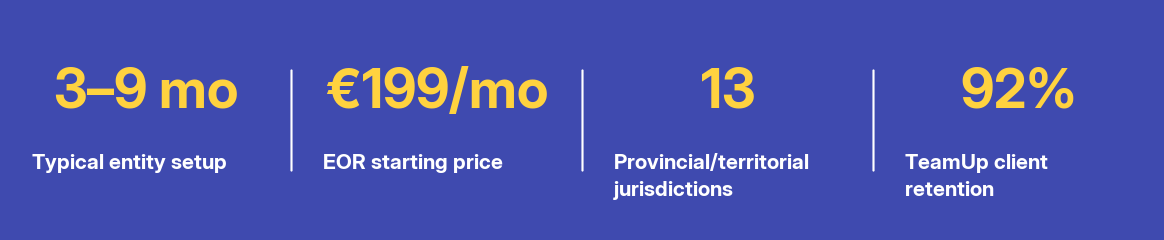
EOR pricing in Canada typically falls between $400 and $700 per employee per month from most global providers. TeamUp's EOR starts at €199 per month per employee in its core markets. For a detailed breakdown of fee structures, see what EOR services cost in Canada.
The EOR fee covers payroll processing, statutory remittances, employment contracts, and compliance maintenance. You pay no incorporation fees, no registered-agent fees, and no annual filing costs. The monthly cost is predictable and scales linearly with headcount.
What a Subsidiary Actually Costs
Incorporating a federal or provincial entity requires legal counsel, a registered office address, and initial filings with the relevant corporate registry. Legal fees for incorporation commonly run between CAD 5,000 and CAD 15,000. That is day one.
Ongoing costs accumulate fast. You need a Canadian accountant for corporate tax returns. You need payroll software or a payroll provider. You need provincial workers' compensation registration. Many provinces require separate health-tax remittances from the employer.
A Montréal-based fintech that incorporated a British Columbia subsidiary to hire five engineers reported spending roughly CAD 60,000 in its first year on legal, accounting, and administrative overhead before a single salary was paid. That fixed cost does not shrink with a small team.
The Crossover Point
| Factor | EOR Model | Canadian Subsidiary |
|---|---|---|
| Upfront cost | Zero to minimal | CAD 5,000–15,000+ legal/setup |
| Monthly per-employee cost | $400–$700 (varies by provider) | Payroll admin + benefits admin |
| Annual compliance overhead | Included in fee | CAD 15,000–40,000+ (accounting, legal, filings) |
| Break-even headcount | Typically under 15–20 employees | Becomes cost-effective above that range |
| Time to first hire | 5–15 business days | 3–9 months |
Below roughly 15 to 20 employees, the EOR model almost always costs less on a per-head basis. Above that range, the fixed overhead of a subsidiary gets spread across enough employees that the per-head cost drops below ongoing EOR fees. The exact crossover depends on your provider, your province, and your benefits package.
Timeline and Operational Complexity
Incorporation and Registration
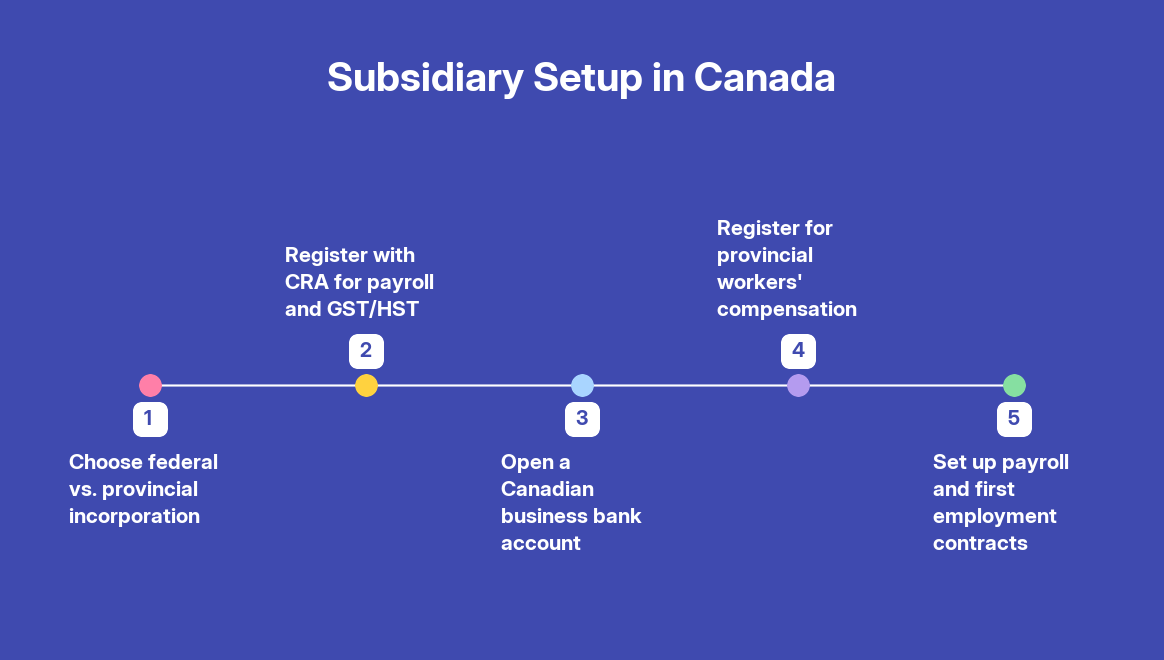
Canada requires separate registrations with the Canada Revenue Agency (CRA) for payroll deductions, corporate income tax, and GST/HST. Each registration carries its own processing timeline. Federal incorporation through Corporations Canada takes one to five business days online. Provincial incorporation timelines vary.
The bottleneck is rarely the corporate filing itself. Opening a Canadian business bank account as a foreign-owned entity takes four to twelve weeks. Banks require corporate documents, director identification, and often an in-person visit or notarized documentation. Without a bank account, you cannot run payroll.
Provincial Layer
Each of Canada's ten provinces and three territories sets its own employment standards, minimum wage, vacation entitlements, and statutory holidays. Ontario's Employment Standards Act, 2000 governs overtime, leaves, and termination differently from British Columbia's Employment Standards Act. Quebec adds the Act Respecting Labour Standards and French-language requirements for employment contracts.
A subsidiary must track and comply with the specific rules of every province where it has employees. An EOR absorbs that tracking. This matters most for companies hiring across multiple provinces simultaneously.
EOR Speed Advantage
An EOR with established Canadian operations can onboard an employee in 5 to 15 business days. No incorporation, no bank account, no provincial registration delays. A London-based e-commerce company that needed a customer-success manager in Toronto had the employee under contract within eight business days through an EOR. The same company estimated four months minimum to set up its own entity.
Legal Exposure and Compliance Ownership
Who Carries Employment Liability
Under an EOR arrangement, the EOR is the legal employer. It bears direct liability for payroll tax remittances, statutory deductions, and employment standards compliance. The Income Tax Act requires employers to withhold and remit Canada Pension Plan (CPP) contributions, Employment Insurance (EI) premiums, and federal and provincial income tax. Those obligations sit with the EOR, not with you.
Termination liability also transfers. Canadian common law allows terminated employees to claim reasonable notice beyond the statutory minimum. Courts assess tenure, age, position, and availability of comparable work. Wrongful-dismissal awards can reach 24 months of compensation in some cases. The EOR manages this exposure.
What Risk Stays with You
An EOR does not eliminate all risk. You retain operational control over the employee's day-to-day work. Workplace health and safety obligations can extend to the functional employer in some provinces. If your instructions create a hazardous condition, provincial inspectors may look past the EOR.
Intellectual property ownership requires specific contractual provisions between you and the EOR. Canadian courts recognize the employer listed on the contract as the default owner of work product. Your service agreement with the EOR must include clear IP assignment clauses. Without them, ownership disputes become expensive.
Watch out: If your EOR contract does not include an explicit IP assignment clause flowing work-product rights from the EOR (as legal employer) to you (as the client), Canadian courts may default IP ownership to the EOR entity. Review this clause before signing.
Tax Permanent Establishment Risk
Operating through a subsidiary creates a clear permanent establishment (PE) in Canada, triggering corporate income tax obligations under the Income Tax Act. An EOR arrangement is designed to avoid creating a PE for the client company. But the line is not absolute.
If your employees in Canada negotiate contracts, close deals, or make binding commitments on your behalf, the CRA could argue that a PE exists regardless of the EOR structure. Companies using EOR employees in sales or business-development roles should get specific tax advice on PE exposure. The complete EOR hiring guide for Canada covers the structural framework in more detail.
When a Subsidiary Makes More Sense Than an EOR
Headcount and Growth Trajectory
The math favours a subsidiary once you project 20 or more employees in Canada within 12 to 18 months. At that scale, the fixed costs of incorporation, accounting, and compliance spread thin enough to undercut cumulative EOR fees. A Berlin-based cybersecurity firm that started with three Canadian hires via an EOR transitioned to its own Ontario subsidiary at employee number 22. The annual cost difference at that headcount exceeded CAD 80,000 in favour of the subsidiary.
Operational Control Requirements
A subsidiary gives you direct control over employee benefits and compensation design. You choose the group health plan, set the RRSP matching formula, and define the vacation policy beyond statutory minimums. An EOR typically offers standardised benefit packages or charges additional fees for custom plans.
Companies that want to build a distinct employer brand in Canada often need that control. Standardised EOR benefits work well for small distributed teams. They work less well for a Canadian office that competes with local employers for talent.
The Hybrid Path
Some companies use both structures simultaneously. They keep early hires on the EOR while the subsidiary incorporation processes. Once the entity is operational, existing employees transfer to the subsidiary payroll. This approach eliminates the gap between decision and first hire. It also lets you test the Canadian market before committing to permanent infrastructure.
The key constraint is timing the transition. Employment contracts need to transfer cleanly. Employees must consent. Accumulated entitlements like vacation accruals and statutory severance rights carry over. A poorly managed transition creates dual-employer confusion and potential liability gaps.

FAQs
Can I convert EOR employees to my subsidiary without restarting their tenure?
Yes, but the process requires a written assignment or novation of the employment contract. Canadian employment law treats continuous service as the default when an employer changes within a related corporate group. The employee's tenure, vacation accruals, and notice entitlements carry over. Document the transfer formally. If you break continuity, you may trigger a constructive-dismissal claim under common law.
Does an EOR create a permanent establishment for corporate tax in Canada?
Not by design. The EOR structure keeps the legal employer separate from your entity. But substance matters more than structure to the CRA. If your EOR-employed staff negotiate or close contracts on your behalf in Canada, the CRA can deem a PE exists under Article V of most Canadian tax treaties. Companies with Canadian sales teams should seek formal tax opinions before relying on the EOR as a PE shield.
What happens to my Canadian employees if I switch EOR providers?
Switching providers means terminating the employment relationship with one EOR and re-hiring through another. Employees may need to sign new contracts. Accrued entitlements like unused vacation must be paid out by the outgoing EOR. Some provinces require statutory notice or pay in lieu. Plan for a 30-day overlap to avoid gaps in benefits, payroll, or pension contributions.
Are there Canadian provinces where subsidiary setup is significantly faster or cheaper?
Federal incorporation through Corporations Canada is often faster than provincial incorporation. It also lets you operate in all provinces. Ontario and British Columbia have relatively streamlined extra-provincial registration processes. Quebec adds complexity through French-language requirements for corporate documents and employment contracts under the Charter of the French Language. Alberta has no provincial sales tax, reducing one registration step.
What to Watch Next
Canada's federal and provincial governments adjust employment standards, minimum wages, and payroll thresholds regularly. The CPP contribution ceiling and EI premium rates change annually. Your decision between EOR and subsidiary is not static. Revisit the cost comparison each year as your Canadian headcount grows. If you started with an EOR at five employees and plan to reach twenty within the next year, begin the subsidiary planning process now. The overlap period is your buffer against compliance gaps.
If you want a side-by-side cost model for your Canadian team size and province, TeamUp can build one. Request a comparison.
Written by the TeamUp editorial team. TeamUp operates across 20+ countries with owned legal entities in its core markets, supporting 200+ businesses with compliant hiring, payroll, and workforce management.
.svg)


