


Top 5 Reasons Companies Choose an EOR in Canada

- What Is an Employer of Record (EOR)?
- Top Reasons Companies Use an EOR in Canada
- How EOR Services Work for Global Hiring in Canada
- EOR Costs and What to Expect
- Risks to Consider When Using an EOR
- How to Choose and Onboard Through a Canadian EOR
- EOR vs. Setting Up a Canadian Subsidiary
- FAQs
- What to Watch Next
Employer of record services solve a specific problem: your company wants to hire someone in Canada, but you have no legal entity there. Without an entity, you cannot run payroll. You cannot remit Canada Pension Plan contributions, Employment Insurance premiums, or income tax. You cannot sign a compliant employment contract under the right provincial legislation.
A London fintech company discovered this when it tried to hire two senior compliance analysts in Toronto. Incorporating a Canadian subsidiary would have taken months. The team needed people within weeks. An EOR gave them compliant hires in 10 business days. Twelve months later, the Toronto team had grown to seven.
This article covers what an EOR actually is in the Canadian legal context, the five core reasons companies use one, how the operational workflow runs, what the cost structure looks like, and where real risks sit. If you are weighing employer of record options in Canada, this is the decision framework.

What Is an Employer of Record (EOR)?
An EOR becomes the legal employer of a worker for tax, payroll, and compliance purposes. Your company directs the employee's daily work. The EOR holds the employment contract, files statutory deductions, and carries the legal obligations that Canadian law places on employers.
Employer of Record Meaning: The Legal Framework Explained
Canada requires every employer to remit CPP, EI, and income tax deductions on behalf of employees. An employer must register with the Canada Revenue Agency. It must comply with the employment standards legislation of the province or territory where the employee works.
An EOR does all of this under its own legal entity. The client company never appears on the payroll filing. The EOR issues T4 slips, remits source deductions, and manages statutory obligations like vacation pay accrual and termination notice.
This is not outsourcing. The EOR is the employer. That distinction carries legal weight.
EOR vs. PEO: Why the Distinction Matters in Canada
A Professional Employer Organization (PEO) enters a co-employment arrangement. Both the PEO and the client share employer responsibilities. The client company must already have a Canadian legal entity. A PEO arrangement suits companies that have incorporated but want to offload HR administration.
An EOR replaces the need for a local entity entirely. The client has no employer obligations under Canadian law. The EOR carries them all.
For a foreign company with no Canadian subsidiary, a PEO is not an option. Only an EOR removes the incorporation requirement.
What an EOR Is Not: Clearing Up Common Misconceptions
An EOR is not a staffing agency. Staffing agencies recruit temporary workers and place them on assignments. An EOR employs people you have already selected, on terms you define.
An EOR is also not a contractor management platform. Misclassifying an employee as a contractor in Canada carries real enforcement risk from the CRA. An EOR eliminates that exposure by placing the worker on a genuine employment contract with full statutory protections.
Top Reasons Companies Use an EOR in Canada

Canada's talent market is deep. Its regulatory environment is complex. These five reasons explain why foreign companies and even domestic ones without multi-provincial presence choose employer of record services in Canada over incorporation.
Reason 1: Entering the Canadian Market Without Incorporating
Setting up a Canadian entity means federal incorporation or provincial registration, opening a corporate bank account, registering with the CRA, and establishing payroll accounts. The process typically takes three to six months before you can issue a first paycheque.
A Munich SaaS company needed a Canadian customer success lead for its North American accounts. Entity setup would have delayed the hire by a full quarter. Through an EOR, the employee started in eight business days. The company avoided incorporation costs entirely.
Reason 2: Navigating 13 Sets of Employment Standards
Canada has 10 provinces and 3 territories, each with distinct employment standards legislation. Vacation entitlements differ. Notice periods differ. Overtime thresholds differ. Public holiday rules differ.
An employee in British Columbia operates under different statutory protections than one in Quebec. A single company hiring across Alberta, Ontario, and Nova Scotia must comply with three separate frameworks. An EOR tracks all 13 jurisdictions and applies the correct rules to each employee.
Reason 3: Speed-to-Hire in a Competitive Talent Market
Canadian tech hubs like Toronto, Vancouver, and Montreal attract global competition for talent. A company that cannot issue a compliant offer within days loses candidates.
EOR onboarding typically completes in 5 to 10 business days. That includes contract drafting, benefits enrollment, and payroll registration. By comparison, entity incorporation alone takes longer than most candidates are willing to wait.
Reason 4: Retaining Global Talent Who Relocate to Canada
Employees relocate. A senior engineer on your Berlin team might move to Vancouver for personal reasons. Without a Canadian entity, you cannot legally employ them there.
An EOR transfers the employment relationship to a Canadian contract. The employee keeps working for your company under your direction. The EOR handles the Canadian payroll, statutory deductions, and employee benefits obligations. No gap in employment. No disruption to the team.
Reason 5: Reducing the Administrative Burden of Canadian Payroll
Canadian payroll is not a single system. Employer obligations include CPP and EI remittances, provincial income tax withholding, and province-specific requirements like Quebec's QPP and QPIP. Year-end reporting requires T4 and RL-1 filings.
A Chicago digital agency with four employees in Ontario and two in Quebec found payroll administration consuming 15 hours per month of its finance team's time. Shifting to an EOR eliminated that overhead and reduced filing errors that had triggered two CRA inquiries in the prior year.
How EOR Services Work for Global Hiring in Canada
| Stage | What Happens | Who Acts |
|---|---|---|
| Onboarding | Contract drafted under provincial law, employee registered for payroll and benefits | EOR |
| Payroll execution | Salary calculated, CPP/EI/income tax withheld and remitted to CRA | EOR |
| Ongoing HR | Leave tracking, benefits administration, compliance updates | EOR + Client |
| Offboarding | Final pay issued, ROE filed with Service Canada, statutory entitlements settled | EOR |
Step 1: Onboarding — Contracts, Compliance, and Role Scoping
The EOR drafts an employment contract that complies with the applicable provincial employment standards act. It registers the employee for payroll, enrolls them in benefits, and sets up statutory deduction accounts with the CRA.
Your company defines the role, compensation, and reporting structure. The EOR translates those terms into a compliant Canadian employment agreement. Onboarding through a global employer of record typically takes 5 to 10 business days from signed offer to first working day.
Step 2: Payroll Execution and Statutory Remittances
Each pay cycle, the EOR calculates gross-to-net pay. It withholds CPP contributions, EI premiums, and federal and provincial income tax. It remits those deductions to the CRA on the schedule the agency requires.
In Quebec, the EOR also handles QPP and QPIP deductions and files with Revenu Québec. The client company sees a single invoice. The EOR manages the multi-agency complexity behind it.
Step 3: Ongoing HR Administration and Employment Support
Between pay cycles, the EOR tracks vacation accrual, manages statutory holiday entitlements, and processes leave requests under the correct provincial framework. If employment standards change mid-year, the EOR updates contracts and policies.
The client company manages daily work direction. The EOR manages the employment infrastructure. That division of responsibility is what separates an EOR from a staffing model.
Step 4: Offboarding — Termination, ROE Issuance, and Final Pay
When employment ends, the EOR calculates final pay including accrued vacation, any statutory notice or pay in lieu, and outstanding expenses. It issues a Record of Employment (ROE) to Service Canada within five calendar days of the interruption of earnings.
The ROE is a government-mandated document. It is not an EOR product. Every Canadian employer must issue one when an employee stops working. The EOR handles this obligation because it is the legal employer.
Watch out: A late or inaccurate ROE can delay an employee's access to Employment Insurance benefits and trigger a Service Canada audit of the employer's payroll records. The EOR's compliance with ROE timelines directly affects the employee's post-employment experience.
EOR Costs and What to Expect
EOR pricing in Canada follows two dominant models. Understanding the structure matters more than chasing a specific monthly figure, because fees shift with provider, headcount, and scope.
How EOR Providers Structure Their Fees
Most EOR providers charge either a flat per-employee-per-month fee or a percentage of the employee's gross salary. The flat-fee model gives cost predictability. The percentage model scales with compensation, which means senior hires cost more to employ through the EOR.
Across the broader EOR market, flat fees typically fall between $300 and $700 per employee per month. Percentage-based models usually range from 10% to 20% of gross salary. Canada sits at the higher end of that range relative to emerging markets due to the complexity of multi-provincial compliance.
What Is Typically Included vs. Billed Separately
Standard EOR fees generally bundle payroll processing, statutory deduction remittances, contract management, and basic HR support. Items frequently billed separately include supplemental health and dental benefits, immigration or work permit support, and equipment provisioning.
Ask any provider for a line-item breakdown before signing. A low headline fee with expensive add-ons can cost more than a higher all-inclusive rate.
Hidden Cost Drivers Companies Often Overlook
Three cost drivers catch companies off guard. First, foreign exchange markups embedded in salary conversions. Second, termination costs. Canadian provincial law requires notice or pay in lieu, and some provinces mandate statutory severance above certain tenure thresholds. Third, benefits inflation. Group health and dental premiums in Canada rise annually.
A Singapore e-commerce company budgeted for base EOR fees but did not account for severance obligations when it restructured its Canadian team after 18 months. The unexpected termination costs exceeded three months of EOR fees for two employees.
Comparing EOR Cost Against Setting Up a Canadian Entity
Entity setup in Canada involves federal or provincial incorporation fees, legal counsel, registered office requirements, corporate bank account setup, CRA registration, and ongoing annual filings. Maintaining an entity also means audit exposure, corporate tax filings, and a minimum level of administrative overhead regardless of headcount.
For one to five employees, an EOR almost always costs less than an entity. The breakeven point where entity economics improve typically sits somewhere between 10 and 20 employees, depending on province and compensation levels. Beyond that range, companies often transition to a direct entity and use the EOR only for provinces where they lack presence.
Risks to Consider When Using an EOR
Every EOR arrangement involves trade-offs. The benefits are real, but so are the structural risks that come with delegating legal employer status to a third party.
Co-Employment Ambiguity and Control Limitations
The EOR is the legal employer. Your company directs the work. That split creates a grey zone. If your managers control scheduling, approve expenses, or impose disciplinary measures, the line between client direction and employer control blurs.
Canadian courts and labor boards look at the substance of the relationship, not just the contract language. A company that exercises too much employer-like control could face co-employment claims. That risk is manageable with clear role boundaries, but it requires discipline.
Compliance Risk If the EOR Fails to Stay Current with Provincial Law
Provincial employment standards change. Ontario amended its Employment Standards Act multiple times in recent years. British Columbia updated its sick leave provisions. If your EOR does not track and apply these changes, your employees may be on non-compliant contracts.
The liability sits with the EOR as the legal employer. But reputational fallout and employee dissatisfaction land on your company. You chose the provider. Employees see you as their employer regardless of the legal structure.
Dependency Risk: What Happens If You Need to Transition Away
Moving employees from an EOR to your own entity or a different provider is not instant. It requires new contracts, benefits re-enrollment, and potential gaps in coverage. Some EOR contracts include lock-in periods or transition fees.
A Boston healthtech company spent four months transitioning eight employees from an EOR to its newly incorporated Canadian subsidiary. The process required individual consent from each employee, new benefit plan enrollment, and CRA registration under the new entity.
Reputational and Cultural Risks for the Client Company
Employees employed through an EOR may feel like second-class team members. Their paycheques come from a different company. Their benefits package may differ from colleagues employed directly. That perception gap can affect retention and engagement.
The companies that manage this well invest in transparent communication. They explain the EOR structure during onboarding. They ensure EOR-employed staff receive comparable benefits and are included in company culture initiatives. The ones that do not address it often see higher turnover in their EOR-employed
workforce within the first year.
How to Choose and Onboard Through a Canadian EOR
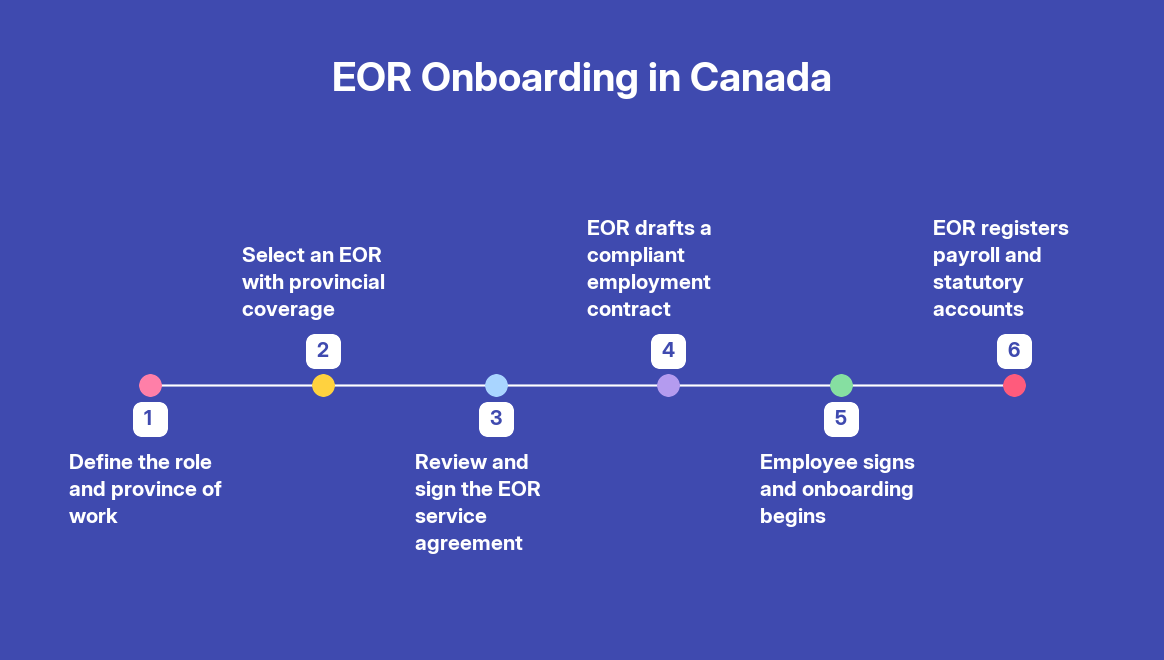
The process starts before you ever talk to a provider. Define the role, the province where the employee will work, and whether the position requires any regulated credentials. Province matters because employment standards, vacation entitlements, and termination rules differ across all 10 provinces and 3 territories. A marketing manager in British Columbia operates under different statutory minimums than one in Ontario.
Next, evaluate your employer of record providers in Canada against your specific provincial needs. Not all providers handle every province with equal depth. Quebec requires particular attention. Ask whether the provider maintains Quebec-specific payroll infrastructure and French-language documentation capabilities.
Once you select a provider, the service agreement defines scope. It specifies which statutory obligations the EOR assumes and which remain yours. Read the indemnification clauses carefully. They determine who bears financial exposure if a compliance error occurs.
The EOR then drafts an employment contract that meets the standards legislation of the employee's province. A London fintech company hiring two compliance analysts in Toronto through an EOR had both contracts reviewed and signed within six business days. The EOR handled CRA registration, set up payroll deductions for CPP and EI, and ran the first pay cycle within three weeks of initial engagement.
Your responsibility during onboarding is providing accurate compensation details, role descriptions, and any variable pay structures. The EOR cannot process what it does not receive correctly.
EOR vs. Setting Up a Canadian Subsidiary
The decision between an EOR and a subsidiary depends on your headcount trajectory, timeline, and appetite for administrative overhead. Neither option is universally better. The right choice depends on where you are in your Canadian hiring lifecycle.
| Factor | EOR Model | Canadian Subsidiary |
|---|---|---|
| Setup timeline | 5 to 15 business days | 3 to 6 months typical |
| Upfront cost | Monthly per-employee fee, no incorporation cost | Federal/provincial incorporation fees, legal setup, registered office |
| Ongoing admin | EOR handles payroll, tax filings, statutory remittances | Internal or outsourced payroll, own CRA accounts, annual filings |
| Direct control | Client directs day-to-day work; EOR holds legal employer status | Full legal and operational control |
| IP ownership | Requires explicit IP assignment clauses in the EOR contract | Direct employer-employee IP ownership |
| Best suited for | 1 to 15 employees, market testing, speed-sensitive hiring | 15+ employees, long-term commitment, regulated industries |
A Singapore-based e-commerce company used an EOR to hire its first four customer support agents in Vancouver. Eighteen months later, with the team at twelve and growing, the company incorporated a British Columbia subsidiary. The EOR managed the transition, including continuity of employee benefits during the handover period.
The crossover point is not purely about headcount. If your Canadian team handles sensitive financial data or operates in a regulated sector like securities, provincial regulators may require a registered business presence. That requirement exists regardless of whether you have three employees or thirty. Companies in unregulated sectors often operate through an EOR arrangement indefinitely without legal issues.
For companies still evaluating their options, the complete hiring guide for employer of record in Canada covers the full regulatory landscape across provinces.
FAQs
What is the difference between an EOR and a staffing agency in Canada?
A staffing agency sources, selects, and supplies workers to client companies. The agency typically retains control over placement decisions and worker assignments. An EOR employs workers that the client company has already identified and selected. The client directs day-to-day work while the EOR handles legal employment obligations. Some providers market themselves as both. In those cases, the nature of the specific engagement determines the legal classification. If the provider sourced and placed the worker, it functions as a staffing agency for that engagement regardless of its branding.
Do I need an EOR to hire a contractor in Canada, or only for employees?
EOR services apply to employment relationships, not independent contractor engagements. If you engage a genuine independent contractor, no EOR is needed. The risk arises if the CRA later determines that your contractor was actually an employee under the common-law test or Quebec's Civil Code test. In that scenario, no EOR would have been in place to cover back-remittances for CPP, EI, and income tax. The reassessment creates retroactive liability plus penalties and interest. Companies unsure about classification should seek a CRA ruling before engaging.
Can a company use an EOR in Canada indefinitely, or is there a point at which setting up a local entity becomes mandatory?
No Canadian federal law mandates incorporation based on headcount alone. You can use an EOR arrangement indefinitely for most roles. The exception applies in certain regulated industries. Provincial securities commissions, banking regulators, and some professional licensing bodies may require a registered business presence regardless of team size. Separately, some EOR providers contractually limit the number of employees they will co-employ in a single province before requiring the client to incorporate. Check your service agreement for those thresholds. They are provider-imposed, not statutory.
If the EOR makes a payroll error in Canada, who is liable — the EOR or the client company?
Most EOR service agreements include indemnification clauses where the EOR accepts liability for errors arising from its own processing. This covers mistakes like miscalculated CPP deductions or late CRA remittances caused by the EOR's systems. The client company remains exposed if it supplied incorrect data. For example, if you report the wrong hours or bonus amounts and the EOR processes them as provided, the resulting CRA penalty falls back on you. A missed CRA remittance deadline caused by late client reporting typically triggers the same exposure. Review your agreement's data-accuracy obligations carefully.
What happens to an employee's benefits and seniority if a company transitions from an EOR to a direct Canadian entity?
Under the successor employer doctrine recognized in several provinces, if the employee's role, responsibilities, and work continue without interruption, the transition may be treated as deemed continuous employment. That means seniority for termination notice purposes carries over from the EOR engagement. Ontario's Employment Standards Act has explicit successor employer provisions. Other provinces vary. Practically, the employee signs a new contract with your entity, but accumulated service may count toward notice and severance calculations. Negotiate the transition timeline with your EOR to avoid gaps in benefit coverage between the two arrangements.
How does Quebec's distinct legal framework affect EOR services?
Quebec operates under the Civil Code rather than common law, which changes how employment contracts are interpreted. Implied terms that exist under common law in other provinces may not apply in Quebec. Bill 96 strengthens the Charter of the French Language and requires that employment contracts, workplace communications, and HR documents be available in French. Not every EOR provider maintains the French-language infrastructure and Quebec-specific compliance systems this demands. The Act Respecting Labour Standards also sets distinct rules for psychological harassment protections and wage recovery. Before engaging an EOR for Quebec-based employees, confirm the provider's specific Quebec capabilities in writing.
Can an EOR in Canada sponsor work permits for foreign nationals?
An EOR can sponsor work permits because it holds legal employer status in Canada. The EOR files the Labour Market Impact Assessment where required and submits the employer compliance documentation. Processing timelines depend on the work permit category and the employee's country of citizenship. Open work permits tied to specific programs do not require LMIA sponsorship. Employer-specific work permits do. The EOR's ability to sponsor is one key advantage over PEO arrangements, where co-employment status can complicate immigration filings. Confirm your EOR's immigration track record in the specific permit category your hire needs.
What to Watch Next
Canada's federal government has signaled reviews of temporary foreign worker programs and employer compliance frameworks. Provincial governments continue adjusting employment standards, with several provinces updating termination notice and vacation entitlement rules in recent legislative sessions. Quebec's Bill 96 language requirements are being enforced with increasing scrutiny, and penalties for non-compliance are rising.
Monitor the CRA's annual updates to CPP and EI contribution thresholds. These change every January and directly affect your per-employee cost through the EOR. If your Canadian team is approaching double digits, model the cost comparison between continued EOR engagement and subsidiary incorporation. Your EOR provider should supply the data to run that analysis. If they cannot, that tells you something about the relationship.
Companies exploring employer of record services for Canadian hiring should start with a single-province pilot. Validate the provider's payroll accuracy, responsiveness, and provincial expertise before scaling. The first hire teaches you more about your EOR than any sales call ever will.
.svg)


