


How Much Does an Employer of Record Cost in Canada?

Our guide to why companies choose an EOR in Canada covers the strategic reasons behind this hiring model, including a brief section on costs. This article goes deeper. It breaks down exactly how EOR pricing works in Canada: what the fees cover, what they exclude, which statutory costs sit on top, and how provincial differences change the numbers.
Canada's payroll tax structure, mandatory benefits, and provincial labor variations make the cost picture more complex than a single monthly fee suggests. Understanding each layer prevents budget surprises. Whether you are hiring one product manager in Ontario or building a five-person support team in British Columbia, this breakdown gives you the detail your finance team needs before signing a contract.

How EOR Providers Structure Their Fees in Canada
Per-Employee Monthly Fee
Most EOR providers charge a flat monthly fee per employee. This fee covers the provider's core service: acting as the legal employer, running payroll, filing taxes, issuing compliant employment agreements, and managing terminations.
Across the Canadian EOR market, monthly fees typically range from $400 to $700 USD per employee. Some providers price higher for short-term contracts or senior executive hires where termination liability is elevated. Others offer volume discounts when you hire five or more employees.
The monthly fee is not your total employer cost. It is the service fee alone.
What the Service Fee Includes
A standard EOR monthly fee in Canada typically covers these core functions:
- Drafting and maintaining a province-specific employment contract
- Monthly payroll processing and direct deposit
- Statutory deductions: income tax, Canada Pension Plan, Employment Insurance
- T4 slip preparation and year-end tax filing
- Basic compliance monitoring for provincial employment standards
- Employee onboarding and offboarding administration
What sits outside the fee varies by provider. Health and dental benefits, workers' compensation premiums, and equity plan administration usually carry separate charges. Before comparing quotes, confirm which statutory costs are bundled and which are passed through as a separate line item.
Markup Models vs. Flat Fee Models
Some providers use a percentage-of-salary markup instead of a flat fee. A markup model charges 10% to 20% of the employee's gross salary. For a Canadian developer earning CAD 120,000 annually, a 15% markup means CAD 18,000 per year in service fees alone.
Flat fee models are more predictable. A $500 monthly flat fee for the same employee totals $6,000 USD per year. The difference becomes significant with higher salaries. A US fintech company hiring three senior engineers in Toronto through a markup model could pay CAD 15,000 more annually than under a flat structure. Always ask which model applies.
The Hidden Cost Layer: Statutory Obligations and Provincial Variations
Federal Employer Contributions
Canada's federal payroll obligations sit on top of any EOR service fee. Every employer in Canada must contribute to the Canada Pension Plan (CPP) and Employment Insurance (EI) on behalf of each employee. The employer's EI premium rate exceeds the employee's share by a fixed multiple set annually by the Canada Employment Insurance Commission.
CPP contributions apply on earnings between a basic exemption amount and the yearly maximum pensionable earnings. Both thresholds change annually. Confirm the current figures on the Canada Revenue Agency portal before budgeting.
These are pass-through costs. Your EOR invoices them to you at actual cost, or bundles them into a loaded payroll cost.
Provincial Tax and Benefit Differences
Canada's ten provinces and three territories each set their own employment standards. This creates real cost variation depending on where your employee works.
| Cost Factor | Ontario | British Columbia | Quebec |
|---|---|---|---|
| Provincial health premium | Employer Health Tax on payroll | Employer Health Tax on payroll | RAMQ: employer contributes to Health Services Fund |
| Paid vacation minimum | 2 weeks (first 5 years) | 2 weeks (first 5 years) | 2 weeks (first 1 year), 3 weeks after |
| Additional payroll levy | None standard | None standard | QPIP (parental insurance) + QPP replaces CPP |
| Workers' comp model | WSIB: industry-rate premiums | WorkSafeBC: industry-rate premiums | CNESST: industry-rate premiums |
Quebec stands apart. It operates its own pension plan, the Quebec Pension Plan (QPP), replacing CPP. It also mandates the Quebec Parental Insurance Plan (QPIP), adding a contribution that other provinces do not have. A Quebec-based hire will carry higher statutory costs than an equivalent role in Alberta.
Workers' Compensation and Industry-Specific Rates
Workers' compensation premiums in Canada are not a flat percentage. Each province sets rates by industry classification. A software company pays a fraction of what a construction firm pays. Your EOR registers your employees under the correct classification code. Misclassification triggers audit risk and potential back-premiums.
Some EOR providers absorb workers' compensation into their monthly fee. Others pass it through at cost. For tech roles, the premium is typically modest. For field-based or manual roles, it can add meaningful cost.
EOR Pricing vs. Subsidiary Setup: A Cost Comparison
When weighing an EOR against setting up a Canadian subsidiary, the cost equation extends well beyond monthly fees.
Upfront Investment for a Subsidiary
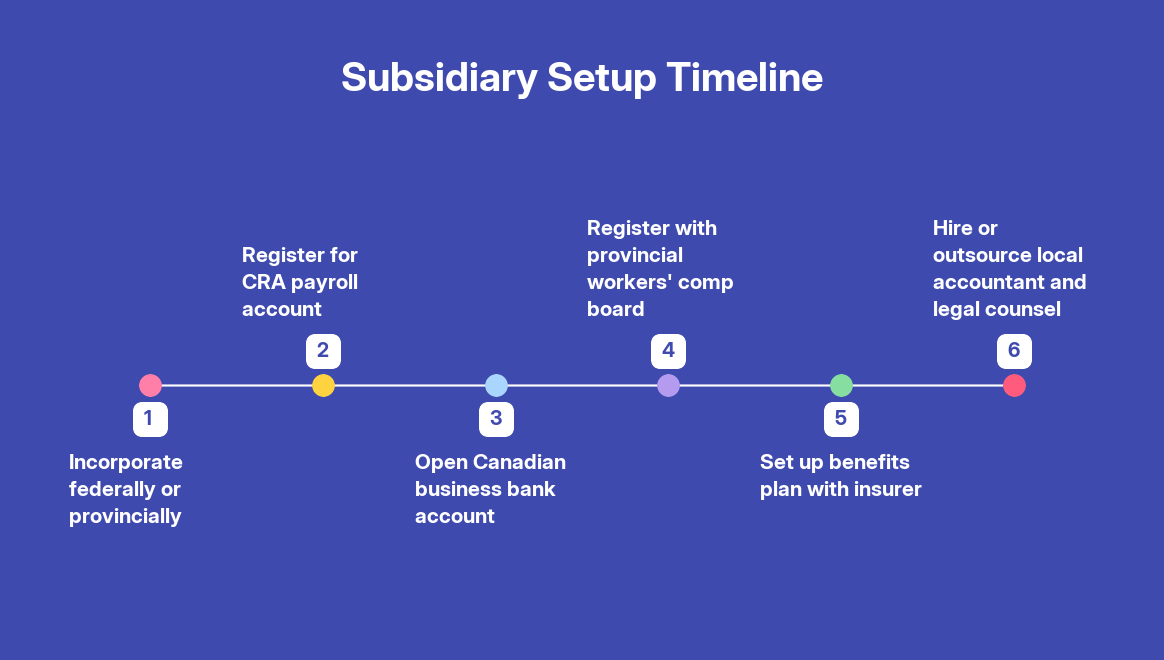
Incorporating a federal or provincial entity in Canada involves registration fees, legal drafting, and accounting setup. Legal fees for incorporation and initial employment contract drafting commonly run CAD 5,000 to CAD 15,000. Annual accounting, tax filing, and corporate maintenance add CAD 8,000 to CAD 20,000 depending on complexity.
You also need a registered office address, a Canadian business bank account, and a CRA payroll account. Each step takes time. Entity setup in Canada typically takes three to six months from first filing to operational payroll.
Break-Even Analysis
For a single employee, the EOR path is almost always cheaper in year one. An EOR charging $500 per month costs $6,000 annually in service fees, plus pass-through statutory costs. A subsidiary costs $15,000 or more in setup alone before you run your first payroll.
The break-even point depends on headcount growth. At five to seven Canadian employees, the per-person cost of maintaining your own entity starts to drop below the cumulative EOR fees. At ten or more, the subsidiary model usually wins on pure cost. But cost is only one factor. Ongoing compliance management, HR administration, and termination liability exposure still carry operational weight even with your own entity.
When EOR Remains Cost-Effective Long-Term
A London-based SaaS company hired two customer success managers in Vancouver through an EOR. Eighteen months later the team still numbered two. At that scale, establishing a subsidiary would have cost more than three years of EOR fees combined. The EOR model remained the rational choice because headcount did not grow beyond the break-even threshold.
Companies hiring for project-based roles or testing a new market also benefit. If your Canadian team might shrink or dissolve within 24 months, the EOR avoids the exit costs of winding down a subsidiary.
How to Evaluate an EOR Quote for Canada

Loaded Cost vs. Service Fee
The most useful number is your total loaded cost per employee. This combines the EOR service fee, the employee's gross salary, all statutory employer contributions, benefits premiums, and any administrative add-ons.
Ask every provider for a loaded cost breakdown. A quote showing only the service fee hides the majority of your spend. Two providers quoting $450 and $600 monthly may deliver identical loaded costs if the cheaper one passes through higher administrative charges separately.
Questions That Reveal True Cost
Before signing, put these questions to each provider:
- Does your fee include workers' compensation premiums, or are they billed separately?
- How do you handle provincial benefits differences for employees in Quebec versus Ontario?
- What is your FX markup on currency conversion from USD or EUR to CAD?
- Are termination costs, including statutory notice and severance, pre-funded or invoiced at the time of termination?
- Do you charge a setup fee per employee at onboarding?
FX markup deserves close attention. Some providers embed a 1% to 3% spread in the exchange rate. On a CAD 100,000 salary, a 2% spread adds CAD 2,000 in hidden annual cost. For EOR providers operating in Canada, transparency on currency conversion separates trustworthy partners from opaque ones.
Watch out: A provider quoting no setup fee may still charge a one-month security deposit per employee, effectively locking up one month of loaded cost as working capital. Ask whether any deposit applies and when it is refundable.
Benefits as a Cost Variable
Canadian employees expect extended health, dental, and vision coverage beyond what provincial health plans provide. Your EOR either offers a group plan or arranges one through a third-party insurer. Group plan premiums for a standard tech-sector benefits package in Canada typically run CAD 150 to CAD 350 per employee per month, depending on coverage level and family status.
Some EOR providers negotiate group rates across their entire Canadian employee pool. That purchasing power can reduce your per-employee benefits cost compared to procuring a standalone plan through your own entity. For a detailed breakdown of what Canadian EOR benefits packages include, see our separate guide.

FAQs
Does an EOR in Canada charge differently for contractors versus employees?
Yes. Contractor management fees are typically lower than full EOR fees because the provider does not handle statutory deductions, CPP, EI, or benefits enrollment. Expect CAD 30 to CAD 80 per contractor per month for payment processing and compliance monitoring. The trade-off is that misclassification risk sits with you. If the CRA reclassifies a contractor as an employee, back taxes, penalties, and interest apply retroactively. An EOR's contractor management service helps reduce that risk through proper classification review.
Are EOR costs tax-deductible for the client company?
EOR fees and the loaded payroll costs invoiced to your company are generally deductible as a business expense in your home jurisdiction. The employee is not on your entity's payroll, so you claim the EOR invoice as a service cost. Consult your home-country tax advisor to confirm treatment. Transfer pricing documentation may be required if the client entity and the EOR operate in different tax jurisdictions and payments exceed local thresholds.
How do termination costs work through a Canadian EOR?
Canadian employment law provides statutory minimum notice and severance based on tenure and province. Ontario, for example, mandates both statutory notice and severance pay for employees with five or more years of service at qualifying employers. Common law reasonable notice can exceed statutory minimums significantly. Most EOR providers invoice termination costs at the time of separation rather than pre-funding them. Budget a termination reserve equivalent to at least two to four months of salary for each Canadian employee, adjusted upward for longer-tenured staff.
Can I switch EOR providers mid-contract without extra cost?
Switching providers requires terminating the employee under the outgoing EOR and re-hiring under the new one. The outgoing provider will invoice any accrued but unused vacation pay, notice period costs, and final statutory remittances. Some providers charge an early termination fee if you exit before a minimum contract period, often 12 months. The incoming provider may charge an onboarding fee. Transition typically takes two to four weeks. Plan the switch at a natural payroll cycle boundary to minimize disruption and double-invoicing for the overlap period.
What to Watch Next
Canada's federal and provincial employment standards continue to evolve. Several provinces have introduced or expanded pay transparency requirements. Quebec regularly adjusts its QPP and QPIP contribution rates. Monitoring these changes matters because each shift directly affects your loaded cost per employee.
Before committing to a provider, request a province-specific cost model for your target roles. Compare loaded costs across at least two providers using the same salary and benefits assumptions. The numbers tell you more than the sales pitch.
If you need a province-specific cost estimate for hiring through an EOR in Canada, request a breakdown from TeamUp.
Written by the TeamUp Editorial Team. TeamUp is a people-first EOR and nearshoring partner helping companies across North America, Europe, the Middle East, and Singapore hire compliantly in 20+ countries.
.svg)


