


Uzbekistan Work Permits & Visas: Employer Guide to Types & Sponsorship
TL;DR
Hiring in Uzbekistan is not as simple as posting a job offer and jumping on Zoom with your new hire. That is especially true if the person you want to hire is a foreign national.
This guide is built for founders, CFOs, and HR leaders evaluating Uzbekistan as a growth market. We will walk you through how work permits and visas actually function, what sponsorship requires in practice, and how to hire both foreign and local talent in full compliance.
Whether you are a scaling startup or an enterprise expanding into Central Asia, this guide is designed to prevent costly mistakes and unnecessary delays. By the end, you will understand:
- How Uzbekistan’s work authorization system operates
- What sponsorship legally entails
- The difference between direct hiring and using an Employer of Record (EOR)
- How to navigate the bureaucracy without operational disruption
Most importantly, you will see why a local Employer of Record in Uzbekistan can become a strategic advantage rather than just a compliance tool.
Quick Navigation
- TL;DR
- Overview of Work Authorization in Uzbekistan
- Types of Work Permits and Visas in Uzbekistan
- Highly Qualified and Qualified Specialists Meaning in Uzbekistan
- Uzbekistan Work Visa Types
- What Does Not Qualify
- Sponsorship Models: Direct Entity vs. Employer of Record
- Step-by-Step: Sponsoring a Foreign National in Uzbekistan
- Hiring Uzbek Nationals via EOR. A Simpler Path to Local Compliance
- Payroll, Taxes & Ongoing Compliance in Uzbekistan
- Compliance Comparison: Uzbekistan vs. Regional Markets
- Mistakes to Avoid When Hiring Foreign Talent in Uzbekistan
- Why Using an Employer of Record in Uzbekistan Makes Strategic Sense
- The Strategic Takeaway
- Final Thought
- Frequently Asked Questions
Overview of Work Authorization in Uzbekistan
Uzbekistan treats foreign employment compliance seriously. Hiring a foreign national without proper authorization can result in significant penalties, including fines of up to 50 times the minimum wage for repeat violations.
The government’s policy objective is clear: prioritize employment for Uzbek citizens and allow foreign hires only when the required expertise cannot be sourced locally.
To legally employ a foreign worker, two separate approvals are required:
- Employer Authorization – Permission for the company to hire foreign nationals
- Employee Work Authorization – Permission for the individual to work in Uzbekistan
No permit means no legal employment. A tourist visa or business visa does not authorize employment under any circumstances.
The system may appear bureaucratic at first glance, but it is structured and predictable. With proper planning or the right local partner, it is fully manageable.
Types of Work Permits and Visas in Uzbekistan
In practice, Uzbekistan’s work authorization framework consists of two core components:
1. Employer Permit (Corporate Work License)
This is issued to the company by the Agency for External Labor Migration. It functions as authorization for the employer to hire foreign workers.
Key features:
- Typically valid for 6 to 12 months
- May specify how many foreign nationals the company can employ
- Required for most foreign hires
2. Employee Work Permit (Confirmation)
This is issued to the foreign employee and authorizes them to work for the sponsoring company.
Key features:
- Usually valid for up to 1 year
- Renewable annually
- Tied directly to the sponsoring employer
Both approvals must be in place before the employee begins work.
Highly Qualified and Qualified Specialists Meaning in Uzbekistan
Uzbekistan provides streamlined treatment for certain high-skilled professionals.
Highly Qualified Specialists
A candidate may qualify if they:
- Hold a degree from a recognized international university
- Have at least 5 years of experience
- Are offered a salary exceeding USD 60,000 per year
Benefits:
- No employer permit required
- Work authorization can be issued for up to 3 years
- Renewable in 1-year increments without limitation
Qualified Specialists
A slightly lower threshold applies:
- 5+ years of experience
- Salary exceeding USD 30,000 per year
These individuals may also bypass the employer permit requirement.
For all other foreign hires, the standard employer permit plus employee confirmation structure applies.

Uzbekistan Work Visa Types
Foreign employees must also secure the correct entry visa.
Type E – Employment Visa
- Typically issued for single entry
- Valid for up to 1 year
- Must align with the issued work permit
This is the standard visa for most foreign hires.
Type S – Specialist Visa
- Valid for up to 3 years
- Generally available to highly qualified specialists
Even if a foreign hire is exempt from the employer permit, they still require proper work authorization and an appropriate visa. There are no immigration shortcuts.
What Does Not Qualify
Business Visa (Type B-2)
- Used for meetings, conferences, exploratory visits
- May allow multiple entries
- Does not permit employment
Using a business visa for ongoing paid work is a common compliance mistake and carries real enforcement risk.
Sponsorship Models: Direct Entity vs. Employer of Record
Once you understand the permits and visas required, the next strategic question is simple:
Who will legally sponsor and employ this person in Uzbekistan?
You have two options:
- Set up and use your own local entity
- Hire through an Employer of Record (EOR)
This decision affects cost, speed, risk, and operational flexibility.
Let’s break it down.
Option 1: Direct Hiring via Your Own Entity
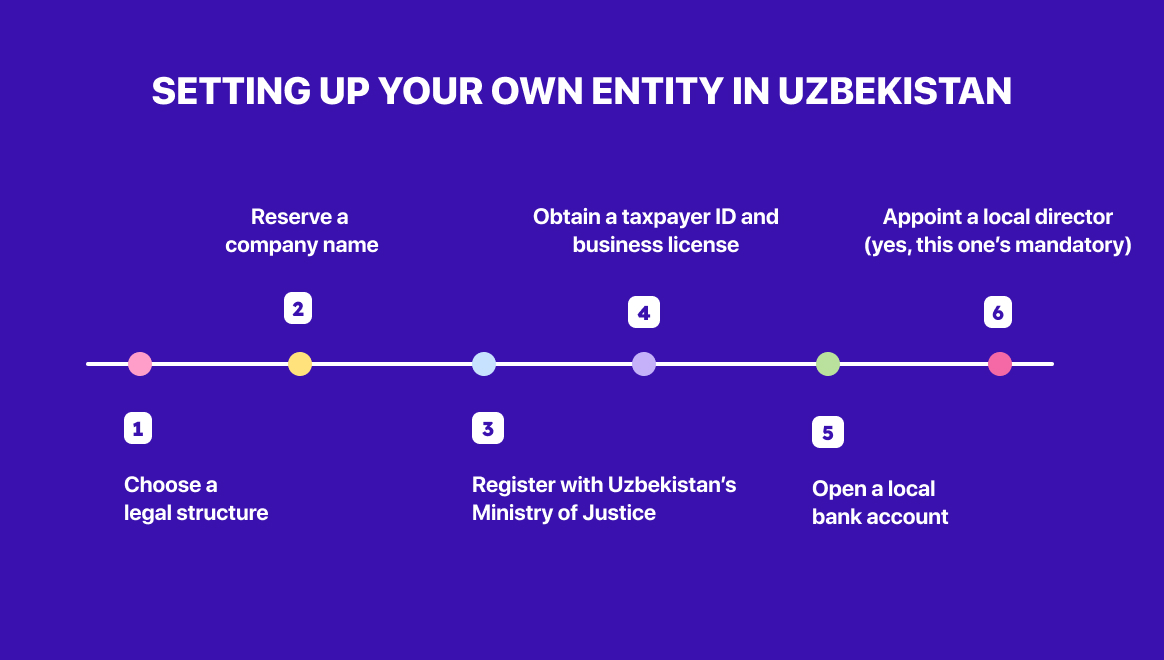
This means establishing a legal company or branch in Uzbekistan and becoming the official employer.
The Upside
- Full legal control
- Direct local presence
- Brand ownership on paper
The Reality
Everything else becomes your responsibility.
What You Take On
- Company incorporation, which can take months
- Significant setup costs
- Ongoing tax registration and compliance
- Monthly payroll in Uzbekistani Som
- Social contributions and tax filings
- Drafting fully compliant Uzbek-language contracts
- Maintaining employment records, including labor books
- Sponsoring work permits and visas directly
Only a locally registered entity can apply for foreign work permits. If you do not already have one, you must create it before hiring.
That means if you only want to hire one or two employees, you are building an entire corporate infrastructure just to support them.
And if you misinterpret local labor regulations, the liability sits entirely with your company.
For many businesses testing the market or hiring small teams, this approach is heavy and inefficient.
Option 2: Hiring via an Employer of Record (EOR)
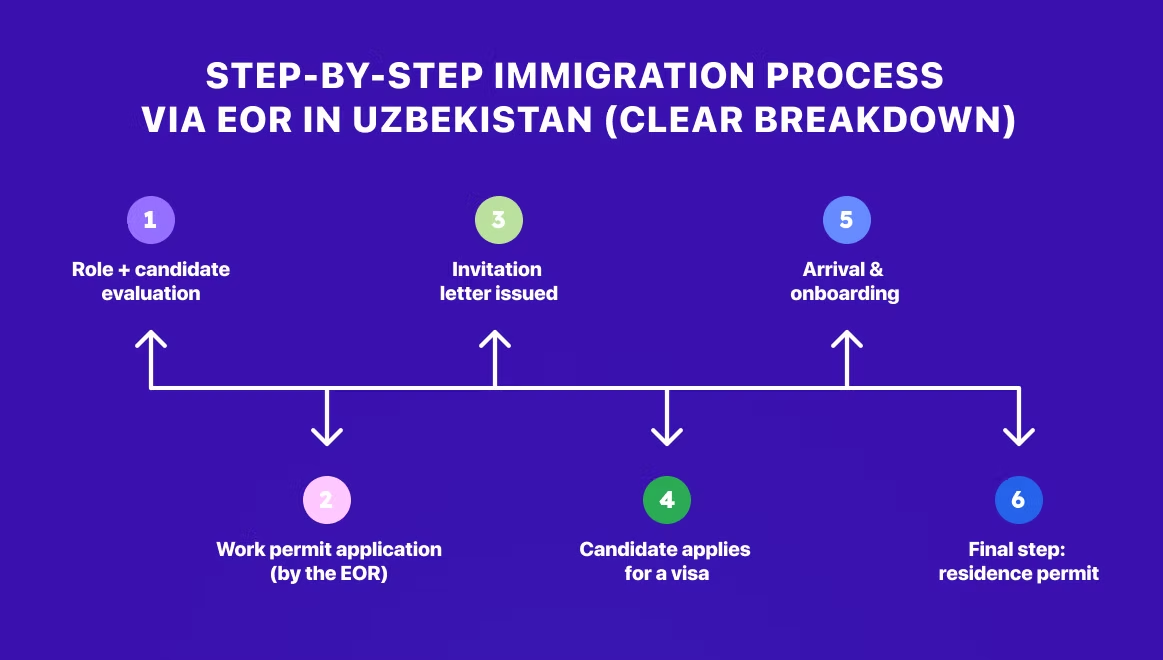
An Employer of Record already has a registered legal entity in Uzbekistan.
They become the legal employer on paper.
You retain operational control.
What That Means in Practice
- No entity setup
- No local incorporation delays
- No payroll infrastructure buildout
- No navigating labor bureaucracy alone
The EOR handles:
- Employment contracts
- Payroll and tax withholding
- Social contributions
- Work permit sponsorship
- Visa processing
- Local registrations
- Ongoing compliance
You focus on managing performance and business results.
For example, the EOR submits work permit applications because they are the official employer of record. They carry the legal compliance burden.
Key Advantages
- Faster onboarding
- Lower compliance risk
- Greater flexibility
- Easier market entry
- Easier exit if needed
If the expansion fails, dissolving an EOR agreement is far simpler than liquidating a legal entity.
The Trade-off
You pay a service fee.
But when compared to:
- Maintaining a subsidiary
- Hiring local HR staff
- Risking compliance penalties
For many companies, it is an obvious strategic trade.
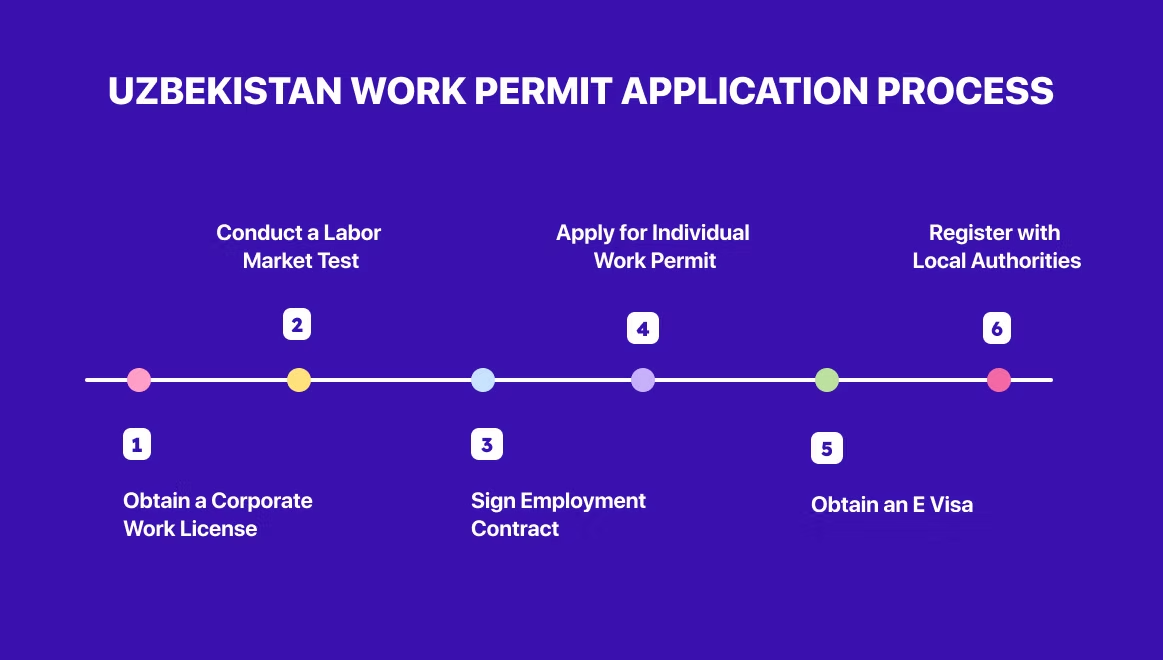
Step-by-Step: Sponsoring a Foreign National in Uzbekistan
Here is the practical roadmap.
Whether you use your own entity or an EOR services, these are the core steps. The only difference is who executes them.
1. Confirm the Hire and Eligibility
First, assess whether the candidate qualifies as:
- Highly Qualified Specialist
- Qualified Specialist
- Standard Foreign Specialist
If they meet the $60,000+ salary and credential threshold, you can skip the employer permit step.
If not, proceed with the full authorization pathway.
Uzbek authorities will evaluate whether this role truly requires foreign expertise.
2. Conduct a Local Labor Market Search
Before approval, you must demonstrate that the position could not be filled locally.
This involves:
- Posting the role locally
- Interviewing Uzbek candidates
- Documenting why they were not suitable
Keep detailed records of:
- Job advertisements
- Interview notes
- Evaluation summaries
Failure to properly document this step can result in rejection.
3. Apply for Employer Permit (Corporate Work License)
For non-exempt hires, the employer must apply to the Agency for External Labor Migration.
Required materials typically include:
- Company registration documents
- Labor test documentation
- Application forms
- Government fee payment
If approved, you receive authorization to hire foreign labor for a defined period.
If you use an EOR in Uzbekistan, they handle this stage.
4. Obtain the Individual Work Permit (Confirmation)
Next, file the employee’s work authorization application.
Common documents include:
- Passport copy
- Notarized diplomas
- Medical certificate
- Police clearance
- Draft employment contract
- Government forms
Uzbekistan no longer requires an HIV-negative certificate.
Authorities will review qualifications and compliance documentation before issuing the confirmation.
5. Secure Visa Invitation and Apply for Type E Work Visa
Once work authorization progresses, you obtain an official visa invitation.
The employee applies at an Uzbek consulate for:
Type E – Employment Visa
Typical consular fees:
- Approx. $80 for 3 months
- Approx. $160 for 1 year single-entry
- Higher for multiple-entry
The candidate must wait abroad until the visa is approved.
6. Entry to Uzbekistan
After visa issuance:
- The employee typically has 30 days to enter Uzbekistan
- Visa is checked at border control
- Work permit supports employment legality
Now the hire is physically in-country.
7. Post-Arrival Registration
Within 3 business days of arrival, the employee must register their address.
Hotels register automatically.
Rental housing requires registration at the local migration office.
At this stage:
- Tax Identification Number (TIN) is obtained
- Enrollment into payroll and social funds begins
An EOR or local HR team usually manages this.
8. Commence Work Legally
Ensure:
- Uzbek-language employment contract is signed
- The workbook is created or updated
- Payroll is properly set up
Now the employee can begin working legally.
9. Monitor and Renew
Work permits can be renewed indefinitely.
Renewal applications must be filed 20 working days before expiration.
Also remember:
- Visa extensions if required
- Reporting job changes
- Notifying authorities upon termination
Compliance is ongoing.
Missed deadlines create operational risk.
Hiring Uzbek Nationals via EOR. A Simpler Path to Local Compliance
So far we’ve focused on foreign nationals. But what if you’re hiring local Uzbek talent?
On the surface, it seems easier. No visa. No work permit. No immigration bureaucracy.
But there’s one critical constraint:
You cannot legally employ a Uzbek citizen without a locally registered entity.
If your company does not have a legal presence in Uzbekistan, you cannot simply add a Uzbek employee to your foreign payroll.
This is where an Employer of Record becomes highly relevant. Even for local hires.
Why Use an EOR for Local Uzbek Employees?
Let’s say you’re a London-based tech company and you find an outstanding developer in Tashkent.
Without a local entity, your options are:
- Misclassify them as an “independent contractor” and pay from abroad. Risky. Potentially illegal if the relationship looks like employment.
- Establish a subsidiary in Uzbekistan for one hire. Expensive and slow.
- Informal third-party arrangements. Extremely risky.
The EOR route removes all of that friction.
What Happens with an EOR
- The EOR’s Uzbekistan entity becomes the legal employer.
- The employee signs a compliant Uzbek employment contract.
- Payroll runs in Uzbek som.
- Income tax and mandatory contributions are withheld properly.
- Social registrations are handled correctly.
- Labor book records are maintained.
- You manage daily work as usual.
From the employee’s perspective, they are formally employed in Uzbekistan.
From your perspective, you avoid entity setup and compliance exposure.
Avoiding Payroll and Tax Risks
Uzbekistan has:
- Personal income tax obligations
- Pension contributions
- Employer-paid contributions
- Mandatory reporting
If you pay someone informally from abroad without proper withholding, you risk:
- Tax liabilities
- Retroactive penalties
- Classification disputes
- Regulatory exposure
An employer of record payroll service ensures:
- Employee registration with tax authorities
- Proper monthly withholding
- Government remittance
- Payslip issuance
- Clean audit trail
You receive one consolidated invoice covering salary, taxes, and service fee.
It is structured. It is compliant. It is defensible.
Labor Law Nuances You Should Not Ignore
Uzbek labor law includes:
- Formal probation requirements
- Strict termination procedures
- Mandatory paid leave minimums
- Defined overtime rules
- Labor book documentation
Termination risk is considered high compared to more flexible markets.
If you terminate incorrectly, the employee may challenge the dismissal and the employer can face liability.
An EOR reduces this risk by:
- Issuing fully compliant bilingual contracts
- Structuring probation properly
- Managing termination legally
- Maintaining required documentation
If there is an inspection, the EOR handles it.
You avoid regulatory exposure.
Payroll, Taxes & Ongoing Compliance in Uzbekistan
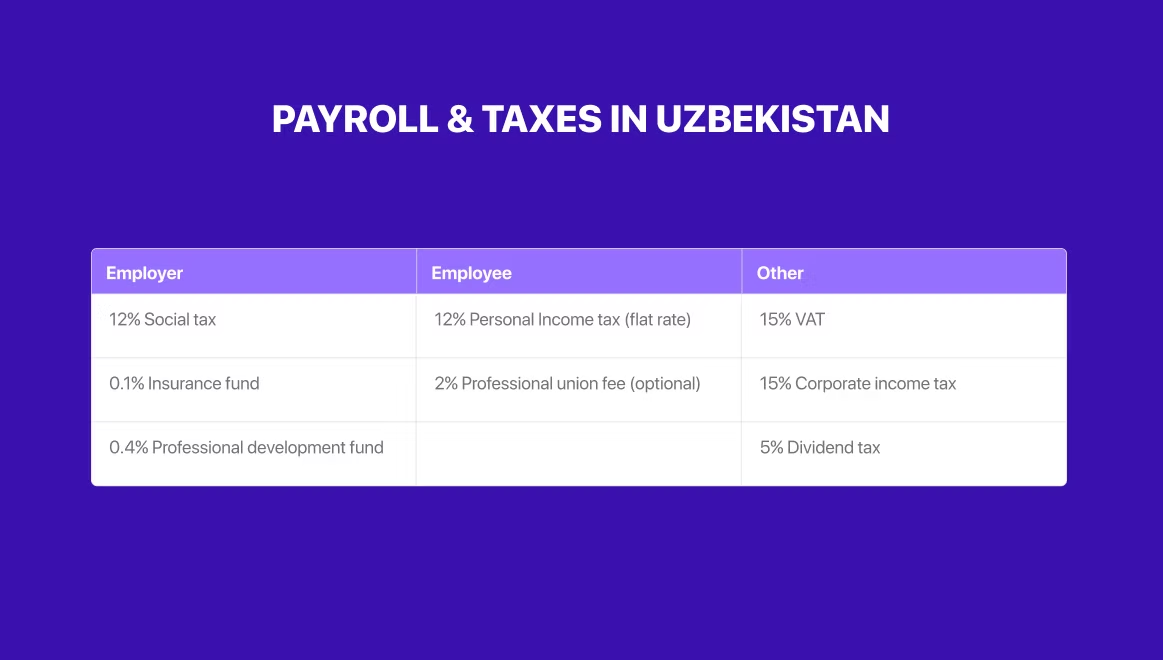
EOR vs. Local Entity
Hiring is not a one-time event. Compliance is continuous.
Let’s compare what happens after onboarding with EOR vs. Local Entity.
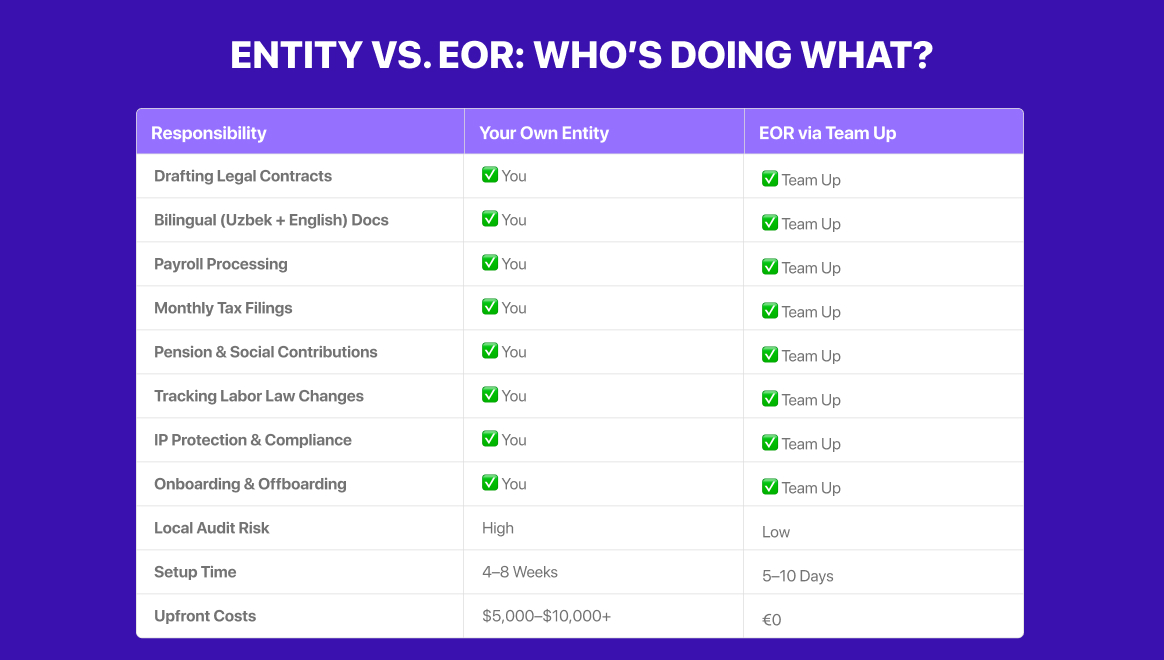
If You Operate Your Own Uzbek Entity
You are responsible for:
- Gross-to-net salary calculations
- Income tax withholding
- Pension and social contributions
- Employer-paid contributions
- Local currency payment
- Monthly tax filings
- Social fund reporting
- Quarterly or annual compliance statements
- Labor books
- Employment contracts in Uzbek
- Proof of wage payment
- Overtime documentation
- Leave tracking
- Paying in Uzbek som
- Handling FX exposure if funded from USD or EUR
- Overtime pay rules
- Statutory leave
- Maternity and sick leave
- Proper termination procedure
Any missed filing or late payment can result in:
- Fines
- Interest penalties
- Compliance investigations
If you do not have dedicated local HR and accounting staff, this becomes operationally heavy.
If You Use an Employer of Record Uzbekistan
The EOR handles:
- Payroll processing
- Tax withholding and remittance
- Social contributions
- Government filings
- Labor law compliance
- Work permit renewals
- Documentation updates
You fund payroll. They execute everything locally.
If tax rates change, the EOR adjusts automatically.
If new reporting forms are introduced, the EOR service provider implements them.
If termination becomes necessary, the EOR executes it compliantly.
From your perspective, compliance becomes managed infrastructure rather than a risk vector.
Compliance Comparison: Uzbekistan vs. Regional Markets
For decision-makers evaluating Central Asia and the Caucasus, context matters.
Here’s how Uzbekistan compares.
Uzbekistan vs. Kazakhstan
Kazakhstan is more restrictive.
Kazakhstan imposes:
- National foreign labor quotas
- Category-specific caps
- Regional allocations
- Annual government approvals
In 2024, Kazakhstan capped foreign permits at roughly 22,000 nationwide. Certain categories filled quickly.
Uzbekistan does not impose publicly rigid numeric quotas in the same way. It relies more on:
- Labor market justification
- Skill classification
- Case-by-case approval
Kazakhstan also requires stronger localization efforts and higher fee structures.
In practice:
Kazakhstan = heavier quota management. Uzbekistan = procedural bureaucracy but fewer hard caps
Both require permits. Both are compliance-driven. EOR support is common in both markets.
Uzbekistan vs. Georgia
Georgia historically had almost no work permit requirements.
- Visa-free stays up to 12 months for many nationalities
- No formal work authorization system until recently
However, from March 2026, Georgia introduced a structured work permit regime.
Even then, Georgia remains:
- More flexible
- Faster in processing
- Without strict labor market tests
- Without national quotas
Georgia remains easier for foreign hiring overall.
Uzbekistan is more controlled and documentation-heavy.
Uzbekistan vs. Armenia
Armenia introduced a unified work-residence permit system in 2022.
- Single integrated application
- Online submission portal
- No broad national quotas
- Exemptions for Eurasian Economic Union citizens
Armenia’s process is:
- More centralized
- Slightly more streamlined
- Still structured
Uzbekistan’s approach is similar in philosophy but often requires more manual documentation and labor market proof.
Both require local sponsorship. Both benefit from EOR facilitation.
Strategic Takeaway
If you compare across:
- Kazakhstan. Highly quota-driven and restrictive.
- Georgia. Historically open, now lightly regulated.
- Armenia. Structured but streamlined.
- Uzbekistan. Controlled, compliance-focused, skill-justified.
Uzbekistan sits in the middle. It is not impossible. It is not chaotic. It is procedural.
If you follow the steps carefully, hiring is achievable.
If you try to shortcut the system, it becomes expensive quickly.
This is precisely why companies entering emerging markets increasingly rely on Employer of Record models.
They allow:
- Fast market entry
- Controlled compliance exposure
- Scalable hiring
- Clean exit strategy
Mistakes to Avoid When Hiring Foreign Talent in Uzbekistan
Hiring foreign professionals in Uzbekistan is absolutely doable. But small mistakes can trigger big consequences.
Fines. Delays. Permit cancellations. Reputational damage.
Here are the most common mistakes employers make. And how to avoid them.
1. Letting Someone Start Work on the Wrong Visa
A business visa is not a work visa. A tourist visa is definitely not a work visa.
If a foreign national performs productive work in Uzbekistan without a Type E employment visa and valid work authorization, it is illegal.
Consequences can include:
- Heavy fines for the employer
- Deportation of the employee
- Blacklisting or entry bans
- Future work permit complications
There is no “we’ll fix it later” workaround. Work authorization must be approved before work begins.
2. Skipping the Labor Market Test
Uzbek authorities expect proof that:
- You attempted to hire locally
- No suitable Uzbek candidate was available
- The foreign hire is genuinely necessary
If you cannot provide documentation, your permit may be denied.
Keep records of:
- Job postings
- Candidate screenings
- Interview summaries
- Written justification
This step is procedural, but it is not optional.
3. Underestimating Timelines
Uzbekistan is not a two-week visa market.
Plan for:
- 2–3 months total processing time
- Additional time for document translation and notarization
- Visa issuance lead time
Do not promise aggressive start dates to candidates.
Build buffer into your hiring roadmap.
4. Failing to Register the Employee After Arrival
Within 3 business days of entry, the foreign employee must register their address.
Failure to register can lead to:
- Fines
- Exit complications
- Immigration flags
Hotels register guests automatically. Private housing requires manual registration.
This step is small but critical.
5. Using Non-compliant Employment Contracts
Your global HQ template will not work as-is.
Uzbek employment contracts must:
- Be in Uzbek (or bilingual with Uzbek governing version)
- Specify salary in UZS
- Define working hours
- Include statutory leave
- Align with termination requirements
Missing mandatory clauses can make the contract unenforceable.
Labor law compliance is not flexible.
6. Misclassifying Employees as Contractors
If the individual:
- Works full-time
- Reports to your managers
- Uses your systems
- Works exclusively for your company
They are an employee.
Calling them a “consultant” does not change the legal reality.
Misclassification risks include:
- Backdated taxes
- Labor disputes
- Social contribution penalties
- Regulatory investigations
Uzbekistan is tightening enforcement in this area.
7. Missing Renewals
Work permits must be renewed at least 20 working days before expiration.
If you miss the deadline:
- The employee may become unauthorized overnight
- They may need to exit the country
- You may need to restart the entire process
Set automated reminders. Or use an EOR provider that tracks this for you.
8. Poor Recordkeeping
You must retain:
- Work permits
- Visa documentation
- Registration slips
- Employment contracts
- Payroll records
- Labor book entries
Inspections do happen.
If authorities ask for documentation and you cannot provide it, penalties follow.
Why Using an Employer of Record in Uzbekistan Makes Strategic Sense
By now, it’s clear:
Hiring in Uzbekistan involves multiple moving parts:
- Employer permit
- Individual work authorization
- Visa sponsorship
- Registration
- Payroll compliance
- Labor law adherence
- Annual renewals
It is manageable. But it is operationally heavy.
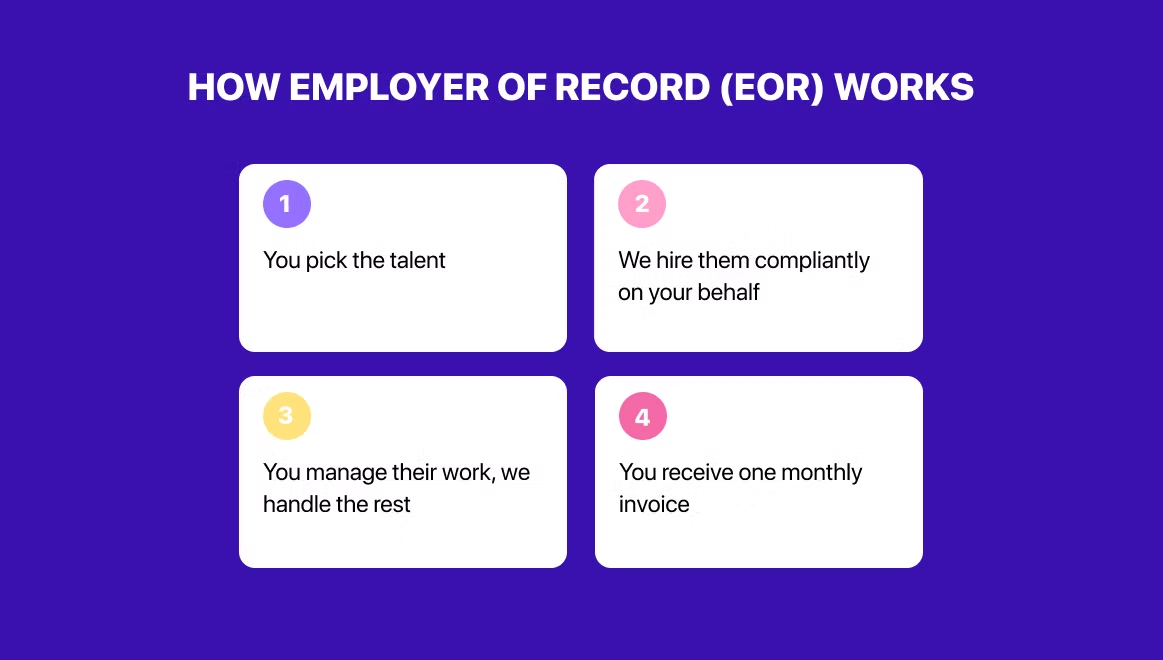
This is where an Employer of Record becomes a strategic asset.
What an EOR Handles for You
A local EOR provider in Uzbekistan will:
- Act as the legal employer
- Apply for work permits
- Manage labor market tests
- Secure visa invitations
- Coordinate embassy filings
- Register employees locally
- Run payroll in UZS
- Withhold and remit taxes
- Maintain labor books
- Track renewals
- Handle compliant terminations
You focus on managing performance.
They focus on compliance.
Why Decision-makers Choose EOR in Emerging Markets
For founders and CFOs expanding into Central Asia, the logic is simple:
- No entity setup required
- No months of incorporation delays
- No need to build local HR infrastructure
- No exposure to unfamiliar labor courts
- No payroll tax learning curve
Instead:
- Fast market entry
- Clean legal structure
- Predictable costs
- Scalable hiring
It’s operational leverage.
The Risk vs. Cost Equation
Yes, an EOR charges a service fee.
But compare that to:
- Entity registration costs
- Ongoing accounting expenses
- Internal HR overhead
- Compliance penalties
- Immigration errors
- Tax audits
The math often favors structured outsourcing.
Especially in early-stage expansion.
The Strategic Takeaway
Your objective is not to master Uzbek labor code.
Your objective is to:
- Access talent
- Build teams
- Execute growth
An Employer of Record turns a compliance maze into an operational service.
No bureaucracy nightmares. No late-night translation research. No accidental violations.
Just structured, compliant hiring.
Final Thought
Uzbekistan is becoming a serious regional talent hub.
But it rewards companies that respect the process.
If you want to hire:
- Fast
- Legally
- Scalable
- Without entity setup
Partnering with a regional Employer of Record is often the most efficient path.
The right structure turns expansion into momentum.
The wrong structure turns it into liability.
Choose wisely.
Frequently Asked Questions
1. What is the difference between a "Permit" and a "Confirmation"?
In Uzbekistan, these are two distinct documents:
- The Permit: This is a corporate license issued to the employer, granting the company the right to hire a specific number of foreign nationals.
- The Confirmation: This is the individual work authorization issued to the employee. A foreigner cannot legally work without a Confirmation, and a company cannot hire without a Permit.
2. What are the main categories for foreign specialists?
Uzbekistan categorizes foreign workers based on their qualifications and salary:
- Highly Qualified Specialists: Foreigners with a degree from a top 1,000 internationally ranked university, at least 5 years of experience, and a salary of at least $60,000 USD per year.
- Qualified Specialists: Those with higher education, 5 years of experience, and a salary of at least $30,000 USD per year.
- General Specialists: Standard employees who do not meet the high-salary thresholds.
3. Does the employer need to prove they couldn't find a local candidate?
Yes, for the General Specialists category. Employers must typically advertise the vacancy locally first. However, Highly Qualified and Qualified Specialists are exempt from this "local labor market test," making the sponsorship process significantly faster for high-level roles.
4. What is the validity period of a work permit?
- Standard Permits: Generally issued for one year and must be renewed annually.
- High-Level Specialists: Confirmations for Highly Qualified and Qualified specialists can be issued for up to three years at a time, with an unlimited number of extensions.
5. Can an employee enter on a Tourist Visa and convert to a Work Visa?
No. Foreigners must typically enter on a Business (B-2) Visa or a specific Work (E) Visa. As of 2026, while many nationalities enjoy visa-free entry for tourism, these entries cannot be converted into a work-authorized status from within the country. The employee must apply at an Uzbek consulate abroad using an official invitation (LOI) from the employer.
6. What are the employer's financial obligations (Fees)?
Employers are responsible for several state fees:
- Review Fee: A small fee (approx. 1 BRV) for the initial application review.
- Issuance Fee: For a standard work permit, the fee is approximately 30 BRV (Base Reference Value).
- Exemptions: Highly Qualified Specialists are often exempt from high issuance fees or pay a significantly reduced rate (approx. 1 BRV).
7. What is the "Accreditation" process for employers?
Before inviting a foreign worker, the employer must undergo "Accreditation" with the Ministry of Foreign Affairs (MFA). This is a one-time setup where the company submits its charter, registration certificate, and director's details to the MFA database to be recognized as a valid sponsor.
8. Are there mandatory medical checks?
Yes. To obtain the work Confirmation, the employee must provide a medical certificate. Note that, as of recent updates, the requirements for HIV testing for work permits have been eased for certain categories, but a general certificate of health from a recognized Uzbek clinic is usually required upon arrival.
9. How long does the entire sponsorship process take?
Employers should budget for the following timeline:
- Corporate Permit/Accreditation: 10–15 working days.
- Work Confirmation (Individual): 15–30 days.
- Visa Issuance (Consulate): 4–10 days.
Total Timeline: Expect 6 to 10 weeks from the initial search to the employee's first day on-site.
10. What are the registration requirements after arrival?
Once the employee enters Uzbekistan, they (or the employer) must register their place of residence with the local Internal Affairs office (formerly OVIR) within three working days. Failure to register is a serious violation that can lead to heavy fines for the employer and deportation for the employee.
.svg)


