


How to Evaluate and Select an Employer of Record for Benefits in Canada

Our parent guide to employee benefits, insurance, and workspace covered what Canadian EOR benefits packages typically include. It walked through health insurance, workspace provisions, and how EOR-delivered benefits compare to direct-entity plans. This article goes deeper on the selection process itself. Choosing an EOR for Canadian operations is not a pricing exercise. It is a benefits architecture decision that affects retention, compliance exposure, and your ability to compete for talent across provinces. The wrong choice locks you into rigid plan structures and limited provincial reach. The right one gives your Canadian team benefits that match or exceed what local employers offer. Here is how to run that evaluation.
Provincial Coverage and Benefit Plan Design
Why Provincial Variation Drives EOR Selection
Canada's public healthcare system operates through provincial and territorial programs. Each province administers its own plan. Ontario's OHIP, British Columbia's MSP, and Quebec's RAMQ each carry different enrollment timelines and residency requirements.
An EOR must register as an employer in every province where your team members reside. That registration triggers provincial payroll tax obligations. Quebec's QPIP and Ontario's EHT are two examples. An EOR that only covers three or four provinces forces you to split your workforce across multiple providers.
Supplemental Health Plans Across Provinces
Provincial medicare covers physician visits and hospital care. It does not cover dental, vision, prescription drugs, paramedical services, or mental health counseling. These gaps are where EOR-provided supplemental benefits matter most.
A Toronto-based fintech company hiring five engineers through an EOR in Ontario and two support staff in Alberta needs a single group benefits plan that works in both provinces. The EOR's insurance carrier must be licensed to underwrite group policies across those jurisdictions. Ask whether the plan is a national group policy or a patchwork of provincial arrangements.
Drug Formulary and Carrier Network Differences
Group insurance carriers in Canada maintain different drug formularies by province. A plan that covers a specific biologic in Ontario may exclude it in Manitoba. During evaluation, request the carrier's formulary summary for every province where you plan to hire.
Paramedical practitioner coverage also varies. Some carriers cap physiotherapy at 10 sessions per year. Others offer 20. These details determine whether your employees perceive the benefits as competitive. They are not visible in a standard EOR proposal unless you ask.
Due Diligence Criteria for EOR Benefits in Canada

Carrier Relationships and Underwriting Model
Not every EOR in Canada holds a direct relationship with a major group benefits carrier like Sun Life, Manulife, or Canada Life. Some EORs purchase coverage through a third-party broker or pool employees under a master policy with another organization.
This distinction matters. Direct carrier relationships give the EOR more control over plan design. Pooled arrangements often mean your employees share a plan structure with unrelated companies. Claims experience from those other groups can affect your renewal rates. Ask the EOR whether they hold a direct group policy number with the carrier.
Waiting Periods and Enrollment Gaps
Most group benefits plans in Canada impose a waiting period before new employees become eligible. The standard range is 30 to 90 days. During that window, your new hire has provincial medicare but no dental, no vision, and no prescription drug coverage.
Some EORs negotiate shorter waiting periods. Others offer bridge coverage through a separate arrangement. A three-month gap in supplemental coverage is a retention risk for senior hires relocating from markets with immediate coverage. Make this a line item in your comparison.
Claims Administration and Employee Experience
| Evaluation Criterion | Strong EOR Indicator | Red Flag |
|---|---|---|
| Claims submission | Digital portal, direct carrier app | Paper forms only |
| Enrollment timeline | Under 5 business days | 30+ days post-start |
| Employee support | Dedicated benefits advisor | Generic help desk |
| Plan documents | Provided before day one | Available only on request |
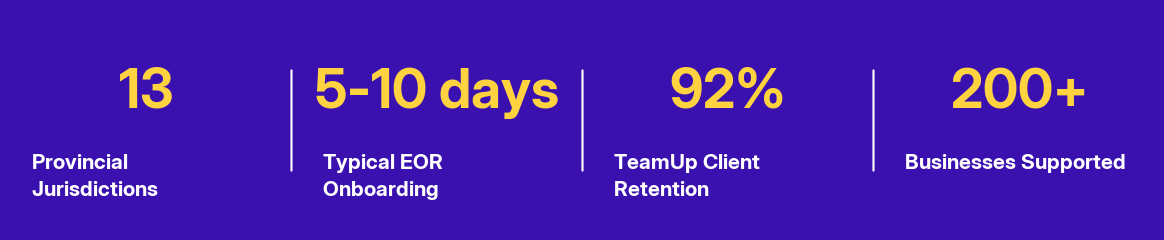
| Provincial reach | All 13 jurisdictions covered | Fewer than 5 provinces |
| Carrier relationship | Direct group policy holder | Pooled under third party |
The employee's daily experience with claims and enrollment shapes their perception of your company. Even if you are the client, the EOR is the employer on record. Slow claims processing reflects on your brand.
Evaluating Contract Terms and Transition Flexibility
Termination Clauses and Benefit Continuity
Canadian employment standards legislation varies by province. Each jurisdiction sets minimum notice periods and severance entitlements. Your EOR contract should specify who bears the financial liability for severance when you terminate an employee or end the EOR relationship.
Some EOR agreements include a clause that shifts all termination costs to the client with 48 hours' notice. Others cap the client's exposure at statutory minimums. Read the termination section before signing. A company using an employer of record in Canada for a 15-person team faces material severance exposure if several employees have accumulated years of service.
Portability of Benefits When Switching Providers
If you outgrow your EOR or decide to establish a Canadian entity, your employees' benefits should transfer without a coverage gap. Ask whether the EOR's carrier allows policy conversion to a new group sponsor.
Most Canadian carriers permit a transfer of coverage without new medical underwriting if the transition happens within 30 days. But the EOR must cooperate in that process. Some EOR contracts include restrictive clauses that delay or complicate transitions. Look for language around "cooperation on plan conversion" or "transition assistance" in the master services agreement.
Data Privacy Under PIPEDA and Provincial Laws
The EOR collects sensitive personal health information through benefits enrollment. Canada's Personal Information Protection and Electronic Documents Act governs how that data is handled federally. British Columbia, Alberta, and Quebec each have their own provincial privacy statutes that may impose stricter requirements.
Your EOR should demonstrate compliance with both federal and applicable provincial privacy legislation. Ask for their privacy impact assessment. Confirm that employee health data stays within Canada or, if transferred cross-border, meets adequacy standards under Canadian law.
Benchmarking EOR Benefits Against Market Standards

What Canadian Employees Expect
Benefits expectations in Canada are shaped by what large domestic employers offer. A mid-career software developer in Toronto expects dental coverage, extended health including mental health support, and a health spending account. Paramedical coverage for physiotherapy, massage therapy, and psychotherapy sessions is standard in competitive packages.
If your EOR plan falls below these benchmarks, you lose candidates to local employers. The EOR should provide a benefits comparison against the market median for your industry and province. Request this during the proposal stage.
Health Spending Accounts and Flexible Benefits
A Health Spending Account (HSA) lets employees claim eligible medical expenses not covered by the base plan. The Canada Revenue Agency sets the rules for what qualifies as an eligible expense. HSAs are tax-effective for both the employer and the employee.
Some EORs include HSAs as a standard component. Others charge an additional administration fee. A $500 to $2,000 annual HSA allocation is common in Canadian tech companies. This flexibility allows employees to personalize their coverage without the EOR needing to redesign the group plan.
Retirement Savings and RRSP Matching
Canada's public pension system includes the Canada Pension Plan (or Quebec Pension Plan in Quebec). Both employer and employee contribute through payroll deductions. Beyond the statutory contribution, competitive employers offer group Registered Retirement Savings Plan (RRSP) matching.
Not every EOR provides RRSP matching as a standard offering. Some can set it up as a custom arrangement through a group RRSP provider. The match rate and vesting schedule become negotiation points. If your competitors offer 3% to 5% RRSP matching, your EOR plan should at least allow for it, even if the contribution rate is your decision.
Watch out: Some EOR contracts treat RRSP matching contributions as a pass-through cost plus an administration fee per employee per month. Confirm whether the fee is flat or percentage-based before committing to a match rate. A percentage-based fee on a generous match can add up quickly across a growing team.

FAQs
Can an EOR provide different benefit plans for employees in different provinces?
Yes. Most EORs with national carrier relationships can customize plan tiers by province or by role level. A senior engineer in British Columbia might receive enhanced paramedical coverage while a junior analyst in Ontario gets the base plan. The EOR's carrier must support multi-tier plan administration. Confirm that the carrier's system can handle province-specific plan variations without manual workarounds, which tend to cause enrollment errors.
What happens to employee benefits if I switch from one EOR to another in Canada?
The outgoing EOR terminates its group policy for your employees. The incoming EOR enrolls them under a new group plan. If the transition happens within 30 days, most Canadian carriers waive new medical underwriting for the transferring employees. Your employees should experience no gap in coverage if both EORs coordinate the handoff date. Get written confirmation of the transition timeline from both providers before setting the switch date.
Does the EOR handle Workers' Compensation Board registration in each province?
The EOR registers with the relevant Workers' Compensation Board in every province where employees work. This is mandatory. Ontario's WSIB, British Columbia's WorkSafeBC, and Alberta's WCB each require separate employer registration and premium payments. The EOR remits premiums based on your industry classification rate. Ask for the WCB account numbers as proof of registration. Without valid WCB coverage, the EOR is operating unlawfully.
Are EOR-provided benefits in Canada tax-deductible for the client company?
The EOR invoices you for total employment costs, including benefits premiums. On your side, the invoice is a service fee paid to the EOR. Tax deductibility depends on your home jurisdiction's rules for foreign service expenses. In most cases, the full EOR invoice qualifies as a deductible business expense. Your tax advisor should confirm the treatment based on your entity's jurisdiction and any applicable tax treaty between your country and Canada.
What to Prioritize Next
Provincial privacy legislation is tightening. Quebec's Law 25 has already introduced stricter consent requirements for personal information handling. British Columbia and Alberta may follow. Any EOR you select today should demonstrate a privacy compliance framework that anticipates these changes, not one that merely meets yesterday's baseline. Start your evaluation by requesting the EOR's provincial registration certificates, carrier policy documents, and privacy impact assessment. Those three documents reveal more about operational depth than any sales presentation.
If you need a Canadian benefits comparison tailored to your team size and provinces, TeamUp can prepare one.
Written by TeamUp — a people-first EOR and nearshoring partner, helping companies hire compliantly across 20+ countries since 2020.
.svg)


