

Employer of Record (EOR) in Canada 2026: The Complete Hiring Guide

- What Is an Employer of Record (EOR)?
- How EOR Services Work in Canada
- Benefits of Using an EOR in Canada vs. Setting Up a Local Entity: Key Differences
- EOR Risks and Compliance Considerations in Canada
- How to Hire Through an EOR in Canada: Step by Step
- Choosing the Right EOR Provider for Canada
- FAQs
- What to Watch Next
An employer of record in Canada lets a foreign company hire Canadian workers without incorporating locally. A London-based fintech firm recently needed two compliance analysts in Toronto. Rather than spend months registering a Canadian corporation, it engaged an EOR and had both analysts onboarded within 10 business days.
Canada's employment framework splits authority between the federal Canada Labour Code and 13 separate provincial and territorial employment standards statutes. Each province sets its own rules on termination notice, vacation entitlements, and statutory holidays. Quebec operates under an entirely distinct civil law tradition with its own pension plan. For a company making its first Canadian hire, that fragmentation creates real compliance exposure.
This guide covers how EOR services work across Canadian provinces, the specific risks they carry, what drives cost, and how the Record of Employment fits into the picture. Whether you are hiring one remote developer in British Columbia or building a five-person sales team across Ontario and Quebec, the mechanics matter.
What Is an Employer of Record (EOR)?

Employer of Record Definition and Meaning
An employer of record (EOR) is a third-party organization that becomes the legal employer of a worker on behalf of a client company. The EOR assumes all statutory employer obligations. These include payroll processing, tax withholding, social contribution remittances, and compliance with local labour law.
The client company retains day-to-day management of the worker. It directs tasks, sets performance expectations, and controls the work product. The EOR handles everything that flows from the employment relationship itself. Think of it as a clean split: the client owns the work, the EOR owns the employment.
This model exists because employment law is territorial. A company incorporated in Germany cannot simply pay a Canadian resident and call it compliant. Canadian tax authorities expect an employer to remit CPP contributions, EI premiums, and income tax at source. Provincial law requires adherence to local employment standards. The EOR satisfies those requirements as the registered employer on Canadian soil.
EOR vs. Staffing Agency: A Critical Distinction
A staffing agency places temporary workers. It recruits candidates, assigns them to client projects, and typically retains them on short-term contracts. The agency's business model centers on recruitment and placement.
An EOR does not recruit. It employs. The client selects its own candidate. The EOR then hires that person under a compliant local employment contract. The relationship is permanent, not project-based. A staffing agency fills a seat. An EOR creates a compliant employment structure around a person the client has already chosen.
EOR vs. PEO: What Canadian Businesses Need to Know
A professional employer organization (PEO) uses a co-employment model. Both the PEO and the client share employer responsibilities. The critical difference: a PEO requires the client to have an existing legal entity in Canada. The PEO layers its services on top of that entity.
An EOR requires no local entity at all. The EOR is the sole legal employer. For foreign companies entering Canada, this distinction is decisive. A co-employment HR and payroll solution works when you already have a Canadian subsidiary. An EOR works when you do not.
How EOR Services Work in Canada

The Step-by-Step EOR Engagement Process
The operational workflow follows a predictable sequence. It begins when the client identifies a candidate and ends with ongoing monthly payroll.
- The client selects a candidate and agrees on compensation terms
- The EOR drafts a locally compliant employment contract under the relevant provincial law
- The employee signs the contract with the EOR as the named employer
- The EOR registers the employee with the Canada Revenue Agency for payroll remittances
- Monthly payroll runs include CPP, EI, and provincial tax deductions at source
- The EOR files annual T4 slips and handles any statutory reporting
A Munich-based SaaS company used this process to hire a product manager in Vancouver. The entire onboarding took 8 business days. Within six months, the team had expanded to four across British Columbia and Ontario.
Federal vs. Provincial Employment Jurisdiction in Canada
Canada has 10 provinces and 3 territories. Each maintains its own employment standards legislation. The Canada Labour Code governs only federally regulated industries: banking, telecommunications, interprovincial transport, and a handful of others. Roughly 6% of the Canadian workforce falls under federal jurisdiction.
The remaining 94% falls under provincial law. That means an employee in Ontario follows the Employment Standards Act, while an employee in Alberta follows the Alberta Employment Standards Code. Vacation minimums, overtime thresholds, and statutory holiday schedules differ across every border.
This is not academic. It shapes every employment contract an EOR drafts.
How a Global EOR Handles Canadian Payroll and Statutory Contributions
CPP (Canada Pension Plan) and EI (Employment Insurance) contributions are mandatory employer obligations across Canada. The CRA sets contribution rates annually, and the EOR must apply the current year's rates each pay period.
Quebec adds a layer. It operates the Quebec Pension Plan (QPP) instead of CPP. Quebec also administers its own parental insurance plan (QPIP). An EOR hiring in both Quebec and Ontario runs two distinct contribution frameworks on the same payroll cycle.
A compliant payroll management service must track these differences at the provincial level. An EOR that treats Canada as a single jurisdiction will generate compliance errors within the first quarter.
Benefits of Using an EOR in Canada vs. Setting Up a Local Entity: Key Differences
| Dimension | EOR Model | Local Entity Setup |
|---|---|---|
| Time to first hire | 5 to 15 business days | 3 to 6 months typically |
| Upfront cost | Monthly per-employee fee, no incorporation | Federal and provincial registration, legal fees, office lease |
| Multi-province compliance | EOR manages each province's standards | Company must track 13 jurisdictions independently |
| Quebec capability | EOR handles QPP, QPIP, and distinct labour code | Requires separate Quebec corporate registration and expertise |
| Ongoing admin burden | Payroll, tax filing, and T4s handled by EOR | In-house payroll team or outsourced provider needed |
| Exit flexibility | Scale down or exit with standard notice periods | Entity dissolution takes months and carries wind-down costs |
Hiring Canadian Employees Without a Local Entity
Foreign companies can engage Canadian workers through an EOR without establishing a local legal entity. That single fact drives most EOR adoption in Canada.
Incorporating a Canadian subsidiary means registering federally or provincially, obtaining a business number from the CRA, opening a Canadian bank account, and appointing a local director in some provinces. A Copenhagen-based e-commerce company evaluated this path for two customer support hires in Montreal. The projected timeline was four months. It chose an EOR to hire compliantly without a local entity and had both employees working within 12 days.
Speed to Market and Operational Simplicity
Speed matters most when the hire is time-sensitive. EOR onboarding in Canada typically completes in 5 to 15 business days. Entity incorporation, by contrast, runs 3 to 6 months when accounting for federal registration, provincial extra-provincial registration, CRA program account setup, and bank account opening.
The operational simplicity compounds over time. The EOR files monthly remittances, issues T4 slips at year-end, and adjusts to annual CRA rate changes. Your finance team never touches Canadian payroll software.
How to Evaluate the Best Employer of Record Companies for Canada
Not every EOR handles Canada's provincial fragmentation well. When evaluating providers, three capabilities separate adequate from strong.
- Multi-province payroll infrastructure: Can the EOR run payroll across Ontario, British Columbia, Alberta, and Quebec simultaneously with correct provincial deductions?
- Quebec-specific expertise: Quebec's civil law system, QPP, QPIP, and French-language contract requirements demand specialized knowledge. An EOR without dedicated Quebec capability is a liability.
- Provincial employment standards tracking: Each province updates its legislation independently. The EOR must monitor and apply changes to vacation accrual, overtime thresholds, and termination provisions in real time.
A provider that treats Canada as one jurisdiction will create compliance gaps that surface during audits or employee disputes.
EOR Risks and Compliance Considerations in Canada

Misclassification and Disguised Employment Risks
The biggest legal risk in any EOR arrangement is misclassification. Canadian tax authorities and provincial labour boards examine the substance of the working relationship, not just the contract label. If the CRA determines that an EOR-employed worker is actually a dependent contractor or an employee of the client company, both parties face reassessment.
The test hinges on control, ownership of tools, chance of profit, and risk of loss. When a client dictates hours, provides equipment, and integrates the worker into its organizational structure, the EOR label alone does not insulate against reclassification. A properly structured EOR engagement maintains clear boundaries. The EOR sets employment terms. The client directs work output.
Watch out: If the CRA reclassifies an EOR-employed worker as the client's direct employee, the client becomes retroactively liable for unremitted CPP, EI, and income tax — plus penalties and interest dating back to the start of the engagement.
Loss of Direct Employment Control and Culture Fit
The EOR is the legal employer. That means the EOR, not your company, issues the employment contract, sets statutory benefit terms, and manages termination procedures. You cannot unilaterally dismiss an employee. You must work through the EOR's processes, which must comply with provincial employment standards on notice and severance.
A Chicago-based digital agency hiring three designers in Toronto found this friction point early. Performance management conversations had to route through the EOR's HR protocols. The agency retained full creative direction but had no direct authority over employment decisions.
This structural separation also affects culture. The employee's legal employer is not your company. Onboarding, benefits communications, and payslips carry the EOR's name. Building loyalty and team identity requires deliberate effort beyond the employment contract.
Provincial Compliance Gaps and Transition Risks
An EOR that lacks deep provincial expertise creates specific risks. Quebec operates under the Civil Code rather than common law. Employment contracts in Quebec carry different enforceability standards. Non-compete clauses that hold in Ontario may be void in Quebec.
Transition risk emerges when a company outgrows the EOR model. Moving employees from the EOR's payroll to your own newly established entity requires careful handling. Each province has rules on continuity of employment, transfer of accrued benefits, and deemed termination triggers. A poorly managed transition can create constructive dismissal claims.
Canada has 10 provinces and 3 territories. A compliance gap in even one of them can trigger liability across your entire Canadian workforce if the issue is systemic — such as incorrect vacation accrual formulas applied to all contracts drafted by the EOR.
How to Hire Through an EOR in Canada: Step by Step

The process starts before you post a job listing. You need to identify which province the employee will work from. This determines the employment standards legislation that governs the contract. It also determines the statutory deductions, leave entitlements, and termination rules the EOR must follow.
A Munich fintech company hiring its first customer success manager in Toronto used an EOR to move from signed offer to first payroll run in 11 business days. The EOR handled Ontario Employment Standards Act compliance, CRA registration, and benefits enrollment. Within four months, the company had added two more hires in British Columbia under the same EOR umbrella.
Once you select your EOR provider, the provider drafts an employment agreement that meets the specific requirements of the employee's province. This is not a template exercise. An agreement compliant in Alberta may be non-compliant in Quebec. The EOR registers as the employer with the CRA and, if applicable, with Retraite Québec for QPP contributions.
After onboarding, the EOR runs payroll on your chosen cycle. It withholds and remits CPP or QPP contributions, EI premiums, and provincial and federal income tax. The EOR also manages statutory leave tracking, issues T4 slips at year-end, and files Records of Employment when required. Your role as the client company is to direct the employee's work, set objectives, and manage performance. The legal employer obligations sit with the EOR. The operational relationship sits with you.
Onboarding timelines through an EOR in Canada typically range from 5 to 15 business days. The variance depends on the province, the complexity of benefits enrollment, and whether the hire requires a work permit.
Choosing the Right EOR Provider for Canada
Selecting an EOR is a compliance decision, not a procurement decision. The wrong provider exposes you to the same risks you hired an EOR to avoid. The table below breaks down the key evaluation criteria.
| Evaluation Criterion | What to Look For | Red Flag |
|---|---|---|
| Provincial coverage | Active payroll registrations in all 13 jurisdictions | Provider covers "Canada" without specifying provinces |
| Quebec capability | Separate QPP registration and CNESST compliance | Treats Quebec identically to other provinces |
| Entity structure | Own Canadian legal entity, not a subcontracted partner | Routes employment through a third-party aggregator |
| Termination handling | Province-specific notice and severance calculations | Uses a single national formula for all provinces |
| Benefits administration | Provincial health plan enrollment plus group benefits | No supplementary health or dental coverage offered |
| Data residency | Canadian-hosted payroll data or PIPEDA-compliant storage | Payroll data stored outside Canada without safeguards |
A Stockholm SaaS company with eight employees across Ontario, British Columbia, and Alberta discovered its initial EOR provider was using a single termination formula for all three provinces. Alberta's termination rules differ from Ontario's. The company switched providers after a near-miss on a wrongful dismissal claim in Calgary.
When evaluating providers, ask for proof of active CRA business numbers in every province where you plan to hire. Ask whether the EOR holds its own workers' compensation board registrations or relies on a partner. If you plan to hire in Quebec, confirm the provider has a separate Retraite Québec employer number and can administer CNESST workplace safety compliance independently.
Cost is relevant but secondary. EOR fees in Canada typically fall between $400 and $800 per employee per month, depending on the provider and the scope of benefits included. A lower fee means nothing if the provider cannot handle a Quebec ROE correctly or miscalculates British Columbia statutory holiday pay.
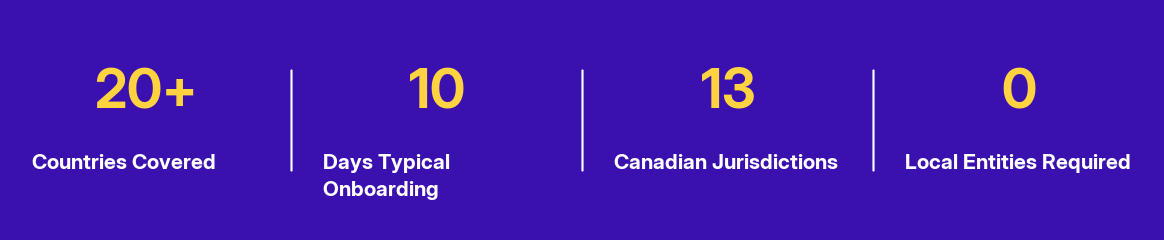
For companies already using an EOR in markets like Turkey or India through a provider like TeamUp, extending that relationship to Canada can reduce vendor complexity. TeamUp operates across 20+ countries with owned entities in its core markets and can coordinate multi-country payroll under a single relationship.
FAQs
Can a foreign company hire in Quebec through an EOR, and how does QPP differ from CPP?
Yes. Quebec operates its own pension plan, the Quebec Pension Plan, administered by Retraite Québec rather than the CRA. The EOR must hold a separate employer registration with Retraite Québec and remit QPP contributions on a distinct schedule. Not all EOR providers maintain this registration. If your EOR lacks a Quebec-specific payroll setup, QPP contributions may be misrouted or missed entirely. This is the single most important due-diligence question when hiring in Quebec. Quebec also administers its own parental insurance plan (QPIP), which replaces the federal EI maternity and parental benefits.
What happens when a client transitions employees from an EOR to its own Canadian payroll?
The transition is a legal event, not an administrative one. Employees may have accrued vacation entitlements, notice period thresholds, and severance eligibility under the EOR's tenure. Most provinces require these accruals to carry over to the new employer. A poorly managed transition can trigger constructive dismissal claims if employment terms change materially. The EOR must issue a Record of Employment at the point of transition. The new employer must issue a new employment agreement that preserves or improves on the existing terms. Budget three to six weeks for this process.
Does using an EOR in Canada prevent a foreign company from creating a permanent establishment for tax purposes?
Not automatically. An EOR handles employment compliance, not corporate tax structuring. If your Canadian-based employee habitually concludes contracts on your behalf or has authority to bind your company, Canadian tax authorities may assert permanent establishment status under the Income Tax Act or an applicable tax treaty. The EOR arrangement reduces PE risk by keeping the employment relationship off your corporate books. It does not eliminate it. Companies should engage Canadian tax counsel alongside their EOR provider, especially if employees perform sales or business development functions.
Is an EOR required to issue a Record of Employment when a client pauses a project and stops an employee's work temporarily?
Yes. A temporary interruption of earnings triggers an ROE obligation under Service Canada rules, even if both parties intend to resume work. The EOR must issue the ROE within five calendar days of the pay period in which the interruption occurs, or within five calendar days of becoming aware of the interruption. Failure to issue on time can delay the employee's access to EI benefits and expose the EOR to penalties. The ROE must accurately code the reason for separation. A project pause typically falls under shortage of work, not a voluntary quit.
Can an EOR be used to hire independent contractors in Canada?
No. EOR services are designed for employment relationships. If you engage someone as an employee through an EOR, the EOR assumes full employer obligations including CPP, EI, and statutory entitlements. Using an EOR to convert a misclassified contractor into a proper employee is a legitimate use case. Using an EOR as a pass-through for contractor payments is not. For genuine contractor engagements, a separate contractor management service handles invoicing, classification review, and compliance. The distinction matters because CRA audits on worker classification can trigger retroactive CPP and EI assessments going back several years.
What to Watch Next
The Canadian federal government has signaled ongoing reforms to the Canada Labour Code, particularly around gig worker classification and federally mandated paid sick leave expansion. Several provinces are also reviewing employment standards legislation to address remote work arrangements that cross provincial boundaries. An employee living in Nova Scotia but working for an Ontario-based team raises unresolved jurisdictional questions that current legislation does not fully address.
Monitor CRA updates on CPP contribution rate changes and the annual EI premium rate announcements, both published each November for the following calendar year. If you are hiring in Quebec, track Retraite Québec's QPP rate announcements separately.
Your concrete next step: audit your current or planned Canadian hires by province. Map each province to its employment standards act, confirm your EOR's active registrations in that jurisdiction, and verify that your employment agreements reflect province-specific terms rather than a national template.
.svg)


