

EOR Providers in Canada: Comparing the Top 5 Companies

Employer of record companies solve a specific problem for foreign businesses entering Canada. You want to hire a product designer in Toronto or a data engineer in Montreal. You do not want to incorporate a Canadian subsidiary, register for provincial payroll accounts, or spend six months learning how Quebec's language laws affect employment contracts. An EOR lets you skip all of that.
The model works. A London-based fintech firm hired four compliance analysts in Vancouver through an EOR in 11 days. Within a year, the Canadian team had grown to twelve. No local entity required.
But EOR providers are not interchangeable. Canada's split between federal and provincial employment law means the wrong provider can create compliance gaps that cost more than the entity you avoided. This article compares five employer of record providers operating in Canada across the dimensions that matter most: service scope, pricing structure, compliance depth, and risk exposure.
What Is an Employer of Record?
Employer of Record Meaning and Definition
An employer of record legally employs workers on behalf of a client company. The EOR signs the employment contract, runs payroll, withholds and remits taxes, administers statutory benefits, and carries the compliance liability that comes with being the legal employer in a given jurisdiction.
Your company directs the employee's daily work. The EOR handles everything that flows from the employment relationship itself. Think of it as separating operational control from legal employment obligations.
This matters in Canada because employment law is not a single system. Federal labour standards cover roughly 6% of the workforce. Provincial statutes govern the rest. Each province sets its own rules for minimum wage, vacation entitlements, termination notice, and statutory holidays. A single EOR must track obligations across up to thirteen jurisdictions.
How an EOR Differs from a PEO
A Professional Employer Organization (PEO) operates through co-employment. You keep your legal entity, and the PEO shares employer responsibilities with you. An EOR replaces your entity entirely. You do not need a Canadian incorporation. That distinction drives everything else.
Under a PEO arrangement, both you and the PEO share liability. Under an EOR, the provider assumes full legal employer status. For a company without a Canadian presence, only the EOR model works. A PEO requires an existing entity to co-employ against.
Why the EOR Model Exists in Canada
Setting up a Canadian subsidiary takes three to six months when you factor in federal incorporation, provincial registration, CRA payroll account setup, and workers' compensation board enrollment. For a company hiring one to five people, that overhead rarely makes sense.
The EOR collapses that timeline to days. A Munich-based SaaS company needed two DevOps engineers in Ontario. Through an EOR, both were onboarded and on payroll within eight business days. The alternative was a four-month incorporation process that would have cost more than the engineers' first quarter of salaries.
Top EOR Providers in Canada

What to Look for in a Canadian EOR Provider
Canada's federal-provincial split creates a compliance surface that generic global platforms often underestimate. Before evaluating any provider, pin down the criteria that actually differentiate them in the Canadian context.
Provincial depth matters more than country count. An EOR that covers 150 countries but treats Canada as a single jurisdiction will stumble in Quebec, where Bill 96 requires French-language employment contracts and workplace communications. Ask whether the provider maintains province-specific employment templates or applies a national template with minor edits. The gap between those two approaches creates real liability.
Platform quality is the second filter. Can the EOR integrate with your existing HRIS? Does its dashboard let you view payroll breakdowns by province? A Series A startup hiring three people cares less about this. A company scaling to thirty Canadian employees cares a lot.
Support model is the third. Some providers assign dedicated account managers. Others route you through ticket queues. When you need to terminate an employee in British Columbia mid-probation, response time matters.
Five Providers Worth Evaluating
The Canadian EOR market includes both global platforms and regional specialists. Five providers consistently appear in shortlists for companies hiring Canadian talent from abroad: Deel, Remote, Papaya Global, Velocity Global, and Team Up.
Deel covers Canada as part of its broad global footprint but uses partner networks in many markets. Remote operates through owned entities in its covered countries. Papaya Global positions itself as an enterprise payroll analytics layer. Velocity Global serves mid-market and enterprise clients at a premium price point.
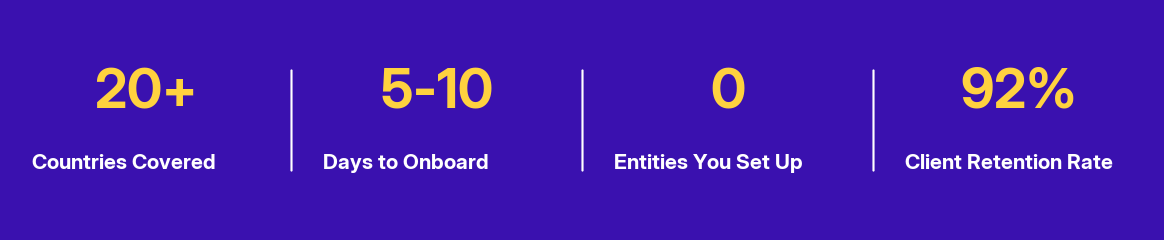
Team Up takes a different approach. With owned legal entities in its core markets and in-country offices across five cities, Team Up delivers hands-on compliance management rather than platform-first automation. For companies whose Canadian hires are part of a broader multi-country team spanning Eastern Europe, Central Asia, or Turkey, that regional depth matters. Team Up's EOR starts at €199 per employee per month in its core markets.
How to Shortlist Based on Your Hiring Goals
Your shortlist depends on your hiring pattern. If Canada is your only market, a Canada-specialist provider may offer deeper provincial expertise. If you are hiring across Canada, Georgia, and Turkey simultaneously, a provider like Team Up that owns entities in multiple regions reduces vendor sprawl.
A Singapore-based e-commerce company hiring customer support staff in both Calgary and Tbilisi consolidated both hires under one EOR. Onboarding completed in seven business days across both countries. A dual-provider setup would have doubled the contract management overhead.
EOR Services Compared: What's Actually Included
| Service Area | What It Covers in Canada | Why It Matters |
|---|---|---|
| Payroll processing | Salary calculation, provincial tax withholding, CPP/EI remittance | Errors trigger CRA penalties |
| Benefits administration | Provincial health top-ups, group insurance, RRSP matching | Benefits expectations vary by province |
| Onboarding/offboarding | Employment contracts, ROE filing, termination compliance | ROE errors delay EI claims |
| Statutory compliance | ESA/provincial labour standards, human rights codes | Each province has distinct rules |
| Immigration support | Work permit sponsorship, LMIA coordination | Required for non-Canadian hires |
Core Services Every Canadian EOR Should Offer
Every EOR operating in Canada should handle payroll processing and compliance at the provincial level. That means calculating and remitting Canada Pension Plan contributions, Employment Insurance premiums, and provincial income tax. It also means filing a Record of Employment (ROE) each time an employee leaves or takes an extended leave. The ROE is a Canadian government form required by Service Canada. It has nothing to do with "employer of record" as a service category, despite the acronym overlap.
Benefits administration is the second non-negotiable. Provincial health insurance covers basics, but Canadian employees expect supplemental benefits. Group health insurance, dental coverage, and retirement savings matching are standard expectations in competitive hiring. An EOR that cannot administer these puts you at a talent disadvantage.
Global EOR Services vs. Canada-Only Providers
Global employer of record platforms spread their compliance resources across dozens of countries. That breadth comes with a trade-off. A provider covering 150 countries may update its Canadian employment templates less frequently than a regional specialist that serves five provinces.
The trade-off runs both ways. A Canada-only provider cannot help when you expand into new markets. A Berlin-based agency that started with three hires in Toronto later needed engineers in Armenia and Kazakhstan. Switching EOR providers mid-scale created a three-week payroll gap. Starting with a multi-country provider would have avoided the disruption.
Platform Features and HR Integrations
Self-service dashboards, API integrations with tools like BambooHR or Workday, and automated compliance alerts separate modern EOR platforms from manual-process providers. If your HR team manages employees across multiple countries, platform capabilities reduce administrative load significantly.
Not every company needs enterprise-grade tooling. A 15-person startup hiring its second Canadian employee does not need Workday integration. Match platform complexity to your actual operational needs, not to a feature checklist.
EOR Costs and Pricing in Canada
How EOR Pricing Models Are Structured
Two pricing models dominate the employer of record market. The first is a flat monthly fee per employee. The second is a percentage of each employee's gross salary. Most providers in Canada use the flat-fee model, though some enterprise platforms still charge a percentage.
Flat fees across the EOR industry typically range from $200 to $700 per employee per month. The spread reflects differences in service scope, provider overhead, and whether the provider owns its local entity or subcontracts to an in-country partner. Percentage-based models usually run between 10% and 20% of gross salary. For senior Canadian hires earning six figures, the percentage model gets expensive fast.
What Drives Cost Variation Across Providers
Province of hire is the first variable. Quebec imposes additional requirements under Bill 96, including French-language contracts and distinct payroll registration. EOR providers that maintain Quebec-specific compliance infrastructure price that coverage into their fees. Hiring in Alberta or Ontario tends to be less complex and less costly.
Benefits complexity is the second driver. A basic statutory-only package costs less than a comprehensive plan with dental, vision, disability, and RRSP matching. Most providers quote the base EOR fee separately from benefits administration. Ask for the all-in cost, not just the platform fee.
Contract duration also affects pricing. Annual commitments often unlock lower per-employee rates. Month-to-month flexibility costs more. A U.S. healthtech company that committed to a 12-month term for its five Canadian hires negotiated a rate roughly 15% below the provider's standard monthly pricing.
Hidden Costs to Watch For
Three cost items frequently appear outside the headline EOR fee. Setup fees cover initial onboarding, employment contract drafting, and provincial registration. Some providers waive these; others charge $300 to $500 per employee.
Offboarding fees are the second surprise. Terminating an employee in Canada requires statutory notice or pay in lieu, ROE filing, and sometimes severance. Some EOR providers charge a separate fee for managing the termination process. Others include it in the monthly rate.
Currency conversion margins are the third. If you pay your EOR in USD or EUR and the employee receives CAD, the provider applies an exchange rate. The spread between the interbank rate and the rate you receive is margin. Some providers embed a 1% to 2% markup. Others are transparent about their FX spread. Ask before you sign.
Watch out: Some EOR contracts include auto-renewal clauses with 60- or 90-day cancellation windows. If you miss the window, you are locked in for another term. Read the termination clause before the pricing page.
Risks of Using an Employer of Record in Canada
Compliance Risks Specific to Canadian Employment Law
Canada's federal-provincial structure creates compliance risk that single-jurisdiction countries do not have. An EOR that applies Ontario employment standards to a Quebec-based employee violates provincial law. Quebec's Act Respecting Labour Standards and its French-language requirements under Bill 96 are distinct from every other province. A generic national template is not compliant.
Misclassification is the second compliance risk. If the Canada Revenue Agency determines that a worker classified as an independent contractor is actually an employee, the EOR and the client may both face back-assessed payroll taxes and penalties. Some companies use EOR arrangements to convert existing contractors to employees precisely to avoid this exposure. That conversion must be handled correctly.
Workers' compensation adds a third layer. Each province runs its own workers' compensation board. An EOR must register with the correct board for each province where it employs workers. A missed registration exposes both the EOR and the client to liability.
Operational and Relationship Risks
The EOR is your employee's legal employer. That creates a relationship dynamic you cannot ignore. Your employee's first point of contact for payroll errors, benefits questions, and leave requests is the EOR, not you. If the EOR's support is slow or inaccurate, your employee's experience suffers and you carry the reputational cost.
Provider insolvency is a low-probability but high-impact risk. If your EOR becomes insolvent, your employees lose their legal employer overnight. Payroll stops. Benefits lapse. You would need to either incorporate an entity or migrate to a new EOR under pressure.
IP ownership ambiguity is a subtler risk. The EOR signs the employment contract. If that contract does not include airtight IP assignment clauses that flow through to your company, work product ownership may be legally unclear.
How to Mitigate EOR Risks Before You Sign
Request the provider's template employment contract before signing the master service agreement. Verify that IP assignment, non-compete, and confidentiality clauses name your company as the beneficiary, not just the EOR.
Ask about the provider's entity structure in Canada. Do they own a Canadian entity, or do they subcontract to a local partner? If subcontracted, you have one more layer of counterparty risk between you and your employee's legal employer.
Confirm provincial coverage explicitly. Ask whether the provider has registered with Quebec's Commission des normes, de l'équité, de la santé et de la sécurité du travail (CNESST) and the relevant workers' compensation board in every province where you plan to hire. A checklist answer is not enough. Ask for registration numbers.
How to Choose and Onboard Through an EOR in Canada
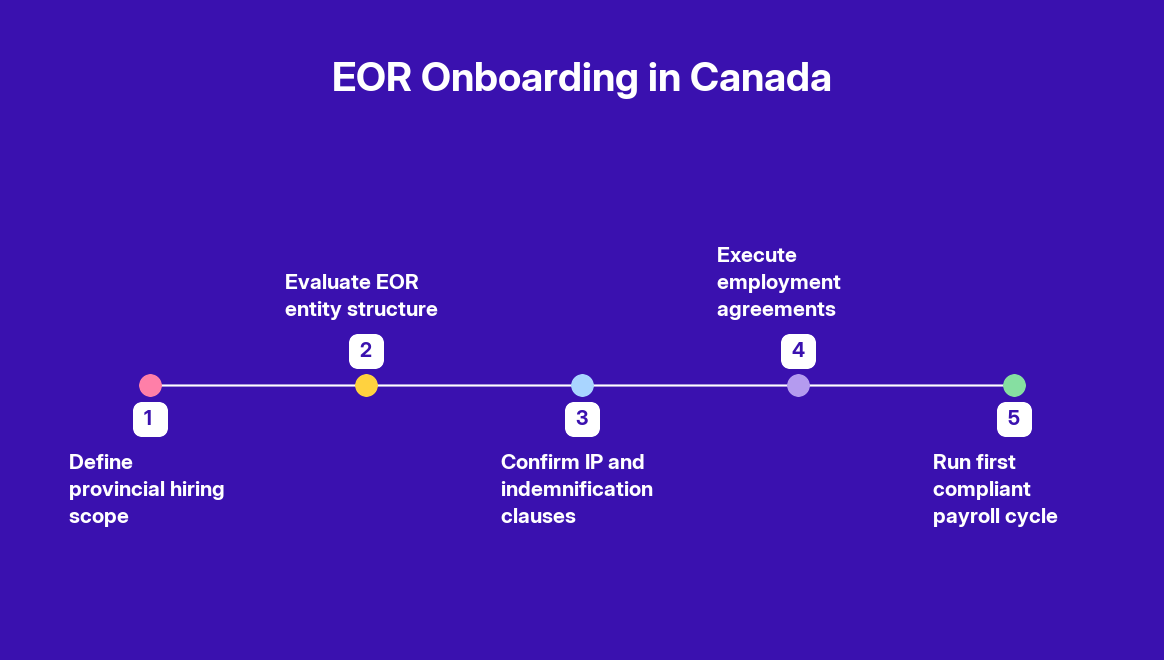
Start with geography. Canada's employment law splits across federal and provincial jurisdictions. An employer of record in Canada that covers Ontario may lack registrations in British Columbia or Nova Scotia. Before you shortlist providers, map every province where you need headcount. That step alone eliminates providers who cannot cover your actual hiring footprint.
Next, verify the EOR's legal presence. Some providers operate through their own Canadian subsidiary. Others subcontract to local partners. The distinction matters when disputes arise. A provider with a direct entity bears liability. A provider routing through a partner may create ambiguity about who owes the employee severance or unpaid wages.
Contract review deserves more time than most buyers give it. Two clauses carry outsized risk. The first is intellectual property assignment. The second is indemnification in the event the EOR becomes insolvent. Both are covered in detail below in the FAQ, but flag them during negotiation, not after signing.
Once contracts are executed, onboarding in Canada through an EOR typically completes in five to ten business days. The EOR drafts the employment agreement, registers the employee for provincial benefits, sets up payroll withholding, and files the necessary employer registrations. A London-based fintech company used an EOR to hire two compliance analysts in Toronto within seven business days. Within four months, they had expanded to five employees across Ontario and Alberta without opening a Canadian office.
EOR vs. Subsidiary in Canada: When to Switch
The decision between an EOR and a Canadian subsidiary is not permanent. It is a function of headcount, timeline, and strategic commitment.
| Factor | EOR Model | Canadian Subsidiary |
|---|---|---|
| Setup timeline | 5–10 business days | 3–6 months including federal and provincial registration |
| Upfront cost | No incorporation fees | Legal, accounting, and registration costs apply |
| Ongoing monthly cost per employee | Fixed EOR fee per employee | Internal payroll and HR overhead |
| Compliance ownership | EOR holds liability | Your company holds direct liability |
| Flexibility to exit | Terminate EOR agreement with notice | Wind-down requires legal dissolution |
| IP ownership default | Requires explicit assignment clause | Employer owns IP by default |
For companies testing the Canadian market with one to five employees, the EOR model reduces risk and cost. A Munich-based SaaS startup hired three customer success managers in Vancouver through an EOR. Eighteen months later, with headcount at twelve, they incorporated a British Columbia subsidiary and transitioned employees off the EOR arrangement. The EOR served as a bridge, not a destination.
The hybrid model is worth considering at scale. Some companies keep a subsidiary for their primary province and use an EOR for isolated hires elsewhere. A single staff augmentation hire in Saskatchewan or a contractor conversion in New Brunswick may not justify provincial employer registration. The EOR covers those edges while the subsidiary handles the core team.
Cost crossover depends on the EOR's per-employee fee and your internal HR capacity. Most finance teams find the math shifts somewhere between eight and fifteen employees, though the exact point varies by province and the complexity of your benefits package.
FAQs
What is a Record of Employment in Canada, and is it the same as an employer of record?
No. A Record of Employment (ROE) is a government form issued by Service Canada whenever an employee's insurable earnings are interrupted, such as a layoff, leave of absence, or termination. It triggers Employment Insurance eligibility. It has nothing to do with the EOR business model. In an EOR arrangement, the EOR is the legal employer on the ROE. If a client company mistakenly assumes responsibility for issuing the ROE itself, the form goes unfiled. That creates a compliance gap and delays the employee's EI claim.
Can a foreign company use an EOR to hire in Quebec specifically?
Yes, but Quebec carries obligations that other provinces do not. Bill 96 requires employers to provide employment contracts and workplace communications in French. Some EOR providers use standardized English-only onboarding templates. Those templates do not satisfy Bill 96. The compliance gap typically surfaces during a CNESST audit or an employee dispute, not during onboarding. Before signing with any EOR, explicitly confirm that their Quebec employment agreements, offer letters, and workplace policies are available in French and comply with the Charter of the French Language.
What happens to the employees if the EOR provider shuts down or loses its operating licence?
This risk is underexplored. The EOR is the legal employer. If it becomes insolvent, employees may be classified as unsecured creditors for unpaid wages and vacation pay. Canadian courts in several provinces have applied a "common employer" doctrine, looking through the EOR arrangement to hold the client company jointly liable under provincial employment standards legislation. Before signing, review whether the EOR carries payroll liability insurance that covers wage obligations during insolvency. Check the indemnification clause for mutual obligations, not just one-directional protection.
Is an EOR the right choice if we plan to hire more than 10 employees in Canada long-term?
It depends on concentration. If all ten employees sit in Ontario, incorporating a Canadian subsidiary likely costs less over a three-year horizon than cumulative monthly EOR fees. The calculation changes when employees are spread across multiple provinces. A hybrid model works well here: maintain a subsidiary in your primary province and use the EOR for one or two hires in provinces where you lack registrations. The trigger for review is not a single headcount number. It is when your annual EOR spend exceeds the projected cost of incorporation plus ongoing in-house payroll administration.
Who owns intellectual property created by an employee hired through an EOR in Canada?
Under Canadian common law, IP created during the course of employment belongs to the employer. In an EOR arrangement, the legal employer is the EOR, not the client company. If neither the master services agreement nor the employment contract includes an explicit IP assignment clause transferring ownership to the client, the work product's ownership is legally ambiguous. This ambiguity has real consequences for software companies and product teams. Ensure the IP assignment appears in both the EOR-client contract and the employee's individual agreement. One clause without the other leaves a gap.
How does workers' compensation registration work across provinces in an EOR arrangement?
Each Canadian province operates its own workers' compensation board. The EOR must register separately in every province where it employs workers. Ontario uses the WSIB, British Columbia uses WorkSafeBC, and Alberta uses the WCB. Premium rates differ by industry classification code and province. If the EOR fails to register in a province where an employee works, the client company may face vicarious exposure. Ask the EOR for its active workers' compensation account numbers in each relevant province before placing employees.
Can an EOR in Canada sponsor work permits for foreign nationals?
Some EOR providers support work permit sponsorship because they hold the legal employer status required for a Labour Market Impact Assessment (LMIA). Not all do. Sponsoring a work permit through an EOR adds processing time beyond the standard onboarding window. LMIA processing alone can take several weeks to several months depending on the stream and occupation. If you need to bring a non-Canadian worker into the country, confirm the EOR's immigration capabilities and whether they handle the LMIA filing directly or subcontract it to an immigration consultant.
What to Watch Next
Canada's federal government has signaled ongoing changes to temporary foreign worker programs and LMIA requirements. Provincial employment standards are also shifting. British Columbia and Ontario have both introduced or expanded rules around pay transparency and electronic monitoring disclosure in recent years. Any company using an EOR in Canada should track provincial legislative updates, not just federal ones.
Quebec's language regulations under Bill 96 continue to tighten. Employers with operations in Quebec should confirm that their EOR refreshes French-language documentation as new provisions take effect. The next step is practical: request your EOR provider's current provincial registration numbers, workers' compensation accounts, and a sample Quebec-compliant employment agreement. If they cannot produce those documents within 48 hours, that tells you something.
.svg)


