Managing Payroll and Compliance Through an EOR in Portugal: A Practical Guide
Our guide to onboarding and managing teams via EOR in Portugal covers the full lifecycle from first hire to daily operations. This child article goes deeper on one part of that lifecycle: the recurring payroll and compliance work that keeps a Portuguese employment relationship lawful month after month.
Portugal layers several obligations on employers. Monthly tax withholding, social security filings, meal allowance rules, and mandatory insurance each follow their own calendar. Miss one, and penalties follow quickly. An employer of record in Portugal absorbs these tasks under its own legal entity. What matters is understanding exactly what happens behind that arrangement so you can verify deliverables, spot gaps, and hold your EOR accountable.
How the Monthly Payroll Cycle Works in Portugal
Salary Calculation and Pay Frequency
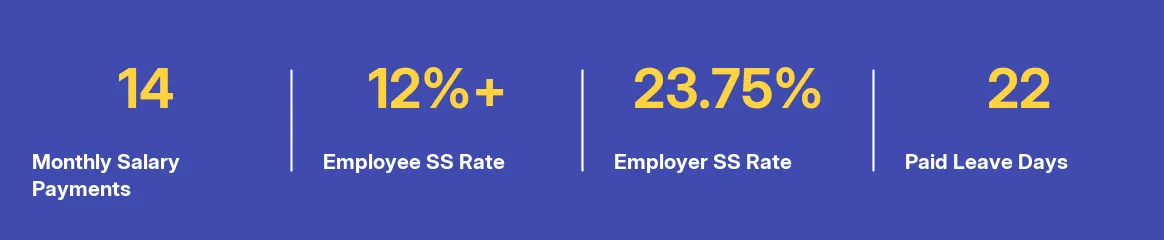
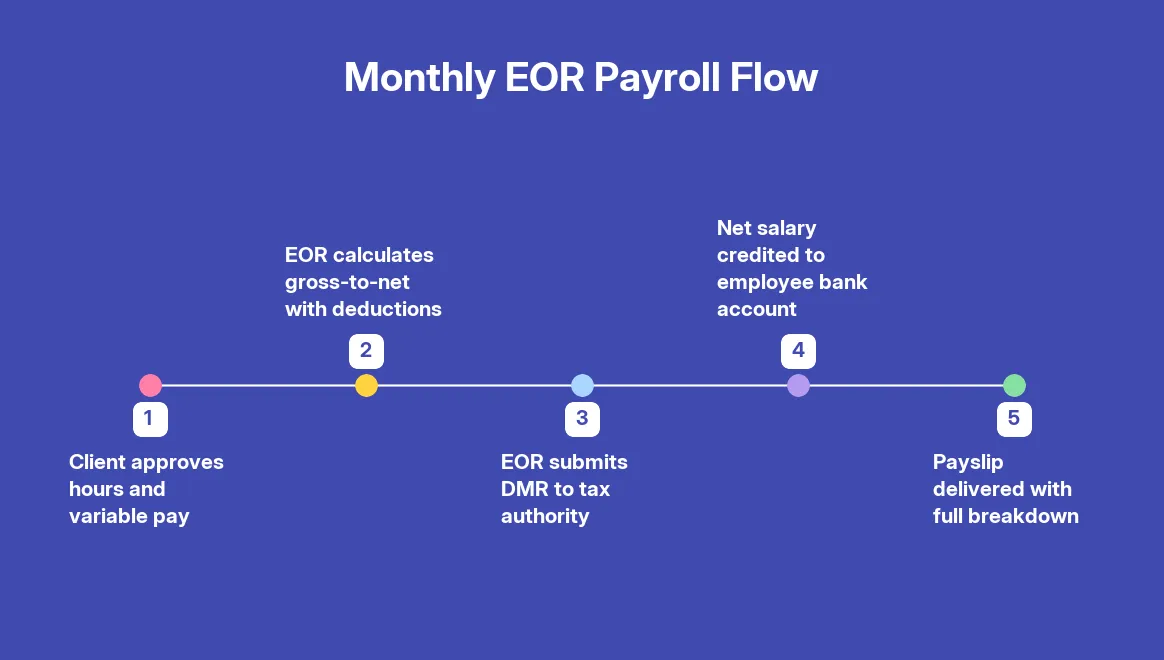
Portuguese labor law requires monthly salary payments. The EOR calculates gross pay, applies withholdings, and credits the employee's bank account by the agreed date. Most contracts specify payment by the last business day of the month.
Gross-to-net calculation in Portugal involves several deductions beyond income tax. The employee's share of social security comes off first. Then the IRS (Imposto sobre o Rendimento das Pessoas Singulares) withholding is applied based on published retention tables. The Autoridade Tributária updates these tables periodically. Your EOR references the current version each payroll run.
Variable Components: Meal Allowance, Holiday Pay, Christmas Pay
Portugal mandates two extra salary payments per year. Employees receive a holiday allowance (subsídio de férias) and a Christmas allowance (subsídio de Natal). Each equals one month's base salary. The EOR can pay these in full at the designated time or prorate them monthly, depending on the employment contract.
The meal allowance (subsídio de refeição) is common across Portuguese workplaces. Below a threshold set by the government, this allowance is exempt from both tax and social security when paid via meal card. Exceed that threshold and the excess becomes taxable. The EOR tracks the current exempt ceiling each year and structures the allowance to preserve the tax benefit. This detail alone can save employees meaningful net income versus a poorly structured arrangement. For a fuller view of benefit structuring, see EOR employee benefits in Portugal.
Tax Withholding and Social Security Contributions
IRS Withholding Mechanics
Portugal uses a progressive income tax system. The employer withholds IRS based on official retention tables published by the Autoridade Tributária. These tables factor in marital status, number of dependents, and whether the employee is a single or dual earner.
The EOR collects each employee's household details at onboarding. It then selects the correct table row for each payroll run. When an employee's personal circumstances change, such as marriage or a new child, the EOR updates the withholding immediately. Getting this wrong creates year-end tax surprises for the employee.
The monthly withholding declaration (Declaração Mensal de Remunerações, or DMR) must reach the tax authority by the 10th of the following month. Late filing triggers automatic penalties.
Social Security: Employer and Employee Shares
| Component | Rate | Paid By | Filing Deadline |
|---|---|---|---|
| Employee contribution | ~11% of gross pay | Deducted by EOR | Monthly, with DMR |
| Employer contribution | ~23.75% of gross pay | Paid by EOR entity | Monthly, with DMR |
| Work accident insurance | Variable by risk class | Paid by EOR entity | Annual renewal |
The EOR registers each employee with Segurança Social and files combined monthly declarations. The employer rate sits substantially above the EU median, making it a significant cost factor. Our sibling article on EOR costs and trade-offs in Portugal breaks down how these contributions affect total employment cost.
A common misconception: freelancer-to-employee conversions sometimes carry retroactive social security exposure. If a worker was misclassified as a contractor, the Segurança Social can demand back-contributions from the employer. The EOR's proper classification at hire eliminates this risk.
Watch out: Portugal's social security authority can audit contribution records going back five years. If your previous contractor arrangement lacked proper classification, converting that worker through an EOR does not erase prior exposure. Address the historical period separately with legal counsel before onboarding.
Leave Management and Statutory Entitlements
Annual Leave and Public Holidays
Portuguese employees receive a minimum of 22 working days of paid annual leave per year. This entitlement is non-negotiable. Employees cannot waive it, and employers cannot buy it out during an active contract.
Portugal observes 13 mandatory public holidays nationally. Some municipalities add a local holiday, bringing the total to 14 in certain regions. The EOR tracks the employee's work location to apply the correct holiday calendar. A Lisbon-based employee and a Porto-based employee may have different local holidays.
Leave accrual for new hires follows a specific formula. An employee who joins mid-year accrues two working days per month of service during the first calendar year. The full 22-day entitlement kicks in on January 1 of the following year.
Sick Leave and Parental Leave
Sick leave in Portugal is paid through Segurança Social, not the employer. The first three days are typically unpaid (the qualifying period). From day four onward, the social security system pays a percentage of the reference salary. That percentage increases with the duration of illness.
The EOR manages the administrative side. It submits the required documentation to Segurança Social, tracks the employee's absence, and coordinates return-to-work protocols.
Parental leave is generous. The initial parental leave period can extend to 120 or 150 consecutive days, depending on the sharing arrangement between parents. Both parents have independent entitlements. The EOR calculates the Segurança Social benefit, files the claim, and manages the payroll adjustment during the leave period.
Ongoing Compliance Obligations the EOR Handles

Work Accident Insurance and Occupational Health
Portuguese law requires every employer to maintain work accident insurance (seguro de acidentes de trabalho). This is not optional. The EOR purchases the policy under its entity, covering all employees against workplace injuries and occupational diseases. Coverage must begin on the employee's first day.
Separately, employers must provide access to occupational health and safety services. The EOR arranges mandatory health exams. New employees undergo an admission exam. Periodic exams follow at intervals defined by the employee's risk category. The EOR schedules these and retains the certificates.
Relatório Único and Annual Reporting
Every employer in Portugal must file the Relatório Único (Single Report) annually. This comprehensive filing covers workforce composition, working hours, training delivered, occupational health activities, and social security contributions. The filing window typically opens in the spring for the preceding calendar year.
The EOR compiles the data from its payroll and HR systems. Missing this deadline carries fines. More critically, the Relatório Único feeds into labor inspectorate audits. An incomplete or inaccurate submission can trigger a formal inspection by the Autoridade para as Condições do Trabalho (ACT).
Payroll Records Retention
Portuguese payroll management obligations extend beyond filing. Employers must retain payroll records, employment contracts, and time-tracking data for specified periods under Portuguese commercial and labor law. The EOR maintains these records in its systems, making them available to the client and to Portuguese authorities upon request.
This record-keeping duty matters especially during employee exits. Termination settlements require accurate historical data on accrued leave, seniority, and variable compensation. An EOR with clean records can process a compliant termination within days. One with gaps creates legal exposure.

FAQs
Can the EOR pay Portuguese employees in a currency other than euros?
No. Portuguese labor law requires salary payment in euros. Employment contracts specify compensation in euros, and bank transfers must settle in euros to a Portuguese or EU bank account. Paying in USD or another currency violates the contractual terms. The EOR handles all currency conversion on the employer side before payroll runs.
What happens if an employee disputes their payslip deductions?
The EOR investigates using the IRS retention tables and Segurança Social contribution rules in effect for that pay period. If the deduction was correct, the EOR provides the employee with a written breakdown showing the applicable table row, dependents declared, and statutory rates. If a genuine error occurred, the EOR corrects it in the next payroll cycle and issues an amended payslip.
Does the EOR handle Portuguese withholding for employees who work remotely from another EU country?
Cross-border situations trigger social security coordination rules under EU Regulation 883/2004. If an employee habitually works from another EU country, you may need an A1 certificate to confirm which country's social security applies. The EOR assesses each case, but the employee's actual work location, not their contract address, determines the applicable regime. Misalignment can result in dual contributions or coverage gaps.
How does the EOR manage mid-year salary adjustments?
The EOR updates the gross salary in its payroll system, recalculates the IRS withholding bracket, and adjusts the social security contributions from the effective date forward. Portuguese law does not require retroactive recalculation for voluntary raises. The updated amount flows into the next DMR filing automatically. Holiday and Christmas allowances recalculate based on the new base salary from the adjustment date.
What to Monitor Next
Portugal's tax authority revises IRS retention tables at least annually. Social security contribution ceilings and meal allowance exemption thresholds also shift. Your EOR should notify you before each change takes effect. Ask for a written update each January at minimum. If your team grows beyond five employees, request quarterly compliance summaries covering DMR filings, Segurança Social status, and insurance renewals. Comparing EOR versus payroll outsourcing in Portugal may also clarify whether your current model still fits as the team scales.
If you need a compliance walkthrough for your Portuguese payroll setup, Team Up can review your current structure. Schedule a consultation.
Written by the Team Up editorial team. Team Up operates as an employer of record across 20+ countries, with direct local coverage in the Caucasus, Central Asia, Turkey, India, and Eastern Europe.
.svg)