EOR vs Payroll Outsourcing in Portugal: What's the Difference?
- What Is an Employer of Record (EOR)?
- What Is Payroll Outsourcing in Portugal?
- EOR vs Payroll Outsourcing: Key Differences
- Risks and Considerations: EOR vs Payroll Outsourcing in Portugal
- How to Choose Between an EOR and Payroll Outsourcing in Portugal
- Cost Structure and Operational Trade-Offs
- FAQs
- What to Watch Next
An employer of record and a payroll outsourcing provider both involve third parties managing employment functions. They are not the same thing. A London fintech needed two senior developers in Lisbon within 14 days. It had no Portuguese entity. Payroll outsourcing was not an option. The company engaged an EOR, signed contracts within a week, and had both developers on compliant Portuguese employment agreements before the month closed.
That scenario illustrates the structural divide between these two models. One transfers legal employer status. The other processes numbers on your behalf. Choosing the wrong model does not just create inconvenience. It creates compliance exposure under Portugal's Código do Trabalho and EU employment directives that apply to every worker on Portuguese soil.
This article breaks down how each model works in Portugal, what risks attach to each, and what cost structures you should expect when building your comparison.
What Is an Employer of Record (EOR)?

Employer of Record Definition: The Legal Mechanics
An employer of record is a third-party organization that becomes the legal employer of your workers in a target country. The EOR signs the employment contract. It appears on government filings. It remits social security contributions, withholds income tax, and administers statutory benefits.
Your company retains day-to-day operational control over the worker's tasks, projects, and output. The EOR absorbs the legal obligations that Portuguese law assigns to an employer. That split is the core mechanic. You direct the work. The EOR owns the employment relationship on paper and in law.
This structure exists because Portugal's Código do Trabalho assigns specific duties to the entity that holds the employment contract. Those duties include issuing compliant contracts, registering workers with Segurança Social, and meeting termination rules. An EOR steps into that role entirely.
What Does Employer of Record Mean in Practice for Portugal?
In practice, an employer of record in Portugal means a foreign company can hire employees in Portugal compliantly without incorporating a local entity. The EOR holds the Portuguese legal presence. It files returns, manages employment contracts under the Código do Trabalho, and handles statutory obligations.
A Toronto-based SaaS company hired a product designer in Porto through an EOR in 9 days. No entity registration. No local accountant. No corporate tax filing in Portugal. The EOR managed the full employment lifecycle.
How an EOR Differs from a Staffing Agency or PEO
A staffing agency supplies temporary workers who remain on the agency's books. A professional employer organization (PEO) co-employs workers alongside your existing entity. An EOR replaces your entity requirement altogether.
The distinction matters in Portugal. PEO arrangements require the client company to already have a registered presence. Staffing agencies operate under Portugal's temporary work legislation with different contract limits. An EOR is the only model where the foreign company needs zero local infrastructure. That is why early-market entrants and companies testing Portuguese talent pools before committing to entity setup typically choose the EOR path.
What Is Payroll Outsourcing in Portugal?

How Payroll Outsourcing Works: Scope and Boundaries
Payroll outsourcing delegates the processing mechanics of payroll to a third-party provider. The provider calculates gross-to-net, generates payslips, computes employer contributions, and files periodic returns with Portuguese tax authorities and Segurança Social.
The client company remains the legal employer. It signs the employment contracts. It bears responsibility for compliance with the Código do Trabalho. The payroll provider is a processor, not an employer.
A Munich e-commerce company with a Lisbon subsidiary used a Portuguese payroll outsourcing firm to handle monthly salary runs for 12 employees. The firm calculated withholdings and filed social security returns. When a termination dispute arose, the company itself bore full legal exposure. The payroll provider had no liability in that outcome.
What Payroll Outsourcing Does Not Cover Under Portuguese Law
Payroll outsourcing does not cover employment contract drafting, termination procedures, disciplinary processes, or benefits administration beyond calculation. It does not shield you from liability if a filing is late or incorrect. The employer remains answerable to Portuguese authorities.
If Portugal's labor inspectorate (ACT) investigates a compliance issue, the registered employer responds. Not the payroll vendor. This is the critical boundary that many companies underestimate.
Who Actually Needs a Registered Entity to Use Payroll Outsourcing?
Every company using payroll outsourcing in Portugal must already hold a registered legal entity in the country. You need a Portuguese NIF (tax identification number), a registered office address, and corporate registration with the commercial registry. Without those, no payroll outsourcing arrangement can legally operate.
Entity setup in Portugal typically takes 4 to 12 weeks depending on corporate structure, beneficial ownership documentation, and notarization requirements. That timeline excludes the additional weeks needed to open a corporate bank account and register as an employer with Segurança Social.
EOR vs Payroll Outsourcing: Key Differences
| Dimension | Employer of Record (EOR) | Payroll Outsourcing |
|---|---|---|
| Legal employer status | EOR is the legal employer | Client company is the legal employer |
| Local entity required | No | Yes |
| Compliance liability | Sits with the EOR | Sits with the client |
| Employment contracts | Drafted and held by EOR | Drafted and held by client |
| Social security registration | EOR registers workers | Client registers workers |
| Termination procedures | EOR manages under local law | Client manages, payroll provider uninvolved |
| Speed to first hire | Typically 5 to 14 business days | Weeks to months (entity setup first) |
Legal Employer Status: Who Bears the Liability?
The table above isolates the structural divide. An EOR absorbs legal employer status. Payroll outsourcing does not. This is not a minor administrative difference. It determines who faces penalties if a contract violates the Código do Trabalho, who responds to labor inspectorate audits, and who bears severance obligations at termination.
Portugal is an EU member state. EU employment directives on working time, anti-discrimination, and posted workers apply directly. The entity holding the employment contract carries those obligations. Under an EOR arrangement, that entity is the EOR. Under payroll outsourcing, it is your company.
Entity Requirements: What Each Model Demands of a Foreign Company
A global employer of record removes the entity requirement entirely. A US company hiring its first employee in Lisbon through an EOR needs no Portuguese corporate presence, no NIF, and no commercial registration. The EOR's existing entity serves as the legal employer.
Payroll outsourcing demands the opposite. Your Portuguese entity must be fully operational before a payroll provider can begin processing. For companies testing a new market or hiring one or two remote workers, that infrastructure cost rarely makes sense.
Operational Control and Day-to-Day HR Responsibilities
Under both models, you direct the employee's work. The difference is who handles the HR and compliance layer surrounding that work.
An EOR manages onboarding documentation, contract amendments, leave administration, and offboarding. A payroll provider handles salary calculation and statutory filings only. Everything else remains with your internal HR team or your Portuguese entity's local staff. For companies without dedicated HR capacity in Portugal, that gap is significant.
Risks and Considerations: EOR vs Payroll Outsourcing in Portugal

Employer of Record Risks: Compliance, Control, and Misclassification
EOR arrangements carry specific risks that compound if the provider lacks Portuguese legal expertise. The first is worker misclassification. If the actual working relationship resembles independent contracting rather than employment, Portuguese authorities may challenge the arrangement regardless of the contract's label.
The second risk is IP ownership ambiguity. Portuguese employment law assigns certain IP rights to the employer of record by default. If your EOR holds the employment contract, IP assignment clauses must explicitly route rights to your company. A Copenhagen design agency discovered this gap after engaging three UX researchers through an EOR in Lisbon. The agency's contracts with the EOR lacked IP assignment language. Resolving that required contract amendments and legal review.
The third risk is vendor dependency. Your EOR controls the employment relationship. Switching providers means terminating and rehiring employees. That process triggers Portuguese termination rules.
Watch out: Under Portuguese law, the entity on the employment contract holds default IP rights. If your EOR agreement lacks an explicit IP assignment clause routing rights to the client company, you may not own what your team creates.
Payroll Outsourcing Risks: Retained Liability and Entity Exposure
Payroll outsourcing risks concentrate on retained liability. Your company owns every compliance outcome. If the payroll provider miscalculates social security contributions, your entity faces the penalty. If a filing deadline passes, your entity receives the notice.
Running a Portuguese entity also creates permanent establishment exposure for corporate tax purposes. Your local presence generates ongoing obligations for annual accounts, corporate tax returns, and beneficial ownership filings. Those costs persist whether you employ two people or twenty.
Portugal-Specific Regulatory Considerations for Both Models
Portugal's labor inspectorate, the Autoridade para as Condições do Trabalho (ACT), actively investigates employment compliance. Both EOR and payroll outsourcing arrangements fall under its jurisdiction.
Portugal also implements EU directives on transparent working conditions, which require employers to provide detailed written information to employees about their terms. The entity classified as the employer must meet those disclosure requirements. Under an EOR, that responsibility transfers. Under payroll outsourcing, it stays with you.
For companies managing employee benefits and insurance in Portugal, understanding which entity bears statutory benefit obligations determines whether gaps in coverage create legal exposure or operational inconvenience.
How to Choose Between an EOR and Payroll Outsourcing in Portugal
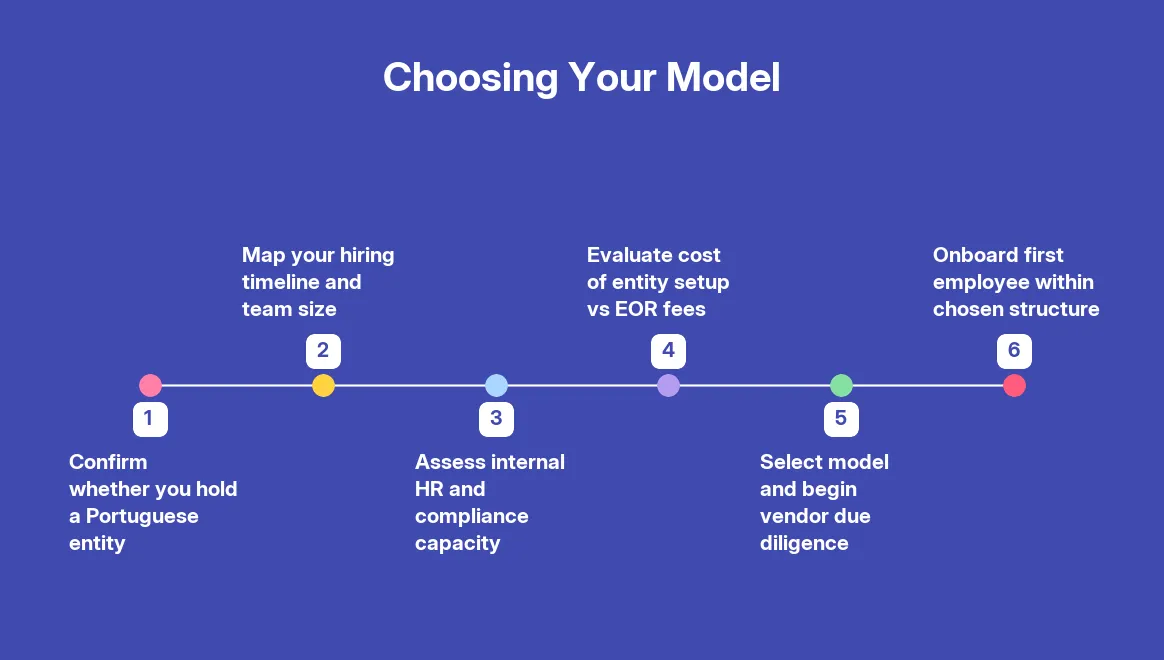
The first question is binary. Do you have a registered legal entity in Portugal? If the answer is no, payroll outsourcing is not an option. You need an employer of record in Portugal or you need to incorporate first.
If you do hold an entity, the decision shifts to capacity. A Lisbon fintech with 40 employees and a dedicated HR manager has the internal infrastructure for payroll outsourcing. A four-person Berlin startup making its first Portuguese hire does not. The entity question filters out one path entirely. The capacity question determines which path is sustainable.
Timeline matters more than most companies expect. Entity registration in Portugal typically takes 4 to 12 weeks depending on the structure. An EOR can onboard an employee in 5 to 10 business days. A Munich healthtech company hired two clinical data analysts in Porto through an EOR in 7 days. The same company estimated entity incorporation would have taken 9 weeks.
Map your headcount trajectory before signing any vendor agreement. If you plan to hire more than 15 employees in Portugal within 18 months, the per-employee EOR fee may exceed the annualized cost of maintaining your own entity with a payroll provider. If your plan is three to five employees for an indefinite period, an EOR keeps fixed overhead near zero. The breakeven depends on your vendor's pricing, your entity maintenance costs, and how much internal HR time you would need to allocate.
Run due diligence on the vendor itself. For EOR providers, confirm they hold a registered entity in Portugal rather than subcontracting through a local partner. For payroll providers, verify they support Portuguese social security reporting formats and can handle the monthly DMR filing to Autoridade Tributária.
Cost Structure and Operational Trade-Offs
Pricing models differ fundamentally between the two approaches. An EOR charges a per-employee monthly fee that bundles compliance, contracts, payroll processing, and statutory filings into one line item. Payroll outsourcing charges per payslip or per employee for processing only. Your entity bears the remaining costs separately.
| Factor | EOR Model | Payroll Outsourcing |
|---|---|---|
| Entity required | No | Yes |
| Typical fee structure | Per employee per month, all-inclusive | Per payslip or per employee, processing only |
| Legal employer liability | EOR holds it | Your company holds it |
| Entity maintenance cost | None for the client | Annual accounting, registered office, corporate tax filings |
| Speed to first hire | 5 to 10 business days | Depends on entity setup timeline |
| Internal HR requirement | Minimal | Moderate to high |
| Scalability ceiling | No hard limit | Limited by entity HR capacity |
The all-inclusive EOR fee looks higher on a per-employee basis. That comparison misses the hidden costs of entity operation. A Portuguese Limitada requires annual financial statements filed with the commercial registry. It requires a certified accountant. It requires corporate income tax returns.
Those fixed costs exist whether you employ two people or twenty. A Singapore e-commerce company maintaining a Lisbon entity for three customer support agents spent more on annual entity compliance than it would have paid in EOR fees for the same headcount. The breakeven only favored entity ownership when headcount reached double digits.
For companies already operating a Portuguese entity, the calculus reverses. You have already absorbed the fixed costs. Adding payroll services at a per-payslip rate is cheaper than layering EOR fees on top of an entity you are already maintaining. The operational question becomes whether your internal team can manage employment law compliance, or whether a PEO model that shares that burden makes more sense.
EOR fees across the region typically fall between €200 and €600 per employee per month depending on the provider and the complexity of local benefits administration. Payroll processing alone usually costs a fraction of that. The gap reflects the difference between processing numbers and owning legal responsibility.
FAQs
Can a foreign company use payroll outsourcing in Portugal if it has a branch office rather than a fully registered subsidiary?
A branch office (sucursal) in Portugal carries its own tax registration and can employ workers directly. This means a sucursal qualifies as the registered entity needed for payroll outsourcing eligibility. The compliance posture differs from a full subsidiary (sociedade) because a sucursal does not have separate legal personality from its parent. Tax obligations, especially permanent establishment rules under Portuguese corporate tax law, may create unexpected exposure that a sociedade structure avoids.
What happens to the employment contract if the EOR vendor we use in Portugal goes out of business?
Under Portuguese labor law, the employment contract exists between the worker and the EOR entity. If the EOR becomes insolvent, the contract does not automatically transfer to the client company. Workers may face termination with claims processed through the Portuguese insolvency regime. To reduce this risk, negotiate contractual clauses that require advance notice of financial distress and a defined transition protocol. Choosing an EOR with owned entities rather than subcontracted partners reduces exposure to single-point-of-failure insolvency.
Is payroll outsourcing in Portugal legal for hiring contractors, or does it only apply to employees?
Payroll outsourcing applies to employees on your entity's payroll. Using it to process payments to contractors does not change the legal classification of those workers. Portugal's Código do Trabalho contains a presumption of employment (presunção de laboralidade) triggered when specific criteria are met, such as fixed working hours or economic dependence. If Autoridade para as Condições do Trabalho reclassifies a contractor as an employee, the liability falls on your entity, not the payroll provider.
If we already have a Portuguese entity but want to expand hiring quickly, does an EOR still make sense?
Yes, and this is a common pattern. An EOR can serve as a temporary operational layer during rapid scale-up, even when you hold a local entity. A London recruitment agency with a Lisbon office used an EOR to onboard 8 sales staff in 12 days while its internal HR team was at capacity. The agency transitioned those employees to its own entity over the following quarter. EOR as a bridge tool separates the speed problem from the compliance problem.
Do EU Posted Workers Directive rules affect EOR arrangements when employees split time between Portugal and another EU country?
They can. When a Portugal-based EOR employee is temporarily assigned to work in another EU member state, the Posted Workers Directive may apply. The host country's core employment terms, including minimum pay, maximum working hours, and rest periods, must be observed during the posting. The EOR or client must file a posting declaration with the host country's labor authority. Failure to do so triggers enforcement action in the host state, not in Portugal.
How long does it typically take to switch from an EOR to your own entity in Portugal once you decide to incorporate?
The transition involves two parallel tracks. Entity incorporation takes 4 to 12 weeks depending on structure and notarial requirements. Employee transfer requires individual consent under Portuguese law because the legal employer changes. Most companies run both tracks simultaneously, with the EOR maintaining employment until the new entity is operational and registered with Segurança Social. Budget 3 to 4 months from decision to full migration, assuming no complications with the commercial registry.
Can an EOR in Portugal sponsor work permits for non-EU nationals?
An EOR holding a registered entity in Portugal can sponsor work permits because it is the legal employer. The application goes through SEF (now succeeded by AIMA) under standard employer sponsorship rules. Processing times vary, but staff augmentation and tech roles often qualify under favorable visa categories. The EOR handles the employer-side documentation, but the employee must still meet individual eligibility criteria including proof of qualifications and a clean criminal record from their country of origin.
What to Watch Next
Portugal's labor regulatory environment is shifting. The government has signaled reforms to the Código do Trabalho affecting temporary work agencies and platform-based employment. Any reclassification of EOR arrangements under temporary work legislation would change the compliance calculus described in this article. Monitor updates from Autoridade para as Condições do Trabalho and the Diário da República for new decrees.
The EU is also advancing its directive on platform work, which may tighten the criteria for distinguishing employees from independent contractors across all member states. Companies using either model in Portugal should audit their worker classifications quarterly rather than annually. The concrete next step: request your current provider's compliance certificate for Portuguese social security and tax filings from the most recent quarter. If they cannot produce it within five business days, that tells you something.
.svg)