Why Use an Employer of Record in France: Key Benefits for Foreign Companies
Our guide to EOR providers in France compared top services, pricing, and onboarding steps. This article goes deeper on the foundational question: why an EOR makes strategic sense for hiring in France specifically.
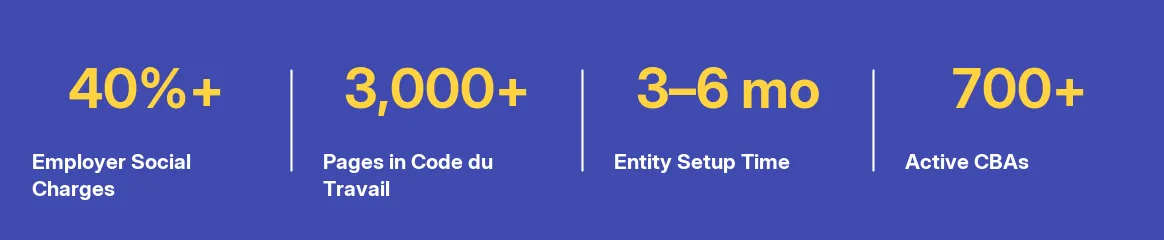
France ranks among the most complex employment jurisdictions in Europe. The Code du travail runs to over 3,000 pages. Collective bargaining agreements bind employers by industry sector, not by choice. Social security contributions from the employer side regularly exceed 40% of gross salary. These structural realities create a compliance burden that is disproportionate to the size of most foreign teams.
This article breaks down the specific labor law barriers, cost dynamics, and compliance risks that push companies toward an EOR model in France. If you need a primer on how EORs work for hiring in France, start there first.
French Labor Law Creates Real Barriers to Direct Hiring
Collective Bargaining Agreements Are Mandatory, Not Optional
France operates over 700 active conventions collectives (collective bargaining agreements, or CBAs). These are not voluntary. The Ministry of Labour extends CBAs across entire industry sectors. Every employer in that sector must comply, regardless of company size or origin.
A CBA dictates minimum salary scales, overtime premiums, paid leave entitlements, notice periods, and severance formulas. A US SaaS company hiring its first sales representative in Paris does not get to choose which CBA applies. The employee's role and the company's industry classification determine it automatically.
Misclassifying an employee under the wrong CBA exposes the employer to back-pay claims. It also triggers inspection risk from the URSSAF, France's social security collection authority. An EOR operating in France already knows which CBA applies to each role and updates compensation structures when CBA revisions take effect.
Working Time Rules Go Beyond the 35-Hour Week
France's statutory working week is 35 hours. That is a structural fact unchanged for over two decades. But the rules around it are layered. Employees working beyond 35 hours accumulate overtime or RTT (réduction du temps de travail) days. RTT entitlements vary by CBA and by contract type.
Cadre employees (executive-grade staff) often work under forfait jours agreements. These fix the annual working time in days rather than hours. The legal ceiling sits at 218 working days per year. Managing these distinctions requires payroll systems that track both hour-based and day-based contracts simultaneously.
Termination Protections Are Among Europe's Strictest
Dismissing an employee in France requires a documented real and serious cause (cause réelle et sérieuse). The process involves a formal pre-dismissal meeting, a mandatory waiting period, and a written notification letter with specific legal language. Procedural errors alone can render a dismissal invalid, even when the substantive grounds are strong.
French labor courts (Conseils de Prud'hommes) handle disputes. The Macron scale sets minimum and maximum indemnity ranges based on tenure and company size. An EOR manages termination procedures through local legal counsel, shielding the client from procedural missteps that commonly trip up foreign employers.
Cost and Speed Advantages Over Entity Setup
Entity Setup Costs Add Up Fast
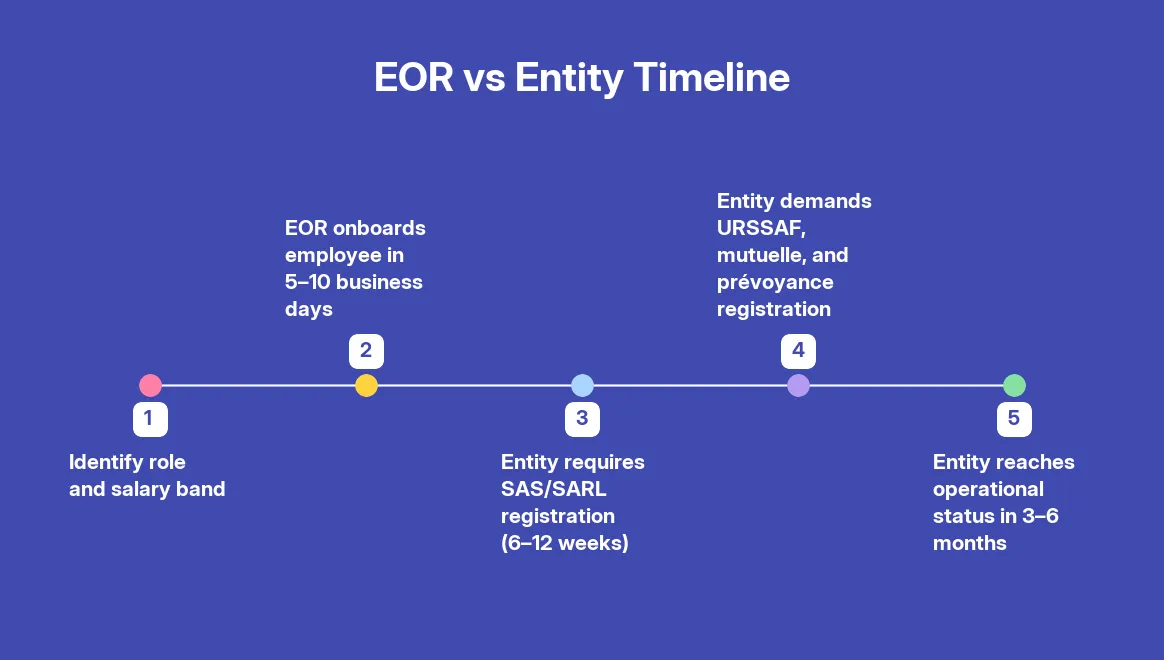
Registering a société par actions simplifiée (SAS) or a SARL in France involves notarial fees, legal drafting, capital deposit, and commercial registry filing. Beyond formation costs, the entity needs a registered office address, a bank account with a French institution, and registration with multiple agencies.
Ongoing obligations include annual accounts filing, corporate tax returns, TVA (VAT) declarations, and URSSAF social contribution reporting. For a company hiring two or three employees, these fixed costs often exceed the total annual payroll burden.
| Factor | EOR Model | Local Entity (SAS) |
|---|---|---|
| Time to first hire | 5–10 business days | 3–6 months |
| Upfront legal costs | None | €5,000–€15,000+ |
| Ongoing admin burden | Handled by EOR | In-house or outsourced |
| CBA compliance | EOR manages | Company's responsibility |
| Exit complexity | Contract termination | Entity liquidation required |
Speed Matters for Competitive Hiring
French tech talent moves fast. A backend developer in Lyon or Toulouse fielding multiple offers will not wait three months for an entity to become operational. EOR onboarding typically completes within 5 to 10 business days. That timeline includes drafting a compliant employment contract, registering the employee with social security agencies, and enrolling them in mandatory health and retirement plans.
A London-based fintech hired two compliance analysts in Paris through an EOR in under two weeks. Setting up a branch office would have delayed those hires by at least 10 weeks. The cost of that delay, in lost productivity and candidate attrition, often dwarfs the monthly EOR fee.
Compliance Risks That an EOR Absorbs
Payroll Tax Complexity in France
French payroll involves more than a dozen separate social contribution lines. The employer pays into URSSAF for health insurance, family allowances, and unemployment. Separate contributions fund complementary pension schemes (AGIRC-ARRCO), mandatory health top-up insurance (mutuelle), and income protection (prévoyance).
Each contribution has its own rate, ceiling, and reporting cadence. The DSN (déclaration sociale nominative) consolidates all payroll reporting into a single monthly electronic filing. Filing errors or late submissions trigger penalties. The URSSAF conducts regular audits, and foreign employers without local expertise are frequent targets.
Companies hiring across multiple European markets face compounding complexity. The payroll mechanics in France differ substantially from those in Germany or Eastern European markets like Turkey. An EOR absorbs these differences across each jurisdiction.
Misclassification Risk for Contractors
France's labor inspectorate actively pursues contractor misclassification. If a worker operates under conditions resembling employment, such as fixed hours, company-provided tools, and a single client, French courts will reclassify the relationship. The consequence is retroactive social contribution liability plus penalties.
The threshold is lower than many foreign employers expect. A US company engaging a "freelance" product designer in Bordeaux under a services agreement faces reclassification risk if that designer works exclusively for the company for more than a few months.
An EOR eliminates this risk entirely. The worker becomes a salaried employee from day one. Social contributions are paid from the first payslip.
Data Protection and Employee Privacy
France enforces GDPR through the CNIL (Commission nationale de l'informatique et des libertés). Employee data processing requires a lawful basis, and payroll data carries specific retention limits. Cross-border data transfers to non-EU jurisdictions need standard contractual clauses or equivalent safeguards.
An EOR with French operations handles employee data within compliant infrastructure. The client company receives only the reporting data it needs. The EOR retains and processes sensitive payroll and HR records under French and EU data protection rules.
When an EOR Is Not the Right Fit

An EOR works best for teams of roughly 1 to 20 employees. Once headcount exceeds that range, the per-employee monthly fee may no longer justify itself against the fixed costs of a local entity.
Companies planning to hold French intellectual property, sign commercial leases, or bill French clients directly also need a local entity. An EOR employs people. It does not create a commercial presence for the client.
The break-even point depends on team size, growth trajectory, and whether the company needs a French entity for commercial reasons beyond employment. A 5-person engineering team with no French revenue is a clear EOR case. A 30-person sales operation generating French-source revenue is not.
Some companies start with an EOR and transition to a local entity once the French team grows large enough. The EOR handles the first 12 to 18 months while the company tests the market and validates the hiring thesis. This staged approach avoids premature entity commitments.
FAQs
Can an EOR sponsor work permits for non-EU employees in France?
Yes. Because the EOR is the legal employer in France, it can sponsor work permit applications. The process involves filing with the local préfecture and, for certain categories, obtaining labor market authorization from DIRECCTE (now DREETS). Timelines vary by permit type but typically run 4 to 12 weeks. The EOR handles the administrative filings. The client company does not need a French entity to bring in non-EU talent.
Do French employees hired through an EOR receive the same benefits as direct hires?
They must. French law does not distinguish between employees based on who the legal employer is. EOR-hired employees receive the same CBA-mandated salary minimums, paid leave, RTT days, mutuelle coverage, prévoyance, and retirement contributions. The EOR must also provide the mandatory annual entretien professionnel (professional development review). Any deviation from CBA standards exposes the EOR to labor court claims.
What happens to employees if I transition from an EOR to my own French entity?
The employees transfer under Article L1224-1 of the Code du travail. This provision mandates automatic transfer of employment contracts when a business or activity transfers between employers. The employees retain their tenure, salary, and accrued rights. The EOR and the new entity coordinate the transfer date. Payroll liabilities up to the transfer date remain with the EOR. Post-transfer obligations shift to the new entity.
How does the EOR handle French profit-sharing obligations?
French companies with 50 or more employees must implement a mandatory profit-sharing scheme (participation). Below that threshold, voluntary profit-sharing (intéressement) is optional. Most EOR-employed teams in France fall below the 50-employee trigger. If the EOR's total French headcount across all clients crosses that threshold, the EOR manages the participation calculation and distribution. Clients should confirm the EOR's current headcount and profit-sharing status during onboarding.
What to Watch in 2026
France continues refining its social contribution reporting through the DSN system. New validation rules and reporting fields take effect periodically. Companies hiring through an EOR benefit from automatic compliance updates without internal payroll system changes. The French labor market also faces evolving case law around remote work agreements and the right to disconnect. These developments affect contract drafting and working time policies. Monitor the Ministère du Travail portal for regulatory updates, and confirm with your EOR provider that contracts reflect the latest legal requirements before each new hire.
If you are evaluating EOR options for your first French hires, Team Up can walk you through costs, timelines, and CBA requirements for your specific roles. Request a France hiring consultation.
Written by Team Up — helping companies hire compliantly across 20+ countries since 2020.
.svg)