What Is an Employer of Record? How EORs Work for Hiring in France
Our guide to EOR providers in France compared the top services and their pricing. This article goes deeper on a foundational question: what exactly is an employer of record, and how does the model function under French law?
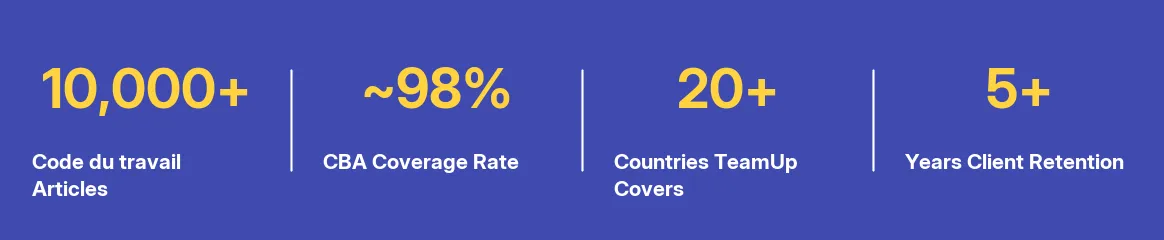
France layers employment obligations more heavily than most European markets. The Code du travail alone runs over 10,000 articles. Collective bargaining agreements cover roughly 98% of the workforce. Social security contributions rank among the highest in the EU. These structural realities shape what an EOR must do here in ways that differ from lighter regulatory environments.
The sections below break down the legal architecture, the tripartite relationship between client, EOR, and worker, the distinctions from related models, and the step-by-step onboarding sequence.
How the EOR Legal Structure Works in France

The EOR as the Legal Employer
An employer of record in France signs the employment contract (contrat de travail), registers the worker with URSSAF, and assumes every obligation the Code du travail places on the employer. The EOR files the Déclaration Préalable à l'Embauche (DPAE) before the employee's first working day. It calculates and remits monthly social security contributions. It issues the bulletin de paie.
This is not a technicality. French courts look at who holds the contract and who exercises the employer's administrative duties. The EOR holds both.
Why French Law Makes Entity Presence Non-Negotiable
France does not permit a foreign company to run payroll for a French tax resident without a local establishment or a compliant intermediary. The URSSAF requires a French SIRET number to process contributions. Without one, a company cannot legally deduct cotisations sociales or issue a conforming payslip.
A US SaaS company hiring its first product manager in Lyon faces a binary choice. It either incorporates a French subsidiary or works with an employer of record service that already holds a registered entity. Entity setup in France typically takes three to six months from first filing to operational payroll. The EOR route compresses that to days.
Collective Bargaining Agreement Obligations
Every French employee falls under a Convention Collective Nationale (CCN) based on the employer's sector classification. The CCN dictates minimum salaries by job grade, notice periods, overtime multipliers, and supplementary benefits. An EOR registered under the wrong CCN exposes the client to reclassification risk.
A fintech in Berlin hired three data engineers through an EOR in Paris. The EOR initially classified them under the Syntec convention, the standard for IT consulting. Six months later, a contract review confirmed Syntec was correct for the activity type. Had the EOR defaulted to a generic services CCN, the engineers' minimum salary thresholds would have been wrong. Getting the CCN right from day one matters.
The Tripartite Relationship: Roles and Boundaries
Who Does What
The EOR model creates three distinct parties. Each carries specific responsibilities that French labor law treats seriously. Blurring these roles creates legal exposure.
The EOR handles contract drafting, payroll processing, social contribution remittance, benefits administration, and employment termination procedures. It is the employer on paper and before the courts.
The client company directs the employee's daily work. It assigns projects, sets deadlines, and manages performance. It does not sign the employment contract.
The employee reports operationally to the client but holds all statutory protections through the EOR. This includes protections under the Code du travail for unfair dismissal, paid leave, and workplace safety.
Where the Line Gets Drawn
French labor inspectors distinguish between legitimate EOR arrangements and disguised employment or illegal temporary staffing (prêt de main-d'œuvre illicite). The distinction hinges on whether the EOR exercises genuine employer authority or merely passes through instructions.
A legitimate EOR sets compensation within CCN parameters. It manages disciplinary procedures. It controls the employment relationship's administrative lifecycle. The client directs daily output but does not decide on raises, contract modifications, or termination unilaterally.
When a client oversteps into employer territory, the arrangement risks requalification. A French labor court could deem the client the true employer. That exposes the client to back-payment of social contributions, penalties, and potential criminal liability for undeclared employment (travail dissimulé). Understanding why companies use an EOR in France requires grasping this boundary clearly.
EOR vs. Related Employment Models in France
Employers entering France encounter several intermediary models. Each carries different legal weight. The table below isolates the structural differences.
| Feature | EOR | PEO (Co-employment) | Staffing Agency (Intérim) | Portage Salarial |
|---|---|---|---|---|
| Legal employer | EOR entity | Shared with client | Agency | Portage company |
| Client needs French entity | No | Yes | No | No |
| Contract type | CDI or CDD | CDI or CDD | Mission-based CDD | CDI with portage |
| Worker type | Employee of client's choice | Client's existing staff | Agency's candidate pool | Independent consultant |
| Maximum duration | Unlimited (CDI) | Unlimited | 18 months (standard) | Unlimited |
| CCN applied | EOR's sector CCN | Client's sector CCN | Agency's CCN | Portage salarial CCN |
Portage Salarial: The French-Specific Model
Portage salarial exists only in French law. It lets an independent consultant operate as a salaried employee of a portage company. The consultant finds their own clients and negotiates their own rates. The portage company handles invoicing, payroll, and social contributions.
This model suits solo consultants, not full-time hires. The portage company takes a management fee of roughly 5% to 10% of revenue. The consultant retains autonomy over client selection. An EOR, by contrast, employs a worker chosen by the client for an ongoing role.
When a PEO Fits Instead
A PEO model works when the client already has a French entity but wants to outsource HR administration. The PEO co-employs the worker alongside the client. Both share employer liability.
Companies scaling from five to fifty employees in France sometimes start with an EOR and later transition to a PEO once they incorporate locally. The EOR removes the entity requirement entirely. The PEO reduces the administrative burden once the entity exists.
How an EOR Onboards a Worker in France

Contract Drafting and Classification
The EOR identifies the correct CCN based on its registered activity. It then drafts the employment contract in French. French law requires specific mandatory clauses: job title, classification level, probationary period terms, compensation breakdown, and working hours.
A CDI (contrat à durée indéterminée) is the default. A CDD (fixed-term) requires a legally valid reason. Using a CDD without proper justification gives the employee grounds to demand reclassification as a CDI. The EOR ensures the contract type matches the engagement's legal basis.
Registration and First Payroll
The EOR files the DPAE with URSSAF no later than the business day before the employee's start date. It registers the employee for mandatory complementary health insurance (mutuelle) and provident insurance (prévoyance), both required under French law for all employees.
First payroll runs within the month of hire. The EOR calculates employer contributions, which in France typically represent a significant percentage on top of gross salary. It withholds the employee's share and remits prélèvement à la source (income tax at source) to the Direction Générale des Finances Publiques. The employee receives a bulletin de paie conforming to the 2017 simplified payslip format.
Onboarding through an EOR in France typically completes in five to fifteen business days, depending on mutuelle provider processing times and the complexity of the CCN classification.
Watch out: Filing the DPAE late or not at all constitutes travail dissimulé under French law. Penalties include criminal sanctions and a flat-rate indemnity of six months' salary owed to the employee.

FAQs
Can an EOR in France hire someone on a freelance basis?
No. The EOR model creates a salaried employment relationship. If your worker operates as an independent consultant, the correct French structure is either portage salarial or direct contractor engagement. Mixing the two creates requalification risk. French courts regularly reclassify freelance arrangements as employment when the worker lacks genuine autonomy over schedules, tools, and client selection. An EOR specifically exists to provide full employment status with social protections.
Does the employee know they work for an EOR rather than my company?
Yes. The employment contract names the EOR as the legal employer. The payslip shows the EOR entity. French transparency requirements make this non-negotiable. In practice, employees understand the arrangement. They report to your team daily while the EOR handles administrative employment matters. Many employees prefer this structure because it gives them full CDI protections from day one.
What happens if I want to terminate an employee hired through an EOR in France?
French dismissal law applies fully. The EOR must follow the licenciement procedure: convocation letter, pre-dismissal meeting, waiting period, and formal notification letter. Dismissal requires a cause réelle et sérieuse. Without valid grounds, the employee can claim unfair dismissal before the Conseil de Prud'hommes. The EOR manages this process, but the client should coordinate closely because documenting performance issues requires input from the operational manager.
Can the EOR sponsor a work permit for a non-EU national in France?
Yes, provided the EOR holds a registered French entity. The EOR files the work authorization request with the DREETS (formerly DIRECCTE) and handles the associated administrative steps. Processing times vary by prefecture and nationality. Some visa categories require the employer to demonstrate the role cannot be filled by an EU resident. The EOR manages this burden of proof as the legal employer of record, drawing on its French entity presence to file directly.
What to Watch Next
France's labor code evolves through annual reform cycles. The government regularly adjusts social contribution thresholds and updates payslip requirements. CCN renegotiations shift minimum salary grids every few years. If you plan to hire in France through an EOR, monitor URSSAF bulletins and your applicable CCN's latest avenant for any changes that affect your team's compensation structure. Confirm current contribution rates with your EOR before each calendar year.
If you are evaluating how an EOR would work for your first hire in France, Team Up can walk you through the contract structure and cost breakdown. Request a France-specific consultation.
Written by Team Up — EOR, Payroll & Nearshoring Helping 200+ companies hire compliantly across 20+ countries since 2020.
.svg)