How to Onboard and Manage Teams via EOR in Portugal
An employer of record lets you hire full-time employees in Portugal without incorporating a local entity. A London fintech needed two senior data engineers in Lisbon. Setting up a Portuguese subsidiary would have taken months and cost tens of thousands in legal and registration fees. Instead, the company hired through an EOR in 7 business days. Within a year, the Lisbon team had grown to six.
Portugal attracts companies for reasons beyond time zone alignment. The country has a deep tech talent pool, EU labor market access, and a cost base lower than Western European averages. But the Código do Trabalho governs every employment relationship tightly. Contracts, social security registration, tax withholding, and termination rules all carry compliance obligations that trip up foreign employers.
This article maps the full EOR lifecycle in Portugal. It covers the legal structure, the onboarding sequence, the split-authority management model, risk categories specific to Portuguese and EU law, and the cost framework for choosing a provider.

What Is an Employer of Record?

Employer of Record Meaning and Legal Definition
An employer of record is a third-party entity that becomes the legal employer of your workers in a foreign country. You direct the employee's daily tasks and manage their output. The EOR holds the employment contract, runs payroll, files taxes, and administers statutory benefits.
The legal employer relationship means the EOR bears compliance liability. It registers the employee with local tax and social security authorities. It ensures the contract meets local labor code requirements. And it processes termination according to local law if the relationship ends.
A US SaaS company hiring a product manager in Porto does not need a Portuguese legal entity. The EOR already has one. That entity signs the employment contract, making the worker a full employee under Portuguese law. The client company retains control over work assignments, goals, and performance reviews.
Why the Distinction Between EOR and Contractor Matters
The difference between an EOR-employed worker and an independent contractor is not just administrative. It is a legal classification with real consequences.
When you engage someone as a contractor but direct their schedule, provide their tools, and integrate them into your team structure, Portuguese authorities can reclassify that relationship as employment. Reclassification triggers back-payment of social security contributions, tax penalties, and potential fines. The misclassification risk is significant in Portugal because the Código do Trabalho defines employment broadly.
An EOR eliminates this risk by design. The worker is a legal employee from day one. Social security contributions flow correctly. Tax withholding follows Portuguese rules. No reclassification claim can arise because the employment relationship is already formalized.
A Copenhagen e-commerce brand learned this the hard way. It had engaged three "freelancers" in Lisbon for over 18 months. When advised of the reclassification exposure, the company moved all three to an EOR arrangement for compliant hiring. The transition took under two weeks.
How EOR Services Work in Portugal

Portugal's Legal Framework: The Código do Trabalho
Portugal's employment law is codified in the Código do Trabalho (Labor Code). This statute governs contracts, working hours, leave entitlements, termination procedures, and collective bargaining. Every employment relationship in the country operates within this framework.
Fixed-term contracts must be provided in writing. They carry specific renewal limits and justification requirements. Indefinite contracts are the default under Portuguese law, and the Código do Trabalho makes converting fixed-term arrangements to permanent status relatively straightforward for employees.
The EOR's Portuguese legal entity ensures every contract drafted meets these requirements. It monitors legislative changes, adjusts contract templates, and flags any collective bargaining agreements that apply to specific industries. For a detailed breakdown of EOR operations in Portugal, the compliance layer runs deeper than most companies expect.
What an EOR Handles on Your Behalf in Portugal
The EOR's operational scope in Portugal covers every employer obligation that Portuguese law assigns to the entity holding the employment contract.
Payroll processing runs monthly. The EOR calculates gross-to-net pay, applies the correct income tax withholding bands, and deducts the employee's social security share. It then remits the employer's contribution to Segurança Social alongside the employee portion.
Beyond payroll, the EOR manages:
- Employment contract drafting and registration
- Segurança Social enrollment for new hires
- Tax authority registration and monthly withholding filings
- Statutory leave tracking and accrual management
- Meal allowance and other mandatory or customary benefits
Social Security, Tax Withholding, and Statutory Benefits
Portugal requires mandatory Segurança Social contributions from both the employer and the employee. The employer's share is substantially larger than the employee's. These rates are set by statute and reviewed periodically. Confirm the current percentages on the Segurança Social portal before budgeting.
Income tax withholding follows a progressive structure. The EOR applies the correct rate based on the employee's income bracket, marital status, and number of dependents. The employee receives net pay after all deductions.
Portugal mandates a minimum number of paid vacation days under national labor law. Employees also receive a vacation subsidy and a Christmas subsidy, each typically equal to one month's base salary. These statutory benefits form a core part of EOR service delivery and must be budgeted into total compensation costs.
A Munich-based healthtech company hiring its first two Portuguese employees was surprised by the 13th and 14th month salary obligations. The EOR had already factored these into the cost projection during the offer stage. No budget surprises after the first payroll cycle.
EOR vs. PEO vs. Independent Contractor: Key Differences
| Dimension | EOR | PEO | Independent Contractor |
|---|---|---|---|
| Legal employer | The EOR entity | Shared (co-employment) | No employer relationship |
| Client entity required | No | Yes, local entity needed | No |
| Worker classification | Full employee | Full employee | Self-employed |
| Compliance liability | EOR bears primary liability | Shared between PEO and client | Client bears misclassification risk |
| Payroll and tax filing | EOR handles entirely | PEO handles administratively | Contractor self-files |
| Best for | Market entry, no local presence | Companies with existing entity | Truly independent project work |
When a PEO Makes Sense Instead
A PEO model assumes your company already has a legal entity in Portugal. The PEO co-employs your workers, managing HR administration, payroll, and benefits. You share employer responsibilities.
This works when you have an established Portuguese subsidiary but want to outsource administrative burden. It does not work for market entry. If you lack a local entity, a PEO cannot serve you.
A Berlin design agency with a registered branch in Lisbon used a PEO for its 12-person Portuguese team. The agency kept its entity for client-facing contracts. The PEO handled payroll, Segurança Social filings, and leave management. The split made sense because the entity already existed.
Where Contractor Engagement Breaks Down
Independent contractors in Portugal must operate with genuine autonomy. They set their own schedules. They use their own tools. They serve multiple clients.
The moment a company dictates working hours, provides equipment, or integrates the contractor into team standup calls, the relationship starts resembling employment. Portuguese labor inspectors actively investigate these arrangements. The difference between EOR and simple payroll outsourcing is often misunderstood, but the distinction from contractor engagement is even more consequential.
Watch out: Portugal's labor inspectorate (ACT) can initiate reclassification proceedings on its own, without a worker complaint. Companies relying on contractor arrangements for ongoing, integrated roles face exposure even if the contractor is satisfied with the setup.
Onboarding Employees in Portugal via EOR

The EOR Onboarding Sequence: Contract to First Payroll
Onboarding through an EOR follows a defined sequence. Each step feeds the next, and skipping or delaying any stage pushes back the employee's first payroll.
- The client confirms the hire and provides compensation details, role scope, and start date
- The EOR drafts a compliant employment contract under the Código do Trabalho
- Both parties review and sign the contract
- The EOR registers the employee with Segurança Social and the Portuguese tax authority
- Benefits enrollment begins, covering statutory leave, meal allowances, and any supplementary benefits
- Payroll setup completes, with the employee entered into the EOR's monthly processing cycle
- First payroll runs on the standard monthly schedule
The contract stage is where most attention concentrates. Portuguese law requires specific clauses for fixed-term contracts, including the justification for the term and the expected duration. Indefinite contracts are simpler but still need to reflect mandatory provisions around probation, notice, and leave.
Local Registration, Benefits Enrollment, and Compliance Checks
Registration with Segurança Social must happen before the employee's start date. The EOR submits the enrollment using its own employer identification number. The employee receives a social security number if they do not already have one.
Tax registration follows a parallel track. The EOR ensures the employee has a Portuguese tax identification number (NIF). For foreign nationals relocating to Portugal, obtaining a NIF is a prerequisite for virtually everything, from opening a bank account to signing a lease.
Benefits enrollment covers the statutory layer first. Paid vacation, the two annual subsidy payments, and sick leave coverage are non-negotiable under Portuguese law. Many EOR providers layer supplementary health insurance on top, which has become a market expectation for competitive offers in Lisbon and Porto.
How Long Does EOR Onboarding Take in Portugal?
Onboarding through an EOR in Portugal typically completes in 5 to 10 business days. The range depends on three factors: how quickly the client finalizes compensation terms, whether the employee already holds a Portuguese NIF, and whether a work permit is required.
For EU nationals, the process is faster. No work authorization is needed. The EOR drafts the contract, registers the employee, and runs the first payroll cycle within the standard timeline.
Non-EU nationals add complexity. Work permit applications require employer sponsorship, which the EOR's Portuguese entity provides. Processing times vary by nationality and permit type. A realistic timeline for non-EU hires stretches to several weeks, sometimes longer if documentation is incomplete.
A Toronto-based AI startup hired a Brazilian machine learning engineer for its Lisbon operations. The EOR handled the work permit sponsorship. From signed offer to first active payroll, the process took four weeks. The startup's HR team spent under three hours total on the administrative side.
Managing Day-to-Day Payroll and Compliance Through an EOR
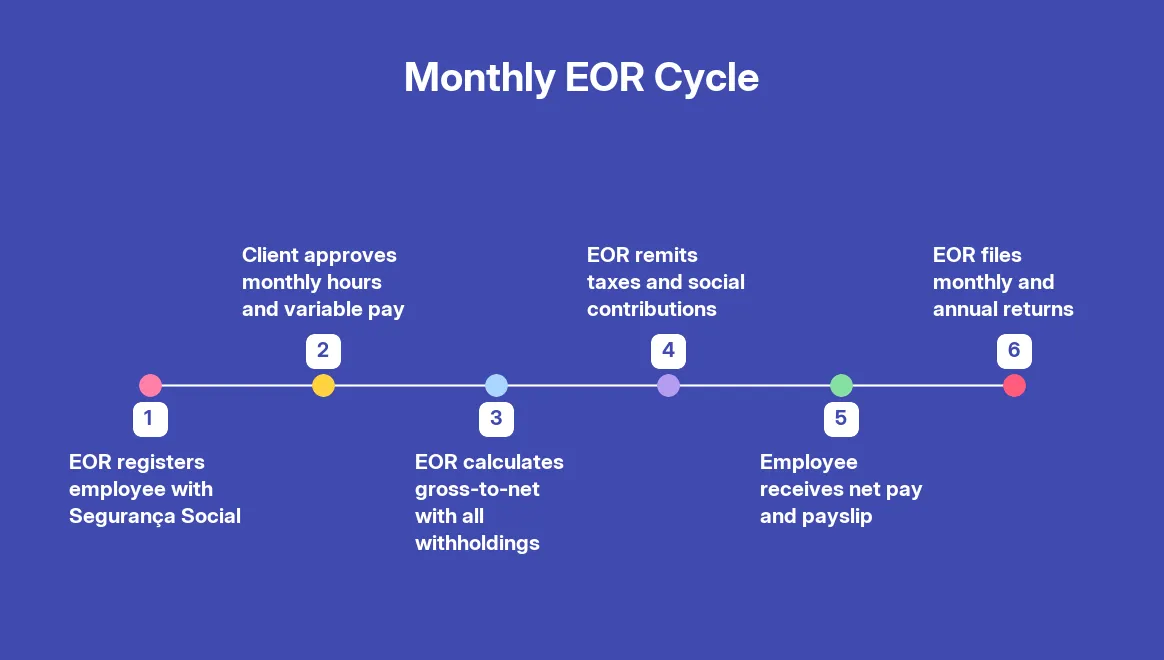
Registration with Segurança Social is the foundation. The EOR submits the employee's identification and contract details to Portugal's social security system before the first pay cycle runs. This step creates the contribution record that determines benefit eligibility for the employee going forward.
Each month, the client reports hours worked, any overtime, bonuses, or commission adjustments. The EOR's payroll team then runs gross-to-net calculations. Portugal's progressive income tax withholding tables change periodically. The EOR applies the current rates without requiring the client to track legislative updates.
Social security splits between employer and employee. The EOR withholds the employee portion from gross pay and adds the employer portion on top. Both amounts are remitted to Segurança Social within the statutory deadline each month. Late filings carry penalties that accrue daily.
A Copenhagen fintech company with eight employees in Lisbon ran its first six months of Portuguese payroll through an EOR. The finance team reviewed monthly cost summaries but never touched a Portuguese tax portal. Year-end reporting, including the annual income declaration, was handled entirely by the EOR's local team.
Beyond payroll, the EOR monitors changes in labor law that affect working conditions. Portugal's Código do Trabalho has undergone several amendments in recent years. Tracking amendments to rules around remote work, overtime compensation, and algorithmic management is an ongoing compliance task. The EOR absorbs that monitoring burden so the client's HR team focuses on people, not regulatory calendars.
Costs, Benefits, and Trade-Offs of EOR in Portugal
EOR pricing in Portugal typically falls within the broader European range. Most providers charge a flat monthly fee per employee. That fee covers employment administration, benefits enrollment, payroll processing, and compliance monitoring. Some providers add setup fees or FX markups on top.
The cost question is not just the EOR fee itself. It is what you avoid spending. Setting up a Portuguese entity requires incorporation, tax registration, a local accountant, a registered office, and ongoing corporate filings. For teams smaller than ten people, those fixed costs rarely make financial sense. The EOR eliminates them.
| Factor | EOR Model | Own Entity |
|---|---|---|
| Setup time | 5-10 business days | 3-6 months typically |
| Upfront cost | Monthly per-employee fee | Incorporation, legal, and accounting fees |
| Ongoing compliance | EOR monitors and files | Internal team or local counsel required |
| Payroll administration | Fully managed by EOR | In-house or outsourced separately |
| Employer liability | Sits with EOR entity | Sits with your company |
| Flexibility to scale down | End contract with notice | Entity wind-down can take months |
| Direct control over HR | Limited to day-to-day management | Full operational and legal control |
The trade-off is control. When you employ through an EOR, the legal employment relationship sits between the EOR and the employee. You direct the work. The EOR holds the contract. For most companies hiring one to fifteen people in Portugal, this trade-off is worth the speed and cost savings. A Stockholm e-commerce company used an EOR for three customer support hires in Porto. Eighteen months later, the team had grown to twelve. At that point, the company began evaluating entity setup. The EOR facilitated the transition planning, ensuring continuity of service for each employee during the handover.
Companies weighing EOR against payroll outsourcing should understand a core distinction. Payroll outsourcing processes pay. It does not employ anyone. You still need a legal entity, still carry employer liability, and still handle contracts and terminations. The EOR wraps all of that into one relationship.
FAQs
Can I use an EOR in Portugal if I already have a registered branch office but not a full subsidiary?
A branch (sucursal) creates a taxable presence in Portugal. This complicates the EOR arrangement. Portuguese tax authorities may treat the branch as the actual employer for social security and withholding purposes, overriding the EOR contract. Some EOR providers will decline to onboard employees when the client already holds a branch registration. Clarify the tax treatment with both the EOR and a local tax advisor before signing any employment agreement.
What happens to an employee's EOR contract if the client company wants to terminate the EOR relationship but retain the employee?
The most common scenario is the client establishing its own Portuguese entity and transferring the employee. Under the Código do Trabalho, the employee's continuity of service and seniority must be preserved. The transfer requires a novation or assignment of the employment contract. The employee must give explicit written consent. Without that consent, the employee remains legally employed by the EOR, and forcing a change could trigger constructive dismissal claims.
Does a remote employee in Portugal hired through an EOR qualify for Portuguese unemployment benefits if they are let go?
Yes. Because the EOR is the registered employer with Segurança Social, all contributions are made under Portuguese social security. This means the employee accrues eligibility for Portuguese unemployment benefits (subsídio de desemprego), not benefits in the client's home country. Eligibility depends on meeting the required contribution period. The EOR handles the termination paperwork and submits the necessary documentation to Portuguese authorities on the employee's behalf.
Is there a maximum duration for which a company can employ someone in Portugal through an EOR before being required to establish a local entity?
Portuguese law does not set an explicit time limit on EOR arrangements. The risk is permanent establishment. If the Portugal-based employee has authority to negotiate and conclude contracts on the client company's behalf, prolonged activity can trigger a deemed permanent establishment under Portuguese and OECD tax rules. Tax authorities assess substance and activity, not duration alone. Arrangements exceeding twelve months involving senior commercial roles warrant a review with international tax counsel.
How does the EOR handle a situation where a Portugal-based employee is covered by a sectoral collective bargaining agreement?
Portugal has extensive sector-level CBAs (Convenções Coletivas de Trabalho) that can override statutory minimums. These affect notice periods, pay scales, working hours, overtime rates, and meal allowances. A quality EOR identifies the applicable CBA based on the employee's role and the sector classification. Failure to apply the correct CBA is a compliance violation. Liability falls on the legal employer, which is the EOR. The client should confirm during onboarding that the EOR has mapped the relevant CBA.
Can an EOR in Portugal employ both full-time and part-time workers, and are the compliance obligations different?
A reputable EOR supports both full-time and part-time contracts. The obligations differ meaningfully. Part-time contracts under the Código do Trabalho require proportional treatment for pay, leave entitlements, and social security contributions. The agreed working hours must be documented in writing before the contract is drafted. Communicating the exact schedule to the EOR upfront is critical. An incorrect classification of hours changes the contribution base and can trigger underpayment penalties from Segurança Social.
What happens if a Portugal-based EOR employee needs to work temporarily from another EU country?
Short assignments under 183 days within a twelve-month period can often remain under Portuguese social security via an A1 certificate. The EOR applies for the A1 form from Portugal's Segurança Social, which certifies continued coverage under Portuguese social security law. Without the A1, the employee may become subject to the host country's social security system. Income tax obligations in the host country may also arise depending on domestic thresholds and applicable double tax treaties. The client should notify the EOR before any cross-border assignment begins.
What to Watch Next
Portugal's labor law continues to evolve. Recent amendments have addressed remote work regulation, platform worker classification, and algorithmic transparency in management decisions. Further changes to the Código do Trabalho are under discussion in Parliament. Companies hiring through an EOR should monitor any shifts in employer social security contribution rates, which the government reviews periodically as part of fiscal policy.
The Non-Habitual Resident tax regime has also undergone significant reform. If your EOR employees previously benefited from NHR advantages, confirm current eligibility rules with your provider. Your concrete next step: request a compliance health check from your EOR partner that maps each employee's contract against the applicable CBA, current withholding tables, and any pending legislative changes that take effect in the coming quarters.
.svg)