


Employer of Record (EOR) in Portugal 2026: The Complete Hiring Guide

- What Is an Employer of Record (EOR)?
- How EOR Services Work in Portugal
- Benefits of Using a Global EOR for Portugal Hiring vs. Entity Setup: Key Differences
- Employer of Record Costs in Portugal
- Risks and Considerations of Using an EOR in Portugal
- How to Hire an Employee in Portugal Through an EOR
- Choosing the Right EOR Provider for Portugal
- FAQs
- What to Watch Next
An employer of record in Portugal lets you hire Portuguese talent next week without spending months incorporating a local entity. A London fintech needed two compliance analysts in Lisbon to cover EU regulatory reporting. Through an EOR, both analysts signed Portuguese-compliant contracts within seven business days. Twelve months later, the team had grown to five.
Portugal sits inside the EU and the Eurozone. Its labor framework, the Código do Trabalho, carries specific obligations that foreign companies cannot ignore. Mandatory 13th and 14th month salary payments, a minimum of 22 working days of annual leave, and employer-side social security contributions all apply from day one. Getting any of these wrong creates liability that lands on whoever holds the employment relationship.
This guide covers how an EOR operates in Portugal, what it costs compared to entity setup, and where the model breaks down. It is written for finance leads, HR directors, and founders weighing their first or next Portuguese hire.
What Is an Employer of Record (EOR)?
Employer of Record Definition and Meaning
An employer of record is a third-party organization that becomes the legal employer of your workers in a target country. You select the candidate, set the role scope, and manage daily work. The EOR signs the employment contract, runs payroll, withholds taxes, and files with local authorities.
This creates a tri-party relationship. The worker reports to your team operationally. The EOR holds the legal employment relationship. You retain full control over tasks, deliverables, and performance.
The critical outcome: companies do not need a legal entity in Portugal to hire compliantly without setting up a local entity. The EOR's existing Portuguese entity carries the employer obligations under local law.
How an EOR Differs from a PEO, Staffing Agency, and Subsidiary
A PEO (Professional Employer Organization) operates under a co-employment model. You must already have your own legal entity in Portugal. The PEO shares employer responsibilities with you, but you remain a co-employer. An EOR is the sole legal employer.
A staffing agency supplies temporary workers for defined assignments. The agency typically owns the candidate relationship and placement. With an EOR, you source your own talent and retain full operational control.
A subsidiary means you incorporate a Portuguese entity, register with tax and social security authorities, and assume all employer obligations directly. That process typically takes three to nine months. An EOR eliminates that timeline entirely.
What a Record of Employment Is — and Why It Is Not the Same Thing
A record of employment is a document, not a service. In several jurisdictions, employers issue it when an employment relationship ends. It certifies tenure, salary history, and reason for separation. It has no connection to the EOR model. The confusion is purely terminological. An employer of record is an ongoing legal arrangement. A record of employment is a one-time administrative document.
How EOR Services Work in Portugal

Step-by-Step: The Portuguese EOR Hiring Process
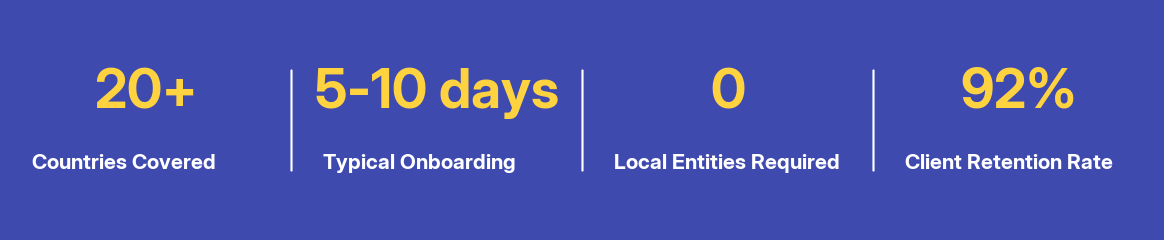
Onboarding through a Portuguese EOR typically completes in five to ten business days. The process follows a predictable sequence once you have selected your candidate.
- You share the candidate's details, role description, and compensation terms with the EOR
- The EOR drafts a Portuguese-compliant employment contract under the Código do Trabalho
- Both parties sign the contract, and the EOR registers the employee with Portuguese social security and tax authorities
- The EOR enrolls the employee in mandatory benefits, including work accident insurance
- Payroll runs monthly, with the EOR calculating gross-to-net, withholding IRS (personal income tax), and remitting social security contributions
A Stuttgart-based industrial IoT company used this process to hire a Portuguese product manager in Porto. The contract was signed on day six. The employee started on day eleven.
Portuguese Labor Law Obligations the EOR Takes On
Portugal's Código do Trabalho governs every employment relationship on Portuguese soil. The EOR assumes these obligations in full.
The standard working week is 40 hours. Portugal mandates a 13th and 14th month salary. The 13th month (Christmas subsidy) and 14th month (holiday subsidy) are not discretionary bonuses. They are statutory salary components, each equal to one month's base pay. Annual leave is a minimum of 22 working days per year.
Probationary periods, notice requirements, and severance calculations follow tenure-based rules set by the Código do Trabalho. Rates and durations are periodically updated. The EOR tracks these changes and applies them to each contract.
Payroll, Social Security, and GDPR Compliance in Practice
Portugal mandates social security contributions split between employer and employee. The EOR remits both portions monthly to Segurança Social. Employer contributions sit meaningfully above employee contributions. Confirm current rates on the Segurança Social portal before budgeting.
IRS withholding applies to every salary payment. The EOR calculates withholding based on the employee's household situation and published tax tables. Monthly declarations go to Autoridade Tributária (the Portuguese tax authority).
Portugal follows EU data protection rules under GDPR. Every employee's personal data, from payroll records to health information, falls under strict processing and storage requirements. The EOR acts as the data controller for employment data. That means breach notification obligations, data minimization, and lawful processing bases are the EOR's responsibility. This matters more than many companies realize when handling cross-border employee data transfers.
Benefits of Using a Global EOR for Portugal Hiring vs. Entity Setup: Key Differences
| Dimension | EOR Model | Portuguese Entity (Subsidiary) |
|---|---|---|
| Time to first hire | 5-10 business days | 3-9 months |
| Upfront investment | Monthly per-employee fee | Legal incorporation, registration, office costs |
| Ongoing compliance burden | Carried by EOR | Carried by your team or local advisors |
| Employer liability holder | EOR's Portuguese entity | Your Portuguese entity |
| Scalability (headcount changes) | Add or reduce headcount flexibly | Fixed overhead regardless of headcount |
| Exit complexity | Terminate EOR agreement after employee offboarding | Wind-down entity, which can take months |
Speed-to-Hire: Entering the Portuguese Market Without a Legal Entity
Entity setup in Portugal requires incorporation at the commercial registry, tax registration with Autoridade Tributária, social security enrollment, and often a Portuguese bank account. Each step has its own processing timeline. Together, they push first-hire readiness out by months.
A Copenhagen e-commerce company needed three customer support agents in Lisbon for peak season starting in six weeks. Incorporating an entity was impossible within that window. Through an EOR, all three agents were onboarded in eight business days. The team handled its first full quarter and two agents were converted to permanent roles.
Risk Transfer and Compliance Assurance
When you use an EOR, the legal employer obligations transfer to the EOR's Portuguese entity. This includes correct IRS withholding, social security remittance, contract compliance under the Código do Trabalho, and work accident insurance.
If the EOR miscalculates a 14th month payment or misses a social security filing deadline, the liability sits with its entity. Your company is not the registered employer. That distinction matters when operating in a jurisdiction where labor courts tend to favor employee protections.
Scalability, Talent Access, and Strategic Flexibility
Portugal's talent pool extends well beyond Lisbon. Porto, Braga, Coimbra, and the Algarve region all produce skilled professionals across tech, finance, and operations. An EOR lets you hire in any Portuguese municipality without geographic restrictions.
The model also serves as a market test. A US SaaS company hired two senior engineers in Porto through an EOR. After eighteen months of strong performance and growing Portuguese revenue, the company incorporated a local entity and absorbed the team. The EOR engagement served as a low-risk proof of concept before a six-figure incorporation commitment.
Employer of Record Costs in Portugal

How EOR Pricing Models Are Structured
EOR providers typically charge one of two ways. The flat monthly fee model charges a fixed amount per employee per month, regardless of salary level. The percentage-of-salary model takes a percentage of the employee's gross compensation, usually in the range of 5 to 15 percent.
Flat fees across the European EOR market generally fall between $300 and $700 per employee per month. The percentage model becomes expensive quickly for senior hires. A product lead earning a high base salary could generate EOR fees that double or triple the flat-fee equivalent.
The True Cost of an Employee in Portugal: Beyond the EOR Fee
The EOR fee is the service charge. It sits on top of the actual employment cost, which in Portugal is substantial.
Portugal mandates a 13th and 14th month salary. That adds two full months of base pay to your annual budget. Employer-side social security contributions add a further percentage on top of gross salary each month. Confirm the current rate with Segurança Social, as it shapes your total cost significantly.
Work accident insurance is mandatory. Meal allowances, though not always legally required, are standard market practice. Skipping them makes your offer uncompetitive in the Portuguese labor market.
Watch out: The 14th month (holiday subsidy) must be paid before the employee's vacation period begins, not at year-end. Misstiming this payment violates the Código do Trabalho and creates immediate liability.
EOR vs. Entity Setup: A Cost-Structure Comparison
For a team of one to five employees, an EOR almost always costs less in total than entity incorporation. The entity route requires legal fees, accounting retainers, registered office costs, and ongoing compliance filings. Those fixed costs do not scale down with headcount.
The crossover point varies. Some companies find that ten or more employees in Portugal justifies a subsidiary. Others stay on EOR at fifteen employees because the compliance burden still outweighs the fee savings. The decision depends on your growth trajectory, how long you plan to operate in Portugal, and whether your team needs a physical office with its own lease.
Risks and Considerations of Using an EOR in Portugal

Compliance Risks: What Happens When the EOR Gets It Wrong
The EOR is the legal employer. But Portuguese authorities can look through the arrangement if the EOR lacks substance. If your company directly controls working hours, sets leave policy, and issues disciplinary actions, regulators may treat you as the true employer. That reclassification triggers back-dated social security, tax penalties, and potential labor court exposure.
Misclassification risk also exists in the other direction. Some companies use EOR arrangements when the worker functions as an independent contractor. Portuguese labor inspectors apply a substance-over-form test. If the relationship looks like employment, it is employment. The Código do Trabalho defines the criteria.
Operational Risks: Control, Culture, and IP Ownership
Your employees work for the EOR on paper. That creates a distance you need to manage deliberately. Performance reviews, promotions, and compensation changes all route through the EOR's HR processes. Some EOR providers handle this smoothly. Others create bottlenecks.
Intellectual property ownership requires explicit contractual provisions. Under Portuguese law, IP created in the course of employment may default to the employer. The EOR is the employer. Without assignment clauses routing IP to your company, you face ownership ambiguity. Ensure the EOR agreement and the employment contract both contain clear IP assignment language.
When an EOR Is the Wrong Solution for Portugal
An EOR does not suit every scenario. If your Portuguese team will exceed twenty employees within two years, the per-employee fees accumulate past the break-even point for entity setup. If you need direct control over employee policies, benefits customization, and local banking relationships, a subsidiary gives you that control.
Permanent establishment risk is the other trigger. If your Portuguese team performs core revenue-generating activities, Portuguese tax authorities may argue your company has a taxable presence. An EOR does not shield you from permanent establishment classification. That determination depends on the nature of the work, not the employment structure.
How to Hire an Employee in Portugal Through an EOR
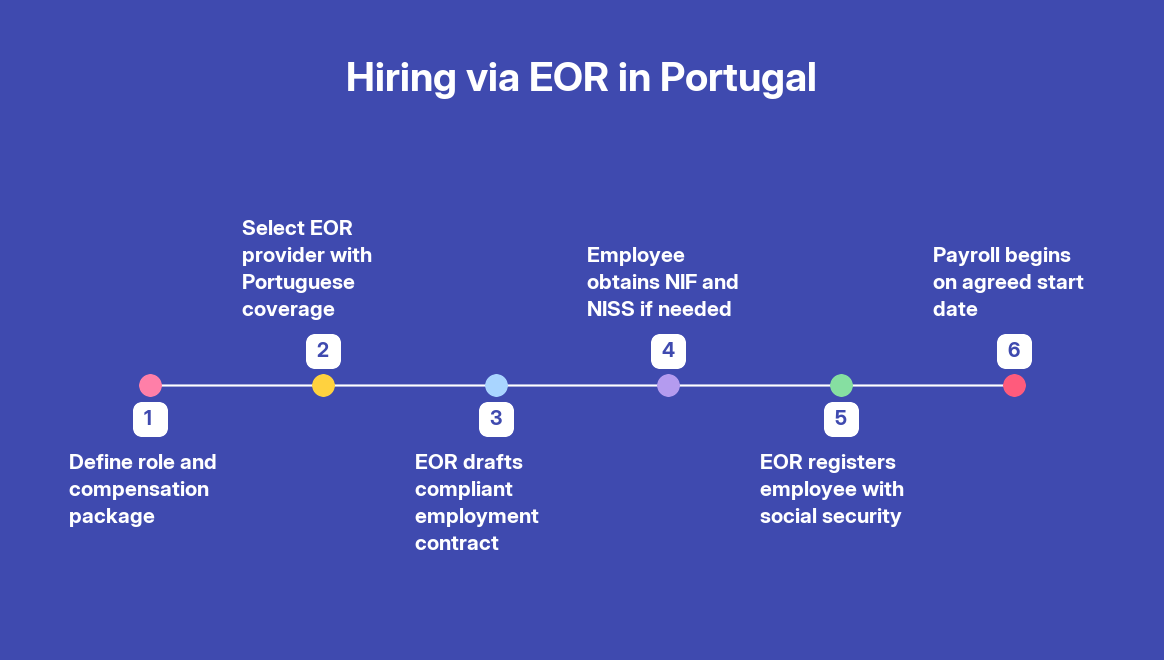
The process starts before any contract is drafted. You define the role, seniority level, and total compensation. The EOR then structures a compliant offer under the Código do Trabalho. This includes the mandatory 13th and 14th month salary payments that Portuguese law requires for all employees.
Your EOR drafts the employment contract in Portuguese. The contract must specify work location, job category, base salary, and applicable collective bargaining agreement. A Munich fintech company hiring two compliance analysts in Lisbon completed this stage in three business days. The EOR had both contracts reviewed and signed within the same week.
Registration with Portuguese social security comes next. The EOR submits the employee's details to Segurança Social and ensures contributions begin from the first pay period. For employees already resident in Portugal with an active NIF and NISS, this step is routine. New arrivals face a longer timeline.
Once registered, the EOR runs payroll monthly. It withholds income tax under IRS rules, remits employer and employee social security contributions, and processes the holiday and Christmas subsidies at the correct intervals. The EOR also handles annual reporting obligations to Portuguese tax authorities.
Throughout the employment, you direct the employee's daily work. The EOR manages the legal and administrative layer. If you later decide to establish your own entity in Portugal, the employment relationship can transfer. That transfer requires a new contract and the employee's consent.
Choosing the Right EOR Provider for Portugal
Selecting an EOR for Portugal means evaluating more than price. The provider's entity structure, payroll accuracy, and knowledge of Portuguese labor law all determine whether you stay compliant or accumulate hidden risk.
| Evaluation Criteria | What to Look For | Red Flag |
|---|---|---|
| Entity type | Own entity or vetted local partner | Undisclosed subcontracting chain |
| CBA coverage | Applies sector-specific CCTs correctly | Ignores collective agreements |
| Payroll handling | Processes 13th/14th month pay automatically | Treats subsidies as optional bonuses |
| Benefits administration | Provides local benefits compliant with Portuguese minimums | Generic global benefits package only |
| Data protection | GDPR-compliant data processing in EU | Employee data stored outside EU without safeguards |
| Termination support | Manages notice periods and severance under Código do Trabalho | Defers termination process to client |
A Toronto e-commerce company switched EOR providers after discovering its original provider had been classifying holiday subsidies as discretionary bonuses. The Portuguese tax authority flagged the error during an audit. The company's new provider corrected the classification and filed amended returns within 30 days.
EOR fees across the Portuguese market typically fall between $300 and $700 per employee per month. Providers with owned entities in Portugal tend to charge at the higher end but offer direct accountability. Those using local partners may offer lower fees while adding a layer of operational distance.
Ask your provider whether they manage contractor relationships alongside EOR employment. Some companies start with contractors in Portugal and later convert them to full employees. A provider that handles both reduces the compliance gap during conversion, especially around misclassification risk. Team Up covers both contractor management and EOR services across its 20+ markets, including Portugal.
FAQs
Can a remote worker in Portugal be hired through an EOR if they are an EU citizen from another member state?
Yes. An EU citizen living and working in Portugal falls under Portuguese labor law and Portuguese social security, regardless of nationality. The EOR must register them with Segurança Social in Portugal. They do not retain home-country social security coverage under a standard EOR arrangement. The exception is posted workers with a valid A1 certificate, which keeps them under their home country's social security for a limited period.
How long does it actually take to onboard an employee in Portugal through an EOR?
For residents who already hold a valid NIF and NISS, onboarding typically completes in five to ten business days. Non-EU hires or recent arrivals without these documents face delays of two to four weeks. Obtaining a NIF requires an appointment with Portuguese tax authorities, and NISS registration depends on social security processing times. This is the most common cause of missed start dates in Portugal.
What happens to the employment contract if the client company terminates its EOR agreement?
The employment contract exists between the EOR and the worker under the Código do Trabalho. It does not automatically transfer to the client company. You must either incorporate a Portuguese entity and negotiate a contractual transfer with the employee's consent, or the EOR must initiate a lawful termination. Termination triggers mandatory notice periods and potential severance obligations. A rushed exit without following these steps exposes the EOR to labor court claims.
Does using an EOR in Portugal create a permanent establishment risk for the client company?
An EOR reduces PE risk but does not eliminate it. If your Portuguese employee has authority to conclude contracts on your behalf, Portuguese tax authorities and OECD PE rules may apply. The distinction matters: an engineer writing code creates minimal PE exposure, while a sales representative signing deals with Portuguese clients creates significant exposure. Review each role individually with a tax advisor before assuming the EOR structure provides full protection.
Can the Non-Habitual Resident tax regime apply to employees hired through an EOR in Portugal?
NHR eligibility depends on the individual's tax residency status and their personal application to Portuguese tax authorities. The employment structure does not determine eligibility. An EOR can employ an NHR-registered individual, but the payroll team must configure the correct withholding rates. Not all EOR platforms handle NHR-specific tax treatment by default. NHR rules are under active legislative review. Verify current eligibility criteria before relying on this regime for compensation planning.
Are collective bargaining agreements enforceable through an EOR arrangement in Portugal?
Yes. Portugal maintains a dense network of sector-level CCTs (Contratos Coletivos de Trabalho). The EOR must apply the CBA relevant to the employee's professional category and sector, even if you as the client company are foreign and not a signatory. This covers minimum pay scales, working conditions, and supplementary benefits. Global EOR platforms that apply only the statutory minimum without checking for applicable CCTs create a compliance gap that Portuguese labor inspectors actively audit.
Can an employee hired through an EOR in Portugal access company equity or stock option plans?
The EOR structure does not prevent equity participation, but it adds complexity. Stock options granted by the client company are taxed as employment income in Portugal at the time of exercise. The EOR must report this as a taxable benefit and withhold accordingly. Some EOR providers lack the payroll configuration to handle equity events correctly. Confirm with your provider before granting options, and ensure the plan documentation references the Portuguese tax treatment to avoid double taxation surprises.
What to Watch Next
Portugal's labor law landscape is not static. The government has signaled further reforms to remote work regulation, digital nomad visa conditions, and the NHR successor regime. Each of these could change the cost calculus for hiring through an EOR.
Monitor updates from the Autoridade para as Condições do Trabalho (ACT) and the Segurança Social website quarterly. CBA revisions in the technology and services sectors can shift minimum pay floors and mandatory benefits mid-year.
Your concrete next step: audit any existing Portuguese employment arrangements against current CBA obligations. If you are using a PEO or EOR provider, request written confirmation that sector-specific collective agreements are applied. That single verification eliminates the most common compliance gap in Portuguese EOR hiring.
.svg)


