


5 Things to Know About EOR-Sponsored Visas in Kazakhstan: Enterprise Guide
TL;DR: Kazakhstan Work Permit and EOR Sponsorship in 2026
Kazakhstan is Central Asia's biggest story right now, and global enterprise teams are finally paying attention at scale. The economy grew 6% in the first half of 2025. The Astana International Financial Centre raised $6 billion in investment that year alone, with more than 4,900 companies from 90+ countries now registered inside it. The AIFC ranks first in Eastern Europe and Central Asia in the Global Financial Centres Index. Fintech firms have quadrupled since 2018. And the government's FDI target, $150 billion by 2029, is backed by real infrastructure, real legal reform, and an English common law jurisdiction that makes Kazakhstan genuinely accessible to international enterprise in a way that most of its Central Asian neighbours simply aren't.
But the moment you decide to bring a foreign specialist into Kazakhstan, whether you're seconding a senior engineer to your Astana hub or transferring a finance lead to your AIFC-registered entity, you're navigating a foreign labour framework that just underwent its most significant overhaul in years. EOR-sponsored visas in Kazakhstan now require a mandatory 15-day labour market test, a region-specific quota system with an annual application deadline, four categories of work permit with different validity and renewal rules, and a new digital platform that replaced the old process on September 1, 2025.
If you're working from a pre-September 2025 playbook, you're already behind.
This guide puts you ahead of it.
Why Hire in Kazakhstan: The Enterprise Case Beyond Oil and Energy

Most companies that discover Kazakhstan start with oil and gas. That's understandable. Kazakhstan is the world's number one uranium producer, operates some of the largest oil fields in the world through joint ventures with Chevron, ExxonMobil, and Shell, and has a National Fund worth tens of billions of dollars buffering its fiscal position.
But the Kazakhstan that matters to enterprise talent strategy in 2025 is a different story.
- The AIFC is the structural differentiator: The Astana International Financial Centre is not just a tax zone; it is the only English common law jurisdiction in Central Asia. It has its own independent court (staffed by former senior UK judges), its own arbitration centre, and its own regulatory authority. For international companies that need legal certainty in a region where civil law systems can be unpredictable, the AIFC is a genuine structural advantage. Over 4,900 companies from over 90 countries are registered there, including firms from the US, UK, China, Singapore, Turkey, and the UAE. In 2025 alone, $6 billion flowed in. This is $2.9 billion more than in 2024.
- The talent picture has matured: Astana IT University, Nazarbayev University, and a growing pipeline of technically trained graduates are producing engineers, data scientists, and financial professionals who are increasingly competitive at an international level. The number of fintech companies registered at the AIFC quadrupled between 2018 and 2025. Kazakhstan now ranks among the top 30 countries globally in digital development according to the UN.
- The cost and timezone structure work: Senior engineers in Almaty and Astana work at 40–55% below Western European cost equivalents. UTC+5 (Astana) and UTC+6 (Almaty) provide timezone overlap with the Gulf, India, and much of East Asia, which makes real-time collaboration genuinely practical. And for companies already operating in Uzbekistan or other parts of Central Asia, Kazakhstan provides a regionally anchored hub with the strongest legal infrastructure in the zone.
- The government is signalling commitment: President Tokayev has removed more than 10,000 unnecessary business requirements since 2023, halving inspection burdens. The Investment Policy Concept through 2029 targets $150 billion in FDI with a digital investment platform that allows permits to be submitted without direct government interaction. These are structural signals, not marketing.
The challenge is the immigration framework. Kazakhstan's work permit system is quota-driven, category-specific, region-locked, and just restructured with reforms that the majority of global EOR platforms haven't fully incorporated into their operating procedures. For international companies without a Kazakhstani entity, an EOR with real in-country infrastructure is the only compliant employer sponsorship pathway.

Kazakhstan Work Permit System Overhaul (2025): New Rules, New Platform, New Risks
Effective September 1, 2025, Kazakhstan overhauled its foreign worker hiring process with a series of new rules aimed at safeguarding domestic employment opportunities. Employers now face more rigorous requirements, including a mandatory 15-day labour market test, a centralized online portal for work permit applications, and expanded local hiring quotas.
This is not a minor update. It is the most significant change to Kazakhstan's immigration and labour regulations in recent years, and it affects every stage of the employer's process — from how and where you post the vacancy, to the platform you must use to file the permit application, to how the system verifies your compliance automatically.
Here is what changed specifically, and why each change matters:
Why Legacy Portals No Longer Work for Work Permit Applications
Employers are now required to apply for a permit or permit renewal through e-government web portals, www.elicense.kz or the www.migration.enbek.kz portal. The critical distinction: the previous portals (egov.kz and elicense.kz) remain technically active, but they do not support the new labour market test requirement that is now mandatory. The previous portals do not support the new rules. Therefore, employers are advised to use only the updated platform for all applications after September 1, 2025.
In practice, this means any EOR filing through the old portal workflow is submitting an application that cannot include the mandatory vacancy publication code, triggering automatic rejection. The migration. enbek.The KZ portal is not optional. It is the only path for a complete, compliant application under the September 2025 rules.
Real-Time Government Cross-Checks and Compliance Monitoring

When submitting an application, the Foreign Labour Information System automatically cross-checks data from other government systems: the Unified Labour Contract Registration System (ULCRS) to verify the conclusion and registration of labour contracts with foreign employees already hired; and the Migration Police to obtain up-to-date migration data.
This matters for employers with existing foreign hires. If any prior foreign employee's labour contract is not registered in the ULCRS, the automated check will flag the application, and it will be rejected, regardless of the quality of the new application itself. An EOR that has not been maintaining mandatory contract registrations for its existing Kazakhstan employees will create a legal compliance liability that blocks new permit applications.
Educational Document Verification via MFA Systems
The local executive body will send requests to the Ministry of Foreign Affairs of the Republic of Kazakhstan to verify the authenticity of the legalization stamp or apostille on educational documents, unless otherwise provided by international treaties or the legislation of the Republic of Kazakhstan. Previously, this verification was handled at the submission stage. Now the MFA conducts it independently. Documents with even minor legalization irregularities, wrong stamp format, expired apostille, or wrong issuing authority will be flagged by this verification layer, and the application will fail. The standard for document preparation has risen accordingly.
ULCRS Registration Requirement: Mandatory for All Labour Contracts and ICT Agreements
Employers are directly responsible for ensuring all labour contracts (including intracompany transfer agreements) with foreign employees are registered in the ULCRS. This is a new obligation. Prior to September 2025, contract registration was not enforced with the same rigour. Now, the automated cross-check makes ULCRS registration a prerequisite, not an administrative afterthought.
Operational Impact for Employers Hiring Foreign Talent in Kazakhstan
If your EOR didn't update its Kazakhstan process on September 1, 2025, it is operating with a workflow that will produce rejections at multiple points. The platform is wrong. The vacancy publication step is missing. The automated verification will flag contract registration gaps. This is not a theoretical risk; it is a documented failure mode for companies that engaged EOR providers who were slow to adapt.
Kazakhstan Labour Market Test: Mandatory for All Foreign Hires
Before September 2025, Kazakhstan's labour market test existed on paper but was not consistently enforced across all categories. The addition of the labour market test is the most substantial change to the Kazakh immigration process in recent years. These reforms seek to preserve the domestic labour market amid increased immigration of foreign nationals into Kazakhstan.
The test is now non-negotiable, applies before any work permit application can be submitted, and adds a minimum of 15 calendar days to every hiring timeline.
How the Labour Market Test Works in Practice
The employer is first required to post a vacancy on the Electronic Labour Exchange (enbek.kz) in the region where the hiring is planned. The vacancy must be published on the exchange for at least 15 calendar days. If no qualified local candidate is found during this time, the company receives a vacancy registration code, which must be entered in the work permit application and reported to the local employment office.
The vacancy must be posted in the specific region where the work will be performed, not nationally. Kazakhstan's work permits are region-specific, and the labour market test must be run in the same region the permit will cover. If your Astana entity needs a permit for a role based in Almaty, the vacancy is posted on enbek.kz for the Almaty region, not Astana. An application submitted with an Astana-region vacancy code for an Almaty-based role will be rejected.
The 15 calendar days are calendar days, not business days. This distinction matters more than it sounds. If the EOR posts the vacancy on a Thursday, the 15-day window includes both weekends, and the application cannot be submitted until the Sunday two weeks later at the earliest. Build this into your hiring calendar from the first conversation, not after the candidate accepts an offer.
What Happens if Local Candidates Apply
If the Electronic Labour Exchange system identifies Kazakhstani candidates who have applied for the vacancy, the employer is expected to review them. There is no formal "rejection document" requirement of the kind seen in Armenia or Azerbaijan, but the employer must demonstrate, through the process, that no suitable local candidate was identified. In practice, for specialist roles with demonstrable skill gaps in the local market, this is typically resolved by the absence of qualified local applicants within the 15-day window.
How to Structure Vacancy Descriptions to Avoid Rejection
This is where EOR expertise makes a material difference. An under-specified vacancy, "Software Engineer, 3+ years' experience", will generate local applicants who technically meet the listed criteria, complicating the next step. A precisely specified vacancy, "Senior MLOps Engineer with 5+ years of experience deploying LLMs in production environments on cloud-native Kubernetes infrastructure", reflects genuine role requirements that the Kazakhstani market cannot currently supply at the described level, and the 15-day window will clear cleanly.
A good EOR drafts the vacancy description with both accuracy and market reality in mind. It's not dishonest. It's precise. And in Kazakhstan, precision is what clears the labour market test.
Exception: Intra-Corporate Transfers (ICT) Explained
For intra-corporate transfer permits, the requirement to submit vacancy reports to the employment centre has been cancelled. Previously, such reports were mandatory, and the work permit application could be accepted no earlier than 15 days after submitting such a report. If you are transferring an existing employee from another country into your Kazakhstani entity under an ICT arrangement, the 15-day test does not apply. This is a meaningful planning advantage for enterprise teams with existing global mobility programs — and one that is worth structuring around if the role qualifies.
Kazakhstan Work Permit Categories Explained: Why Misclassification Causes Rejections

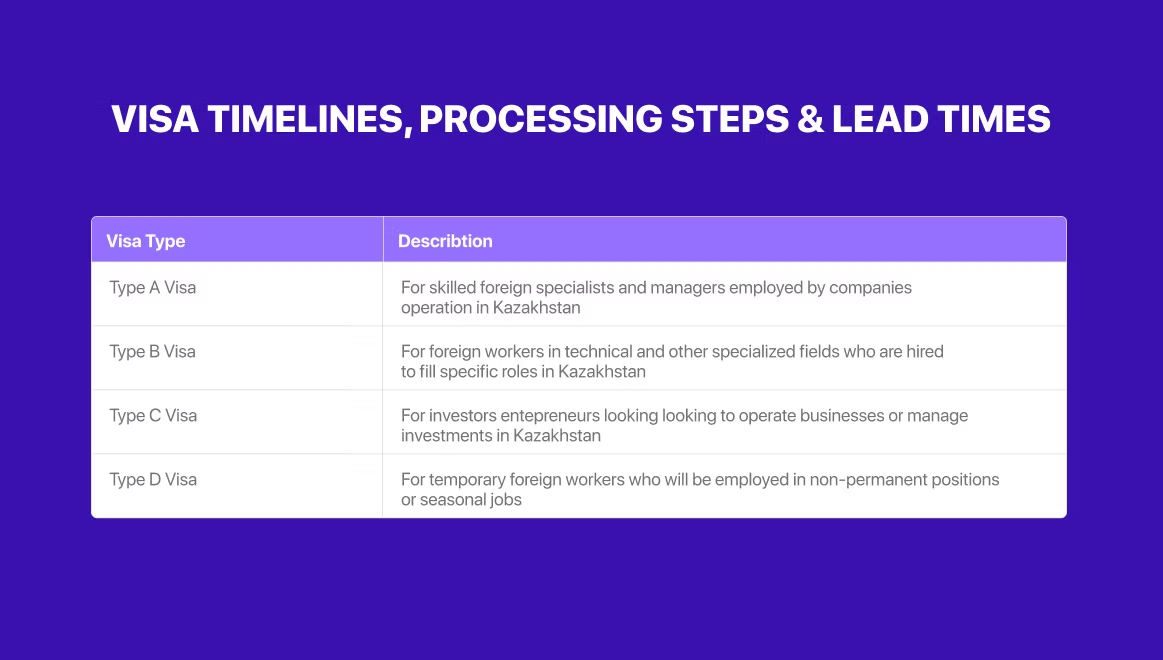
This is the compliance intelligence gap that causes the most timeline surprises in Kazakhstan. The country's work permit system is structured around four categories, each with different validity periods, renewal rights, ratio requirements, and replacement obligations. Assigning your hire to the wrong category creates either an overburdened application or a permit that doesn't match the role, both of which trigger either rejection or post-approval violations.
Here is what each category actually covers:
Category 1: Senior Managers and Executives
This covers heads of organizations, their deputies, and executives with authority over the company's operations. Category 1 permits are issued for 1, 2, or 3 years and are renewable for the same period. The ratio requirement, at least 70% of Category 1 and 2 roles must be filled by Kazakhstani nationals, applies to the employer's total workforce in these categories.
For EOR-sponsored hires, Category 1 is typically reserved for senior executives seconded to the Kazakhstani entity with genuine operational authority. It is not a category that can be used for senior individual contributors; a director-level engineer who doesn't manage people is not Category 1.
Category 2: Specialists and Mid-Level Management
This covers department managers, senior specialists, and technical leads. Category 2 permits are issued for 12 months, renewable up to three times (i.e., up to a maximum of 4 years with renewals). The 70% local ratio applies to Category 2 combined with Category 1.
Most enterprise professional hires, engineering leads, product directors, finance managers, and data scientists fall into Category 2. This is the standard EOR-sponsored work permit track for specialist talent.
Category 3: Skilled Workers and Technicians
Category 3 covers blue-collar and mid-level technical roles, skilled tradespeople, technicians, and operators. The 90% local ratio applies, meaning at least 90% of employees in Category 3 roles must be Kazakhstani citizens. The ratio is strictly enforced and effectively limits foreign workers in this category to a small fraction of the workforce.
For most enterprise teams, technology, finance, and operations leadership, Category 3 is unlikely to be relevant. But if your Kazakhstan operation includes technical field roles in construction, energy, or manufacturing, Category 3 is the applicable track, and the 90% ratio constraint will govern how many foreign specialists you can bring in.
Category 4: The Most Restrictive and Most Misunderstood Category
Category 4 covers unskilled workers, the lowest-skilled category in the permit system. Permits are issued for 12 months and are non-renewable. More importantly, the employer is required to ensure that every Category 4 foreign national is replaced by a Kazakhstani citizen within six months to one year. Foreigners involved in the 4th category will be replaced by Kazakhstani citizens in identical or comparable positions within six months to one year, and they must also provide information on the replacement on the portal migration.enbek.kz.
The replacement requirement is now tracked through the migration. enbek.KZ portal, meaning the government has visibility into whether replacements are happening on schedule. An employer who consistently fails to replace Category 4 foreign workers within the required timeframe faces permit bans on future applications.
The category assignment trap:
Most enterprise teams that engage an EOR without specialist Kazakhstan knowledge default to Category 2 for everything because it's the most flexible. But here's the critical ratio issue: when calculating the foreign-to-local ratio, the company must also account for any employees engaged under outsourcing contracts. This means that if your Kazakhstani entity outsources certain functions and those outsourced employees fill roles in Categories 1 or 2, they count in the denominator of the ratio calculation. An EOR in Kazakhstan that doesn't account for outsourced headcount when calculating your ratio compliance may tell you that your permit is within quota, when it actually isn't.
Kazakhstan Work Permit Quota System: Deadlines, Regional Limits, and Hiring Risk
Kazakhstan's work permit system is not demand-driven. It is pre-approved and quota-bounded. You cannot simply decide in January that you want to hire a foreign national in March and file a permit application. You need quota headroom that was approved the previous year, and if it wasn't, you're waiting until the next cycle.
Here's how the quota system works operationally:
Annual Quota Filing Deadline (September 30) and Why It Matters
Every year (usually by September 30), employers must submit a request for the number of foreign workers they intend to hire in the following year. For 2026, the government has set the general quota at 0.25% of the total labour force. If a company has not applied for a quota, obtaining a new work permit can be extremely difficult.
The quota request is filed with the regional Akimat (the local executive authority). It must include justification for engaging foreign workers, identification of the specific projects being implemented, and, for companies with existing foreign hires, copies of current contracts as confirmation. The Akimat reviews the request and can reject it if the employer has labour law violations or if, in the committee's assessment, the need could be met by local personnel.
Regional Quotas vs National Limits: Key Differences
This is not a single Kazakhstan-wide quota allocation. Each permit is tied to the region where the work will be performed, and the quota must be specifically requested for that region. The employer confirms the need for a foreign worker and checks quota availability for the relevant region and job category. An enterprise with operations in both Astana and Almaty needs separate quota allocations for each city. A permit approved under the Astana quota cannot authorize work in Almaty.
Quota Exemptions: The ICT Advantage for Multinational Companies
Not all hires require a quota. Quota is not required for foreign employees attracted under intra-corporate transfer (ICT), or working under exemption without a work permit (for example, as an investor or director of the company with 100% of foreign shares).
This is a material planning advantage for enterprise teams with existing global operations. If you're bringing a specialist from your London office to your Astana hub through a formal ICT arrangement, with proper documentation of the sending and receiving entities' relationship, the employee's qualifications, and the ICT agreement, you can bypass the quota system entirely. The ICT track does not require a quota pre-application, which means it can be initiated at any point in the year rather than being constrained by the September filing deadline.
How Quotas Impact 2026 and 2027 Hiring Plans
If you're reading this and have not yet submitted a quota request for the current hiring year, check whether you missed the September 30 deadline. If you have, the ICT pathway may be your most viable route for any time-sensitive hires. If you're planning expansion, the quota application for the following year should be in your HR calendar no later than Q3 of the current year, not as an afterthought after you've extended a job offer.
An EOR that manages your Kazakhstan quota application, monitors the regional Akimat's process, submits justification documentation on your behalf, and tracks the approval is doing work that directly determines whether your hiring plans are executable in Q1 of the following year.
Kazakhstan Replacement Obligation: Local Workforce Requirements by Category
The concept of "Kazakhstanisation", gradually replacing foreign specialists with local talent, is embedded structurally in Kazakhstan's immigration law. It is not just a policy aspiration. It is a documented, tracked obligation with enforcement consequences.
Here's what it looks like in practice, and what changed in September 2025:
Replacement Ratios for Categories 1, 2, and 3
For Category 4 workers (unskilled), the replacement obligation is the most acute: the employer must replace every Category 4 foreign worker with a Kazakhstani citizen within 6 to 12 months, and must report the replacement status in the migration. enbek.KZ portal. The new September 2025 rules expanded this reporting obligation — previously, replacement tracking was required only for identical positions. Foreigners involved in the 4th category will be replaced by Kazakhstani citizens in identical positions or other positions belonging to the fourth category for a period of six months to one year. The "or other positions belonging to the fourth category" expansion is new. It means that even if the exact role changes, the employer must demonstrate active Kazakhstanisation across the Category 4 workforce.
Expansion of Replacement Rules to Category 4
Rather than a time-bound replacement deadline, the ratio requirement operates as a continuous enforcement mechanism. For Categories 1 and 2, at least 70% of the workforce in those roles must be Kazakhstani citizens. For Category 3, at least 90%. If your workforce ratio falls below these thresholds, whether because a local employee leaves, or because you added a foreign hire that pushed the ratio over, you are in breach of your permit conditions.
The ratio now also explicitly includes employees engaged under outsourcing contracts in its calculation. If your entity outsources back-office functions and the outsourced workers are in Category 2 roles, they count in your ratio denominator. An EOR managing your permit compliance must track this against the full workforce picture, not just direct employment contracts.
What Happens if Replacement Requirements Are Not Met
In case of violations, a ban on attracting foreign labour can be imposed. This is not a minor administrative fine. A company-level ban on attracting foreign labour freezes all future work permit applications, including renewals for existing foreign employees. For enterprise teams building a Kazakhstan hub over a multi-year period, a single replacement obligation failure can paralyze the hiring pipeline for a full permit cycle.
EAEU Exemption Explained: Who Qualifies and Why It Matters
Citizens of Russia, Belarus, Kyrgyzstan, and Armenia (fellow EAEU members) can come to Kazakhstan for the purposes of work, to receive remuneration from a Kazakh company, without a work permit. However, a foreigner's employment in Kazakhstan based on a work permit, a residence permit or a certificate of self-employment implies the conclusion of an employment contract in accordance with the current legislation of the Republic of Kazakhstan. An employment contract is also required when hiring citizens from the EAEU member states (Armenia, Belarus, Russia, and Kyrgyzstan).
The work permit exemption does not mean the employment relationship is unregulated. EAEU nationals still need a compliant employment contract, tax registration, an IIN issuance, and payroll under the Kazakhstani Labour Code. An EOR that treats EAEU nationals as "no paperwork needed" hires is creating exposure, just on the payroll and contract compliance side, rather than the permit side.
How to Hire in Kazakhstan With an Employer of Record: Step-by-Step Process
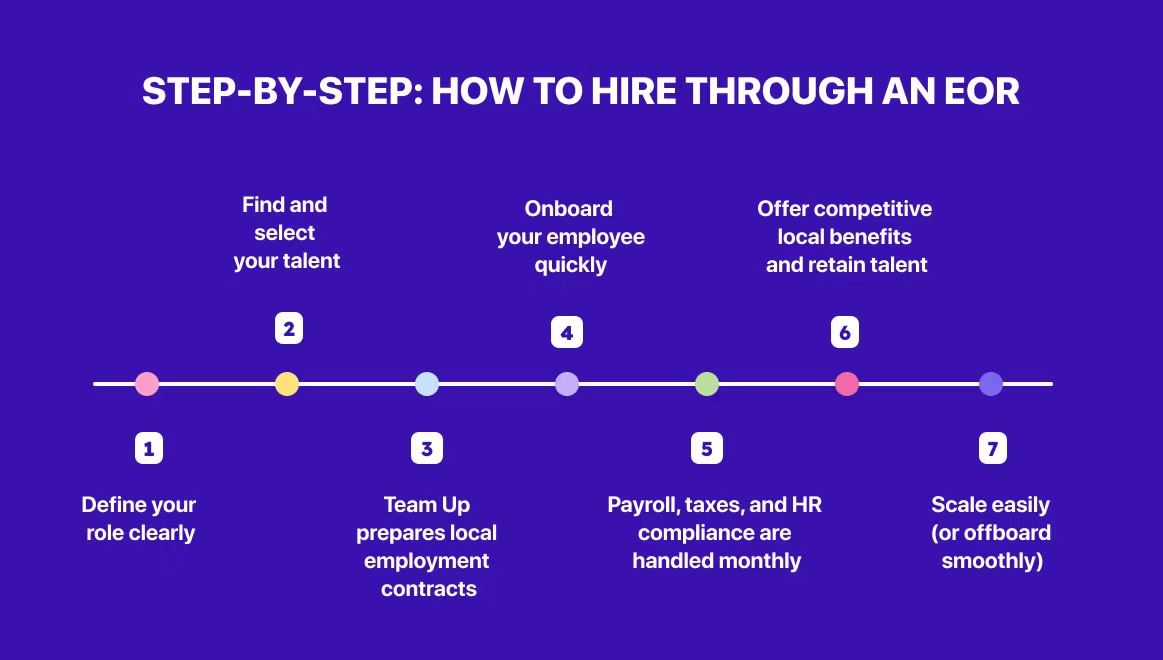
Here is the complete sequenced playbook, from first engagement to fully authorized, legally registered, payroll-active employee in Kazakhstan.
Phase 1: Pre-check and strategy (Days 1–7)
Your EOR's Kazakhstan legal team reviews:
- Which of the four permit categories applies to the specific role and seniority level
- Whether the ICT pathway is available (and preferable, given its quota exemption and labour market test waiver)
- Current quota availability in the specific region where the employee will work
- The employer entity's ratio compliance status, counting both direct employees and outsourced headcount
- EAEU citizenship check: does the candidate's nationality qualify for the permit exemption?
- Document legalization and apostille requirements for this specific nationality
- Whether the ULCRS contract registration history for all existing foreign employees is clean and current, because the automated cross-check will surface any gaps immediately on filing
Phase 2: Quota confirmation and vacancy posting (Days 7–10)
If a quota is required, confirm that the entity's quota allocation for the current year includes headroom for this hire in this region. If no quota headroom exists, assess whether ICT is structurally viable.
The EOR posts the vacancy on enbek.kz for the specific region where the work will be performed. The vacancy code is generated. The 15-day clock starts.
The vacancy is drafted with role-appropriate precision, neither so generic that it attracts unqualified local applicants, nor so narrow that it looks engineered. An EOR with Kazakhstan market knowledge calibrates this correctly on the first draft.
Phase 3: Document preparation (Days 10–22, parallel with the labour market test)
While the 15-day window is running, all employer and employee documents are prepared:
Employer-side (your EOR):
- State registration certificate of the legal entity
- Evidence of tax standing (no outstanding violations)
- Current ratio compliance documentation
- ULCRS registration confirmation for all existing foreign employees
- Vacancy publication code from Enbek.kz
Employee-side:
- Valid passport
- Educational diploma, legalized (apostille or embassy legalization, depending on the country) and ready for MFA authenticity verification
- CV and professional qualifications documentation
- Proof of professional experience relevant to the role
Phase 4: Permit application via migration. enbek.kz (Day 22+)
After the 15-day vacancy publication period, and with a clean status on all verification layers, the EOR submits the full application through migration. enbek.kz, including the vacancy publication code. The system runs automated cross-checks against the ULCRS and Migration Police databases in real time at submission.
Processing time: 15–30 business days from submission for a standard Category 1 or 2 permit. State fees are paid at this stage (approximately 20,000–100,000 KZT depending on category and duration).
Phase 5: Work visa and entry (Days 45–55)
Once the work permit is approved, the employee applies for a C3 Work Visa at the nearest Kazakhstani consulate in their home country. The application requires: the work permit approval, an invitation letter from the employer (your EOR), a passport, photos, and applicable consular fees.
Consulate processing: 5 business days. The employee then travels to Kazakhstan.
Phase 6: Post-arrival formalities (Days 55–65)
Within 3 business days of arrival, the EOR notifies the Migration Service of the employee's arrival, now processed digitally via the e-Qonak or Visa-Migration portal. Missing this deadline is a standalone compliance violation.
Within 10–14 days of arrival, the employee obtains an Individual Identification Number (IIN). The IIN is required for tax registration, salary processing, and healthcare enrollment. No IIN, no legal payroll.
The EOR signs the local employment contract under the Kazakhstani Labour Code, registers it in the ULCRS (mandatory under the September 2025 rules), enrolls the employee in Kazakhstan's mandatory social insurance system (ENPF, compulsory pension fund, plus social tax and mandatory health insurance), and initiates payroll in Kazakhstani Tenge (KZT).
Total timeline: from EOR engagement to legally working, registered employee:
approximately 8–12 weeks for a standard permit track. The ICT track can be faster, given the labour market test waiver. Exact timing depends on the nationality's document legalization requirements and the regional Akimat processing speed.
Work permit validity and renewal periods:
- Category 1: 1, 2, or 3 years (renewable for the same period)
- Categories 2 and 3: 12 months, renewable up to 3 times
- Category 4: 12 months, non-renewable
Renewals must be initiated before permit expiry. Post-expiry work without a valid permit is an immediate violation.
Compliance Risks in Kazakhstan: The Real Cost of Work Permit Violations
Kazakhstan's compliance enforcement has sharpened materially since the September 2025 overhaul. The migration. enbek.KZ portal creates a unified, real-time record of every employer's foreign workforce, including permit status, contract registration, IIN issuance, and replacement obligation progress. The government has visibility it simply didn't have before.
Risks for Foreign Employees Without Valid Work Authorization
- Working without a valid work permit or IIN: immediate violation, deportation risk
- Location violation: Work permits are location-specific, and employees must remain in the approved work location unless authorized to relocate or change employers. An employee permitted to work in Astana who performs work in Almaty, even temporarily, is in breach of their permit conditions.
- Changing employers without a new permit: immediate immigration violation; the permit is employer-specific and non-transferable
Risks for Employers and EOR Sponsors
- Fines per unauthorized foreign employee under Kazakhstan's Administrative Code: a fine of 60 to 150 MCI (Monthly Calculation Index). Repeated violation entails a fine of 80 to 200 MCI. In 2025, 1 MCI = 3,932 KZT. That puts single-violation fines in the range of KZT 236,000–590,000 per employee (approximately $500–$1,200), with repeat violations doubling the exposure.
- In severe cases, authorities can impose a 12-month restriction on sponsoring new foreign hires. A 12-month hiring ban, triggered by a single compliance failure, can stall an entire Kazakhstan expansion program.
- ULCRS registration failures: the automated cross-check now surfaces unregistered contracts at the point of new permit applications — meaning historical non-compliance creates compounding problems
- Ratio violations: failing to maintain the 70%/90% local employee ratios (counting outsourced headcount) triggers permit issuance refusals on renewals and new applications
- Replacement obligation failures (Category 4): failure to replace foreign workers within the 6–12 month window is logged in migration.enbek.kz and triggers ban consideration
The “Neo Nomad Visa” Misconception Explained
In 2024, the government introduced a "Neo Nomad" visa for foreigners who combine travel and remote work. This visa provides professionals the right to stay in Kazakhstan for up to one year while working remotely for international employers. However, this visa does not allow the holder to work for a local Kazakhstani legal entity. If your foreign hire holds a Neo Nomad visa and begins performing work for your Kazakhstani entity, even informally, they are in violation. The Neo Nomad visa authorizes remote work for overseas employers only. It is not a work permit.
Employer of Record Kazakhstan: Why Local Infrastructure in Astana and Almaty Matters
Kazakhstan is not the market you want to figure out on the job. The September 2025 overhaul created a new operational reality that requires genuinely current, in-country expertise, not a global EOR platform that updated its FAQ page in October 2025.
Team Up operates with directly owned entities across Central Asia and beyond, including Kazakhstan, Uzbekistan, Georgia, Armenia, Azerbaijan, Turkey, India, and Egypt. In Kazakhstan specifically, this means:
- Native migration.enbek.kz operations. Team Up's Astana and Almaty compliance teams were operating on the new platform from September 1, 2025, not after client applications started failing on the old system. Vacancy postings, permit applications, contract registrations in the ULCRS, and replacement obligation tracking are all processed natively through the updated digital infrastructure.
- Quota management as a standing service. Team Up files regional quota applications on behalf of its Kazakhstan clients every year before the September 30 deadline with documented justification, current contract evidence, and region-specific allocation. Before you confirm a new hire in Kazakhstan, Team Up's team checks your available quota headroom in real time, in the specific region, for the specific category. You know whether the hire is executable before you extend the offer.
- Category assignment precision. Assigning your hire to the correct permit category — and drafting the vacancy description accurately enough to clear the labour market test without attracting unsuitable local applicants — is an operational skill that comes from experience, not from reading the law. Team Up's Kazakhstan legal team has run hundreds of Category 1 and 2 applications and understands what vacancy descriptions clearly enbek.kz for each type of specialist role.
- ICT structuring. For enterprise teams with global mobility programs, Team Up can assess whether a given transfer qualifies for the ICT pathway, bypassing both the quota requirement and the 15-day labour market test. Proper ICT documentation (sending entity letter, receiving entity letter, employee qualifications confirmation, ICT agreement) is prepared correctly from the first submission.
- Full payroll compliance in KZT. ENPF pension contributions, social tax, mandatory health insurance, IIN registration, ULCRS contract registration, and 3-day arrival notification, all processed as standard, not as exceptions. The compliance record that feeds into every future permit application is clean from day one.
For enterprise teams building capability in Astana's AIFC corridor, Almaty's tech ecosystem, or regional operations across Kazakhstan, Team Up is the EOR that knows the difference between a clean September 2025 application and one that gets rejected by the automated cross-check before a human ever looks at it.
Bottom Line
Kazakhstan has arrived as an enterprise hiring destination. The AIFC's English common law jurisdiction, Nazarbayev University's talent output, Astana's rapidly expanding tech and fintech cluster, and a government genuinely invested in making foreign capital feel welcome, these are structural advantages, not temporary conditions. The $6 billion that flowed into the AIFC in 2025 alone tells you where serious international capital is pointing.
But the immigration framework requires serious operational discipline. The September 2025 overhaul raised the standard across the board: a new digital platform, a mandatory 15-day labour market test, automated cross-checks that surface contract registration failures instantly, and an annual quota deadline that freezes options for unprepared companies. The four permit categories have different rules, different ratio requirements, and different replacement obligations, and assigning a hire to the wrong category creates compounding problems over the permit lifecycle.
EOR-sponsored visas in Kazakhstan work reliably, efficiently, and with full legal compliance when the EOR has the entity, the Astana and Almaty legal team, the updated September 2025 workflows, and the track record to run the process correctly from the first application to the last renewal.
That is not every EOR. It is the right one.
Talk to Team Up about your Kazakhstan hiring plans.
FAQ: EOR-Sponsored Visas in Kazakhstan
What is visa sponsorship for employment in Kazakhstan?
Visa sponsorship for employment in Kazakhstan means a registered Kazakhstani employer formally applies to the regional labour authority for a work permit on behalf of a foreign national, then supports the employee's work visa and post-arrival registrations. Only employers with registered legal entities in Kazakhstan can sponsor. Without an entity, international companies use an EOR.
What changed on September 1, 2025, in Kazakhstan's work permit system?
As of September 1, 2025, Kazakhstan introduced amendments including a mandatory publication of job vacancies on the government electronic labour exchange, adherence to a 15-day waiting period, automated verification via interagency systems, and mandatory registration of contracts in the ULCRS. The new migration.enbek.KZ portal is the required platform for all applications under the new rules.
Do I have to complete a labour market test for every foreign hire in Kazakhstan?
Yes, for all standard work permit categories. The 15-day vacancy posting on enbek.kz is mandatory before any permit application can be filed. The one significant exception is intra-corporate transfers (ICT), for which the labour market test requirement has been cancelled.
What are Kazakhstan's four work permit categories?
Category 1: senior executives (1–3 year permits, renewable). Category 2: managers and specialists (12 months, renewable up to 3 times). Category 3: skilled workers (12 months, renewable up to 3 times). Category 4: unskilled workers (12 months, non-renewable, with mandatory replacement by a Kazakhstani citizen within 6–12 months). The 70% local ratio applies to Categories 1 and 2 combined; 90% applies to Category 3.
How does the annual quota work?
Employers must submit a region-specific quota request to the regional Akimat by September 30 each year for the following year. The national general quota for 2026 is set at 0.25% of the total labour force. ICT hires are quota-exempt.
Do EAEU citizens (Russians, Belarusians, Kyrgyz, Armenians) need work permits in Kazakhstan?
No, EAEU citizens do not require a work permit to be employed in Kazakhstan. However, they still require a compliant employment contract registered in the ULCRS, an IIN, and payroll run under the Kazakhstani Labour Code.
What is the Neo Nomad visa, and can it be used for local employment?
The Neo Nomad visa allows foreign nationals to live in Kazakhstan for up to one year while working remotely for an overseas employer. It does not authorize work for a local Kazakhstani legal entity. Using it as a de facto work authorization for a local role is an immigration violation.
Can a foreign employee change employers while on a Kazakhstan work permit?
No. Work permits in Kazakhstan are employer-specific. A permit issued for Company A is not valid for Company B. A new permit application is required. Unauthorized employer changes are immigration violations.
What are the penalties for non-compliance in Kazakhstan?
Fines per unauthorized foreign employee range from 60–150 MCI (~$500–$1,200 in 2025), with repeat violations incurring 80–200 MCI. Severe violations can result in a 12-month ban on sponsoring new foreign hires, which freezes the entire expansion pipeline.
.svg)


