


What is Employer Sponsorship in Kazakhstan And How Does It Work?
TL;DR:
Employer sponsorship in Kazakhstan is the employer-led legal process that makes a foreign hire “work-authorised” in the country. In plain terms, employer sponsorship in Kazakhstan usually means you, the employer, secure permission to employ foreign labour through the local executive bodies and then support the visa, migration notification, and temporary stay steps that sit around that permission. It is compliance-heavy by design.
The rules exist to protect the local labour market, enforce quotas, and track foreign workers through formal systems.
This guide strips away the corporate fluff to show you how sponsorship actually works in the 2026 Kazakhstan market, covering the four permit categories, the 2026 MCI fee structure, and the "EOR shortcut" for companies that don't want to spend six months setting up a local office.
Quick navigation
- TL;DR:
- The 2026 Kazakhstan Sponsorship Snapshot
- What does employer sponsorship mean in Kazakhstan
- How employer sponsorship works step by step
- Eligibility and the rules that actually decide approvals
- Costs, timelines, and document checklist
- When to use an Employer of Record in Kazakhstan
- The Bottom Line
The 2026 Kazakhstan Sponsorship Snapshot
- The Golden Ratio: For most roles, you need 9 local employees for every 1 foreign specialist (the "90/10 Rule").
- The Ticking Clock: You must post a vacancy on Enbek.kz for at least 15 days before you can even apply for a work permit.
- The 2026 Price Tag: Government fees for a standard specialist permit are roughly $1,000 annually, based on the 4,325 KZT MCI.
- The Speed Pass: Onboarding via a local entity takes 1–4 months; using employer of record services cuts that to under two weeks.

What does employer sponsorship mean in Kazakhstan
In Kazakhstan, “employer sponsorship” is best understood as a chain of legal permissions and employer duties. A typical corporate hire route starts with the employer obtaining a permit to employ foreign labour through the local executive body. The rules also require the employer to respect quotas, meet local workforce content ratios, and provide evidence like education documents and proof of local replacement planning in many cases.
Then comes the immigration layer. Many foreign nationals need a work visa aligned to employment, commonly the “C3” work visa category. Official guidance describes “C3” as the working visa for foreigners visiting for work, and it lists an invitation with a visa support number from the Ministry of Internal Affairs plus an employment contract as required documentation.
Finally, the “stay and tracking” layer starts. Kazakhstan requires a receiving party to notify migration services of a foreigner’s arrival within three working days, even if the person entered visa-free. This is not a polite request. Late notifications can trigger fines in monthly calculation indices, and repeat violations can trigger a one-year ban on issuing visa invitations.
Strong opinion: If your plan involves a foreign hire “starting on a business visa while we sort it out”, do not do that in Kazakhstan. The official guidance directly links non-compliant work activity and visa-purpose mismatch to fines and possible deportation outcomes for the individual. It also links host failures to fines and invitation restrictions that can damage your hiring roadmap.

How employer sponsorship works step by step
There is no single flow that fits every foreign hire in Kazakhstan. The process branches early based on nationality, role category, and whether an exemption applies.
Step one. Identify which hiring lane you are in
Most corporate hires fall into one of three lanes:
Lane A. Standard foreign labour route. Employer needs permission to employ foreign labour within the quota and then supports work visa and stay compliance.
Lane B. Exempt route. Some foreign nationals do not require a permit from local executive bodies for employment in specific scenarios, including certain categories published under government rules. The official eGov guidance lists many exemptions, including certain roles tied to major investment projects, special economic zones, and specific ecosystems.
Lane C. EAEU route. Citizens of Russia, Kyrgyzstan, Belarus and Armenia can carry out labour activities in Kazakhstan without obtaining a permit on the basis of an employment contract. This changes the “sponsorship” story significantly, but does not remove employer responsibilities like migration notifications and proper stay documentation.
Step two. Plan around quota timing and local compliance gates
For employers using the standard route, the process is quota-driven. The official guidance states that employers must submit applications for employment of foreign labour annually, no later than October 1, to the relevant local executive bodies where foreign employees will work. This is why Kazakhstan feels easy for some companies and impossible for others. If you miss quota planning, you are not “late to paperwork”. You are late to the system.
Step three. File the employer permit through the digital pathway
Kazakhstan’s own eGov service description for issuing or renewing a permit to attract foreign labour explains that issuance and extension are paid services (per charge rates), and it outlines a formal timeline. The permit is issued within 19 working days, with an 8 working day notification step and a 10 working day window to pay the permit issuance fee after the decision. It also indicates the service is delivered through the e-licensing route, using digital signature credentials.
Step four. Secure the visa support invitation and the work visa, where required
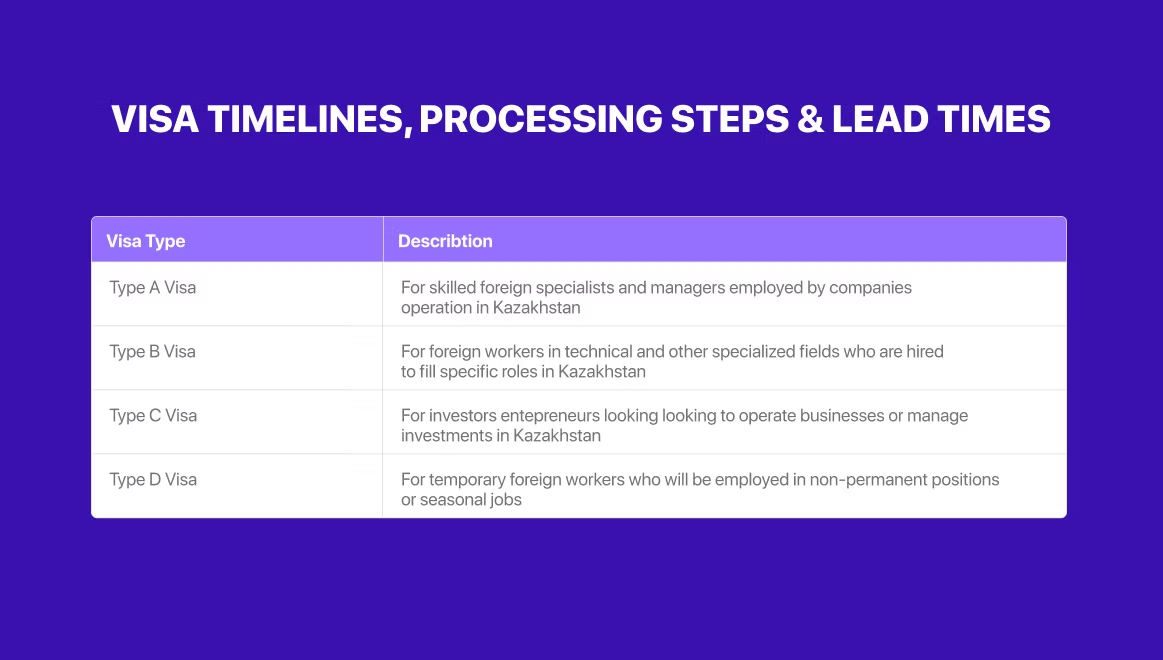
For “C3” visas, official consular guidance lists an invitation letter with a visa support number from the Ministry of Internal Affairs and an employment contract as part of the required set. Official Kazakhstan guidance also publishes typical visa duty and consular fee anchors. It lists a state fee for multiple-entry visa issuance inside Kazakhstan and separately notes consular fees outside Kazakhstan, for example, US$80 for a single-entry and US$200 for a multiple-entry for one year.
Step five. Execute arrival, notifications, and temporary stay correctly
The receiving party must notify the migration service of the foreign citizen’s arrival within three working days. That obligation covers visa and visa-free entry. It is submitted by the receiving party, not the foreigner. Late notification triggers fines, and repeat violations can trigger a ban on issuing visa invitations, which is exactly the kind of “small oversight” that becomes a big business problem.
Temporary stay documentation also matters. Kazakhstan guidance explains that a temporary residence permit supports residence for a defined period based on purpose, including employment, and that the process runs through the internal affairs authorities.
Kazakhstan has also tied long-stay processing to biometric compliance. The eGov service notes mandatory fingerprint registration when obtaining a temporary residence permit.
The Four Pillars: Work Permit Categories
People can smell BS from a mile away, so let's be honest: not all foreign hires are treated equal. Kazakhstan divides sponsored talent into four categories, each with different hurdles.
| Category | Typical Roles | 2026 Quota Status | Local Ratio Requirement |
| Category 1 | CEOs, Founders, Top Execs | Highest Priority | 70% Locals |
| Category 2 | Department Heads, Managers | High Priority | 70% Locals |
| Category 3 | Engineers, Devs, Specialists | Most Common | 90% Locals |
| Category 4 | Skilled Workers | Restricted | 90% Locals |
Eligibility and the rules that actually decide approvals
If you want founder-level clarity, here it is. Kazakhstan is not “hard” because the rules are unclear. Kazakhstan is hard because the rules are deterministic, time-bound, and monitored. If you do not design your hiring plan around them, you will lose weeks and sometimes quarters.
Quotas. 2026 numbers and categories
Kazakhstan sets and distributes a quota for attracting foreign labour annually. For 2026, the total quota is set at 0.25% of the country’s total workforce. It is split into Categories I to IV (executives, heads of structural subdivisions, specialists, and skilled workers). Official reporting also notes a separate quota for labour immigrants employed in households of 2.9%.
Practical translation. Your role category matters because it directly collides with quota availability. If your hiring plan is “we will relocate three specialists in Q4”, you need to align that to the quota application cycle and category.
Local content ratios. The hidden gate most global teams miss
The official eGov guidance states that issuance or extension of employer permits is performed if local workforce ratios are met. At least 70% Kazakh citizens in the workforce belong to the first and second categories. At least 90% Kazakh citizens in the workforce belong to the third and fourth categories.
It also explicitly notes that for calculating local content, nationals of the Eurasian Economic Union are not counted among foreign employees. This can materially change your staffing maths if you hire from the EAEU.
Strong opinion: This ratio rule should sit in your hiring forecast spreadsheet right next to headcount. If it is an afterthought, your permit becomes a gamble.
Labour market test and the 15-day vacancy posting. A modern compliance requirement
Kazakhstan introduced a labour market testing process where employers must post vacancies on the Electronic Labour Exchange for 15 calendar days before submitting a work permit application, then include the vacancy registration code in the application. This change increases expected processing time by at least 15 days.
This is not bureaucracy for the sake of it. It is Kazakhstan operationalising “local labour priority” into a measurable compliance step. Plan for it.
Exemptions that matter if you are building in Kazakhstan
Kazakhstan has meaningful exemptions. Some are broad, others are narrow. The eGov foreign labour guidance lists categories where quota and employer permits may not apply, including certain investment project contexts, special economic zones, specific education organisations, and key technology ecosystems.
Three that commonly affect international businesses:
- 100% foreign-owned entity leadership. The eGov guidance includes an exemption for the first head and their deputy of a Kazakhstani legal entity with 100% foreign participation in charter capital, but it is capped at not more than one position for each of these posts.
- AIFC and tech ecosystems. The eGov guidance includes exemptions tied to participants and entities of the Astana International Financial Centre and to the Astana Hub International Technology Park.
- EAEU citizens. Citizens of EAEU member states are listed as not needing permits in the published list, and eGov guidance also states EAEU citizens can carry out labour activities without obtaining a permit on the basis of an employment contract.
Enforcement. Fines that hit employers, not just employees
Kazakhstan publishes employer-side penalties. The eGov foreign labour procedure page quotes Article 519 of the Administrative Violations Code and outlines fines where an employer involves foreign labour without required permission or uses foreigners without required authorisations. The scale varies by company size and can reach hundreds of monthly calculation indices, with higher fines for repeat offences.
Separately, entry and stay guidance also links host failures like late arrival notification to MCI-based fines and possible bans on issuing visa invitations.
Costs, timelines, and document checklist
If you are hiring in Kazakhstan, speed comes from predictable sequencing. Here is the sequence that keeps timelines honest.
Timeline. The “realistic minimum” planning model
Start with the official employer-permit service timeline. Kazakhstan’s eGov service description states the permit is issued within 19 working days and includes a 10 working day deadline to pay the permit fee after the decision. Then add the labour market test requirement of 15 calendar days for vacancy publication before applying. That alone adds at least two weeks. Then add visa support and visa issuance timelines, which vary by mission and route. Official sources still give fixed anchors, but processing speed depends on document readiness and the route used.
Practical takeaway. A clean, well-planned case should be forecast on a multi-week timeline. If someone promises “we can sponsor in a few days”, they are either talking about a special exemption lane or they are selling fantasy.
Costs. What you should budget for
Budget in three buckets.
Bucket one: Employer permit fees. The official process states issuance and extension are paid according to charge rates, with a tax levy payable through banks and within 10 working days after notification.
Bucket two: Visa duties and consular fees. Official guidance lists national duties in MCI for certain visa processing steps, and it also notes consular fee anchors outside Kazakhstan, such as US$80 single-entry and US$200 multiple-entry for one year.
Bucket three: Compliance overhead you cannot avoid. Document legalisation and notarised translations may be required for education documents in permit applications. This is explicitly referenced in Kazakhstan’s published document requirements for permits.
Core document checklist. Corporate hires
The eGov foreign labour procedure outlines the kinds of documentation employers may need when applying, including detailed information about foreign employees, notarised educational documents and translations where needed, employer confirmation of qualifications, local workforce content information (with exceptions for small entities and other carve-outs), and evidence on replacement planning of foreign employees with citizens of Kazakhstan.
For the visa invitation stage, official invitation guidance states that for labour activity, you additionally provide a certificate issued to the employer for attracting foreign labour, or documents confirming the visa recipient does not need permission under legislation or treaties.
Two compliance details that prevent nasty surprises
Arrival notification is mandatory. The host party must notify within 3 working days, and late notification can trigger fines and a repeat-violation invitation ban. Fingerprinting is not optional in many cases. eGov guidance explains fingerprinting requirements tied to visas and temporary residence permits, and refusal can trigger administrative consequences.
When to use an Employer of Record in Kazakhstan

Here is the blunt truth. Many companies do not struggle in Kazakhstan because they fail to “understand sponsorship”. They struggle because they try to run sponsorship without a local compliance muscle. Employer sponsorship touches quota planning, workforce ratio calculations, digital signature infrastructure, visa support invitations, arrival notifications, and stay documentation. That is not a side project for a recruiter.
This is exactly where an EOR model can make hiring in Kazakhstan practical. An EOR partner becomes the legal employer in Kazakhstan and operationalises the obligations that the law places on “the receiving party” and employing entity. It is especially useful when you want to hire quickly in hubs like Almaty or Astana, validate the market, and avoid entity setup overhead in the first phase.
When EOR is the right move in Kazakhstan

Choose an EOR when you fit these conditions:
You want to hire now, but you do not have a Kazakhstan entity. You need local payroll and compliant employment contracts fast. You need migration notifications and temporary stay steps handled correctly because the penalties are employer-facing.
You are hiring EAEU citizens. You might not need a work permit, but you still carry host responsibilities like notifications and ensuring the right basis for stay and work. EOR helps you avoid the classic “we assumed exemption means no compliance” mistake.
You are building a mixed workforce, and local content ratios matter. An experienced local operator can model categories and ratios as you scale, keeping you eligible for permits instead of running into a quiet rejection.
What a credible Kazakhstan EOR must do, or you are still exposed
A serious EOR in Kazakhstan should operationalise at least these controls:
- Manage arrival notifications within 3 working days, including for dependants, because employers are explicitly responsible as the host party.
- Enforce role-to-permit alignment, because Kazakhstan publishes fines for employing a foreign worker in a position not corresponding to the permit.
- Manage quota and workforce ratio compliance. This includes the 70% and 90% local content rules and the EAEU counting rule.
- Build processes for labour market testing: the 15-day vacancy publication and the registration code requirement before a permit application.
- Handle state deadlines like the 10-working-day payment window after permit decision.
Team Up positioning in Kazakhstan
Team Up positions itself as the most reliable regional EOR partner in Kazakhstan by focusing on compliance execution, not surface-level “platform features”. In Kazakhstan, that means making employer sponsorship predictable. Quota planning. Category and ratio modelling. Invitation and visa support. Arrival notifications. Temporary stay and fingerprinting steps. The unglamorous work that prevents fines, blacklisting, and invitation bans.
The Bottom Line
Employer sponsorship in Kazakhstan tells the truth about your business. Are you solvent? Are you actually creating value? Are you supporting the local market? If you can answer "yes," Kazakhstan is a goldmine. If the paperwork feels like a war crime, it’s because you’re trying to do it alone.
Team Up provides the "honesty" your organisation needs to tap into the Almaty hub without the BS.
Frequently asked questions
1. What is sponsorship for employment in Kazakhstan?
Sponsorship for employment is a structured, employer-led process required to legally hire a foreign national. Because the government strictly regulates foreign labor, the local company acts as the "sponsor" by applying for permits, justifying the need for the foreign specialist, and guaranteeing compliance with migration and labor laws.
2. What does sponsorship for employment mean?
It means the employer is legally accountable for the foreign worker's status. The sponsor is responsible for the entire lifecycle of the employment, including:
- Proving no local candidate could fill the role (Labour Market Test).
- Navigating regional quotas for foreign labour.
- Filing for work permits and visa invitations.
- Ensuring timely arrival notifications and registering the employment contract in the government's unified digital system.
3. Do I need sponsorship for an employment visa status in Kazakhstan?
It depends on the worker's citizenship. * EAEU Citizens: Citizens of Armenia, Belarus, Kyrgyzstan, and Russia do not need a work permit or employer-sponsored visa to work in Kazakhstan. They only require a valid employment contract registered in the national system.
- Other Foreigners: Yes, they generally require sponsorship. They must have an approved work permit and an appropriate work visa (e.g., C3 category) linked to that specific employer.
4. Define sponsorship for employment visa status.
In Kazakhstan, a visa alone is insufficient to work. Sponsorship for employment visa status is a two-part requirement:
- Work Authorisation: An employer-obtained permit that grants the right to work in a specific role and region.
- Visa/Residency Support: An invitation from the employer that allows the worker to apply for a visa (or Temporary Residence Permit) matching the purpose and duration of the work.
5. Does "DACA employer sponsorship" apply in Kazakhstan?
No. DACA (Deferred Action for Childhood Arrivals) is a U.S.-specific policy. There is no equivalent in Kazakhstan. Foreigners in Kazakhstan are governed strictly by migration laws that distinguish between citizens, permanent residents, EAEU nationals, and foreign specialists requiring employer-sponsored work permits.
6. What is the role of the "Electronic Labour Exchange" (Enbek.kz)?
It is mandatory for the labor market test. Before you can request a work permit, you must publish your vacancy on Enbek.kz for at least 15 calendar days. The system automatically tracks whether any qualified Kazakh citizens apply. If the vacancy remains unfilled, you may then proceed with the sponsorship application.
7. What are the "Local Content" ratios?
To maintain sponsorship eligibility, employers must adhere to government-mandated local-to-foreign ratios.
- Categories 1 & 2 (Executives/Managers): At least 70% of the staff must be Kazakh nationals.
- Categories 3 & 4 (Specialists/Skilled Workers): At least 90% of the staff must be Kazakh nationals.
- Note: Even small companies are not exempt if they hire foreign labour.
8. What happens if I use an Employer of Record (EOR)?
Using an EOR is the most common way for foreign firms to manage sponsorship without establishing a local legal entity. The EOR acts as the "Sponsor" of record, assumes all liability for the worker's status, handles the Enbek.kz vacancy posting, and manages the complex digital reporting required by the Ministry of Labor.
9. What are the penalties for non-compliance?
Kazakhstan enforces strict penalties for "illegal labor activity." This includes:
- Working outside the approved job title or region.
- Failing to register the employment contract in the Unified System (HR-Enbek) within 5 business days.
- Hiring a foreigner without a valid work permit.
- Consequences: Heavy administrative fines for both the employer and the employee, and potential deportation or multi-year re-entry bans for the worker.
10. Can I hire a foreigner on a "Business Trip" instead of sponsorship?
Using a business visa (e.g., for meetings or conferences) to perform regular work is illegal. In 2026, authorities use integrated digital systems to cross-reference an individual's visa purpose with their activities. If they are performing duties for a Kazakh entity, they must be formally sponsored for employment; otherwise, they risk being classified as an "illegal worker."
.svg)


