Employer of Record (EOR) vs Setting Up Your Own Entity: Which is Better?
Introduction
This question comes up in every international expansion conversation. And the honest answer is: it depends — but the decision criteria are specific enough that you should be able to reach a clear answer for your situation within the time it takes to read this article.
Employer of record services and local entity setup are not competing philosophies. They are tools designed for different stages of a company's international presence. The most common mistake is applying the wrong tool to the wrong stage, usually by setting up an entity before the market is validated, or by staying on EOR long after the entity would have been more cost-efficient.
This guide breaks down both models with real numbers across the markets where Team Up operates, Georgia, Armenia, Azerbaijan, Turkey, India, Kazakhstan, Uzbekistan, and gives you a structured framework for deciding which path fits your situation right now.
What You Are Actually Choosing Between
Before the comparison, a clear framing of what each model actually is.
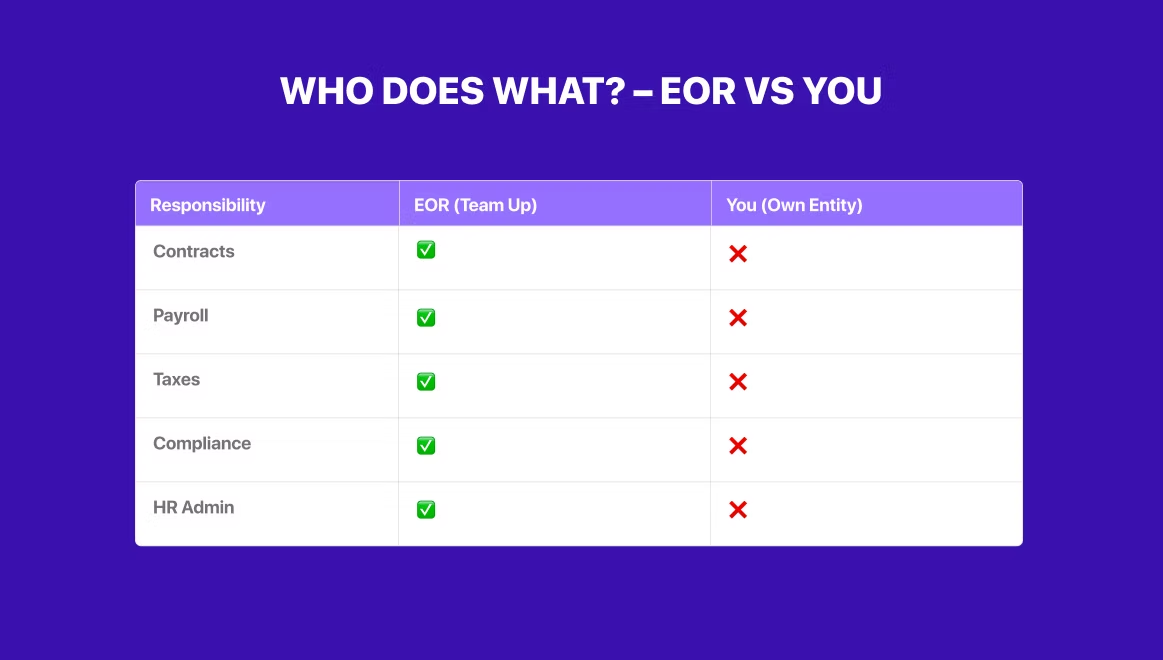
Employer of Record (EOR): A third party becomes the legal employer of your staff in the target country. You direct the work. The EOR owns the employment relationship, contracts, payroll, statutory benefits, compliance, and immigration sponsorship. You have no registered entity in the country. You pay the EOR a per-employee monthly fee.
Own entity: Your company registers a legal subsidiary, branch, or representative office in the target country. You become the registered legal employer. You own every employment obligation: payroll tax registration, social insurance enrollment, employment contract issuance, labor law compliance, benefit administration, immigration sponsorship capability, and the ongoing cost of running the entity.
The structural question is simple: do you need or want to own the employer infrastructure in the country? If yes, entity. If not, EOR. Everything else (cost, speed, risk, flexibility) flows from that structural choice.

The Cost Comparison: What You Are Really Spending
This is where most company models go wrong. The cost comparison between EOR and entity setup is not EOR's monthly fee vs. the entity registration cost. It is the full five-year cost of each model, including costs that do not appear in the headline number.
The True Cost of Setting Up Your Own Entity
Entity setup costs vary significantly by country. Here is the realistic range for the markets most relevant to this cluster:
Upfront registration costs: Across most markets in the Caucasus, Central Asia, Turkey, and India, entity setup involves: legal fees for incorporation, government filing fees, minimum capital requirements (some jurisdictions mandate significant share capital), local director appointment and compensation, bank account setup, tax registration, and social insurance enrollment.
Total upfront cost range: $20,000–$250,000+, depending on the country. For markets like Kazakhstan (where a Kazakhstani entity involves BIN registration, tax registration with the State Revenue Committee, banking setup, and labor quota documentation) or India (where registration covers PAN, TAN, EPF, ESIC, Shops and Establishments Act, and Profession Tax registration across potentially multiple states), the setup complexity is real, and the legal fees reflect it.
Annual ongoing compliance costs: Running a legal entity requires annual audits (mandatory in many jurisdictions), monthly payroll filings, quarterly tax returns, annual tax returns, government reporting, registered agent fees (where required), and the cost of local legal counsel to monitor regulatory changes. In most markets: $30,000–$80,000 per year per country.
The cost that kills the entity model at low headcount: Total first-year cost of an entity in most emerging markets: $50,000–$330,000+ before your first employee is paid. For a team of 5 engineers earning $2,500/month gross each, that entity overhead represents $10,000–$66,000 per employee in year one, before you count their salary.
The wind-down cost: If the market does not perform and you need to exit, entity dissolution takes six to twelve months in most markets and generates its own legal and administrative costs. You are paying entity overhead while you wait for permission to stop.
The True Cost of EOR
EOR pricing has two layers: the service fee and the statutory employer contributions.
EOR service fee: Team Up's EOR services start at €199 per employee per month in Georgia — one of the most competitive owned-entity EOR rates in the region. Across other markets: Armenia (€199–€250 estimated), Azerbaijan (€250–€350, reflecting the 17–24.5% employer social contribution rate), Turkey (€250–€400, reflecting 22.75% total employer social security), India ($150–$250 for India-specialist providers), Kazakhstan (€200–€350), Uzbekistan (€200–€300).
Statutory employer contributions: These are not the EOR's fee. They are the statutory obligations any employer faces in that country, passed through by the EOR:
- Georgia: ~2% on top of gross salary
- Armenia: minimal employer contribution (health insurance ~$28/month from January 2026)
- Azerbaijan: 17–24.5% on top of gross salary
- Turkey: 20.75% social security + 2% unemployment = 22.75%
- India: ~12% EPF + 3.25% ESI + 4.81% Gratuity = ~20% total for qualifying employees
- Kazakhstan: ~15–20% combined employer contributions
- Uzbekistan: ~12.1%
Total EOR cost per employee example — Georgia, $2,500 gross salary:
- Gross salary: $2,500
- Employer social contributions (~2%): $50
- EOR service fee (~€199): ~$215
- Total monthly employer cost: ~$2,765 (~10.6% above gross)

The break-even crossover: EOR is typically more economical at low headcount or uncertain demand. Entities can become cheaper per employee at scale, but only after you price in the real operating burden.
The generally accepted crossover point: 15–25 employees in a single country, with a long-term commitment and a properly funded entity operation. Below that threshold, EOR wins on total cost almost every time — especially when year-one entity setup costs are properly accounted for.
What the UK example looks like concretely: Setting up a UK entity and hiring one employee for a year costs an estimated $78,000–$128,000 in total including entity overhead. The equivalent EOR cost: approximately $7,188 in service fees. That ratio — roughly 10–18x more expensive for entity vs. EOR at one employee — reflects the entity economics at low headcount.
The Timeline Comparison: What You Are Actually Waiting For
The timeline is where entity setup creates its most concrete competitive damage. Talent does not hold offers open while registration paperwork clears.
Entity Setup Timelines by Market
Georgia: Entity registration through the National Agency of Public Registry can be relatively fast by regional standards — 1–2 weeks for the basic LLC registration. But add bank account setup (2–4 weeks), tax registration (1–2 weeks), social insurance enrollment (1–2 weeks), and labor code compliance preparation — and you are looking at 6–10 weeks minimum before you can run a first payroll. From March 2026, the new Special Labour Permit requirement for foreign workers adds an immigration step that must be completed before employment begins.
Armenia: Entity registration through the State Register of Legal Entities takes approximately 1–3 days for the basic registration. But add bank account setup, tax registration with the SRC, mandatory enrollment in the SRC digital contract platform, and social insurance setup — 4–8 weeks before operational payroll.
Azerbaijan: Among the more complex entity setups in the Caucasus. DSMF registration, tax authority enrollment, work permit quota applications (where foreign staff are planned), and banking setup — 8–16 weeks minimum.
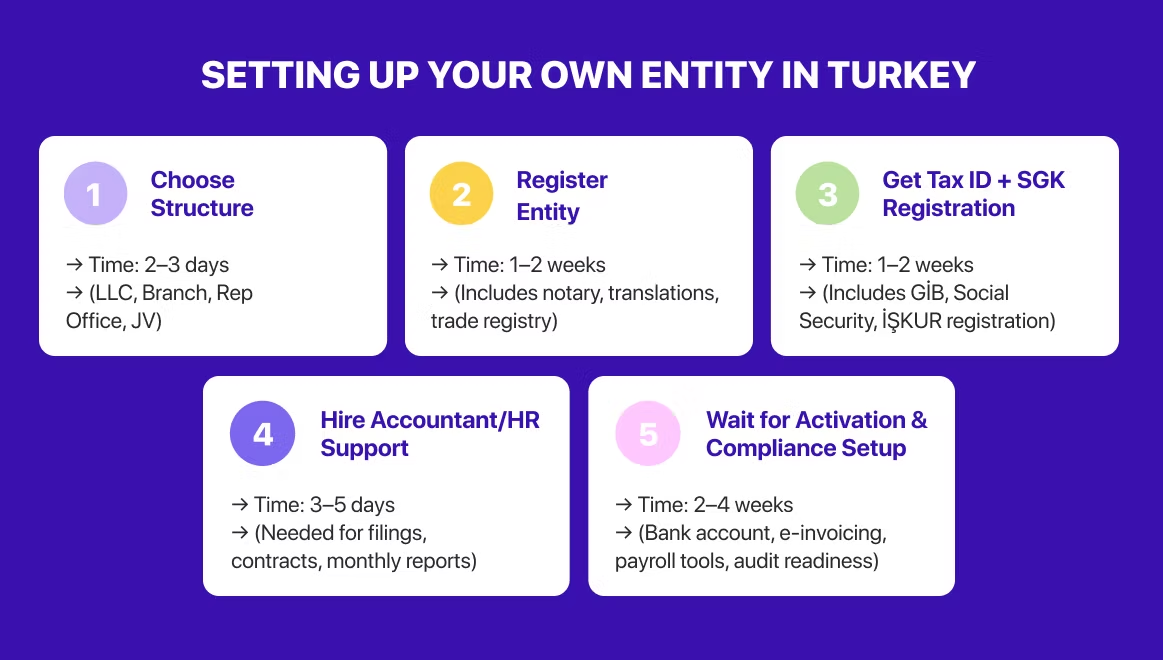
Turkey: Entity setup for a Turkish limited company (Limited Şirketi) involves notarized articles of association, Trade Registry enrollment, tax office registration, SGK (social security) registration, and İŞKUR (employment agency) registration. Timeline: 6–12 weeks with experienced local counsel.
India: One of the most complex entity setups in the cluster. PAN, TAN, EPF, ESIC, Shops and Establishments Act registration (state-specific), GST registration (where applicable), and corporate bank account. Multi-state hiring adds state-level Professional Tax registration. Timeline with experienced counsel: 8–16 weeks.
Kazakhstan: BIN registration, tax registration with the State Revenue Committee, banking, and labor documentation for foreign worker quota applications. 8–16 weeks.
Uzbekistan: Company registration, tax registration, banking, and Corporate Work License for foreign worker hiring. 10–16 weeks.
EOR Timeline
An EOR with owned entities already has the registration, banking, and social insurance infrastructure in place. For standard hires:
- Offer letter issued: 24–48 hours
- Employment contract signed: within days
- First payroll run: within the standard payroll cycle of the country
The operational timeline advantage is not marginal. It is the difference between hiring now and hiring in three months, in markets where the candidate you want is considering two other offers right now.
The Compliance Risk Comparison: Who Is on the Hook
Entity: You Own Every Compliance Obligation
When you are the registered legal employer, you own the full compliance obligation. That includes:
- Payroll tax filing accuracy (Georgia: Revenue Service, Armenia: SRC, Turkey: SGK, India: multiple authorities)
- Statutory employer contributions calculated and remitted on time
- Employment contracts compliant with the current labor code
- Regulatory change monitoring and employment term updates when laws change
- Work permit sponsorship capability for foreign nationals
- Benefits administration per local requirements
What this means in practice: when Armenia introduced mandatory health insurance withholding of AMD 10,800/month per employee in January 2026, companies with Armenian entities needed to update payroll systems, revise contracts, and adjust cash flow planning — immediately, and independently. If they were not tracking Armenian SRC regulatory updates, they found out when an audit surfaced the gap.
The compliance burden scales with every country you are in. For a company hiring in five markets, that is five labor codes to track, five payroll systems to maintain, and five sets of regulatory changes to monitor — all simultaneously.
EOR: Compliance Is the EOR's Obligation
The EOR is the registered legal employer. The compliance obligation sits primarily with them. Payroll tax accuracy, benefit administration, contract compliance, regulatory monitoring — these are the EOR's responsibility, absorbed by their in-country teams.
This risk transfer is real. But it is only as strong as the EOR's actual compliance capability. An EOR that uses local aggregator partners in your target market may not have tracked the January 2026 Armenia health insurance change until a client flagged it. An EOR with owned entities and in-country teams tracked it before the effective date and updated payroll automatically.
The compliance advantage of EOR is the owned-entity EOR with in-country staff — not the platform with aggregator partners.

Immigration Sponsorship: A Structural Difference
This is the comparison dimension most analyses skip. It is also one of the most operationally critical for companies hiring foreign nationals or relocating employees.
Entity: You Can Sponsor, But You Have to Run the Process
With your own entity, you can act as the immigration sponsor for foreign national employees — but only after your entity is fully registered and compliant. The sponsoring entity must have active tax and payroll compliance history in the jurisdiction. A newly registered entity may not yet qualify in some markets.
Running immigration sponsorship in-house also means managing the process: labor market tests (Kazakhstan's 15-day enbek.kz posting, Georgia's 10-business-day vacancy posting from March 2026), quota applications (Kazakhstan's annual quota by September 30, Azerbaijan's strict prior authorization), FRRO registration in India within 14 days of arrival. These processes require local knowledge and consistent execution.
EOR: The EOR Sponsors Directly, No Entity Required
An EOR with owned entities already holds the registered legal employer status required for immigration sponsorship. Work permit applications are filed by the EOR entity as the employer of record. The client company does not need its own entity.
This matters most in two scenarios:
Market entry without an entity: A company wants to relocate a senior engineer from Istanbul to Tbilisi. Under Georgia's March 2026 Special Labour Permit requirement, a registered Georgian employer must file the application. With no Georgia entity, the company cannot sponsor. Team Up's Tbilisi entity handles the permit application, the 10-day vacancy posting, and the subsequent D1 visa process — all without the client needing Georgian incorporation.
Fast-moving immigration decisions: When an employee needs a Kazakh work permit within a specific quarter, the 90/10 quota rule and September 30 annual quota application deadline are the operational constraints. An EOR that has already managed Kazakh quota applications for multiple clients navigates this as standard workflow. A company setting up its own entity for the first time discovers the September 30 deadline when it is already missed.
For a full breakdown of how EOR-sponsored immigration works across all seven markets, see our guide on work permit and employer registration requirements and our article on EOR-sponsored visas for enterprise businesses.
Country-by-Country Analysis: What the Decision Looks Like in Practice
EOR vs.Eentity Georgia
Entity setup: Fast registration (1–2 days for LLC), but new Special Labour Permit requirement from March 2026 creates a foreign worker sponsorship obligation that requires the entity to be registered and compliant before permits can be filed. Bank account setup and payroll registration add 4–8 weeks to operational readiness.
EOR (Team Up): Owned entity in Tbilisi. Handles Special Labour Permit sponsorship directly. EOR from €199/month. No entity registration timeline. Hiring a developer costs approximately $36,000/year vs $110,000 in the US.
Decision guidance: For 1–15 employees, EOR wins on cost and speed. At 20+ employees with long-term commitment, entity evaluation is worth it — though Georgia's relatively simple entity structure means the crossover is more accessible here than in Kazakhstan or India.
EOR vs.Eentity Armenia
Entity setup: Fast registration (1–3 days), but the SRC digital platform mandate from January 2026 requires in-country technical integration for contract filing. Mandatory health insurance (AMD 10,800/month from January 2026) must be built into payroll from day one. August 2026 shift to Work Visa entry means immigration compliance requires an active employer status.
EOR (Team Up): Owned entity in Yerevan. SRC digital platform access established. January 2026 health insurance mandate processed on day one. EOR from €199–€250/month.
Decision guidance: Armenia's IT sector growth (24.5% Q1 2025) makes it a high-value market for tech hiring. The compliance changes in 2026 make an EOR the lower-risk entry model. Entity justification with 20+ long-term engineers.
EOR vs.Eentity Azerbaijan
Entity setup: Among the most complex in the Caucasus. DSMF registration mandatory before payroll. Employer social contributions 17–24.5% — the highest in the region. Strict work permit prior authorization for every foreign national. Entity setup timeline: 8–16 weeks.
EOR (Team Up): Owned entity with active DSMF registration. Work permit applications are filed directly with the State Migration Service. EOR from €250–€350/month.
Decision guidance: Azerbaijan's compliance complexity makes EOR the strong default for market entry at almost any headcount below 25. The entity crossover point is higher here because the ongoing compliance burden is significantly greater than in Georgia or Armenia.
For more on employer sponsorship obligations in the Caucasus, see our guide on employer sponsorship in Georgia and the Caucasus.
EOR vs.Eentity Turkey
Entity setup: Turkish Limited Şirketi setup involves notary, Trade Registry, SGK, İŞKUR. Timeline 6–12 weeks. Employer social contributions 22.75%. Progressive income tax 15–40%. C-suite titles are possible through entity employment — an important structural limitation of the EOR model in Turkey.
EOR (Team Up): Owned entity in Istanbul. Full SGK compliance, overtime rules, severance management. EOR from €250–€400/month. C-suite titles (CEO, CFO) are not possible under EOR — a real limitation for companies placing senior executives.
Decision guidance: For operational roles (engineers, operations, support), EOR is the clear entry model. For companies placing C-suite or senior leadership in Turkey, entity setup is required or should be evaluated alongside EOR for initial operational hiring.
EOR vs.Eentity India
Entity setup: Among the most complex in the cluster. PAN, TAN, EPF, ESIC, Shops and Establishments Act (state-specific), GST, Corporate Identification Number. Multi-state hiring compounds complexity. Timeline: 8–16 weeks. Annual compliance: significant. Entity setup cost in India: $15,000–$40,000 upfront; ongoing at $20,000–$40,000/year.
EOR (Team Up): Owned an India entity. Full EPF, ESIC, Gratuity, TDS, and Professional Tax compliance. India-specialist EOR rates: from approximately $150–$250/month — significantly below global platforms ($450–$700). Hiring senior engineers at $2,000–$3,500/month vs $10,000–$15,000/month in the US.
Decision guidance: India is the market where EOR makes the strongest cost case at the widest headcount range. Entity is justified at 25–50+ employees with long-term commitment. Below that, the India entity setup and compliance burden is rarely justified relative to the EOR cost.
For employee relocation to India — including FRRO registration, Employment Visa sponsorship, and tax residency considerations — see our guide on relocation legal requirements and practical steps.
EOR vs.Eentity Kazakhstan
Entity setup: BIN registration, State Revenue Committee tax registration, banking, labor quota documentation. 8–16 weeks. The 90/10 quota rule for specialists means the entity must maintain a 9:1 ratio of local to foreign workers in relevant categories. September 30 annual quota application deadline. Work permit prior authorization for all foreign nationals.
EOR (Team Up): Owned entity in Almaty. Annual quota applications managed proactively. 15-day enbek.kz market test handled as standard workflow (September 2025 reform). ULCRS contract registration. EOR from €200–€350/month.
Decision guidance: Kazakhstan's quota complexity makes EOR particularly valuable — not just as a compliance service but as a planning tool. An EOR that has already managed the quota application cycle knows the September 30 deadline and plans around it. A company setting up its own entity for the first time discovers it mid-process.
EOR vs.Eentity Uzbekistan
Entity setup: Company registration, tax registration, Banking, Corporate Work License for foreign worker hiring. Work permit processing takes up to 3 months. The State Social Insurance Law was restructured in January 2026. my.mehnat portal is mandatory for leave registration.
EOR (Team Up): Owned entity in Tashkent. Corporate Work License maintained. The 2026 social insurance restructure will be processed on day one. EOR from €200–€300/month.
Decision guidance: Uzbekistan is earlier in its development as a hiring market, with lower salary levels that make the flat EOR fee a higher proportion of gross. For high-volume junior hiring in Uzbekistan, compare the flat-fee vs. percentage-of-salary model options. Entity setup is rarely justified below 30 employees, given the complexity.
The Decision Framework: EOR or Entity?
Answer these five questions in sequence. The combination of answers leads to a clear recommendation.
Question 1: Do you already have a registered entity in the target country?
If yes → entity is available as an option. Continue to Question 2. If no → EOR is the compliant path. Stop here unless the entity setup timeline is acceptable.
Question 2: How many employees are you planning in this country?
1–10 → EOR. Entity overhead is not justified. 11–20 → EOR, but begin entity feasibility analysis. 20+ with long-term commitment → Evaluate entity seriously.
Question 3: How certain are you that this market will work for your business?
Testing / uncertain → EOR. Clean exit with standard notice. No entity to wind down. Proven / committed → Entity evaluation begins to make financial sense.
Question 4: Do you need to hire foreign nationals who require immigration sponsorship?
Yes → EOR provides immediate sponsorship capability through owned entities. Entity can do this too, but requires full registration before sponsorship is possible, and takes months. No → Immigration consideration does not affect the decision.
Question 5: Are there corporate structure requirements that only an entity can meet?
Government contracts, FEZ benefits (Azerbaijan), financial services licenses, regulated industry requirements → Entity may be required regardless of cost and headcount. None → EOR remains viable.
The 2026 pattern
The most common approach is not EOR or entity. It is EOR then entity, by design.
Phase 1 (market entry): Use EOR to hire critical roles fast, validate demand, and build early traction. Hire while the entity's work proceeds in parallel if a long-term commitment is already clear.
Phase 2 (scale): Once the market is proven and headcount approaches 15–20, begin entity registration. Use EOR fees as the buffer while the entity processes.
Phase 3 (transition): Transfer employees from EOR employment contracts to entity employment. Onboard a payroll provider or an in-house payroll team for the entity. EOR engagement ends.
This staged model removes the "bet everything on market entry" risk and lets the entity's investment follow the evidence rather than precede it.
What EOR Cannot Replace?
An honest comparison acknowledges what entity setup provides that EOR does not.
- Full control over HR programs and employment structure: With your own entity, you design and implement your HR policies, compensation structures, equity plans, and employer brand without adapting to an EOR's standard framework. EOR contracts are compliant with local law but use the EOR's standard employment structure. Heavily customized compensation or non-standard benefit designs may require entity employment.
- Corporate structure requirements: Some business activities require a registered company in the target country: government contracts in many markets, Free Economic Zone participation in Azerbaijan (0% income tax, reduced social contributions — but only for registered zone entities), financial services licenses, and sector-specific regulatory approvals.
- Long-run cost efficiency at scale: At 20–30+ employees in a single country with a confirmed long-term commitment, the cumulative EOR service fees approach and then exceed the amortized cost of running a local entity well. The crossover is real — it just requires genuinely accounting for the full entity running cost, not just the registration fee.
- Senior executive roles in Turkey: C-suite titles (CEO, CFO, General Manager) are generally not possible under the EOR model in Turkey due to corporate authority requirements. For senior leadership placements, entity employment is required.
The Right Model for Your Stage
The EOR vs. entity question is ultimately a stage question. Where are you in your relationship with this market?
Testing the market → EOR. No capital committed. Clean exit available. Compliance handled. Hire starts within days.
Scaling with confidence → EOR, with entity evaluation running in parallel.
Long-term, 20+ employees, proven market → Entity, with EOR used for new markets in the same portfolio.
Team Up provides employer of record services with owned legal entities in Georgia, Armenia, Azerbaijan, Turkey, Kazakhstan, Uzbekistan, and India. EOR starting at €199/month. No upfront capital. No entity to wind down if the market doesn't perform. 200+ businesses supported. 4,000+ talent placed. 92% client retention over five years.
If you are at the testing or early-scaling stage in any of these markets, the EOR model is built for exactly where you are.
Frequently Asked Questions
At what point does entity setup become cheaper than EOR?
The crossover point is typically 15–25 employees in a single country with a long-term commitment, when annual EOR fees approach the amortized cost of running a properly funded entity. The analysis must include: entity setup cost, annual compliance cost, local legal counsel, HR administration overhead, and wind-down cost exposure. Below that headcount, EOR is almost always cheaper on a total first-year cost basis. Entity setup costs $20,000–$250,000+ upfront; EOR has no upfront capital requirement.
Can an EOR help with work permit sponsorship if I have no local entity?
Yes — provided the EOR holds owned registered entities in the target country with active payroll and tax compliance history. Team Up sponsors work permits directly in all seven of its core markets. The EOR's entity acts as the legal employer on immigration applications, absorbing the compliance obligations that the permit requires. For more detail, see our guide on compliant hiring in your target market.
What happens to my employees when I transition from EOR to my own entity?
Transitioning requires: registering the local entity, establishing employer tax registrations, and moving employees from EOR employment contracts to your entity's direct employment contracts — following local labor law requirements for the transfer. In most markets, this involves either a contract novation (Armenia, Georgia) or a technical termination and re-hire (Turkey, in some cases India). Budget 2–4 months for the transition process and appropriate legal support. Your EOR should facilitate and document the transfer.
Is EOR suitable for a company planning to be in a market permanently?
EOR is an excellent entry and scale model. For permanent, long-term presence at scale (25+ employees), the entity model often becomes more cost-efficient and gives more control over HR programs. The most common outcome for companies with long-term presence in Team Up's markets is: EOR for years 1–2, entity registration in year 2, transition to direct employment in year 2–3. The EOR delivers the market validation that makes the entity investment rational.
What is "sponsorship for an immigration-related employment benefit" and how does it work through an EOR?
It means the employer formally provides the employee's right to work in the target country — a work permit, sponsored visa, or residence permit application. The sponsoring employer must be a registered legal entity with active compliance history in that jurisdiction. Through an EOR with owned entities, this sponsorship is provided by the EOR's entity — no client entity required. The EOR files the permit application, maintains the compliance record, and tracks permit conditions and renewals as part of the ongoing employment relationship.
.svg)