


Kazakhstan Work Permits & Visas: Employer Guide to Types & Sponsorship
TL;DR
Kazakhstan is not a “hire first, figure it out later” country.
It’s a “prove you deserve this foreign hire” country.
If you’re expanding into Kazakhstan, you will deal with:
- Government quotas
- Mandatory labor market tests
- Strict foreigner-to-local ratios
- Category-based permits with expiration limits
- Real state fees that aren’t symbolic
You can absolutely hire foreign talent here.
But Kazakhstan wants receipts.
This guide tells you exactly what you’re signing up for, how the permit system works, and when using an Employer of Record in Kazakhstan is the smart move instead of setting up your own entity and learning the hard way.
Quick Navigation
- TL;DR
- Overview of Kazakhstan’s Work Permit System
- Work Permit Categories in Kazakhstan
- The Ratio Rule That Changes Strategy
- Visa Types for Foreign Workers in Kazakhstan
- Sponsorship Requirements for Employers in Kazakhstan
- With vs Without a Local Entity in Kazakhstan
- Employer Responsibilities and Required Documents (Kazakhstan)
- EOR vs. Setting Up Your Own Entity in Kazakhstan
- Why EOR Simplifies Compliance in Kazakhstan
- Payroll and Labor Law Obligations in Kazakhstan
- Final Thoughts
- Frequently Asked Questions
Overview of Kazakhstan’s Work Permit System

Kazakhstan does not assume you need a foreign worker.
You have to prove it.
In most cases, any foreign national coming to work in Kazakhstan needs:
- A work permit
- A work visa
No shortcuts. No “consultant” loophole. No, “they’ll only be here a few months.”
If they’re working. They need authorization.
There’s one meaningful exception. Citizens of the Eurasian Economic Union, Russia, Kyrgyzstan, Armenia, and Belarus don’t need work permits. Everyone else does.
And here’s the part companies don’t love:
You cannot hire in Kazakhstan without a local entity.
Not legally.
So your choices are simple:
- Set up your own Kazakhstan entity
- Or use an Employer of Record that already has one
There is no hybrid grey-zone solution that ends well.
The Quota Conversation Nobody Mentions Early Enough
Every year, Kazakhstan sets quotas for foreign workers.
Let that sink in.
There is a finite number of work permit allowed, split by region and category.
This is not a vibe. It’s policy.
If you want to hire a foreign specialist, you need:
- A quota slot
- A successful labor market test
- A compliant application
Miss the quota window? You wait.
And yes, before sponsoring a foreign employee, you must advertise the role locally. Usually on Enbek.kz. For at least 15 days.
The government wants proof that you tried to hire a Kazakh citizen first.
You don’t get to skip this because your candidate is “perfect.”
Kazakhstan’s position is clear. Foreign talent is allowed. Local talent comes first.
Timeline Expectations
If you’re used to faster markets like Georgia, Kazakhstan will feel… structured.
From start to approval, expect 1 to 2 months. Sometimes longer.
That includes:
- Labor market posting
- Quota confirmation
- Document submission
- Government review
- Visa issuance
Promise a start date too early, and you’ll look unprepared.
Kazakhstan rewards planning. It punishes improvisation.

Work Permit Categories in Kazakhstan
Kazakhstan doesn’t issue one generic work permit. It sorts foreign employees into categories.
And those categories shape everything. Duration. Renewal limits. Fees. Ratios.
Category 1 – Executives
Top management. CEOs. Deputies.
- Valid 12 to 36 months
- Renewable
- Government fees up to roughly $1,800 per year
If you’re importing leadership, Kazakhstan assumes you’re bringing strategic value. You pay more. You get flexibility.
Category 2 – Managers
Department heads. Functional leaders.
- Valid 12 months
- Renewable up to three times
Mid-level authority, tighter controls.
Category 3 – Specialists
Engineers. Developers. Analysts. Skilled professionals.
- Valid 12 months
- Renewable up to three times
- Government fees are around $1,000 annually
This is where most foreign hires land.
And this is where the localization math matters.
Category 4 – Skilled Workers
Technical or semi-skilled roles.
- Valid 12 months
- Not renewable
Kazakhstan is explicit here. These hires are temporary. You are expected to transfer knowledge and replace them with a local within 6 to 12 months.
If your expansion model relies heavily on foreign technical labor, Category 4 is not your long-term friend.
The Ratio Rule That Changes Strategy
Here’s the part many expansion plans ignore until it’s too late.
Kazakhstan requires:
- At least 70% locals in Category 1 and 2 roles
- At least 90% locals in Category 3 and 4 roles
Which means foreigners can only make up:
- 30% of executives/managers
- 10% of the specialists/technical workforce
Small businesses with fewer than 20 employees are exempt.
Everyone else plays by this rule.
This is not theoretical. Authorities check.
Kazakhstan doesn’t just want foreign expertise. It wants localization. And eventually, replacement.
Regional Restrictions
Work permits are tied to a specific region.
You can’t casually relocate your foreign employee from Almaty to Astana without considering permit implications.
Business travel across regions is limited. Around 90 days per year in most cases.
It’s manageable. But it’s controlled.
Let’s Be Direct
Kazakhstan is not hostile to foreign businesses.
But it is disciplined.
It wants:
- Structured hiring
- Local workforce protection
- Compliance, you can defend on paper
If you respect the system, it works.
If you try to treat it like a fast, flexible market, it reminds you quickly that it isn’t one.
And that’s usually when companies start looking seriously at using an Employer of Record in Kazakhstan, instead of building internal expertise the hard way.
Visa Types for Foreign Workers in Kazakhstan
Here’s the blunt truth.
A work permit alone does nothing.
It doesn’t let your hire board a plane.
It doesn’t let them cross the border.
It doesn’t let them live in Kazakhstan.
They also need a visa.
And not just any visa.
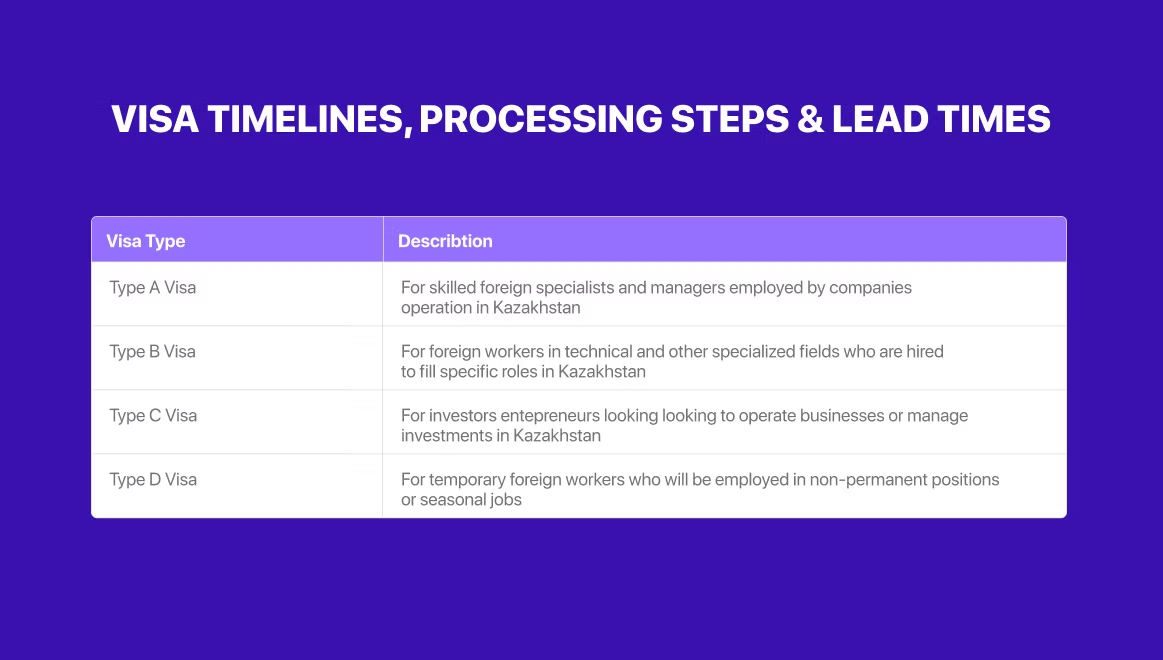
Kazakhstan has a menu of visa types, but if you’re hiring foreign employees, you’re mostly dealing with the M-series.
If someone tells you, “They can just come on a business visa for now,” that’s the moment you stop the meeting.
Because no. They can’t.
M1 Visa – The Actual Work Visa
This is the one that matters.
The M1 visa is issued after the work permit is approved. It allows the foreign employee to enter Kazakhstan and legally work.
In older embassy language, you might see it called C3. Same thing. Different labeling era.
Key points:
- Tied directly to the work permit
- Usually multi-entry
- Valid for up to 1 year (aligned with permit)
- Requires official employer invitation
No M1. No legal work.
That’s the rule.
M2 Visa – Dependents
Spouse. Kids.
That’s it.
The M2 visa lets family members live in Kazakhstan with the foreign employee.
It does not allow them to work.
If your employee’s spouse wants to work, that’s a separate permit process. There’s no automatic privilege.
M3 Visa – The “Administrative Step” Visa
This one exists for situations where the foreign national must enter Kazakhstan to complete formalities before full permit issuance.
Think:
- In-person submissions
- Medical exams
- Administrative confirmations
It’s short-term. It’s procedural. It’s not a working visa.
M4 Visa – Investors and Entrepreneurs
The M4 visa is for people investing in Kazakhstan or setting up businesses.
Not for your engineers.Not for your marketing director.
It’s for founders and capital movers.
If you’re hiring through an Employer of Record, this visa is irrelevant to you.
M5 Visa – Seasonal Work
Short-term labor. Agricultural or defined seasonal needs.
Still requires authorization. Just under a slightly different framework.
Unless you’re running a seasonal operation, you probably won’t touch this.
The Non-Negotiable Part
Let’s be extremely clear.
Tourist visas do not allow work.Business visas do not allow work.
Not “light consulting.”Not “just onboarding.”Not “internal meetings while we sort paperwork.”
If the person is performing work tied to a Kazakh employer, they need a work permit and the correct visa.
Kazakhstan enforces this.
And violations don’t just affect the employee. They hit the employer.
Fines. Restrictions. Even temporary bans on sponsoring new foreign hires.
This is not theoretical.
Sponsorship Requirements for Employers in Kazakhstan
Here’s where it gets serious.
Kazakhstan doesn’t let just anyone sponsor foreign workers.
You need:
- A registered legal entity in Kazakhstan
- Clean compliance status
- No outstanding labor or tax violations
If you don’t have a local entity, you cannot sponsor a work permit.
Full stop.
Your only compliant options are:
- Incorporate locally
- Or use an Employer of Record with an existing entity
There is no middle path.
The Labor Market Test
Kazakhstan wants proof you tried to hire locally.
This is not symbolic.
You must:
- Post the vacancy on the state portal (Enbek.kz)
- Leave it live for at least 15 days
- Document the results
If you skip this step, your application dies immediately.
No explanation. No debate.
The country’s policy is simple: foreign talent is supplemental, not default.
Quota Allocation
You don’t just apply for a permit.
You apply within a quota system.
Each region has limits. Each category has limits.
If the quota is full, you wait.
Kazakhstan has digitized parts of the process through migration.enbek.kz, which helps administratively.
But it does not make the quota disappear.
This is why planning matters.
Employer Invitation and Visa Support
To get the M1 visa, the employer must:
- Issue a formal invitation letter
- Obtain visa support approval
- Coordinate with the Ministry of Foreign Affairs
This is not a generic HR email.
It’s a government-backed sponsorship document.
If you’re using an Employer of Record, they handle this.
If you’re doing it yourself, welcome to paperwork.
Fees and Financial Obligations
Work permits are not free.
They are priced based on category and role.
Expect:
- Around $1,000 per year for specialists
- Up to $1,800+ for executives
- Paid annually
- Non-refundable
These are government fees. Not service fees.
On top of that, Kazakhstan enforces salary thresholds for foreign workers.
You cannot underpay an expatriate to reduce costs.
The government checks compensation levels to ensure foreign hiring is justified.
Ratio Requirements
This is where expansion strategies sometimes break.
Kazakhstan requires:
- 70% local staff in executive/manager categories
- 90% local staff in specialist/technical categories
If hiring your foreign candidate pushes you over those limits, your permit will likely be denied.
No negotiation.
Unless you qualify for specific exemptions.
Ongoing Employer Responsibilities
Sponsorship doesn’t end when the visa is issued.
The employer must:
- Register the employee locally
- Ensure they obtain an Individual Identification Number
- Enroll them in mandatory systems
- Track visa and permit renewals
- Ensure role and region alignment
If the employee violates terms, the employer can face penalties.
In severe cases, authorities can impose a 12-month restriction on sponsoring new foreign hires.
Kazakhstan holds sponsors accountable.
With vs Without a Local Entity in Kazakhstan
Let’s simplify the decision.
If You Have a Local Entity
You handle:
- Labor market testing
- Quota management
- Permit filing
- Visa invitations
- Fees
- Compliance
- Ongoing renewals
You carry the risk.
You carry the administrative load.
If You Don’t Have a Local Entity
You cannot sponsor directly.
An Employer of Record becomes the legal employer.
They:
- Submit the permit
- Manage quotas
- Issue invitations
- Handle compliance
- Absorb local liability
You manage the employee’s daily work.
They manage the legal reality.
The Honest Take
Kazakhstan is not chaotic.
It’s not hostile.
It’s structured.
It protects its labor market.
It expects documentation.
It expects planning.
If you respect the system, it works.
If you try to improvise around it, it pushes back hard.
And that’s usually the moment companies realize that setting up an entity for two hires might not be the smartest first move.
Employer Responsibilities and Required Documents (Kazakhstan)
Kazakhstan doesn’t care about your expansion strategy.
It cares about documentation, quotas, ratios, and proof.
If you sponsor a foreign worker directly, you carry the full legal responsibility. That means assembling the correct documents, following procedure precisely, and maintaining compliance long after the permit is issued.
Here’s what that actually involves.
1. Employer Documentation for the Work Permit Application
When applying for a work permit, the sponsoring entity must submit the following core documents:
Corporate Documents
- Certificate of state registration of the legal entity
- Company charter (articles of association)
- BIN (Business Identification Number)
- Extract from the state register confirming active status
- Proof of authorized capital (particularly relevant for certain permit categories)
These confirm the company is legally established and operational in Kazakhstan.
Tax Compliance Proof
Authorities may request:
- Certificate of no tax arrears
- Latest financial statements (especially for Category 1 & 2 roles)
- Confirmation of tax registration
If the company has unpaid taxes or prior labor violations, approval can be denied.
Labor Market Test Evidence
Mandatory under current rules.
You must:
- Publish the vacancy on Enbek.kz
- Keep it live for at least 15 calendar days
- Document that no suitable local candidate was found
You’ll need:
- Vacancy posting reference number
- Screenshot or portal confirmation
- Short explanation report justifying foreign hire
Without this, the system rejects the application automatically.
Work Permit Application Form
Submitted electronically via the migration.enbek.kz portal.
Includes:
- Foreign candidate details
- Category of permit (1–4)
- Region of employment
- Salary level
- Justification for hiring
- Confirmation of local ratio compliance
State Fee Payment Receipt
Fees depend on category and region.
Approximate annual fees:
- Category 1 (Executives): up to ~250 MCI (~$1,800+)
- Category 2 (Managers): ~200 MCI
- Category 3 (Specialists): ~137 MCI (~$1,000)
- Category 4 (Skilled workers): ~95 MCI
Payment proof must be uploaded.
2. Employee Documentation
The employer must collect and submit:
Passport
- Valid for entire intended work period
- Translated into Kazakh or Russian
- Notarized
Educational Documents
- Diploma(s)
- Professional certificates
Requirements:
- Notarized translation
- Apostille or legalization (depending on country)
- In some cases, nostrification (recognition by Kazakh authorities)
CV and Experience Confirmation
- Resume
- Employment reference letters
Especially important for Category 2–3 roles where experience level justifies the permit.
Police Clearance
- Criminal background certificate from home country
- Translated and legalized
Frequently required for long-term permits.
Medical Certificate
May include:
- General health certificate
- HIV test (depending on visa type and duration)
Requirements can vary by region and visa type.
Photographs
Standard biometric photos per consular specifications.
3. Post-approval Employer Responsibilities
Permit approval is not the finish line.
It’s the starting line.
Migration Registration
After entry, the foreign employee must be registered with the migration authorities.
Failure to register can result in:
- Fines
- Administrative penalties
- Employer restrictions
IIN (Individual Identification Number)
Mandatory for:
- Payroll
- Taxes
- Pension contributions
- Opening a bank account
Processing time: ~10–14 days.
Employment Contract Registration
Every employment contract must be:
- Signed in compliance with Kazakh labor law
- Registered in the unified employment system (enbek.kz) within 5 business days
Missing this deadline = non-compliance.
Local-to-foreigner Ratio Compliance
Must maintain:
- 70% local staff for Categories 1–2
- 90% local staff for Categories 3–4
Violation can result in:
- Permit rejection
- Fines
- Temporary hiring bans
Mandatory Contributions (2026 Structure)
Employer obligations include:
- 10% income tax withholding (employee)
- Social tax (~9.5%)
- Social insurance contributions
- Mandatory pension contributions (3.5% employer in 2026)
- Mandatory medical insurance contributions
- Workplace accident insurance
All filed monthly through digital tax portals.
Late filings = automatic penalties.
Work Permit Validity & Renewals
- Initial permits: typically 12 months
- Category 2–3: renewable up to 3 times
- Category 4: non-renewable
- Renewal application must be filed at least 30 days before expiry
Working on an expired permit = administrative violation.
Realistic Timeline
From job posting to full compliance:
| Stage | Duration |
| Labor market test | 15 days |
| Document preparation | 2–3 weeks |
| Work permit processing | 3–6 weeks |
| Visa issuance | 1–2 weeks |
| Post-arrival formalities | 1–2 weeks |
Average: 8–12 weeks total.
Faster only if:
- Documents are ready
- Quota is available
- No additional queries are raised
EOR vs. Setting Up Your Own Entity in Kazakhstan
There are only two legal ways to hire in Kazakhstan:
- Register your own local entity and sponsor directly
- Use an Employer of Record with an existing Kazakh entity
There is no third option.
No contractor loophole.
No “we’ll just pay them from abroad” workaround.
If someone tells you otherwise, they’re either misinformed or gambling.
Option 1: Setting Up Your Own Entity
This means creating a Kazakh LLP (most common structure) or a branch/representative office.
What That Actually Involves
Before you hire your first employee, you must:
- Register the company with the Ministry of Justice
- Obtain a BIN (Business Identification Number)
- Open a local bank account
- Register with tax authorities
- Register for social contributions
- Secure a legal address
- Appoint a director (local or foreign with work authorization)
Incorporation timeline: typically 4–8 weeks if smooth.Longer if documents need apostille/legalization abroad.
That’s before you even apply for a work permit.
Ongoing Administrative Reality
Once operational, your entity must:
- Run monthly payroll in KZT
- Withhold 10% individual income tax
- Pay social tax (~9.5%)
- Pay social insurance (~3.5%)
- Pay employer pension contribution (3.5% as of 2026)
- Pay mandatory medical insurance
- Register employment contracts within 5 business days
- Maintain compliance with 70% / 90% local ratio rules
- Manage quota allocations annually
- File tax reports monthly and quarterly
Miss one filing? Automatic fines.
Misapply a ratio rule? Work permit rejection.
Late renewal? Administrative violation and potential 12-month hiring restriction.
When an Entity Makes Sense
- You’re hiring 15+ employees long term
- Kazakhstan is a core revenue market
- You need commercial contracts under your own name
- You plan physical operations (warehouse, local clients, licensing)
- You have in-house legal and HR capacity
At scale, entity cost per employee drops. But below the scale, overhead eats you alive.
Option 2: Using an Employer of Record (EOR)
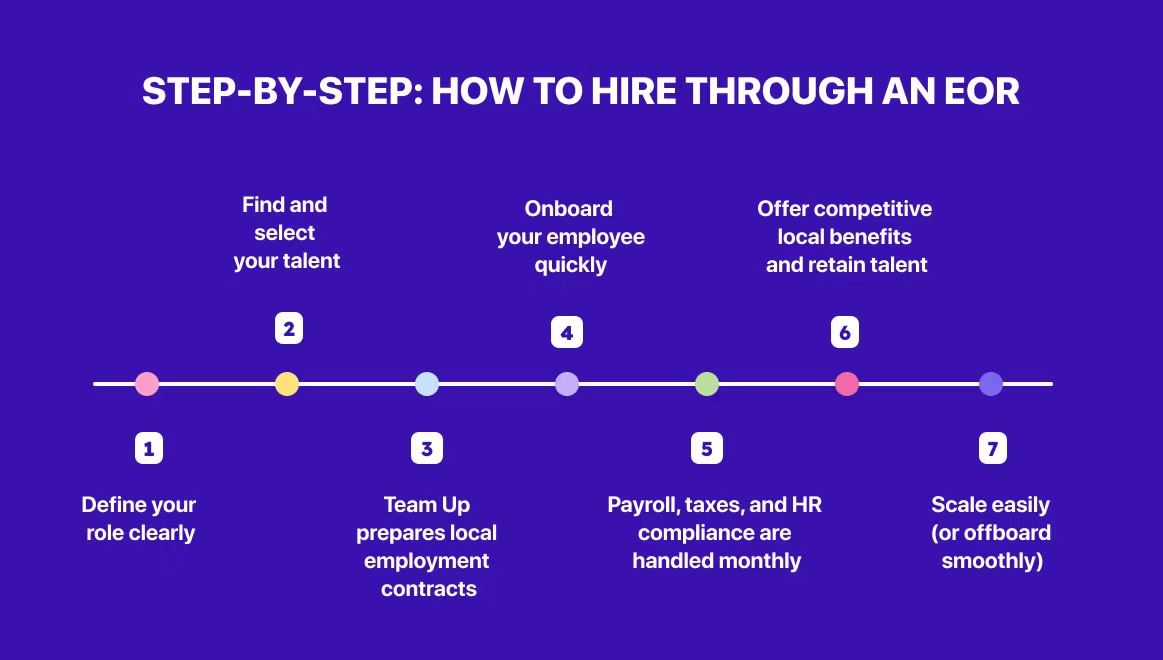
This means a Kazakh-registered company employs your staff legally, and you manage their work operationally.
Legally:
- The EOR is the employer on paper
- You control the day-to-day work
- The employee signs a contract with the EOR entity
What the EOR Handles
Immigration:
- Labor market test coordination
- Quota management
- Work permit submission
- Visa invitation issuance
- Migration registration
- IIN acquisition
- Renewals tracking
Payroll:
- Salary calculation in KZT
- Tax withholding
- Pension contributions
- Social tax & insurance payments
- Monthly tax filings
- Payslips
- Year-end reporting
Labor compliance:
- Contract drafting (Kazakh/Russian + English)
- Contract registration on enbek.kz
- Overtime calculations
- Leave tracking (24+ days minimum)
- Termination compliance
- Severance calculation
Insurance:
- Workplace accident coverage
- Mandatory contributions
- Optional private benefits

Law updates:
- Pension rate changes
- New digital filing systems
- Migration rule adjustments
- Ratio rule amendments
You fund payroll. They execute compliance.
Cost Reality
Yes, EOR charges a fee.
Typically:
- Flat monthly fee per employee
- Or the percentage of gross payroll
But compare that to:
- Accounting retainer
- HR manager salary
- Legal counsel
- Corporate compliance costs
- Director services
- Office lease
- Bank maintenance fees
- Quota mismanagement risk
For 1–5 hires, EOR is almost always financially cleaner.
Once you hit 20–30 employees, the equation shifts.
Risk Comparison
| Risk Factor | Own Entity | EOR |
| Work permit rejection | On you | Managed by EOR |
| Payroll miscalculation | On you | On EOR |
| Tax filing errors | On you | On EOR |
| Labor inspection | Direct exposure | EOR interfaces |
| Renewal tracking | Your HR | EOR monitors |
| Quota misalignment | Your responsibility | EOR manages the pool |
Kazakhstan does enforce. Digital cross-checking is increasing.
The system is not forgiving of “we didn’t know.”
Local vs Global EOR

Here’s where nuance matters when comparing local VS. global EOR providers.
A global platform may cover 100 countries.
But Kazakhstan has:
- Regional quota nuances
- Local labor inspector practices
- Russian/Kazakh documentation expectations
- Specific migration portal workflows
A provider with direct Kazakh entity and local team understands:
- How Almaty differs from Astana
- How regional quota pressure works
- How to resolve migration officer queries fast
Local presence matters more than marketing reach.
Why EOR Simplifies Compliance in Kazakhstan
Kazakhstan’s system isn’t chaotic.
It’s procedural.
Miss a step and it locks you out.
An EOR simplifies because:
- They already satisfy quota ratios across client workforce
- They already maintain compliance infrastructure
- They already file monthly tax reports
- They already have migration portal access
- They already know documentation pitfalls
You are not learning by trial and error.
You are plugging into an existing compliant structure.
EOR ComplianceFor Foreign Hires in Kazakhstan
EOR ensures:
- No work starts before permit approval
- Visa is properly issued
- Migration registration completed within the required timeframe
- Permit renewal filed 30–60 days in advance
- Position changes reported
No grey zones. No visa misuse.
EOR Compliance For Local Kazakh Hires
Even without immigration:
- Contract must be locally compliant
- Payroll must follow tax law
- Contributions must be filed monthly
- Employment must be registered in the digital system
Paying someone from abroad as a “contractor” while they work full-time in Kazakhstan is increasingly risky.
Authorities are tightening digital enforcement.
EOR eliminates that exposure.
The Honest Take
If you want full control and you’re ready for structural commitment, build the entity.
If you want speed, risk insulation, and operational clarity, use EOR.
Kazakhstan rewards compliance discipline.
It penalizes improvisation.
Choose based on scale and timeline, not ego.
Payroll and Labor Law Obligations in Kazakhstan
The part employers underestimate, then regret.
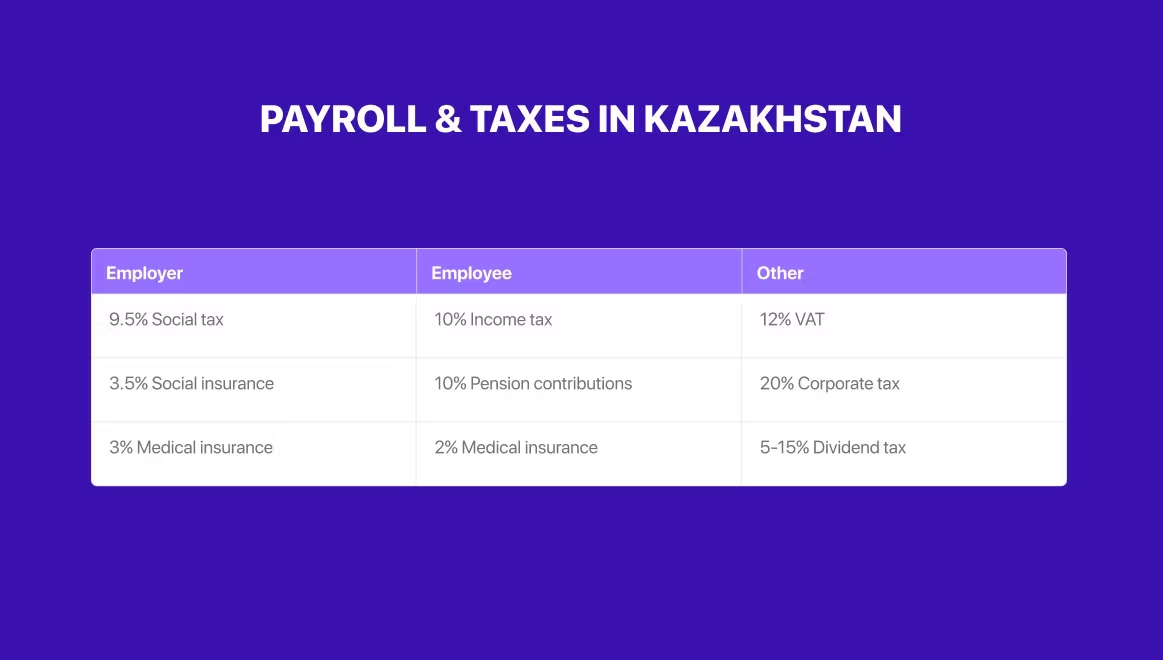
If you employ anyone in Kazakhstan (local or foreign, via entity or via EOR), you’re signing up for a monthly rhythm: run payroll, withhold correctly, remit on time, and keep the digital trail clean. Kazakhstan is getting better at catching “close enough” compliance through portals and cross-checks, so vibes-based payroll is a bad plan.
1) Employee deductions you must withhold
These are the usual core items:
- Mandatory pension contributions (OPV). Kazakh nationals pay 10% of gross income, withheld by the employer and remitted to the pension fund. Foreign nationals without permanent residence generally aren’t required to join.
- Mandatory social medical insurance (OSMI) employee payments. Withheld from the employee at 2% (rate in force since 1 Jan 2021).
2) Employer on-costs on top of gross salary
This is where budgeting often breaks.
- Social tax. Flat 9.5%, paid by the employer (not withheld from salary). Due by the 25th of the following month.
- Social insurance contributions.3.5% of gross salary, but only up to a cap. It’s calculated per employee up to 7× minimum monthly wage. Also, it is deducted from social tax, so it doesn’t always behave like a pure “extra” line item, depending on how your payroll is structured.
- OSMI employer contributions. Employer pays 3% (rate in force since 1 Jan 2022).
- Obligatory employer pension contributions (the newer one). This is the big “people missed the memo” change. The employer contribution schedule is:
- 1.5% from Jan 2024
- 2.5% from Jan 2025
- 3.5% from Jan 2026
- 4.5% from Jan 2027
- 5% from Jan 2028 It applies to employees born after Jan 1, 1975, and has a cap based on a multiple of minimum wage.
What this means in plain English. If you’re cost-modeling Kazakhstan and you’re only adding “10% PIT” in your spreadsheet, you are undercounting. Hard.

3) Deadlines and reporting
- Social tax payments due:25th of the next month.
- Personal income tax + social tax report due: quarterly, by the 15th day of the second month after the quarter ends.
This is the stuff that triggers fines because it’s boring. Boring fines are still fines.
4) Caps and minimum wage reality check
These contributions aren’t unlimited. Kazakhstan uses caps tied to minimum wage for several items (social insurance, OSMI base, employer pension contribution base).
Also, minimum wage changes over time, and the contribution caps move with it. For context, KPMG lists KZT 85,000 as the 2024 minimum monthly wage.
So if your article is for 2026, you should phrase minimum wage as “set annually” unless you’re going to quote the 2026 figure with a source.
5) The compliance “gotchas” that actually bite
- You can’t “just pay from abroad” and call it clean. If it’s employment, it needs local payroll treatment.
- Foreigners. Visa, work permit, registration, contract paperwork. One missing step can turn into “stop work immediately” problems.
- Digital footprint. Kazakhstan increasingly expects employment to be reflected in official systems. If it isn’t, that looks like shadow employment, even when you “meant well”.
6) Entity vs EOR, what changes in payroll?
The law doesn’t change. The risk does.
- With your own entity, your accountant becomes the hero or the reason your CFO drinks. You own filings, payments, audits, and mistake costs.
- With an EOR, you still fund payroll, but the EOR executes remittances, reporting, payslips, and keeps you aligned with the moving parts (especially the employer pension contribution ramp). That’s what you’re paying for.
Final Thoughts
People love to talk about “expanding into new markets” like it’s a slide in a pitch deck. Kazakhstan is not a slide. It’s a system.
Yes, the upside is real. You get access to a strong technical workforce, competitive salary levels, a bilingual talent pool that comfortably navigates Russian and increasingly English, and a strategic base in Central Asia. That part is attractive.
The part nobody romanticizes. Quotas. Labor market tests. Work permit categories. Pension contributions that change over time. Digital contract registration. Immigration deadlines that do not care about your product launch timeline.
Kazakhstan is not hostile to foreign employers. It’s structured. And structured systems reward companies that respect them.
If you approach hiring here casually, you’ll feel friction everywhere. Delays in permits. Rejections because a job wasn’t posted correctly. Payroll penalties because a contribution rate changed and nobody updated the spreadsheet. Employees who technically can’t work because a renewal was filed late.
None of that is dramatic. It’s just expensive and exhausting.
If you approach Kazakhstan with a compliance-first mindset, it becomes predictable. Plan the timeline realistically. Run the local vacancy posting properly. Budget employer on-costs accurately. Track renewal deadlines months in advance. Register contracts. Pay contributions on time. Keep documentation clean.
Do that, and the system works.
This is also where many companies decide whether they want to build local infrastructure or borrow it.
Kazakhstan can absolutely support serious international growth. But it’s not a place for improvisation. Treat compliance as infrastructure, not overhead, and you’ll find the market far more welcoming than its paperwork suggests.
Frequently Asked Questions
1. What are the four main categories of work permits?
Work permits are issued based on the employee's role, which determines the requirements and validity:
- Category 1: Top executives and their deputies.
- Category 2: Heads of structural divisions (middle management).
- Category 3: Specialists (requires higher education and experience).
- Category 4: Skilled workers (manual or technical labor).
2. What is the annual "Foreign Labor Quota"?
Every year (usually by September 30), employers must submit a request for the number of foreign workers they intend to hire in the following year. For 2026, the government has set the general quota at 0.25% of the total labor force. If a company has not applied for a quota, obtaining a new work permit can be extremely difficult.
3. Does the "Local-to-Foreign" ratio apply to all companies?
Yes, most companies must maintain a specific ratio of Kazakhstani citizens to foreign staff:
- Categories 1 & 2: At least 70% of the staff in these roles must be local.
- Categories 3 & 4: At least 90% of the staff in these roles must be local.
Exemption: Small businesses with fewer than 20 employees are currently exempt from these ratio requirements.
4. What is the mandatory "Local Labor Market Test"?
Before hiring a foreigner (especially in Categories 3 and 4), employers must post the vacancy on the Enbek.kz (Electronic Labor Exchange) portal. You can only proceed with a work permit application if no suitable local candidates are found within 15 calendar days of the posting.
5. What is the C3 Work Visa?
The C3 Visa is the standard entry and residence authorization for foreign employees. It is issued after the work permit is secured.
- Duration: Typically issued for the duration of the work permit (up to 3 years for managers).
- Family: C3 holders can sponsor "Accompanying" visas for their spouse and children.
6. Are there any work permit exemptions?
Yes. Certain foreign nationals do not require a work permit to work in Kazakhstan:
- EAEU Citizens: Citizens of Russia, Belarus, Armenia, and Kyrgyzstan.
- First Managers: Directors of branches/representative offices of foreign companies and 100% foreign-owned LLPs.
- Astana Hub/AIFC: Companies registered in the Astana Hub (IT) or the Astana International Financial Centre (AIFC) benefit from simplified, permit-free hiring.
7. How does the "Intra-Corporate Transfer" (ICT) work?
Multinational companies can transfer employees from a foreign branch to a Kazakhstan branch.
- Benefit: ICTs are exempt from the standard quota system.
- Requirement: The employee must have worked for the foreign parent company for at least one year prior to the transfer.
8. What is the new "Neo Nomad" (B12-1) Visa?
Launched recently for the 2025–2026 period, this visa is for remote workers employed by companies outside Kazakhstan.
Employer Note: If your employee is working for your foreign entity but wants to live in Kazakhstan, they should use this visa. It does not allow them to work for a local Kazakhstani legal entity.
9. How long does the sponsorship process take?
Employers should plan for a three-stage timeline:
- Work Permit (Local Labor Office): 15–30 business days.
- Letter of Invitation (LOI/Visa Support): 5–7 business days.
- Visa Stamping (Consulate): 5 business days.
Total Timeline: Roughly 2 to 3 months.
10. What are the employer's compliance duties after arrival?
- Notification: You must notify the Migration Service of the employee's arrival within 3 business days. This is now done digitally via the e-Qonak or Visa-Migration portal.
- IIN: Ensure the employee obtains an Individual Identification Number (IIN) for tax and salary purposes.
- Degree Verification: The Ministry of Labor now strictly verifies the Apostille or legalization of the employee’s university diploma.
.svg)


