A Guide to the Top 5 Trends in Employer of Record Services for 2026
Introduction
Employer of record services are not what they were three years ago. The market has grown — from $5.2 billion in 2024 to $5.97 billion in 2026, on a path toward $10 billion by 2035. But growth numbers alone do not explain what is actually happening. The model itself is changing: in how it handles compliance, in where it operates, in who is using it, and in what "employer of record" means in practice versus in a sales pitch.
Five trends are defining 2026 specifically. Not predictions about what might happen — things that are happening now, that are changing how companies structure their international hiring, and that have direct implications for anyone building teams in Georgia, Armenia, Azerbaijan, Turkey, India, Kazakhstan, and Uzbekistan.
- Introduction
- Why 2026 Is a Pivotal Year for Employer of Record (EOR) Services
- Trend #1: Regulatory Velocity Has Turned Compliance From a Feature Into a Differentiator
- Trend #2: EOR Visa and Work Permit Sponsorship Now a Core Offering
- Trend #3: The Caucasus and Central Asia Have Emerged as the EOR Market's Most Significant Growth Frontier
- Trend #4: Employee Relocation Has Become a Hiring Strategy, Not Just an HR Operation
- Trend #5: The Regional Specialist Model Is Outperforming the Global Platform Model in Emerging Markets
- What These Five Trends Mean for Your Hiring Plan
- Staying Ahead of the Trends in Your Target Markets
- Frequently Asked Questions
Why 2026 Is a Pivotal Year for Employer of Record (EOR) Services
Before the five trends, one framing point.
The standard case for EOR — speed to market, no entity needed, compliance handled — has not changed. What has changed is the environment those benefits operate in. Regulatory complexity is accelerating faster than most companies anticipated. Immigration frameworks in key emerging markets have tightened significantly in a single year. The informal arrangements that many companies relied on in the Caucasus and Central Asia have been replaced by formal systems with real enforcement teeth.
54% of organizations say they currently use or plan to use an EOR, surpassing fully owned entities (45%) and independent contractors (34%). But adoption has outpaced understanding. Nearly one in four decision-makers cannot accurately define what an EOR is, with misunderstanding highest among mid-to-large enterprises.
That gap between adoption and understanding is where most hiring mistakes happen in 2026. The five trends below close that gap, at least for the markets where Team Up operates.

Trend #1: Regulatory Velocity Has Turned Compliance From a Feature Into a Differentiator
For years, EOR providers sold "compliance handled" as a standard service. In 2026, compliance monitoring has become the primary differentiator between EOR providers — because the pace of regulatory change has made it impossible for any provider to deliver this promise without genuine in-country infrastructure.
Cross-border employment compliance concerns increased by 29%, driving EOR service adoption. That figure understates what is happening on the ground.
In the twelve months from mid-2025 to mid-2026, the markets most relevant to emerging-hub expansion saw a wave of regulatory changes that required immediate operational responses:
- Georgia — March 1, 2026: A Special Labour Permit became mandatory for all foreign workers. This replaced an informal system that had operated for years on visa-free entry. The new requirement introduced a 10-business-day domestic vacancy posting, a 30-day processing window, and a GEL 2,000 fine per employer and employee for non-compliance. EOR services are the most popular solution in 2026 for companies that want to avoid the administrative burden of the new laws. An EOR handles the local digital signatures, the labor market testing, and the 2026 tax updates, allowing you to hire in Tbilisi without a local office.
- Armenia — January 1, 2026: Mandatory health insurance withholding of approximately $28 per employee per month became law. All employment contracts must now be executed through the SRC digital platform — paper contracts are invalid for new hires. From August 2026, all foreign employees must enter on a Work Visa, not switch from tourist status.
- Uzbekistan — January 1, 2026: A restructured State Social Insurance Law changed how social benefit payments are routed. All leave registration must flow through the government's my.mehnat portal. November 2025 amendments changed overtime compensation rates.
- Kazakhstan — September 1, 2025: A mandatory 15-calendar-day domestic vacancy posting on enbek.kz became a prerequisite for all foreign work permit applications. Employment contracts with foreign nationals must now be registered in the Unified Labor Contract Registration System (ULCRS).
Each of these changes required employers to update payroll systems, revise employment contracts, and adjust onboarding processes — before the effective dates, not after. An EOR that learns about these changes from its clients is not managing compliance. It is reacting to it.

The trend: compliance management in 2026 is not a platform feature. It is a function of whether the EOR has people physically present in the market who know the regulatory environment in real time. That distinction is now separating providers who deliver on their compliance promise from those who merely include it in their marketing.
AI-powered compliance tools have improved error detection by around 29%, helping prevent costly regulatory mistakes before they happen. But technology does not replace the in-country knowledge required to understand how a regulation change affects a specific employment contract in a specific country. In markets like Azerbaijan, where work authorization enforcement is active and penalties compound, there is no platform substitute for a team that has navigated the process dozens of times.
Trend #2: EOR Visa and Work Permit Sponsorship Now a Core Offering

Three years ago, most EOR service providers listed immigration support as an optional add-on or a premium tier feature. In 2026, immigration capability is moving to the center of what companies evaluate when choosing an EOR. The reason is structural.
Global immigration in 2026 is more selective, digital, and talent-focused than ever. Low-skilled and temporary migration faces barriers, while skilled professionals, researchers, and investors have expanding (but competitive) opportunities.
Immigration is increasingly less about approvals; it is becoming a risk framework that sits across sponsorship, payroll, ownership, remote work, workforce planning, and talent strategy.
That framing — immigration as a risk framework, not a transactional process — changes how companies evaluate EOR providers.
The questions are no longer "Do you support visas?" and "How much extra does it cost?" They are: "Can you sponsor a work permit in Kazakhstan for a Russian national under the September 2025 reform?" "What is your process for the 15-day enbek.kz posting requirement?", and "How do you handle the August 2026 work visa transition in Armenia?"
The immigration capability gap between owned-entity EOR providers and aggregator platforms has become the most visible fault line in the market. Here is why it matters structurally:
Work permit and visa sponsorship require the sponsoring entity to be a registered legal employer with active payroll compliance in the target country. An EOR that owns its entity files the permit application directly, interfaces with immigration authorities, and tracks permit conditions as an ongoing employer obligation. An EOR that uses a local partner routes the application through that partner — adding coordination layers, accountability gaps, and timeline risk.
In markets where immigration enforcement has tightened — Azerbaijan (zero-tolerance enforcement, every foreign worker requires prior State Migration Service authorization), Georgia (Special Labour Permit from March 2026), Kazakhstan (September 2025 labor market test reform) — the aggregator model's accountability gap is not an operational inconvenience. It is a real compliance risk.
With international assignments averaging approximately $77,000 per employee, organizations are increasingly shifting toward short-term assignments, regional mobility, and nearshoring to manage expenses. That shift toward shorter assignments and nearshoring creates more frequent immigration transactions, not fewer. Each assignment change — a new market, a relocated employee, a permit renewal — requires an EOR with direct immigration infrastructure to execute without friction.
The implication for companies evaluating EOR providers in 2026: immigration sponsorship is no longer a feature to check off a list. It is a capability to verify operationally. Ask the provider: which countries do you sponsor directly? What was your process for Georgia's March 2026 Special Labour Permit requirement? Who files the Kazakhstan quota application for our hires, and by what deadline?
Trend #3: The Caucasus and Central Asia Have Emerged as the EOR Market's Most Significant Growth Frontier
The global EOR conversation has historically been dominated by North America, Western Europe, and APAC. That center of gravity is shifting.
Emerging economies accounted for 50% of 2025 hires, a trend accelerating into 2026.
In 2026, several trends are leading the way in global mobility: stricter worker classification laws, demand for real-time data across HR and immigration, remote hiring as the norm, and a focus on automation and security in payroll and documents.
Within this broader emerging-market shift, the Caucasus and Central Asia represent a specific opportunity that most global EOR platforms are structurally underprepared for — and that regional specialists like Team Up have been building infrastructure for since 2020.
The case for the Caucasus rests on three converging factors:
- Cost advantage: Hiring a developer in Georgia costs approximately $36,000/year. The equivalent role costs $110,000 in the US and $75,000–$90,000 in Western Europe. That cost differential is not a temporary arbitrage — it reflects structural economic differences that persist across the entire Caucasus and Central Asian region.
- Talent quality: Armenia's IT sector grew 24.5% in Q1 2025 alone. Georgia has become a significant hub for internationally mobile professionals, including engineers and product managers who have worked for European and US companies. Kazakhstan and Uzbekistan are earlier in their growth curve but moving fast — Kazakhstan generates 60% of Central Asia's GDP and has a growing technology workforce.
- The regulatory formalization that makes EOR essential: The end of the "informal work" era. Historically, Georgia allowed foreigners to work on visa-free entry, and Armenia was flexible with paper contracts. As of 2026, all three Caucasus countries now require a formal Work Permit or specialized registration prior to or immediately upon starting work, with digitalization through government portals.
This formalization is the key dynamic. It means the informal arrangements that many companies used to access Caucasus talent — employing developers "on tourist visas," running payroll through informal arrangements — are no longer viable. The talent pools are still there. The cost advantage is still real. But accessing them now requires formal EOR infrastructure.
For global EOR providers operating through aggregator partners in these markets, this transition creates service gaps. Their local partners may not have updated their processes for Georgia's new permit sequence, or Armenia's SRC digital contract mandate, or Kazakhstan's ULCRS registration requirement. For owned-entity regional specialists, this transition is the environment they have been operating in — and their clients have been protected from it.
The strategic implication: as the Caucasus and Central Asia formalize, the competitive advantage of owned-entity regional specialists over global aggregators widens. The companies that identified this talent market early and built the right EOR partnership are ahead. The companies discovering it now face a more complex entry environment — but with the right partner, the fundamentals still make it worth it.

Trend #4: Employee Relocation Has Become a Hiring Strategy, Not Just an HR Operation
International assignments used to be a feature of large enterprise HR. In 2026, companies of every size are treating employee relocation as a deliberate talent strategy — and EOR is what makes that strategy executable.
Three forces drive the shift
- Immigration tightening in traditional destination countries. H-1B visa costs in the US are rising, selection rates remain below 25%, and the lottery element makes planning impossible. In the UK, post-Brexit immigration changes have raised barriers and costs for EU talent. For companies that used to rely on bringing talent to Western markets, the constraints are increasingly pushing the question in the other direction: can we bring the company to the talent?
- Cost of living arbitrage for employees. Companies are actively expanding into emerging talent markets. The Middle East continues to grow as an energy and innovation hub. Meanwhile, the traditional model of concentrating talent in global hubs such as London, New York, and Singapore is giving way to a more distributed approach. For employees, relocating from Moscow, Istanbul, or Kyiv to Tbilisi — where living costs are lower and quality of life is high — is increasingly attractive as a career move, not a career compromise.
- The EOR model's expansion into relocation support. EOR providers have traditionally been seen as remote employment tools — you hire someone who is already in the target country. The emerging trend is using EOR as the legal infrastructure for relocation: an employee moves to a new country, and the EOR's owned entity in that country becomes their employer of record and immigration sponsor simultaneously.
This model requires the EOR to handle both employment compliance and immigration sponsorship as a unified workflow — not as separate services with separate vendors. The work permit must precede payroll registration in most markets. The residence permit application follows the work permit approval. The EOR that manages both sequences as one process eliminates the coordination gaps that create delays and compliance exposure.
How does it look in practise
In practice, this means an EOR's owned entity sponsors the work permit, issues the compliant employment contract, runs payroll from day one, and tracks permit conditions and renewal dates as ongoing employer obligations. For a company relocating an engineer from London to Yerevan, or a product manager from Berlin to Tbilisi, this integrated workflow is what makes the move legally possible without the company owning a local entity.
The practical constraint: not every EOR can do this in every market. Immigration sponsorship requires the sponsoring entity to be a registered legal employer with active compliance history. An EOR that uses local partners in the target country may route the sponsorship through a partner, adding accountability gaps and timeline risk. An EOR with owned entities handles it directly.
Treating immigration as a separate, final stage instead of an ongoing part of the hiring and onboarding process is one of the most frequent compliance gaps uncovered in fast-growing international teams. The EOR trend in 2026 is the full integration of immigration into the employment workflow — not as a separate service, but as a core function of the legal employer relationship.
Trend #5: The Regional Specialist Model Is Outperforming the Global Platform Model in Emerging Markets
The EOR market in 2025 saw a significant bifurcation: global platforms continued to dominate by coverage count and brand recognition, while regional specialists won on compliance quality, client retention, and operational delivery in specific markets.
This bifurcation has become a deliberate strategic choice for companies that understand what they are buying.
Here is the dynamic. Regional firms saw a growth of 21% in partnerships in 2025 — reflecting companies that chose to use a regional specialist for specific markets alongside a global platform for broader coverage. The hybrid model — global platform for North America and Western Europe, regional specialist for the Caucasus or Central Asia — has become a recognized best practice for companies with diverse geographic hiring footprints.
Why does the regional specialist consistently outperform the global platform in emerging markets?
In-country infrastructure is the product, not a feature
A global EOR platform covering 150+ countries has, by necessity, distributed its in-country expertise thinly. In Georgia, Armenia, Azerbaijan, Kazakhstan, and Uzbekistan, "coverage" typically means a local aggregator partner whose compliance practices the platform has limited visibility into. A regional specialist with owned entities and physical offices in these markets has made a concentrated capital and operational investment. That investment is the product. The compliance expertise is not a dashboard feature — it is people who live and work in the market.
Regulatory velocity rewards local knowledge
As documented in Trend #1, the pace of regulatory change in the Caucasus and Central Asia has been high in 2025–2026. The entities that tracked these changes in real time and responded before effective dates were the ones with in-country legal and HR teams. Global platform compliance updates, by contrast, are often generated by legal vendors or aggregator partners and may lag behind effective dates by weeks.
Client retention tells the story
Team Up's 92% client retention rate over five years is a proxy for delivery quality that review counts and G2 ratings cannot replicate. Retention means the compliance has been accurate, the payroll has been timely, the immigration has been handled, and the account relationships have held. It means the model works — not just in the first quarter, but in year three and year five.
The competitive dynamic in 2026 is not that global platforms are bad. Deel, Remote, Multiplier, and G-P all deliver value in the markets where they have genuine infrastructure. The trend is that companies entering the Caucasus, Central Asia, Turkey, India, and MENA are increasingly recognizing that "covered" does not mean "served well" — and are choosing regional specialists for those specific markets accordingly.
EOR is becoming a critical tool within a broader compliance and workforce strategy. Compliance is now one of the biggest drivers of contingent workforce strategy. When compliance is the primary driver, the provider's actual compliance infrastructure — not their platform's compliance monitoring feature — becomes the decision criterion.
Team Up was founded in 2020 with the specific thesis that the Caucasus, Central Asia, Turkey, India, and MENA are markets where companies need a regional specialist, not a global platform's secondary coverage tier. Since then: 200+ businesses supported, 4,000+ talent placed, 92% client retention over five years. Trusted by HP, Armani Exchange, Jack & Jones, Telia, Wizzair, eBazaaris, SplitMetrics, and 200+ other organizations across North America, Europe, the Middle East, and Singapore.
What These Five Trends Mean for Your Hiring Plan
Each of the five trends above has a practical implication for how you structure your next expansion.
On regulatory velocity: If you are hiring in Georgia, Armenia, or Uzbekistan in 2026, your EOR must have already processed the 2026 regulatory changes — not be catching up to them. Ask specifically: how did you handle Armenia's January 2026 health insurance mandate? Georgia's March 2026 Special Labour Permit? If the answer requires checking with a local partner, you have your answer about the compliance model.
On immigration as a strategy: If any of your hires involve foreign nationals or employee relocations, immigration sponsorship must be part of the EOR conversation from day one — not a separate add-on discussion after employment is confirmed. The permit process must start before the employment relationship, not after.
On the Caucasus and Central Asia as a frontier: The talent is real, the cost advantage is real, and the regulatory formalization is real. The companies that access this talent market now — with proper EOR infrastructure — will have built teams and processes before the market becomes crowded. The entry window remains open, but it is narrower than it was two years ago.
On employee relocation as a strategy: If you are facing H-1B lottery risk, rising Western market talent costs, or retention challenges with globally mobile employees who want to live in lower-cost markets, EOR-enabled relocation is now an executable strategy. The infrastructure exists. The question is whether your EOR can do it without splitting the immigration and employment workflows between separate vendors.
On regional specialists: If your expansion is into the Caucasus, Central Asia, Turkey, India, or MENA, the global platform's coverage map is not the right evaluation criterion. The right criterion is: does this provider own entities in my specific target countries, and can they show me evidence of compliance delivery in those markets over the past 12 months?
Staying Ahead of the Trends in Your Target Markets
The five trends above are not future projections. They are happening now, in the markets where Team Up operates.
Regulatory velocity is reshaping what compliance delivery means. Immigration is moving from an add-on to a core. The Caucasus and Central Asia are formalizing and opening simultaneously. Employee relocation is becoming a talent strategy. And regional specialists are earning their position through delivery quality, not just marketing claims.
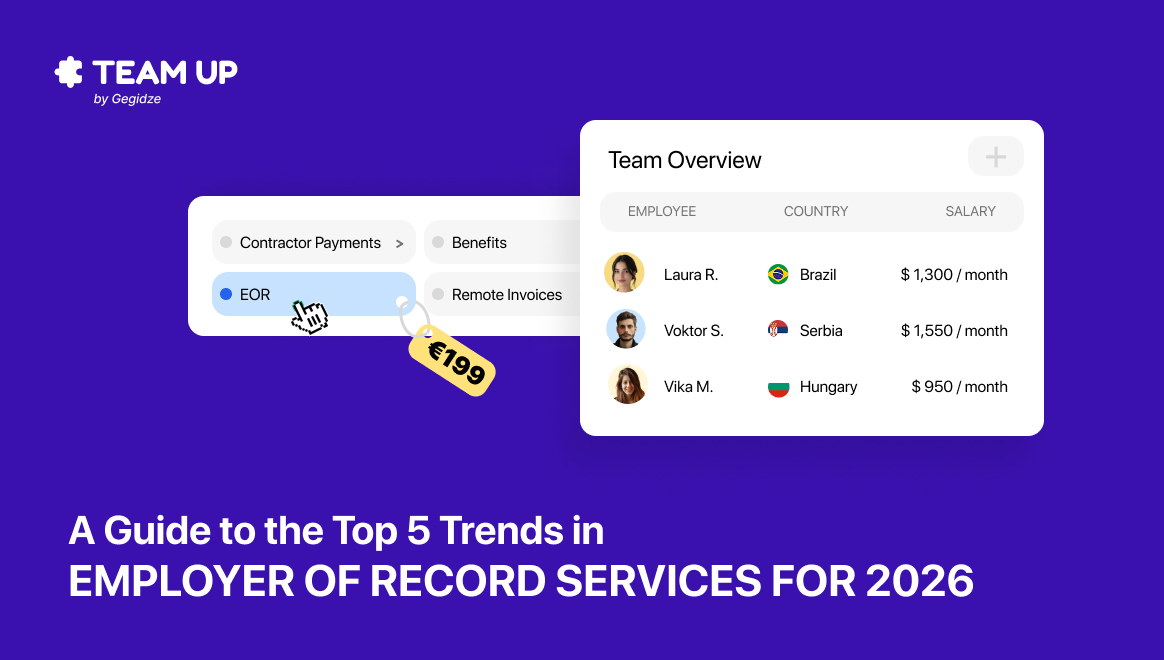
Team Up has supported 200+ businesses and placed 4,000+ talent since 2020, with a 92% client retention rate over five years. Owned entities in Georgia, Armenia, Azerbaijan, Turkey, Kazakhstan, Uzbekistan, and India. In-country offices in Tbilisi, Yerevan, Istanbul, Almaty, and Tashkent. EOR services start at €199 per employee per month.
If you are planning expansion into any of these markets in 2026, the trends above are the context. Team Up is the infrastructure.
Frequently Asked Questions
What is the most significant EOR trend in 2026 for emerging market hiring?
Regulatory velocity. The pace of labor law changes across the Caucasus and Central Asia in 2025–2026 has been higher than at any point in the past decade, with major changes in Georgia, Armenia, Uzbekistan, and Kazakhstan all taking effect within a 12-month period. This has made in-country compliance monitoring — not platform-based alerts — the primary differentiator between EOR providers. For work permit requirements and regulatory changes by country, see our guide on compliant hiring in emerging markets.
Why is immigration becoming more central to EOR services in 2026?
Because immigration policies in key talent markets are tightening while demand for cross-border talent is rising. The combination of stricter work authorization requirements (Georgia, Azerbaijan, Kazakhstan), the decline of informal arrangements that companies used to rely on, and the increase in deliberate employee relocation as a talent strategy has elevated immigration from an optional add-on to a core function of EOR. Providers that can sponsor work permits directly — through owned entities — are structurally better positioned than those that route sponsorship through aggregator partners.
What does the shift toward regional EOR specialists mean for companies using global platforms?
It does not mean global platforms are wrong for every situation. Global platforms deliver strong value in North America, Western Europe, and large APAC markets where their infrastructure is genuine. For the Caucasus, Central Asia, MENA, and India, the trend is toward hybrid models: a global platform for established markets, a regional specialist for the markets where in-country expertise is non-negotiable. 21% growth in regional firm partnerships in 2025 reflects this trend in practice.
How is the employee relocation trend changing what companies ask of their EOR?
Companies are increasingly asking EORs to manage both the employment relationship and the immigration workflow as a unified process — not as separate services. This requires the EOR to hold owned entities (for sponsorship capability), have in-country immigration expertise, and coordinate permit applications, employment contracts, and payroll registration in the correct sequence. For countries like Kazakhstan, where the immigration and payroll registration sequence is strict, this integrated workflow capability is not optional.
What is "sponsorship for an immigration-related employment benefit" and how does EOR provide it?
It means the employer formally provides the employee's right to work in the target country — a work permit, sponsored visa, or residence permit application. An EOR with owned entities in the target country holds the registered legal employer status required to file these applications. The EOR becomes the sponsor on the immigration documents, takes on the ongoing compliance obligations, and tracks permit conditions and renewals as part of the employment relationship. This is one of the core functions that distinguishes EOR from payroll outsourcing, which cannot provide immigration sponsorship without client entity ownership.
.svg)