


Work permits, visas & immigration when hiring via Employer of Record (EOR) in Kazakhstan
Intro: Kazakhstan is open for business, but is your hiring model legal?
There’s a reason companies use an Employer of Record when hiring in Kazakhstan.
It’s not because they’re scared of paperwork.
It’s because the alternative is worse: fines, audits, and a Migration Service officer asking questions you can’t answer.
You think hiring someone remotely is as simple as sending a contract and a paycheck, right?
Cool. Tell that to the Kazakh government.
Because once your “contractor” starts working full-time, reporting to your team, and using your tools, guess what?
He’s your employee. And unless you're set up locally, you're breaking the law.
Not hypothetically. Not "technically."
Actually breaking the law.
Work permits, visas, registrations, quotas, they all matter.
And “we didn’t know” isn’t a valid excuse.
So if you're serious about building a team in Kazakhstan…
You need to hire legally. You need to stay compliant.
And you need to understand what the hell you're doing.
This guide explains it. No fluff. No filler.
Just the visa rules, work permits, and EOR model explained like you actually want to hire someone without getting burned.

Why can’t you ignore immigration rules in Kazakhstan?
Because Kazakhstan doesn’t play the “move fast, break laws” game.
You might get away with contractor gray zones in some markets. Kazakhstan isn’t one of them. Here, immigration rules are clear, enforced, and not something you want to trip over because you thought sending a monthly Payoneer payment counted as “doing it right.”
Freelance? Full-time? The law knows the difference
Let’s be blunt:
If someone’s working full-time for you from Kazakhstan, following your roadmap, reporting to your team, and using your tools, you can’t call them a freelancer and hope no one notices.
Under Kazakh labor and migration law, that’s employment.
And if they’re not registered properly? You’re in violation.
This isn’t theoretical risk. We’re talking real fines, blocked payrolls, tax investigations, and in some cases, visa revocations. It gets messy, fast. And your startup doesn’t need that kind of mess right now, not with Q3 deliverables already slipping.
Here’s what most companies get wrong:
- They skip the work permit because “it’s just one dev.”
- They assume remote = invisible.
- They think a foreign contractor agreement magically overrides local labor law.
It doesn’t. And Kazakhstan has no patience for that logic.
So what’s the fix?
The government tracks foreign labor quotas.
They require employer registration.
They issue actual work permits tied to legal entities, not Gmail accounts and Upwork profiles.
So, unless you plan to incorporate locally, file for a business license, register with the tax authorities, and learn how the migration quota system works…
You're better off letting an EOR do it for you.
With the right EOR, your hire gets a fully legal employment status.
Work permit issued. Residency managed. Visa filed.
You get peace of mind, a clean monthly invoice, and zero risk of watching your best engineer disappear because the paperwork didn’t go through.
This isn’t about red tape. It’s about hiring like a grown-up in a market that’s watching.
Ignore immigration rules in Kazakhstan, and you’re not hiring, you’re gambling.
And not the smart kind.
Work permits & visa types for foreign talent in Kazakhstan
Here’s the thing about hiring foreign talent in Kazakhstan:
You can’t just fly someone in, hand them a laptop, and call it a day.
Kazakhstan runs on paperwork, not wishful thinking. And if your remote hire isn’t properly documented with the right work permit and visa, it doesn’t matter how good their GitHub repo looks. They’re not legally allowed to work for you.
Let’s break down how it actually works.
No work permit = no legal employment
Kazakhstan doesn’t have a “freelancer visa” loophole or a digital nomad workaround for full-time hires.
If your team member is working from Kazakhstan, even remotely, and they’re not a citizen or permanent resident, you’re looking at a work permit situation.
Yes, even if they’re using their own laptop.
Yes, even if you’re paying them from abroad.
Yes, even if they only join one standup a week.
What kind of permits are we talking about?
Work permits in Kazakhstan fall under the foreign labor quota system, meaning companies can’t just sponsor as many workers as they want. There are limits. And categories.
Here’s the simplified version:
- Category 1: Executive leadership roles
- Category 2: Managers and department heads
- Category 3: Specialists and mid-level professionals (your typical senior dev falls here)
- Category 4: Skilled workers and junior roles
Each category has its own salary floor and documentation requirements. And most EOR hires land in category 2 or 3, senior product engineers, team leads, and other skilled roles.
What about the visa?
To legally enter and stay in Kazakhstan for employment, your candidate will need:
- Work Visa (C3 category): Tied directly to the work permit
- Residence registration: Completed within days of arrival
- Medical check + local address confirmation: Mandatory, even for remote workers
And all of that has to be sponsored by a local, registered employer.
Which means, if you don’t have a Kazakh legal entity, you can’t sponsor it.
An EOR can. That’s the difference.
Do remote workers need this too?
Yes.
Kazakhstan doesn’t care if the work is “remote.”
If they’re living in the country, working full-time, and earning income tied to your business, they fall under employment law.
Even if you think it’s “just a contractor.”
Even if it’s “just temporary.”
Immigration doesn’t operate on vibes. It operates on permits.
How the EOR model solves work permit challenges
Hiring in Kazakhstan doesn’t have to feel like you’re applying for a visa to Mars.
You don’t need to learn immigration law.
You don’t need to navigate government portals in Cyrillic.
And you definitely don’t need to set up a legal entity just to hire one engineer.
You just need the right model and the right partner.
That’s where the Employer of Record (EOR) comes in.
The EOR is your legal shortcut, the good kind
Here’s what makes the EOR model different:
You still manage your team’s work.
But the EOR becomes the legal employer on paper and in law.
That means they’re the ones:
- Sponsoring the work permit
- Handling visa registration
- Dealing with Kazakh immigration
- Filing government paperwork
- Responding to tax and labor inspections (so you don’t have to)
All while your hire gets paid legally, taxed correctly, and onboarded like a full-time employee, without you touching a single local form.
No entity. No quota headaches. No risk.
If you tried to do this yourself, here’s what you’d need:
- A registered local company
- Approval to hire foreign workers
- Time and budget for the quota process
- A legal team fluent in Kazakh employment law
- Payroll infrastructure
- HR support on the ground
Or…
You could work with an EOR that already has all of that and hires your team through their entity instead.
They handle everything behind the scenes. You get one clean monthly invoice.
The result? Zero immigration stress.
- Your hire is fully legal from day one
- Their visa and work permit are tied to the EOR
- You skip the quota process entirely
- No legal exposure, no misclassification, no “hope this counts as a contractor” guesswork
- You scale the team. The EOR handles the paperwork.
Think of it like a hiring firewall
The EOR sits between you and the legal risks.
You get the talent.
They take on the liability.
If anything goes sideways, permit delays, compliance checks, or sudden legal changes, the EOR deals with it.
You don’t get dragged into it.
You don’t take the hit.
You just keep building.
That’s not just convenient. That’s smart.

Hiring without an entity, what it looks like in Kazakhstan
Let’s be honest.
You don’t want to open a company in Kazakhstan just to hire one developer.
And you shouldn’t have to.
Because setting up an entity here? It’s not just paperwork.
It’s months of legal back-and-forth, tax registration, bank setup, HR infrastructure, and yes, yearly audits in a language you don’t speak.
All just to send someone a payslip.
No thanks.
But what if you could hire without the headache?
That’s the EOR model in action.
You don’t open a local entity.
You don’t hire contractors and hope no one asks questions.
You hire full-time employees, legally, through an Employer of Record (EOR) already set up in Kazakhstan.
They become the legal employer.
You still manage the work.
So what does this actually look like?
Here’s how it plays out:
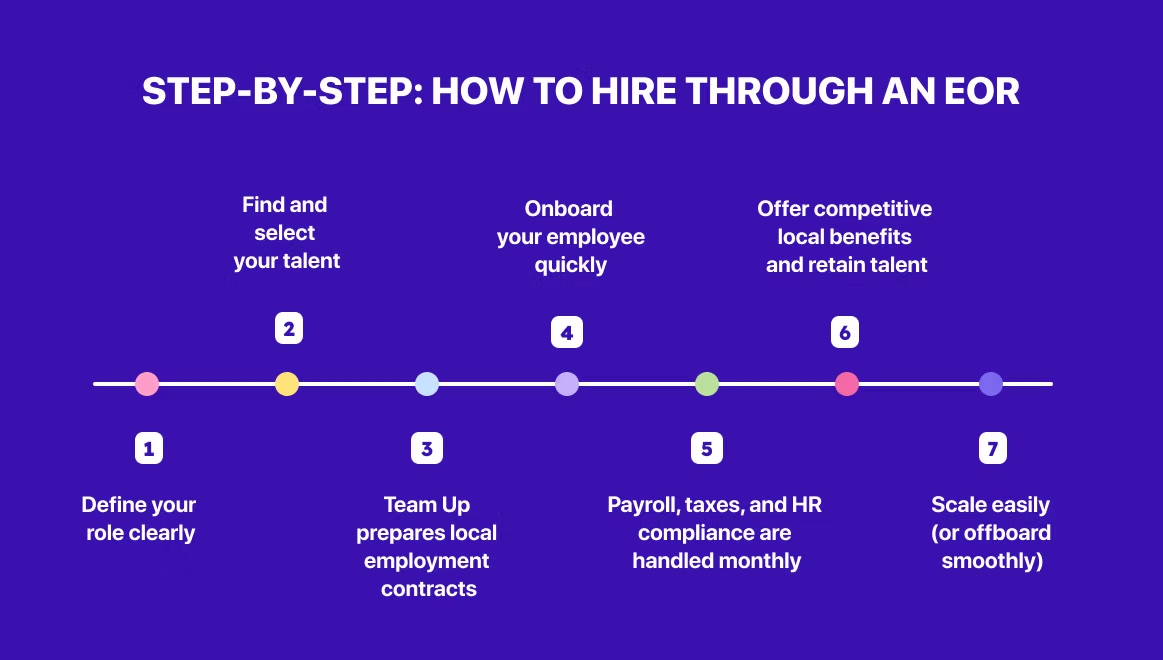
- You define the role, tech stack, experience, timezone, and English level
- We (as your EOR) handle employment contracts, work permits, payroll, taxes
- Your new hire works directly with your team — in Slack, in Git, in standups
- You get one monthly invoice — no hidden fees, no extra filings, no tax mess
And all of it happens without you needing to touch a Kazakh government portal.
What do you miss by not opening an entity?
Glad you asked:
- No company registration
- No bank account setup
- No payroll department
- No local tax filings
- No managing labor law compliance
- No foreign director appointment
- No overhead if you scale up or down
In short: no baggage.
Wait, is this even legal?
Yes. 100%.
The EOR is a fully compliant local entity.
They employ your team under Kazakh labor law.
They register for taxes, handle work permits, and provide all required documentation.
Your developers are real employees, with all the legal protections and benefits they’re entitled to.
You stay out of the liability zone.
It’s the cleanest way to build your team here without drowning in admin.
Visa timelines, processing steps & lead times
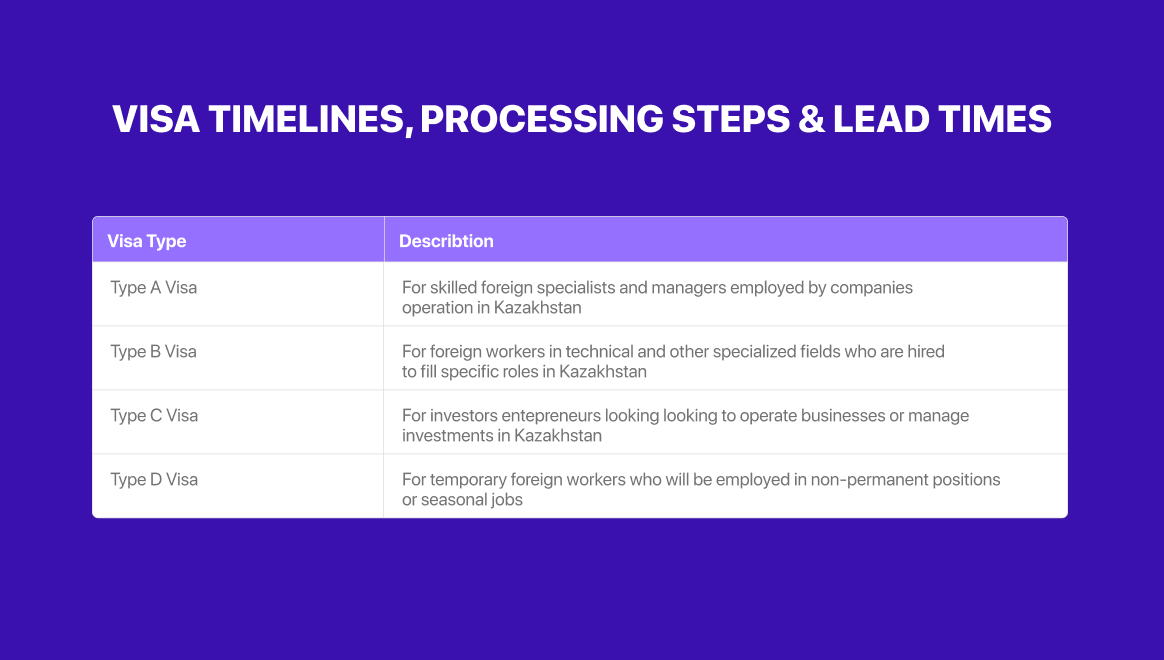
If you think visa paperwork is just a formality, Kazakhstan will humble you.
This isn’t the kind of place where you can wing it and hope customs doesn’t notice.
Work visas here come with structure. Deadlines. Government quotas. Actual consequences.
So if you’re planning to bring in foreign talent or hire someone already living in Kazakhstan, you need to know what the process looks like. And how long does it really take?
Spoiler: it’s not instant.
Good news? It’s doable if you have the right setup.
How long does it take to get a work visa in Kazakhstan?
Here’s a rough breakdown of the timeline when using an EOR that knows what they’re doing:
| Step | Duration |
| Candidate document collection | 3–5 business days |
| Work permit application | 15–20 business days |
| Work visa invitation approval | 5–7 business days |
| Consular visa processing | 5–10 business days |
| Local migration registration | Within 3 business days of entry |
Total: 4–6 weeks from “let’s hire them” to “they’re legal and ready.”
Note: This varies depending on the candidate’s nationality, local migration rules, and whether they’re already in-country.
Step-by-step: What actually happens?
- Document prep
You collect the basics: passport, diploma, resume, and previous employment proof. We check and translate what’s needed. - Work permit application
- Filed by the EOR as the sponsoring employer. Includes a quota check based on region and role.
- Visa invitation
Once the work permit is approved, the EOR requests an official visa invitation from the Kazakh authorities. - Visa issuance
Candidate visits the Kazakh consulate in their home country and receives a C3 work visa. - Entry & registration
After arrival, the candidate must register their residence and complete any additional steps (like a medical exam) within a few days. - Employment activation
Full onboarding begins, contract, payroll, local tax registration, and workspace setup (if needed).
Can this process be rushed?
Some steps can move faster, but there’s no real “fast track.”
Kazakhstan has a system, and it’s not built for startups in a hurry.
That’s why having an EOR already embedded in the system matters.
They:
- Know which documents pass without red flags
- Handle translations and notarizations
- Have working relationships with local offices
- Can spot quota issues before you waste weeks on the wrong permit
Employer of Record vs PEO in Kazakhstan: What’s better for immigration?
Let’s settle this.
In Kazakhstan, the difference between an Employer of Record (EOR) and a Professional Employer Organization (PEO) isn’t just a technicality. It’s the difference between legal employment and non-compliance.
If you’re planning to hire foreign talent or employees based in Kazakhstan, and immigration is on the table (spoiler: it always is), here’s what you need to know before making the wrong choice.
What is a PEO, and why doesn’t it work here
A PEO, or Professional Employer Organization, is a co-employment model.
That means you still need to be a legal employer in Kazakhstan. The PEO just helps manage HR functions like payroll, benefits, and compliance, once you’ve already registered your local entity.
Sounds harmless, until you realize this:
- A PEO cannot sponsor work permits or visas.
- A PEO cannot act as the legal employer in Kazakhstan.
- A PEO cannot handle local labor filings or employment registrations for foreign companies.
So, unless you’ve already gone through the long and expensive process of opening a local subsidiary, a PEO simply can’t get your employees through immigration.
No entity = no PEO.
What is an EOR, and why does it work better in Kazakhstan
An Employer of Record (EOR) in Kazakhstan is a different model altogether.
The EOR becomes the full legal employer of your talent, on paper, with the government, and in the eyes of Kazakhstan’s immigration system.
That gives them the authority to:
- Sponsor work permits and employment visas
- Register your team with local labor and tax authorities
- Handle all filings, payroll, and social contributions
- Maintain compliance with Kazakh employment and immigration law
You still manage the day-to-day work. You still define the role.
But the EOR holds the legal responsibilities that keep your hire compliant and protected.
Why does this matter for immigration?
Kazakhstan’s visa system is strict.
You need a work permit and a legal employer to bring in foreign talent.
That permit must be tied to an authorized entity that is recognized by the government.
PEOs don’t meet that requirement. EORs do.
Without a valid permit and employer sponsorship, your team member isn’t just at risk of being denied a visa; they’re technically working illegally.
Which means you’re liable.
EOR vs PEO in Kazakhstan side by side
| Criteria | PEO in Kazakhstan | EOR in Kazakhstan |
| Requires you to open a local entity | Yes | No |
| Acts as the legal employer | No | Yes |
| Can sponsor work permits and visas | No | Yes |
| Handles employment registration | No | Yes |
| Registers and remits local taxes | Sometimes | Yes |
| Manages payroll and benefits | Yes (co-managed) | Yes (fully managed) |
| Works for foreign companies | No | Yes |
| Legal employment for foreign workers | Not possible | Fully covered |
Still thinking about using a PEO?
Unless you already operate a legal entity in Kazakhstan with a registered tax ID, HR infrastructure, and a legal team fluent in local law, a PEO can’t do what you need it to.
You can’t sponsor a visa.
You can’t register for employment.
You can’t meet compliance standards.
All the administrative support in the world won’t change the fact that your company doesn’t exist on paper in Kazakhstan. And the government won’t let you employ anyone until it does.
With an EOR, you’re operational from day one
An EOR provider in Kazakhstan already has a local legal entity.
They already know the labor code.
They already have the quota system mapped out and the visa process streamlined.
You don’t wait months to get started.
You don’t spend tens of thousands on incorporation.
You don’t get caught off guard when the migration office asks for documents you didn’t know existed.
You get the team member you need, fully legal, fully employed, and ready to work.
Common mistakes (and how your EOR prevents them)
Let’s talk about how companies screw this up.
Because hiring in Kazakhstan sounds simple, until it’s not. Until your “contractor” gets flagged by immigration. Until your payment platform freezes mid-sprint. Until someone asks, “Wait… who actually owns the code?”
Most remote teams don’t mess up out of laziness. They mess up because they don’t know what they don’t know.
Here are the most common mistakes we see, and how a solid Employer of Record (EOR) keeps you out of the danger zone.
Mistake 1: Misclassifying employees as contractors
This one’s the classic. You think you’re being lean. Agile. Resourceful.
But here’s the problem:
If someone is working full-time for your company, reports to your team, and builds your product, they’re not a contractor under Kazakh labor law. They’re an employee.
Treat them like a freelancer, and you open yourself up to:
- Fines for misclassification
- Backdated tax and social contributions
- Legal disputes
- And yes, potential loss of IP rights
How your EOR prevents it:
We hire your team member legally, through our local entity, with a compliant employment contract that protects your business and theirs.
Mistake 2: Skipping the work permit
“They’re just working remotely.”
“They’re already in Kazakhstan.”
“They’re using their own laptop.”
None of that matters.
If they’re living in Kazakhstan and working for your company, they need a work permit.
Skipping it means they’re working illegally, and you’re liable.
How your EOR prevents it:
We handle the entire immigration process, work permit, visa, and residence registration tied to our local entity. No guesswork. No legal exposure.
Mistake 3: Using a contract template that doesn’t hold up
Downloaded a one-size-fits-all employment contract from the internet? Cool. It won’t work here.
Kazakhstan has specific legal requirements around IP, jurisdiction, taxes, termination, and more. If your contract doesn’t comply locally, it might not protect you at all.
How your EOR prevents it:
We issue bilingual, locally compliant employment agreements with enforceable IP transfer, NDA clauses, and proper tax setup under the Kazakh civil code.
Mistake 4: Forgetting about payroll compliance
You can’t just wire money and call it salary.
Kazakhstan requires formal payroll registration, monthly filings, accurate payslips, pension contributions, income tax withholdings, and more.
Skip any of that, and your hire becomes a liability, not an asset.
How your EOR prevents it:
We manage payroll from start to finish. Gross salary, tax deductions, pension, reporting, all done properly, all done locally.
Mistake 5: Underpaying and hoping for the best
You find a “cheap” junior who says they can do the work.
Six weeks later, your feature still doesn’t ship, and no one’s heard from them since Friday.
Kazakhstan isn’t about hiring cheap. It’s about hiring right, in a stable market with fair salaries and strong retention.
How your EOR prevents it:
We help you price roles correctly and connect you with a vetted talent pool who’ve already worked in EU/US teams, so you don’t waste cycles rehiring.
Mistake 6: Overengineering with a local entity
You set up a company to hire two devs. Now you’re drowning in paperwork, tax filings, legal notices, and a Kazakh accounting system you never wanted to understand.
How your EOR prevents it:
We already have the local entity. You hire through us, stay compliant, and avoid becoming your own Kazakhstan HR department.
Immigration isn’t the only compliance you need to worry about
Getting the visa is just the beginning.
Sure, work permits and migration filings are critical, but they’re only one piece of the compliance puzzle in Kazakhstan. Because once your new hire is legally in the country, the real responsibilities kick in: payroll, tax, employment law, and local labor protections.
And no, skipping these isn’t a “move fast” strategy.
It’s a “get audited, pay fines, lose your developer” strategy.
Payroll in Kazakhstan comes with rules and receipts
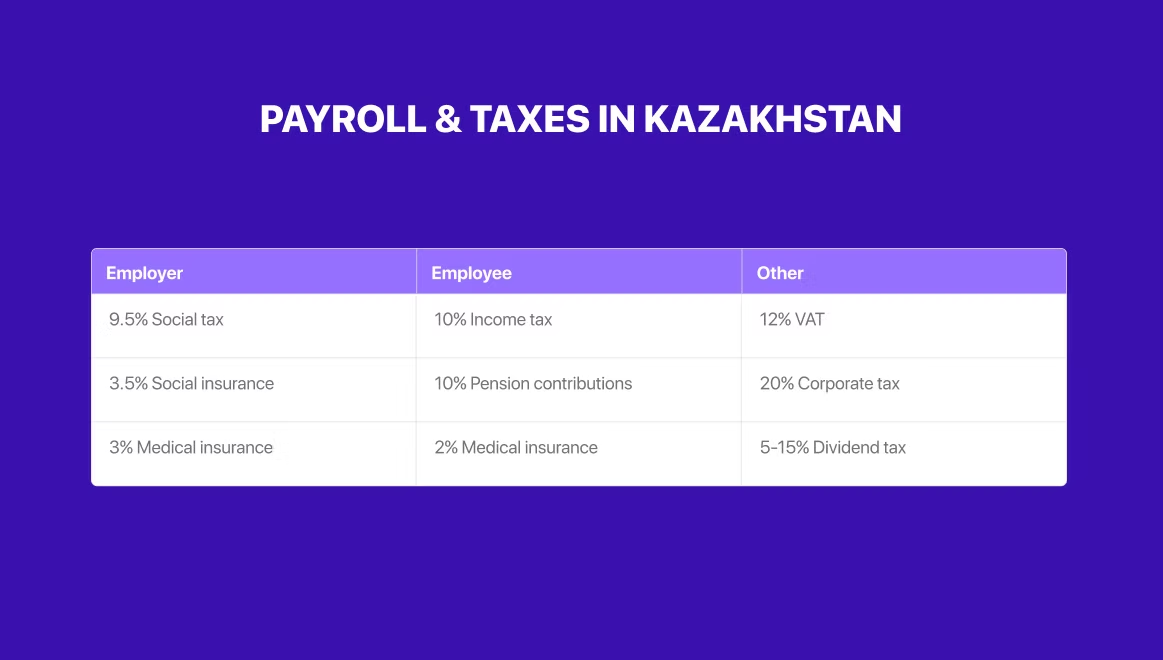
You can’t just send money via Wise and hope for the best.
Kazakhstan requires:
- Monthly payroll calculations based on gross salary
- Income tax withholdings (typically 10%)
- Employer social contributions (over 20%)
- Payslips with government-mandated reporting
- Filing with the State Revenue Committee
Miss one of these steps? That’s not a slap on the wrist. That’s a compliance failure with financial consequences for you and your hire.
How your EOR handles it:
We achieve payroll compliance for you. Your developer gets paid on time, taxed correctly, and receives a locally compliant payslip. You get one clean invoice and zero stress.
Local labor law isn’t optional
You might have your own way of doing things, but in Kazakhstan, employment law has its own opinion.
You’re expected to provide:
- Proper notice periods for termination
- Paid annual leave (minimum 24 calendar days)
- Sick leave, parental leave, and public holiday observance
- A written employment contract in Kazakh or Russian
- Formal offboarding process with final payment and paperwork
Cut corners on any of these, and you're wide open to legal disputes, and your IP could walk out the door with the resignation letter.
How your EOR handles it:
We follow the Kazakh labor code to the letter. From onboarding to offboarding, we keep your hire protected and your company out of legal trouble.
IP protection doesn’t work if your contract doesn’t
Let’s be clear: if you’re hiring someone to build your product and your contract doesn’t comply with Kazakh law, you may not legally own what they create.
Without proper IP assignment, NDA clauses, and confidentiality terms drafted in a locally enforceable contract, your business could be exposed.
How your EOR handles it:
Every employment agreement we issue includes IP transfer, data protection, and confidentiality clauses in both the local language and English, reviewed and ready to hold up in court.
Ready to hire in Kazakhstan? Do it the compliant way
Kazakhstan isn’t a backdoor market. It’s not a freelancer workaround.
It’s a legitimate, fast-growing talent hub if you hire the right way.
You want a senior engineer who shows up, ships clean code, and doesn’t disappear when the tax office comes knocking? You need more than a Zoom interview and a contract PDF.
You need structure.
You need legal protection.
You need a hiring model that works in Kazakhstan, not just looks good in a Slack thread.
Here’s what compliant hiring actually looks like
- A legal employment contract under Kazakh labor law
- A registered employer who can sponsor visas and work permits
- Monthly payroll filed correctly with tax authorities
- IP protection and benefits that keep your team loyal and protected
- No shortcuts, no misclassification, no “hope this works” guesswork
This isn’t optional if you want to build something real here.
It’s mandatory if you want to sleep at night.
And here’s how Team Up makes it simple
We’re already on the ground in Kazakhstan.
You choose the talent.
We handle:
- Employment
- Immigration
- Payroll
- Compliance
- Benefits
Your developer feels like a full-time team member.
You stay out of legal trouble.
And your hiring funnel doesn’t get held up by paperwork you were never supposed to manage in the first place.
Want to see what it really costs?
Check the salary benchmarks, tax breakdowns, and total monthly cost of hiring in Kazakhstan, all factored into one clean invoice.
Want to know what roles you can fill?
Senior backend engineers, DevOps, QA, and product managers, we’ve already hired them.
We know the local talent pool. We know what they expect. And we know how to make your offer the one they say yes to.
Kazakhstan is open, but only to companies that do it right
Hiring in Kazakhstan isn’t about finding a shortcut. It’s about building the kind of team that lasts, one that’s legal, protected, and ready to deliver from day one.
The visa forms, tax rules, and compliance headaches?
We handle those.
You focus on hiring great people and building something worth their time.
With Team Up as your Employer of Record in Kazakhstan, you don’t just avoid mistakes — you hire with confidence.
No red tape. No misclassification risk. No missed deadlines because your developer got stuck at the border.
So if you’re expanding to Kazakhstan, do it properly.
Do it fast.
Do it with a partner who’s already set up to win.
Let’s make your next hire the easiest one yet.
.svg)


