


EOR vs Setting Up Your Own Entity in Canada

A London fintech wants to hire three machine-learning engineers in Toronto. The CEO asks a simple question: do we set up a Canadian subsidiary, or use an employer of record? That question shapes months of legal work, tens of thousands in costs, and the company's compliance posture across 13 jurisdictions.
Canada is not one labor market. It is 10 provinces and 3 territories, each with distinct employment standards legislation. A single misstep in payroll remittances to the Canada Revenue Agency can trigger penalties that dwarf the cost of getting the structure right from the start. The choice between an EOR and your own entity is not a procurement decision. It is a structural one that touches tax, IP, control, and long-term exit flexibility.
This article breaks down both models for companies hiring in Canada. It covers how EOR services work in the Canadian context, what incorporating actually demands, the risks each path carries, and how to decide which fits your stage and headcount.
What Is an Employer of Record?

Employer of Record Meaning and Definition
An employer of record (EOR) is a third-party organization that becomes the legal employer of your workers in a target country. The EOR signs the employment contract, runs payroll, remits statutory deductions, and carries the compliance obligations that local law assigns to an employer. Your company directs the employee's daily work. The EOR handles everything on the government-facing side.
This division matters in Canada because employers must remit CPP, EI, and income tax deductions to the CRA. Missing those obligations exposes the legal employer to penalties and interest. Foreign companies can legally hire in Canada through an EOR without establishing a domestic entity. That single fact is what makes the model viable for market entry.
A Munich SaaS company used an EOR to hire two product designers in Vancouver within seven business days. Twelve months later, it had grown the team to six without filing a single corporate registration in British Columbia.
What Is a Record of Employment in Canada — and Why the Confusion?
The term trips up foreign employers regularly. A Record of Employment (ROE) is a specific document issued to Canadian employees when an interruption of earnings occurs. It triggers Employment Insurance eligibility. The ROE is a CRA payroll document. It has nothing to do with the EOR business model.
When a Canadian EOR terminates or lays off a worker, the EOR issues the ROE. The client company never touches it. This distinction matters because searching "record of employment" in Canada returns CRA guidance, not EOR providers. Understanding the difference prevents confusion during due diligence.
How EOR Differs from a Staffing Agency or PEO
A staffing agency supplies temporary workers and retains them as its own employees. A professional employer organization creates a co-employment relationship where both the PEO and your company share employer responsibilities. An EOR is neither. The EOR is the sole legal employer on paper. Your company has no employer obligations under Canadian law. That clean separation is what eliminates the need for a local entity.
EOR Services and How They Work in Canada

The Mechanics of an EOR Engagement: Who Does What
The EOR registers as the employer with the CRA and the relevant provincial authorities. It opens payroll accounts, calculates statutory deductions for CPP, EI, and federal and provincial income tax, and remits those amounts on the prescribed schedule. It also issues Records of Employment when an interruption of earnings occurs. The client company controls daily work assignments, performance management, and compensation decisions.
Your employees sign a contract with the EOR. That contract must comply with the employment standards legislation of whatever province or territory the employee works in. Ontario's Employment Standards Act differs from Alberta's, which differs from Quebec's. The EOR absorbs that complexity. A detailed compliance checklist for Canadian EOR engagements covers what provincial obligations the provider must meet.
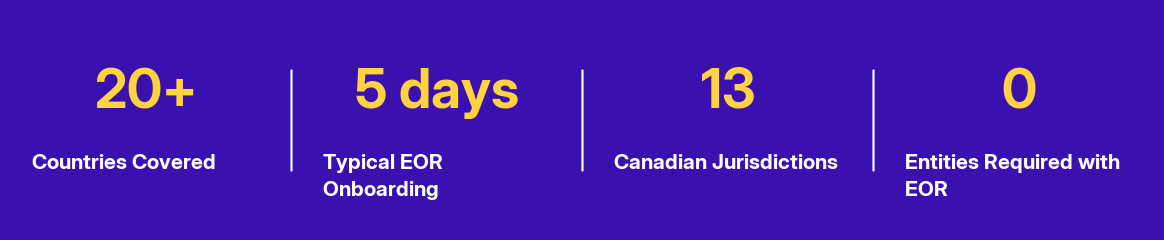
A Chicago logistics company hired a supply-chain analyst in Calgary through an EOR. Onboarding took five business days. The company avoided registering a federal business number, opening a CRA payroll account, and navigating Alberta's employment standards independently.
Provincial and Federal Compliance Layers an EOR Navigates
Canada's 10 provinces and 3 territories each maintain separate employment standards covering minimum wage, overtime, statutory holidays, vacation entitlements, and termination notice. Federally regulated employers in sectors like banking, telecommunications, and interprovincial transport fall under the Canada Labour Code instead. Most private-sector hires fall under provincial jurisdiction.
An EOR operating across Canada must maintain compliance with every jurisdiction where it employs workers. That means tracking legislative updates in each province independently. British Columbia's rules on overtime differ from Ontario's. Quebec requires French-language employment contracts in many cases. The EOR handles all of it under a single service relationship.
Global EOR Services: Extending the Model Across Borders
When Canada is one market in a broader expansion, a global employer of record handles multi-country payroll under one provider relationship. A Singapore e-commerce company scaling into both Canada and Turkey, for example, can use the same EOR partner rather than managing separate in-country providers. Team Up covers both markets with owned legal entities, which means direct compliance accountability in each jurisdiction.
Global EOR services add value when headcount is distributed across three or more countries. The operational gain is not just payroll consolidation. It is unified contract management, consistent benefits administration, and a single point of contact for compliance questions spanning different legal systems.
EOR vs Setting Up Your Own Entity in Canada: Key Differences
| Dimension | Employer of Record | Own Canadian Entity |
|---|---|---|
| Time to first hire | 5 to 10 business days | 3 to 6 months typically |
| Local entity required | No | Yes — federal or provincial incorporation |
| Ongoing corporate filings | Handled by EOR | Your responsibility annually |
| Direct employer-brand control | Limited — EOR is named employer | Full control |
| IP and data sovereignty | Governed by EOR contract terms | Direct ownership by your entity |
| Multi-province compliance | EOR manages across jurisdictions | You manage per province |
| Exit complexity | Contract termination with notice period | Entity dissolution, CRA deregistration |
What Incorporating in Canada Actually Requires
Setting up a Canadian legal entity requires registration under the Canada Business Corporations Act or a provincial equivalent. That registration is the beginning, not the end. You need a registered office address in Canada, at least one director who meets any applicable residency rules, corporate bank accounts, CRA business number registration, and payroll account setup.
Each of those steps involves processing times that vary by province. Federal incorporation through Corporations Canada is often faster than provincial incorporation in Ontario or Quebec. But incorporation alone does not make you operational. You still need to register for provincial employer health tax where applicable, set up workers' compensation accounts, and comply with provincial privacy legislation.
Speed, Control, and Operational Footprint: A Direct Comparison
The table above captures the structural differences. The speed gap is the most immediate. An EOR can onboard a Canadian employee within days. Entity incorporation typically takes months when you factor in legal counsel, banking setup, and CRA registration. A Tel Aviv cybersecurity firm needed a threat-intelligence analyst in Montreal. Using an EOR, the analyst started within eight business days. The alternative would have required Quebec-specific incorporation, French-language documentation, and CNESST registration.
Control runs the other direction. With your own entity, you own the employer brand directly. Your company name appears on the employment contract, the T4 slip, and every government filing. With an EOR, the provider's name appears instead.
Which Business Stages Favour Each Approach
The EOR model fits companies testing a market, hiring under ten employees, or entering Canada without long-term revenue commitments. Once your Canadian headcount exceeds a threshold where the monthly EOR fees approach the annualized cost of maintaining your own entity, the math shifts. That threshold depends on your industry and compensation levels. Detailed cost modeling for Canadian EOR engagements helps pin down where the crossover falls for your specific case.
Many companies use a hybrid approach. They start with an EOR to make their first hires while entity incorporation is underway. The EOR absorbs compliance risk during the months it takes to become fully operational.
Risks and Costs of Each Approach

Employer of Record Risks: What Companies Often Overlook
The most common EOR risk is co-employment exposure. If your company exercises too much direct control over employment terms, a Canadian court or the CRA could treat you as the true employer. That determination could trigger retroactive payroll tax liability and penalties.
Provider insolvency is another risk most buyers ignore. If your EOR fails to remit CPP, EI, or income tax deductions, the CRA may pursue the legal employer. But if the provider becomes insolvent, the compliance gap lands on you. Screening EOR providers for Canadian compliance is not optional. It is a prerequisite.
Watch out: Data-handling risk is often invisible in EOR contracts. Your employees' personal information sits on the provider's systems, governed by the provider's privacy practices. If the EOR processes data across borders, Canadian provincial privacy statutes may apply differently than you expect.
Own-Entity Risks: Compliance Burden and Hidden Overhead
Running your own entity means absorbing every compliance obligation directly. Multi-provincial payroll is where most foreign companies stumble. Each province sets its own rules for overtime calculations, statutory holiday pay, and termination entitlements. A single payroll error in Ontario does not replicate the same error in British Columbia. You face 13 potential audit surfaces.
Director personal liability is another risk specific to own-entity structures. Under the Canada Business Corporations Act, directors can be personally liable for unpaid employee wages up to a statutory limit. That liability does not exist in an EOR model because your executives are not directors of the employing entity.
Cost Structure of an EOR vs Cost Structure of a Canadian Entity
Rather than chase specific figures that shift with every provider's pricing update, focus on the cost categories each model carries.
EOR cost structure:
- Monthly per-employee fee
- Possible onboarding or setup charges
- Foreign exchange markup on salary disbursements
- Potential termination or offboarding fees
Own-entity cost structure:
- Legal fees for incorporation and ongoing counsel
- Registered office and agent costs
- Accounting and annual corporate filing fees
- Payroll software or outsourced payroll processing
- Workers' compensation premiums by province
- Provincial employer health tax where applicable
- Entity dissolution costs at exit
The EOR model converts fixed overhead into a variable monthly cost. The own-entity model front-loads expenses but lowers the per-employee marginal cost as headcount grows. A New York digital agency with two Canadian employees found the EOR model cost roughly 40% less in total annual overhead than maintaining a dormant Ontario corporation. At eight employees, the equation reversed.
How to Transition from an EOR to Your Own Canadian Entity
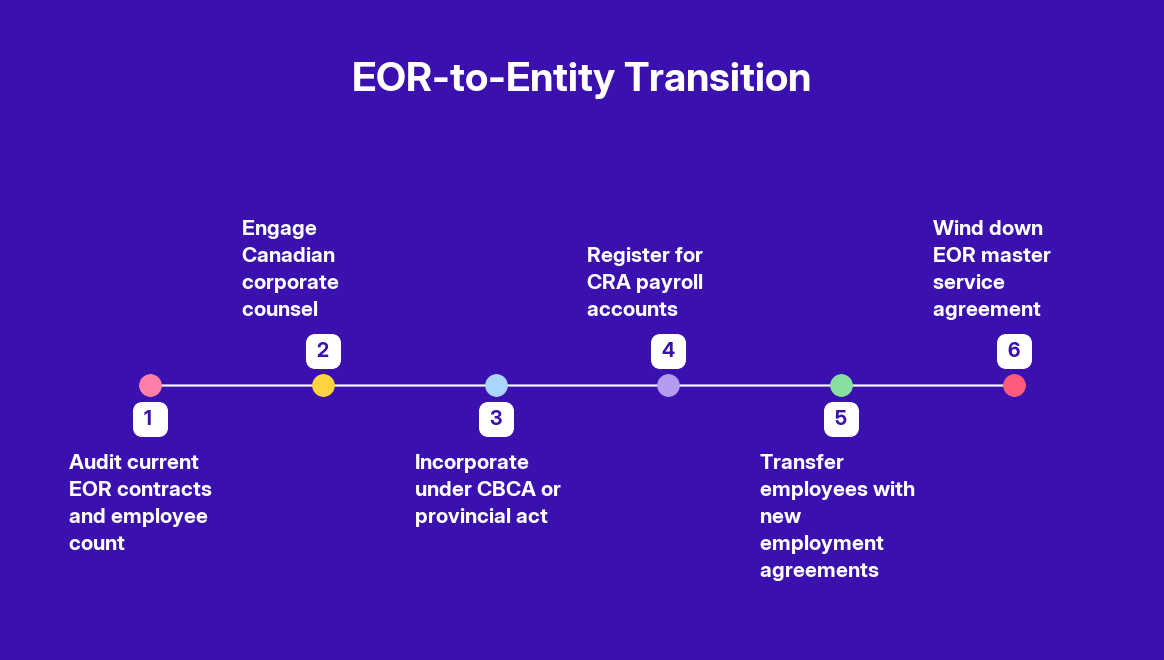
The transition from an employer of record to a Canadian subsidiary is not a single event. It is a phased migration that typically runs 12 to 20 weeks from first legal engagement to final payroll cutover. Rushing it creates gaps in employee coverage.
Start with a contractual audit of your EOR master service agreement. Most agreements include a notice period of 30 to 90 days. Your transition timeline must respect that window. Identify which employees sit in which provinces, because you will need separate provincial employer registrations alongside your federal CRA payroll account.
Incorporation itself moves relatively quickly. Filing under the Canada Business Corporations Act or a provincial equivalent takes days to weeks depending on the jurisdiction. The slower work comes after: obtaining a Business Number from the CRA, opening a Canadian bank account, and registering for workers' compensation in each province where you have employees.
Employee transfer is the most sensitive step. You cannot simply "reassign" employees from the EOR's payroll to yours. Each employee needs a new employment agreement with your Canadian entity. The EOR must issue a Record of Employment (ROE) for each departing worker. Any accrued vacation pay, banked overtime, or benefit entitlements under the EOR contract must be settled before transfer. A Munich-based industrial automation firm that moved six Ontario-based sales staff from an EOR to its own Canadian subsidiary in 2024 budgeted 14 weeks for the transition. The actual process took 17 weeks because Quebec payroll registration lagged behind the other provinces.
One detail that catches companies off guard: director residency rules. Federal corporations under the CBCA currently require that a percentage of directors be Canadian residents. Confirm the current threshold with your corporate counsel before finalizing your board composition.
When an EOR Still Makes Sense Long Term
Not every company outgrows the EOR model. For some, the employer of record cost in Canada remains lower than entity maintenance even at moderate headcounts. The decision depends on more than employee count.
| Factor | Favors EOR Long Term | Favors Own Entity |
|---|---|---|
| Headcount | Under 8 employees | Over 12 employees |
| Province spread | Workers in 4+ provinces | Concentrated in 1-2 provinces |
| Contract type | Project-based or fixed-term | Permanent, open-ended roles |
| Industry regulation | Non-regulated sectors | Federally regulated industries |
| Government contracts | Not pursuing public tenders | Bidding on federal or provincial RFPs |
| IP sensitivity | Standard work product | Core technology development |
| Time horizon | Market-testing phase (under 2 years) | Committed Canadian presence (3+ years) |
A London fintech company with three compliance analysts in Toronto and one data engineer in Vancouver has used an EOR for over two years. The team handles regulatory monitoring, not core product development. IP risk is minimal. Provincial spread across Ontario and British Columbia would mean dual workers' compensation registrations if they incorporated. For this profile, the EOR model remains the lower-friction choice.
Federally regulated employers face a different calculus. Companies in banking, telecommunications, or interprovincial transportation fall under the Canada Labour Code rather than provincial employment standards. An EOR operating in these sectors needs specific compliance infrastructure. Not all employer of record providers in Canada handle federally regulated industries. Vet this before signing.
Companies pursuing Canadian government contracts should also weigh entity requirements early. Some federal and provincial procurement frameworks require bidders to maintain a registered Canadian entity. An EOR arrangement typically does not satisfy that requirement. If public-sector revenue is part of your Canadian strategy, entity incorporation may be necessary regardless of headcount.
For companies hiring across multiple TeamUp-covered markets, the EOR model scales without multiplying entities. A staff augmentation approach that places engineers in Tbilisi and sales staff in Toronto through the same EOR provider avoids two separate incorporation processes. TeamUp's own-entity presence across 20+ countries means a single relationship covers both hires.
FAQs
Can a US company hire Canadian employees without setting up a Canadian entity?
Yes. A US company can hire Canadian workers through an employer of record without incorporating in Canada. The EOR becomes the legal employer for tax and compliance purposes. One critical exception: if the Canadian worker also serves as a director or officer of the US parent company, the CRA may treat the US company as having a permanent establishment in Canada. That triggers corporate tax obligations the EOR contract will not cover. Screen for this role overlap before onboarding.
What happens to employees if an employer of record company shuts down or loses its payroll licence?
Employment contracts sit between the EOR entity and the employee, not the client company. If the EOR becomes insolvent, employees may face unpaid wages. The client's recourse depends on the indemnification clause in the master service agreement. Before signing with any provider, confirm whether the EOR maintains a segregated payroll trust account that ring-fences employee funds from operating capital. Also verify whether the EOR carries errors-and-omissions insurance. These protections are rarely discussed during sales conversations but matter when things go wrong.
How does the EOR model handle Quebec specifically, given its distinct labour laws?
Quebec operates under the Act Respecting Labour Standards, administered by the CNESST (Commission des normes, de l'équité, de la santé et de la sécurité du travail). Employment contracts in Quebec are governed by the Civil Code of Quebec rather than common law. This changes the legal treatment of termination notice, good faith obligations, and non-compete enforceability compared to other provinces. Not all EOR providers maintain genuine Quebec expertise. Ask prospective providers how many Quebec-based employees they currently manage and whether they use Quebec-qualified legal counsel for contract drafting.
At what headcount does it typically make financial and operational sense to transition from an EOR to a Canadian own entity?
There is no single threshold. A company with 10 employees spread across five provinces faces more entity complexity than one with 15 employees concentrated in Ontario. Federally regulated sectors add compliance layers that raise the cost of running your own entity. Companies needing to bid on Canadian government contracts may require an entity at any headcount. The rough pattern observed across the market: companies with fewer than 8 employees in one or two provinces typically find the EOR model cheaper. Beyond 12 employees in a concentrated geography, own-entity economics usually improve.
Does using an employer of record in Canada affect a company's ability to protect intellectual property created by Canadian employees?
It can, if the contracts are not structured correctly. Because the EOR is the legal employer, IP assignment clauses must appear in both the EOR master service agreement and the individual employment contract. Without explicit assignment language, Canadian IP law defaults may vest certain rights in the employee or create ambiguity about ownership. Have Canadian IP counsel review the full contractual chain before your first hire. Pay special attention to moral rights under the Canadian Copyright Act, which employees cannot waive in the same way as economic rights.
Can an EOR in Canada sponsor work permits for foreign nationals?
Yes. Because the EOR is the legal employer on record, it can submit Labour Market Impact Assessment (LMIA) applications and sponsor work permits on behalf of foreign workers. The client company directs the employee's day-to-day work, but the EOR handles the immigration paperwork and employer obligations. One nuance: LMIA-exempt work permit categories sometimes require the employer to demonstrate a genuine business presence. Confirm with your EOR whether the specific permit stream you need is compatible with the EOR structure before the candidate accepts the offer.
What are the payroll tax risks if a company misclassifies workers in Canada instead of using an EOR or own entity?
The CRA can reclassify independent contractors as employees retroactively. When that happens, the company owes unpaid CPP contributions, EI premiums, and income tax withholdings for the entire misclassified period, plus interest and penalties. Provincial employment standards boards can also order retroactive vacation pay and statutory holiday pay. In Ontario, the Employment Standards Act allows claims covering up to two years of unpaid entitlements. Using an EOR or properly incorporating eliminates this exposure because workers are classified as employees from day one.
What to Watch Next
Canada's federal government is actively reviewing gig economy classification rules. Proposed amendments to the Canada Labour Code could narrow the definition of independent contractor for federally regulated work. Provincial legislatures in Ontario and British Columbia are considering similar reforms. If these changes pass, companies that currently engage Canadian workers as contractors will face pressure to convert them to employee status, either through an EOR or an own entity.
Watch for CRA updates on the employer of record compliance in Canada front. The agency has increased audit activity on foreign employers with Canadian workers. Your concrete next step: review every Canadian worker engagement you have today and confirm whether each person is correctly classified, properly covered by an employment agreement, and remitting through a compliant payroll channel. If any gap exists, close it before year-end filing season begins.
.svg)


