


Legal and Compliance Checklist for EOR Services in Canada

Employer of record services carry a compliance burden in Canada that catches many foreign companies off guard. A US fintech company expanding into Toronto might assume Canadian employment law mirrors American at-will norms. It does not. Canada layers federal and provincial legislation in ways that create distinct obligations for every province where you place a worker.
The EOR model solves the entity problem. A third-party company becomes the legal employer, handling payroll, statutory remittances, and employment contracts under Canadian law. But legal employer status does not eliminate risk for the client. Misclassification exposure, indemnification gaps, and provincial variation all demand a structured compliance approach. Whether you are hiring one product manager in Vancouver or building a five-person engineering team in Montreal, the checklist matters more than the contract.
This article maps the legal framework, walks through a phased compliance checklist, and flags the risks that turn a compliant arrangement into an expensive liability.
What Is an Employer of Record in Canada

Employer of Record Definition and Meaning
An employer of record (EOR) is a third-party company that legally employs workers on behalf of a client business in Canada. The EOR signs the employment contract, runs payroll, remits taxes, and carries the statutory obligations of the employer under Canadian law. The client directs the employee's daily work. The EOR owns the employment relationship.
This structure lets foreign companies hire in Canada without incorporating a local entity. A London-based SaaS company hired two customer success managers in Toronto through an EOR in 6 days. Within four months, they had expanded the team to five without registering a Canadian subsidiary. The EOR filed all payroll remittances, issued employment contracts compliant with Ontario's Employment Standards Act, and managed benefits enrollment.
For a deeper look at how this model works across provinces, see the complete guide to EOR hiring in Canada.
How an EOR Differs from a PEO in Canada
The distinction matters because it determines who carries legal liability. A Professional Employer Organization (PEO) operates under a co-employment model. The client company must already have a Canadian legal entity. The PEO shares employer responsibilities but does not replace the client as the legal employer.
An EOR replaces the client entirely as the employer of record. No Canadian entity required. This is the critical structural difference for foreign companies entering the market.
When Canadian Businesses Typically Use an EOR
EOR arrangements are not limited to foreign market entry. Canadian companies also use them to hire across provincial borders without registering in each province. A Calgary-based logistics firm that needs three warehouse coordinators in Quebec faces a distinct regulatory regime. The EOR absorbs that provincial compliance layer.
Legal Obligations of an EOR in Canada

Canada has both federal and provincial employment standards legislation. That dual structure is the first compliance reality an EOR must address.
Federal vs. Provincial Employment Standards: Who Governs What
The Canada Labour Code governs federally regulated industries: banking, telecommunications, interprovincial transportation, and federal Crown corporations. Most other employers fall under provincial jurisdiction. Each province and territory maintains its own employment standards act.
This means an EOR operating in Ontario follows the Ontario Employment Standards Act for minimum employment terms. The same EOR placing a worker in British Columbia follows BC's Employment Standards Act. Vacation entitlements, overtime thresholds, statutory holidays, and termination notice periods all vary by province.
A German digital agency hired a UX designer in Alberta and a content strategist in Nova Scotia through the same EOR. The EOR maintained two separate compliance frameworks. Alberta's rules on overtime averaging differ from Nova Scotia's. The statutory holiday calendar is different. Vacation accrual rates are different. One EOR, two distinct legal regimes.
Payroll Tax Remittance: CPP, EI, and Income Tax Withholding
Employers in Canada must remit CPP (Canada Pension Plan) contributions and EI (Employment Insurance) premiums on every payroll cycle. Both CPP and EI involve employer and employee portions. The EOR withholds the employee share and remits both portions to the Canada Revenue Agency.
Income tax withholding follows CRA tables based on the employee's province of employment and TD1 personal tax credit claims. Quebec adds a layer: workers in Quebec contribute to the Quebec Pension Plan (QPP) instead of CPP, and the province administers its own parental insurance plan.
Workers' Compensation and Mandatory Coverage Requirements
Provincial workers' compensation coverage is mandatory in all Canadian provinces and territories. The EOR must register with the relevant provincial workers' compensation board and remit premiums based on the industry classification and payroll volume. Coverage is not optional, and the EOR cannot delegate this obligation to the client through contract terms alone.
Compliance Checklist for EOR Services in Canada
| Phase | Obligation | Responsible Party | Frequency |
|---|---|---|---|
| Pre-Hire | Employment contract drafting | EOR | Per hire |
| Pre-Hire | Work authorization verification | EOR | Per hire |
| Ongoing | CPP/EI/income tax withholding and remittance | EOR | Each pay period |
| Ongoing | Workers' compensation premium remittance | EOR | Monthly or quarterly |
| Ongoing | Provincial statutory benefit compliance | EOR | Continuous |
| Year-End | T4 slip issuance | EOR | By last day of February |
| Year-End | T4 Summary filing with CRA | EOR | By last day of February |
| Separation | Record of Employment (ROE) issuance | EOR | Per separation event |
Pre-Hire Compliance: Employment Contracts and Work Authorization
Every EOR engagement starts with a written employment contract. Canadian common law provinces do not require a specific format, but the contract must meet or exceed provincial minimum standards. Quebec's Civil Code imposes additional requirements around language and contract terms.
The EOR must verify work authorization before the employee's first day. Canadian citizens and permanent residents need no additional documentation. Foreign nationals require a valid work permit. A mid-sized US marketing agency hired a Brazilian graphic designer to work remotely from Vancouver. The EOR provider handled visa sponsorship and confirmed the work permit was in place before the start date. Onboarding completed in 9 business days.
Ongoing Payroll and Benefits Compliance
Each pay period, the EOR withholds and remits CPP contributions, EI premiums, and federal and provincial income tax. The remittance schedule depends on the employer's CRA remitter category. Late remittances trigger penalties and interest from the CRA.
Provincial benefit requirements add ongoing obligations. Ontario's Employer Health Tax applies once payroll exceeds a threshold set by the province. British Columbia has its own employer health tax. The EOR must track these thresholds across every province where it places workers.
Year-End and Reporting Obligations
T4 slips must be issued to employees by the last day of February each year. The EOR files the T4 Summary with the CRA on the same deadline. Quebec requires a separate Relevé 1 (RL-1) slip for provincial reporting. Missing these deadlines exposes the EOR to penalties that flow downstream to the client relationship.
Provincial-Specific Compliance Considerations
Provincial variation is not cosmetic. It creates real compliance gaps for EOR companies operating across multiple provinces. Saskatchewan requires written notice of employment terms within the first 30 days. Ontario's ESA includes specific provisions for electronic monitoring policies. Quebec mandates French-language employment contracts in most circumstances. Each province adds a compliance layer the EOR must track and apply to the correct employee.
Risks and Challenges of Using an EOR in Canada

Worker Misclassification Risk Under Canadian Law
Misclassifying employees as independent contractors is a compliance risk under Canadian law. The CRA applies a multi-factor test examining control, ownership of tools, chance of profit, and risk of loss. Provincial employment standards agencies apply similar tests. An EOR arrangement does not eliminate this risk. It shifts it.
If the CRA determines that a worker classified as a contractor should have been an employee, the EOR (or the client, depending on the arrangement) faces back-assessed CPP, EI, and income tax liability. A Toronto-based recruitment firm learned this when the CRA reassessed three contractors it had engaged through a provider that failed to properly structure the employment relationship. The back-assessment covered 18 months of unpaid employer contributions.
Loss of Direct Employment Control and HR Visibility
The EOR is the legal employer. That means the client does not control employment terms, disciplinary processes, or termination procedures directly. This creates friction when the client wants to terminate an employee quickly. Canadian provinces impose minimum notice periods and, in many cases, severance entitlements based on length of service. The EOR must follow those rules regardless of the client's preference.
Contractual and Liability Gaps Between EOR and Client
The EOR-client service agreement is the single document that allocates risk. Weak contracts leave gaps. If the agreement does not specify indemnification for CRA reassessments, the client may absorb the financial exposure. If it does not address intellectual property assignment, the EOR's status as legal employer could complicate IP ownership claims under Canadian law.
Watch out: In Canada, the legal employer presumptively owns work product created by its employees. If the EOR contract does not include an explicit IP assignment clause flowing rights to the client, the client's ownership position is weaker than it assumes.
Choosing an EOR That Is Not Compliant With Canadian Standards
Not all EOR providers in Canada maintain provincial registrations across every jurisdiction where they place workers. An EOR that is registered in Ontario but places a worker in Manitoba without proper workers' compensation registration in that province creates an uninsured liability. The client bears reputational risk. The worker bears coverage risk. Due diligence on the EOR's provincial registrations is not optional.
How to Evaluate and Select an EOR Provider in Canada
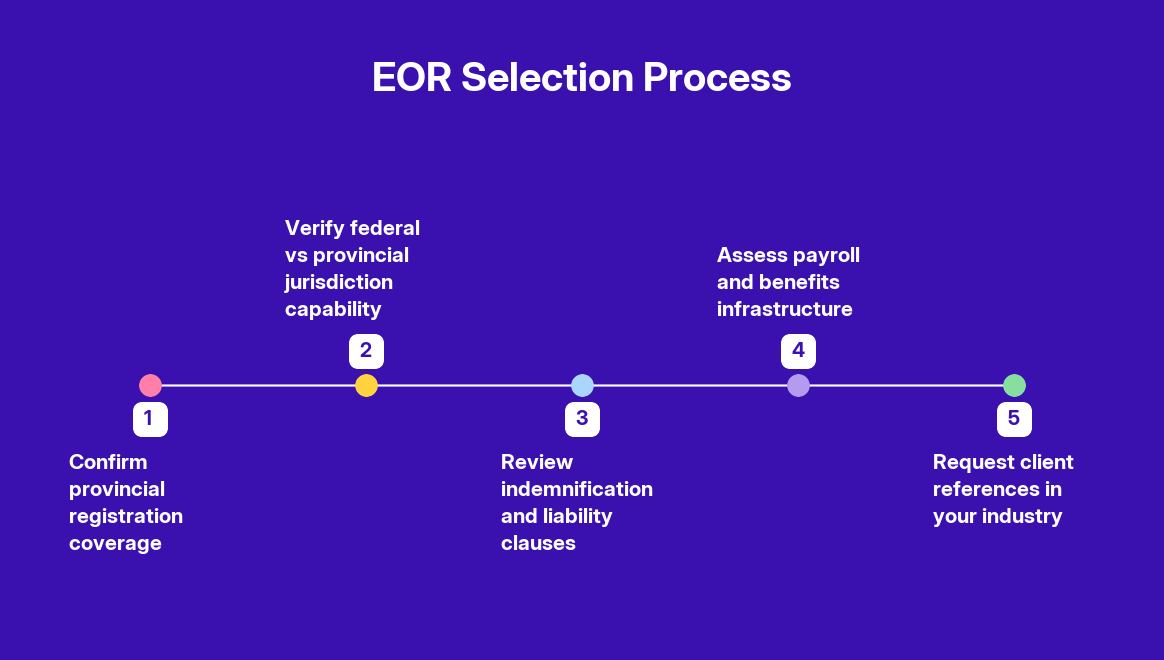
Selecting an employer of record in Canada starts with provincial registration verification. Ask for proof of active workers' compensation accounts in every province where your employees will work. A provider registered only in Ontario cannot compliantly employ a remote worker in British Columbia. This is not a theoretical concern. It is the single most common gap in EOR due diligence.
Next, confirm whether the provider can handle both federal and provincial jurisdiction workers. A fintech company that hired six customer support agents in Toronto through an EOR discovered this gap when it later needed to onboard a compliance officer whose role fell under federal banking regulation. The Canada Labour Code governed that role, not Ontario's Employment Standards Act. The EOR lacked federal jurisdiction compliance protocols. The hire stalled for three weeks.
Indemnification clauses deserve scrutiny from your legal team before signing. The service agreement should specify who bears financial liability for payroll remittance errors, missed statutory filings, and penalties from CRA or provincial authorities. Vague language like "shared responsibility" protects neither party. Look for explicit allocation of liability for CPP, EI, and income tax remittance failures.
Evaluate the provider's payroll infrastructure across provinces. Each province sets its own rules for pay frequency, vacation pay accrual, and statutory holiday entitlements. Your EOR should demonstrate automated compliance with these variations rather than applying a single national template. Ask how they handle the T4 reporting cycle and whether they issue Records of Employment directly through Service Canada's ROE Web system. A Vancouver digital agency that switched employer of record providers in Canada after its first provider manually submitted ROEs by paper learned the cost of outdated infrastructure: two employees experienced EI claim delays of over four weeks.
Comparing In-House Entity Setup vs EOR in Canada
The decision between incorporating a Canadian entity and using an EOR depends on timeline, team size, and how long you plan to operate in the market. Both paths achieve compliant employment. They differ sharply in cost structure, speed, and operational burden.
| Factor | Canadian Entity (Incorporation) | EOR Model |
|---|---|---|
| Setup timeline | 4 to 12 weeks depending on province | 5 to 10 business days typical |
| Upfront cost | Federal and provincial incorporation fees, legal counsel, registered office, initial CRA registrations | Monthly per-employee fee, no incorporation cost |
| Ongoing admin | In-house or outsourced payroll, annual corporate filings, provincial reporting | EOR handles payroll, remittances, statutory filings |
| Provincial expansion | Separate extra-provincial registration per new province | EOR extends coverage if registered in that province |
| Control over employment terms | Full direct control | EOR is legal employer; client directs daily work |
| Exit complexity | Wind-down filings, final payroll, dissolution process | Contract termination with standard notice |
A UK e-commerce company exploring the Canadian market hired two marketing specialists in Montreal through an EOR. The entire onboarding took seven business days. Eighteen months later, with a team of nine across three provinces, the company incorporated a Canadian subsidiary and transitioned employees in-house. The EOR served as a compliant bridge during the market-validation phase. That bridge saved roughly five months compared to incorporating before hiring.
For companies with fewer than ten employees in Canada and no certainty about long-term presence, the EOR model reduces fixed costs and administrative exposure. Once headcount grows beyond a threshold that justifies dedicated HR and payroll staff, entity incorporation becomes more cost-effective per employee. The crossover point varies by province, industry, and benefits complexity. There is no universal number, but most companies begin evaluating the transition between eight and fifteen employees.
Team Up supports companies at both stages. Through its EOR and PEO services, clients can start with a fully managed employment model and later shift to co-employment or self-managed payroll as their Canadian presence matures. Staff augmentation and contractor management fill gaps during transitions. Benefits administration, equipment provisioning, and workspace solutions round out the operational infrastructure without requiring a local HR department from day one.
FAQs
Can a foreign company use an EOR in Canada without ever registering a Canadian business entity?
Yes, in most cases. The EOR serves as the registered employer, so the foreign client does not need a Canadian business number or corporate registration for employment purposes. The critical exception involves permanent establishment risk. If your employees in Canada consistently negotiate and close contracts on your behalf, CRA may determine that you have a permanent establishment under the Income Tax Act or an applicable tax treaty. EOR use does not automatically shield you from that determination. Companies with Canadian-based sales teams should seek specific tax treaty advice.
What happens to the Record of Employment if an EOR contract is terminated mid-employment?
The EOR, as the legal employer, must issue the ROE when the employment relationship with its entity ends. This obligation exists even if the worker continues performing the same role for the client under a new employment structure. The ROE must reflect the last day of paid employment under the EOR's payroll. During the transition period, a gap between the old ROE and the new employer's first pay period can trigger an automatic EI eligibility inquiry. Coordinating the transition date between the outgoing EOR and the incoming employer or new entity avoids unnecessary Service Canada flags.
Does an EOR in Canada have different obligations for federally regulated industries like banking or telecommunications?
Yes. Workers in federally regulated sectors fall exclusively under the Canada Labour Code, not provincial employment standards. This applies to banking, interprovincial transport, telecommunications, and federal Crown corporations. The Canada Labour Code sets different rules for termination notice, overtime, holidays, and unjust dismissal protections. Some provincial EOR providers lack the compliance infrastructure to manage federal jurisdiction workers. Before placing an employee in a federally regulated role, confirm that your EOR has specific experience with Part III of the Canada Labour Code. Getting this wrong means applying the wrong statutory framework to the entire employment relationship.
How does Quebec's distinct labour law framework affect EOR compliance compared to other provinces?
Quebec operates under the Act Respecting Labour Standards rather than common-law provincial employment legislation. Four specific requirements create a compliance layer absent in other provinces. First, employers must contribute to the Quebec Parental Insurance Plan (QPIP) instead of the federal EI parental benefit component. Second, the Charter of the French Language requires employment contracts, communications, and workplace documents to be available in French. Third, Quebec mandates a skills development levy for employers whose total payroll exceeds a periodically adjusted threshold. Fourth, the Commission des normes applies Quebec-specific termination and severance standards. Many pan-Canadian EOR providers handle these requirements inconsistently.
If an EOR makes a payroll error resulting in underpaid CPP or EI, who is liable — the EOR or the client company?
CRA holds the employer of record primarily liable for remittance failures under the Income Tax Act and Employment Insurance Act. The EOR, as the registered employer with CRA, faces penalties and interest assessments directly. The client company is not typically on CRA's enforcement radar for remittance shortfalls. That said, the EOR service agreement usually contains indemnification clauses allowing the EOR to recover losses caused by client-provided errors, such as incorrect salary figures or unreported bonuses. Review the indemnification language carefully. It determines whether the EOR absorbs the loss or passes it through to you.
Can an EOR in Canada sponsor work permits for foreign nationals?
An EOR can support the work permit process because it holds the legal employer status required for Labour Market Impact Assessments and employer-specific work permits. The EOR appears as the named employer on the LMIA application and the work permit itself. One operational constraint applies: if the worker later transitions to direct employment with the client company, a new work permit tied to the new employer is typically required. Open work permits are the exception. Transitioning between EOR and direct employment mid-permit creates immigration processing delays that range from several weeks to several months depending on the permit category.
What happens if an employee works remotely from a different province than the one where the EOR registered them?
Provincial employment standards and workers' compensation obligations generally follow the province where the employee physically performs the work. If an employee registered under the EOR's Ontario payroll account relocates to Alberta and works from there permanently, the EOR must register with Alberta's Workers' Compensation Board and apply Alberta's Employment Standards Code. Temporary travel is generally not an issue, but sustained remote work from another province creates a compliance gap. Some EOR agreements address this with relocation notification clauses. Others do not. Confirm your EOR's policy on interprovincial mobility before approving remote work arrangements across provincial borders.
What to Watch Next
Canada's federal government has signaled ongoing review of gig economy classification rules. Any changes to the distinction between employees and independent contractors will affect how EOR providers structure engagements. Provincial minimum wage adjustments happen on varying schedules across all provinces and territories. Quebec's Bill 96 continues to expand French-language requirements for workplaces, with enforcement timelines that affect EOR documentation practices.
Monitor CRA's evolving guidance on permanent establishment determinations for foreign companies using Canadian EOR arrangements. As remote work normalizes, the boundary between "no Canadian presence" and "taxable permanent establishment" is shifting. Your concrete next step: request your EOR provider's current provincial registration certificates and their written policy on interprovincial worker mobility. If they cannot produce both within a business day, that tells you something about their compliance infrastructure.
.svg)


