


How Much Does It Cost to Use an EOR in Canada?
- What Is an Employer of Record in Canada?
- How EOR Services Are Priced in Canada
- Types of EOR Pricing Models: Flat Fee vs. Percentage of Salary
- Hidden Costs and Risks of Using an EOR in Canada
- How to Evaluate and Select an EOR Provider in Canada
- When an EOR Makes Financial Sense vs. Incorporating in Canada
- FAQs
- What to Watch Next
Employer of record cost in Canada depends on more than the sticker price a provider quotes you. A Singapore-based fintech company recently hired two compliance analysts in Toronto through an EOR. The monthly service fee looked clean. Then came CPP contributions, EI premiums, and a Quebec payroll tax the provider flagged only after the second employee's contract was signed.
Canada's federal-provincial split creates cost layers that most global EOR pricing pages do not surface. Each province sets its own employment standards, vacation entitlements, and in some cases, additional payroll taxes. Quebec operates under a distinct civil law framework with French-language requirements that add administrative overhead.
This article breaks down the actual cost structure of using an employer of record in Canada. It covers what sits inside the service fee, what falls outside it, and how pricing models shift the math depending on your headcount and salary bands.
What Is an Employer of Record in Canada?
How an EOR Functions as the Legal Employer
An EOR acts as the legal employer on record for your Canadian workers. You direct day-to-day tasks, set project goals, and manage performance. The EOR holds the employment contract, runs payroll, remits taxes to the Canada Revenue Agency, and administers statutory benefits.
This creates a tri-party relationship. The worker reports to your team operationally. The EOR carries the employer obligations under Canadian law. Your company pays the EOR a service fee plus the total employment cost.
Using an EOR eliminates the need to establish a Canadian legal entity. A Dutch e-commerce company hiring three customer support agents in Vancouver used an EOR to go from signed offer letters to active payroll in seven business days. Setting up a federal corporation with provincial registration would have taken months.
EOR vs. PEO: Key Differences in the Canadian Context
A PEO uses a co-employment model. You maintain a Canadian entity, and the PEO shares employer responsibilities for HR administration and benefits. An EOR replaces the entity requirement entirely.
This distinction matters for compliance liability. Under a PEO, your Canadian entity still holds legal exposure. Under an EOR, the provider assumes that exposure. For companies without an existing presence in Canada, this makes the EOR the default structure.
Why Companies Use an EOR Instead of Incorporating in Canada
Provincial employment standards vary across Ontario, British Columbia, Quebec, and every other jurisdiction. Managing those differences requires local expertise. An EOR absorbs that complexity into a single commercial relationship. A US-based SaaS startup that needed one senior developer in Montreal chose an EOR over incorporation. The cost of maintaining a dormant Quebec entity would have exceeded the annual EOR fee within the first year.
How EOR Services Are Priced in Canada

What Is Included in a Standard EOR Service Fee
EOR providers bundle several functions into one recurring charge. Your monthly fee typically covers payroll processing, statutory tax remittances, employment contract drafting, and ongoing compliance monitoring under Canadian law. Some providers include basic HR administration. Others charge separately for onboarding, offboarding, or benefits enrollment.
The service fee is your cost for the EOR's infrastructure. It does not include the employee's gross salary or the employer-side statutory contributions. Those are passed through at cost. Separating these two layers matters when comparing quotes. A provider with a lower service fee but opaque passthrough charges can end up costing more.
Provincial Complexity and Its Effect on Pricing
Canada's provincial patchwork affects what an EOR must manage. Quebec requires French-language employment contracts. It also operates the Quebec Pension Plan instead of CPP and levies a provincial health services fund contribution on employers. British Columbia and Ontario each set their own vacation accrual rules, statutory holidays, and termination notice periods.
EOR providers that operate across multiple provinces need compliance teams covering each jurisdiction. That overhead shows up in pricing. Hiring in one province is simpler. Hiring across three or four raises the administrative burden and can increase the per-employee fee.
What Clients Actually Pay For: Employer Contributions Explained
Canadian employers are legally required to contribute to CPP and EI. These are not optional. The EOR remits both on your behalf, and the cost passes through to you. Provincial workers' compensation premiums add another mandatory layer. The rates vary by province and by the employee's occupational classification.
A UK recruitment agency hiring five contract recruiters in Ontario through an EOR saw employer-side contributions add roughly 12 to 18 percent on top of each employee's gross salary. The EOR's service fee was a separate line item. Understanding this split prevents sticker shock when the first invoice arrives.
Types of EOR Pricing Models: Flat Fee vs. Percentage of Salary
| Dimension | Flat Monthly Fee | Percentage of Salary |
|---|---|---|
| Calculation basis | Fixed amount per employee per month | Percentage applied to gross monthly salary |
| Cost predictability | High — stays constant regardless of salary | Varies with salary changes, bonuses, raises |
| Cost efficiency for high earners | More favorable — fee does not scale with pay | Becomes expensive as salaries rise |
| Cost efficiency for junior hires | Less favorable — same fee on a lower base | Lower absolute cost on smaller salaries |
| Scalability with headcount | Predictable budgeting at scale | Total cost grows with both headcount and pay |
| Typical client profile | Companies with senior or specialized hires | Companies with entry-level or mid-range staff |
The Flat Monthly Fee Model: Predictability at Scale
EOR services typically use two pricing models. The flat monthly fee charges a fixed amount per employee regardless of salary. This model rewards companies hiring senior talent. A principal engineer earning CAD 160,000 annually costs the same service fee as a junior analyst earning CAD 55,000.
That predictability simplifies budgeting. A German fintech company that hired four machine learning engineers in Toronto through an EOR locked in a flat monthly rate. When two engineers received raises after six months, the service fee stayed unchanged.
The Percentage-of-Salary Model: When It Costs More Than You Expect
The percentage model ties the EOR fee to gross compensation. This works well for lower salary bands. It punishes you at the top end. A director-level hire earning CAD 200,000 under a percentage model can generate a service fee two to three times higher than the same hire under a flat-fee arrangement.
Bonuses and commissions amplify this. If your EOR applies its percentage to total compensation rather than base salary, variable pay inflates the fee every pay cycle.
Hybrid and Custom Models Used by Global EOR Providers
Some global EOR providers offer hybrid structures. They charge a flat base fee plus a smaller percentage on compensation above a threshold. Others negotiate custom pricing for multi-country mandates that include Canada alongside other markets.
These arrangements typically start at five or more employees. A US healthtech company hiring across Canada, India, and Colombia negotiated a blended rate. The per-employee fee in Canada was higher than in the other two markets. That reflects Canada's regulatory complexity and cost of living.
Choosing the Right Model for Your Hiring Volume and Worker Seniority
The decision hinges on two variables. First, how senior are your hires? If average salaries exceed CAD 120,000, flat-fee models almost always win. Second, how many employees are you hiring? Providers often discount flat fees at higher volumes. Five or more hires in a single province can unlock meaningfully lower per-employee rates.
Run the math on both models before signing. Request a total cost projection from each provider that includes the service fee, all statutory employer contributions, and any onboarding or offboarding charges. The model that looks cheaper on a pricing page may not survive contact with actual payroll numbers.
Hidden Costs and Risks of Using an EOR in Canada
Costs That Fall Outside the EOR Quote
Most EOR proposals show the service fee and statutory contributions. Several costs sit outside that frame. Setup fees for new employee onboarding range from a one-time charge to a recurring per-event fee. Benefits administration beyond statutory minimums often carries a separate premium. Currency conversion markups affect non-CAD clients. A US company paying invoices in USD should ask whether the EOR applies a spread on top of the interbank rate. Markups between 1% and 3% are common across the industry and compound across every payroll cycle.
Compliance Risks Unique to the Canadian Regulatory Environment
Provincial employment standards create real misclassification exposure. An employee working remotely from Alberta who relocates to Quebec mid-contract triggers a jurisdiction change. The EOR must update the employment terms, language of the contract, and contribution structure. Providers that lack robust compliance infrastructure in Canada may miss this transition. The liability flows back to you as the client directing the work.
Watch out: If your Canadian employee moves provinces mid-contract, the EOR must reclassify the employment under the new province's standards. Quebec in particular requires French-language contracts and operates its own pension system. An EOR that misses this shift exposes you to provincial labor board complaints.
What Happens When an EOR Relationship Ends: Transition and Offboarding Costs
Canadian employment law requires reasonable notice or pay in lieu for terminated employees. Provincial minimums exist, but courts often award more. An EOR termination is not just an account closure. It requires proper severance calculation, final payroll with accrued vacation payout, and Record of Employment filing with Service Canada.
If you are transitioning employees from one EOR to another, expect a gap period. The offboarding EOR may charge a final-month administration fee. The onboarding EOR will charge setup fees. A mid-market SaaS company switching EOR providers for its six-person Toronto team faced a full month of overlapping charges during the transition.
How Global EOR Arrangements Add a Layer of Complexity
Routing Canadian hires through a global EOR platform introduces intermediary risk. Some global providers subcontract to a local Canadian partner rather than operating their own entity. This creates a chain: your company pays the global EOR, the global EOR pays the local partner, and the local partner holds the employment relationship. Each link adds margin. Each link adds a point of failure for compliance.
Ask whether the provider holds its own Canadian entity or subcontracts. A provider with a direct entity carries the liability itself. A provider routing through a partner may not catch provincial nuances the same way. EOR fees across global providers typically fall between $200 and $600 per employee per month. The spread reflects both service depth and whether the provider operates directly or through intermediaries.
How to Evaluate and Select an EOR Provider in Canada
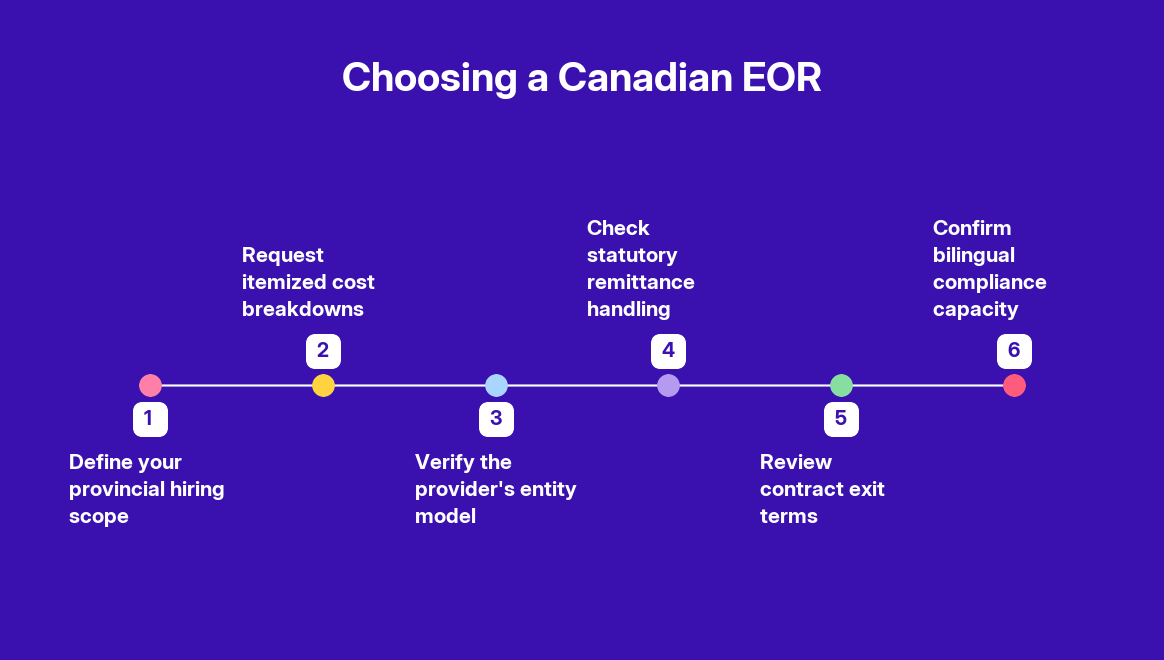
Start with your provincial hiring map. A company planning to hire only in Ontario faces a different compliance surface than one recruiting across Quebec, British Columbia, and Alberta. Your shortlist of employer of record providers in Canada should reflect that scope from the first conversation.
Request itemized pricing from at least three providers. The quote should separate the management fee from statutory employer costs like CPP, EI, and provincial health premiums. If a provider bundles everything into a single "all-in" number, ask for the breakdown in writing. A London fintech evaluating EOR options for five customer success hires in Toronto cut its projected annual spend by 14% after comparing itemized quotes against bundled ones from two competitors.
Verify entity structure early. Providers with a direct Canadian entity file remittances under their own payroll account with the Canada Revenue Agency. Those using a local partner route filings through a third party. That distinction matters when disputes arise or when the CRA audits source deductions.
Review exit clauses before signing. Some contracts impose 60- or 90-day notice periods. Others charge early termination fees equal to two or three months of management fees. These terms affect your total cost of engagement more than the monthly rate itself.
Check whether the provider can handle employer of record compliance in Canada across provinces with distinct regulatory requirements. Quebec's language laws, British Columbia's Employment Standards Act amendments, and Ontario's Working for Workers Act each create separate compliance obligations. A single-province playbook will not cover a multi-province workforce.
When an EOR Makes Financial Sense vs. Incorporating in Canada
The break-even point between an EOR and a Canadian subsidiary depends on headcount, timeline, and how many provinces you plan to hire in. Neither option is universally cheaper.
| Factor | EOR Model | Canadian Subsidiary |
|---|---|---|
| Upfront cost | No incorporation fees; onboarding in days | Federal or provincial incorporation fees plus legal setup |
| Monthly ongoing cost | Management fee + statutory contributions per employee | Internal payroll, HR, and compliance overhead |
| Time to first hire | Typically 5 to 15 business days | 3 to 6 months for full operational readiness |
| Multi-province complexity | Provider handles each province's standards | You register separately in each province for payroll tax |
| Control over benefits design | Limited to provider's plan options | Full control over plan selection and negotiation |
| Exit flexibility | Contract termination per agreement terms | Entity wind-down involves CRA clearance and legal dissolution |
For teams of one to fifteen employees, the EOR model usually costs less on a total basis. A Munich e-commerce company hiring eight warehouse logistics coordinators in British Columbia through an EOR spent roughly 40% less in its first year than a competitor that incorporated a BC subsidiary for a similar team size. The competitor needed four months just to complete provincial registration.
Once headcount crosses roughly fifteen to twenty employees concentrated in one or two provinces, the math shifts. Internal payroll and HR infrastructure begins to amortize, and the per-employee management fee of the EOR becomes the more expensive line item. That threshold varies by industry and by how much compliance complexity your HR team can absorb.
Companies using an EOR as a bridge strategy get the strongest return. You enter the market in days, validate the hiring plan, and incorporate later if the team grows past the break-even point. TeamUp supports this model across its 20+ covered countries, with EOR services designed to scale alongside the client rather than lock them into a permanent arrangement.
FAQs
Can a foreign company use an EOR in Quebec specifically, and does it cost more than other provinces?
Yes, but Quebec adds a compliance layer most providers price separately. Bill 96 (amendments to the Charte de la langue française) requires employment contracts, workplace communications, and HR documents to be available in French. An EOR operating in Quebec must support this obligation. Some global platforms either charge a language compliance add-on or exclude Quebec entirely. Ask your provider whether French-language contract drafting and communication support are included in the base fee or billed as extras before committing to Quebec-based hires.
What happens to an employee's Record of Employment (ROE) if the EOR relationship is terminated mid-year?
The EOR, as the legal employer, must issue the Record of Employment to Service Canada within 5 calendar days of the employee's final pay period. This is not the client company's obligation. If the EOR contract is cancelled abruptly or the provider ceases operations, the worker's Employment Insurance eligibility can be delayed during the gap. Before terminating an EOR agreement, confirm in writing that all ROEs will be filed on schedule. Request copies for your records as a safeguard.
Is an EOR arrangement suitable for hiring independent contractors in Canada, or only full-time employees?
EOR services are structured for full-time employment relationships. Most reputable providers will not onboard a worker classified as an independent contractor through an EOR arrangement. The Canada Revenue Agency applies a four-factor common law test to distinguish employees from contractors, examining control, ownership of tools, chance of profit or loss, and integration into the business. Routing a genuine contractor through an EOR creates co-employment risk and potential misclassification liability. For contractor engagements, use a dedicated contractor management service instead.
If my company is based outside Canada and pays the EOR in USD, how does currency conversion affect the real cost?
Currency conversion can shift the real cost by 2% to 5% depending on the provider's billing structure. Some EOR vendors invoice in CAD and handle conversion internally at transparent interbank rates. Others bill in USD but apply a marked-up exchange rate or add an explicit FX fee. The advertised per-employee cost can diverge meaningfully from your actual invoice total. Review the billing currency clause in your master services agreement. Ask whether the FX rate is locked monthly or floating, and whether conversion markups are disclosed separately.
Can a Canadian startup use an EOR to hire its own founders or early employees before it has incorporated?
Most EOR providers explicitly prohibit this. When the beneficial owner or a director of the client company is also the worker being employed through the EOR, it creates a circular employment structure. This arrangement fails the arm's-length test that underpins the EOR model. The EOR is supposed to employ workers on behalf of a separate client entity. If the client and the worker are the same person, the legal separation collapses. Pre-incorporation founders should explore a PEO arrangement or fast-track their incorporation before hiring through any third-party employer structure.
How long does it take to onboard a Canadian employee through an EOR?
Onboarding through an established employer of record in Canada typically completes in 5 to 15 business days. The timeline depends on how quickly the employee submits personal tax forms, banking details, and Social Insurance Number verification. Provincial registration requirements can add a few days in jurisdictions where the provider does not already hold an active payroll account. Quebec onboarding tends to run toward the longer end of that range due to additional language compliance steps and Revenu Québec registration.
What happens to employee benefits if I switch EOR providers mid-year?
Switching providers mid-year triggers a gap risk on benefits coverage. Group health and dental plans are tied to the outgoing EOR's policy. The new provider must enroll employees under a separate plan, and most Canadian group insurers impose a waiting period of 30 to 90 days for new enrollees. During the gap, employees may lose prescription drug or paramedical coverage. Negotiate a transition clause in both the exit and entry contracts that specifies coverage continuity obligations. Some providers offer interim individual health spending accounts to bridge the gap period.
What to Watch Next
Canada's federal government has signaled continued tightening of employer reporting obligations through the CRA. Proposed amendments to source deduction remittance timelines and digital payroll reporting requirements could increase the compliance burden for EOR providers operating across multiple provinces. Quebec's language enforcement under Bill 96 is also expanding, with new workplace inspection guidelines expected to affect EOR employment contracts.
Monitor the annual CPP and EI rate adjustments published by the CRA each November. These directly affect the statutory cost component of your EOR invoice. If your provider does not proactively communicate rate changes before the new calendar year, treat that as a service quality signal.
Your concrete next step: request a current-year cost projection from your EOR provider that separates the management fee from all statutory employer contributions, province by province. Compare that projection against the actual invoices after Q1 to measure variance. That exercise alone will tell you whether your provider's pricing transparency holds up under real payroll conditions.
.svg)


