What is Employer Sponsorship in Egypt And How Does It Work?

TL;DR
Expanding into Egypt’s vibrant market is exciting – but employer sponsorship in Egypt is one hurdle you must clear to do it legally. In simple terms, this means navigating Egypt’s work permit and visa process so your foreign hires can live and work there. What is sponsorship for employment? It’s when a company “sponsors” (takes responsibility for) a foreign employee’s legal authorization to work. In Egypt, that involves paperwork, government approvals, and compliance with local labor laws. If you’re a decision-maker looking to hire internationally in emerging hubs like Egypt, understanding this process isn’t optional – it’s mission-critical to avoid bureaucratic nightmares and hefty penalties.
Egypt’s system isn’t as byzantine as some, but it has its quirks. You’ll encounter strict quotas favoring local talent, detailed documentation requirements (yes, including a health check), and a requirement to prove no Egyptian could fill the role before hiring a foreigner. The good news? Done right, visa sponsorship for employment in Egypt is very achievable. This guide breaks down everything: types of work permits and visas, the legal requirements and employer obligations, what it means to “require sponsorship for employment” in Egypt, how direct sponsorship compares to using an Employer of Record (EOR), and how an EOR like Team Up makes the whole thing easier. We’ll even show why employment sponsorship via Team Up’s EOR services is the smartest way to hire in Egypt compliantly, without corporate fluff – just founder-level clarity, local insight, and a touch of wit. Let’s dive in.
Quick Navigation:
- TL;DR
- What is Employer Sponsorship in Egypt?
- Types of Work Permits and Visas in Egypt for Sponsored Employees
- Legal Requirements and Employer Obligations for Visa Sponsorship for Employment in Egypt
- How to Require Sponsorship for Employment in Egypt?
- Direct Sponsorship vs Employer of Record in Egypt
- How an Employer of Record in Egypt Manages Sponsorship and Compliance
- Conclusion: Key Takeaways and Next Steps
- FAQ
What is Employer Sponsorship in Egypt?
Employer sponsorship is the process by which a company in Egypt takes legal responsibility for a foreign employee’s right to work in the country. In practice, this means the employer arranges and endorses the employee’s work permit and visa, essentially vouching to the government that this worker is authorized and needed. When you sponsor someone for employment, you’re promising the Egyptian authorities that you will comply with all regulations – from securing the initial work visa to paying the necessary fees and ensuring the hire only does the job you’ve sponsored them for.
In Egypt, foreigners may only work after obtaining a work permit (license) from the Ministry of Manpower, and employers may only hire foreigners once they have that permit in hand. No work permit means no legal work – it’s that simple. The sponsor (employer) is the entity that applies for and holds this permit on behalf of the foreign national. This is often referred to as “visa sponsorship for employment”, since securing the work visa is intertwined with employment status.
Sponsorship is not a one-time rubber stamp; it’s an ongoing commitment. By sponsoring an employee, you agree to follow Egyptian labor laws and immigration rules throughout their employment. That includes things like registering them with social insurance, withholding taxes, and renewing permits on time. Essentially, employment sponsorship in Egypt is you saying, “We’ll take care of this person’s legal work status and obey all the rules while doing so.” Fail in any part of that, and you – not the employee – will face the consequences (fines, permit cancellation, or worse). It’s a serious responsibility, but with the right guidance, it’s absolutely manageable.

Types of Work Permits and Visas in Egypt for Sponsored Employees
When planning to start remote hiring in Egypt, it’s important to understand the types of work permits and visas available. Egypt doesn’t have dozens of work visa categories like some countries, but there are a few key ones to know:
Work Permit for Foreign Workers
The core permit is required for any non-Egyptian employee. It’s typically issued for one year at a time and can be renewed annually as long as conditions are met. This permit is obtained through the Ministry of Manpower by the employer (sponsor) on behalf of the worker. It’s the linchpin of legal employment – without it, the person cannot lawfully work or get a long-term residence. The work permit process usually starts once an employment offer is in place and involves submitting extensive documentation (see next section). Upon approval, it allows the foreign national to live and work in Egypt for the duration (usually 1 year, renewable).
Entry/Temporary Visa (Tourist Visa Conversion)
A short-term visa to enter Egypt is often used as a stepping stone to a work permit. Egypt generally requires the individual to enter on a valid visa (often a 30-day tourist or temporary visa), which can then be converted into a work visa after the work permit is approved. In practice, the employer gets preliminary approval for the work permit from inside Egypt, then the foreign employee obtains a short-term entry visa from an Egyptian consulate to travel to Egypt. Once in Egypt, the final work permit paperwork is completed (including medical tests), and the work visa/residence permit is issued. This two-step dance (entry visa, then work permit/visa) is common – you can’t just show up and start working; you need that official entry endorsed by the labor authorities.
Ordinary Work Visa (Residence Visa)
A longer-term visa is issued alongside the work permit. While the work permit is the government’s permission for you to employ a foreigner, the visa (often called a residence visa or work visa) is what allows the person to reside in Egypt. Typically, once the first year’s work permit is approved, the employee gets a residence visa. Egypt offers an “ordinary” residence visa that can be valid for 3 to 5 years, often matching the expected employment duration. This longer visa often applies to experienced professionals and can be accompanied by visas for immediate family (e.g., a spouse can get a residence permit for the same duration as the worker’s permit). It’s a way to avoid renewing entry visas constantly – instead, you renew the work permit each year, and the residence visa remains as long as the work permit is active.
Special 10-Year Visa
A very long-term residence option for specific cases. Egypt has a special visa valid for 10 years (renewable) aimed at particular foreign nationals, such as those born in Egypt before 1952 or who have 20+ years of residency in Egypt. This is a niche category – not relevant for most business hires – but worth noting. It’s essentially a legacy privilege for certain expats with deep ties to Egypt. Most employers won’t deal with this visa, but if your new hire strangely qualifies (for example, an older expat who lived in Egypt decades ago), it’s an available path.
Investor Visa (Investment Residency)
A visa for foreign investors establishing businesses in Egypt. If you or your hire is investing a substantial amount (usually starting around $200,000) in Egypt – say, opening a local company or venture – an Investor Visa can be obtained. This isn’t a “work visa” per se for an employee, but rather for those investing and running a business. It allows residence in Egypt for the duration of the investment (often one-year increments, renewable, with potential for permanent residency later). For a typical employer hiring staff, this isn’t directly relevant unless you as the founder are moving to Egypt and investing. Still, it’s good to know Egypt encourages investment by offering visa facilitation for investors.
It’s also important to mention what doesn’t exist: Egypt, as of now, has no special “digital nomad” visa or remote-worker permit. Any foreigner working in Egypt (even if they’re a remote employee for an overseas company) is expected to have a proper work permit and residence visa. There’s no official shortcut for freelancers or nomads.
In other words, working on a tourist visa is illegal – even if many attempt to do so under the radar, it’s a risk for both the worker and the company. Always aim to have the correct work permit/visa in place for anyone you’re engaging in Egypt.

Legal Requirements and Employer Obligations for Visa Sponsorship for Employment in Egypt
Getting a work permit in Egypt isn’t just about filing a form and waiting. The law imposes several strict requirements on employers (sponsors) before a foreigner can be approved to work. These rules exist to protect the local labor market and ensure that hiring a foreign national is truly necessary and done by the book. Here’s what you, as an employer, are obligated to do when sponsoring an employee in Egypt:
1. Labor Market Test – Hire Locals First
Egypt prioritizes jobs for Egyptians. By law, you must prove that no qualified Egyptian was available for the position before hiring a foreigner. Practically, this means you’ll submit a justification letter with the work permit application explaining your recruitment efforts and why this foreign candidate is uniquely suited. If you skip this or if authorities believe an Egyptian could do the job, your work permit request will be denied. In short, “We had no choice but to hire from abroad” must be part of your story.
2. Quota Restrictions
To further protect local employment, Egypt sets a quota – foreign employees generally cannot exceed 10% of the total workforce. In fact, recent regulations cap foreign workers at 10% of staff (and no more than 20% of your company’s payroll expenses). Large enterprises need to mind this ratio, though small businesses and certain industries (like free zone companies or specific technical exceptions) might get some leeway. If you really need to exceed the quota, you’d have to seek special approval from an exceptions committee (and pay extra fees). For most companies, plan on keeping foreign hires relatively limited in number. This quota means employer sponsorship in Egypt is not a route to flood your new office with expats – you’ll be expected to build local capacity alongside any foreign experts.
3. Registration and Licensing
The sponsoring company must be a legally registered entity in Egypt, with proper incorporation and tax registration. You also should be registered with the Ministry of Manpower as an employer eligible to sponsor foreign workers. If you don’t have a legal entity in Egypt, you cannot directly sponsor a work permit – this is where an Employer of Record comes in handy (more on that later). The takeaway: you need a presence (your own or via a partner) that the government recognizes, before you can even start the sponsorship process.
4. Documentation Galore
Get ready for paperwork. Sponsoring an employee requires a stack of documents from both the company and the candidate. These typically include:
- Work permit application form (completed and signed)
- Employee’s passport (valid) and several passport-sized photos
- Employee’s qualifications (diplomas, degrees, professional certificates relevant to the job)
- Employee’s Egyptian tax ID number (they’ll need to register for one if they haven’t already)
- Company’s incorporation documents (proof you have a legal entity in Egypt, e.g. commercial registration)
- Official job offer or employment contract in Arabic (detailing the role and salary)
- Justification letter (why you need to hire a foreigner for this role)
- Power of attorney or authorization showing your company representative is authorized to submit the work permit application on the employee’s behalf
- Medical tests for the employee, notably a negative HIV/AIDS test result (required by Egyptian authorities to ensure public health)
All documents not originally in Arabic must be translated. Some papers (like degrees) may need to be notarized and authenticated back in the employee’s home country, and then again by Egyptian authorities. It’s a thorough vetting – Egypt basically wants to see that this person is qualified, healthy, and legitimately hired by a real company.
5. Fees and Costs
Egypt imposes fees for work permits, and they escalate the longer a foreigner stays. For a first-year work permit, the fee is around EGP 6,000; it increases with each renewal (EGP 1,500 more for year 2, etc.), capping at EGP 100,000 for longer durations. If you get an exemption to exceed the foreigner quota, there’s an extra fee (starting EGP 10,000). Additionally, short-term work (under 14 days) has a special fee of 10% of the worker’s wages. All fees must be paid via electronic payment in the name of the foreign worker. As the sponsor, you are responsible for these costs – you can’t ask the employee to pay the government fees. Budget accordingly for the visa costs and renewals in your hiring plans. (Note: Some nationalities are exempt from fees under reciprocity agreements – e.g., Sudanese, Palestinians, etc., as per Egyptian law – but they still need the permit. This is a minor detail unless your hire happens to be from a favored country.)
6. Local Training Obligations
If you’re hiring a foreign expert or technician, Egyptian law expects you to train local counterparts. Specifically, companies hiring foreign experts must appoint two Egyptian assistants/understudies with similar qualifications and provide on-the-job training to them. You should even keep progress reports on their training. This rule underscores Egypt’s goal: to transfer knowledge to locals. While enforcement may vary by industry, it’s on the books. As a compliant employer, be prepared to have Egyptian staff shadow your foreign hires if applicable – and frankly, it’s a good practice for succession planning.
7. Ongoing Compliance (During and After Employment)
Sponsorship doesn’t end once the visa is issued. Employers have ongoing duties, such as:
- Maintain valid contracts and records: The employment contract should be kept up-to-date and conform to any changes in law. All HR records for the foreign worker must be properly maintained.
- Payroll compliance: You must register the employee with Egypt’s Social Insurance Authority, withhold income taxes, pay social security contributions (~18.75% employer share), and file monthly payroll reports. Essentially, treat them like any local employee in terms of payroll compliance (with some expat nuances if salary is foreign currency, etc., but taxes must be paid locally).
- Notifications: If the foreign employee quits, is terminated, or even absents themselves without leave for 15+ days, you must notify the authorities within 7 days. This is to prevent unauthorized stay or work. Failing to report could land you in trouble. Similarly, when you hire them and when they start work, there may be notification requirements.
- Permit renewals and cancellations: Apply to renew the work permit at least 2 months before it expires (renewals for long-term foreign employees often need higher-level approval as the years go on). If the employment ends, you should cancel the permit and the visa to ensure the person isn’t counted under your quota or your responsibility anymore.
- General law adherence: Of course, all Egyptian labor laws (minimum wage, working hours, overtime, leave, termination procedures, etc.) apply to the foreign employee just as they would to locals. There’s no special exemption for expats beyond possibly some different treatment in social insurance or tax calculations. As the sponsor, you must provide the required benefits and protections (e.g., paid leave, severance if applicable) – compliance is key to keeping the work authorization valid and avoiding disputes.
It’s a lot, right? If you’re thinking “Wow, that’s a lot of hoops to jump through,” you’re not wrong. Missing any of these obligations can result in fines, denial of the work permit, or legal liability. Egypt takes these rules seriously. The government has been tightening enforcement in recent years, as seen with the new decree in 2025 that reinforced quotas and electronic systems for work permits.
The bottom line: Employer sponsorship in Egypt means full compliance mode. You have to do things by the book – from proving the need for a foreign hire, to filing every paper correctly, to following up throughout the employment. This ensures you stay in the clear and your employee can work without issues. Many companies find this daunting, which is why they seek help from experts or Employer of Record Egypt solutions. We’ll discuss those soon.
How to Require Sponsorship for Employment in Egypt?
Let’s be real: hiring in Egypt is a vibe, but the paperwork is a workout. If you’ve ever seen the box checked "require sponsorship for employment" on a job application, you’re looking at a candidate who is essentially saying: "I’m great for the job, but I need you to be my legal guardian in the eyes of the Egyptian government."
In plain English, sponsorship for employment visa status is the legal bridge between a talented foreigner and a desk in Cairo. Here is the refined, "no-BS" guide to what this means for your business.
The Breakdown: Who Needs What?
In Egypt, the rules are fairly binary. You either have the right to work by birth/status, or you need a company to vouch for you.
| Candidate Type | Status | Do they need sponsorship? |
| Egyptian Citizen | Local | No. Just a standard contract. |
| Permanent Resident | Long-term expat | No. Their status covers them. |
| Foreign National | Tourist/Expat/Remote | Yes. You must provide visa sponsorship for employment. |
1. The "Red Flag" (That Isn't a Dealbreaker)
When a candidate says they require sponsorship for employment, they aren’t being difficult—they’re being honest. It’s a signal to you that this hire comes with:
- Time: Expect a 1–3 month lead time for processing.
- Cost: There are government fees and legal "hoop-jumping" costs.
- Commitment: You are now responsible for their legal stay.
If you aren't prepared for the admin, hiring a "sponsorship required" candidate will feel like trying to eat Marmite for the first time—confusing, slightly salty, and potentially a shock to the system.
2. The "Start Date" Reality Check
In Egypt, the law is clear: you can’t just put a foreign national on the payroll and hope for the best.
- The Rule: The work permit process should be initiated before they start.
- The Loophole: Once the documents are submitted and the application is officially "in process," the person can usually begin working under a provisional authorization.
- The Catch: They must enter the country on the correct visa. You can't just "flip" a tourist visa into a work permit effortlessly while they sit in an office in Maadi.
3. The "Contractor Trap."
If you are a foreign company with no entity in Egypt, you might think: "I'll just hire this person as an independent contractor to skip the sponsorship headache."
The Truth: If they work for you 40 hours a week, use your equipment, and report to your managers, the Egyptian government calls them an employee. Calling them a "contractor" is a legal band-aid that can lead to massive fines for misclassification.
If you want to hire someone in Egypt legally without setting up your own Egyptian branch, you need an Employer of Record (EOR).
Note: An EOR acts as the "sponsor" on your behalf, handling the EOR payroll services and compliance so you can focus on the actual work.
4. Is the Candidate Worth It?
When you see "require sponsorship for employment visa status meaning" on a profile, ask yourself:
- Do we have the infrastructure? (An Egyptian entity or an EOR partner).
- Is the talent unique? (Egypt has a massive local talent pool; sponsorship is usually reserved for specialized roles.)
- Are we patient? (The 3-month wait is real.)
The Bottom Line
Sponsorship for employment in Egypt is simply a formal commitment. It’s the cost of doing business with global talent. If handled correctly—usually through an EOR partner who knows the local "flavor" of bureaucracy, it’s a seamless way to build a world-class team in a rising tech hub.
Direct Sponsorship vs Employer of Record in Egypt
Now that we’ve covered what sponsorship entails, let’s talk about your options. Broadly, you have two ways to sponsor a foreign employee in Egypt: Direct sponsorship (you do it yourself as the employer) or through an Employer of Record (EOR), who sponsors the employee on your behalf. Both routes get the visa in place, but there are major differences in effort, cost, and risk. Let’s compare:
Direct Sponsorship in Egypt: Hiring and Sponsoring Foreign Employees Yourself
This is the traditional route. You establish a legal entity in Egypt (if you don’t have one already), and you handle all the sponsorship steps directly with the government. You or your HR team will prepare the paperwork, submit the application to the Ministry of Manpower, pay the fees, and ensure ongoing compliance. Essentially, you become the full local employer. The foreign employee will appear on your Egyptian company’s payroll and headcount.
Pros:
You have full control. Your own entity sponsorship might make sense if you plan a large, long-term operation in Egypt (and thus will hire many people and invest heavily locally). It can sometimes be faster if you already know the ropes. And some companies simply prefer having their own subsidiary handle everything for strategic reasons.
Cons:
Setting up an entity in Egypt just to hire one or two people is time-consuming and costly. You’ll need to incorporate (which can take weeks/months), rent office space (even if just a legal address), hire an accountant and maybe a lawyer, and navigate local bureaucracy continuously. Compliance risk is all on you. If you miss a step, it’s your company that gets fined. Your team must become experts in Egyptian labor and immigration law – or hire expensive consultants. The administrative burden is heavy: monthly tax filings, social insurance, contract translations, audits... the list goes on. Direct sponsorship is essentially building a mini-HR and legal department in a new country. For many companies, that effort outweighs the benefits, especially for a small number of hires.
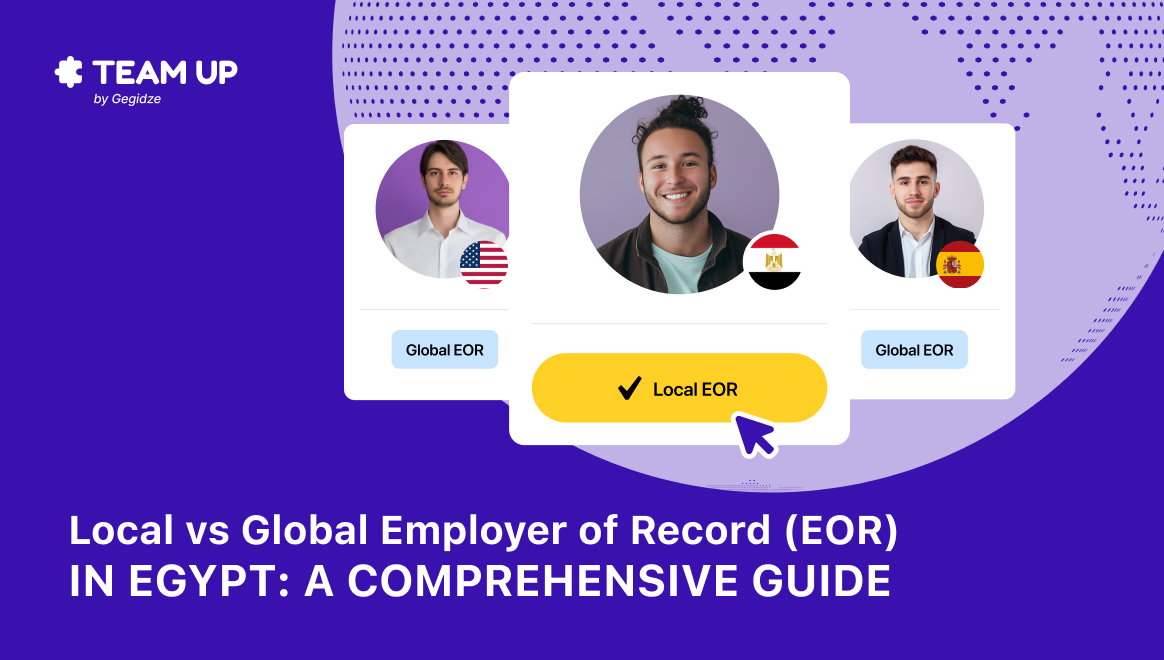
Employer of Record Egypt: EOR-Sponsored Employment for Faster Market Entry
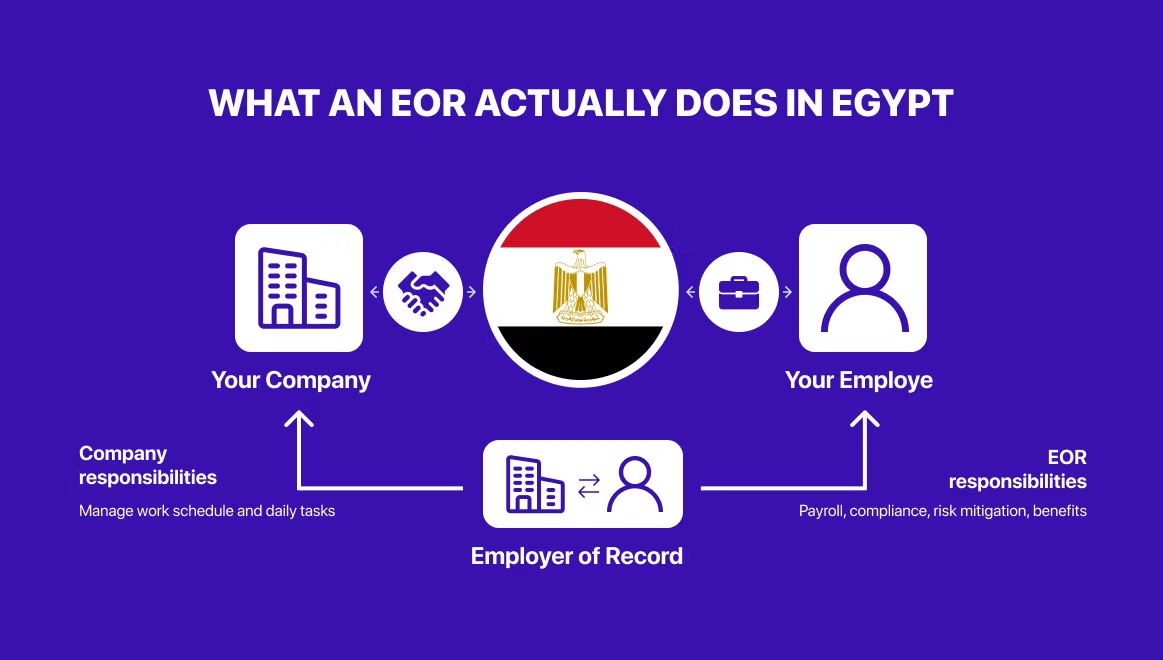
In this model, you partner with a third-party firm (the EOR) that already has a legal entity in Egypt. The EOR becomes the “legal employer” of your selected candidate and handles the entire sponsorship process. They obtain the work permit and visa under their entity’s name, but the individual actually works for you (you direct their work, just not on paper). The EOR takes care of all local employment compliance, and you simply pay a service fee plus the employee’s salary. Essentially, you’re renting a spot on the EOR’s entity to legally host your worker.
Pros:
Simplicity and speed. You bypass the need to set up your own company or learn Egyptian labor law from scratch. A good EOR will already be registered with authorities to sponsor foreign workers, so they can start the process immediately. They know the documentation drill, have local staff who can queue at government offices, and often have streamlined processes from doing this repeatedly.
This can cut down the visa processing time and drastically reduce your internal workload. Risk reduction is huge: the EOR shoulders the compliance burden – they are responsible for correct filings, tax payments, contract compliance, etc. If something is amiss, the authorities go to the EOR (who are experts in preventing issues), not you.
Additionally, you get flexibility: if, down the line, that employee leaves or your project ends, you can terminate without having to shut down a whole entity; the EOR simply ends the local employment smoothly. In short, EOR-sponsored employment is plug-and-play hiring in Egypt.
Cons:
There’s a fee for EOR services (usually a monthly per-employee fee).
However, when you tally it against the cost of running your own entity (or the risk of fines for mistakes), many find it’s more than worth it. You also relinquish a degree of control over the administration of employment – for instance, the employment contract will be between the EOR and the employee, not directly with your company (though you can add your IP protection and confidentiality clauses via the EOR).
For some very control-oriented companies, this is a mental hurdle. And you must ensure you choose a reliable EOR; a bad one could drop the compliance ball, which would still impact your operations. That said, picking a reputable EOR largely mitigates this.
Compliance and Perception:
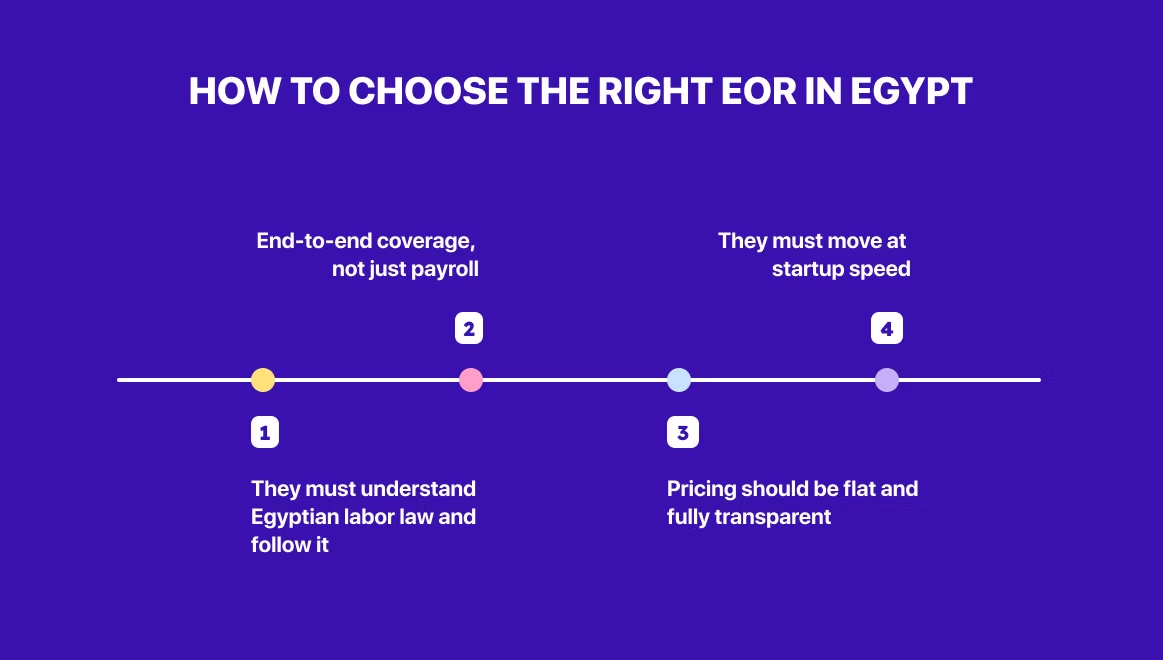
Both direct and EOR routes are legal in Egypt. Working with an EOR is not a loophole or grey area – it’s explicitly a service model where the EOR is the local employer of record. Egyptian authorities care that someone is the registered employer and meeting all obligations, not whether that entity is owned by you or is an EOR service provider. In fact, many global companies use international employer of record services to manage sponsorship in countries where they don’t have an office. It’s a recognized solution to stay compliant without over-investing initially.
One thing to be aware of: if you’re transitioning someone who’s been working as an “independent contractor” to a proper sponsored employment via EOR, you’re essentially correcting a compliance risk. In Egypt, if it walks and talks like an employee, the law treats it as employment. Using contractors long-term to avoid sponsorship can backfire – authorities can reclassify that relationship and penalize you. So EOR is a way to do it right.
Decision point: If you plan to hire dozens of people in Egypt and make it a core hub, you might consider direct investment in a local entity eventually. But if you are testing the market, hiring a handful of key roles, or just don’t want the headache of managing Egyptian bureaucracy, an EOR is likely the smarter choice. It lets you focus on the person’s work, while the EOR handles the red tape.
How an Employer of Record in Egypt Manages Sponsorship and Compliance
Using an Employer of Record service sounds great in theory – but how does it actually work in practice, especially for managing employer sponsorship and ongoing compliance in Egypt? Let’s demystify the process. We’ll use Team Up (a regional EOR specialist) as an example of what happens behind the scenes when you choose the EOR route:
1. The Instant Gateway (No Entity, No Problem)
Setting up a legal entity in Egypt can take months of bureaucratic wrestling.
- The Reality: We already have a fully registered Egyptian legal entity. It’s vetted, registered with the Labor Ministry, and has all its tax and social insurance ducks in a row.
- The Value: We are "pre-approved" to sponsor. You don't wait for a business license; you just use ours.
2. Wrestling the Arabic Legalese
Egyptian labor law requires contracts in Arabic. If you try to Google Translate your way through this, you’re asking for a lawsuit.
- What we do: We gather the docs (passports, diplomas, even the mandatory medical tests) and draft bilingual, airtight contracts.
- The Protection: The contract is between the employee and Team Up, but it includes ironclad clauses to protect your IP and confidentiality. You get the security of Western standards with the legality of Egyptian law.
3. The "Ministry Dance": Getting the Work Permit
This is where most DIY attempts fail. The Egyptian Ministry of Manpower requires a "justification" for hiring a foreigner.
- The "Team Up" Way: We know the officials and the policy nuances (like the 1:10 foreign-to-local worker ratio). We frame the application, highlight the unique skills of your hire, and handle the back-and-forth queries.
- The Result: You don’t even hear about the bureaucratic hiccups; you just get a notification when the permit is ready.
4. The "boots on the ground" Onboarding
Once the permit is approved, the candidate needs a visa.
- Coordination: We coordinate with Egyptian consulates for the entry visa and often accompany the employee to their in-country medical exams or government appointments.
- The Experience: Your hire feels supported, and you don't have to learn how the Cairo Public Service building is laid out.
5. Payroll, Taxes, and "Invisible" Compliance
Managing Egyptian payroll is a monthly headache of social insurance, income tax withholding, and reporting.
- The Monthly Flow: We handle the registration for social insurance and pay the employee in EGP (or other currencies where compliant).
- The Invoice: You receive one consolidated invoice in your preferred currency. It covers gross salary, employer taxes, and our service fee.
- The Safety Net: If Egyptian tax laws change tomorrow, we update our systems instantly. You stay 100% compliant without ever logging into a local tax portal.
6. Managing the "Off-Ramp" (Termination)
Saying goodbye is the hardest part—and the most legally dangerous.
- Clean Exits: We calculate severance, unused vacation payouts, and notice periods according to the latest Egyptian decrees.
- Visa Cancellation: Crucially, we ensure the work permit and residency are canceled properly. This prevents "ghost" employees from cluttering your headcount or creating future liability with the government.
7. Proactive Strategy (Avoiding the "2025 Trap")
A good EOR doesn't just push paper; they act as a scout.
- Example: Egypt recently updated decrees regarding foreign worker limits and electronic payment requirements for fees.
- Our Role: We tell you before you hire your next person: "Hey, we’re approaching the 10% quota limit; let’s strategize." It’s like having a local COO and a legal team for the price of a monthly subscription.
The Honest Truth: Global EOR giants often treat Egypt as just another line on a spreadsheet. In a place like Cairo, bureaucracy requires showing up in person and nurturing local relationships. We do the "human" work so you can do the "business" work.
In summary, an EOR manages employer sponsorship by doing everything a local employer would do – but with specialist focus and efficiency. From the outside, it will appear as if your employee is employed by a local company (which they are, legally), but day-to-day they work for you, and you get to skip to the part where they’re productive on the job, rather than drowning in admin. The compliance heavy lifting – the part that feels like deciphering hieroglyphs – is handled by the EOR.
Crucially, the quality of EOR services matters here. A global employer of record that is spread thin might treat you like just another ticket in the system; a dedicated regional player like Team Up brings a more hands-on approach, understanding that Egyptian bureaucracy sometimes requires showing up in person, nurturing relationships, and double-checking every stamp. They combine global standards with local know-how – meaning your interests are protected on both fronts.
By using an EOR, you ensure that sponsorship is not a one-time event but a continuously managed aspect of the employment. This drastically lowers the risk of something slipping through the cracks. For a decision-maker, it means peace of mind: you will stay compliant, and you won’t be caught off guard by an obscure rule or deadline. All the while, your employee experiences a smooth onboarding and stable employment, and you can focus on integrating them into your team and hitting your business goals in Egypt.
Conclusion: Key Takeaways and Next Steps
Entering the Egyptian market and hiring talent doesn’t have to feel like unraveling the pyramids’ mysteries. Let’s recap the actionable takeaways from this deep dive into employer sponsorship in Egypt:
In conclusion, Egypt offers tremendous opportunities – a growing talent pool, strategic location, and dynamic economy. Don’t let the fear of red tape hold you back. With a clear understanding of what employer sponsorship means and how it works in Egypt, and with Team Up’s honest, sharp, and reliable support at your side, you can navigate Egypt’s hiring landscape with confidence.
Compliance will be handled, your bases will be covered, and you’ll be free to actually build your business. Now, go forth and hire that rockstar candidate – we’ll handle the paperwork! Here’s to your successful expansion in Egypt.
FAQ
1. What is sponsorship for employment in Egypt?
Sponsorship is the mandatory legal process where an Egyptian-registered entity (the "host party") vouches for a foreign national to obtain a Work Permit. The employer must prove the role is necessary, that it cannot be filled by a local, and that the company is compliant with social insurance and tax laws.
2. What is the "10% Foreign Labor Cap" (1:9 Ratio)?
By law, foreign employees must not exceed 10% of a company’s total workforce.
- The "Multiplier" Rule: To hire one foreigner, you must generally employ at least nine Egyptian nationals.
- Exceptions: In 2026, some investment-heavy sectors or projects under the General Authority for Investment (GAFI) can petition for a higher ratio (up to 20%), though this requires higher fees.
3. What are the new 2026 Work Permit fees?
Fees have increased significantly under recent decrees:
- Minimum Fee:15,000 EGP (approx. $300 USD).
- Maximum Fee: Can reach 150,000 EGP (approx. $3,000 USD) depending on the sector, salary level, and whether the company is exceeding the standard labor ratio.
- Annual Increase: Renewal fees typically increase by 1,000 EGP each year for the first three years.
4. How does the "Labor Market Test" work?
Before sponsorship, the employer must submit a "Employment Justification" letter to the Ministry of Labor. You must demonstrate that you advertised the role and that no qualified Egyptian national was available. In 2026, authorities frequently cross-reference these claims with the National Job Database.
5. Can I hire a foreigner on a Tourist or Business Visa?
No. It is strictly illegal to perform productive work on a tourist or standard business e-visa.
- The Risk: Working without a permit can result in company fines of up to 100,000 EGP, and the employee may face immediate deportation and a permanent re-entry ban.
6. Are there exemptions from the Work Permit requirement?
As of 2026, a few specialized categories are exempt:
- Investors: Partners who invest at least $35,000 USD in specific types of partnerships.
- Short Assignments: Foreigners entering for very brief technical missions (a few days) may be waived, but must still pay a transactional fee.
- Diplomats/Experts: Staff in certain scientific or antiquities-related institutions.
7. What are the mandatory "Experience Certificate" requirements?
To sponsor a foreign specialist, you must provide a Certificate of Experience covering at least three years in a similar role. This document must be printed on the previous employer's letterhead, legalized by the Egyptian Consulate in the issuing country, and accompanied by a certified Arabic translation.
8. Define sponsorship for employment visa status for "Remote" teams.
If you wish to hire Egyptian talent remotely for a foreign company, you cannot sponsor them directly without a local entity. Most global firms use an Employer of Record (EOR). The EOR acts as the legal sponsor on paper, managing the 2026 social insurance contributions (3% minimum annual raise) and tax withholding.
9. What is the 2026 "Security Clearance" step?
Every foreign work permit application must pass a Security Clearance from the State Security Service. This is often the longest part of the process, taking anywhere from 1 to 3 months. Employers cannot bypass this step, and the employee often stays on a temporary "processing" status until it is finalized.
.svg)