PEO vs Employer of Record (EOR) in South Korea: Which is right for your organization?
TL;DR
- PEO and EOR are both HR outsourcing models, but they solve different problems and carry different legal structures. In South Korea, that distinction is not a technicality — it determines whether your company has a legal employer on record or not.
- A PEO is a co-employment arrangement: it shares employer liability with your company. You must already have a registered Korean entity for a PEO to function. Without one, the PEO model is not available to you as a legal structure in Korea.
- An EOR is the sole legal employer. It holds every obligation under the Labour Standards Act (LSA), National Pension Service (NPS), National Health Insurance (NHIS), Employment Insurance (EI), and Workers' Compensation Insurance (WCI) — without requiring your company to have a Korean entity.
- South Korea's labour law is consistently pro-employee. Ordinary dismissal is prohibited without justifiable cause. Severance pay — one month's average wages per year of service — is mandatory for every employee who has worked more than one year. Retirement pensions are mandatory under the Employee Retirement Benefit Security Act. Getting termination wrong in Korea is expensive and legally complex.
- For foreign nationals working in Korea, employer sponsorship of work visas (primarily E-7 Specially Designated Activities) requires a legally registered Korean employer. An EOR with Ministry of Justice approval for visa sponsorship can sponsor this independently. A PEO requires the client entity to be the sponsoring employer.
- For most international companies entering Korea without an entity, the EOR is the only legally viable model. For established Korea operations with 50+ permanent employees, a PEO adds value as an administrative efficiency layer on top of an existing entity.
- Team Up operates as a global EOR partner — not a PEO — because the EOR model is the structure that delivers genuine compliance transfer in South Korea's post-reform regulatory environment, particularly following the strengthened enforcement of the Dispatched Workers' Protection Act.
The PEO vs EOR South Korea question comes up the moment a company decides to hire there seriously. South Korea is not a casual market entry. It has one of Asia's most productive and technically sophisticated workforces, a world-class semiconductor and technology ecosystem centred on Seoul, Suwon, and Daejeon, and a growing track record as a destination for global R&D operations. It also has one of the most employee-protective labour frameworks in East Asia — and a regulatory approach to third-party employment arrangements that has tightened considerably over the past five years.
Understanding the difference between a PEO and an EOR in Korea is not an academic exercise. It determines whether your company carries the employer liability for your Korean hires directly, or whether that liability sits with the EOR as the registered legal employer. It determines whether you can sponsor work visas for foreign national hires. It determines what happens when an employee is dismissed and whether the legal exposure lands on your company or on your employment partner. And it determines whether your hiring arrangement is compliant with Korea's Dispatched Workers' Protection Act — one of the most actively enforced labour statutes in the region.
This article draws the line clearly, with the compliance depth and local specificity that the South Korea market requires.
Table of Contents
- TL;DR
- Why South Korea Requires a Structurally Correct Employment Model
- What Is a PEO and How Does It Work in South Korea?
- What Is an EOR and How Does It Work in South Korea?
- The Core Difference Between PEO and EOR in South Korea: Co-Employment vs. Sole Legal Employment
- South Korea's Dispatched Workers' Protection Act: Why It Changes the PEO Equation
- Four-Insurance System: NPS, NHIS, EI, and WCI — Who Manages What Under Each Model
- PEO in South Korea: The Narrow Window Where It Makes Sense
- EOR in South Korea: When It Is the Correct Structure
- Severance, Retirement Benefits, and Termination Compliance: Where PEO and EOR Diverge
- True Employer Cost in South Korea: Understanding the Full Cost Per Employee
- PEO vs EOR South Korea: Full Decision-Stage Comparison Table
- The Decision Framework: How to Choose Between PEO and EOR for South Korea
- How Team Up Handles EOR Operations in South Korea
- Frequently Asked Questions
- Final Thoughts
Why South Korea Requires a Structurally Correct Employment Model
South Korea is not a market that tolerates improvised employment structures. The Ministry of Employment and Labour (MOEL) conducts active labour inspections. The National Labour Relations Commission (NLRC) adjudicates wrongful dismissal claims with real speed and real consequences. The four-insurance system — covering pension, health, employment insurance, and industrial accident compensation — requires employer registration across four separate government bodies before the first employee starts work. And the Dispatched Workers' Protection Act, substantially strengthened in 2020, specifically targets misclassified or improperly structured third-party employment arrangements.
For international companies, the compliance risk is compounded by cultural and linguistic distance. Korean labour law is administered primarily in Korean. Regulatory communications from MOEL, NHIS, NPS, and the Korea Workers' Compensation and Welfare Service (COMWEL) arrive in Korean. Disputes before the NLRC proceed in Korean. A company that attempts to manage its Korea employment obligations from a global HR team without local expertise is not just operationally exposed — it is functionally blind to the compliance events occurring in its own employment relationships.
The EOR model addresses this structural problem by making the compliance burden local. The EOR is the registered Korean employer. Every regulatory interaction is handled by an entity that operates within the Korean legal system daily. The client company directs the work. The EOR manages the legal employment relationship, the four-insurance registrations, the payroll tax obligations under the Individual Income Tax Act, and the termination events that require compliance with the Labour Standards Act.
| South Korea's standard working hours under the Labour Standards Act are 40 hours per week (eight hours per day), with a maximum of 12 hours of extended work per week — reduced from 68 hours to 52 hours total by the 2018 Working Hours Reform. Companies that hire Korean employees and allow or require extended work beyond 52 hours per week are in direct violation of the LSA, subject to criminal penalties for responsible management, and exposed to wage claims from affected employees covering the full period of the violation. This is a compliance risk that a co-employment arrangement with a PEO does not remove from the client company. |

What Is a PEO and How Does It Work in South Korea?
A Professional Employer Organisation — PEO — operates as a co-employer alongside your company. In the PEO model, both entities share the employer relationship with the workforce. The PEO takes on administrative employer functions: payroll processing, benefit administration, insurance remittances, and HR compliance support. The client company retains operational control — directing the work, setting compensation, making hiring and termination decisions, and defining the employment scope.
The structural prerequisite of the PEO model is an existing legal entity on the client side. In South Korea, this means a registered company under the Commercial Act — a Jusik Hoesa (corporation) or Yuhan Hoesa (limited liability company) — with a business registration number (사업자등록번호) issued by the National Tax Service (NTS), four-insurance employer registrations, and active payroll infrastructure. Without this foundation, there is no co-employer on the client side, and the PEO arrangement has no legal basis under Korean law.
Where Korean PEO Providers Typically Operate
In practice, PEO providers in South Korea tend to offer payroll outsourcing, HR administration, and four-insurance management to companies that already have established Korean entities but want to reduce the internal HR administrative burden. They are not, in the main, market-entry vehicles for foreign companies without Korean entities. The regulatory framework — and specifically the Dispatched Workers' Protection Act — makes the co-employment model legally risky for arrangements where the client company exercises control over work that the PEO formally employs.
What Is an EOR and How Does It Work in South Korea?
An Employer of Record in South Korea is the sole legal employer. It holds a Korean business registration, four-insurance employer numbers across NPS, NHIS, EI, and COMWEL (WCI), and the payroll infrastructure to remit income tax withholding under the Individual Income Tax Act (소득세법). Every employment contract is between the EOR and the employee. The EOR is the entity listed on the employee's salary certificate, the entity contributing to their NPS pension account, and the entity responsible for paying statutory severance when the employment ends.
Your company — the client — is the operational manager of the employee's day-to-day work. You set the scope, the deliverables, the working hours, and the performance standards. But you are not the employer of record. That status sits with the EOR, and it carries the full weight of Korean employer obligations.
For international companies entering South Korea without an entity, the EOR removes the three-to-five-month entity formation timeline. A new employee can be onboarded in three to five business days. Four-insurance registrations are completed before the start date. The first payroll run is compliant with NTS withholding requirements and produces a correctly issued Korean payslip. None of this requires the client to have a Korean business registration number.
EOR as the Gateway to Korea Talent Markets
South Korea's talent markets — particularly in Seoul's Gangnam and Pangyo districts, the semiconductor corridor in Suwon and Hwaseong, and the research hub in Daejeon — are competitive and move quickly. Companies that require three to five months of entity formation before making their first offer lose candidates to competitors who are ready to hire now. The EOR's ability to compress the hiring timeline to days is a strategic advantage that compounds across the first year of Korea operations.
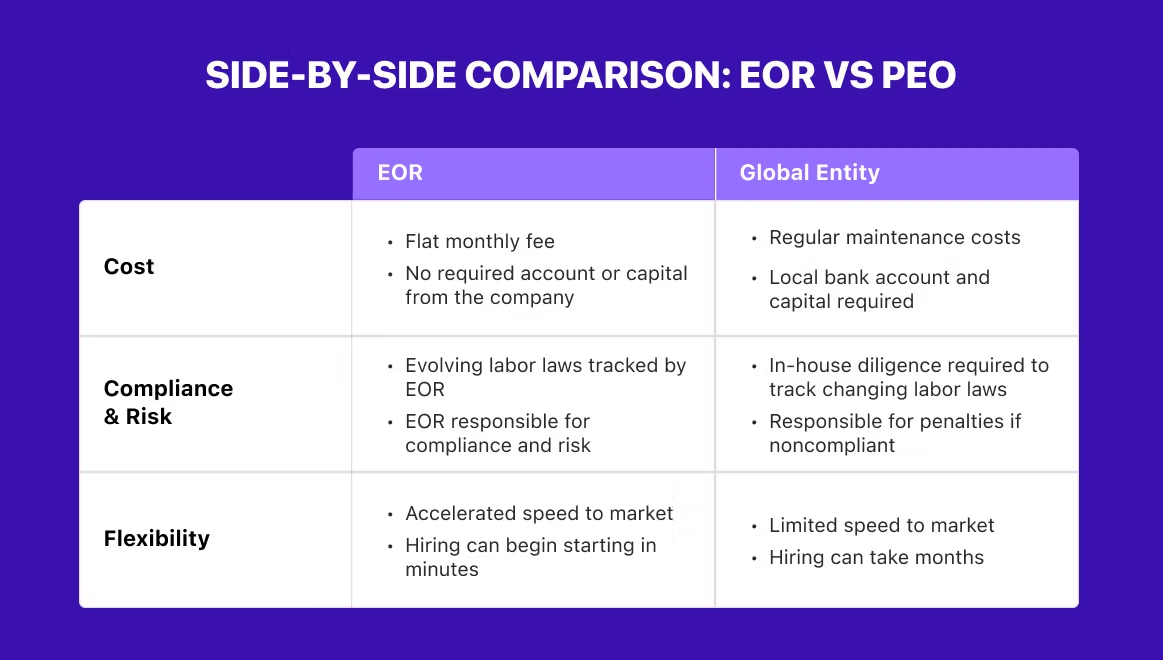
The Core Difference Between PEO and EOR in South Korea: Co-Employment vs. Sole Legal Employment
Liability Architecture in the PEO Model
In a PEO co-employment arrangement, liability is distributed between the PEO and the client entity. When a Korean employee files a wrongful dismissal claim with the NLRC, both entities may be named. When MOEL conducts a labour inspection, the client entity's operations are in scope. When NPS audits contribution records, the client's four-insurance registrations are examined alongside the PEO's. The PEO provides HR and payroll administration. It does not absorb employer liability. Your company retains it — often without the operational infrastructure to manage it effectively.
This shared liability structure can work when the client company has a mature Korea HR function, local legal counsel familiar with MOEL enforcement practices, and systems for managing the four-insurance obligations independently of the PEO. For most international companies entering Korea, those conditions do not exist. The PEO provides administrative relief, not compliance protection.
Liability Architecture in the EOR Model
In an EOR arrangement, the employer liability sits with the EOR as the named employer of record. A wrongful dismissal claim targets the EOR. An MOEL inspection examines the EOR's employment records. An NPS audit reviews the EOR's contribution history. The client company is the operational principal directing the work — a distinct legal relationship from the employment relationship itself. That separation is the compliance architecture that most international companies need in a market where they do not have the local legal infrastructure to manage employment disputes independently.
South Korea's Dispatched Workers' Protection Act: Why It Changes the PEO Equation
The Act on the Protection, etc. of Temporary Agency Workers (파견근로자 보호 등에 관한 법률) — commonly referred to as the Dispatched Workers' Protection Act — is the statute that most directly affects how third-party employment arrangements are evaluated in South Korea. The Act restricts the use of dispatched (agency) workers to 32 specifically designated job categories. Outside those categories, the dispatch of workers is prohibited. If a company uses a staffing or PEO arrangement to employ workers in non-designated roles — which includes most professional, managerial, and technical functions — it may be found to be using illegal dispatch.
The consequences of an illegal dispatch finding are serious. The hirer (client company) is deemed to have an employment relationship with the dispatched workers directly, effective from the date the illegal dispatch began. This means the client company becomes the employer of record retroactively — with the full stack of Korean employer obligations, four-insurance back-contributions, and potential MOEL penalties applying from that original date. For a company that has operated a PEO arrangement across 20 employees for two years in roles outside the designated categories, the retroactive liability exposure is substantial.
The EOR model is not a dispatch arrangement in the sense targeted by the Act. The EOR is the genuine legal employer — not an agency supplying workers to a client who is effectively the employer. The employment relationship is between the EOR and the employee, the EOR exercises its own employer functions independently, and the client company's relationship with the work product is a commercial service agreement rather than a worker supply arrangement. This structural distinction is what makes the EOR model compliant in Korea's regulatory environment where traditional staffing PEO models are under active enforcement scrutiny.
| Under the 2020 amendments to the Dispatched Workers' Protection Act, Korean courts significantly expanded the standard for determining when a dispatched worker relationship exists — looking at the practical reality of who controls the work rather than the formal contractual structure. A PEO arrangement where the client company exercises day-to-day direction over employee work, sets individual performance targets, approves leave, and makes disciplinary decisions is likely to be found a de facto dispatch relationship by a Korean court, regardless of the contract label. This is the enforcement gap that makes the PEO model structurally risky in Korea for professional workforce arrangements. |
Four-Insurance System: NPS, NHIS, EI, and WCI — Who Manages What Under Each Model
Every employer in South Korea must register with and contribute to four mandatory insurance schemes from the first day of employment. These are not optional and they are not aggregated into a single government body — each has its own registration, contribution rate, remittance schedule, and audit process.
| Insurance System | Governing Body | Employer Rate (Approx.) | Employee Rate (Approx.) | PEO Model: Who Files? | EOR Model: Who Files? |
| National Pension (NPS) | National Pension Service | 4.5% of standard monthly income | 4.5% | Client entity and/or PEO (shared) | EOR solely |
| National Health Insurance (NHIS) | NHIS Corporation | 3.545% of monthly income | 3.545% | Client entity and/or PEO (shared) | EOR solely |
| Employment Insurance (EI) | Ministry of Employment & Labour | 0.9%–1.85% (size-dependent) | 0.9% | Client entity and/or PEO (shared) | EOR solely |
| Workers' Compensation (WCI) | COMWEL | 0.7%–18.6% (industry risk) | 0% | Client entity and/or PEO (shared) | EOR solely |
In the PEO model, the question of which entity is registered with each insurance body — and which entity carries the audit exposure for contribution accuracy — is contractually variable and legally ambiguous in Korean regulatory practice. In the EOR model, the answer is unambiguous: the EOR holds all four registrations and carries all four audit risks. The client company receives a consolidated payroll report showing contributions per employee per scheme, but has no direct registration liability to any of the four government bodies.
| NPS contribution accuracy depends on correct standard monthly income (SMI) reporting. The SMI is not simply the monthly salary — it must be updated annually by November of each year to reflect current salary levels, and adjusted immediately upon promotion or salary increase. Employers that fail to update SMI generate systematic NPS underpayment, which MOEL identifies through the annual SMI reconciliation process. A qualified EOR manages SMI updates as a scheduled compliance event tied to payroll change notifications. |
PEO in South Korea: The Narrow Window Where It Makes Sense
The Conditions That Make a PEO Viable in Korea
A PEO arrangement in South Korea makes operational sense under a specific and fairly narrow set of conditions. First, your company must already have a registered Korean entity with active four-insurance employer registrations and a business registration number. This is not optional — without it, the co-employment structure has no client side. Second, the PEO's role must be genuinely administrative — managing payroll processing, insurance premium calculations, HR documentation, and benefit administration — rather than providing labour supply functions that the Dispatched Workers' Protection Act restricts. Third, the roles being covered by the arrangement must either fall within the designated dispatch categories or the PEO relationship must be structured to avoid the practical reality tests that Korean courts apply.
In practice, this describes a mature Korea operation — typically 100 or more employees, an established local HR presence, and a defined administrative outsourcing need. A company with 120 Korean employees, a Korean HR manager, and a clear operational separation between its management functions and the PEO's administrative functions can use a Korean PEO provider to reduce the payroll and insurance management burden without creating dispatch law exposure. That is a legitimate and efficient use of the model.
What Makes a PEO the Wrong Choice in Korea
A PEO is the wrong choice for any company that does not have a Korean entity and is considering a PEO as a substitute for entity formation. It does not work that way in Korea. It is the wrong choice when the arrangement involves the PEO formally employing workers who are functionally under the client company's direct daily control — because that fact pattern maps to illegal dispatch in Korean regulatory practice. And it is the wrong choice when the company needs work permit sponsorship for foreign national hires, because the PEO's co-employer status does not give it independent visa sponsorship standing under Korean immigration law.
EOR in South Korea: When It Is the Correct Structure

Market Entry Without Entity Formation
Forming a Korean Jusik Hoesa requires articles of incorporation, a seal certificate, a capital deposit, business registration with the NTS, and four-insurance employer registrations across NPS, NHIS, MOEL, and COMWEL. The realistic timeline from initiation to first hire is three to five months under normal conditions. For companies responding to a specific opportunity — winning a Korean client, needing to retain a candidate before a competitor does, or launching a Korea-based function on a fixed schedule — that timeline is prohibitive. An EOR with established Korean employer infrastructure compresses it to days.
EOR for Compliance-First Korea Operations
South Korea has one of Asia's most active labour regulatory environments. MOEL inspections are routine. NLRC claims are common. Individual Income Tax Act withholding audits by NTS are conducted systematically. For companies that need clean employment records — correctly structured Labour Standards Act contracts, uninterrupted four-insurance contributions, accurate payroll tax withholding, and properly documented termination events — the EOR model provides documentation integrity that a co-employment arrangement cannot. Every employee has one employer of record. Every contribution sits under one four-insurance registration. The compliance record is auditable and clean.
EOR for Market Testing and Exit Flexibility
Korea entity dissolution is not a quick process. Winding down a Jusik Hoesa requires a shareholders' resolution, a liquidation period during which all tax obligations must be cleared with NTS, MOEL notification for any workforce reduction, and severance payment processing for all terminated employees. The realistic timeline for a clean dissolution is six to twelve months. An EOR arrangement, by contrast, can be wound down within the contractual notice period. Termination events — severance calculation, final payslip, four-insurance de-registration — are managed by the EOR within the statutory requirements of the Labour Standards Act. The client does not carry the entity dissolution overhead.
Severance, Retirement Benefits, and Termination Compliance: Where PEO and EOR Diverge
Mandatory Severance Under the Labour Standards Act
Korea's Labour Standards Act mandates severance pay for every employee who has worked more than one year — regardless of the reason for termination, including resignation. The statutory severance is calculated as 30 days' average wages for each full year of continuous service. The "average wages" calculation uses the average daily wage over the three months preceding termination, including all regular wages and allowances. For an employee earning KRW 60 million per year who resigns after five years, the mandatory severance is approximately KRW 25 million — payable within 14 days of the termination date under the Act.
This is not a performance-based payment. It is not at the employer's discretion. It is a legal obligation that applies to every employee, including those who resign voluntarily, as long as they have worked more than one year. Many international companies discover this obligation only when their first Korean employee departs — at which point the 14-day payment deadline is already running.
Employee Retirement Benefit Security Act: Pension or Retirement Fund
Beyond the Labour Standards Act severance, Korean employers are required under the Employee Retirement Benefit Security Act (근로자퇴직급여 보장법) to provide either a Defined Benefit (DB) pension plan or a Defined Contribution (DC) plan for employees who have worked at least one year. The DB plan requires the employer to fund a retirement benefit equivalent to at least 30 days' average wages per year of service — essentially the same calculation as the LSA severance but managed as an ongoing pension liability rather than a lump-sum termination payment. The DC plan requires the employer to contribute at least 1/12 of the employee's annual wages each month into a personally managed retirement account.
In the EOR model, the EOR manages the retirement benefit obligation — setting up the correct plan for each employee, making regular DC contributions or maintaining the DB reserve, and processing the retirement benefit payment on termination alongside the LSA severance calculation. In a PEO arrangement, the retirement benefit obligation sits with the client entity as the co-employer, requiring the client to maintain its own pension plan infrastructure or contract separately for DC plan management.
Ordinary Dismissal: The Justifiable Cause Requirement
The Labour Standards Act prohibits ordinary dismissal without justifiable cause. Unlike many Anglo-American employment systems, Korean law does not permit at-will termination for regular employees. A dismissal is only justified if there is a genuinely compelling operational reason (business necessity, redundancy following documented workforce planning), the reason has been communicated to the employee in writing 30 days in advance (or 30 days' pay in lieu), and the NLRC — if the employee disputes the dismissal — accepts the reason as meeting the statutory standard. Dismissals that fail this standard result in reinstatement orders or back-pay awards, and potentially both.
An EOR manages termination as a structured compliance event — assessing the cause, preparing the required written notifications, calculating the LSA severance and retirement benefit on the correct average wage base, and coordinating the four-insurance de-registrations by the required deadline. The client company does not manage any of this directly. In a PEO co-employment arrangement, the client entity is the operational employer making the dismissal decision and retains direct NLRC exposure for any dismissal it initiates.
True Employer Cost in South Korea: Understanding the Full Cost Per Employee
Building a Korea headcount model on gross salary is the most common financial planning error companies make when entering the market. The true employer cost includes four-insurance contributions, mandatory retirement benefit accruals, and any employer-funded benefits that are market-competitive in Korea. The table below shows the employer cost structure for a mid-level professional employee earning KRW 60,000,000 per year (approximately KRW 5,000,000 per month gross).
| Cost Component | Calculation Basis | Monthly Cost (KRW) | Annual Cost (KRW) |
| Gross Monthly Salary | Base salary | 5,000,000 | 60,000,000 |
| NPS Employer Contribution (4.5%) | 4.5% of standard monthly income | 225,000 | 2,700,000 |
| NHIS Employer Contribution (3.545%) | 3.545% of monthly income | 177,250 | 2,127,000 |
| Employment Insurance — EI (0.9%) | 0.9% of monthly wages (employee-side EI basis) | 45,000 | 540,000 |
| Workers' Comp — WCI (est. 1.0%) | Varies by industry risk class | 50,000 | 600,000 |
| Retirement Benefit Accrual (1/12 annual) | 1/12 of annual wage per month (DC plan) | 416,667 | 5,000,000 |
| Total Employer Cost (monthly) | 5,913,917 | 70,967,000 | |
| Employer Cost as % of Gross Salary | ~118% | ~118% |
The 118% figure is a mid-range estimate for a professional employee in a standard industry risk category. For employees in high-risk industries (construction, manufacturing, chemical processing), the WCI premium rises significantly — up to 18.6% of wages in the highest risk categories — pushing total employer cost to 130% or more of gross salary. For companies offering additional employer-funded benefits common in Korea's competitive talent market (meal allowances, commuting allowances, wellness programs), the effective total cost is higher still.

PEO vs EOR South Korea: Full Decision-Stage Comparison Table
The table below maps every decision-relevant factor against the PEO and EOR models in South Korea. It is structured for a CFO, legal counsel, or HR leadership review — not as a summary of marketing claims but as a functional decision tool.
| Decision Factor | PEO in South Korea | EOR in South Korea |
| Legal employer status | Co-employer (shared with client entity) | Sole employer of record |
| Requires client Korean entity? | YES — Jusik Hoesa or similar required | NO — EOR is the registered entity |
| Four insurance registrations | Client entity holds registrations | EOR holds all four registrations |
| Dispatched Workers Act compliance | High risk for non-designated roles | Compliant — EOR is genuine employer |
| Labour Standards Act coverage | Shared — client in direct LSA exposure | EOR assumes full LSA liability |
| NLRC wrongful dismissal exposure | Client entity is directly exposed | EOR is named employer in NLRC claims |
| Severance payment obligation | Client entity carries a direct obligation | EOR calculates and pays, manages timeline |
| Retirement benefit (DC/DB plan) | Client entity must establish plan | EOR manages plan and monthly contributions |
| Work permit (E-7) sponsorship | Requires client entity as primary sponsor | EOR sponsors independently |
| NPS SMI update management | Divided responsibility — error-prone | EOR manages all annual SMI updates |
| Time to first hire | 3–5 months (entity formation first) | 3–5 business days |
| Market exit flexibility | Entity dissolution: 6–12 months minimum | Wind-down within contractual notice period |
| Best suited headcount range | 100+ employees, permanent operations | 1–100 employees, any stage |
| Suitable for companies without entity | NO | YES |
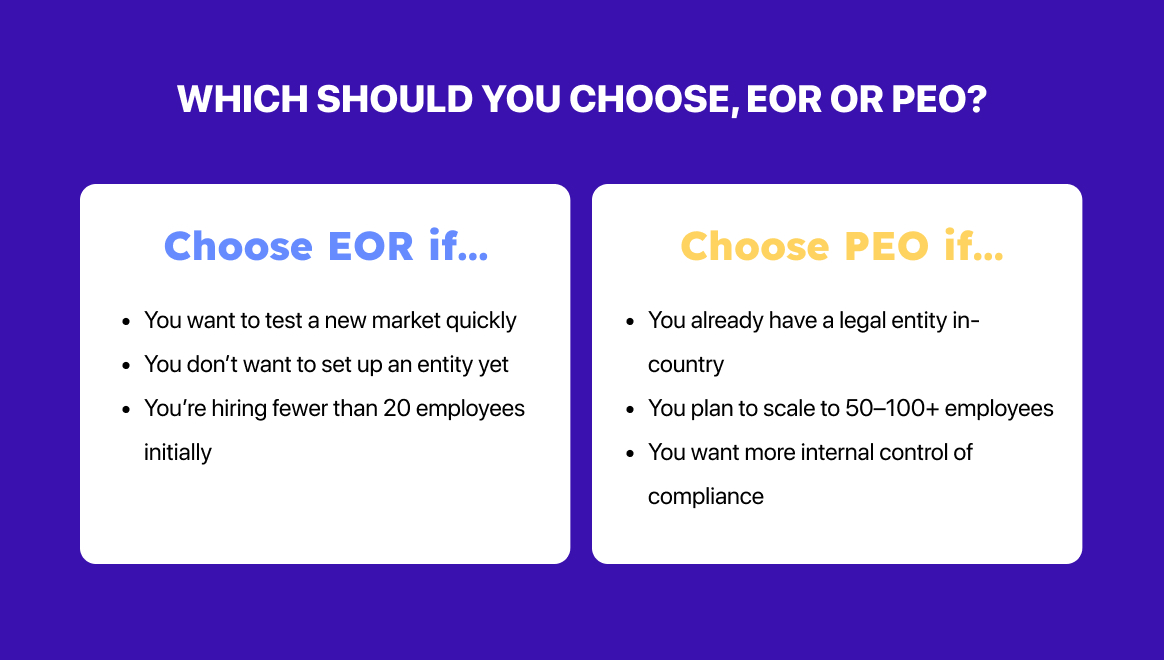
The Decision Framework: How to Choose Between PEO and EOR for South Korea
Step 1 — Does Your Company Have a Registered Korean Entity?
This is the binary first question. If the answer is no, the PEO model is not legally available to you as a genuine co-employment structure in Korea. You are choosing between an EOR and entity formation. If the entity formation timeline and capital investment are justified by your Korea headcount trajectory and confidence in permanent presence, form the entity and consider a PEO for administrative efficiency at scale. If the timing is wrong or the permanence is uncertain, the EOR is the correct structure now, with the option to transition to a local entity once the operation is established.
Step 2 — Assess Your Dispatched Workers Act Exposure
If you have a Korean entity and are evaluating a PEO, the critical question is whether the roles you are filling fall within the 32 designated dispatch categories under the Dispatched Workers' Protection Act. For most professional, managerial, and technical roles — software engineering, data science, finance, legal, HR — they do not. If your Korea workforce is primarily in non-designated roles and the PEO arrangement places the PEO as the formal employer while your management team exercises daily operational control, you have the fact pattern for an illegal dispatch finding. The EOR model eliminates this risk by being the genuine employer rather than a labour supply intermediary.
Step 3 — Evaluate Your Work Permit Requirements
If any of your Korea hires require work permit sponsorship — foreign nationals relocating from other markets, intracompany transfers, or specialist hires requiring E-7 visas — the EOR provides cleaner and more direct sponsorship infrastructure than a PEO co-employment arrangement. The EOR sponsors the visa independently as the registered employer. The PEO requires your entity to be the primary MoJ-registered sponsor, adding operational steps and timeline.
Step 4 — Assess Your Risk Tolerance for Termination Events
Korean termination is the event where the difference between PEO and EOR compliance exposure is most concrete. If your organisation needs to be able to initiate a termination and have the full LSA procedure — 30-day notice, justifiable cause documentation, average wage severance calculation, 14-day payment deadline — managed by an entity that carries the NLRC exposure independently, the EOR model provides that protection. If your Korea HR team is capable of managing LSA termination procedures directly, the PEO's administrative support adds value without requiring you to outsource the employer liability.
How Team Up Handles EOR Operations in South Korea
Team Up operates as a global employer of record — not a PEO — with dedicated South Korea employment infrastructure. For companies hiring in Korea, this is what that means operationally:
- Entity-free legal hiring from day one: Team Up is the registered Korean employer under the Labour Standards Act, enabling LSA-compliant employment contracts, four-insurance registration before the employee starts, and first payroll run within days of offer acceptance — without any Korean entity requirement on the client side.
- Full four-insurance management: NPS, NHIS, EI, and WCI registrations are held by Team Up across all employees. Standard monthly income updates are managed as scheduled compliance events. Contribution remittances are made on time to all four government bodies. Audit records are maintained per statutory retention requirements.
- Labour Standards Act payroll compliance: Monthly salary payments are processed under the Individual Income Tax Act withholding schedule, with annual year-end tax settlement (연말정산) managed per NTS requirements. Payslips are issued in the correct Korean format, with all mandatory deductions clearly itemised.
- Severance and retirement benefit management: LSA severance is calculated on the correct average wage basis and paid within the 14-day statutory deadline. DC retirement plan contributions are made at 1/12 of annual wages per month. Final retirement benefit payments are processed correctly at termination.
- E-7 and other work visa sponsorship: Team Up manages the MoJ work permit application process for foreign national hires, including qualification verification, employment offer letter preparation, and visa status maintenance throughout the employment period.
- Dispatched Workers Act-compliant structure: Team Up operates as a genuine employer of record, not a labour supply intermediary — ensuring that the employment arrangement is not characterised as illegal dispatch under Korean regulatory standards.
- Multi-market global EOR coverage: Team Up's employer-of-record infrastructure extends across Eastern Europe, the Caucasus, Turkey, Central Asia, India, and MENA, allowing clients managing Korea hiring alongside other emerging market operations to use a single contract structure, consistent reporting, and one operational contact across all markets.
Frequently Asked Questions
Is mandatory severance in South Korea the same as retirement benefits?
They are related but distinct obligations. The Labour Standards Act mandates severance pay of 30 days' average wages per year of service, payable within 14 days of termination for any employee who has worked more than one year — including those who resign voluntarily. The Employee Retirement Benefit Security Act separately requires employers to provide either a Defined Benefit pension plan or a Defined Contribution plan, with DC contributions equivalent to at least 1/12 of the employee's annual wages remitted monthly. The two obligations overlap in their calculation basis (both use average wage concepts) but are administered separately. A qualified EOR manages both as connected but distinct payroll compliance events.
Can a company in South Korea terminate an employee who is not performing well?
Yes, but the process must comply with the Labour Standards Act's justifiable cause requirement. The employer must document the performance issue through a structured process — written warnings, performance improvement plans with measurable targets and reasonable timelines, and written notice of the dismissal at least 30 days before the effective date (or 30 days' wages in lieu). The documentation must be comprehensive enough to satisfy NLRC scrutiny if the employee contests the dismissal. Korean labour courts apply a high evidentiary standard for performance-based dismissals. An EOR manages this process — from the initial warning documentation through the final dismissal notice and severance payment — with legal oversight of the specific documentation required.
What is the 52-hour working week rule in South Korea and how does it affect international companies?
The 2018 Working Hours Reform capped total weekly working hours — regular plus extended work — at 52 hours for companies with five or more employees. The 52-hour limit is enforced by MOEL with criminal penalties (up to two years' imprisonment or KRW 20 million fine) for responsible managers who knowingly allow or require violations. For international companies managing Korean employees from headquarters in different time zones, this is a live compliance risk. Meeting expectations for US or European business hour overlap can push Korean employees toward working hours that violate the 52-hour cap. An EOR advises on working hour compliance and documents employment contracts with clear provisions for meeting the statutory limit.
Does using an EOR in South Korea affect how Korean employees perceive their employment?
Korean employees are familiar with the concept of being employed through a professional employer organisation or a registered employer-of-record structure. The employment contract names Team Up (or the relevant EOR) as the employer — which is legally required to be accurate — and the client company as the operational principal directing the work. The employee's four-insurance coverage is active, their NPS pension is accumulating, their severance is accruing, and their retirement benefit contributions are being made. In practice, Korean employees evaluate the quality of their employment based on the substantive terms — compensation, working conditions, management quality — rather than the legal employer name. Transparency about the structure is both legally required and professionally standard in Korea's internationally-integrated talent markets.
How does an EOR handle the annual year-end tax settlement (연말정산) in South Korea?
Year-end tax settlement (yeommal jeongsan) is the annual process by which Korean employers reconcile each employee's actual annual income tax liability against the amounts withheld throughout the year. It runs in January for income earned in the prior calendar year. Employees submit deduction receipts (for medical expenses, education, charitable contributions, and other deductible items) to the employer. The employer adjusts the withholding accordingly, either refunding over-withheld amounts in the February payslip or collecting under-withheld amounts. The final reconciliation is reported to NTS via the annual payment records. An EOR with Korean payroll infrastructure manages this entire process — employee communication, deduction receipt collection, withholding recalculation, and NTS reporting — as a scheduled compliance event rather than an ad hoc HR exercise.
What happens to four-insurance registrations if I transition from an EOR to a local Korean entity?
The transition involves a four-insurance employer transfer process: the EOR's employer registrations with NPS, NHIS, MOEL (EI), and COMWEL (WCI) must be closed (탈퇴) for the transferred employees, and new employer registrations must be opened under the client company's entity. This process must be managed carefully to avoid coverage gaps — a gap in NHIS registration, for example, means the employee's health insurance coverage lapses during the gap period, which creates both a statutory violation and a real employee welfare impact. A qualified EOR coordinates the transition in a single administrative sequence, ensuring continuous coverage across all four insurance schemes throughout the transfer.
Final Thoughts
South Korea is a serious market that requires a structurally serious employment approach. The Labour Standards Act's justifiable cause requirement for dismissal, the Dispatched Workers' Protection Act's restrictions on third-party employment arrangements, the four-insurance system's parallel compliance obligations, and the mandatory severance and retirement benefit framework create a compliance architecture that is genuinely demanding for international companies operating without local infrastructure.
The PEO vs EOR South Korea question has a clear answer for most international companies: without a Korean entity, the EOR is the only model that functions. With a Korean entity and 100-plus employees in permanent roles, a PEO adds administrative efficiency. For everything in between — and for any company concerned about Dispatched Workers' Act exposure in professional workforce arrangements — the EOR delivers better compliance outcomes, cleaner liability separation, and simpler operational management than a co-employment structure in which the client company retains direct NLRC, MOEL, and four-insurance exposure.
Build your Korea headcount model on the real employer cost. Verify that any EOR you engage operates as a genuine employer of record — not a labour supply intermediary. Confirm that work permit sponsorship is available independently through the EOR before you bring any foreign national hires into your Korea team. And make sure your employment contracts are structured under the Labour Standards Act with the 52-hour working week cap, the probationary period provisions, and the mandatory benefit obligations correctly reflected from day one.
Team Up provides compliant EOR services in South Korea and across key emerging markets globally. Contact the Team Up team to receive a Korea employer cost breakdown for your headcount profile, a compliance readiness assessment for any existing arrangement, and a clear onboarding timeline for your first hire.
.svg)