PEO vs Employer of Record (EOR: Which is right for your organization?
TL;DR
Every international hiring conversation eventually surfaces both terms. PEO. EOR. Employer of Record services. Professional Employer Organisation. They both involve outsourcing HR functions to a third party. They are both used to simplify employment across borders. And they are confused with each other constantly — in vendor pitches, in procurement discussions, and in internal HR strategy documents.
The confusion is understandable. But the models are structurally different in one way that changes every downstream decision: who is the legal employer?
Get this wrong, and you could find yourself in a market where you thought you were using an EOR but actually bear full employer liability — or, worse, you attempt to run an EOR arrangement in a market where you do not have the entity infrastructure a PEO requires. This guide makes the distinction clear, applies it to the markets where it matters most, and gives you a concrete framework for choosing the right model.
Quick Navigation:
- TL;DR
- PEO VS EOR
- What Does PEO Stand For In HR
- What Employer of Record Services Actually Do
- What Is Co-Employment? And How to Avoid Risks
- The Immigration Advantage: Why EOR Outperforms PEO for Visa Sponsorship
- The Benefits Advantage: Where PEOs Have the Edge
- Cost Structure: What Each Model Actually Costs
- Regional Fit: Which Model Works in Your Target Markets
- Comparison Table: PEO vs EOR Across 12 Criteria
- Decision Framework: 6 Questions to Find Your Answer
- The Right Model for Your Expansion
- Frequently Asked Questions
PEO VS EOR
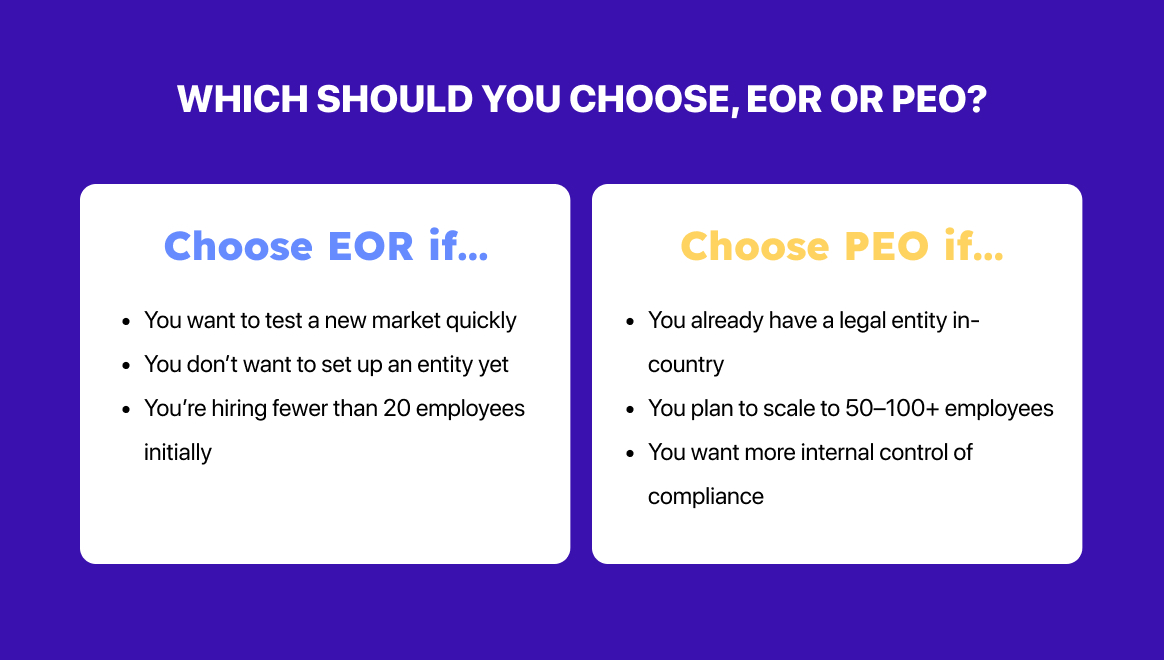
Before comparing features, services, pricing, or regional fit, there is one question that determines whether PEO or EOR applies to your situation.
Do you already have a registered legal entity in the country where you want to hire?
If yes, PEO is a viable option. You already have the legal employer status the PEO co-employment model requires.
If no, PEO is not an option for direct employment in that country. You need an EOR, which provides the legal entity infrastructure in your place.
That is the starting point. Everything else, liability, scope, cost, benefits, access, immigration capability, flows from that answer.
Here is why this matters so concretely. A PEO operates through co-employment. It means the PEO and your company share employer responsibilities for your employees. The employee's paycheck may come through the PEO, but your company remains recognised as the employer. That requires your company to have a legal employer status in the country, which means a registered entity.
An EOR operates differently. The EOR becomes the sole legal employer. Your company has a services agreement with the EOR. The employee's employment contract is with the EOR. On all tax documents, government filings, and employment records, the EOR's entity is the employer. Your company directs the work. The EOR owns the employment relationship.
This is not a subtle administrative difference. It determines who can legally hire employees in a new country, who bears liability when something goes wrong, and who can sponsor work permits for foreign nationals.

What Does PEO Stand For In HR
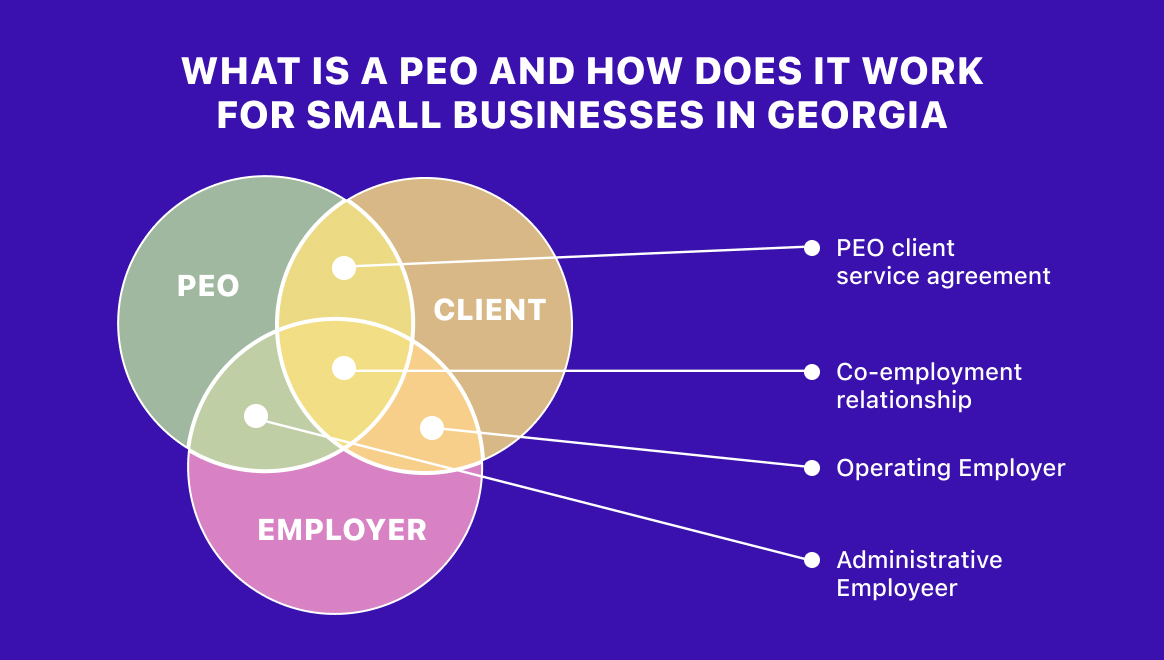
A Professional Employer Organisation enters a co-employment arrangement with your business. You remain a recognised employer. The PEO shares the administrative and compliance responsibilities of employment, but the liability is shared too, not transferred.
What the professional employer organization handles:
- Payroll processing and tax filings, often under the PEO's tax identification number
- Employee benefits enrollment and administration
- Workers' compensation insurance and claims management
- HR compliance support and regulatory guidance
- Onboarding and offboarding administration
- Employee handbook development, performance management tools
What you retain:
- Day-to-day management of employees
- All hiring and firing decisions
- Legal employer status (your company remains on the hook as an employer)
- Shared liability for compliance violations
- The obligation to have a registered entity in the target country
Where PEOs create genuine value
The most compelling PEO benefit is benefits access. PEOs pool employees from hundreds or thousands of client companies and use that aggregated workforce to negotiate insurance rates that individual small or mid-sized companies could not access alone. A 25-person company using a PEO may be able to offer health insurance, retirement plans, and wellness programs at rates typically reserved for companies with hundreds of employees. According to NAPEO, businesses that use a PEO grow 7–9% faster and have 10–14% lower employee turnover compared to peers — largely because of this benefits access advantage.
Who PEO is built for
Companies with 10–200 employees, primarily in their home market or in countries where they already have entities, who want to outsource the HR administrative burden without losing employer control. PEOs are predominantly a US domestic model, though international PEO services exist for companies with established entities in multiple countries.
What Employer of Record Services Actually Do
An EOR takes a fundamentally different approach. Instead of sharing employer responsibility with your company, the EOR becomes the sole legal employer. Your company does not appear on the employment contract, the payslip, or the government filings. The EOR does.
What the EOR handles:
- Becoming the registered legal employer in the target country
- Drafting employment contracts in the local language, compliant with local labor law
- Processing payroll in local currency, including all tax withholdings and remittances
- Enrolling employees in statutory benefit programs (annual leave, health insurance, pension)
- Filing payroll returns and annual employee income statements
- Monitoring labor law changes and updating employment terms accordingly
- Termination management under local notice and severance rules
- Work permit and visa sponsorship for foreign nationals (where the EOR holds required entity status)
What you retain:
- Day-to-day management and performance direction
- Hiring decisions (you select the candidate; the EOR formalizes the employment)
- Operational control over the employee's work scope and delivery
Where EOR creates its strongest value: Market entry without entity setup. For a company hiring its first employees in Georgia, India, or Kazakhstan, setting up a local entity takes three to nine months and $20,000–$250,000 in upfront costs. An EOR with owned entities in those markets lets you make a compliant hire within days of signing. No entity, no capital tied up, no six-month wind-down if the market does not perform.
Who EOR is built for: Companies entering new international markets without existing entities, testing a new geography with 1–15 employees, hiring remote talent across borders, or needing to sponsor work permits for foreign nationals in markets where they have no registered employer presence.
For country-specific guidance on work permit requirements and what employer registration looks like before you can legally hire, see our guide on work permit sponsorship and employer registration by region.
What Is Co-Employment? And How to Avoid Risks
The word "co-employment" sounds neutral. In practice, it means shared liability, and shared liability has a very specific implication when something goes wrong.
In a PEO co-employment arrangement, if a Turkish labor inspector audits your Turkish entity's employment practices and finds non-compliant overtime provisions, your company faces the enforcement action. The PEO supported your HR administration, but your company was the employer on the record, and the compliance obligation was yours to ensure. The PEO may have provided guidance and tools — but guidance and tools are not the same as legal employer status.
In an EOR arrangement, the EOR is the legal employer on that same employment record. If a Georgian tax authority questions whether all social contributions have been remitted correctly, the EOR is the entity under scrutiny, because the EOR is the registered employer. Your company is a client of the EOR, not the employer of the Georgian employee.
This distinction becomes most significant in three scenarios:
Employment disputes: When an employee brings a labour claim, it runs against the employer. With a PEO, your company is part of that legal employer relationship. With an EOR, the claim runs primarily against the EOR.
Terminations: Terminating employees in markets with strong labour protections — Turkey's one-month-per-year severance, Armenia's notice periods, Azerbaijan's procedural requirements — is a process the legal employer must execute correctly. With a PEO, your company shares the execution responsibility. With an EOR, the EOR manages the termination under local law, absorbing the compliance risk.
Regulatory changes: When Georgia introduced its new Special Labour Permit requirement for foreign workers in March 2026, the employer of record had a direct obligation to update employment arrangements. An EOR with owned Georgia operations handled this immediately. A PEO supporting a company's Georgia subsidiary sent guidance — but the compliance action was the company's responsibility.
The Immigration Advantage: Why EOR Outperforms PEO for Visa Sponsorship
This is the capability gap that surfaces most clearly when companies try to hire foreign nationals in emerging markets.
Work permit and visa sponsorship in almost every country requires the sponsoring company to be the registered legal employer with active tax and payroll compliance in that jurisdiction. Immigration authorities look at the employer of record on the application — not a co-employer, not a services partner.
In a PEO arrangement, your company is the (co-)legal employer. If your company has a registered entity in the target country, you can sponsor, though the PEO may not always support this directly. If your company does not have an entity, sponsorship is not possible through a PEO arrangement.
In an EOR arrangement, the EOR is the sole legal employer with a registered entity. They sponsor the work permit directly, as the recognised employer in the immigration system. No client entity required.
This matters in every market:
Georgia: From March 2026, a Special Labour Permit is required before any foreign worker can begin employment. The EOR, as the registered employer in Georgia, files the permit application. A company without a Georgia entity, and thus no registered employer status, cannot.
Azerbaijan: Every foreign national requires prior work permit authorisation from the State Migration Service. The State Migration Service processes applications from registered Azerbaijani employers. No entity = no application. An EOR with an owned Azerbaijan entity sponsors and manages the permit process as a standard part of their service.
Kazakhstan: The 90/10 quota rule and mandatory 15-day domestic vacancy posting must be completed by the registered employer before a foreign work permit can be filed. An EOR operating in Kazakhstan handles both requirements as workflow. A company without a Kazakhstan entity cannot initiate the process.
India: Foreign professionals require work authorisation from a registered Indian entity as the sponsoring employer. An EOR in India with its own entity structure handles this directly.
The Benefits Advantage: Where PEOs Have the Edge
Here is an honest acknowledgement: PEOs are genuinely better at one thing than most EORs.
Group benefits access.
PEOs pool the employees of hundreds or thousands of client companies and use that aggregated workforce to negotiate with health insurers, retirement plan providers, and benefits administrators. A 30-person startup using a PEO might access health insurance plans with coverage quality and pricing typically reserved for 500-person enterprises. PEO clients in the US, according to NAPEO data, save an average of 15% on health insurance premiums compared to independent coverage.
This is real value. It is a genuine reason to choose a PEO over managing benefits independently, particularly for domestic US operations.
The question is how much this advantage means in the specific markets you are entering.
In Georgia, the benefits landscape is materially different from the US. There is no national minimum wage, statutory sick pay defaults to unpaid, and supplementary health insurance above the state system is provided as a market benefit, not a pooled group plan accessed through a PEO. The "group rates" that make PEOs compelling in the US do not translate to the same advantage in Tbilisi.
In Armenia, Turkey, India, and Kazakhstan, statutory benefits are defined by local labour codes. The EOR administers them compliantly. Supplementary benefits, private health insurance, L&D stipends, and wellness programs can be structured through the EOR without needing a pooled PEO arrangement to access competitive pricing.
The benefits advantage of a PEO are real and meaningful in mature, established markets, particularly the US. In emerging markets where the benefit expectations and insurance infrastructure are different, the EOR's ability to administer local statutory benefits compliantly is more relevant than access to US-style group plans.
Cost Structure: What Each Model Actually Costs
The pricing structures look different on the surface but become more similar once you account for the entity requirement embedded in the PEO model.
PEO pricing: PEOs typically charge 2–12% of gross payroll per month, or a flat fee of $40–$200 per employee per month. For a 25-person team with an average salary of $60,000/year, that means approximately $2,500–$18,000 per month in PEO fees.
This sounds significantly cheaper than EOR pricing — until you factor in entity costs.
EOR pricing: EOR service fees range from $199–$800+ per employee per month depending on the provider and market. Team Up's EOR services start at €199 per employee per month in Georgia.
The hidden cost in PEO pricing — entity setup: Before you can use a PEO in a new country, you need a registered entity there. Entity setup costs $20,000–$250,000 upfront and $30,000–$80,000 per year in ongoing compliance. For small teams in new markets, this entity cost eliminates the PEO pricing advantage immediately.
True total cost comparison — 5 employees in Turkey over 12 months:
| Cost category | PEO model | EOR (estimate) |
| Provider service fee | ~$6,000 (est. $100/emp/month) | ~$18,000–$24,000 (est. €300–400/emp/month) |
| Entity setup in Turkey | $25,000–$60,000 | $0 |
| Annual compliance maintenance | $15,000–$25,000 | $0 |
| Local legal counsel (contracts, compliance) | $5,000–$10,000 | $0 |
| Total first-year cost (est.) | $51,000–$101,000 | $18,000–$24,000 |
The crossover point — where PEO economics become more favorable than EOR — typically occurs when you have 15–20+ employees in a single country and a long-term commitment to that market. At that scale, the entity is worth registering, and the PEO's per-employee fee becomes more competitive than the accumulated EOR service cost.
Below that threshold, in markets where you do not have an entity, EOR is almost always cheaper on a total cost basis.
For employer sponsorship obligations in Georgia specifically — and how they intersect with cost planning — see our guide on employer sponsorship in Georgia.
Regional Fit: Which Model Works in Your Target Markets
The PEO vs EOR question has a different answer in different geographies. Here is how it maps to the markets.
PEO VS EOR in Georgia
PEO: Only viable if your company has a registered Georgian entity. Georgia's legal registration process is relatively fast compared to other Caucasus countries, but still requires time and upfront cost. The new Special Labour Permit requirement from March 2026 adds an immigration step that requires the employer to be registered.
EOR: The clear default for market entry. Team Up's Georgia EOR starts at €199/month with owned entities, direct immigration sponsorship capability, and a Tbilisi-based team that handled the March 2026 permit requirement as standard compliance workflow.
PEO VS EOR in Armenia
PEO: Viable with a registered entity. Armenia's SRC digital platform requirement (mandatory from January 2026 for all contracts and filings) requires in-country system access that only a registered entity or its authorized EOR can provide.
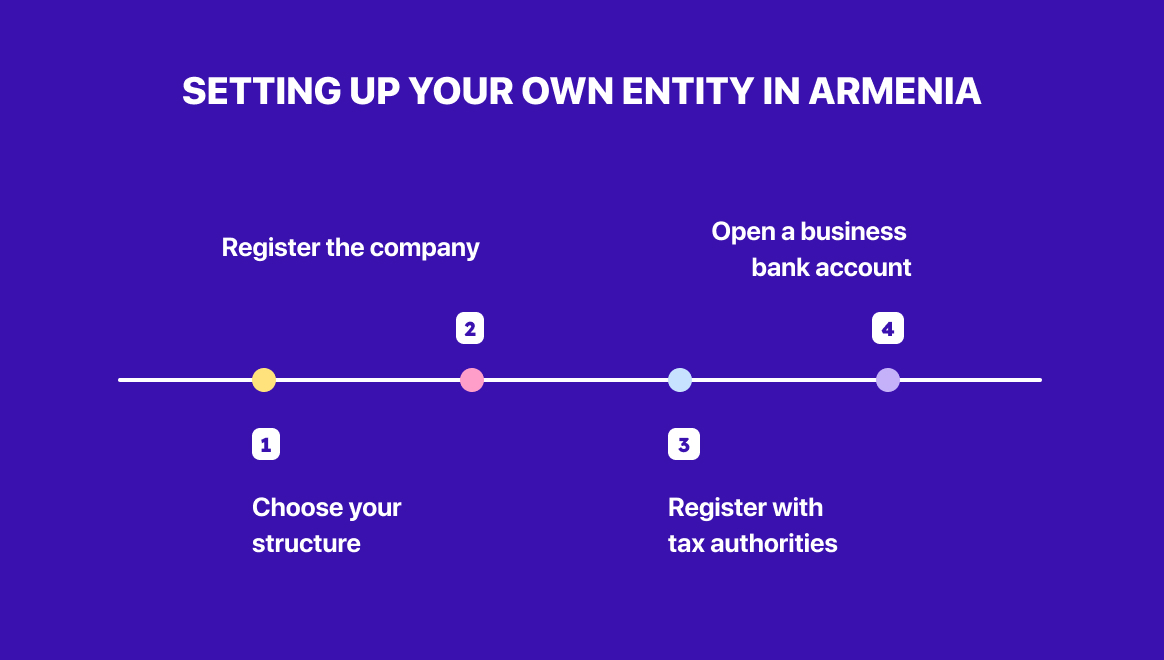
EOR: Preferred for market entry. Armenia's IT sector grew 24.5% in Q1 2025 — companies moving quickly to access that talent pool do not want to wait for entity registration.
PEO VS EOR in Azerbaijan
PEO: Not practical without an entity, and Azerbaijan has the most stringent work authorization framework in the Caucasus. Even with a co-employer, the immigration process for foreign workers requires a registered Azerbaijani employer as the sponsor.
EOR: The only compliant path for companies without an Azerbaijani entity. Employer social contributions of approximately 17–24.5% on top of gross salary — the highest in the region — are a payroll complexity the EOR manages as standard.
PEO VS EOR in Turkey
PEO: Viable with a registered entity. Turkey's labour code is complex, with progressive income tax up to 40%, 22.75% employer social contributions, annual minimum wage reviews, and specific C-suite title limitations under the EOR model. A PEO supporting an established Turkish entity provides meaningful HR administration support.
EOR: The right entry model for companies hiring in Turkey for the first time. Turkey is a large and strategically important market; EOR gives you access without the six-month entity setup timeline.
PEO VS EOR in India
PEO: Viable with a registered entity. India specialist PEO and payroll providers are a strong choice for companies with established India operations wanting to reduce the internal HR burden of EPF, ESIC, Gratuity, Professional Tax, and TDS management.
EOR: The fastest compliant path for companies without an India entity. India-specialist EOR providers (a category where regional depth consistently outperforms global aggregators) typically charge $150–$250 per employee per month — significantly below the $450–$700 charged by global platforms.
PEO VS EOR in Kazakhstan and Uzbekistan
PEO: Theoretically viable with entities in each country. In practice, entities in Kazakhstan and Uzbekistan are operationally complex and rarely justified for small teams.
EOR: The practical default. Kazakhstan's 90/10 quota rule and Uzbekistan's new State Social Insurance Law (effective January 2026) are the kinds of compliance specifics that regional EOR operators handle as standard — and that PEO arrangements cannot resolve when you lack the foundational entity.
For companies relocating foreign employees into any of these markets, the entity question is even more critical. Work permit sponsorship, relocation support, and housing allowance tax treatment all require the EOR's legal employer status to function. See our guide on relocation legal requirements and employer obligations.
Comparison Table: PEO vs EOR Across 12 Criteria
| Criteria | PEO | EOR |
| Legal employer | Shared (co-employment) — your company remains a legal employer | Sole legal employer is the EOR |
| Local entity required | Yes — the client must have a registered entity | No — the EOR's entity replaces yours |
| Employment contract issuer | Both parties (co-employer arrangement) | EOR only |
| Legal liability | Shared between client and PEO | Substantially transferred to EOR |
| Work permit / visa sponsorship | Complex — client entity must co-sponsor or EOR acts as sole employer | Yes — EOR sponsors as sole legal employer |
| Benefits access | Strong — pooled group rates across client workforce | Standard — statutory + supplementary, market-specific |
| Payroll processing | Included | Included |
| Labor law monitoring | Advisory support — client retains compliance responsibility | EOR monitors and updates employment terms proactively |
| Termination management | Advisory — client remains exposed | EOR executes termination under local law |
| Cost structure | Lower per-employee fee + mandatory entity costs | Higher per-employee fee, zero entity cost |
| Market entry speed | Slow — entity required first (3–9 months) | Fast — hiring in days |
| Exit flexibility | Low — entity wind-down takes 6–12 months | High — standard notice period, no entity to dissolve |
| Best for | Established operations with entities, domestic/known markets | New market entry, no entity, high compliance risk |
| Geography | Primarily domestic or established international markets | Designed for international expansion and emerging markets |
Decision Framework: 6 Questions to Find Your Answer
Work through these questions in sequence. The answer to the first one usually determines the model.

Do you have a registered legal entity in the target country?
Yes → PEO is an option. Continue to Question 2.
No → EOR is the only compliant path for direct employment. Stop here.
Are you hiring foreign nationals who need work permit sponsorship?
Yes → EOR provides cleaner, more direct immigration sponsorship capability, even if you have an entity. Consider EOR unless your entity is already an established employer of record in that market.
No → Continue to Question 3.
How many employees are you planning to hire in this country?
1–15 → EOR is almost always more cost-effective in total, even with higher per-employee fees, because you avoid entity setup and maintenance costs.
15–20+ → Begin entity evaluation. At this scale, the amortized entity cost starts competing with EOR fees.
20+ with long-term commitment → Entity + PEO or direct payroll provider may make more sense long-term.
How long do you plan to operate in this market?
Testing — 6–18 months with exit possibility → EOR. Clean exit without entity wind-down.
Long-term, 3+ years → Evaluate entity setup alongside EOR. Use EOR to start, build toward entity if scale justifies.
How familiar are you with the local labour law and compliance environment?
Unfamiliar — no in-country HR or legal team → EOR absorbs the compliance monitoring and update responsibility. PEO requires you to stay informed independently.
Familiar — in-country team or strong local legal counsel → PEO is more viable if you have the entity and the expertise to manage co-employment compliance.
Do you need group benefits at competitive rates for employee retention?
Yes, in the US or an established Western market → PEO has a real advantage. Group insurance pooling is a meaningful PEO differentiator in those markets.
In emerging markets (Caucasus, Central Asia, MENA, India) → EOR is typically more relevant. The statutory benefit obligations and supplementary benefit expectations are market-specific, not pooled.
The Right Model for Your Expansion
The question is not which model is better in the abstract. It is the model that applies to your specific situation.
If you already have entities in your target markets and want to improve HR administration, benefits access, and compliance support, PEO is a strong choice, particularly in the US and established Western markets.
If you are entering Georgia, Armenia, Azerbaijan, Turkey, India, Kazakhstan, Uzbekistan, or Egypt without a local entity, employer of record services are not just the better choice. They are often the only compliant path forward.
Team Up operates owned legal entities across all eight of those markets. In-country teams in Tbilisi, Yerevan, Istanbul, Almaty, and Tashkent manage every employment relationship directly, not through aggregator partners. EOR services start at €199 per employee per month in Georgia, with full compliance coverage, direct immigration sponsorship, and payroll management as standard.
Frequently Asked Questions
Can a PEO sponsor work permits for foreign nationals entering a new country?
Not without a registered entity in that country. Work permit sponsorship requires the sponsoring employer to be a registered legal entity with active tax and payroll compliance in the target jurisdiction. In a PEO co-employment arrangement, if your company does not have an entity in the target country, there is no recognised employer to file the permit application. An EOR with owned entities in target markets can sponsor directly as the sole legal employer. For country-specific guidance on work permit requirements and sequencing, see our guide on work permit processes for EOR-employed staff.
Is a PEO cheaper than EOR for international hiring?
The per-employee service fee is lower with a PEO (typically 2–12% of payroll or $40–$200/month) than with an EOR ($199–$800+/month). But the PEO model requires a local entity, which costs $20,000–$250,000 to establish, plus $30,000–$80,000 per year in ongoing compliance. For teams of 1–15 employees in a new market, EOR is almost always cheaper in total first-year cost. The PEO model becomes more cost-effective once the entity is already established and the team is large enough to amortise entity overhead.
What does "co-employment" mean in practice for an employee?
In a co-employment arrangement, the employee may receive payslips under the PEO's name for payroll purposes, but their employment relationship with your company is real and recognised. Your company makes all operational decisions — who to hire, what to pay, what to work on, and when to terminate. The PEO handles administrative functions and shares compliance responsibility. For the employee, the experience is often seamless — better benefits access, more professional HR support — but their manager is still you.
Can I use both a PEO and an EOR simultaneously?
Yes. Many companies do. A PEO for domestic employees where an entity exists, and an EOR for international hires in markets without entities. The models serve different geographies and do not conflict. The key is being clear internally about which employees sit under which arrangement — particularly for compliance reporting, benefits administration, and who bears employer liability in each jurisdiction.
When should I transition from EOR to a PEO or direct entity?
The transition typically makes sense at 15–20+ employees in a single country with a 3+ year commitment, when the amortised entity cost per employee becomes lower than the ongoing EOR service fee. The process involves registering a local entity, setting up employer tax registrations, transferring employees from EOR employment contracts to your entity's direct employment (following local labour law transfer requirements), and engaging a payroll provider or PEO to support the operational HR function. Budget 2–4 months and appropriate legal costs for the transfer process.
.svg)