Workspace and Remote Work Support EORs Offer Employees in France
Our parent guide to employee benefits, insurance, and workspace outlines the broad role an EOR plays across French benefits administration, social protection, and workspace support. This article goes deeper on the workspace dimension specifically. It covers the legal obligations French employers face when supporting remote workers, how EORs structure coworking and home-office arrangements, what equipment and expense rules apply under French labor law, and the cross-border complications that arise when remote employees split time between France and another jurisdiction.
France treats remote work as a structured employer obligation. That distinction creates compliance requirements most foreign companies underestimate.
French Legal Framework for Remote Work Arrangements
France regulates remote work more formally than most EU member states. The framework sits across multiple legal sources.
The Code du Travail and Télétravail Provisions
The Code du Travail (French Labour Code) defines télétravail in Articles L1222-9 through L1222-11. These provisions establish that remote work must be voluntary for the employee and formalized either through a collective agreement or a company charter. An employer cannot impose remote work unilaterally except in exceptional circumstances such as a public health emergency.
The Labour Code requires the employer to cover costs arising directly from remote work. This is not optional. It includes internet access, electricity consumption, and any equipment the employee needs to perform their role. French courts have consistently upheld this principle.
The Right to Disconnect
France's droit à la déconnexion (right to disconnect), codified in the Labour Code since 2017, requires companies with 50 or more employees to negotiate policies limiting after-hours digital communication. An EOR operating as the legal employer in France must build this into employment contracts and internal policies. Failing to address the right to disconnect exposes the employer to labor inspectorate scrutiny.
ANI Framework Agreement
The Accord National Interprofessionnel (ANI) of November 2020 on télétravail provides additional guidance. It clarifies that remote work arrangements should specify the number of remote days, the equipment provided, and how the employer monitors working conditions at the remote location. The ANI is not binding law in the same way as the Code du Travail. But it shapes collective bargaining agreements that many sectors follow.
For companies hiring in France through an employer of record, the EOR bears direct responsibility for compliance with all three layers. The foreign client company does not negotiate with French unions or draft the télétravail charter. The EOR does.
How EORs Structure Workspace Provision in France

Home-Office as the Default Model
Most EOR-employed workers in France operate from home. The EOR formalizes this through a télétravail clause in the employment contract. That clause specifies the agreed number of remote days per week, the employer's equipment obligations, and the expense reimbursement structure.
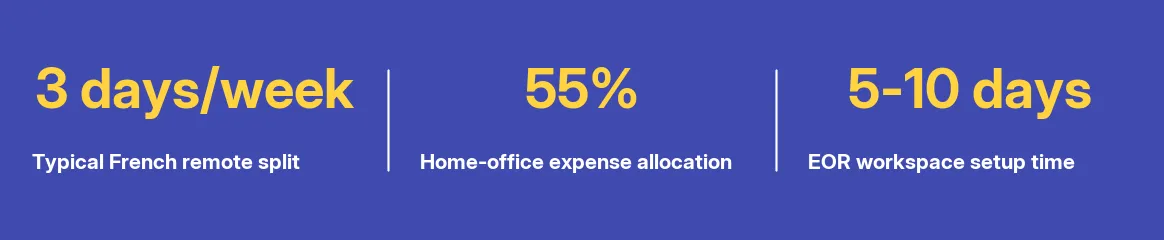
A UK fintech company hiring three product managers in Lyon through an EOR had each employee working four days remotely and one day from a coworking space. The EOR drafted individual télétravail agreements, procured monitors and ergonomic chairs, and set up monthly expense reimbursements for internet and electricity. The entire setup completed in eight business days.
Coworking Space Access
When a role requires in-person collaboration or the employee lacks a suitable home workspace, the EOR arranges coworking access. This typically involves a partnership with a coworking provider in the employee's city. Paris, Lyon, Marseille, Bordeaux, and Toulouse all have deep coworking markets.
The EOR signs the membership agreement as the legal employer. The employee receives a pass or booking allocation. Costs flow through the EOR's payroll administration rather than requiring the employee to pay and seek reimbursement. TeamUp offers dedicated workspace solutions for exactly this kind of arrangement.
Hybrid Models and Client-Site Work
Some EOR arrangements involve employees working partly from a client's French office. This creates a co-activity situation under French labor law. The EOR must ensure the employee's working conditions at the client site meet occupational health and safety standards. A formal agreement between the EOR and the client typically addresses access rights, emergency procedures, and liability allocation.
Equipment, Expense Reimbursement, and Employer Obligations
French law places equipment and expense obligations squarely on the employer. The EOR, as the legal employer, carries these obligations in full.
What the Employer Must Provide
The Code du Travail does not prescribe an exact equipment list. But established case law and URSSAF (the French social security collection body) guidance create a clear standard. The employer must provide or reimburse:
- Laptop or desktop computer suitable for the role
- Monitor, keyboard, and mouse if the role requires extended screen work
- Ergonomic desk chair meeting occupational health standards
- Internet connection costs attributable to professional use
- Electricity costs during working hours
- Phone or phone plan if the role requires voice communication
The EOR either procures equipment directly and ships it to the employee, or reimburses the employee under a documented policy. TeamUp handles equipment provisioning as part of its EOR service in markets where it operates.
URSSAF-Compliant Expense Allocation
URSSAF publishes guidance on how to allocate home-office expenses between professional and personal use. The allocation methodology matters because it determines whether reimbursements qualify as exempt from social contributions.
| Expense Category | Typical Allocation Method | Social Contribution Treatment |
|---|---|---|
| Internet | Pro-rata by working hours | Exempt if documented |
| Electricity | Pro-rata by workspace area and hours | Exempt if documented |
| Equipment purchase | 100% professional if role-specific | Exempt |
| Home insurance supplement | Proportional to workspace area | Exempt if justified |
| Furniture (desk, chair) | 100% professional | Exempt with invoice |
The EOR must retain documentation supporting each allocation. URSSAF audits can go back three years. An undocumented flat allowance risks reclassification as taxable salary, triggering back-contributions and penalties.
Watch out: A flat monthly "remote work allowance" without documented allocation methodology can be reclassified by URSSAF as disguised salary. The EOR must maintain per-category records linking each reimbursement to actual professional use.
Occupational Health at Home
French employers bear responsibility for employee health and safety even at the home workspace. The EOR must verify that the home office meets basic ergonomic standards. In practice, this means an initial self-assessment questionnaire completed by the employee, covering desk height, lighting, ventilation, and electrical safety. Some EORs supplement this with a virtual ergonomic consultation.
The health insurance and social protection obligations that apply to office-based employees extend identically to remote workers. Workplace accidents occurring during télétravail hours at the designated home workspace are covered under the same régime général.
Managing Cross-Border Remote Work Through a French EOR

Remote work creates cross-border complications when an employee hired in France works temporarily from another country.
Social Security and the A1 Certificate
Under EU Regulation 883/2004, an employee working in two or more EU member states may trigger split social security obligations. If a French EOR employee spends more than 25% of working time in their country of residence outside France, social security may shift to that other country.
The EOR manages this by monitoring the employee's work location. For short-term travel within the EU, the EOR obtains an A1 portable document from URSSAF confirming continued French social security coverage. Without the A1, the employee risks double contributions.
Tax Residency and Permanent Establishment Risk
A French EOR employee working remotely from Germany for extended periods could create a permanent establishment (PE) risk for the client company under the France-Germany tax treaty. The EOR structure reduces but does not eliminate this risk entirely.
The critical variable is whether the employee exercises decision-making authority on behalf of the client in the other jurisdiction. Companies hiring through an EOR for work visa purposes should coordinate immigration and tax planning together. An employee with a French work permit who relocates to another EU country raises both PE and immigration questions simultaneously.
Standard EOR practice limits remote work from outside France to 30 to 90 calendar days per year. Beyond that threshold, the EOR typically requires a formal multi-country arrangement or a separate employment structure in the second country.

FAQs
Can a French EOR employee refuse to return to an office if their contract specifies télétravail?
Yes, if the employment contract or télétravail agreement specifies full remote work. The employer cannot unilaterally change this condition. Modifying the remote work arrangement requires the employee's written consent under French law. The exception is force majeure, where the employer can temporarily require office attendance. But reversing a contractual remote arrangement permanently requires a formal contract amendment process.
Does the EOR need to conduct a physical inspection of the home workspace?
French law does not mandate a physical inspection. The employer must verify that the workspace meets basic health and safety standards, but this is typically done through a self-assessment form completed by the employee. Some collective bargaining agreements in specific sectors require more rigorous checks. The EOR follows the applicable convention collective for the employee's industry classification, which may impose additional verification steps beyond the Labour Code minimum.
What happens if an EOR employee in France works from a café or public space instead of their declared home office?
The télétravail agreement designates a specific work location. Working from an undeclared location creates insurance complications. A workplace accident at a café would not automatically qualify as an occupational accident under the régime général because it occurred outside the designated workspace. The EOR should clarify location requirements in the contract and address occasional mobile work through a separate clause covering nomadic working arrangements.
How does a French EOR handle workspace costs when the employee moves cities within France?
The employment contract specifies the employee's work location. A city change may require a contract amendment. The EOR reassesses coworking options in the new city and adjusts expense reimbursements based on local cost differences. Paris-based employees typically generate higher workspace costs than those in Bordeaux or Nantes. The EOR recalculates the URSSAF-compliant allocation for the new residence and updates the monthly reimbursement structure accordingly.
What to Watch Next
French remote work regulation continues evolving. The government has signaled further refinements to télétravail rules, particularly around employer monitoring of remote workers and digital surveillance limits. URSSAF periodically updates its expense allocation thresholds, and new collective bargaining agreements regularly modify sector-specific remote work conditions. Track the applicable convention collective for your employee's industry. Review your EOR's télétravail charter annually against current ANI guidance. Build a 90-day review cycle for any employee whose cross-border work patterns approach the 25% threshold under EU social security coordination rules.
If you are hiring remote workers in France and need workspace, equipment, and expense compliance handled from day one, talk to TeamUp about your setup.
Written by the TeamUp Editorial Team. TeamUp provides EOR, payroll, and workspace solutions across 20+ countries, with owned legal entities in its core markets and in-country offices in Tbilisi, Yerevan, Istanbul, Almaty, and Tashkent.
.svg)