How to Onboard an Employee Through an EOR in France: A Step-by-Step Guide for 2026
Our guide to why companies choose an EOR in France covers the strategic reasons behind that decision. This article goes deeper on what happens after you choose. Specifically, the onboarding process itself.
Onboarding through an EOR in France is not a single event. It is a compliance sequence that starts weeks before the employee's first day and continues through the first payroll cycle. French labor law imposes strict requirements on employment contracts, social security registration, and mandatory benefits enrollment. Missing a step does not just delay the hire. It can trigger penalties from URSSAF or expose the arrangement to requalification risk.
This guide walks through each phase, from pre-contract due diligence to post-onboarding compliance obligations.
Pre-Onboarding: What Happens Before the Contract
Scoping the Role and Compensation Structure
The onboarding process begins before a contract is drafted. Your EOR needs to understand the role, its classification under French collective bargaining agreements, and the total compensation package.
France operates under a system of conventions collectives (collective bargaining agreements). These are sector-specific agreements that set minimum salary floors, job classifications, and mandatory benefits above the statutory baseline. The Syntec convention covers IT and consulting roles. The Métallurgie convention covers engineering and manufacturing.
Your EOR identifies which convention applies to the role. This determines minimum pay, overtime rules, and supplementary benefits. Getting this wrong affects every payroll calculation that follows.
Gathering Employee Information
Before drafting the contract, the EOR collects documents from the incoming employee. The standard set includes:
- Valid identity document (national ID card or passport)
- Proof of address in France
- Social security number (numéro de sécurité sociale) or application receipt
- RIB (relevé d'identité bancaire) for salary payments
- Mutual health insurance preferences or existing coverage details
For non-EU nationals, additional documents come into play. The EOR verifies work authorization status and confirms the employee holds a valid titre de séjour with work permission. A UK SaaS company hiring its first French sales lead through an EOR would need the provider to confirm residency and work authorization before any contract is issued. This verification step typically adds 3 to 5 business days.
Drafting the Employment Contract
French law requires a written employment contract. For CDI (contrat à durée indéterminée) agreements, while not technically mandatory in writing, standard practice and collective agreements almost always require one. For CDD (contrat à durée déterminée) fixed-term contracts, a written document is legally required.
The contract must be in French. Bilingual versions are common for international hires, but the French-language version governs in any dispute. The EOR drafts this contract incorporating all mandatory clauses the applicable convention collective requires.
The Onboarding Sequence: From Signed Offer to First Payroll

The DPAE Filing
The Déclaration Préalable à l'Embauche (DPAE) is the single most time-sensitive filing in French onboarding. The EOR must submit it to URSSAF no earlier than 8 calendar days before the start date and no later than the day before work begins.
This is non-negotiable. Employing someone without a filed DPAE constitutes travail dissimulé (concealed employment). Penalties are severe. URSSAF can impose administrative fines, and the employer faces potential criminal liability.
The EOR handles this filing electronically through the URSSAF portal. Confirmation arrives within 24 hours in most cases.
Social Security and Benefits Registration
Once the DPAE clears, the EOR registers the employee with the relevant social security bodies. France's social protection system covers health insurance, family benefits, retirement, and unemployment insurance. Employer contributions fund this system.
French law mandates that every employer provide a mutuelle (complementary health insurance). The employer must cover at least 50% of the premium. The EOR selects a compliant group plan and enrolls the employee during onboarding. As detailed in our overview of how EOR services work in France, this benefit management is a core part of the provider's compliance responsibility.
The EOR also enrolls the employee in prévoyance (supplementary disability and death insurance). Many collective agreements make prévoyance mandatory for cadre-level employees from day one.
The Medical Visit
French employers must schedule a visite d'information et de prévention (VIP) within three months of the start date. For employees in roles with specific health risks, a reinforced medical examination is required before they begin work. The EOR coordinates this with the local service de santé au travail (occupational health service).
| Onboarding Element | Deadline | Who Handles It |
|---|---|---|
| DPAE filing | Day before start date | EOR |
| Mutuelle enrollment | From first day of employment | EOR |
| Prévoyance enrollment | Per collective agreement terms | EOR |
| Medical visit (VIP) | Within 3 months of start | EOR coordinates |
| First bulletin de paie | End of first pay period | EOR |
Post-Onboarding Compliance: What Keeps the Employment Legal
Monthly Payroll Obligations
France requires employers to issue a bulletin de paie (payslip) every pay period. This document is not a summary. It is a legally specified breakdown of gross pay, each individual social contribution, tax withholding under the prélèvement à la source system, and net pay.
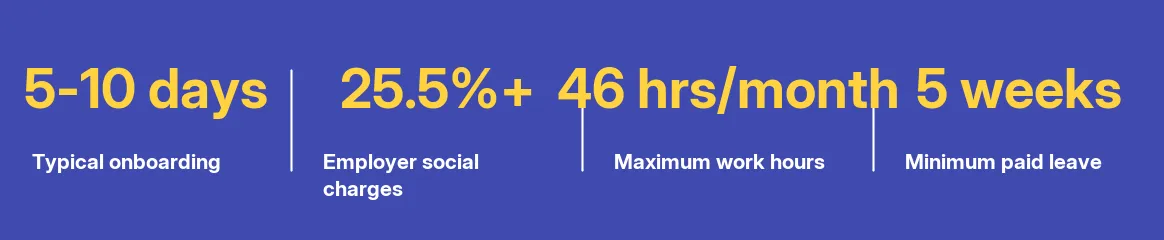
The EOR calculates and remits employer social charges to URSSAF monthly. These charges fund health insurance, pension, unemployment, and family benefits. The combined employer-side rate exceeds 25% of gross salary. The exact percentage varies based on salary level and applicable collective agreement.
Watch out: France's DSN (Déclaration Sociale Nominative) replaced most legacy social declarations. The EOR must file this unified monthly report electronically by the 5th or 15th of the following month, depending on company size. A missed DSN filing triggers automatic penalties from URSSAF.
Ongoing Record-Keeping
French labor law requires employers to maintain several registers. The registre unique du personnel must list every employee with their hire date, contract type, and qualification. The EOR maintains this register as the legal employer.
Working time records are equally critical. France's 35-hour statutory workweek means the EOR must track hours, overtime, and rest periods. For cadre employees on a forfait jours (fixed annual days worked) arrangement, the EOR monitors annual day counts instead. The maximum under most collective agreements is 218 working days per year.
The EOR stores employment records for the legally required retention periods. Payroll records must be kept for five years. Employment contracts should be retained for the duration of employment plus the applicable statute of limitations.
Managing the Employee Relationship After Day One

The Client-EOR-Employee Triangle
The EOR is the legal employer. You direct the employee's daily work. This dual relationship requires clear boundaries.
French courts scrutinize EOR arrangements for signs of prêt de main-d'oeuvre illicite (illegal labor lending). The EOR must retain genuine employer authority over employment terms, disciplinary matters, and contractual changes. You manage tasks, projects, and performance goals. Blurring these lines creates legal risk.
A Berlin fintech company using an EOR to employ three product designers in Lyon would give design briefs and sprint feedback directly. The EOR would handle contract amendments, leave approvals, and any disciplinary processes. This separation is not bureaucratic formality. It is what keeps the arrangement legal under French labor law.
Amendments, Renewals, and Offboarding
Any material change to employment terms requires a formal contract amendment (avenant). Salary increases, role changes, or modifications to working hours all need written documentation. The EOR prepares these amendments in compliance with applicable conventions collectives.
Companies hiring across multiple European markets often discover that France's employment protections are more employee-favorable than most. If you are also building teams in France through an EOR, understanding the onboarding process prevents costly surprises during offboarding. Termination in France requires specific procedures, notice periods defined by the collective agreement, and indemnité de licenciement (severance) calculations based on tenure.
For companies comparing EOR providers in France, onboarding depth is a meaningful differentiator. Some providers handle DPAE and payroll but outsource benefits administration. Others manage the full cycle internally.

FAQs
Can an EOR onboard a non-EU national who does not yet have a work permit in France?
The EOR can sponsor certain work authorization categories because it acts as the legal employer. The process involves filing with the local DIRECCTE (now DREETS) and the French consulate in the employee's home country. Timelines vary by permit type, but the autorisation de travail process alone typically takes 4 to 8 weeks after submission. The EOR cannot start employment until the permit is granted and the employee holds a valid titre de séjour.
What happens if the wrong collective bargaining agreement is applied during onboarding?
Applying the wrong convention collective means every payroll calculation, benefit enrollment, and overtime rule may be incorrect. The employee can claim the more favorable terms from either agreement. URSSAF may also recalculate contributions retroactively. Correcting the error requires issuing amended payslips, adjusting social charges, and potentially paying back-pay differences with interest.
How quickly can an EOR complete onboarding for someone already residing in France with work authorization?
When documentation is ready and the employee holds valid work authorization, onboarding typically completes in 5 to 10 business days. The DPAE filing takes 24 hours for confirmation. Mutuelle and prévoyance enrollment happen simultaneously. The main variable is scheduling the medical visit with the local occupational health service, which sometimes has a waiting list of several weeks.
Does the employee's trial period start on the contract signature date or the actual first working day?
The période d'essai (trial period) begins on the employee's first actual working day, not the contract signature date. Duration depends on the employee's classification under the applicable collective agreement. For cadre-level employees, the initial trial period under French law can run up to four months, renewable once if the collective agreement and the contract both permit renewal. Any suspension (illness, leave) extends the trial period by the equivalent duration.
What to Prepare Next
French onboarding requirements shift as collective agreements are renegotiated and URSSAF updates its filing platforms. Monitor the DSN reporting calendar each year for deadline changes. Review your EOR's mutuelle and prévoyance coverage annually against collective agreement minimums. If you plan to scale beyond France, map out which markets share similar social security structures and which require entirely different onboarding workflows.
If you need a walkthrough of onboarding timelines and costs for your first French hire, TeamUp can prepare a country-specific breakdown. Request a consultation.
Written by the TeamUp editorial team. TeamUp operates direct entities across the Caucasus, Central Asia, Turkey, India, and Eastern Europe, supporting compliant hiring for 200+ businesses across 20+ countries.
.svg)