Health Insurance and Social Protection Under EOR Arrangements in France
Our guide to employee benefits, insurance, and workspace covers the full scope of what French EOR employees receive. This article goes deeper on one critical piece: the health insurance and social protection architecture that applies when an EOR legally employs your workforce in France.
France operates one of the most comprehensive social protection systems in Europe. The obligations are not optional. They are statutory, layered, and enforced through employer-side contributions that rank among the highest globally. An employer of record in France assumes all of these obligations as the legal employer. That includes enrollment in the public health system, mandatory complementary health insurance, and contributions to disability, maternity, and retirement funds.
This article breaks down each layer. It covers what the EOR must register, what it must fund, and where gaps can expose your employee or your company.

How France's Social Protection System Works for EOR Employees
France's social protection operates through the Sécurité Sociale, a unified framework with five distinct branches. Each branch covers a different risk category. The EOR, as the legal employer, registers employees and remits contributions across all five.
The Five Branches
The five branches of French social security cover health, workplace accidents, retirement, family benefits, and unemployment. Collectively, these branches create a safety net that applies from an employee's first day.
- Maladie (health insurance): covers medical care, prescriptions, hospital stays, and daily cash benefits during illness
- Accidents du travail / Maladies professionnelles (workplace accidents and occupational illness): covers treatment costs and income replacement for work-related injuries
- Retraite (retirement): funds the state pension through contributions to CNAV and complementary pension schemes like AGIRC-ARRCO
- Famille (family benefits): finances allowances for childcare, housing, and family support through the CAF
- Chômage (unemployment): funded through contributions to France Travail (formerly Pôle Emploi)
Each branch collects contributions as a percentage of gross salary. The employer's share is significantly larger than the employee's share.
EOR Registration Obligations
The EOR registers each employee with URSSAF, the collection body that administers social security contributions. URSSAF issues the employer's SIRET number and processes the Déclaration Sociale Nominative (DSN), a monthly electronic filing that reports salary, contributions, and employment data for every employee.
A late or incorrect DSN triggers penalties. URSSAF audits are common. The EOR must also file a Déclaration Préalable à l'Embauche (DPAE) before the employee's first working day. This pre-hire declaration is mandatory and must reach URSSAF at least eight days before the start date.
For foreign nationals, the EOR coordinates with immigration authorities alongside URSSAF enrollment. Details on that process appear in our guide to work permits and visas for EOR hires in France.
Contribution Rates and Cost Impact
French employer social charges are among the highest in the OECD. The total employer-side burden typically runs between 40% and 50% of gross salary, depending on salary level and applicable exemptions.
Key components include health insurance, retirement (base and complementary), unemployment, family allowances, workplace accident insurance, and several smaller levies. The exact rate fluctuates based on the employee's compensation band and any applicable reductions such as the réduction générale (Fillon reduction) for lower salaries.
| Contribution Category | Paid By | Approximate Share of Gross |
|---|---|---|
| Health insurance (Maladie) | Employer + Employee | Employer ~13%, Employee ~0.5% |
| Retirement (CNAV base) | Employer + Employee | Employer ~8.5%, Employee ~6.9% |
| AGIRC-ARRCO (complementary pension) | Employer + Employee | Employer ~5-6%, Employee ~3-4% |
| Unemployment (France Travail) | Employer only | ~4% |
| Family allowances (CAF) | Employer only | ~3.5-5.25% |
| Workplace accidents | Employer only | Variable by sector |
These rates shift periodically. Confirm current percentages on the URSSAF portal before budgeting.
Mandatory Health Coverage: Sécurité Sociale Through an EOR
Every employee in France receives public health coverage from day one. This is not contingent on tenure. It is automatic upon registration.
What the Public System Covers
The French public health system reimburses a fixed percentage of medical costs. The standard reimbursement rate for general practitioner consultations is 70%. Hospital stays are typically reimbursed at 80%. Prescription drugs vary between 15% and 100% depending on the medication's classification.
The gap between the reimbursement rate and the actual cost is called the ticket modérateur. This is the portion the employee pays out of pocket, unless a complementary insurance plan covers it. That is where the mutuelle comes in.
How the EOR Ensures Continuity
The EOR's DSN filing automatically enrolls the employee in the Caisse Primaire d'Assurance Maladie (CPAM), the local health insurance fund. The employee receives an attestation de droits confirming their coverage. They also receive or update their Carte Vitale, the electronic health card used at pharmacies and medical offices.
If the employee previously worked for another French employer, their rights transfer without interruption. If they are new to France, the EOR's DPAE filing initiates the affiliation process. First-time enrollments can take several weeks. During that window, the employee can still access care and request reimbursement retroactively.
For employees who also need workspace and remote setup support, the EOR coordinates health coverage alongside ergonomic and equipment obligations. Both fall under the employer's duty of care.
Complementary Health Insurance (Mutuelle) Obligations
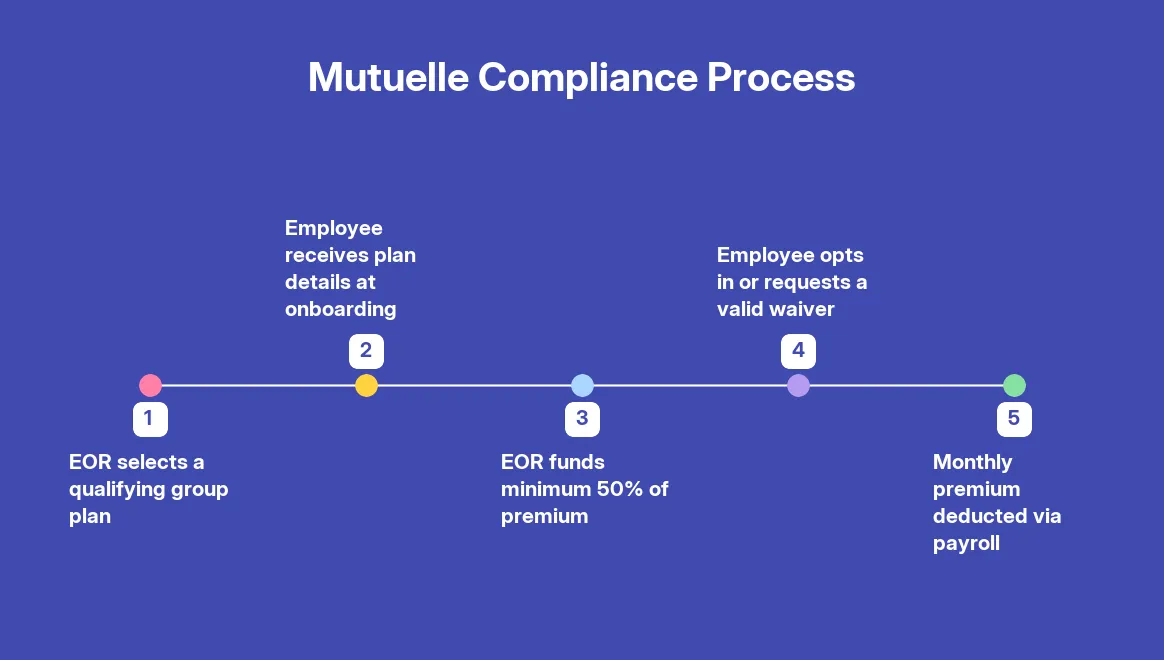
Since the ANI agreement of 2013 and its implementing legislation, every private-sector employer in France must provide a group complementary health plan. The EOR bears this obligation in full.
Minimum Coverage Requirements
The plan must meet a minimum benefits floor defined by regulation. This floor includes full coverage of the ticket modérateur for consultations and hospital stays, a dental care allowance, an optical allowance renewed periodically, and full coverage of the hospital daily surcharge (forfait journalier).
Plans that fall below this floor are non-compliant. URSSAF can reclassify the employer's contributions as taxable compensation, triggering back taxes and penalties.
Employer Funding Rules
The EOR must fund at least 50% of the mutuelle premium. Many EOR providers exceed this minimum to remain competitive in talent markets. The employer's contribution is exempt from social charges up to a regulatory ceiling. Exceeding that ceiling converts the excess into taxable income for the employee.
The employee may waive participation only under specific circumstances. Valid waivers include employees already covered as dependents under a spouse's plan, employees on a fixed-term contract shorter than 12 months, or employees who held individual coverage at the time of hire. The EOR must document these waivers in writing.
Portability After Termination
When the employment relationship ends, the employee retains mutuelle coverage under portabilité. This continuation lasts for the duration of their unemployment period, capped at 12 months. The former employer (the EOR) does not fund this extension. The cost is mutualized across the group plan's active members.
Watch out: If the EOR's group mutuelle plan does not meet the regulatory minimum basket of care, URSSAF can retroactively strip the tax-exempt status of all employer contributions. This creates a back-tax liability for every employee on that plan, not just new hires.
Navigating Leave, Disability, and Long-Term Benefits

French social protection extends well beyond medical care. The EOR manages several leave and disability entitlements that carry strict procedural requirements.
Sick Leave and Daily Allowances
When an employee falls ill, they must provide a medical certificate (arrêt de travail) within 48 hours. The CPAM pays indemnités journalières (daily allowances) starting from the fourth day of absence. These allowances replace roughly 50% of the employee's daily reference salary, subject to a ceiling.
The employer (the EOR) supplements this under most collective bargaining agreements. Many conventions collectives require the employer to top up sick pay to 90% of gross salary for the first 30 days, then 66% for the following 30 days. The applicable convention depends on the employee's sector classification.
Maternity, Paternity, and Adoption Leave
Maternity leave in France lasts a minimum of 16 weeks for a first or second child. The CPAM funds daily allowances during this period. The EOR must hold the employee's position and cannot terminate the contract during protected periods before, during, and after maternity leave.
Paternity leave has expanded in recent years. The current statutory entitlement is 25 calendar days for a single birth. The CPAM funds this leave directly. The EOR processes the payroll adjustments and ensures the DSN reflects the leave period accurately.
Long-Term Disability and Invalidity
If an employee's condition persists beyond six months, the CPAM may classify them under the invalidité regime. This provides a pension based on the employee's category of disability. Category 1 covers employees who can still work part-time. Category 2 covers those who cannot work at all. Category 3 covers those who need assistance from another person.
The EOR's benefits administration responsibilities include coordinating with the CPAM on category assessments and adjusting payroll to reflect any partial return to work.
Retirement Contributions and Vesting
Every month of EOR employment generates retirement credits under both the CNAV base regime and the AGIRC-ARRCO complementary scheme. These credits vest immediately. The employee loses nothing if they leave the EOR arrangement or change employers. All credits follow the individual throughout their career.

FAQs
Can an EOR employee in France access the same public healthcare as a direct hire?
Yes. The Sécurité Sociale makes no distinction based on how the employment relationship is structured. The EOR's URSSAF registration and DSN filings create the same affiliation as any other private-sector employer. The employee receives identical CPAM coverage, the same Carte Vitale, and the same reimbursement rates. The only variable is the quality of the complementary mutuelle plan the EOR selects, which can differ between providers.
What happens to health coverage if the EOR contract ends mid-year?
The employee retains mutuelle coverage through portabilité for up to 12 months, matching their unemployment period. Public health coverage through CPAM continues as long as the individual remains a French resident. If they leave France, coverage depends on bilateral social security agreements between France and their destination country. EU citizens retain rights under EU coordination regulations.
Does the convention collective affect what the EOR must provide?
Absolutely. France has hundreds of sector-specific collective bargaining agreements. Each one can impose obligations above the statutory minimum for sick pay top-ups, mutuelle coverage levels, additional paid leave, and end-of-year bonuses. The EOR must identify the correct convention based on the company's activity code. Applying the wrong convention exposes the EOR to back-pay claims and URSSAF penalties.
Are part-time EOR employees entitled to the same social protection?
Part-time employees receive full Sécurité Sociale affiliation regardless of hours worked. Their contribution amounts are proportional to salary, but the coverage scope is identical. The EOR must still offer the group mutuelle plan and fund at least 50% of the premium. Part-time status does not create a valid waiver ground. The only difference is that daily allowances for sick or maternity leave are calculated on a lower reference salary, reducing the cash benefit amount.
What to Watch Next
France regularly adjusts social security contribution ceilings, mutuelle minimum baskets, and leave entitlements through annual budget legislation and regulatory decrees. The Plafond de la Sécurité Sociale (PASS) resets each January, affecting contribution caps across multiple branches. Monitor the URSSAF and Ameli portals for updates before each payroll cycle. If you are building a team in France and want clarity on your total employer cost before the first hire, a structured cost estimate prevents surprises.
If you need a France-specific cost breakdown covering social charges, mutuelle, and total employer burden, request an estimate from TeamUp.
Written by the TeamUp Editorial Team. TeamUp helps companies hire compliantly across 20+ countries through owned legal entities, with in-country offices in Tbilisi, Yerevan, Istanbul, Almaty, and Tashkent. Founded 2020. 200+ businesses supported. 92% client retention over five years.
.svg)