Work Permits, Visas & Immigration When Hiring via EOR in France
- What Is an Employer of Record and How Does It Work in France
- How an EOR Handles Work Permits and Visas in France
- EOR vs PEO vs Legal Entity: Key Differences for France
- Employer of Record Cost in France
- How to Onboard a Non-EU Employee Through an EOR in France
- Choosing an EOR Partner for France: What to Evaluate
- FAQs
- What to Watch Next
An employer of record becomes your legal hiring vehicle in France. That matters most when you need to bring non-EU talent into the country and lack a French entity. A London fintech company recently hired two data engineers from Tunisia through an EOR in France. Onboarding took 12 days. Within four months the team had expanded to five.
France sits at an intersection that makes immigration compliance unusually demanding. EU and EEA nationals move freely. Non-EU workers face layered permit requirements touching the Préfecture, DIRECCTE, OFII, and URSSAF. Missing a single filing exposes the employer on record to sanctions. That employer is the EOR, not your home-country company.
This article breaks down how the EOR mechanism works for immigration in France, which permit pathways apply, what risks to watch, and how pricing typically structures around work authorization services.
What Is an Employer of Record and How Does It Work in France

An employer of record acts as the legal employer on record in France. It bears direct responsibility for employment contracts, payroll, social security contributions, and compliance with the Code du Travail. Your company directs the employee's daily work. The EOR owns the employment relationship.
Employer of Record Meaning: The Legal Employer Distinction
The distinction is structural, not cosmetic. Under French labor law, the entity that signs the employment contract is the employer. That entity files the Declaration Préalable à l'Embauche (DPAE) with URSSAF before the employee's first working day. It registers the employee with France's social security system. It withholds income tax at source under the prélèvement à la source regime.
When you use an EOR, that entity is not your company. It is the EOR's registered French legal entity. Your company has no direct employment obligations under French law. A Copenhagen SaaS startup used this structure to place a product manager in Lyon without incorporating in France. The entire contract was governed by French law, but the startup's only counterparty was the EOR.
How an EOR Operates Under the French Labour Code
French employment contracts must comply with the Code du Travail. That means CDI or CDD contract structures, mandatory clauses on working hours and probation, and collective bargaining agreement coverage where applicable.
The EOR drafts contracts that meet these requirements. It processes monthly payroll, remits employer social charges, and files quarterly and annual declarations. The EOR also handles mutuelle enrollment. France mandates complementary health insurance for all private-sector employees. This obligation falls on the legal employer.
For companies exploring compliant EOR hiring in France, the practical effect is speed. You avoid 3 to 9 months of entity setup. The EOR's existing registration lets you hire within days.
How an EOR Handles Work Permits and Visas in France

France is an EU member state. EU, EEA, and Swiss nationals have the right to work without a separate work permit. Non-EU nationals require valid work authorization before they can legally start employment.
EU vs Non-EU Nationals: Who Needs a Work Permit in France
The split is binary. A German, Portuguese, or Romanian citizen needs no permit. They present an ID, and the EOR files the DPAE. A Brazilian, Indian, or Georgian citizen needs a work permit and a long-stay visa before the first day of work.
The EOR handles this distinction during onboarding. Right-to-work verification is the EOR's legal obligation as the French employer. It checks nationality documents, verifies permit validity for non-EU hires, and retains copies in the employee file. A Berlin e-commerce company hired three customer support agents through an EOR in Paris. Two held EU passports and started within 7 days. The third, a Ukrainian national, required a Talent Passport. The full process took closer to 8 weeks.
Key Visa Pathways an EOR Can Support
Two permit types dominate skilled non-EU hiring in France.
The EU Blue Card targets highly skilled non-EU professionals. It requires a qualifying employment contract and a salary above a statutory threshold. France sets this threshold periodically. Confirm the current figure with the Préfecture or the French Ministry of the Interior before filing. The Blue Card grants residence and work rights, typically for a renewable multi-year period.
The Talent Passport (Passeport Talent) is France's flagship permit for qualified professionals. It covers multiple categories: highly skilled employees, researchers, company founders, and artists. The Talent Passport grants a multi-year residence and work permit. It does not require a separate labor market test in most categories.
The EOR sponsors both pathways. Because it holds French legal entity status, it files applications as the employer. It assembles supporting documentation: employment contract, company financials, housing attestation, and skills evidence. The EOR does not transfer immigration sponsorship liability to your company. It bears that responsibility as the legal employer.
Immigration Documents the EOR Manages
The document chain for non-EU hires involves multiple filings:
- Work permit application to DIRECCTE or the relevant Préfecture
- Long-stay visa coordination with the French consulate in the employee's country
- OFII registration upon the employee's arrival in France
- DPAE filing with URSSAF before the start date
- Social security enrollment and mutuelle registration
Each filing has its own timeline and dependency. The DPAE, for instance, must be filed no later than the last business day before the hire date. Missing it triggers sanctions against the legal employer. The EOR owns every step. Your company provides the candidate and the role specification. The EOR manages the rest.
EOR vs PEO vs Legal Entity: Key Differences for France
| Dimension | EOR | PEO | Own French Entity |
|---|---|---|---|
| Legal employer | EOR's French entity | Shared (co-employment) | Your company |
| Entity required from client | No | Yes, existing French entity | Yes, you incorporate |
| Work permit sponsorship | EOR sponsors directly | Joint or client-led | Your entity sponsors |
| Setup timeline | 5 to 10 business days | Weeks (contract negotiation) | 3 to 9 months |
| Payroll and social charges | EOR handles entirely | Shared responsibility | Your obligation |
| Compliance liability | Primarily on EOR | Split between parties | Entirely on you |
| Best suited for | 1 to 50 employees, no French presence | Companies with existing French entity | Long-term, high-headcount presence |
The table shows three distinct models. Each shifts liability and speed differently.
A PEO in France requires you to already have a French entity. The PEO co-manages HR and payroll, but the employment relationship is shared. Co-employment means split liability. If a work permit lapses, both parties face exposure. This model suits companies that have an entity but want to outsource administration.
An EOR eliminates the entity requirement entirely. A Chicago healthcare analytics company used an EOR to hire a machine learning engineer in Marseille. The company had no European presence. The EOR's French entity sponsored the employee's Talent Passport, filed all social declarations, and ran payroll from month one. Total time from signed offer to the engineer's first day: 9 weeks, including the permit processing period.
Setting up your own entity makes sense at scale. Once you project 30 or more employees in France, the fixed cost of a Société par Actions Simplifiée (SAS) or SARL spreads across enough headcount to justify the incorporation timeline. Below that threshold, the EOR model typically delivers faster market entry and lower administrative overhead.
For a detailed breakdown of compliance requirements when using EOR services in France, the regulatory checklist covers URSSAF registration, collective agreement classification, and mandatory benefit enrollment.
Employer of Record Cost in France

EOR pricing in France follows two primary models. The first is a flat monthly fee per employee. The second is a percentage of the employee's gross salary. Both are common across the market.
How EOR Pricing Is Typically Structured
Flat-fee models charge a fixed amount per employee per month. This fee covers payroll processing, contract management, statutory filings, and compliance monitoring. EOR fees across European markets typically fall between $300 and $700 per employee per month. France tends toward the higher end of that range because of the complexity of its social security system and collective bargaining obligations.
Percentage-based models take a share of the employee's gross salary. This approach scales with compensation. A senior engineer earning significantly more than a junior analyst generates a higher EOR fee under this model. Companies hiring high-salary roles should compare both structures before signing.
Cost Factors Specific to Immigration Support
Work permit and visa support often sits outside the base EOR fee. Providers may charge separately for permit application management, legal counsel on immigration cases, and government filing fees passed through at cost. Ask your EOR to itemize these charges.
Permit renewals add a recurring cost dimension. A Talent Passport typically requires renewal tracking and re-filing. If your EOR bundles renewal management into the base fee, that simplifies budgeting. If it charges per renewal event, factor that into your multi-year cost model.
Entity Incorporation as the Cost Benchmark
Entity setup in France involves incorporation fees, registered office costs, statutory audit requirements above certain thresholds, and ongoing accounting obligations. The incorporation process alone takes 3 to 9 months from first filing to operational status. During that period, you cannot legally employ anyone in France.
A Toronto robotics company compared both paths. It needed two firmware engineers in Toulouse. Incorporation would have cost months of delay and five-figure setup expenses before the first hire. The EOR route placed both engineers within 6 weeks, including one non-EU permit. The company plans to incorporate only if headcount crosses 25.
Hidden Costs to Clarify Before Signing
Three line items catch companies off guard. FX markup on salary disbursement is the first. Some EOR providers embed a currency conversion spread. The second is offboarding costs. French labor law imposes specific severance and notice obligations. Ask whether the EOR's fee covers end-of-contract processing or charges separately. The third is collective bargaining agreement compliance. France has hundreds of conventions collectives. Classification into the wrong one affects salary floors, mandatory bonuses, and benefit structures.
How to Onboard a Non-EU Employee Through an EOR in France
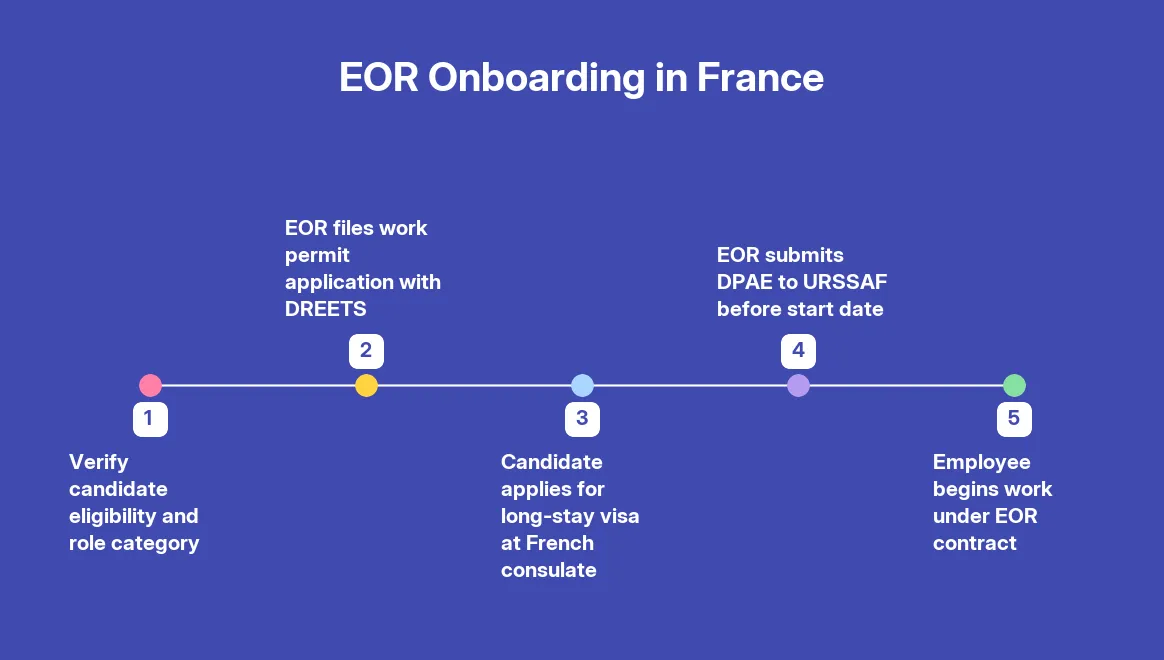
The sequence above compresses months of bureaucratic coordination into a managed workflow. Each step has dependencies that determine the next one's timeline.
Role category verification comes first. The EOR assesses whether the position qualifies for a Talent Passport, EU Blue Card, or standard authorization. This classification shapes the entire application pathway. A wrong choice forces a restart. A Copenhagen fintech hiring a data engineer in Paris through an EOR completed this verification in two business days. The EOR identified the Blue Card pathway as optimal based on the role's salary band and qualification requirements.
Once the permit pathway is confirmed, the EOR files the work authorization request with the regional DREETS office. The EOR's registered French entity status is critical here. Only a legal employer domiciled in France can sponsor the application. The candidate then applies for a long-stay visa at the French consulate in their country of residence. Consular processing runs in parallel with the French administrative review, but the visa cannot be issued until the work authorization is approved.
Before the employee's first working day, the EOR must file a Déclaration Préalable à l'Embauche (DPAE) with URSSAF. This declaration is mandatory under French law. Missing it exposes the employer to sanctions for undeclared work. The EOR handles this filing as part of its payroll and compliance obligations, closing the last administrative gap before the employee begins.
Choosing an EOR Partner for France: What to Evaluate
Your evaluation should go beyond pricing. The right employer of record partner for France brings compliance depth in three areas that separate strong providers from weak ones: immigration processing capability, convention collective classification accuracy, and offboarding risk management.
| Evaluation Criterion | Strong EOR Indicator | Red Flag |
|---|---|---|
| Entity structure | Owns a registered French legal entity | Uses a local partner or subcontractor |
| Immigration capability | Sponsors work permits directly as legal employer | Outsources permit processing to a third-party agency |
| Convention collective expertise | Classifies roles under the correct CBA before contract drafting | Uses a generic catch-all agreement |
| Offboarding support | Calculates statutory severance and handles DREETS notifications | Charges separately for termination processing |
| Payroll transparency | Discloses FX spreads and all employer-side charges | Bundles costs into a single opaque monthly fee |
| Contract language | Drafts CDI or CDD contracts compliant with the Code du Travail | Offers only English-language templates |
A Hamburg logistics company evaluated three EOR providers before hiring two supply chain managers in Lyon. The selected provider's ability to classify both roles under the correct transport and logistics convention collective saved the company from a salary floor miscalculation. The two competitors had proposed a generic IT services classification. That error would have triggered back-pay liability during a labor inspection.
Entity ownership matters for immigration specifically. An EOR that owns its French entity sponsors work permits under its own registration. Providers using local partners introduce a layer of dependency. If that partner relationship ends, permit continuity becomes uncertain. For a complete compliance checklist for EOR services in France, verify these structural factors before signing.
Watch out: Some EOR providers classify all tech roles under the Syntec convention collective by default. France has over 700 conventions collectives, and misclassification affects minimum salary, bonus obligations, and mandatory training budgets. Ask your EOR to confirm the specific CBA code before the employment contract is drafted.
FAQs
Can an EOR in France sponsor a work visa for a non-EU national who is currently outside France?
Yes. The EOR initiates the work authorization application with DREETS from France while the candidate remains abroad. Once approved, the candidate applies for a long-stay visa at the French consulate in their country of residence. One important edge case: candidates holding a valid French student visa can often transition to a work-authorized status without leaving France. This changes the EOR's timeline and document burden significantly, sometimes cutting weeks from the process.
What happens to an employee's work permit if the client company terminates its EOR contract mid-permit period?
The work permit is tied to the EOR as legal employer, not to the client company. If the client exits the EOR arrangement, the employee's authorization remains valid under the EOR entity. Transferring the employee to a new employer requires a fresh permit application unless a direct employment transfer is executed within the administrative window. Companies should negotiate permit continuity clauses in the EOR contract before signing, specifying obligations during client exit scenarios.
Does a French EOR arrangement work for remote employees based outside France who are employed by a French entity?
This creates a distinction most companies miss. A non-EU national physically working in France through an EOR needs French work authorization. A foreign national working remotely from their home country for a French EOR client does not need French work authorization. They instead trigger tax residency and local employment law obligations in their home jurisdiction. The French EOR arrangement becomes legally irrelevant for their work authorization and may create a separate, unaddressed compliance risk in the employee's actual country.
Can an employee hired through a French EOR later transfer to a direct employment contract with the client company's own French entity?
Yes, but the timing carries risk. If the employee holds a work permit tied to the EOR as employer of record, the transfer requires notification to French authorities. In some cases, approval is needed before the permit can be reissued under the client entity. During this transition, the employee must not begin work for the new entity without valid authorization. Companies setting up their own French entity frequently underestimate this gap. Build the permit transfer timeline into your entity setup plan before announcing the transition to the employee.
Is the Talent Passport visa available to all roles, or are there qualifying criteria an EOR must verify before applying?
The Talent Passport is not a general-purpose work permit. It covers specific categories: researchers, highly qualified employees, investors, artists, and certain company founders. The EOR must verify which category the role falls under before selecting this pathway. An incorrect category application risks rejection and forces a restart under the correct category. The original submission date is not preserved. For roles that do not fit any Talent Passport category, the EOR should direct the application toward the EU Blue Card or a standard work authorization instead.
What is the EOR's liability if a hired employee is found working without valid authorization in France due to an administrative error by the EOR?
Because the EOR is the legal employer, immigration enforcement liability sits with the EOR entity. Sanctions for employing an unauthorized worker in France fall on the registered employer, not the client company. Client companies should verify whether their EOR contract includes indemnification clauses covering consequential damages such as business disruption or project delays. Many standard EOR agreements limit liability to direct costs only. This is a contract negotiation point worth raising before signing, not after an enforcement action.
How long does the full EOR onboarding process take for a non-EU hire in France, from role verification to first working day?
Timelines vary by permit type and consular processing speed. As a general pattern, the administrative sequence from role verification through work authorization approval through consular visa issuance through DPAE filing takes several weeks to several months. Talent Passport and Blue Card applications tend to move faster than standard authorizations. The EOR controls the French-side filings, but consular processing in the candidate's home country is outside the EOR's direct influence. Ask your EOR for a milestone-by-milestone timeline specific to the permit category and consulate involved.
What to Watch Next
France's immigration framework for skilled workers is under active discussion at both national and EU levels. Proposed adjustments to Blue Card salary thresholds and processing timelines could change how EOR providers structure their applications. The French government has also signaled interest in expanding digital nomination processes for work authorization filings, which would shorten the DREETS stage for EOR-sponsored permits.
Monitor two things in the coming months. First, any revision to the Talent Passport qualifying categories that could expand or narrow eligibility for your target roles. Second, updates to convention collective salary floors, which shift annually and affect your total employer cost. Ask your EOR provider for a quarterly compliance briefing covering both immigration and labor law changes. A proactive check costs nothing. A missed update costs back-pay, penalties, or a voided permit.
.svg)