Top 5 Reasons Companies Choose an EOR in France

An employer of record lets you hire a senior product manager in Lyon next month. No French subsidiary. No months of paperwork with the Greffe du Tribunal de Commerce. A London fintech did exactly that: it brought on two France-based compliance analysts through an EOR in 11 days. Within a year, the French team had grown to seven.
France has one of the most regulated labor markets in Europe. The Code du Travail runs thousands of pages. Collective bargaining agreements layer additional obligations on top. Termination rules alone can stall a foreign company for weeks. For businesses outside France, these barriers turn a straightforward hire into a legal project.
This article covers what an EOR is, why it matters in the French context, how the service works operationally, and what to watch for in cost and risk. If you are weighing your first French hire or scaling an existing team, the framework here applies.

What Is an Employer of Record (EOR)?
Employer of Record Definition and Meaning
An employer of record is a third-party organization that becomes the legal employer of your workers in a target country. You direct the employee's daily work. The EOR holds the employment contract, runs payroll, files taxes, and manages statutory benefits.
In France, this structure carries specific weight. Every employment contract must comply with the French Labour Code. The EOR signs a contract that satisfies Code du Travail requirements. It registers the employee with URSSAF for social contributions. It applies the correct collective bargaining agreement for the employee's sector.
The relationship is tripartite. The EOR employs the worker legally. Your company manages the work output. The employee reports to you on tasks and deliverables. This separation is what allows a foreign company to hire compliantly without a local entity in France.
EOR vs PEO: Key Distinctions for France
A Professional Employer Organization (PEO) operates differently. In a PEO arrangement, you share employer responsibilities under a co-employment model. The PEO handles HR administration, but you retain legal employer status alongside it.
In France, this distinction matters more than in many markets. French labor courts scrutinize the employer-employee relationship closely. Co-employment arrangements can create legal ambiguity around who bears liability for terminations, workplace disputes, or CBA compliance.
An EOR removes that ambiguity. One party is the legal employer. That party is the EOR. Your company has no direct employment liability in France. For companies without a French entity, this is the only practical path. A PEO requires you to already have a registered entity in France. An EOR does not.
| Dimension | EOR | PEO |
|---|---|---|
| Legal employer | The EOR | Shared (co-employment) |
| Entity required in France | No | Yes |
| Employment contract holder | EOR | Client company and PEO jointly |
| Liability for French labor law | EOR | Shared |
| Best for | Companies without a French entity | Companies with an existing French entity |
Why Companies Use an EOR in France

Speed to Market Without a Legal Entity
Setting up a société par actions simplifiée or a SARL in France takes months. You need articles of association, a registered office, capital deposit, Kbis registration, and local director arrangements. A Stuttgart-based industrial automation company needed three French sales engineers within a quarter. Entity formation would have consumed most of that timeline. Through an EOR, onboarding started within two weeks.
An EOR eliminates the need to establish a legal entity in France before hiring. That is not a minor operational shortcut. It removes the capital commitment, the ongoing corporate tax filing obligations, and the need for a local managing director.
Navigating French Labour Law Compliance
France's labor code is dense. The 35-hour working week is law. French employees are entitled to a minimum of five weeks of paid annual leave. Overtime calculations follow strict multipliers defined in the applicable CBA.
Collective bargaining agreements add another layer. France has hundreds of active CBAs covering different industries. They govern minimum pay scales, notice periods, bonus structures, and seniority benefits. Applying the wrong CBA can trigger back-pay claims and inspectorate fines. The EOR identifies the correct CBA for each employee's role and sector.
France also has strict rules around employee termination and redundancy procedures. Dismissals require formal cause, documented procedures, and mandatory pre-termination meetings. Getting this wrong exposes a foreign company to labor court claims. The EOR carries that procedural burden.
Access to French Talent Without Incorporation Risk
A Toronto-based SaaS company wanted two UX researchers in Paris. Incorporating in France for two hires made no financial sense. The EOR hired both under compliant CDI contracts within 9 days. The company accessed French talent without taking on incorporation risk or ongoing entity maintenance.
This pattern repeats across industries. Companies test a market, hire a small team, and scale only if results justify entity formation later. An EOR can reduce time-to-hire in France compared to entity setup. It keeps the commitment reversible.
How EOR Services Work in France
| Stage | EOR Responsibility | Your Responsibility |
|---|---|---|
| Contract drafting | Drafts CDI or CDD compliant with Code du Travail and applicable CBA | Defines role, scope, compensation |
| URSSAF registration | Registers employee, files DPAE declaration | None |
| Payroll execution | Calculates gross-to-net, applies social contributions, issues payslip | Approves payroll data |
| Tax withholding | Applies prélèvement à la source (PAS) | None |
| CBA compliance | Identifies and applies correct sectoral agreement | Confirms industry sector |
| Termination | Manages procedure, notice, severance per law and CBA | Decides to end engagement |
The Onboarding and Contract Process Under French Law
The EOR drafts an employment contract that meets Code du Travail requirements. In France, contracts must specify the role, working hours, compensation, applicable CBA, and trial period terms. For indefinite contracts (CDI), the EOR also includes clauses on non-compete obligations, confidentiality, and mobility if relevant.
Before the employee's first day, the EOR files a déclaration préalable à l'embauche (DPAE) with URSSAF. This is mandatory. Filing must happen within eight working days before the start date. The EOR also registers the employee with the relevant mutuelle (complementary health insurance) and prévoyance (supplementary insurance) providers. These are statutory in France, not optional. For a deeper look at what coverage your French hires receive, see the guide on employee benefits and insurance under EOR arrangements in France.
Payroll, Tax Withholding, and Social Contributions
French payroll is among the most complex in Europe. The payslip alone can run 40 to 50 lines. EOR providers handle the full gross-to-net calculation. They withhold income tax under France's prélèvement à la source system, which routes withholding directly to the tax authority.
Social contributions in France are split between employer and employee. The employer portion is significant. URSSAF collects contributions covering health insurance, family benefits, unemployment insurance, and retirement. The EOR calculates and remits these monthly. Rates shift annually, so confirm the current schedule on the URSSAF portal before budgeting.
Managing Terminations and Redundancies Through an EOR
Firing someone in France is not a quick email. The Code du Travail requires a formal process. The employer must invite the employee to a pre-termination meeting with at least five working days' notice. The meeting must follow a structured format. Only after this meeting can the employer issue a dismissal letter, which must state specific, documented cause.
Severance calculations depend on the CBA, tenure, and reason for dismissal. The EOR manages this entire sequence. It drafts the convocation letter, conducts or advises on the meeting, calculates severance, and files the required paperwork. A Chicago-based e-commerce company needed to end an engagement with a Paris-based marketing lead after a strategic pivot. The EOR handled the full procedure in 23 days, including the mandatory waiting periods.
How to Choose the Best EOR for France

Local Legal Expertise and CBA Coverage
France's CBA system makes local expertise non-negotiable. A provider that treats France as one more country in a dropdown menu will misapply sectoral agreements. Ask any prospective EOR provider operating in France which CBAs they currently administer. A credible provider can name specific conventions collectives and explain how they affect payroll calculations.
The EOR should also have in-house or retained French labor law counsel. France's Prud'hommes (labor courts) resolve disputes between employers and employees. If a case reaches the Prud'hommes, your EOR's legal team represents the employer side. This is not hypothetical. French labor court filings run into the hundreds of thousands annually.
Technology, Reporting, and Integration Capabilities
Your EOR should produce French-compliant payslips that meet the 2017 bulletin de paie simplifié format. It should provide monthly reporting on gross cost, employer contributions, and net pay. GDPR compliance is mandatory. Employee data processed through the EOR's platform must stay within frameworks that satisfy French CNIL requirements.
Ask whether the platform integrates with your HRIS or accounting system. A Copenhagen-based digital agency managing 12 French contractors-turned-employees needed monthly cost exports compatible with their NetSuite instance. Integration capability saved five hours of manual reconciliation per cycle.
Key Questions to Ask EOR Companies Before Signing
Before you select a provider, the complete hiring guide for EOR in France offers a full checklist. At minimum, ask these questions:
- Which French CBAs do you currently administer, and how many employees fall under each?
- Who handles Prud'hommes representation if an employee files a claim?
- How do you manage mid-year CBA salary grid updates?
- What is your process for URSSAF audits, and who bears the liability for errors?
- Can you support both CDI and CDD contracts across multiple French regions?
A provider that hesitates on any of these is likely routing French employment through a local partner rather than managing it directly. That introduces a layer of risk you should price into your decision.
Watch out: Not all EOR providers own their French entity. Some subcontract to local partners. If the subcontractor misapplies a CBA or botches a termination procedure, the liability chain back to your company can be murky. Ask explicitly whether the provider holds its own SIRET number in France.
EOR Costs and Risks to Consider in France
How EOR Pricing Is Typically Structured
EOR pricing in France generally follows one of two models. The first is a flat monthly fee per employee. This typically falls within the range observed across European markets, from roughly $400 to $700 per employee per month for France. The second model charges a percentage of the employee's gross salary, usually between 10% and 20%.
Both models sit on top of the actual employment cost. Your total outlay includes the employee's gross salary, employer social contributions (which in France are among the highest in the EU), and the EOR's service fee. Some providers add setup fees, offboarding fees, or currency conversion markups.
| Cost Component | What It Covers | Who Sets It |
|---|---|---|
| Employee gross salary | Base pay, bonuses, overtime | You (within CBA minimums) |
| Employer social contributions | URSSAF, retirement, unemployment, mutuelle, prévoyance | French law and applicable CBA |
| EOR service fee | Contract management, payroll, compliance, HR support | The EOR provider |
| Setup / onboarding fee | Contract drafting, DPAE, benefits enrollment | The EOR provider (varies) |
| Offboarding / termination fee | Severance processing, legal procedure management | The EOR provider (varies) |
Employer of Record Risks Specific to the French Market
The primary risk in France is co-employment reclassification. French labor courts can determine that the client company, not the EOR, is the true employer. This happens when the client exercises excessive
control over daily work activities, sets schedules, or directs the employee as if they were a direct hire.
French labor inspectors and the Conseil de prud'hommes look at substance over form. If your managers conduct performance reviews, assign tasks directly, and approve leave without routing through the EOR, the relationship starts to resemble direct employment. The consequence is severe. Courts can requalify the arrangement, making your company liable for all back social contributions, severance, and penalties.
A practical guardrail: channel all employment-related instructions through the EOR. The client defines project goals and deliverables. The EOR manages the employment relationship itself.
How to Onboard an Employee Through an EOR in France
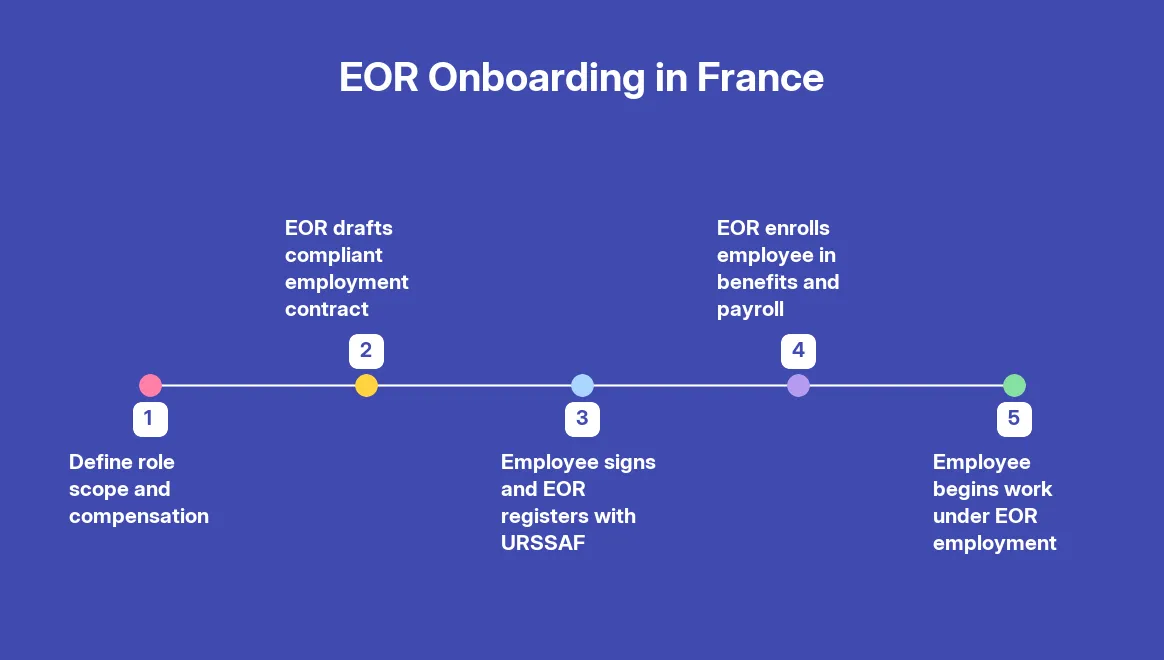
The process begins before any contract is drafted. You share the role scope, reporting structure, compensation range, and start date with your employer of record partner. This scoping phase determines which collective bargaining agreement applies and what mandatory benefits the contract must include.
The EOR then drafts a French-law-compliant employment contract. This contract must specify the applicable CBA, job classification, probationary period terms, and working hours. France's Code du Travail requires that CDI contracts include specific mandatory clauses. CDD contracts carry additional requirements around justification and maximum duration.
Once the employee signs, the EOR handles registration. This means declaring the employee with URSSAF, enrolling them in complementary health insurance (the mutuelle is mandatory), and setting up payroll with the correct tax withholding under the prélèvement à la source system. The EOR also registers the employee for pension contributions and prevoyance coverage as required by the applicable CBA.
A Munich-based fintech company used an EOR to hire two compliance analysts in Paris in 12 business days. Setting up a French SAS for the same purpose would have taken three to four months, including bank account opening delays that routinely extend French entity formation timelines.
The entire onboarding cycle through an EOR typically takes 5 to 15 business days. The variance depends on contract negotiation, CBA identification, and whether the role requires any specific regulatory declarations.
EOR vs. Setting Up a Legal Entity in France
The decision between an EOR and a French entity is not just about cost. It is about timeline, operational overhead, and how long you plan to operate in the market.
| Factor | EOR in France | French Legal Entity (SAS/SARL) |
|---|---|---|
| Setup timeline | 5–15 business days | 3–6 months |
| Upfront cost | Monthly per-employee fee, no setup fee | Registration fees, legal fees, notary costs, capital deposit |
| Ongoing admin | Handled by EOR | In-house or outsourced HR, payroll, legal counsel |
| Payroll and tax | EOR manages URSSAF, income tax withholding | Company manages directly or hires a provider |
| CBA compliance | EOR identifies and applies correct CBA | Company must identify, interpret, and apply CBA |
| Termination risk | EOR manages process under French law | Company bears full legal exposure |
| Best for | 1–20 employees, market testing, project teams | Long-term presence, 20+ employees, local clients |
An entity makes sense when you have committed to France for the long term. Once your headcount exceeds roughly 15 to 20 employees, the per-employee EOR fee often exceeds the amortized cost of running your own entity with a local HR manager and payroll provider.
For smaller teams, the math favors an EOR. A Toronto-based SaaS company hired four customer success managers in Lyon through an EOR over six weeks. Eighteen months later, they had grown to eleven employees. At that point, they began entity formation while the EOR continued managing the existing team during the transition. That overlap model kept payroll running without interruption.
The overlooked cost of entity ownership in France is not formation. It is the ongoing compliance burden. Annual accounts filing, CSE obligations once you cross employee thresholds, mandatory profit-sharing schemes at 50 employees, and regular labor inspectorate interactions all require dedicated resources. An employer of record in France absorbs these obligations entirely.
Watch out: France requires companies with 11 or more employees to establish a Comité Social et Économique (CSE). If your headcount through an EOR approaches this threshold, confirm with your provider how CSE elections and employee representation obligations are handled under the EOR's own legal structure.
Companies that need both a local entity and an EOR are not unusual. A German retail brand with an existing Paris showroom entity used an EOR to staff a separate remote analytics team across Marseille and Bordeaux. The EOR handled a different CBA and employment structure than the showroom entity, keeping both workforces compliant without cross-contamination of employment terms.
For a broader comparison of employer of record providers in France, evaluate whether each provider owns its French entity or operates through a local partner. That distinction determines accountability when things go wrong.
FAQs
Can a company use an EOR in France if it already has a registered legal entity there?
Yes, and this is more common than most companies expect. A company with an existing French entity might use an EOR for a specific project team, a workforce in a different region, or during an M&A transition where the entity's employment capacity is constrained. The key risk is co-employment classification. French labor courts may scrutinize arrangements where both the entity and the EOR employ workers doing similar work for the same client. Keep the organizational separation clear: different reporting lines, different functions, and different CBAs where applicable.
Does an EOR in France automatically apply the correct collective bargaining agreement for my employee's role?
A qualified EOR should, but the process is not automatic. France has over 700 active CBAs, and some roles fall under multiple possible agreements. A software developer employed by a financial services firm could fall under the Syntec CBA for tech services or the banking sector CBA, depending on how the EOR's entity is classified and the employee's primary function. The EOR resolves this by matching the role to the activity code (code NAF/APE) of its own entity. Ask your EOR which CBA they apply before the contract is signed, not after.
What happens to my employee's contract if I want to terminate the EOR relationship and bring them in-house?
French law protects continuity of employment. The transfer typically follows Article L1224-1 of the Code du Travail, which preserves the employee's seniority, accrued leave, and contractual entitlements when employment transfers between legal entities. The employee's contract transfers to your new French entity without a break. You cannot reduce their terms. The employee must be informed and, in most cases, must consent. Plan three to four months of overlap between the EOR and your new entity to avoid gaps in social security registration and payroll.
Is an EOR the same as a portage salarial arrangement in France?
No. Portage salarial is a France-specific legal framework, formally regulated since 2017, that allows independent professionals to operate under an umbrella company. The professional finds their own clients and sets their own fees. The portage company provides a pay slip and social coverage. An EOR is employer-facing: the client company selects the employee, defines the role, and the EOR acts as the legal employer. If you are hiring a French contractor who currently works through portage salarial and you want to convert them to a full employee, an EOR handles that conversion. Portage salarial does not.
How does an EOR handle a French employee who goes on long-term sick leave?
France distinguishes between standard sick leave and affection de longue durée (ALD), which covers serious long-term illnesses. Under ALD, the Caisse Primaire d'Assurance Maladie (CPAM) reimburses daily allowances directly to the employee. The EOR remains obligated to maintain the employment contract, continue complementary health coverage, and comply with return-to-work medical evaluations. The client company bears no direct employer obligation during this period. When the employee returns, the EOR coordinates a mandatory medical visit with the médecin du travail before the employee resumes work.
What employee benefits does an EOR provide beyond the statutory minimum in France?
French CBAs often mandate benefits above the statutory floor. These include enhanced prevoyance coverage for death and disability, supplementary pension contributions, meal vouchers (titres-restaurant), and transport allowances. A strong EOR builds these into the employment contract from day one. Beyond CBA-mandated benefits, some EOR providers offer optional benefits like private dental coverage, gym memberships, or remote work stipends. TeamUp's approach covers statutory and CBA-required benefits as standard, with optional enhancements available depending on the role and sector.
Can an EOR sponsor a work permit for a non-EU national to work in France?
Yes. Because the EOR is the legal employer in France, it files the work authorization request with the DIRECCTE (now DREETS) on behalf of the employee. The process involves demonstrating that the role could not be filled by a candidate already authorized to work in France. Processing times vary by region and nationality, but expect eight to twelve weeks for standard cases. The EOR manages the entire administrative process, including the OFII medical appointment and residence permit coordination. Non-EU nationals on certain bilateral agreements may qualify for faster processing tracks.
What to Watch Next

France's labor regulatory landscape does not sit still. The government periodically revises employer social contribution rates, and recent reforms to unemployment insurance have changed how short-term contracts are taxed. Monitor URSSAF's annual circulars for updated contribution schedules.
The European Union's proposed directive on platform work may affect how France classifies workers engaged through intermediaries. If adopted, it could tighten the regulatory framework around EOR arrangements for certain roles. Watch for transposition timelines into French law.
Your concrete next step: audit your current or planned French workforce against the applicable CBA. Misclassification under the wrong agreement is the most common compliance gap companies discover after onboarding. A PEO or EOR partner with deep French expertise can run this audit before your first hire.
.svg)