How Employer of Record Services Actually Work in France: Contracts, Payroll & Compliance Explained
Our guide to reasons companies choose an EOR in France explained why foreign businesses turn to this model. It covered entity setup comparisons, cost considerations, and provider selection criteria. This article goes deeper on the operational mechanics. How does an EOR actually run payroll in France? What goes into a compliant French employment contract? How do social security contributions flow from gross salary to the various caisses?
France layers more statutory obligations onto employers than most EU member states. Understanding each step matters. The difference between a smooth hire and a labour tribunal claim often comes down to contract clauses, payslip calculations, and filing deadlines that the EOR handles daily.

The Employment Contract: What French Law Requires

French employment law treats the written contract as the foundation of the employment relationship. The EOR drafts, issues, and maintains this document on behalf of the client company.
CDI vs. CDD: Choosing the Right Contract Type
France distinguishes between the contrat à durée indéterminée (CDI) and the contrat à durée déterminée (CDD). The CDI is an open-ended contract. French law treats it as the default. A CDD is a fixed-term contract permitted only under specific circumstances defined in the Code du travail.
A CDD requires a legally valid reason. Temporary replacement of an absent employee qualifies. A seasonal spike in workload qualifies. Hiring someone for a permanent role does not. Using a CDD without a valid justification exposes the employer to reclassification as a CDI by a labour court.
Most EOR engagements use CDIs. The client controls the role scope and day-to-day tasks. The EOR holds the legal employer position and bears the compliance burden.
Mandatory Contract Clauses
French law prescribes specific elements in every employment contract. Missing one creates legal risk.
Required clauses include:
- Job title and description aligned with the applicable convention collective
- Gross salary and payment frequency
- Weekly working hours, normally pegged to the 35-hour legal limit
- Trial period duration and renewal terms, capped by the convention collective
- Workplace location and any remote work provisions
- Reference to the applicable collective bargaining agreement
The convention collective is not optional. France has roughly 700 active collective bargaining agreements covering nearly every industry sector. Each one dictates minimum salary grids, overtime rules, notice periods, and supplementary benefits. The EOR identifies the correct convention based on the company's activity code and applies it to the contract.
A London-based fintech hiring its first product manager in Paris through an EOR would see the contract drafted under the Syntec convention collective. That agreement sets specific salary minimums by job classification tier and mandates a cadre or non-cadre status that affects social security contribution rates.
Payroll Processing and Tax Withholding in France
Gross-to-Net Calculation
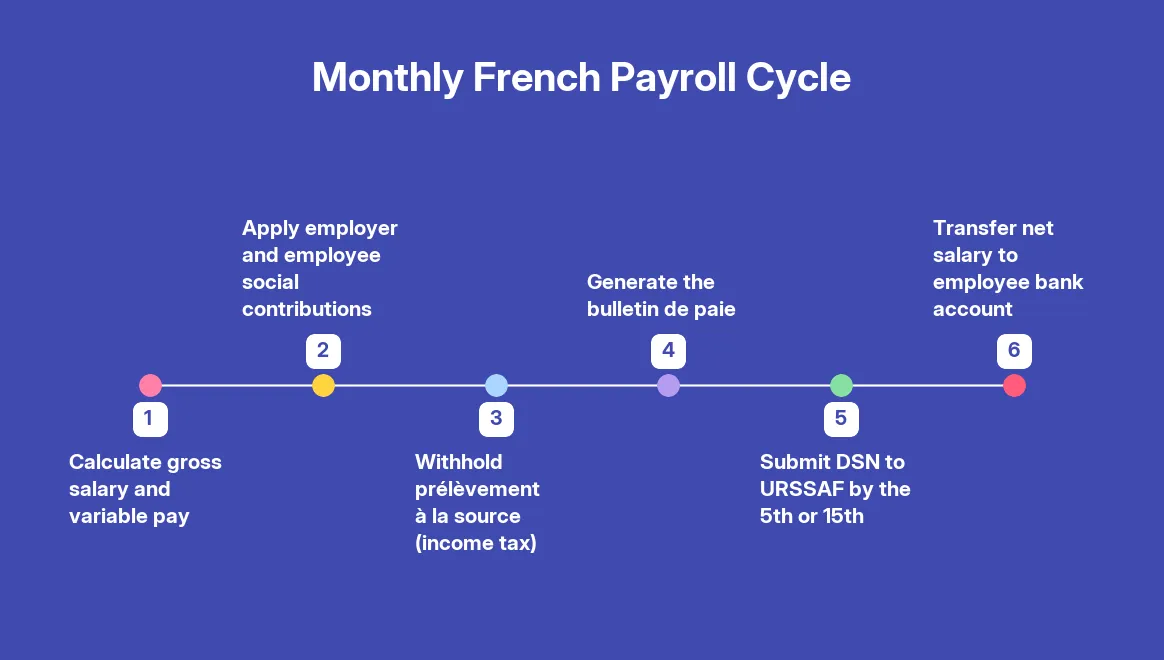
French payslips are famously detailed. A typical bulletin de paie runs 30 or more line items. The EOR calculates each one monthly.
Employee social contributions reduce gross salary by roughly 11% or more, depending on the convention collective and cadre status. Employer contributions sit on top of gross salary. They range from approximately 25% to 42% of gross, varying by salary level, location, and applicable agreements. The exact rates shift annually as URSSAF publishes updated schedules.
The prélèvement à la source (PAS) is France's pay-as-you-earn income tax system. The EOR withholds income tax directly from the employee's net salary each month. The tax administration provides each employee's personalized withholding rate. If no rate is available, the EOR applies the default grid rate.
The DSN Filing
France consolidated employer reporting into a single monthly electronic filing called the déclaration sociale nominative (DSN). The DSN replaced multiple legacy declarations. It transmits payroll data, social contribution amounts, and employee events to URSSAF and all connected agencies in one submission.
Filing deadlines depend on company size. Employers with 50 or more employees file by the 5th of the following month. Smaller employers file by the 15th. Late DSN submissions trigger automatic penalties.
The EOR submits this filing every month for each employee it manages. Getting it right requires certified payroll software that maps each salary component to the correct DSN code. Errors in the DSN propagate downstream to pension records, healthcare coverage, and tax reporting.
Social Security and Benefits Administration
France operates one of the most comprehensive employee benefits systems in Europe. The EOR registers each employee with the relevant bodies and remits contributions throughout the employment.
The Social Security Architecture
French social security covers health insurance, family allowances, unemployment insurance, retirement pensions, and workplace accident insurance. URSSAF collects the bulk of these contributions. Pension contributions flow separately to AGIRC-ARRCO for the compulsory complementary retirement scheme.
The employer contribution burden is substantial. A position with a gross annual salary of EUR 50,000 might generate employer charges exceeding EUR 20,000 on top. The precise figure depends on the convention collective, cadre classification, and applicable regional or sectoral surcharges. Confirm current rates on the URSSAF website before budgeting.
Mandatory Supplementary Benefits
Beyond base social security, French employers must provide two supplementary benefits:
- Mutuelle (complémentaire santé): Employers cover at least 50% of the premium for a group health insurance plan meeting minimum coverage thresholds defined by decree. The EOR selects and administers this plan.
- Prévoyance: For cadre-status employees, a supplementary death and disability insurance policy is mandatory under the convention collective nationale des cadres. Many non-cadre conventions also require prévoyance coverage.
A Toronto-based SaaS company hiring three engineers in Lyon through an EOR would see these benefits set up automatically. The EOR negotiates group rates with French insurers, enrolls each employee, and deducts premium shares from payroll.
The EOR also administers paid leave. French employees receive a minimum of five weeks of annual paid leave. Many conventions grant additional days. The EOR tracks accrual, validates requests, and calculates leave pay including any convention-specific bonuses like the prime de vacances.
Ongoing Compliance and Employee Lifecycle Management
The EOR's role does not end at contract signing and first payroll. French employment law creates obligations throughout the entire employee lifecycle.
Mid-Employment Obligations
| Obligation | Frequency | Who Handles |
|---|---|---|
| Entretien professionnel (career interview) | Every 2 years | EOR schedules, client conducts |
| Médecine du travail (occupational health) | At hire + periodic | EOR registers with service provider |
| DSN filing | Monthly | EOR payroll team |
| Mutuelle enrollment changes | As needed | EOR HR team |
| Salary grid compliance check | Annual | EOR reviews against convention |
The entretien professionnel is a mandatory career development interview. Employers must conduct one at least every two years. Failure to comply triggers a penalty: the employer must credit the employee's compte personnel de formation (CPF) with an abondement correctif.
Occupational health registration is another obligation the EOR manages from day one. Every employee must undergo a visite d'information et de prévention upon hiring. The EOR enrolls the company with an approved service de santé au travail.
Termination and Offboarding
French dismissal law is among the most protective in the EU. Terminating a CDI requires a cause réelle et sérieuse. The process follows a strict sequence: convocation letter, pre-dismissal meeting with legally mandated waiting periods, and a formal dismissal letter.
The onboarding and offboarding process through a French EOR involves precise documentation at every stage. The EOR prepares the solde de tout compte, the certificat de travail, and the attestation Pôle emploi. Missing any of these documents exposes the employer to tribunal claims.
Rupture conventionnelle offers a negotiated alternative. Both parties agree to end the CDI with an indemnity at least equal to the legal minimum. The EOR handles the homologation filing with the DREETS, which must approve the agreement within 15 business days.
Watch out: Even under rupture conventionnelle, the employee retains a 15-calendar-day retraction right after signing. The EOR cannot submit the homologation request until that window closes. Miscounting those days invalidates the entire agreement.

FAQs
Can the EOR apply a different convention collective if the client's industry is ambiguous?
The convention collective is determined by the employer's principal economic activity, not the employee's job function. When the EOR is the legal employer in France, its own activity code could theoretically apply. Reputable EORs register under codes that match the client's actual business sector to avoid misclassification risk. If URSSAF challenges the classification, penalties and back-contributions can apply retroactively.
How does the EOR handle the French participation and intéressement profit-sharing schemes?
Companies with 50 or more employees in France must implement a participation scheme sharing a portion of profits with employees. Since the EOR is the legal employer, headcount thresholds apply to its total French workforce, not just one client's team. Crossing the 50-employee threshold triggers participation obligations, CSE committee formation, and additional reporting. Ask your EOR provider where they stand relative to this threshold before signing.
What happens if a French employee disputes their payslip calculations?
The employee can raise the dispute directly with the EOR or file a claim with the conseil de prud'hommes. French law requires the employer to justify every line on the bulletin de paie. The EOR maintains payroll records for five years. If the court finds underpayment of social contributions or incorrect application of the convention collective salary grid, the EOR bears the financial liability and must rectify back pay.
Does the EOR manage RTT days in addition to standard paid leave?
Réduction du temps de travail (RTT) days apply when an employee works more than the 35-hour legal weekly limit under a forfait jours or similar arrangement. The convention collective and company-level agreement determine how many RTT days accrue. The EOR tracks RTT balances separately from congés payés and ensures proper accounting on the payslip. Unused RTT days follow different carryover rules than standard leave. Check the applicable convention for expiry deadlines.
What to Prepare Before Your First French EOR Hire
French employment mechanics reward preparation. Before engaging an EOR, identify the correct convention collective for your activity, define whether the role qualifies for cadre status, and budget employer charges at 25–42% above gross salary. These three decisions shape contract terms, contribution rates, and benefit obligations for the entire employment. As France continues refining DSN reporting requirements and adjusting social contribution schedules, working with an EOR that operates directly in Europe keeps compliance current without requiring your team to track every URSSAF circular.
If you need a detailed cost projection for hiring in France through an EOR, TeamUp can build one for your specific role and team size. Request a France hiring estimate.
Written by Team Up — people-first EOR and nearshoring partner since 2020.
.svg)