


Employer of Record (EOR) vs Setting Up Your Own Entity in the Philippines: Which is Better?
Introduction
The Philippines is a high-value hiring market. A deep English-speaking talent pool, strong BPO and technology sectors, and a GDP growth rate of 5.8–6.0% projected for 2026 make it one of the most compelling destinations for companies building international teams.
And then you discover what it takes to hire there legally.
Employer of record services are what most companies use to enter the Philippines quickly and compliantly. But entity setup — registering a Philippine corporation, branch office, or subsidiary — remains the right answer for some situations. The question is not which model sounds better in a pitch, Entity setup or EOR. It is the model that fits your specific situation, headcount, timeline, and risk tolerance right now.
This guide gives you the real comparison: actual entity setup costs, timeline, registration steps, ongoing compliance overhead, immigration implications, and where the break-even crossover sits. The numbers are specific to the Philippines. So is the decision framework.
EOR VS Entity: What You Are Actually Choosing Between
The structural question is the same one in every market: do you need or want to own the employer infrastructure in the Philippines?
Employer of Record (EOR) in The Philippines
A third party, Team Up, in this context, becomes the legal employer of your Philippine staff. You direct the work. The EOR holds the employment contracts, runs payroll, remits SSS, PhilHealth, and Pag-IBIG, pays 13th-month, files BIR returns, and handles DOLE compliance. You pay a per-employee monthly fee starting from €199/month. No Philippine entity is required from your company.
Setting Up an entity in The Philippines
Your company registers a legal entity in the Philippines — typically a domestic corporation for foreign-owned businesses. You become the registered employer. You own every employment obligation: payroll registration, SSS/PhilHealth/Pag-IBIG enrollment, BIR tax filings, DOLE compliance, 13th-month pay tracking, labor dispute management, and the ongoing cost of running the entity.
The structural question: do you want to own that infrastructure, or do you want Team Up to provide it for you while you build your team?
Everything else — cost, speed, risk, flexibility, immigration capability — flows from that structural choice.

Setting Up Your Own Philippine Entity: The Real Cost and Timeline
This is where most companies underestimate the gap. Entity setup in the Philippines is not just a registration fee. It is a multi-step, multi-agency process that takes longer and costs more than the first online guide suggests.
The Registration Sequence
Setting up a foreign-owned corporation in the Philippines requires sequential registration across multiple government agencies:
Step 1: Securities and Exchange Commission (SEC) Every corporation operating in the Philippines must register with the SEC. The digital eSPARC platform has streamlined the process — SEC review takes 3–7 business days for standard applications, with same-day processing for simple domestic corporations.
Costs at SEC stage: ~PHP 8,000 in SEC filing fees (for a corporation with PHP 1 million in authorized capital), notary and books ~PHP 4,000, legal research and filing fees totaling approximately PHP 3,310–5,000 for a standard capitalized entity.
Step 2: Bureau of Internal Revenue (BIR) After SEC approval, you have 30 days to register with the BIR and obtain your Certificate of Registration and Tax Identification Number (TIN). BIR registration also covers VAT registration (if applicable), Authority to Print receipts, and payroll tax withholding registration.
Costs: BIR stamps approximately PHP 1,200. Professional assistance for BIR registration: PHP 5,000–15,000 depending on the service provider.
Step 3: Local Government Unit (LGU) Business Permits Mayor's Permit and Barangay Clearance from the LGU where your office is located. Required before you can begin operations.
Costs: PHP 8,000–25,000 depending on location and business classification.
Step 4: SSS, PhilHealth, Pag-IBIG Registration You must register as an employer with all three agencies within 30 days of your first hire. Each has its own online portal and registration process.
Step 5: Corporate Bank Account A corporate bank account is required for depositing paid-up capital and running payroll. Opening a corporate account for a foreign-owned company can take 2–6 weeks due to KYC and documentation requirements.
Step 6: DOLE Registration (where applicable) Companies with 5 or more employees must register with DOLE and may be subject to Department Order 174-17 compliance reviews.
Total Timeline
The full sequence from initial SEC filing to fully operational employer status takes:
- On average, full registration (SEC, BIR, and permits) takes 30–45 working days
- Company registration in the Philippines typically takes 6–10 weeks, depending on business structure, approvals, and local registration requirements
- With complications, bank account delays, or LGU backlog: up to 4–6 months
During that entire window, you cannot legally hire employees in your own name. The talent you identified in week one of the process may not still be available in month three.
The Capital Requirement
This is the Philippine-specific cost most foreign companies discover too late.
The minimum capital requirement for foreign-owned companies is generally $200,000 for full foreign ownership, though BOI-registered or export-oriented companies may qualify for a $100,000 threshold. This capital must be paid up and deposited in a Philippine corporate bank account.
For a company setting up a Philippine entity to hire five engineers, that $200,000 capital requirement alone represents $40,000 per employee before a single salary is paid. That is not an operating cost — it is locked capital.
Certain entity structures and BOI registration categories reduce or eliminate this requirement. But navigating those exemptions requires local legal expertise, adds to the setup timeline, and introduces additional regulatory obligations.
Total First-Year Entity Cost
Bringing together registration costs, capital requirements, legal fees, and ongoing compliance:
| Cost Category | Amount |
| SEC registration fees | PHP 8,000–12,000 (~$140–$210) |
| BIR registration and stamps | PHP 6,000–15,000 (~$105–$260) |
| LGU permits | PHP 8,000–25,000 (~$140–$435) |
| Notarization, legal drafting | PHP 15,000–50,000 (~$260–$870) |
| Bank account and corporate setup | PHP 10,000–30,000 (~$175–$520) |
| Local legal counsel (entity type, capital structure) | PHP 50,000–200,000 (~$870–$3,480) |
| Paid-up capital (foreign-owned) | $100,000–$200,000 |
| Annual compliance (audit, tax filings, SEC annual report) | PHP 50,000–200,000/year (~$870–$3,480/year) |
| Annual LGU permit renewal | PHP 8,000–25,000/year |
Total first-year commitment (excluding capital lockup): approximately $5,000–$10,000+ in direct setup and compliance costs.
Including the capital requirement: $105,000–$210,000+ in total committed capital before operational payroll begins.
Entity setup typically involves a 4–8 month timeline and ₱300,000–₱800,000 cost to establish a domestic corporation, secure SEC registration, BIR registration, and DOLE compliance documentation — and that range does not include the foreign ownership capital requirement.
Ongoing Annual Compliance Costs
Running a Philippine entity is not a one-time cost. Annual obligations include:
- SEC annual financial statement filing (audited after Year 1)
- BIR annual income tax return (corporate rate: 25% of taxable income)
- Quarterly BIR tax return filings
- Monthly BIR withholding tax remittances (Form 1601-C, due by the 10th of the following month)
- SSS, PhilHealth, Pag-IBIG monthly remittances
- Annual LGU permit renewal (Mayor's Permit, Barangay Clearance)
- DOLE compliance documentation for companies with 5+ employees
- External audit fees (mandatory after Year 1)
Estimated annual ongoing compliance cost: PHP 100,000–500,000 ($1,740–$8,700) depending on entity complexity, plus external audit fees (PHP 50,000–200,000+).

EOR in the Philippines: What the Cost Actually Looks Like
EOR pricing in the Philippines ranges from approximately $199–$599 per employee per month, depending on the EOR provider and service depth. Team Up's EOR platform starts from €199 per employee per month.
The EOR fee covers: employment contracts compliant with the Philippine Labor Code, payroll processing in PHP, SSS/PhilHealth/Pag-IBIG enrollment and monthly remittances, 13th-month pay accrual and disbursement, BIR income tax withholding and filing, DOLE compliance, and offboarding management.
No upfront capital. No paid-up capital requirement. No registration process. No locked working capital.
Total employer cost per employee per month through EOR (example: PHP 80,000/month gross):
| Cost component | Monthly amount |
| Gross salary | PHP 80,000 |
| SSS employer contribution (~PHP 3,500) | PHP 3,500 |
| PhilHealth employer (2.5%) | PHP 2,000 |
| Pag-IBIG employer (2%) | PHP 1,600 |
| 13th-month accrual (1/12 per month) | PHP 6,667 |
| EOR service fee (Team Up from €199) | ~PHP 11,700 (~$199) |
| Total monthly employer cost | PHP 105,467 |
Annualized for 5 employees at this salary level: approximately PHP 6.33 million ($110,000), including all statutory contributions and EOR service fees.

Compare to the entity setup at the same headcount
Same 5 employees, same salaries, own Philippine entity:
- First-year setup and compliance costs: $5,000–$10,000
- Annual ongoing compliance: $5,000–$15,000
- Capital requirement: $100,000–$200,000 (locked)
- Statutory employer contributions: same as EOR (pass-through)
- Total first-year commitment: $110,000–$225,000 before considering the capital lockup
At 5 employees, EOR wins on total first-year cost by a significant margin, particularly when the capital requirement is included in the entity calculation.
The Timeline Comparison: Speed to First Hire
This is where entity setup creates the most concrete competitive damage.
- Entity route: SEC registration to fully operational employer status takes 6–10 weeks minimum, often longer. During that time, the company cannot legally hire employees as an employer of record. The talent window during which your identified candidates are available may close before your entity is operational.
- EOR route: Team Up can issue a compliant employment contract and begin onboarding within days of the decision. Hiring employees in the Philippines can happen within 3–7 days without the entity setup process. The talent you identified on Monday can be onboarded by Friday.
- That speed advantage is most commercially significant in two scenarios:
- Competitive hiring: In the Philippines technology and BPO sectors, strong candidates receive multiple offers. A company that can confirm an offer and begin onboarding within a week consistently outperforms competitors whose entity process takes months.
- Revenue-driven market testing: If your Philippines expansion is tied to a new product launch, a client contract, or a sales commitment with a timeline, the entity model's 6–10 week minimum represents a genuine revenue risk. EOR closes that gap immediately.
Compliance Risk: Who Is on the Hook
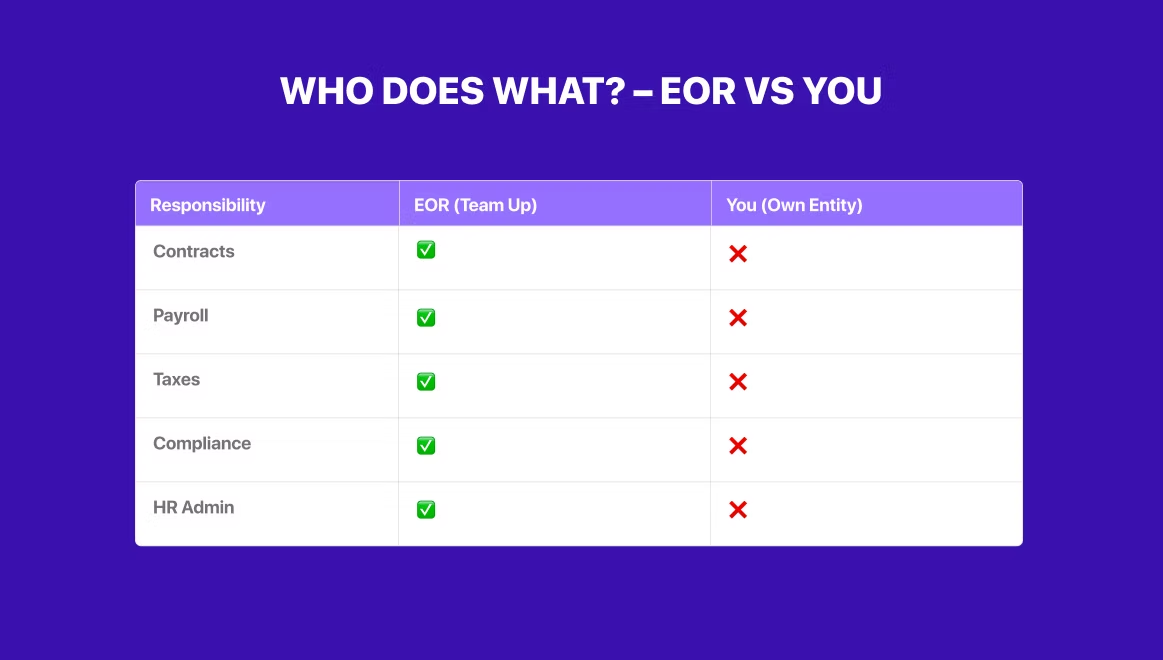
Entity: You Own Every Compliance Obligation
When you are the registered Philippine employer, the full compliance stack is yours:
DOLE enforcement. The Department of Labor and Employment actively enforces Department Order 174-17, which prohibits "labor-only contracting." Any employment arrangement that looks like the employer does not hold genuine employer status faces DOLE audit exposure. As the registered entity, you are directly accountable.
13th-month pay. The legal obligation to pay 1/12th of annual basic salary by December 24 each year sits with the registered employer — your entity. Missing it, paying it late, or calculating it incorrectly creates fines and potential NLRC complaints.
Security of tenure. Once an employee completes 6 months of continuous service, they acquire regular employee status with constitutional security of tenure. Terminating a regular employee without just or authorized cause and proper due process exposes the entity to reinstatement orders and back-pay awards from the NLRC. These are real and significant liabilities.
BIR payroll compliance. Monthly income tax withholding (Form 1601-C) is due by the 10th. Annual summary returns (Form 1604-C) are due by January 31. Late filing: 25% surcharge plus 12% annual interest on the unpaid amount. These penalties are not discretionary.
EOR in the Philippines: Compliance Transfers to Team Up
When you hire through Team Up, the compliance obligations sit with Team Up's Philippine operations as the legal employer. SSS remittances, PhilHealth contributions, Pag-IBIG payments, 13th-month pay, BIR withholding filings, and DOLE compliance are Team Up's responsibility — not yours.
This risk transfer is real, but it is only as strong as the EOR's actual compliance capability. Team Up's platform manages all statutory filing deadlines automatically, with compliance monitoring built into the payroll cycle.
What stays your responsibility: performance management, work direction, and providing the business rationale and documentation if a termination decision becomes necessary.

The Philippines-Specific Entity Challenges That Most Guides Miss
Three Philippine-specific entity requirements consistently catch foreign companies off guard.
The Foreign Ownership Capital Requirement
As noted above: $200,000 minimum paid-up capital for full foreign-owned entities in most sectors. This is not an operational cost — it is a statutory capital deposit that sits in a Philippine corporate bank account.
For a company hiring 3–5 people in the Philippines as a market test, this capital requirement represents $40,000–$65,000 per employee in locked-up capital before payroll begins. The EOR model has no equivalent requirement.
The Foreign Investments Negative List (FINL)
The Philippines restricts foreign ownership in certain industries under the FINL. Mass media, retail trade (with some exemptions), small-scale mining, and several other sectors are closed to full foreign ownership. Companies in adjacent sectors — digital media, e-commerce with physical goods — need legal advice to confirm their FINL classification before committing to a foreign-owned entity structure.
EOR bypasses the FINL question for employment purposes. The EOR is the registered employer. The client company's foreign ownership does not create a FINL issue for the employment relationship.
The Resident Alien Director Requirement
Philippine domestic corporations must have directors who can legally hold office in the Philippines. For foreign-owned companies, ensuring that board composition meets local requirements — while maintaining actual management control — requires careful legal structuring that adds to setup complexity and ongoing governance cost.
For employer sponsorship obligations in the Philippines context and how EOR eliminates the entity requirement, see our guide on employer sponsorship in the Philippines and beyond.
EOR vs. Entity: The Decision Framework
Answer these five questions in sequence. The answers route to a clear recommendation.
Question 1: How many employees are you planning to hire in the Philippines?
1–10 employees → EOR. The entity setup cost and capital requirement are not justified at this headcount. EOR from €199/month per employee delivers compliant employment at a fraction of the entity overhead.
11–20 employees → EOR, but begin entity feasibility analysis. At this scale, the cumulative EOR fees over 24 months start approaching entity overhead.
20+ employees with long-term commitment → Entity evaluation is justified. Run the full break-even analysis before deciding.
Question 2: How certain are you that the Philippines market will work for your business?
Testing / uncertain → EOR. No capital locked up. Clean exit with standard notice. No 6-month entity wind-down process if the market does not perform.
Proven / committed → Entity evaluation begins to make sense. The capital requirement and compliance infrastructure become justified by the operational commitment.
Question 3: Do you need to hire foreign nationals who require AEP sponsorship?
Yes → EOR provides immediate sponsorship capability through its Philippine operations. Entity can also sponsor, but adds 6–10 weeks to the timeline before sponsorship is possible.
No → Immigration consideration does not change the decision.
Question 4: Are there structural requirements that only an entity can meet?
BOI registration for investment incentives, PEZA zone participation for tax benefits, government contracts requiring a registered Philippine counterparty, or sector-specific licenses (banking, education, healthcare) → Entity may be required regardless of headcount.
None of the above → EOR remains the right model for the hiring stage.
Question 5: What is your exit plan if the Philippines does not work out?
Need clean exit in weeks → EOR. Standard notice period, EOR manages compliant offboarding, no entity to dissolve.
Can absorb 3–6 month wind-down → Entity wind-down is feasible but involves SEC dissolution filing, BIR clearance, tax assessment, LGU permit cancellation, and employee separation compliance — a multi-month process.
The 2026 Philippines Pattern: EOR then Entity, by Design
The most rational approach for most companies entering the Philippines in 2026:
- Phase 1 (months 1–12): Use Team Up's EOR to hire the first 5–15 people. Validate the market, the talent quality, the time zone fit, and the operational model. No capital locked up. No entity overhead.
- Phase 2 (months 12–24): If the market proves itself and headcount is growing past 20, begin entity setup in parallel with EOR operations. Start the SEC process while EOR employees continue to work.
- Phase 3 (year 2–3): Register the entity. Transfer employees from EOR employment contracts to entity employment as the operational and financial crossover justifies it. EOR engagement ends.
This staged approach lets the entity investment follow the evidence — not precede it.
For companies planning to bring employees into the Philippines from other markets during any of these phases, see our guide on relocation legal requirements and practical steps.
What Entity Setup Provides That EOR Cannot Fully Replace
An honest comparison acknowledges where entity setup creates value that EOR cannot replicate.
BOI and PEZA investment incentives. The Philippines offers significant tax incentives for companies registered with the Board of Investments (BOI) or operating in PEZA economic zones: income tax holidays, reduced corporate tax rates, VAT zero-rating. These incentives are only available to registered Philippine entities. An EOR employer relationship does not qualify for these incentives. For companies with significant Philippines revenue or operations, these incentives can more than offset entity setup costs.
Full HR program control. With your own entity, you design your employment policies, compensation structures, equity participation plans, and employer brand independently. EOR contracts comply with local law but use the EOR's standard employment framework. Heavily customized compensation structures — co-investment plans, unusual equity arrangements, non-standard benefit designs — require entity employment.
DOLE-registered employer status. For certain regulated activities — labor-only contracting concerns, contractor registration, special employment categories — being a registered Philippine employer has distinct regulatory benefits and relationships that EOR cannot provide.
Long-run cost efficiency at scale. As documented in the break-even analysis: at 20–30+ employees with a 3+ year commitment, the entity model becomes more cost-efficient. This crossover is real and should be planned for, not discovered.
The Right Model for Your Philippines Stage
The question is not which model is better in the abstract. It is which model fits your Philippines stage right now.
Testing the market with 1–15 hires: EOR. No capital locked up. No entity overhead. Compliant employment from days, not months. Clean exit if the market does not perform.
Scaling with confidence at 15–25 employees: EOR, with entity evaluation running in parallel. Begin the SEC process while EOR employees continue working — use the transition period to validate the investment.
Long-term, 25+ employees, proven market: Entity, with EOR used for new-hire overflow during transition or for markets outside the Philippines in your broader hiring portfolio.
Team Up's EOR platform covers the Philippines from €199 per employee per month — with SSS, PhilHealth, Pag-IBIG, 13th-month pay, BIR filing, and DOLE compliance managed as standard. 200+ businesses. 4,000+ talent. 92% client retention over five years.
For companies hiring across the Philippines and other emerging markets simultaneously — the Caucasus, Central Asia, Turkey, India, or MENA — Team Up's 20+ country network consolidates all of that compliance under one platform.
Frequently Asked Questions
What is the minimum capital requirement for a foreign-owned company in the Philippines?
Generally $200,000 USD for full foreign ownership in most sectors, with some exemptions for BOI-registered or export-oriented companies ($100,000). This capital must be paid up and deposited in a Philippine corporate bank account before the entity becomes operational. There is no equivalent capital requirement for hiring through an EOR — it is one of the most significant cost differences between the two models at low to mid headcount.
How long does Philippine entity registration take?
The full sequence from initial SEC filing to fully operational employer status, including BIR registration, LGU permits, and all government agency enrollments — takes 6–10 weeks in most cases. With complications, bank account delays, or LGU processing backlogs, it can stretch to 3–4 months. During this entire period, you cannot legally hire employees as a registered employer. EOR allows hiring within days of decision.
Can an EOR sponsor an Alien Employment Permit (AEP) for foreign nationals in the Philippines?
Yes, provided the EOR holds active DOLE registration and operates as a genuine registered Philippine employer. Team Up's Philippines operations hold this status and manage AEP applications as part of the employment engagement. The 9G Working Visa from the Bureau of Immigration follows after AEP approval. Budget 4–8 weeks for the full work authorization process for foreign nationals. See our guide on work permit requirements for details.
What is the DOLE Department Order 174-17 and how does EOR protect against it?
Department Order 174-17 prohibits "labor-only contracting" — arrangements where an intermediary provides workers to a company that effectively controls their employment without a genuine employment relationship. An EOR that is a genuine legal employer with its own DOLE registration, active payroll compliance, and real employment obligations is compliant with D.O. 174-17. An EOR that operates as a simple passthrough without genuine employer infrastructure creates the same DOLE exposure as a non-registered contractor. Always verify that your EOR is a registered Philippine employer, not a passthrough structure.
When should I switch from EOR to a Philippine entity?
The typical crossover point in the Philippines, given the foreign capital requirement, is 20–30 employees with a confirmed 3+ year commitment. At that scale, the cumulative EOR service fees over 24–36 months approach the amortized cost of running a Philippine entity properly, and the capital requirement ($200,000) is more easily justified. Below that threshold — particularly for market-testing phases with 1–15 employees — EOR is almost always more cost-efficient on total first-year basis.
.svg)


