What is Employer Sponsorship in Turkey And How Does It Work?
TL;DR
- The Golden Rule: You must hire 5 Turkish citizens for every 1 foreign national (the "5-to-1 Rule").
- The Cost of Entry: Minimum paid-in capital of 500,000 TRY is required to become a sponsor.
- The Paycheck: Salaries for foreigners are tied to multipliers of the minimum wage (e.g., 4x for Engineers).
- The Speed: Onboarding takes 30–60 days via the standard route, or 48 hours via an Employer of Record (EOR).
What does employer sponsorship mean in Turkey

Employer sponsorship in Turkey is not a letter. It is not a promise. It is a regulated work permit process run by the Republic of Türkiye Ministry of Labour and Social Security, typically through the Directorate’s e-İzin application system. The employer is the filer. The employer is accountable for meeting evaluation criteria and for post-approval obligations like social security registration and compliant wage reporting.
If you have seen job applications asking “what does it mean to require sponsorship for employment” or “do I need sponsorship for employment visa status”, here is the Turkey translation. It means the candidate cannot legally work in Turkey unless an employer (or another lawful route like an independent permit) secures a work permit or exemption for them before they start. A residence permit by itself does not give the right to work.
Two Turkey-specific points that trip up even experienced global teams:
First, a work permit is generally treated as a residence permit for the period it is valid. So once sponsorship succeeds, the employee usually does not need a separate residence permit for lawful stay. But there are exceptions. Work permits issued to international protection applicants, conditional refugees, and foreigners under temporary protection do not replace residence permits.
Second, “visa sponsorship for employment” is only half the story. For many hires, the visa is the entry step, and the work permit is the real authorisation. The system is designed so that the employer’s obligations continue after approval. If you treat sponsorship as finished when the card is issued, you create compliance risk immediately.

How Employer Sponsorship Works Step-By-Step
Turkey runs two core process routes. The “right” one depends on where the candidate is when you start.
Route A. Application from abroad (most common for relocations)
- The employer and the candidate sign an employment contract for relocation.
- The candidate applies in person at a Turkish Embassy or Consulate in their country of citizenship or legal residence to start the work visa process and obtain a reference number.
- The employer submits the work permit application via the government system and must submit the required documents to the Ministry within ten working days after the candidate’s consular application. Miss this window, and you lose time. Often, you lose the entire attempt.
- If approved, fees are paid. Then the consulate issues the work visa sticker, and the foreigner enters Turkey.
- Post-entry compliance starts immediately. The employer must complete social security onboarding. The official MoLSS infographic also flags address registration obligations, including registration in the address system within 20 days of entry.
Route B. Domestic application (candidate is already in Turkey)
This route is available if the foreigner has a valid residence permit in Turkey for at least six months. Then the employer files the work permit application domestically through the system. There are also limited cases where foreigners “legally present in Turkey” may apply without a valid residence permit, if determined by the Directorate. Do not assume this applies. Verify upfront.
Eligibility rules and evaluation criteria that make or break approvals
This is the part most companies underestimate. Turkey is fast when you meet criteria. Turkey is brutal when you do not. The official evaluation criteria are published and specific. Treat them like a checklist, not a vibe.
The four criteria buckets you must design around
Employment criteria. The “5 Turkish citizens” rule
For workplaces subject to the balance sheet basis procedure, the baseline rule is at least five Turkish citizens employed for each foreigner you apply for. There is also a high-revenue exemption for workplaces with net sales of 50,000,000 TRY or more in the last year, where the employment criterion is not applied for up to five foreigners.
Financial eligibility criteria. Capital, sales, or exports
For newly established workplaces without year end statements, paid-in capital must be at least 500,000 TRY. For established workplaces with statements, you generally need either 500,000 TRY paid-in capital, or 8,000,000 TRY net sales, or 150,000 USD exports.
There are transitional provisions about when thresholds took effect and what counted as sufficient before 01/01/2025. This matters for renewals and for companies that were formed during the changeover period.
| Financial Indicator | Minimum Threshold for 2026 | Context and Exceptions |
| Paid-in Capital (Standard) | 500,000 TRY | Required for most LLCs and JSCs to initiate sponsorship. |
| Paid-in Capital (Foreign Partner) | 500,000 TRY | For foreign shareholders seeking their own work permit. |
| Annual Net Sales | 8,000,000 TRY | An alternative for active workplaces with lower capital. |
| Annual Export Value | 150,000 USD | An alternative for export-oriented businesses. |
| High-Revenue Exception | 50,000,000 TRY | The 5:1 ratio is waived for the first five foreigners if sales exceed this. |
Salary criteria. Multiples of the gross minimum wage
The published salary floors are role-based multiples of the current gross minimum wage at the application date. Five times for senior executives and pilots. Four times for engineers and architects. Three times for other managers. Two times for “expertise and mastery” roles. Minimum wage for domestic work and other professions.
This is one of the cleanest rejection triggers. If you under-offer, you can be compliant with your own compensation philosophy and still fail the permit criteria. Do not negotiate this late.

Mandatory Minimum Gross Salaries for Foreigners in 2026
| Occupational Category | Multiplier | Minimum Gross Monthly Salary (TRY) |
| High-level Managers and Pilots | 5.0x | 165,150.00 |
| Engineers and Architects | 4.0x | 132,120.00 |
| Department or Unit Managers | 3.0x | 99,090.00 |
| Specialised Roles and Teachers | 2.0x | 66,060.00 |
| Domestic Workers and Junior Staff | 1.0x | 33,030.00 |
Exceptions and industry-specific rules
Turkey does allow targeted exemptions. One notable example is the information technology industry. Employment and financial eligibility criteria are not applied for specific expert IT roles in businesses operating in the IT sector. There is also a limited exemption cap for non-IT workplaces hiring expertise roles, up to two foreigners. Salary criteria still matter.
For workplaces operating specifically in the informatics sector, the employment and financial sufficiency criteria are generally waived for specialised roles such as:
- Software Development Specialists
- Database and System Network Specialists
- Mobile Software and Security Specialists
- Enterprise Architecture Specialists
If a company is not in the tech sector but requires such specialised talent (for instance, a retail chain hiring a mobile developer), it may apply this exemption for up to two foreign nationals.
This policy acknowledges the global shortage of high-tier technical skills and allows Turkish firms to remain competitive without the burden of hiring five local citizens for every critical tech hire. Furthermore, companies located in Technoparks (Technology Development Zones) or those holding R&D/Design Center certificates are granted even broader exemptions, provided they obtain a positive opinion from the Ministry of Industry and Technology.
There are also exceptions for foreigners with legal residence history in Turkey. If a foreigner has legally resided in Turkey for at least three years in the last five years (excluding student residence), employment and financial eligibility criteria do not apply for up to three foreigners within that scope.
Company partner and founder sponsorship. The part most founders get wrong
If the foreigner is a company partner, the criteria are explicit. The foreigner generally needs at least 500,000 TRY as their share of capital, the company’s paid-up capital must be at least 500,000 TRY, and shareholding must be at least 20%. The business must employ at least five Turkish citizens. For the initial work permit, the five-employee condition is annotated and then strictly expected from the seventh month onward. There is a carve-out if the foreign partner’s capital share is 100,000 USD or more. Founder-level takeaway. Do not plan a “move first, hire later” strategy if you are sponsoring yourself through a new entity. Renewals are where the system checks.
Hard stop restrictions
Turkey also limits certain professions and duties to Turkish citizens by law. Work permits cannot be granted for roles reserved to Turkish citizens in relevant legislation. This is not a nuance. It is a blocker. Always check role eligibility before you promise sponsorship.
Non-compliance risk. Real fines in 2026
If a company employs foreigners without a work permit, the published 2026 administrative fine is 102,503 TRY per foreigner. Foreigners working dependently without a permit are also fined.
Enforcement of sponsorship rules has become increasingly automated. The Ministry now employs artificial intelligence to detect "suspicious employment" patterns, such as companies with high turnover of foreign staff or those failing to meet the 5:1 ratio mid-year.
Penalties for Unauthorised Work and Compliance Failures
| Violation Type | Fine for Employer (TRY) | Fine for Employee (TRY) |
| Work Without Permit (Dependent) | 81,683 | 32,654 |
| Work Without Permit (Independent) | N/A | 65,352 |
| Failure to Notify (Resignation/Termination) | 5,423 | 5,423 |
| VERBIS Registration Failure (2026) | 85,437 - 1,709,200 | N/A |
Beyond financial penalties, unauthorised employment frequently leads to "N-codes" (such as N-82 or N-99) being placed on the foreigner's passport, which act as de facto entry bans. Employers found to be engaging in "fake employment" (sponsoring someone who does not actually work at the premises) face permanent exclusion from the sponsorship system and potential criminal prosecution for document forgery.
Costs, timelines, and document checklist
If your goal is predictable hiring, you need a predictable budget and a predictable timeline. Turkey provides both. But only when you treat documentation as an operations pipeline.
How long does employer sponsorship take in Turkey?
Official guidance for duly completed applications is a 30-day completion benchmark, provided information and documents are complete. The 30-day clock starts from the system submission date. If additional info is requested, the clock restarts from the date you upload the requested documents.
This is why teams feel wildly different outcomes. “Turkey is slow” usually means “our submission was incomplete or inconsistent.”
Government fees. 2026 official amounts
The Ministry publishes work permit fee amounts and a separate valuable paper fee.
Key 2026 fee points decision makers should know:
- Fixed-term work permit up to 1 year. 12,574.90 TRY.
- Permanent work permit document fee. 125,802.20 TRY.
- Independent work permit document fee. 125,802.20 TRY.
- Valuable paper fee (2026). 964.00 TRY.
- Critical deadline. If required fee and valuable paper fee are not paid within 30 days of notification, the application is rejected.
Hidden but predictable costs
These are not “gotchas”. They are normal Turkey process costs that affect your true budget: document translation and notarisation. Potential apostille or consular legalisation depending on where documents come from. Courier costs. Potential sectoral pre-permits (education or health).
Document checklist. The minimum viable set
The Ministry’s own step-by-step material lists core documents typically expected.
Foreign employee side commonly includes: employment contract, biometric photo, passport, diploma. Employer side commonly includes tax registration certificate, trade registry gazette, balance sheet, certificate of activity. Sectoral pre-permits may be required, for example from Republic of Türkiye Ministry of Health or Ministry of National Education.
For education roles specifically, pre-permit can also involve Council of Higher Education depending on the institution and role.
Post-approval compliance timeline. Do not skip this
Official guidance emphasises post-entry steps. In foreign applications, foreigners entering Turkey are obliged to register in the address registration system within twenty days at the latest from entry. Employers must also fulfil social security obligations on time.
When to use an Employer of Record in Turkey
This is where most “emerging hub” hiring plans get real. If you already have a Turkish entity or you are ready to establish one, direct sponsorship can work well. If you do not, attempting to sponsor through a non-existent local employer is a dead end.
An Employer of Record model solves a specific constraint. You want to start remote hiring in Turkey quickly, compliantly, and without setting up an entity on day one. The EOR becomes the legal employer in Turkey. Payroll runs locally. Social security obligations are met locally. Employment contracts are locally compliant. That matters because Turkey’s work authorisation and employment compliance are intertwined.
Choosing Entity vs EOR for Turkey sponsorship isn’t hard if you use these decision rules. They are blunt because Turkey rewards clarity.
Choose direct entity sponsorship when
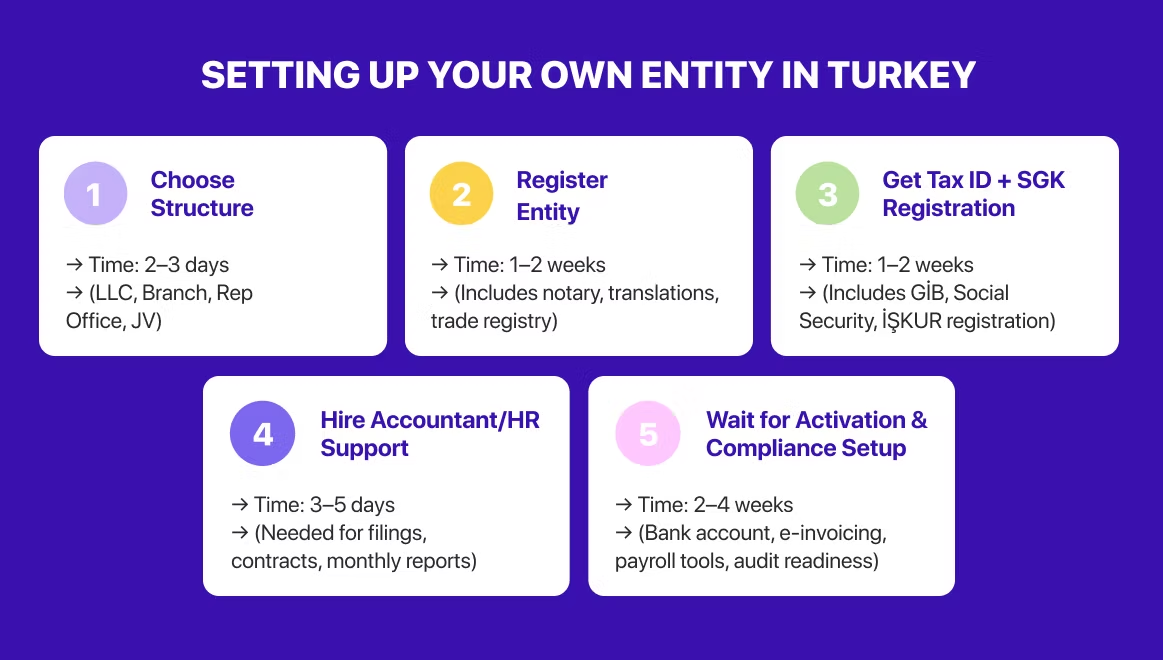
You need your own Turkish entity for invoicing, local sales, local procurement, or regulated activity. You plan to scale headcount in Turkey. You can meet capital, headcount, and reporting requirements consistently.
Choose a Turkey EOR when
You are piloting the market. You need one to ten hires faster than entity formation. You want predictable payroll and social security compliance while you validate the business case. You want a single operational owner for immigration-linked onboarding tasks.
Compliance checks that a serious Turkey EOR should handle for you
- Work permit criteria validation before you offer. Salary multipliers, financial tests, employment ratio.
- Process routing. Abroad vs domestic application and the ten working day rule.
- Fee payment controls. Avoid 30 day payment deadline rejections.
- Clean onboarding. Address registration timing awareness and social security compliance timing.
- Risk prevention. Avoiding illegal work scenarios that trigger 2026 fines.

Team Up positioning in Turkey
If you want a strong opinion. For Turkey, “global platform coverage” is not the same as “local reliability”. The regulatory rules are published, yes. But the operational reality is about preventing mistakes and sequencing steps correctly.
Team Up positions itself as the most reliable regional EOR partner in Turkey by focusing on compliance execution. Not vague promises. Contracts, payroll, social security, and immigration-linked onboarding done in the right order
Conclusion: Strategic Implications for 2026
The Turkish sponsorship model in 2026 is no longer a simple transactional process but a sophisticated component of the national economic strategy. For employers, the primary challenges are the heightened financial thresholds and the absolute necessity of maintaining the 5:1 ratio. For foreign professionals, the unified permit offers a stable path to residency, provided they can secure a sponsor capable of meeting the role-based salary multipliers.
The introduction of the Digital Nomad Visa and the Informatics Sector exceptions signals a desire to attract flexible, high-tech talent, but these remain "fenced" pathways with strict limitations on local market entry. Ultimately, the success of an employer sponsorship in Turkey depends on meticulous documentation and a proactive approach to the 10-day application windows that define the international recruitment cycle. As the Ministry moves toward even more data-driven inspections, transparency in salary declarations and financial reporting will remain the only viable strategy for long-term operational success in the Turkish market.
Frequently Asked Questions
1. What is sponsorship for employment in Turkey?
It is the formal, employer-led process required to obtain a Work Permit from the Ministry of Labour and Social Security. Because foreign nationals generally cannot apply for their own work authorisation, the sponsoring employer must submit the application through the Ministry's electronic portal (e-Permit System) to demonstrate that they are a legitimate, tax-compliant entity capable of employing the individual.
2. What does sponsorship for employment mean?
It means the employer accepts full legal and financial responsibility for the foreign national’s work status. This involves filing the initial application, meeting strict evaluation criteria (such as paid-in capital and local hiring ratios), and completing post-approval obligations, such as timely registration with the Social Security Institution (SGK).
3. Do I need sponsorship for an employment visa status in Turkey?
Yes. If the worker is a foreign national who does not already possess an unrestricted right to work, they require sponsorship. Holding a standard residence permit (ikamet) does not grant the right to work; a valid Work Permit is the only document that authorises employment.
4. Define sponsorship for employment visa status.
In Turkey, it is an integrated process where the approved Work Permit acts as both the legal basis for employment and a substitute for a residence permit. For candidates outside the country, this sponsorship initiates a "Work Visa" application at a Turkish consulate, which is then finalised as a formal Work Permit upon entry.
5. Does "DACA employer sponsorship" apply in Turkey?
No. DACA (Deferred Action for Childhood Arrivals) is a U.S.-specific immigration policy and has no legal equivalent in Turkey. In Turkey, all foreign workers—regardless of their prior status—must meet the Ministry’s standard evaluation criteria, which focus on the employer's capital, the local-to-foreign employee ratio (typically 5:1), and the role's professional necessity.
6. Are there "Employer of Record" (EOR) services for Turkey?
Yes. Given the complexity of Turkish compliance—which requires a local legal entity, paid-in capital of at least 500,000 TL, and strict quota management—many international companies use Global Employer of Record (EOR) services.
7. How does an EOR work in Turkey?
An EOR acts as the legal employer for your staff in Turkey. They use their own pre-existing, compliant Turkish legal entity to:
- Sponsor the work permit: Fulfilling the "sponsorship" role on your behalf.
- Manage Payroll: Handling mandatory SGK (Social Security) contributions, income tax withholding, and inflation-adjusted salary indexation.
- Ensure Legal Compliance: Managing contracts, probation periods, and termination requirements under the Turkish Labour Law.
8. What are the key employer obligations during sponsorship?
- Maintain Ratios: Ensuring you maintain five Turkish citizens for every one foreign worker hired.
- Salary Thresholds: Paying the foreign employee at or above the Ministry-mandated multipliers of the minimum wage (e.g., higher rates for managers and engineers).
- Reporting: Notifying authorities of any changes in the employee’s role, salary, or termination within the legally mandated timeframes.
9. What happens if a sponsored employee leaves the company?
The employer is legally obligated to notify the Ministry of Labour that the employment relationship has ended. The foreign national's work permit, which also serves as their residence permit, will cease to be valid, and the employee must typically transition to a different legal status or leave the country within a 10-day grace period.
10. Can I hire a foreigner if they already have a residence permit?
Yes, but they still require a work permit. If a foreigner already has a valid non-touristic residence permit, the employer can apply for a "Domestic Work Permit Application" through the Ministry's system, which is often faster as it avoids the need for a separate work visa application at a foreign consulate.
.svg)