


PEO vs Employer of Record (EOR) in the Philippines: Which is right for your organization?
Introduction
Here is a confusion that happens constantly. A company searches for "PEO Philippines" expecting the same model they use for domestic US HR administration — where a PEO co-employs their workforce, gives them access to better benefits, and handles payroll compliance without needing to set up anything first.
That model does not exist in the Philippines the same way it does in the United States.
Philippine labor law governs PEO co-employment differently. The entity requirement that the US PEO model sidesteps does not disappear in the Philippines — it is a structural prerequisite. And for foreign companies trying to hire Filipino employees without a registered Philippine entity, employer of record services are not just an alternative. They are often the only fully compliant path forward.
This guide makes the distinction clear, not in abstract terms, but in the specific Philippines legal and operational context where it matters.
The US PEO Model vs. the Philippine Reality
In the United States, a Professional Employer Organization (PEO) enters a co-employment arrangement with your company. The PEO processes payroll under its own EIN, administers benefits across its pooled client base, and handles compliance filings. Your company remains the legal employer for operational purposes. The PEO adds HR infrastructure on top.
The commercial advantage: the PEO's scale gives your small or mid-sized company access to Fortune 500-grade health insurance rates, streamlined compliance management, and a single vendor for complex multi-state payroll.
Many international HR teams search for "PEO Philippines" expecting the same model — access to a provider who can plug into their existing Philippines operations and handle the administrative burden. What they find is a different structure governed by different laws.
In the Philippines, a PEO is legal — but it functions within a specific legal framework:
- DOLE Department Order 174-17 (prohibiting labor-only contracting)
- Labor Code of the Philippines, Articles 106–109 (permissible contracting arrangements)
- Civil Code, Articles 1700–1712 (employment relationship definitions)
Under these frameworks, a PEO can operate as a co-employment or HR compliance service — but only when the client company already has a registered Philippine entity. The PEO cannot substitute for an EOR in representing a foreign company before Philippine government agencies. It cannot be the registered employer on government contribution filings when the client company is not itself a registered Philippine employer.
The practical implication: EOR remains the only fully compliant structure for foreign companies hiring directly in the Philippines without establishing a local entity. PEO works under local co-employment structures, not as a direct foreign employment solution.

What Philippine PEO Actually Is
Once you accept that the Philippine PEO model requires a local entity, the model's value proposition becomes clear, for companies that already have one.
A Philippine PEO is a service where your company and the provider share employment responsibilities. You remain the legal employer (because you hold a local entity), while the PEO manages day-to-day HR administration, payroll, benefits enrollment, and compliance support aligned with DOLE, SSS, PhilHealth, Pag-IBIG, and BIR requirements.
What the PEO handles:
- Payroll administration and remittance (SSS, PhilHealth, Pag-IBIG, BIR withholding)
- HR administration (employment contracts, onboarding documentation, records management)
- Benefits administration (13th-month pay, statutory leave tracking, HMO coordination)
- Labor compliance support (DOLE-aligned policies, handbook alignment, compliance monitoring)
- Employee relations and grievance process support
What you retain:
- Legal employer status (your Philippine entity is on the employment contract)
- Hiring and termination decisions
- Day-to-day work direction and performance management
- Full compliance liability as the registered employer
The key distinction from EOR: in a PEO arrangement, the employment contract is between your company and the employee. In an EOR arrangement, the contract is between the EOR and the employee.
That contract location determines who bears the compliance liability. And in the Philippines, where DOLE actively enforces Department Order 174-17 and the NLRC regularly rules on employer-employee relationships, that distinction is legally material.
PEO cost in the Philippines
Philippine PEO pricing typically runs lower than EOR — around $99/month per employee for co-employment administrative support (SOS benchmark), versus $199+/month for EOR. But the entity requirement is the equalizer: if you do not have a Philippine entity, the lower PEO fee is irrelevant because PEO is not available to you.

What Employer of Record Philippines Actually Is
Under employer of record services in the Philippines, the EOR becomes the legal employer, not your company. The EOR signs the employment contract, registers the employee with SSS/PhilHealth/Pag-IBIG, files BIR withholding returns, and assumes responsibility for DOLE compliance as the registered employer.
An Employer of Record employs your team through its own local entity, so you don't need one. A Professional Employer Organization co-employs workers alongside a company that already has its own entity in-country.
What the EOR Philippines handles
- Employment contracts compliant with the Philippine Labor Code (signed by EOR as legal employer)
- Payroll in PHP on the semi-monthly cycle (15th and end of month)
- SSS enrollment and remittance (10% employer contribution, capped at PHP 3,500/month)
- PhilHealth enrollment and remittance (2.5% employer, capped at PHP 2,500/month)
- Pag-IBIG enrollment and remittance (2% employer, capped at PHP 200/month)
- 13th-month pay accrual and December disbursement
- BIR income tax withholding (Form 1601-C monthly) and annual summary (Form 1604-C)
- DOLE compliance — registered employer for DOLE purposes, including D.O. 174-17
- 6-month security of tenure tracking — proactive notification before the regularization deadline
- Termination process management under the Labor Code (just cause or authorized cause)
- Immigration sponsorship for foreign nationals — AEP application and 9G visa coordination
What you retain:
- Day-to-day work direction
- Performance management
- Hiring decisions (you select; EOR formalizes)
- Compensation decisions (subject to local minimums)
For the employer sponsorship context — what it means when a hire requires sponsorship for an immigration-related employment benefit like an AEP — the EOR's registered employer status is what makes sponsorship possible without your company having a Philippine entity. See our guide on AEP sponsorship and employer registration in the Philippines.
The Core Decision Criterion: Do You Have a Philippine Entity?
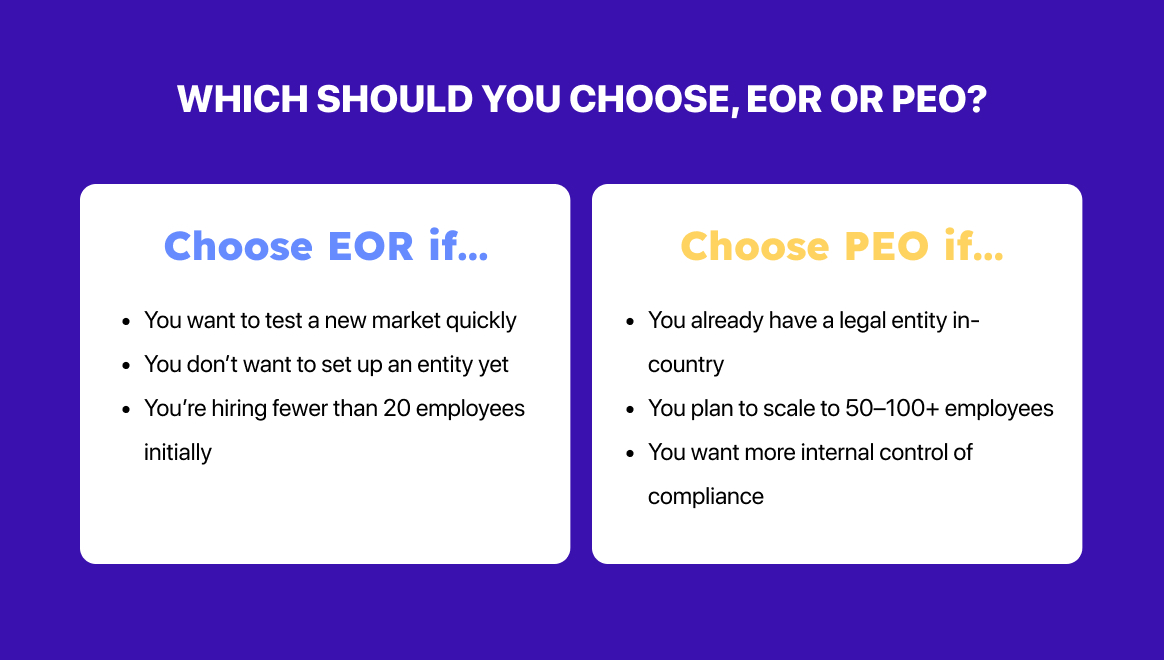
This is the question that resolves the PEO vs. EOR choice for most companies.
You have a registered Philippine SEC entity, active BIR registration, and are already a registered employer with SSS/PhilHealth/Pag-IBIG: → PEO is available. Evaluate whether the co-employment model fits your needs.
You do not have a registered Philippine entity: → EOR is the only compliant path for direct employment. Philippine PEO cannot represent you before government agencies as the employer.
That routing covers approximately 80% of the companies who ask this question. For the remaining 20% who do have an entity and are evaluating whether to switch from entity-managed payroll to a PEO, the evaluation continues to the criteria below.
The Legal Liability Difference: Who Is on the Hook
This is the dimension that matters most from a risk management perspective — and where PEO and EOR differ fundamentally.
PEO Philippine: Shared Liability
In a Philippine PEO co-employment arrangement, your company (as the registered entity and legal employer) retains shared liability for compliance obligations.
PEO co-employment creates shared liability exposure. The client company remains liable for operational employment decisions including termination, discrimination, and workplace safety. The PEO assumes liability for payroll tax accuracy, social insurance filings, and benefits administration errors.
What this means in practice:
- If an employee files an NLRC complaint for illegal dismissal, your company (as the registered employer on the contract) is the respondent
- If DOLE audits your entity for labor-only contracting under D.O. 174-17, your entity faces the enforcement action
- If SSS or PhilHealth finds remittance errors, your entity's employer account is the subject of the assessment
- If 13th-month pay is miscalculated or unpaid, DOLE complaints run against your entity
The PEO is your service provider for compliance administration. The compliance obligation remains yours.
EOR Philippine: Liability Transfer to Team Up
In an EOR arrangement, Team Up is the legal employer. The compliance obligations transfer to Team Up's Philippine operations:
- NLRC complaints from employees run against Team Up as the employer of record
- DOLE audits and D.O. 174-17 assessments apply to Team Up's registered operations
- SSS, PhilHealth, and Pag-IBIG remittance obligations are Team Up's accounts
- BIR withholding accuracy is Team Up's filing responsibility
This risk transfer is real. But it requires using a genuinely compliant EOR — one that operates as a registered Philippine employer with active government enrollments, not a passthrough or aggregator arrangement that looks like EOR but functions like an intermediary the Labor Code would classify as labor-only contracting.
The DOLE test for genuine employment: Does the EOR provide the work or service? Does the EOR have substantial capital or investment? Does the EOR carry employment risk? A properly structured EOR passes all three tests because it employs workers as a core business function, not as a contracting layer.
For enterprise companies hiring foreign nationals through EOR, the immigration liability transfer is equally significant. See our article on EOR-sponsored visas for enterprise businesses.
What is The DOLE Department Order 174-17 Dimension
Department Order 174-17 is the compliance regulation that makes the PEO vs. EOR distinction most consequential in the Philippine context.
D.O. 174-17 prohibits "labor-only contracting" — arrangements where a contractor supplies workers to a principal employer without genuinely being the employer. The key indicators of prohibited labor-only contracting are:
- The contractor does not have substantial capital or investment
- The contractor's workers perform work that is directly related to the principal's main business
- The contractor does not control the workers' performance or results
An EOR that is a genuine legal employer — with its own registered entity, active payroll compliance, capital base, and HR infrastructure — passes the D.O. 174-17 test because it is not a contractor supplying workers. It is the employer, with the full employment relationship running through its entity.
A PEO operating correctly also passes this test, because the underlying legal employer is the client's registered Philippine entity — there is a genuine, registered employment relationship.
The arrangements that fail: informal staffing companies, "outsourcing" arrangements where the client directs work without a genuine employment relationship through the provider, or EOR providers that operate as thin intermediaries without genuine Philippine employer infrastructure.
For companies choosing between PEO and EOR specifically to manage D.O. 174-17 risk:
- PEO + your entity = shared liability but you remain the registered employer
- EOR + Team Up's entity = liability transferred, Team Up is the registered employer
- Informal contractor arrangements = D.O. 174-17 exposure regardless of contract label
When PEO Philippines Makes Sense
For companies with established Philippine operations, PEO delivers specific value.
You have a Philippine entity and want to outsource HR administration
Your SEC-registered subsidiary is operational. Payroll is running. But the internal HR team is stretched — tracking SSS/PhilHealth/Pag-IBIG deadlines, managing BIR filings, and staying current on DOLE regulatory changes is consuming time that should go to people management. A Philippine PEO handles the administrative layer while your entity remains the legal employer.
You have a Philippine entity without building an HR benefits function
You have a Philippine entity and want to offer competitive supplementary benefits without building an HR benefits function. PEOs with pooled client bases can negotiate group HMO rates and supplementary benefit packages that a single-entity employer cannot access at equivalent pricing. For a Philippine company with 30 employees wanting to offer competitive HMO coverage, the PEO's purchasing power is meaningful.
You are transitioning from EOR to an entity and need ongoing HR support.
Many companies use EOR to enter the Philippines, register a Philippine entity once the market is proven, and then transition from EOR to direct employment. A PEO can be engaged at the entity stage to provide ongoing payroll and HR administration without requiring the client to build an internal Philippines HR team.
Who Philippine PEO is NOT for: Foreign companies without a Philippine entity who want to hire Filipino employees. The entity requirement is non-negotiable. If you do not have a registered Philippine entity, you need EOR — not PEO.
For employer sponsorship context and what it means for companies with vs. without Philippine entities, see our article on what employer sponsorship means and how it works.
When Philippines Employer of Record Is the Right Answer

EOR is the correct model in four situations — three of which apply to virtually every company entering the Philippines for the first time.
- Situation 1: You do not have a Philippine entity. This is the baseline. EOR is the only fully compliant path for foreign companies hiring Filipino employees without a registered Philippine entity. Attempting to hire through a PEO, an informal contractor arrangement, or a "freelancer" classification creates legal exposure under the Labor Code and D.O. 174-17.
- Situation 2: You are testing the Philippines market and want a clean exit option. EOR is the market-testing structure. No capital locked up. No entity to wind down. If you hire three customer success representatives through Team Up for six months, validate the talent quality and time zone fit, and decide the Philippines is not the right hub for your operations, you exit on standard notice. The EOR manages the compliant offboarding. Your total exposure is the EOR fees and the employees' notice period entitlements.
- Situation 3: You need to hire foreign nationals in the Philippines who require AEP sponsorship. Work permit sponsorship requires the sponsoring employer to be a registered Philippine entity with active DOLE compliance. Team Up's Philippine operations hold that registration and sponsor AEP applications directly. If your company has no Philippine entity, AEP sponsorship is only possible through an EOR.
- Situation 4: You are building a Philippines team as part of a multi-market expansion. Companies hiring across the Philippines and other emerging markets — Georgia, Armenia, Kazakhstan, India, Turkey — need a single EOR relationship that covers all markets under one compliance framework. Team Up's 20+ country platform covers Philippines operations alongside owned entities in the Caucasus, Central Asia, Turkey, and India. One invoice, one account team, one compliance calendar.
For how EOR enables employee relocation to the Philippines and what legal requirements it involves, see our guide on relocation legal requirements and practical steps.
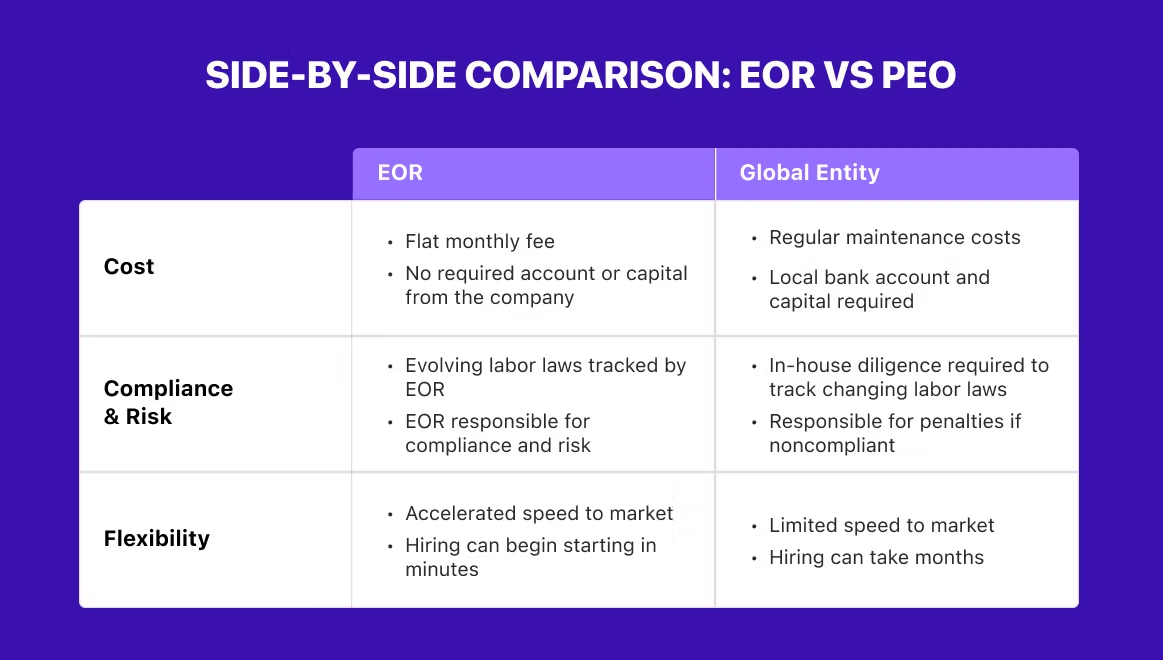
Side-by-Side Comparison: Philippines PEO vs. EOR
| Criteria | Philippine PEO | EOR (Team Up) |
| Legal employer | Your Philippine entity | Team Up (EOR entity) |
| Philippine entity required | Yes — mandatory | No |
| Employment contract issuer | Your entity | Team Up |
| DOLE compliance liability | Your entity (shared with PEO) | Team Up |
| SSS/PhilHealth/Pag-IBIG registration | Your entity's accounts | Team Up's accounts |
| 13th-month pay obligation | Your entity | Team Up |
| BIR withholding filing | Your entity (PEO administers) | Team Up files |
| AEP/9G visa sponsorship | Your entity (if registered) | Team Up (no entity needed) |
| NLRC complaint respondent | Your entity | Team Up |
| Security of tenure management | Shared (PEO advises) | Team Up manages proactively |
| Pricing (approximate) | ~$99/month (admin fee) | From €199/month (full EOR) |
| D.O. 174-17 compliance | Yes (if entity is genuine employer) | Yes (Team Up is genuine employer) |
| Market entry speed | Weeks–months (entity required first) | Days (no entity required) |
| Exit flexibility | Entity wind-down required | Standard notice, EOR manages |
| Best for | Established PH entities wanting HR outsourcing | Foreign companies without PH entity |
The Clear Answer for Most Companies Entering the Philippines
If you are entering the Philippines for the first time and do not have a registered Philippine entity, you need EOR. Not PEO. Not an informal contractor arrangement. Not a freelance structure.
EOR remains the only fully compliant structure for foreign companies hiring directly in the Philippines without establishing a local entity.
If you already have a Philippine entity and want to outsource the HR administration burden, PEO is a legitimate and cost-effective model, provided you choose a provider with genuine DOLE-compliant operations who understands Department Order 174-17 and does not create labor-only contracting exposure.
Team Up's Philippines EOR platform starts from €199 per employee per month. One employment contract. Full SSS, PhilHealth, Pag-IBIG, and BIR compliance. 13th-month pay managed. AEP and 9G visa sponsorship available. And if the Philippines is one of several markets in your expansion, Team Up's 20+ country network covers the Caucasus, Central Asia, Turkey, and India under the same platform.
200+ businesses. 4,000+ talent placed. 92% client retention over five years.
Frequently Asked Questions
Is PEO legal in the Philippines?
Yes, but with significant constraints compared to the US model. A Philippine PEO operates as a co-employment or HR compliance service under DOLE Department Order 174-17 and the Labor Code. It requires the client company to have a registered Philippine entity. It cannot represent a foreign company as the legal employer before government agencies. For foreign companies without a Philippine entity, EOR — not PEO — is the correct and compliant model.
What is the main difference between PEO and EOR in the Philippines?
The legal employer. In a PEO arrangement, your company's Philippine entity is the legal employer — the PEO handles administrative HR functions on your behalf. In an EOR arrangement, Team Up is the legal employer through its Philippine operations — your company has no direct employment relationship with the Filipino employee. The entity requirement flows from this difference: PEO requires your entity; EOR replaces the need for one.
Can an EOR sponsor an Alien Employment Permit for a foreign national in the Philippines?
Yes. Team Up's Philippine operations hold the registered employer status required to sponsor AEP applications with DOLE. The AEP is issued to the employee as a Team Up-employed staff member. The subsequent 9G Working Visa is also coordinated through Team Up's engagement. Budget 4–8 weeks for the full immigration process. For the full work authorization requirements, see our guide on AEP sponsorship and employer registration in the Philippines.
Why do so many companies search for PEO Philippines but actually need EOR?
The US PEO model is widespread and well-understood in global HR circles. Many HR teams search for the Philippines equivalent expecting the same model — a provider who can handle HR and payroll administration without entity setup. When they discover the Philippine PEO model requires an entity, most of them are actually looking for an EOR. The confusion is structural: the US PEO partially solves the entity-equivalent problem in some states; the Philippine PEO does not. For companies entering the Philippines for the first time, EOR is almost always the correct answer.
When does it make sense to transition from EOR to a PEO arrangement in the Philippines?
When you register a Philippine entity and want to transition from Team Up as the legal employer to your own entity, while continuing to outsource payroll administration and HR compliance. The transition involves: registering the Philippine entity, enrolling as an employer with SSS/PhilHealth/Pag-IBIG/BIR, transferring employee contracts from Team Up to your entity (following local Labor Code transfer requirements), and engaging a PEO or payroll provider for ongoing administration. Budget 2–4 months for the transition with local legal support.
.svg)


