


India Work Permits & Visas: Employer Guide to Types & Sponsorship
TL;DR
Expanding your team into India’s talent-rich market can feel like entering a compliance maze. One wrong move, like hiring a foreigner on the wrong visa, can lead to rejected entries, heavy fines, or even jail time under India’s Foreigners Act. This guide is here to give you founder-level clarity on India work permits and visas, from who needs them and the types available, to a step-by-step sponsorship process for employers. We’ll also show how an Employer of Record service in India (EOR) can simplify it all, letting you hire fast and stay compliant without setting up a local entity.
We dive straight into what decision-makers need to know with clear steps, compliance context, local law examples, and practical tips to avoid pitfalls. By the end, you’ll understand:
- Who needs a work permit in India (and the few exceptions)
- Types of Indian work visas – Employment Visas, Business Visas, and more
- How to sponsor a foreign employee’s visa – step by step, with your obligations
- How Employer of Record services in India [EOR-02] help you hire legally (fast, without an entity)
- Risks of misclassification or non-compliance – and how to avoid devastating mistakes
- EOR vs. setting up your own entity in India – a comparison of speed, cost, and risk
- Typical timelines and costs for Indian work permits (so you can plan)
- Common hiring mistakes to avoid – with pro tips for a smooth expansion
Let’s navigate India’s visa and work permit process with confidence, and turn what could be a legal headache into a growth opportunity for your business.
Who Needs a Work Permit (Visa) in India?
If you’re not an Indian citizen (or an Overseas Citizen of India), you must have a proper work visa to legally work in India. There are no shortcuts or “grey areas” here – employing a foreign national without the correct visa is illegal and can trigger severe penalties. For example, attempting to have someone work on a tourist visa violates immigration law and can result in fines or even imprisonment of up to five years. In short, any non-Indian needs prior authorization to work, usually in the form of an employment-related visa.
Are there any exceptions? Yes – a very limited few. India has special agreements with some neighbors, so citizens of Nepal and Bhutan don’t need work visas and may live and work freely in India under long-standing treaties. Additionally, people of Indian origin who hold an OCI (Overseas Citizen of India) card enjoy rights to work in India without a separate permit. Aside from those cases, every other foreign national – whether they’re from the US, Europe, or elsewhere- needs an Indian work visa sponsored by an employer to be legally employed in the country.
Tip:Don’t assume remote work gets a free pass. India doesn’t offer a digital nomad visa, and “working” remotely on a travel visa is still considered employment without authorization. In other words, your UX designer can’t just hop over on a tourist visa and start working from a cafe in Goa – that’s illegal, plain and simple. If they’re doing productive work in India, they need the proper work visa, or you’re both at risk.
Types of Work Visas in India

India’s immigration system offers several visa categories for foreigners, but only a couple allow gainful employment. As an employer, it’s critical to choose the right visa type for each foreign hire – the visa must match the purpose of the stay. Here are the primary work-related visas and what they mean for you as a sponsoring company:
Employment Visa (E Visa) in India
Employment Visas are the go-to option for hiring a foreign employee to work in India. This visa is issued to foreign nationals who have a job offer from an Indian company (or an organization registered in India) for a skilled, specialized role. Key points about the Employment Visa include:
- Skilled role requirement: You can only sponsor an Employment Visa if the role requires specialized skills, qualifications, or experience not readily available in the local talent pool. The government expects that you’re bringing in an expert or senior professional, not displacing an available Indian worker.
- Minimum salary threshold: To qualify, the job’s annual salary must usually be at least ₹1.625 million (≈ USD $25,000). India sets this floor to ensure only high-skilled positions are filled by expats. (There are a few exceptions – for example, teaching faculty at elite institutions, certain NGO workers on token stipends, translators, or ethnic chefs can be exempt from the $25K rule.) Make sure your offer meets the pay criteria, or the visa will be denied.
- Duration: An Employment Visa can be issued for up to 1 year initially (often tied to the contract term) and is renewable in-country. In some cases, longer durations (up to 5 years) are granted upfront for highly specialized roles or intracompany transfers, but this is at the discretion of the authorities. Typically, plan on a one-year visa and extend it annually as needed.
- Tied to the employer: The visa is employer-specific – it will actually list your company as the sponsoring employer. The holder can only work for that named entity in India. If they switch jobs, they need a new visa. If they leave your company, the visa becomes invalid. (In practice, if a foreign employee resigns, you should notify authorities, and they may have to depart or convert their status.)
The Employment Visa is your main route to legally employ foreign talent in India. Get your paperwork and salary in line with the requirements, and ensure the role genuinely needs an international hire. The government will scrutinize this. If done right, an Employment Visa lets your expat employee live in India and work for you full-time, fully compliant with local laws.
Business Visa (B Visa) in India
A Business Visa is not the same as a work permit. This visa is for business-related visits, not direct employment by an Indian company. Typically, you’d use a Business Visa to send foreign staff to India for activities like attending meetings, exploring partnerships, setting up a subsidiary, or negotiating deals. Key things to know:
- Allowed activities: Business Visas cover a range of short-term business activities – like a foreign executive attending a week of client meetings, an investor exploring opportunities, or a founder setting up an Indian entity. It can also be used by prospective business owners to establish a commercial presence or by senior employees of a foreign company to oversee Indian operations temporarily.
- No hands-on work for an Indian employer: The Business Visa does not allow the person to take up employment in India or receive a local salary. They cannot fill a permanent role in an Indian organization on this visa. It’s strictly for business visits. If the work in India is more than just meetings or setup – i.e., day-to-day operational involvement in an Indian company – an Employment Visa is required. Misusing a Business Visa for what is essentially employment is a violation of immigration rules.
- Duration: Business Visas can be granted for multiple entries and a longer validity (often 1 to 5 years), but stays per visit are usually limited (e.g., 180 days at a time). If someone on a Business Visa needs to stay longer than 6 months at a stretch, they must register with the FRRO as well. This visa is more flexible in validity, but again, it’s not a work permit – it’s meant for visits, not hiring.
- When to use: Use Business Visas for things like sending your non-Indian founders or product leads to India to explore the market or meet clients, not to sneak someone in to actually perform a job based in India. It’s great for short-term needs, but the second that person needs to perform regular duties for an Indian organization, you’re in Employment Visa territory.
Intern Visa in India
India also offers an Intern Visa for foreign nationals interning in India-based organizations, companies, or NGOs. If you plan to host a foreign intern, they’ll need this visa. The Intern Visa has some particular conditions:
- It’s generally available for those who intend to intern with an Indian company, educational institution, or NGO. The internship offer must be in place.
- Often, the intern must begin the internship within a certain period of graduating from their last degree (to ensure they are bona fide interns and not professionals in disguise). In practice, Indian consulates commonly require that the internship start within one year of the intern’s graduation.
- The duration is usually up to 1 year (or less, depending on internship length). It’s a short-term, non-renewable visa – after the internship, the individual is expected to leave (or convert to another status if applicable).
- It does not permit full employment. Any stipend should be reasonable for an internship. If you decide to hire the person full-time after the internship, they’ll need to exit and re-enter on an Employment Visa.
For employers, the Intern Visa is a way to bring in foreign interns legitimately. Just be prepared to provide documentation of the internship program, and note that interns on this visa can’t be treated as regular employees.
Project Visa in India
A Project Visa is a niche category India created for foreign nationals coming to India for specific projects in certain sectors. Currently, Project Visas are primarily issued for foreign workers (often from specific countries) in the power and steel sectors on projects in India. Unless you’re in those industries, you likely won’t use this visa, but for completeness:
- Industry-specific: Project Visas are limited to projects in power, steel, and a few other infrastructure sectors deemed important. For example, if a foreign company is awarded a construction project for a power plant in India, their engineers and technical staff might come on Project Visas.
- Tied to the project: The visa is valid only for the duration of that project and for work on that specific project site. It’s not transferable to other work. Once the project is completed (or the term ends), the visa holder must leave or convert to a different visa if eligible.
- Special procedures: These visas often require additional approvals and coordination with Indian government ministries. Employers sponsoring Project Visas must often coordinate with sectoral authorities and ensure compliance with all project-related immigration guidelines.
For most tech startups or service companies, Project Visas won’t be relevant. But if you’re in heavy industry or taking part in a government-approved project, be aware that this visa exists as a route to bring in specialized project staff.
Dependent Visa (Entry “X” Visa) in India
When you bring foreign employees to India, they may want to bring along their immediate family. India issues an Entry Visa (often coded “X”) for spouses and dependents of those who hold long-term visas (like Employment or Student visas). Key points:
- A dependent Entry Visa allows the person (e.g., the spouse or child of your foreign employee) to live in India with the primary visa holder for the duration of the primary person’s visa. It’s essentially a residential visa for family unity.
- Importantly, the Entry (X) Visa does not permit the dependent to work in India. So if your employee’s spouse also wants to work, they must qualify and apply for their own Employment Visa through an employer. The Entry Visa is purely to stay in the country as a dependent. No paid work allowed on that status.
- Dependents on Entry Visas also must register with the FRRO if their stay exceeds 180 days, just like work visa holders. And their visa validity will typically match the primary worker’s visa duration.
As an employer, you might not deal directly with applying for dependents’ visas (the individuals handle that), but be aware of it. It can affect relocation planning, and you may need to provide supporting documents like proof of employment for your employee when their family applies.
Summary of Visa Types: In most hiring cases, Employment Visas are the answer for foreign employees. Business Visas are only for short-term business travel, not formal employment. Intern Visas and Project Visas serve specific use cases (interns and certain project workers), and Entry Visas cover dependents who come along. Choosing the correct category is critical – using the wrong visa (e.g., trying to have someone work on a Business Visa) is considered visa fraud and can land both employer and employee in serious trouble. Always align the visa type with the individual’s actual activities in India.

How to Sponsor a Work Visa in India (Step-by-Step)
Sponsoring a foreign employee’s work permit in India involves multiple stages and coordination between the employee, the employer, and Indian authorities. Below is a step-by-step breakdown of how the process works from the employer’s side, and what you’ll need to prepare and do at each stage:
1. Confirm the Right Visa Type:
Determine which visa category fits the situation. If the person will be your full-time employee in India, it almost certainly means an Employment Visa (not a Business Visa). Verify that the role meets the criteria for an Employment Visa – i.e., it’s a skilled position and you’re paying at least the minimum salary. Also, ensure the candidate has the necessary qualifications or experience to justify hiring a foreign national. If they’re coming for meetings or a short setup period only, a Business Visa might suffice, but tread carefully. When in doubt, lean toward the Employment Visa for anything involving hands-on work for your company in India.
2. Ensure You’re an Eligible Sponsor
Only legally registered entities in India can sponsor an Employment Visa. That means your company (or subsidiary/branch) must exist in India as a legal entity (e.g., a private limited company, LLP, etc.) and have the proper registrations (tax IDs, etc.). You will need to provide proof of your company’s Indian registration in the visa application. If you don’t have an Indian entity, you cannot directly sponsor a work visa – that’s the law. (This is exactly where using an EOR can help, since an EOR becomes the local employer on record [EOR-04].) Additionally, as a sponsor, you should be prepared to demonstrate why this foreign hire is needed – for instance, showing the specialized skills or global experience they bring that isn’t easily found locally. Indian authorities want to see that the hire benefits the company and country, not displaces a local worker.
3. Issue a Compliant Offer Letter/Contract
Before the visa can be processed, the foreign candidate will need an employment contract or offer letter from you (the sponsoring company) in India. This contract should state the job title, duties, salary, and duration of employment. Make sure it meets Indian labor law standards (probation periods, notice, etc.) and, crucially, that the salary meets the visa threshold. The Indian embassy will scrutinize the contract’s salary and terms. If you’re unsure about local contract norms, consider getting it reviewed by an India HR expert or using an Employer of Record service to issue a locally compliant contract. Having a clear, formal job contract is mandatory – the visa application will include this document.
3, Gather Required Documentation
Both you (the employer) and the employee will need to compile a stack of documents for the visa application. From the employer side, key documents typically include:
- Company registration certificates: e.g., Certificate of Incorporation of your Indian entity, GST registration, etc., to prove your company is legitimate.
- Support/invitation letter: A letter on your company letterhead, formally inviting the employee to work in India and confirming you will be their sponsor. This usually should mention the role, why the person is suited for it, the salary, and a commitment that you’ll abide by Indian laws and take responsibility for the individual.
- Financial statements or profile: In some cases, you might include a brief company profile, annual report, or bank statements to show the company’s standing (this is less common, but may be required if the consulate wants proof that the company can pay the salary and is a bona fide operation). The employee will need to provide: passport, passport-size photos, copies of educational qualifications and certifications, a résumé, and any relevant reference letters. They’ll also fill out the official visa application form online (print it for submission). As the employer, help your candidate ensure nothing is missing – any missing or incorrect document can delay or derail the visa.
4. Submit the Visa Application
The foreign employee typically submits their visa application in their home country (or current country of residence) at the Indian Embassy or Consulate. Many Indian consulates outsource the collection of visa applications to a visa application center (like VFS Global). The process is usually: fill out the online application on the Government of India’s visa portal, print and sign it, and take it along with all supporting documents to the consulate appointment. As the employer, your role is to make sure the applicant has all the employer-provided docs (invitation letter, contract, etc.) and to coordinate on any questions. In some cases, the consulate may request an in-person interview with the applicant before approval – ensure your candidate is prepared to explain their role and your company’s business in India clearly and truthfully.
5. Pay Visa Fees & Await Approval
Visa fees must be paid at the time of application – these vary based on the applicant’s nationality and the visa duration. (For example, a US citizen’s Employment Visa fee might differ from a French citizen’s.) As a ballpark, work visa fees can range from around $150 up to $1,000 USD in total, depending on the circumstances. The fee is usually paid by the applicant at the bank or visa center, but you may decide to reimburse this cost as the employer. Once the application is in, processing can take anywhere from a few days to a few weeks. Some Indian missions advertise a minimum of 3-5 working days processing time, but in reality, plan for a few weeks to be safe – especially if a background referral to New Delhi is needed for security clearance (which can happen randomly or for certain nationalities). During this waiting period, do not let the employee travel to India – they must wait for the visa stamp in their passport first.
6. Entry to India & Onboarding
Once the visa is approved, congratulations – your new hire can travel to India and start work! But the process isn’t entirely over. Upon entry, immigration will stamp their passport and note the visa validity. Now your obligations as an employer shift to local compliance (payroll setup, tax withholding, etc. – more on that later). It’s wise to schedule the employee’s start date a bit after their arrival to accommodate any remaining formalities.
7. FRRO Registration (Post-Arrival)
Important: If the granted visa is for more than 180 days, or if the person will be in India over 6 months, they must register with the Foreigners Regional Registration Office (FRRO) within 14 days of arrival. This is a mandatory step often overlooked by newcomers. As the employer, you should absolutely assist with this – typically, your HR or admin team (or your EOR partner) can help fill out the FRRO online registration and accompany the employee to the FRRO office if needed. The employee will get a Residential Permit from the FRRO. Failing to register on time can result in penalty fines and a lot of hassle – the clock starts the day they land. Set a reminder and help them get it done in the first week or two. (During COVID and beyond, some of this can be done online, but rules still require the timely submission of information.)
8. Ongoing Compliance & Renewals
Work permits aren’t a one-and-done deal. You need to maintain compliance throughout the foreign worker’s tenure. This means: ensuring you continue to meet all tax and labor obligations for this employee, monitoring the visa expiry date and initiating renewals well in advance (start at least 2 months before expiration for extensions), and updating the authorities on any changes (e.g., residential address changes may need to be updated with FRRO). If the employment terminates, you should inform the FRRO/Foreigner Registration office and the employee will likely have to depart promptly. Essentially, sponsoring a foreign employee is a commitment – stay on top of the paperwork to avoid any lapses.
By following these steps diligently, you’ll navigate the Indian work visa process as smoothly as possible. It is a paperwork-heavy, procedural process, yes – but with careful attention to detail, it’s manageable. Many companies handle this regularly. Still, if this list seems daunting, the next sections will explain how partnering with an expert or an Employer of Record can offload much of this burden.
Employer Obligations & Compliance Risks in India
Hiring foreign nationals in India comes with a slew of employer obligations, and failing to meet them isn’t just a minor slip-up; it can be downright dangerous for your business. Let’s talk compliance: what you must do when employing an expat in India, and the major risks if you don’t.
Obligations when employing a foreigner:
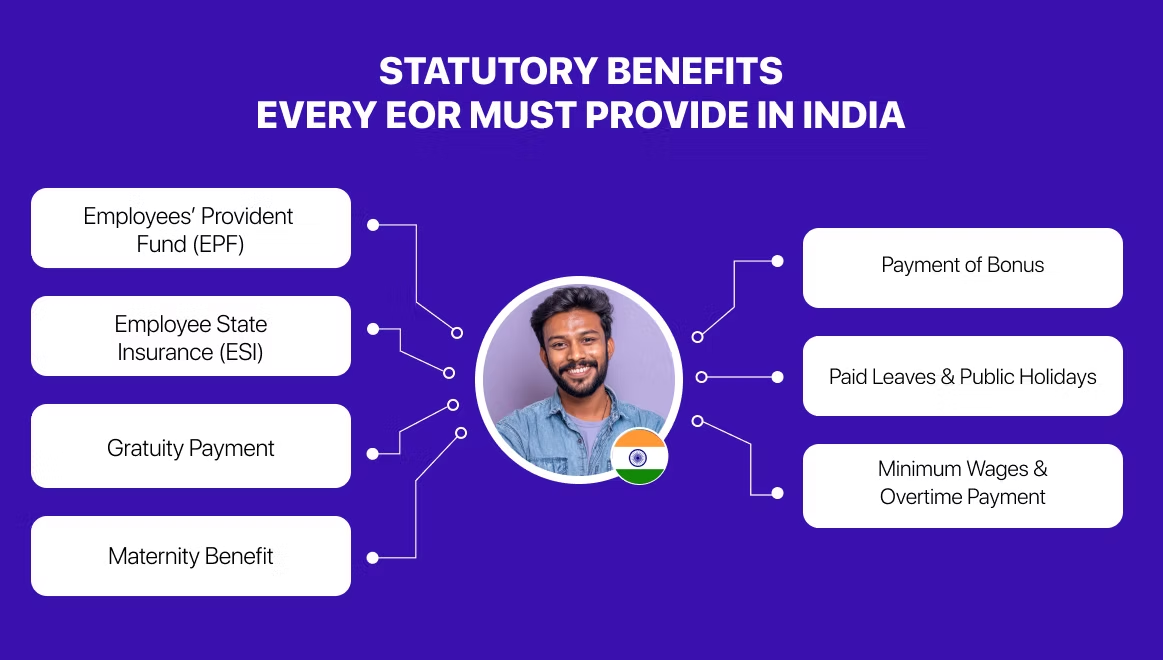
- Follow all Indian labor laws – exactly as you would for an Indian employee. Foreign employees aren’t outside the system. You need to provide statutory benefits (Provident Fund, health insurance if applicable, gratuity, maternity/paternity leave, etc.) just as required by law. They have the same rights under labor laws (for instance, you can’t bypass termination rules or notice pay just because someone is foreign). Essentially, once on your payroll, they are subject to Indian employment law protections.
- Tax withholding and filings: You must deduct the appropriate income taxes (TDS) from the foreign employee’s salary and remit to the authorities, and comply with any social security contributions. India has some provisions for foreign workers (e.g., some can opt out of PF if their home country has a social security agreement), but you need to handle this correctly. Every payslip, every monthly tax deposit – it all must be done on time. If you mess up payroll compliance, you get the penalties, not the employee or the EOR.
- Maintain valid visas at all times: Keep track of your foreign employees’ visa expiration dates. If a visa is expiring and you want to continue employment, you must work on renewal well in advance. It’s your responsibility to only allow people with valid work authorization to work. Letting a visa lapse while the person is still working for you = big legal trouble (fines, and you’ll have an illegal worker on your hands). Calendar those dates and start extension processes early.
- FRRO & local registration: As noted, help ensure your expat hires register with the FRRO if required and update that registration for any changes (address, new passport, etc.). Also, some states in India require employers to report the hiring of foreign nationals to local police or labor departments. For example, when you have a foreign employee, you may need to inform the local Foreigner Registration Office of their presence and any change in their employment status. Stay in touch with local authorities as required – don’t “hide” a foreign employee off the books.
- Exit formalities: When a foreign employee resigns or is terminated, you have some extra steps. Apart from the standard HR process, you should notify the FRRO that the individual is no longer employed (especially if it’s before their visa expiry). They may be required to depart India quickly (visas often are cancelled within a short grace period after employment ends). As a courteous practice, many employers help outgoing expat staff with the logistics of wrapping up their FRRO deregistration or visa cancellation to ensure no loose ends. You don’t want an overstayer linked to your company.
Risks of non-compliance or misclassification:
What if you decide to “wing it” and ignore some of these rules? In short: don’t. India’s legal system can be slow, but it packs a punch when infractions surface. Here are some scenarios and why they’re extremely risky:
Hiring on the wrong visa
Say you bring in a foreign engineer on a Business Visa because it was “faster” than an Employment Visa. If caught, this is viewed as employment without authorization. The foreigner can be deported and blacklisted, and your company could face legal action for employing someone illegally. Under Section 14 of the Foreigners Act, both employer and employee can face penalties – including fines and imprisonment. Immigration authorities do conduct random checks and audits on companies known to employ expats. It’s not worth it. As one compliance expert bluntly put it, working on a tourist/business visa in India is forbidden and can lead to penalties – the government has zero tolerance for visa abuse.
Misclassifying an employee as a “contractor”
This is a common temptation globally – why not just call the person a consultant and pay them overseas? In India, if that person is physically working in India under your direction, immigration will still view them as needing a proper work visa. Separately, Indian labor authorities might view them as your de facto employee regardless of the paperwork. You could face a double-whammy: immigration violations for the visa issue, and labor law violations for not adhering to employment laws. Misclassification also means no social security, no protections, which can lead to disputes. If a misclassified “contractor” takes you to labor court, odds are you’ll lose. Remember, Indian courts rarely side with the employer in such cases of evasion. The financial liabilities (back-paying benefits, taxes, penalties) and reputational damage can be massive. In short, you gain nothing by trying to skirt the rules – you just accumulate risk.
Failure to pay taxes or benefits
Maybe you correctly got the visa, but then you pay the person off-cycle or overseas to save on taxes, or you don’t enroll them in required benefit plans (like Provident Fund). This will unravel. India’s systems (like the income tax database) will eventually flag discrepancies. If an audit finds you haven’t paid PF or withheld taxes for an expat employee, you’ll owe all those back contributions plus interest and fines. The employee might also get hit with tax issues, but you can bet you’ll be in the firing line for facilitating it. Non-compliance with statutory filings – be it missing a monthly PF deposit or not registering under the Shops & Establishments Act – can result in fines, legal notices, and could jeopardize your ability to do business in that state. India has a reputation for bureaucracy, and part of that means there are many checkpoints for compliance – it will catch up to you if you try to cut corners.
Penalties and blacklisting
Severe, willful violations (like employing several foreigners illegally or a history of non-compliance) can get your company blacklisted from sponsoring future visas. Think about that – you’d effectively be shut out from international hiring until you clean up the mess (and that can take years of legal processes). Individual executives might also face personal liability in some cases. And consider the PR angle: getting busted for illegal employment can make news, which is not the kind of headline a growing startup wants. It can scare away investors and partners. The cost of compliance is always cheaper than the cost of getting caught non-compliant.
The takeaway here is straightforward: take compliance seriously from day one. If this sounds onerous, remember that there are services and partners (like EORs or legal firms) whose entire job is to handle this for you. Many companies partner with an Employer of Record specifically to avoid these pitfalls – because the EOR contractually absorbs these compliance duties, ensuring every i is dotted and t crossed. Let’s explore that option next, because it’s one of the smartest ways to de-risk your India expansion.
How an Employer of Record (EOR) Can Simplify India Work Permits
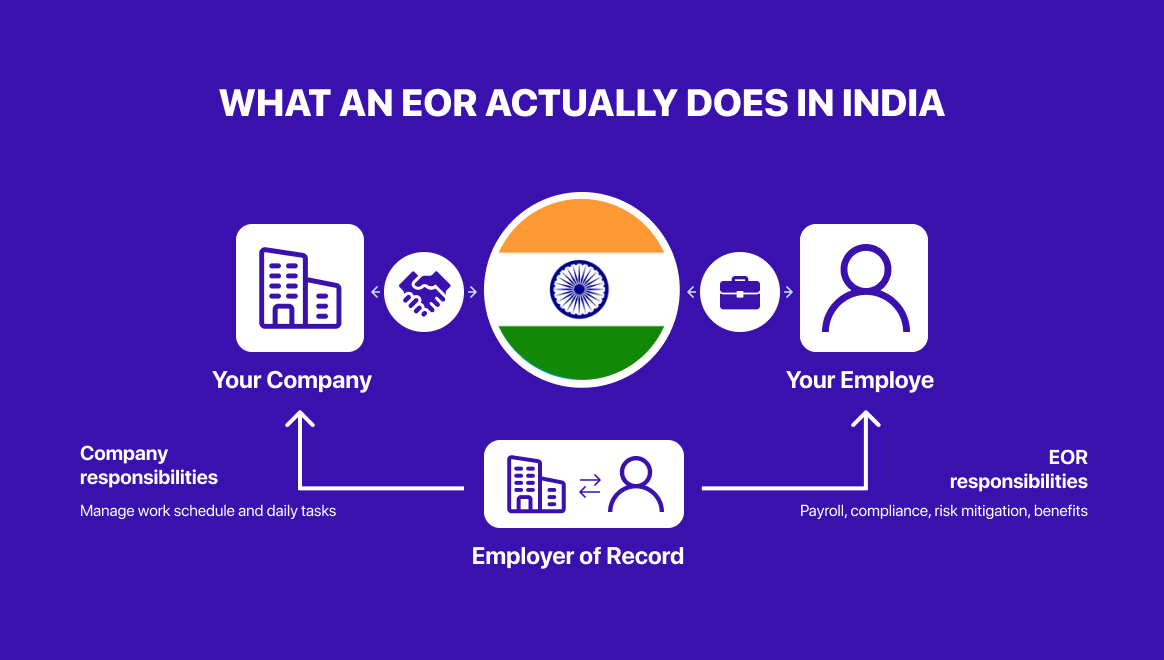
Navigating visas, entity setups, and labor compliance in India can be overwhelming – especially if you’re eager to start hiring now, not months from now. This is where partnering with an Employer of Record in India can be a game-changer.
An EOR is essentially a third-party organization that becomes the legal employer of your hires in India, handling all local employment formalities on your behalf. In the context of work permits and visas, a good EOR service takes on the heavy lifting so you don’t have to. Here’s how:
No Local Entity Needed
Perhaps the biggest benefit – with an EOR, you don’t need to set up a subsidiary or branch in India to hire someone. The EOR already has a fully compliant Indian entityready to employ your candidate. This means they can sponsor the Employment Visa for your hire as the local employer. You skip the entire process of incorporating a company, obtaining tax registrations, and learning Indian corporate law, which could take months and considerable expense. The EOR’s entity is the vehicle to quickly and legally get your team on the ground.
Expert Visa Sponsorship & Immigration Support:
Employer of Record services in India specialize in this exact process – it’s in their interest to get work permits approved quickly and without issues. They will manage the visa paperwork end-to-end: preparing the invitation and sponsorship letters, ensuring the employment contract meets all the Indian legal requirements, and guiding the candidate through the consular application.
A quality EOR knows the nuances of Indian immigration rules intimately (for example, the $25K salary rule, or which consulates might ask for extra documents) and can preemptively address them. Essentially, you’re hiring their expertise. Instead of you fumbling through forms for the first time, the EOR has likely done it dozens of times and has a streamlined process. They’ll even accompany your employee to the FRRO if needed and handle that registration. This removes a huge weight from your shoulders.
Speed and Efficiency
By leveraging an EOR, you can often onboard a foreign hire in weeks instead of many months. How so? Think about it: without an entity, you simply can’t hire or sponsor a visa at all. Your alternative would be spending 2-3 months (at a minimum) to establish a company in India, plus the visa processing time after that. An EOR can start the visa sponsorship process immediately since the infrastructure is in place. In fact, if you already have a candidate identified, an EOR might secure their Employment Visa and have them legally working in India in as little as 4-6 weeks (sometimes faster), whereas doing it yourself might push your project timeline out 6+ months. In the startup world, speed matters – and EOR services are built for speed of entry. You can hire in India fast without waiting for bureaucracy to catch up with your ambitions.
Local Compliance, Handled
Remember all those compliance obligations we talked about? An EOR assumes those on your behalf. They become the Employer of Record, meaning they are officially responsible for things like paying salaries, withholding taxes, enrolling the employee in mandatory benefits, filing all employment law paperwork, and so on. A good EOR will have robust processes to ensure 100% compliance with Indian laws – it’s literally their business to do so. This drastically lowers your risk of mistakes. The EOR will make sure no PF filing is missed, no visa renewal is forgotten, and no employment contract clause is out of line. They essentially serve as your shield against India’s regulatory complexity. If you’re worried about misclassifying employees or messing up some obscure rule, an EOR provides peace of mind. (Many EORs even contractually assume liability for compliance – so if something were done incorrectly, they bear the risk, not you. It’s like an insurance policy.)
Avoiding Misclassification and Other Pitfalls
Let’s be real, some companies that try to DIY their India hires end up attempting shady workarounds (like those we discussed: hiring contractors instead of employees to avoid work visas, or using business visas for work). An EOR removes any temptation or need for that. By employing the person properly on your behalf, the individual is correctly classified from day one – no grey areas, no creative interpretations. This keeps you far away from the misclassification trap and associated penalties. Additionally, an EOR will typically include misclassification insurance or guarantees in their service, further protecting you. In short, it’s the compliant path, not a workaround – and that’s exactly what you want when the penalties for non-compliance are so high.
Full HR Administration and Support
Beyond just the visa, an EOR in India handles the entire employment lifecycle for that worker. That means once the person is on board, the EOR runs payroll (in INR), deposits taxes to the Indian government, provides payslips, administers any benefits (like health insurance or provident fund), and ensures all statutory reports are filed.
They even assist with termination processes if, down the line, you need to part ways with the employee, making sure it’s done per Indian law. Essentially, you manage the day-to-day work, and the EOR takes care of everything else, HR/legal.
This is invaluable if you don’t have an in-house HR team versed in Indian law. It’s also very human – many EORs will work with your employee directly to answer any HR questions, help with things like opening bank accounts, etc., making the expat’s transition smoother. You get to focus on your product and team integration, while the EOR worries about the government paperwork.
Scalability and Multi-country support
Many EOR providers have a global network. If India is just one of the new markets you’re targeting, you can often use a single global Employer of Record partner to hire in multiple countries seamlessly.
Today, it’s an engineer in Bangalore, tomorrow it might be a designer in Vietnam or a salesperson in Brazil – a global EOR can support all those hires under one umbrella contract. This is much more efficient than setting up entities country by country or dealing with different local HR consultancies.
It’s like a one-stop shop for global hiring. Even within India, if you end up hiring people in multiple states, the EOR handles the state-specific compliance (like state profession tax or labor welfare fund registrations), which you might not even be aware of. In short, EOR = plug-and-play international hiring.
Of course, an EOR service isn’t free – there’s typically a monthly fee per employee for the convenience and service. However, when you stack that fee against the costs of entity setup, legal counsel, accounting, payroll administration, and the opportunity cost of delays, it often comes out looking like a bargain.
For instance, many global EOR providers charge around $500–$600 USD per employee per month, whereas local-focused EOR services (like Team Up’s ₹ local model) might be closer to €199 per month – in any case, far cheaper than establishing a full subsidiary and hiring a compliance team. And importantly, that fee bundles all those critical services together.
To maximize this benefit, make sure to choose a reputable EOR partner. There are many Employer of Record services in India, from big global firms to regional specialists. Look for one with a strong compliance track record, transparent pricing, and fast response times. It helps to compare the top EOR providers in India on factors like cost, included services (do they handle visa sponsorship in-house?), and client reviews. The right EOR will feel like an extension of your team, not just a vendor.
In summary, using an EOR is about speed, simplicity, and safety. You get your talent onboarded quickly, skip the bureaucracy of entity setup, and significantly reduce the risk of running afoul of Indian laws. Many startups use an EOR as a bridge solution – start with an EOR to scale up a small team in India quickly and legally, and later, if you’re finding huge success in India, you can transition to your own entity (the EOR can even help transition the employees to your new entity when the time comes). This hybrid approach is common and smart. In any case, an EOR lets you enter India’s market confidently, knowing compliance is under control.
EOR vs Setting Up Your Own Entity in India: A Cost & Risk Comparison
Should you use an EOR or establish your own subsidiary in India? It’s a fundamental strategic question for companies planning to hire in India. The answer often depends on your stage of growth, the number of employees, and long-term plans. Let’s break down the trade-offs on multiple fronts: speed, cost, compliance, and control, so you can make an informed decision.
Speed to Hire
Employer Of Record Services India
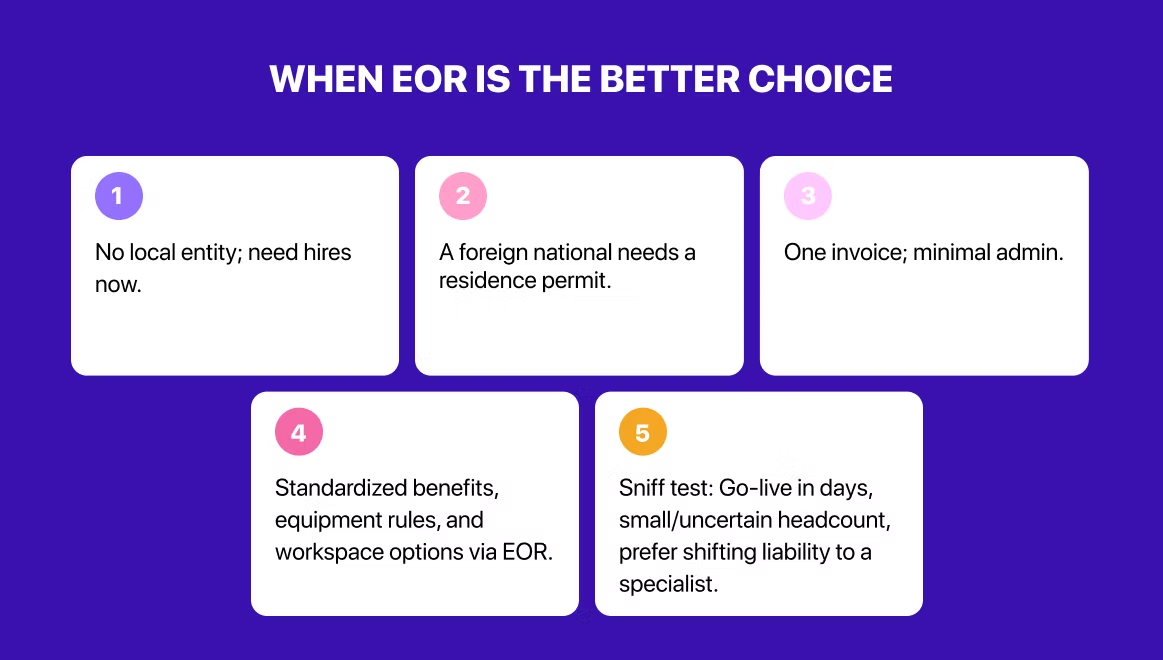
Using an Employer of Record, you can start hiring almost immediately. As discussed, an EOR already has the legal infrastructure. You could sign an agreement with an EOR this week and have a new Indian employee legally on payroll by next month (or even sooner). There’s virtually no lead time to “set up” – your EOR partner handles the onboarding and visa sponsorship right away. This speed is invaluable if you’ve found the perfect candidate and don’t want to lose them to a slow process, or if a project demands someone on the ground ASAP.
Own Entity Route
Setting up your own company in India is not instantaneous. Even with expert help, incorporation can take several weeks, and that’s just the beginning. You’ll need to register for taxes (PAN, TAN, GST if applicable), open bank accounts, possibly register with regional authorities (like Shops & Establishments in the state you operate), and build out payroll infrastructure. Realistically, you’re looking at 2–3 months at minimum before all is said and done (and that’s if everything goes smoothly and you’re aggressively pushing). Only then can you start sponsoring visas and hiring. If you’re on a tight timeline, this delay can be a deal-breaker. As one company put it, with an EOR, you hire in weeks, not months.
Verdict: EOR wins on speed. An EOR is the fast-track option – you skip the setup and go straight to hiring. Setting up an entity is a long game.
Upfront and Ongoing Costs
Costs to Use EOR
EOR services charge a monthly fee per employee. This fee typically covers all employment overhead for that worker (payroll, compliance, admin) plus the EOR’s margin. For example, an EOR might charge, say, $500 per employee per month, or a flat fee like €199 as Team Up does locally. If you have one employee, you pay that fee; if you have five, it’s five times that fee, etc. There’s usually no high upfront cost beyond perhaps a small setup fee in some cases. So the initial cost is very low – you pay as you hire. If you decide to terminate the service, you generally only pay for the months of service used. In exchange, you’re not dealing with any local accounting or legal fees on an ongoing basis, and the EOR fee is predictable and bundled.
To put it in perspective, consider a scenario of hiring 5 employees in India via EOR vs. an own entity. With an EOR at ~€199/employee/month: that’s about €199 * 5 * 12 = €11,940 per year in service fees. That’s it – €12k and your five employees are fully managed and compliant.

Entity Costs
Setting up and running your own entity comes with both one-time and recurring costs that can far exceed an EOR’s fees, especially at small scale. Upfront, you’ll incur expenses for company registration (government fees are modest, but legal and consulting fees can run a few thousand dollars easily). If you’re not personally navigating Indian bureaucracy, you’ll hire a law firm or incorporation service. Let’s say that’s $5k-$10k in setup professional fees for a quality job (just an estimate – could be more if your structure is complex). Then, you need a local accountant or finance person to run payroll and handle monthly filings (you’ll likely hire a firm on retainer or a full-time accountant). Add monthly accounting fees. You might also need an HR consultant to draft local-compliant contracts and policies, another cost. Office space (if required for registration or operations) is another factor – though many startups go without a physical office initially, note that some Indian registrations require a local address and rent agreement.
Now, ongoing: annual compliance filings, auditing of accounts (India mandates an annual audit even for private limited companies), corporate tax returns, possibly GST returns if applicable – you’ll need to budget for a CPA firm to handle these. And payroll overhead: you’ll be paying employer contributions to PF (provident fund) and other statutory benefits for each employee, regardless of EOR or own entity (though EOR fee often covers administering those). The big difference is that if you have your own entity, you bear all these overhead costs even if you have just one or two employees.
A real-world comparison: one analysis found that running a small 5-person entity in India could incur €30,000–€40,000 in the first year when you factor in incorporation, local staff, compliance setup, and overhead. By contrast, the EOR cost for those 5 employees was under €12k. That’s a dramatic cost saving for the initial stages. Even if those estimates vary, the message is clear – until you have scale, an entity is far more expensive.
Verdict: For small-to-medium team sizes, EOR is usually more cost-effective upfront and in the first few years. Only when you scale to a larger team (dozens of employees) might the balance tip. Many companies find that, for entities with 50+ employees, the fixed costs of an entity start to be cheaper per employee than paying EOR fees. Until then, an EOR can be a bargain when you count avoided setup costs and costly mistakes. And let’s not forget, doing it wrong (messing up compliance on your own) can lead to fines or legal fees that blow any budget – an EOR helps avoid those “surprise” costs.
Compliance and Liability
Employer of Record India
When you use an Employer of Record, compliance is part of the package. The EOR contract will typically state that they are responsible for complying with all local employment laws for the employees they host. That means they will handle registrations, tax withholdings, social contributions, contracts in line with the law, etc. If there’s a mistake (say, a filing was done wrong), a good EOR will take accountability to fix it – after all, they are the legal employer on record.
Effectively, the liability for employment compliance shifts to the EOR provider. They carry that risk, so you don’t have to. Of course, this doesn’t mean you’re 100% risk-free (e.g., you still must not instruct the EOR to do something unlawful), but it greatly reduces your exposure. Also, EORs are by nature compliance experts; their entire business model depends on not screwing up filings or laws. They are likely to do a more thorough job than a small startup trying to juggle foreign compliance on its own.
Additionally, reputable EORs often have insurance and legal teams. If an employment dispute arises or an audit occurs, they handle it. You’re a step removed, which can buffer you. And crucially, using an EOR means you avoid the risk of misclassification because employees are properly classified from the start, as we noted. Many EOR agreements include indemnification clauses where the EOR indemnifies you against compliance breaches on their part. It’s hard to overstate the peace of mind this brings when operating in a country 5,000 miles away.
Hiring via Own Entity
If you set up your own entity, all compliance burden and liability is squarely on you. You are responsible for knowing and following every rule – and there are many. Indian corporate compliance can be complex: labor laws (which can vary by state for certain things), the Industrial Employment Standing Orders, the Shops and Establishments Act, gratuity, maternity benefits, employee insurance (ESI), provident fund, professional taxes... the list goes on. If you inadvertently violate any of these, your company is on the hook for penalties. And “I didn’t know” is not an acceptable defense. You will need to invest in local legal counsel or experienced HR personnel to avoid missteps. Even then, the risk of an oversight is there.
One common area of risk with your own entity is employee terminations. If you don’t navigate terminations correctly (especially for certain tenure or role thresholds), you could face labor court cases. Another risk is local inspectors – India does still have labor inspectors who can do checks. With your own entity, you might have inspections for shops & establishments compliance, or PF/ESI inspections. That’s your headache to deal with. An EOR would shield you from that by handling it themselves.
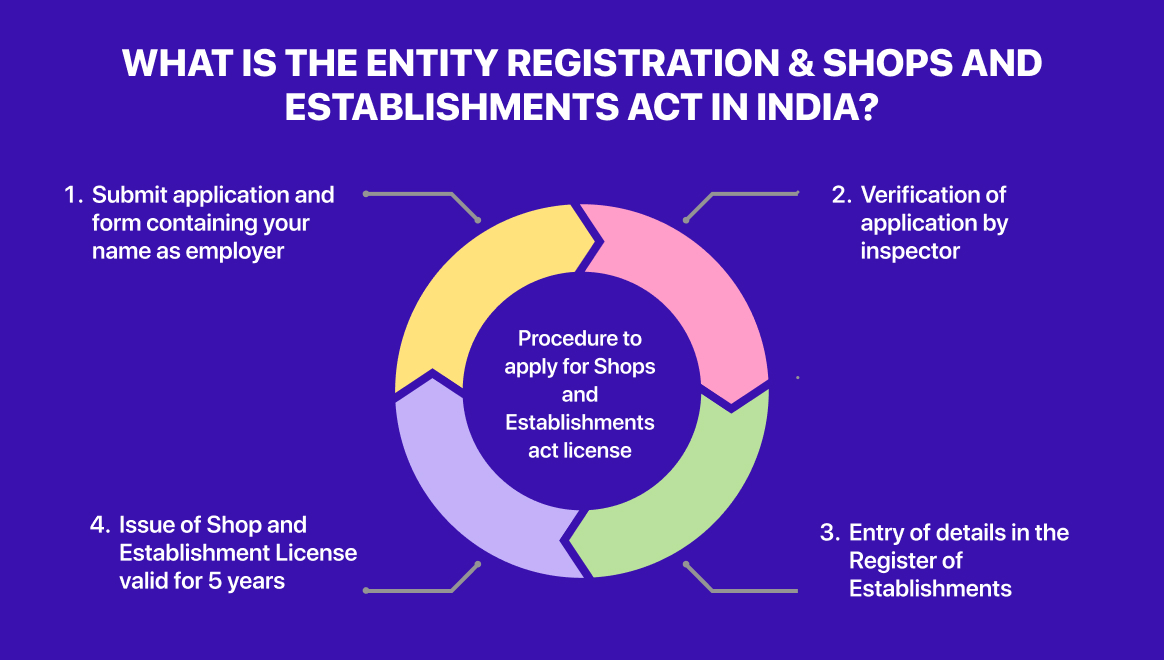
In short, running your own entity requires a robust compliance setup. Many companies do it successfully, but they usually have a dedicated team for it. If you’re a small outfit, the margin for error is thin – and the consequences can range from fines to business suspension. It’s a higher-stakes game.
Verdict:EOR provides a far lower-risk path in terms of compliance and liability, especially for companies without existing India HR/legal expertise. Your own entity gives you full control (more on that next) but with full liability. It’s a trade-off between control and risk.
Control and Customization
Employer of Record India
When you use an EOR, you are outsourcing the employment admin function. That means you give up a degree of control over certain processes. For instance, the employees technically are employees of the EOR company, not yours (legally). Culturally, day-to-day, they act as your employees, but their paychecks and contracts come from the EOR. Some companies worry this could affect loyalty or culture, though in practice, employees hired via EOR know who they work for (your brand), and usually it’s fine. However, you may have less flexibility to customize certain things – for example, if you want a very unique benefit or stock option plan, the EOR has to be able to accommodate it under local law. Most EORs try to be flexible, but they’ll have standard templates.
Also, any changes like promotions, salary changes, terminations – you have to communicate with the EOR to execute those. It adds a layer of process (usually just an email or portal submission, but it’s an extra step). Essentially, you are collaborating with the EOR’s HR and payroll team on all HR matters for those employees, rather than having it entirely in-house.
Lastly, an EOR might restrict certain business activities – for example, if you wanted your employee to do something outside the normal scope that could risk the EOR’s compliance, they might push back. But for typical work, this is rarely an issue.
Hiring via Own Entity
With your own entity, you have full control. You can craft your own policies, set up your own office culture under your banner, and directly employ people as part of your company. This can be advantageous as you scale – employees may feel more directly part of your global organization when they’re officially on your books (though this is arguably psychological, it can matter for some). You can implement whatever benefits or incentive structures you want (as long as they meet minimum legal requirements). You can respond to changes faster since it’s your internal team handling it – no need to ask a third party.
Additionally, having your own entity is essential if you plan to do more than just hire people – for example, if you plan to generate revenue in India, sign local clients, or hold assets, you likely need a local company for those operations. An EOR is only meant for employment; it doesn’t cover setting up a sales office or contracting with customers (that would still be done via your foreign HQ or require an entity). So if your expansion strategy involves deeper local operations, an entity becomes necessary at some point.
Verdict:Control vs convenience is the balance here. Early on, most companies value convenience and low risk (hence EOR). As they grow and their Indian presence becomes more core (dozens of staff, local revenue, etc.), control considerations might prompt establishing an entity. It’s not either/or forever – many use EOR now, entity later (and some even maintain a mix, keeping some workers on EOR if they expand to new states or need a quick hire elsewhere).
Making the Choice
In general, using an EOR is ideal for the initial stage of expansion – when you have a small number of employees (say 1–20) and are testing the waters or scaling gradually. It’s also great if you explicitly want to avoid the administrative burden and focus purely on product and team integration. Many startups and even larger SMEs stick with EOR for the long haul if they never plan to have more than a couple of dozen people in India.
On the other hand, setting up an entity starts to make sense when you’re committed to India as a significant operation: perhaps you’re opening an R&D center with 50 engineers, or you need a local sales office to bill Indian clients, or you want to build a visible employer brand in India as “YourCompany India Pvt Ltd.” At that point, the costs and efforts can be justified by the scale and the need for full control.
One common trajectory is the hybrid path we noted: start with EOR, get off the ground quickly, build your team and validate the expansion, and then once you hit a critical mass (could be 10 employees, 30 employees, or a certain revenue milestone), you transition those employees from the EOR to your newly formed entity. A good EOR will even assist in that transition to make it seamless (since it usually means the EOR is offboarding those folks to join your entity, they plan for that possibility).
Keep in mind that forming an entity later doesn’t mean you were wasting money on EOR fees initially – you were buying speed and risk mitigation during the period it mattered most. Think of it as paying a bit of a premium to rent a compliant hiring presence in India, until you’re ready to “buy” (establish your own). That rent-to-own strategy is very common and actually optimal for many.
In summary, here’s a quick comparison checklist:
- Timeline: EOR – start now. Own Entity – start after months.
- Upfront cost: EOR – negligible. Own Entity – significant (setup, advisors).
- Per employee cost: EOR – ongoing fee, which, for small numbers, is cheaper overall. Own Entity – lower marginal cost at large scale but high fixed costs.
- Compliance risk: EOR – provider shoulders most risk (they’re the legal employer). Own Entity – you shoulder all risk (need in-house expertise).
- Flexibility: EOR – very flexible in starting/stopping, but a somewhat standard approach is needed. Own Entity – fully tailorable operations, but less flexibility to exit (winding up an entity is another process).
- Use case: EOR – best for initial market entry, small/medium teams, or if you don’t want any back-office hassle. Own Entity – best for large-scale operations, long-term established presence, or if required for business activities in the country.
Many companies ultimately use a mix of both across their global expansion strategy. The great news is, India offers both paths, and you can choose what fits your strategy today and pivot later if needed.
Typical Timelines and Costs for Indian Work Permits
How long will it take and how much will it cost to get your foreign hire legally working in India? Let’s set some expectations:
Visa Processing Time – Plan for a Few Weeks (or More)
In the best case, some Indian embassies have turned around Employment Visas in under a week. Officially, once an application is submitted, you’ll often see guidance like “minimum 3-5 working days processing”. For example, the Indian consulate in Houston notes about 5–6 business days if everything is in order. However, buffer in extra time. First, gathering documents and scheduling the visa appointment can itself take 1–2 weeks (some consulates have wait times for appointments). Second, processing can vary by nationality; certain nationalities undergo additional clearances from New Delhi, which can add a couple of weeks. And Indian holidays can slow things down too.
A reasonable estimate for an Employment Visa process, from the day you finalize the paperwork to the day the visa is stamped, is around 2 to 4 weeks. It could be faster, or it could be longer if complications arise. Always start the visa process as soon as your offer is accepted. If the person needs to be in India by a certain date (for a project launch, etc.), begin the process at least 8 weeks early to be safe. It’s far easier to have them approved early and wait a bit than to scramble if there’s a delay.
Also, keep in mind the FRRO registration timeline after arrival: that’s 14 days from landing. It doesn’t delay them starting work (they can work in those 14 days), but it’s a time-bound post-arrival task. Include it in your onboarding schedule. If you use an EOR, they will usually get the FRRO appointment sorted in that first week.
Visa Validity and renewals
The first Employment Visa is usually valid for 12 months (or the length of the job contract, if shorter). Renewals (extensions) are done in India through the Ministry of Home Affairs/FRRO. Renewal processing can take a few weeks as well, and the employee cannot leave India while the renewal is in progress unless they get special permission (since their passport may be with authorities for the visa endorsement). So time your renewals carefully – apply about 2 months before expiry to avoid gaps. Most renewals are granted if the employment situation remains the same and taxes have been paid, etc. You can renew annually up to a total stay of 5 years, typically, and beyond 5 years is possible, but with more scrutiny or long-term stay considerations.
Work Permit/Visa Costs
The costs for obtaining an Indian work visa consist of government visa fees, plus any service charges (for visa center processing) and possibly medical or document costs. The government fee depends largely on the applicant’s nationality and the visa duration/entries. For instance, a 1-year multiple-entry Employment Visa for a U.S. citizen might cost a few hundred dollars, whereas for some other nationalities it might be lower. As a general ballpark, expect total application fees in the range of $150 up to $1,000.
- At the lower end, some nationalities might pay around $200 or less for a 6-12 month visa.
- At the higher end, 5-year visas or certain countries’ citizens might edge toward $800-$1000. For example, U.S. citizens often pay higher fees for Indian visas (since reciprocity matters – India charges what those countries charge Indians).
- There can also be a visa service center fee (like $15-$20) and possibly courier fees if you opt to mail the passport back.
Don’t forget the indirect costs: getting documents notarized or apostilled if required (not usually needed for India work visas, but sometimes proof of degrees needs to be notarized), traveling to the consulate (if the consulate isn’t in the applicant’s city, they might incur travel costs or use an agency to submit documents).
If the employee has dependents applying for Entry Visas, there will be separate fees for each of those as well (typically similar ballpark per visa).
One cost that is easy to overlook is the FRRO registration fee. Registering with the FRRO itself is usually free, but if someone fails to register in 14 days, there are penalty fees (these might be around ₹10,000 or more, roughly $120+, depending on how late, etc.). So avoid that by being on time. Also, if a visa needs to be extended in the country, there might be fees for the extension process (involving the FRRO/MHA), though if you’re simply renewing annually, that’s part of the standard process with its own fee schedule.
Using an Agent or EOR
If handling the visa process feels daunting, companies or individuals sometimes hire a visa facilitation agent to help compile documents and schedule appointments. These agents charge a service fee (perhaps $100–$300, depending on service level). If you partner with an EOR, these services are often included – the EOR will have an internal team or partner who does this, effectively bundled into the EOR fee. That’s another cost angle to consider: going solo, you might spend extra on consultants to do things an EOR would include.
Opportunity cost
While not a line-item “cost,” consider the opportunity cost of delays. If a critical hire can’t start because their visa got delayed due to your paperwork mistake, that delay could cost your project significantly. In that sense, spending on expert help or an EOR can be seen as cost-avoiding, potential revenue, or development delays.
Typical Hiring Budgeting
When budgeting for a foreign hire in India, factor in: visa fee (one-time, in the first year), flight tickets (if you’re covering relocation), possibly a relocation allowance (to cover initial housing, etc., if you provide that), and the ongoing employment cost (salary + benefits). The visa cost is usually negligible in the big picture – a few hundred dollars relative to a salary of tens of thousands. But not having the visa in time can be extremely costly, so budgets should emphasize getting it done right, not cutting corners.
To give one more perspective: some companies allocate around $1,000–$2,000 for the whole visa process per hire (including any agency help, courier, etc.), and around 4–6 weeks of lead time before the person can be at work. If you use an EOR, the direct visa costs may be lower for you (since the EOR might handle a chunk), but you’ll be paying the EOR fee for convenience.
Finally, renewal costs: Each year when renewing an Employment Visa, there will be renewal fees (often a bit lower than initial issue fees, but of a similar magnitude) and FRRO extension processing. Ensure either you or your EOR budgets for those in year 2 onwards. And if a foreign employee exits India and later returns, a fresh visa process starts again.
In conclusion, plan for a few hundred dollars in government fees, a few weeks of processing, and absolute adherence to timelines. If you’re proactive and prepared, the process costs and timings are quite manageable. If you’re last-minute and lax, it can become more expensive (expediting couriers, last-minute fixes) and stressful. And remember, any mistakes can cause costly rework – e.g., a missing document could mean rescheduling an interview or reapplying. Precision is key.
Mistakes to Avoid (and Pro Tips for Success)
Entering India can be hugely rewarding for your business, but it’s also easy to stumble if you’re not careful. Here are some common mistakes companies make when hiring foreigners in India, and how you can avoid them:
Trying to use the wrong visa
This is by far the biggest mistake. Tempted to have your new hire come on a Tourist or Business Visa and “figure it out” later? Don’t do it. Immigration officers in India aren’t fools – if someone shows up with a tourist visa but a suitcase full of office equipment, they’re going to have a bad day. We’ve heard of founders trying to label a full-time engineer as a “business visitor” – only for that person to be turned away at the airport or flagged later. Always use the Employment Visa for employment. It might seem like extra paperwork upfront, but it is the paperwork. Pro tip: Start the Employment Visa process early and do it by the book. The short-term gain of sneaking someone in is absolutely not worth the risk of deportation or getting the company blacklisted. When in doubt, consult an immigration expert rather than guessing.
Ignoring the salary threshold
As an employer new to India, you might not know the ₹1.625 million rule and end up offering a foreign hire a salary below the required minimum. The result? Visa denied. We’ve seen companies lose perfect candidates because they low-balled an offer under the threshold or simply weren’t aware of it. Don’t penny-pinch here – ensure your foreign hires’ salaries meet the criteria (and realistically, to attract global talent to India, you should be offering competitive pay anyway). If the role truly can’t justify $25k/year, it likely won’t justify a foreign visa either (barring special exemption cases). Pro tip: Check the latest guidelines on the minimum salary each year (it sometimes updates or gets clarified). And if your candidate is just at the borderline, consider bumping the package a bit to sail through visa approval.
Incomplete or inconsistent documentation
The devil’s in the details. A common error is inconsistencies between documents – e.g., the job title on the invitation letter doesn’t exactly match the one on the contract, or the salary is quoted in USD in one place and INR in another without clarification. These give visa officers reasons to delay or doubt. Another mistake is missing documents – like not including a copy of the company’s registration, or the candidate’s resume. Pro tip: Double-check every piece of paperwork. Create a checklist and have at least two people review the full application packet before submission. Ensure all letters are on letterhead, signed, dated, and all figures (salary, duration, etc.) are consistent across documents. Little details can matter – for instance, if the applicant’s name is spelled slightly differently on their passport vs. their degree certificate, have them provide an affidavit of name variation or at least point it out in a cover letter. Smooth out any potential question mark before it’s questioned.
Missing the FRRO registration deadline
You successfully got the visa, and your hire is in India – victory! Don’t pat yourself on the back too hard until FRRO registration is done, if required. Many a company has dropped the ball here, figuring the hardest part was over. But a foreign employee who doesn’t register within 14 days (when they need to) is technically in violation. Penalties can accrue daily after the deadline. It’s an avoidable mistake that can cause panic when you realize on day 20 that nothing was done. Pro tip: Treat FRRO registration as part of onboarding – like you would an orientation or getting their laptop. Day 1 or 2 in India, get the FRRO appointment scheduled (many cities allow online registration now, which simplifies it). If you’re working with an EOR, they will usually handle this – but confirm it’s in motion. Mark the 14-day limit in your calendar; don’t rely on the employee to remember while they’re juggling relocation.
Poor record-keeping
Over the course of employment, you might need to produce documents again for renewals or audits. We’ve seen companies lose track of important papers (e.g., a copy of the initial visa approval or FRRO registration) and scramble later. Pro tip: Keep a digital folder for each foreign employee with all their visa-related documents, approval letters, copies of passport pages, FRRO certificates, etc. Also, keep copies of all compliance filings related to them (tax payment receipts, PF registration if applicable). This way, if a question arises or renewal time comes, you have everything at your fingertips. It’s part of being prepared for any compliance inquiry.
Not planning for renewals and transitions
Maybe you assumed your foreign hire would only stay a year, but now you (and they) want to extend – awesome, but did you start the renewal process in a timely manner? Or perhaps you plan to shift the person to your new Indian subsidiary next year – have you thought about the implications (cancel old visa, get a new visa under the new entity)? These transition points can be tricky if not planned. Pro tip: Anticipate the next step. About 3–4 months before an Employment Visa expires, decide if you are renewing or if the project will wrap up. If renewing, prepare to file with FRRO/MHA at least 8 weeks in advance. If not renewing (employee will leave), ensure they exit before expiration to avoid overstay issues. And if you’re moving from an EOR to your own entity or vice versa, loop in legal advisors to plan a smooth handover of sponsorship – it will likely mean a fresh visa application under the new sponsor, which you should time such that there’s no gap in the person’s work authorization.
Choosing the wrong partner or advisor
Some companies try to save money by using inexperienced consultants or, worse, ignoring expert help entirely. Indian immigration and labor compliance is not the place to wing it from Google results alone. If you partner with an EOR, choose one with proven India expertise (check their content, client case studies, or ask for references). If you go it alone, at least consult with a reputable immigration lawyer for the visa part and a labor lawyer or HR consultant for the employment law part. Pro tip: Do your due diligence on any service provider. An incompetent agent can mess up your application and cost you months. Similarly, not using any help when you’re not fully versed is risky – one misclassified contractor or a missed tax form can spiral into a larger problem. It’s worth investing a bit in professional guidance up front. As the saying goes, “hire well, or spend twice.”
Ignoring cultural and employee experience factors
While not a compliance “mistake,” treating your foreign hire purely as a legal object and not integrating them can backfire. Remember, moving to India (or even working remotely for an Indian office) is a big transition for a foreign employee. Help them out – maybe offer relocation assistance, an orientation about Indian workplace culture, or connect them with other expats. Companies that only focus on the paperwork and then leave the person hanging often see those hires quit prematurely because they didn’t settle in. Pro tip: Make your expat hires feel welcome. Simple things like providing temporary accommodation, connecting them with a local buddy, or giving them a primer on Indian business etiquette can go a long way. A happy employee will be patient through any bureaucratic hiccups; an unhappy one might bail, rendering all that visa effort moot.
Conclusion
In summary, avoid cutting corners, stay organized, and leverage expertise. India’s system has its challenges, but it’s navigable with diligence. Many companies have successfully brought in the talent they need and thrive in India – you can too, by learning from others’ mistakes instead of repeating them.
Lastly, keep learning. Regulations can evolve (for instance, new visa categories might open up, or salary thresholds might adjust with inflation). Stay updated via official channels or your EOR partner. Our legal and compliance checklist for India is a resource you can bookmark for changes and detailed sub-topics. Expanding into India is a journey – but with the right approach, it can be one of the most rewarding moves your company makes.
By now, you should have a solid understanding of the ins and outs of work permits and visas for India. It’s a lot of information, but the key takeaways are clear: follow the rules, leverage local expertise, and don’t go it alone if you don’t have to. India is an incredible opportunity for growth, and with proper compliance, you can tap into its talent pool without fear. Whether you use a global Employer of Record to handle everything, or eventually establish your own presence, you’re now equipped to make the choice confidently.
Ready to hire in India? If you need speed and peace of mind, consider partnering with an EOR to be your guide and safety net. If you’re going solo, start early, be thorough, and maybe re-read this guide once more with your team to ensure everyone’s on the same page. Here’s to expanding your global team – and doing it right, with no nasty surprises. Good luck, and happy hiring in India!

.svg)


