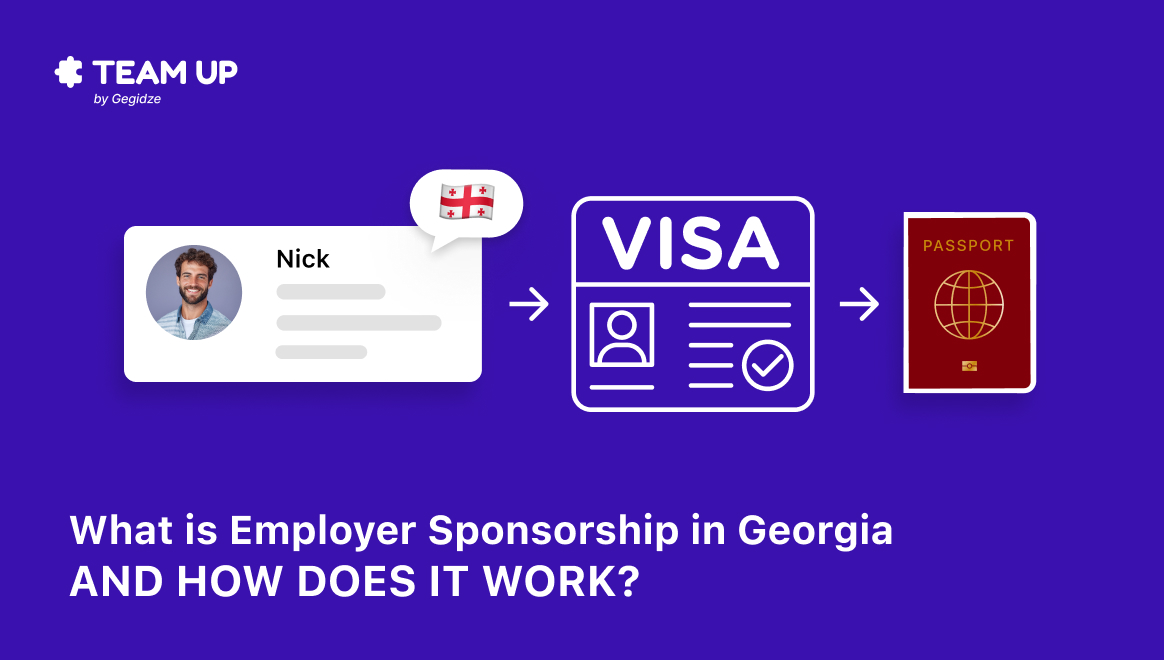
What is Employer Sponsorship in Georgia And How Does It Work?
TL;DR
If you’re looking into employer sponsorship in Georgia, you’re likely at that awkward stage of growth where your favorite remote "freelancer" is suddenly a mission-critical hire, or you’ve realized that the talent pool in Tbilisi is too good to ignore.
The honest truth? Most people think Georgia is a legal Wild West because of its famous 365-day visa-free regime. But there’s a massive difference between "staying here to work on your laptop" and "legally employing someone under Georgian law." One is a vacation; the other requires a formal legal handshake with the state.
This guide cuts through the corporate fluff to show you exactly how sponsorship works in the "Pearl of the Caucasus."
Quick Navigation
- TL;DR
- The Regulatory Shift: From Liberalization to Resolution 70
- The Mechanics of the Special Labour Activity Permit
- The Labour Market Test and Worknet Integration
- Strategic Exemptions for High-Value Roles
- Financial Thresholds: The Turnover and Income Requirements
- The Immigration Funnel: Permits, Visas, and Residency
- Tax Optimization and Sponsorship Status
- Georgia's Position as a Regional EOR Partner
- Monitoring and the Role of the Labour Inspectorate
- Strategic Conclusions for Decision-Makers
- Frequently Asked Questions
The Regulatory Shift: From Liberalization to Resolution 70
The legislative foundation for the current sponsorship environment was laid on June 26, 2025, when the Georgian Parliament adopted sweeping amendments to the Law on Labour Migration. These changes were not merely administrative but were designed to address a structural discrepancy: while only 42,000 foreign nationals were officially registered as workers, actual labor migrant numbers were estimated at nearly six times that amount. This gap prompted the creation of a unified, staged process for work-related permits, effectively ending the informal hiring of non-residents.
The centerpiece of this reform is Government Resolution No. 70, signed on February 20, 2026, which established the "rulebook" for labor migration. Under this resolution, the concept of "employer sponsorship" is no longer a passive act of hiring but an active, administrative "permit" process. This permit, often referred to as the Right to Work, is a mandatory prerequisite for any foreign national wishing to engage in remunerated labor, whether through a local employment contract or as a self-employed entrepreneur.
| Key Feature of Resolution 70 | Implementation Detail |
| Mandatory Permit | The Special Labour Activity Permit is required before any work begins. |
| Primary Authority | Issued by the State Employment Promotion Agency (SESA). |
| Eligibility Scope | Applies to employees, freelancers, and company directors. |
| Administrative Staging | A permit must be secured before applying for a D1 visa or residence permit. |
| Processing Fees | 200 GEL for standard (30 days); 400 GEL for expedited (10 days). |
The intent behind these regulations is twofold: to increase transparency in the labor market and to protect the local workforce from being undercut by an influx of unregistered labor. Consequently, the "Right to Work" is no longer granted by default but is subject to a "Local First" scrutiny, requiring employers to demonstrate that no suitable Georgian candidate could fill the role.

The Mechanics of the Special Labour Activity Permit
The Special Labour Activity Permit serves as the legal anchor for all foreign labor in Georgia. It is an administrative authorization that binds a specific employee to a specific employer and a specific job position. This lack of portability means that if a foreign national changes jobs, they must undergo the entire permit application process again under the new sponsor.
Applicant Categorization: Employee vs. Self-Employed
Resolution 70 distinguishes between two primary types of applicants, each with a distinct compliance path. The "Labour Immigrant" is a foreign national hired by a Georgian company under an employment contract. In this scenario, the employer is the primary sponsor and must submit the application on behalf of the employee. The employer assumes full responsibility for the accuracy of the professional data and the justification for hiring a non-resident.
Conversely, "Self-employed Foreigners" include freelancers, independent contractors, and partners or directors of Georgian legal entities. These individuals must apply for the Right to Work independently, submitting proof of their ongoing or planned economic activity. A significant novelty for this group is the mandatory video interview with the State Employment Promotion Agency. This interview, frequently conducted in English, serves to verify the authenticity of the applicant’s business plan and professional credentials.
| Applicant Category | Primary Responsibility | Mandatory Requirements |
| Labour Immigrant | Sponsoring Employer | Signed contract, Worknet posting, qualification proof. |
| Self-Employed | Foreign Individual | Business plan, turnover certificates, and video interview. |
| Company Director | Individual/Entity | Proof of partnership/management, video interview. |
The procedural rigor applied to directors is a detail that has caught many foreign entrepreneurs off guard. Because the definition of "self-employed" is broad enough to cover anyone managing a Georgian entity, even founders of established firms must now obtain formal labor authorization to legally execute their management authority.
The Labour Market Test and Worknet Integration

Perhaps the most disruptive element for decision-makers hiring in Georgia is the mandatory Labour Market Test. This requirement mandates that employers prioritize Georgian citizens for all vacancies unless they can prove a lack of local expertise. The process is digitized and integrated into the national employment portal, Worknet.
The 10-Day Posting Requirement
Before an employer can even submit an application for a foreign national's work permit, they must post the vacancy on www.worknet.moh.gov.ge for a minimum of 10 business days. This portal, managed by the State Employment Promotion Agency (SESA), acts as a clearinghouse for local talent. During this 10-day window, the Agency proactively searches its database for qualified Georgian candidates who meet the job requirements.
If the Agency identifies suitable local candidates, the employer is notified and must review these applicants. If the employer decides not to hire the suggested local candidates, they must provide a "justified refusal" within three working days. This justification is not a mere formality; SESA has the discretion to review the validity of the refusal. If the Agency determines that the refusal was not properly justified, for instance, if the local candidate was rejected for arbitrary reasons, it has the power to discontinue the work permit application for the foreign national entirely.
Defining "Justified Refusal"
The criteria for a justified refusal are strictly professional. Employers must demonstrate that the local candidate lacks specific, objective qualifications required for the role, such as a specialized degree, a particular technical certification, or proficiency in a language necessary for the business. Narrative justifications that rely on "cultural fit" or subjective traits are unlikely to survive Agency scrutiny. This shift forces employers to be far more precise in their initial job descriptions and vacancy postings.
| Justified Refusal Element | Employer Requirement |
| Objective Qualification | Must match the vacancy description posted on Worknet. |
| Degree/Specialization | Higher education in a relevant specialty is often required for high-skill roles. |
| Agency Review Period | SESA reviews the justification within 3 additional working days. |
| Consequence of Failure | Discontinuation of the foreign worker's permit process. |
This mechanism ensures that employer sponsorship in Georgia is used as a tool for filling genuine skill gaps rather than as a convenience for hiring international talent over qualified local residents.
Strategic Exemptions for High-value Roles
Recognizing that certain sectors and positions require immediate global talent to remain competitive, Resolution 70 provides several pathways that bypass the preliminary Labour Market Test. While these roles still require the Special Labour Activity Permit, they are exempt from the 10-day vacancy posting and the Agency-led candidate search.
The High-Earner Exception
The most prominent exemption applies to specialists with a high salary. If the monthly gross remuneration for a position exceeds 15,000 GEL (approximately $5,600 USD), the employer is not required to post the vacancy on Worknet. However, this exemption is not granted on salary alone; the position must also objectively require higher education in a relevant specialty. This "High-Earner Exception" is particularly beneficial for executive-level relocations and niche technical experts where the global market rate exceeds local norms.
International Company and Startup Incentives
To foster the growth of the digital economy, entities with "International Company" status or "Innovative Startup" status are also exempt from the Labour Market Test. This allows tech firms and service centers to hire foreign personnel directly, recognizing that these organizations often operate in international markets with specific technical needs that the local labor pool may not yet fully satisfy. These statuses act as a "fast-track" for sponsorship, significantly reducing the time-to-hire for critical engineering and management talent.
Financial Thresholds: The Turnover and Income Requirements
Employer sponsorship in Georgia is underpinned by strict financial benchmarks designed to verify the economic legitimacy of the employment relationship. These thresholds apply to both the sponsoring entity’s revenue and the employee’s salary.
The 50,000 GEL Turnover Requirement
The most significant financial barrier for sponsoring an employee is the employer turnover requirement. A sponsoring LLC or Individual Entrepreneur must demonstrate an annual turnover of at least 50,000 GEL for every foreign national they employ. This requirement is aggregate, meaning a company wishing to sponsor three foreign employees must show a turnover of at least 150,000 GEL within the preceding 12 months.
For educational and medical institutions, the threshold is slightly lower, set at 35,000 GEL per foreign employee. Compliance is verified through Revenue Service turnover certificates, VAT statements, or in some cases, certified auditor reports. This regulation serves as a safeguard against "shell companies" that might be used to circumvent immigration laws, ensuring that only viable businesses with a genuine economic footprint can sponsor foreign labor.
The 5x Subsistence Minimum Rule
On the employee side, the salary provided by the sponsor must meet the "Work-Residence" track threshold. The foreign national must demonstrate a net monthly income of at least five times the Georgian subsistence minimum for a working-age male. The subsistence minimum is an official figure updated monthly by Geostat, based on a "minimum food basket" containing 40 essential products and caloric requirements defined by the FAO/WHO.
| Economic Indicator (Late 2025/2026) | Value (GEL) | Application to Sponsorship |
| Subsistence Minimum (Working-Age Male) | ~283.3 GEL | The baseline for income requirements. |
| Residency Income Threshold (5x) | ~1,416.5 GEL | Minimum monthly net income for the permit. |
| Average Monthly Nominal Earnings | ~2,271.6 GEL | Regional market benchmark for talent. |
| Employer Turnover per Foreigner | 50,000 GEL | Mandatory annual revenue for the sponsor. |
These financial prerequisites create a clear boundary: employer sponsorship in Georgia is intended for professionals and enterprises that contribute meaningfully to the national economy through taxable income and business activity.
The Immigration Funnel: Permits, Visas, and Residency
Obtaining the Special Labour Activity Permit is merely the first stage of the legal journey. For a foreign national to work and live in Georgia legally, they must navigate a "unified, staged process" that links their work authorization to their immigration status. This funnel ensures that labor activity and physical stay are perfectly synchronized.
The standard progression begins with the work permit, which then becomes the mandatory prerequisite for either a D1 category immigration visa (if the individual is abroad) or a labor residence permit (if they are already in the country). The relationship between these documents is symbiotic: the Right to Work authorizes the activity, while the visa or residence permit authorizes the stay.
The D1 Immigration Visa
For talent hired from outside Georgia, the D1 visa is the primary entry vehicle. Once the Right to Work permit is issued, the applicant has 30 calendar days to apply for the D1 visa at a Georgian consulate. The D1 visa is specifically designated for labor and entrepreneurial activities and is required even for citizens of some visa-free countries if they intend to transition directly to a residence permit. Without the D1 visa, most foreign nationals cannot apply for a residence permit from within Georgia, effectively forcing them to leave the country to regularize their status.
The Labour Residency Permit
For those already in Georgia legally (e.g., under a 365-day visa-free stay), the process requires applying for a residence permit within 10 calendar days of receiving the work permit. The permit is usually granted for the same duration as the work permit, typically 6 months to 1 year for initial applications, with the possibility of annual extensions. IT professionals, however, can receive initial residence permits for up to 3 years, reflecting the government's strategic priority on the tech sector.

Tax Optimization and Sponsorship Status
A nuanced understanding of Georgia's tax regimes is essential for decision-makers, as certain statuses can dramatically lower the cost of employer sponsorship. The interaction between a company’s tax status and its ability to sponsor foreign workers is a unique feature of the Georgian market.
Virtual Zone Person (VZP) vs. International Company (IC)
The Virtual Zone and International Company regimes offer world-class incentives for the IT sector, but they differ in their substance requirements and sponsorship ease.
| Tax/Substance Attribute | Virtual Zone Person (VZP) | International Company (IC) |
| Corporate Income Tax | 0% on foreign IT income | 5% on distributed profits |
| Personal Income Tax | 20% (standard) | 5% (reduced for employees) |
| Dividend Tax | 5% | 0% |
| Substance Requirement | Development in Georgia | Local staff physical presence |
| Sponsorship Advantage | No strict experience rule | Exempt from Labour Market Test |
While the Virtual Zone is ideal for lean operations and remote developers, the International Company status provides a much more robust sponsorship environment. IC status allows companies to offer a 5% personal income tax rate to their employees, making their gross-to-net salary packages far more attractive to international talent. Furthermore, the exemption from the Labour Market Test for IC-status firms removes the risk of a SESA-led candidate search, providing much-needed certainty for global HR departments.
Georgia's Position as a Regional EOR Partner

For companies without a physical presence in the South Caucasus, the complexity of Resolution 70 has made the Employer of Record (EOR) model the most practical entry point. An EOR provider acts as the legal employer for workers in Georgia, assuming all liability for payroll, taxes, and most importantly, the entire sponsorship process.
EOR as a Compliance Engine
In the 2026 landscape, an EOR is not just a payroll provider but a compliance engine. Because the EOR possesses the necessary Georgian legal entity, it already satisfies the 50,000 GEL turnover requirement and has established relationships with SESA. This allows international firms to hire Georgian talent or relocate foreign specialists without the cost and risk of incorporating locally.
The EOR in Georgia signs a compliant employment contract, manages the Worknet vacancy posting (if applicable), and handles the filing for the Right to Work and residency permits. This "managed sponsorship" model allows decision-makers to focus on talent acquisition and day-to-day management while the EOR ensures that every worker remains in good standing with the Ministry of Health and the Labour Inspectorate.
Comparing EOR Providers

The quality of EOR services in Georgia varies significantly. Some global providers rely on third-party partners, which can introduce delays and lead to a lack of accountability in the complex permit process. Conversely, regional specialists who own their Georgian entities offer deeper expertise in local "edge cases," such as sponsoring directors or navigating the justified refusal process for niche technical roles.
| Feature | Global EOR (Deel/Remote) | Regional Specialist (Gegidze/Team Up) |
| Entity Ownership | Often partner-led in Georgia | Fully owned local entities |
| Immigration Support | Simple cases only | Complex/Edge case expertise |
| Turnover Requirements | Managed at client level | Handled by EOR at scale |
| Service Fee | Typically higher ($400-$600) | Competitive mid-market ($200-$350) |
For decision-makers, the choice of EOR partner is a critical component of their Georgian strategy. A provider with a strong local compliance team can reduce the time-to-onboard and mitigate the risk of permit rejections.
Monitoring and the Role of the Labour Inspectorate
Compliance under Resolution 70 is not a "one-and-done" event but an ongoing obligation. The Georgian Labour Inspectorate has been granted extensive monitoring powers to ensure that employer sponsorship is not being abused and that the local labor market is protected.
Audits and Inspections
The Labour Inspectorate regularly conducts audits of companies employing foreign nationals. These inspections verify that the worker is physically present (where required), that their actual duties match their work permit, and that their salary meets the 5x subsistence minimum threshold. Employers are required to notify the Agency of any termination or modification of an employment contract within five calendar days. Failure to provide this notification carries a fine of 1,000 GEL.
The Penalty Framework
The penalties for non-compliance are strictly enforced and apply to both the employer and the employee. This joint liability ensures that both parties have a vested interest in maintaining legal status.
- Unauthorized Employment: Engaging a foreign national without the Right to Work leads to a 2,000 GEL fine for the employer per employee and a 2,000 GEL fine for the worker.
- Repeat Offenses: Subsequent violations lead to doubled or even tripled fines, potentially reaching 12,000 GEL.
- Arbitrary Sector Change: If a foreigner changes their field of activity without renewing their permit, they face a 2,000 GEL fine.
- Obstruction of Inspections: Hindering the Labour Inspectorate's activities results in a 5,000 GEL fine for self-employed individuals.
These enforcement measures are designed to eliminate the "grey market" and ensure that employer sponsorship in Georgia remains a transparent, regulated process.
Strategic Conclusions for Decision-Makers
The transformation of Georgia’s labor migration rules represents a fundamental shift in how international businesses must operate in the region. The move from an informal system to a mandatory, permit-based framework creates new administrative hurdles but also offers a higher degree of legal certainty and EU alignment.
For decision-makers, the strategy for 2026 and beyond must be rooted in three pillars:
- Early Planning: The 30-day processing window and the 10-day Worknet posting mean that the hiring cycle in Georgia now requires a minimum lead time of six weeks.
- Financial Vigilance: Ensuring that both the company turnover (50,000 GEL) and the employee salary (5x subsistence minimum) are documented through the proper Revenue Service channels is non-negotiable.
- Strategic Outsourcing: Leveraging EOR partners and specialized tax statuses (like International Company status) can mitigate the administrative burden of the Labour Market Test and provide a significant competitive advantage in attracting global talent.
Georgia remains an exceptionally attractive destination for hiring from emerging hubs, offering a flat 20% income tax and a sophisticated digital infrastructure. By mastering the nuances of employer sponsorship, organizations can continue to tap into the nation’s high-skilled, cost-competitive labor pool while ensuring full compliance with the new European-standard regulatory framework. The "Right to Work" is no longer a privilege, it is the prerequisite for business success in the modern South Caucasus.
Frequently Asked Questions
1. What is sponsorship for employment in Georgia?
In 2026, sponsorship for employment means a Georgian company taking legal responsibility for a foreign worker's right to perform labor. The employer must now initiate a formal "Special Labour Activity Permit" application through the Ministry of Labour’s electronic system. Without this sponsor-led permit, the employee cannot legally work or apply for residency.
2. Does every foreign hire require sponsorship for an employment visa status?
Yes, unless they are permanent residents. As of March 1, 2026, almost all foreign nationals (non-permanent residents) require sponsorship for employment visa status to work. This includes those previously working under the one-year visa-free entry rule.
3. What is the "50,000 GEL Turnover Rule"?
To qualify as a sponsor for a Work Residence Permit, the Georgian company must demonstrate a minimum annual turnover of 50,000 GEL (~$18,500 USD) for each foreign employee they sponsor.
- Exception: Educational and medical institutions have a lower threshold of 35,000 GEL.
4. What does it mean to require sponsorship for employment in 2026?
When a candidate says they require sponsorship for employment, it means the employer must first perform a Labour Market Test. This involves advertising the vacancy on the state portal (Worknet.moh.gov.ge) for 10 business days. You can only hire a foreigner if the state fails to provide a suitable local Georgian candidate.
5. Define sponsorship for employment visa status for "Remote Workers"?
Even if an employee works remotely for your Georgian company, you must still provide visa sponsorship for employment if they reside in Georgia. However, foreigners working for non-Georgian companies while living in Georgia are exempt from this specific employer permit, as they fall under the new Digital Nomad Residency category.
6. What are the 2026 fines for hiring without sponsorship?
The "informal" era is over. Working without a Special Labour Activity Permit results in a 2,000 GEL fine for both the employer and the employee. Repeated violations within one year result in doubled or even tripled fines and potential deportation of the staff.
7. What is sponsorship for an immigration-related employment benefit?
This legal phrase refers to the employer’s obligation to provide specific documents—such as a certified employment contract and proof of company turnover—to help the employee secure a D1 (Work) Visa or a Work Residence Permit. These are the primary "benefits" tied to the employer's sponsorship.
.svg)