What Is a PEO? Understanding Professional Employer Organizations in Caucasus

TL;DR
Expanding your business into the Caucasus, comprising Georgia, Armenia, and Azerbaijan, is a bit like the "Marmite" of international growth. To the uninitiated, the paperwork looks like a bureaucratic war crime.
But for the savvy founder who sees the Virtual Zone tax benefits in Georgia or the booming tech ecosystem in Yerevan, it’s the tastiest strategic move on the 2026 map.
However, there is a fundamental truth you need to face: people in this region can smell corporate BS from a mile away. If you try to manage a team in Tbilisi or Baku using a generic, "one-size-fits-all" global software without local teeth, you aren't just risking a bad hire, you're begging for a regulatory audit.
As of early 2026, the question "What is a PEO in the Caucasus region?" has become the most critical inquiry for HR managers and CFOs.
In these markets, a Professional Employer Organization (PEO) isn't just an "outsourced HR" vendor. It is a co-employment partner that acts as your local legal shield in a territory where the laws just got a massive, high-tech upgrade.
If you want to hire here today, you need to know that as of January and March 2026, the rules of the game have changed. You can no longer "wing it." You need a partner who understands that compliance isn't a checkbox.
It’s your license to operate.
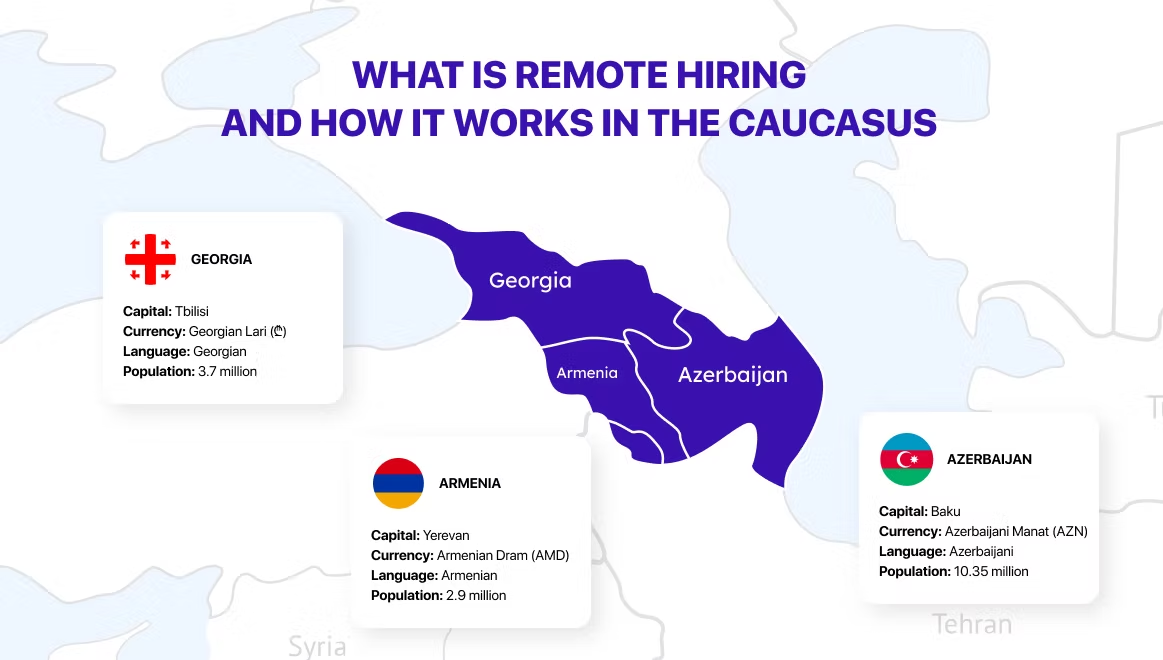
Table of contents
- TL;DR
- The "Entity" trap in the Caucasus region
- What a PEO really means in the Caucasus region
- How a PEO works in the Caucasus. Step by step
- PEO Compliance in the Caucasus 2026 Mandates
- Professional Employer Organization Pros and Cons in the Caucasus
- PEO vs staffing agency vs HR outsourcing in the Caucasus
- The verdict. Is a PEO your best move in the Caucasus?
- Ready to hire in the Caucasus without learning compliance the hard way?
- Frequently asked questions
The "Entity" trap in the Caucasus region
Before we dive into the "how," let’s clear up the biggest lie in the industry. Many providers use the terms PEO and EOR interchangeably. In the Caucasus, that’s a dangerous mistake.
- PEO (Professional Employer Organization): You HAVE a local legal entity (e.g., a Georgian LLC). You use the PEO to handle the mess of local payroll, benefits, and the new 2026 work permit filings.
- EOR (Employer of Record): You DO NOT have an entity. The provider hires the talent on their own paper and "leases" them to you.
If you are just testing the waters, you need an EOR. But if you’ve committed to the region and registered your company, a PEO is your lifeline. It allows you to focus on building your product while we handle the 2,000 GEL fines that the Georgian Ministry of Labor is now handing out for improper foreign worker registration.

What a PEO really means in the Caucasus region
This is where global PEO explanations quietly fall apart.
Across the Caucasus:
- Employment contracts are issued by the legal employer
- Payroll taxes and social contributions are filed by the entity
- Terminations, disputes, and audits target the employer
So PEO Caucasus really means:
- Outsourced HR administration
- Payroll processing support
- Help navigating local filings
It does not mean:
- Hiring without a local entity
- Transferring legal or tax liability
- Shielding your business from disputes
Think of a PEO as a tool for efficiency, not protection.
That distinction matters more here than in many regions, because enforcement is practical, not theoretical.
Understanding Professional Employer Organizations in Georgia 2026
The most significant update for anyone remote hiring in the Caucasus right now is the Georgia Labor Migration Law of 2026, which fully kicked in on March 1st.
- The Mandate: Foreigners can no longer perform any paid activity for local employers without a Work Permit (D1 Visa) or a specific labor residence.
- The Penalty: Employing a foreigner without this permit is a 2,000 GEL fine per worker. If you’re a repeat offender, those fines double or triple, and you risk an entry ban for your talent.
- The PEO Value: A local PEO manages the submission to the Ministry of Internally Displaced Persons, Labor, Health, and Social Affairs. We ensure your staff are "Authorized Labor Migrants" before they even touch their laptops.
Understanding Professional Employer Organizations in Armenia 2026
If Georgia is focusing on who can work, Armenia is focusing on how they are registered. As of January 1, 2026, the "handshake deal" is officially dead.
- Mandatory E-Contracts: Every single employment contract must now be created, signed, and terminated within the State Revenue Committee (SRC) digital platform.
- The E-Signature Hurdle: To sign these, both the employer and the employee need a qualified electronic signature. For foreign employees, this creates a "closed loop" nightmare that a PEO is specifically designed to untangle.
- Real-Time Visibility: The Armenian authorities now have real-time visibility into your payroll. If your contract doesn't match your payment, the system flags it instantly.
Understanding Professional Employer Organizations in Azerbaijan
Azerbaijan remains a highly regulated environment where the State Migration Service conducts actual on-site raids.
- The 35,000 AZN Risk: Hiring a foreigner without a work permit carries a staggering fine of up to 35,000 AZN (~$20,000 USD).
- The Currency Rule: You cannot pay local employees in USD or EUR. Salaries must be paid in Manat (AZN). A PEO handles the pegging of salaries to your home currency while ensuring the local bank transfer is compliant with Article 174 of the Labor Code.
How a PEO works in the Caucasus. Step by step
Let’s walk through what actually happens when companies use a PEO in this region.
Step 1. You must already have a local entity
Before a PEO can do anything meaningful, you need:
- A registered company in Georgia, Armenia, or Azerbaijan
- Tax registration and local bank accounts
- Employer registration with the relevant authorities
No entity. No PEO. There is no regional workaround.
This alone is why PEOs are rarely the first move for foreign companies entering the Caucasus.
Step 2. You hire employees under your company
With a PEO:
- Employment contracts are issued by your entity
- Local labor law applies in full
- Termination rules, notice periods, and documentation are your responsibility
The PEO may help prepare documents. Legally, the employer is still you.
Step 3. The PEO administers payroll
This is where PEO payroll in the Caucasus actually adds value.
Typically, a PEO supports:
- Monthly payroll calculations
- Tax withholding and reporting
- Social contribution processing
- Payslips and payroll records
But here’s the line that matters.
If payroll is incorrect or late, authorities don’t call the PEO. They call your company.
Step 4. Compliance and audits stay with you
Even with a PEO:
- Labor disputes: Name your entity
- Tax audits target your filings
- Termination claims hit your balance sheet
A PEO supports operations.
It does not absorb risk.
PEO Compliance in the Caucasus 2026 Mandates
Getting the team through the door is only half the battle. In 2026, the Caucasus states introduced "High-Tech Compliance", digital systems designed to catch even the smallest administrative slip-up. If your PEO isn’t integrated into these state portals, you’re effectively flying blind.
1. Armenia’s Electronic Contract Revolution

As of January 1, 2026, the "paper contract" in Armenia has officially moved to the museum.
- The Mandate: All new employment contracts, modifications, and terminations must be processed through the State Revenue Committee (SRC) Digital Platform.
- The E-Signature Barrier: To sign these, every employee needs a local electronic signature. If you’re hiring a digital nomad or a foreign specialist, untangling the "ID card vs. E-signature" loop is a bureaucratic nightmare.
- The PEO Value: We act as the digital custodian. We manage the e-signatures, upload the contracts, and ensure that the "Handover Act" is digitally timestamped to prevent future disputes over equipment or IP.
2. Azerbaijan’s "Remote Work" and "Family Care" Update
Azerbaijan just overhauled its Labor Code in January 2026, introducing concepts that Western founders are familiar with but with local Azerbaijan-specific twists.
- Remote Work Clauses: For the first time, "Remote (Distant) Work" is officially codified. You must now specify exactly how electronic software and technical means are provided and reimbursed in the contract.
- Family Responsibility Protections: A new category of "Employee with Family Responsibilities" has been introduced. These workers have priority when it comes to shift scheduling and are protected against being assigned night shifts without consent.
- The 46-Day Leave Rule: Veterans and certain categories of specialists are now entitled to a massive 46 days of annual leave.
3. Georgia’s Compliance Monitoring (The Labor Inspection)

Georgia may have a 20% flat tax, but its Labor Inspection Department has become one of the most active in the region.
- Occupational Safety: Even for a software team, you are required to have a certified Safety Officer (or a PEO performing that role) if you have an office.
- The Work Permit Audit: Starting March 2026, the Ministry will conduct digital cross-checks. If an employee has a "Business" bank account receiving local transfers but no D1 Special Labour Permit, the system flags it automatically.
Professional Employer Organization Pros and Cons in the Caucasus
By now, you’ve seen the "Marmite" reality of the Caucasus: the rewards are high, but the bureaucracy is an acquired taste. Choosing a PEO is a strategic decision that balances speed against structure. Here is the honest, no-BS breakdown of the pros and cons of partnering with a PEO in 2026.
The Pros of Professional Employer Organization in the Caucasus
- Access to "Fortune 500" Benefits: In markets like Georgia and Armenia, small startups often struggle to get high-tier private health insurance. A PEO pools thousands of employees, giving your 5-person dev shop the same negotiating power (and lower premiums) as a multinational bank.
- Compliance on Autopilot: As we’ve seen with the March 2026 Georgia Work Permit laws and Armenia’s E-contract mandates, the rules change fast. A PEO updates your contracts and filings in real-time. You aren't just buying software; you’re buying an "insurance policy" against 2,000 GEL fines.
- Focus on the Code, Not the Tax Code: Scaling a business is hard enough. Offloading the payroll, pension (4% in Georgia/Armenia), and state filings allows your team to focus on building the product, not chasing down a "lost" tax payment in a Baku bank.
- Reduced Liability: Through co-employment, the PEO shares the legal risk. If there’s a payroll tax error, it’s under their EIN (Employer Identification Number), and a reputable PEO carries the professional liability insurance to cover it.
The Cons of Professional Employer Organization in the Caucasus
- The "Paperwork" Middleman: Since the PEO is the employer on paper for tax and benefits, your employees may have to contact the PEO for health insurance claims or pay stubs. This can sometimes feel "impersonal" if the PEO doesn't have a human-centric support team.
- Loss of Absolute Customization: Most PEOs offer standardized benefit packages. If you want a hyper-specific, boutique insurance plan that isn't in the PEO's "pool," you might be out of luck, or forced to pay a massive premium to step outside their standard offering.
- Pricing Scalability: PEOs typically charge a percentage of gross payroll (3–6%) or a flat fee per employee. As your salaries grow (and developers in the Caucasus are getting more expensive by the day), your PEO bill grows too. At a certain scale (usually 100+ employees), it may eventually become cheaper to hire a full-time in-house HR and legal team.
- Dependency Risk: You are tethered to the PEO's technology. If their digital platform in Armenia goes down on payday, your team’s morale goes down with it.
PEO vs staffing agency vs HR outsourcing in the Caucasus
This confusion shows up in almost every expansion call.
Someone says, “We just need help hiring in the Caucasus.”Three vendors raise their hands. All three claim they can “solve it end to end.”
They can’t. Not in the same way.
In the Caucasus Region, these models do different jobs, carry different liabilities, and create different compliance outcomes across Georgia, Armenia, and Azerbaijan.
If you pick the wrong one, you don’t get slightly worse service. You get the wrong legal structure.
Below is a comprehensive, decision-grade breakdown with outlines you can use internally.
Quick definitions (so we stop mixing terms)
Staffing agency
A recruiting and placement provider. Sometimes they also manage contractors. Usually not the legal employer of your long-term team.
HR outsourcing (HRO)
A service model where you outsource HR admin tasks. Payroll support might be included. Employer identity does not change.
PEO (Professional Employer Organization)
A co-employment model. You keep the entity and remain the legal employer. The PEO supports HR and payroll administration.
1) Staffing agency in the Caucasus. What it really is
What they do
- Source candidates in the local market
- Screen, interview, shortlist
- Sometimes, coordinate offers and onboarding logistics
- Some will place contractors under their own contractor agreements
What they typically handle
- Recruitment process management
- Candidate pipeline, sourcing channels
- Background checks (if requested)
- Market salary guidance (often broad, sometimes inaccurate)
What they do not handle
- Legal employment compliance under your company
- Payroll tax filings for employees hired by you
- Social contributions administration for your employees
- Employment contracts under local labor law
- Terminations and dispute handling as the employer
Liability reality check
If the worker is your employee, the staffing agency is out of the picture the moment the contract is signed.
If the agency places contractors and “manages them,” you still carry risk if the relationship behaves like employment. Especially in Georgia, where misclassification is a common founder mistake.
When a staffing agency makes sense
- You have an entity already and only need recruiting help
- You want niche profiles and don’t have local sourcing reach
- You have in-house HR/legal or an EOR partner covering compliance
When a staffing agency is the wrong tool
- You need compliant hiring without an entity
- You want payroll and tax handled
- You want legal employer responsibility off your books
- You want one model that can scale across Georgia, Armenia, and Azerbaijan
2) HR outsourcing in the Caucasus. What it actually covers
HR outsourcing sounds broad because it is. That’s the danger.
In the Caucasus, “HR outsourcing” often means outsourcing admin work that your entity is still responsible for.
What HR outsourcing usually does
- HR administration and documentation
- Payroll processing support
- HR policies and templates
- Leave tracking and attendance support
- Basic compliance reminders
What it can include, depending on the provider
- Payroll calculation and payslip generation
- Filing support or preparation of tax reports
- Benefits admin coordination
- HRIS setup and HR operations
What it does not change
- Employer identity
- Legal employer obligations
- Tax authority relationship
- Responsibility for employment disputes
Liability reality check
HR outsourcing can reduce workload.
It does not reduce legal exposure.
If taxes are misfiled, your entity is liable.
If a termination is mishandled, your entity is liable.
If an employee claims unpaid leave or wrongful dismissal, your entity is liable.
When HR outsourcing makes sense
- You have an entity and need operational support
- You have a stable, local team and want a predictable admin
- You have internal legal oversight for terminations and disputes
When HR outsourcing is the wrong tool
- You don’t have an entity
- You want speed to hire across multiple Caucasus markets
- You want liability shifted away from your company
3) PEO in the Caucasus. What co-employment means here
PEO is the most misunderstood term in this region.
People hear “PEO” and assume “they’ll employ people for me.”
That is EOR. Not PEO.
What a PEO does
- Supports HR administration under a co-employment arrangement
- Supports payroll processing and reporting
- Helps keep documentation aligned with local requirements
- Coordinates benefits admin, where applicable
What a PEO does not do
- Replace your entity
- Become the legal employer
- Absorb labor or tax liability
- Shield you from audits or disputes
Liability reality check
In the Caucasus, the legal employer matters more than your vendor relationship.
With a PEO:
- Your entity is on the employment contract
- Your entity is on the payroll filings
- Your entity is responsible for compliance outcomes
The PEO helps you run operations.
It does not protect you.
When a PEO makes sense in the Caucasus
- You already have a local entity
- You are hiring at scale
- You want HR operations handled by specialists
- You have internal finance or legal teams overseeing risk
When a PEO is the wrong choice
- You’re entering the market
- You want to hire 1 to 10 people quickly
- You don’t have an entity
- You want legal employer responsibility shifted away from you
Side-by-side comparison (what decision-makers actually need)
| Question | Staffing Agency | HR Outsourcing | PEO |
| Do they recruit talent? | Yes | Sometimes | Sometimes |
| Do they run payroll? | Rarely | Sometimes | Yes |
| Do they change who the employer is? | No | No | No |
| Do they reduce legal employer liability? | No | No | No |
| Do you need a local entity? | Depends | Yes | Yes |
| Best for | Hiring pipeline | Admin support | Admin + payroll ops |
| Worst for | Compliance, payroll | Market entry | Market entry |
If you’re reading this and thinking, “So who hires without an entity?”
That’s an EOR.
And that’s why this cluster exists.
The verdict. Is a PEO your best move in the Caucasus?
Here’s the clean answer.
- If you’re already established, a PEO can improve efficiency.
- If you’re entering the market, a PEO is usually the wrong first step.
The companies that scale cleanly in the Caucasus almost always follow this sequence:
- Start with an EOR service in the Caucasus
- Validate the market
- Set up an entity
- Introduce a PEO only when the scale justifies it
That’s not conservative. It’s practical.

Ready to hire in the Caucasus without learning compliance the hard way?
Here’s the part most providers won’t say plainly.
If you choose the wrong hiring model in the Caucasus, you don’t just lose time.
You inherit compliance exposure that follows you for years.
That’s why teams work with Team Up.
Not because we promise shortcuts.
Because we help you pick the right structure before mistakes get baked in.
What working with Team Up actually gives you
- Clear guidance. PEO, EOR, or neither.
- Local execution you can defend in audits.
- A clean path from first hire to scale.
- Regional expertise, anchored in Georgia.
We don’t sell optimism.
We sell structures that survive scrutiny.
If you’re hiring in the Caucasus now
Before you:
- Open an entity you’re not ready for
- Sign a PEO contract that doesn’t do what you think
- Let “we’ll fix it later” become expensive
Talk to Team Up.
We’ll look at your plan and tell you, honestly, what works. And what doesn’t?

Frequently asked questions
What is a PEO in the Caucasus?
A PEO in the Caucasus (Professional Employer Organization) is an HR and payroll support provider that works with companies that already have a local legal entity in one of the Caucasus countries.
The company remains the legal employer.
The PEO supports HR administration and payroll operations.
A PEO does not hire employees for you and does not remove compliance responsibility.
What does PEO stand for in HR?
In HR, PEO stands for Professional Employer Organization.
It refers to a co-employment model, where:
- Your company employs the worker
- The PEO supports HR and payroll administration
In the Caucasus, co-employment is administrative only. Legal liability stays with the employer.
What is the PEO meaning in HR for the Caucasus region?
The PEO meaning in HR in the Caucasus is narrower than in some Western markets.
It means:
- Outsourced HR administration
- Payroll processing support
- Help navigating local filings
It does not mean:
- Legal employer substitution
- Hiring without an entity
- Compliance risk transfer
Local labor authorities focus on employer identity, not vendor relationships.
What is a professional employer organization definition in the Caucasus?
A professional employer organization definition in the Caucasus is:
A third-party provider that assists an existing local company with HR and payroll administration under a co-employment model, while the company remains the legal employer.
Anything beyond that is marketing, not legal reality.
What is the difference between PEO and EOR in the Caucasus?
The difference between PEO and EOR in the Caucasus comes down to one factor.
Who is the legal employer.
- PEO Caucasus
- You are the legal employer
- Local entity required
- Compliance risk stays with you
- EOR Caucasus
- EOR is the legal employer
- No entity required
- Compliance risk shifts to the EOR
They solve different problems and are not interchangeable.
PEO vs EOR Caucasus. Which one should I use?
PEO vs EOR in the Caucasus depends on your expansion stage.
Use a PEO if:
- You already have an entity in Georgia, Armenia, or Azerbaijan
- You employ a larger local team
- You want HR and payroll efficiency
Use an EOR if:
- You don’t have a local entity
- You want to hire quickly
- You want compliance and employer risk off your balance sheet
Most foreign companies should start with EOR, not PEO.
Employer of Record vs PEO Caucasus. Which is safer?
From a compliance and risk perspective, employer of record vs PEO in the Caucasus is clear.
An EOR is safer for:
- Market entry
- Small teams
- Investor-backed companies
- Speed-critical hiring
A PEO assumes you already accept local compliance risk.
How does PEO payroll work in the Caucasus?
PEO payroll in the Caucasus means the PEO supports:
- Payroll calculations
- Tax withholding
- Social contribution processing
- Payslips and payroll reporting
However:
- Payroll filings are under your entity
- Authorities contact your company if issues arise
Payroll execution is outsourced. Payroll liability is not.
What is the PEO payroll meaning in the Caucasus?
The PEO payroll meaning in the Caucasus, refers to administrative payroll support.
It does not mean:
- Payroll risk transfer
- Employer responsibility transfer
- Audit protection
Your company remains fully accountable.
.svg)