Local vs Global Employer of Record (EOR) in Caucasus: A Comprehensive Guide
TL;DR
- EOR in the Caucasus = fast, compliant hiring without a local entity: An Employer of Record (EOR) legally employs your team in Georgia, Armenia, or Azerbaijan on your behalf, handling contracts, payroll, and taxes so you don’t have to navigate local bureaucracy. You manage the work; they handle the local legalities.
- Why hire in Georgia, Armenia, and Azerbaijan? These markets offer strong engineering talent with less competition. Georgia and Armenia have highly English-proficient, remote-ready developers; Azerbaijan is an emerging tech talent pool with government-backed IT initiatives. Time zones align with Europe/MENA, and labor costs/taxes are lower than Western hubs.
- Local vs Global EOR – key difference: A local EOR (region-specific provider) has on-the-ground entities and expertise in each Caucasus country, offering tailored compliance (e.g., bilingual contracts, direct use of local government portals) and fla,t affordable fees. Global EORs provide one platform for many countries but often charge higher (e.g., ~$599/month globally vs local ~€199 in Georgia) and may outsource to local partners behind the scenes.
- Government compliance is non-negotiable: In 2026, all three countries rigorously enforce payroll tax reporting. EORs plug directly into official systems – Georgia’s RS.ge tax portal, Armenia’s SRC e-filing, Azerbaijan’s EMAS (Unified Employment Subsystem) – to register employees and file taxes on time. This keeps you off the regulators’ radar and avoids misclassification fines.
- Termination must follow local rules: Georgian law mandates 30 days’ notice or one month severance pay in many cases. Armenia and Azerbaijan scale notice periods and severance by tenure and cause – e.g., Armenian redundancies usually require 1 month’s pay. A good EOR navigates these rules and handles offboarding paperwork so you don’t get surprise claims or labor inspector knocks.
- Flat vs % pricing: Local EORs in the Caucasus usually offer a flat monthly fee per employee (transparent and budget-friendly). Many global EORs use a percentage of payroll (e.g,. 10–15%), which can skyrocket costs for senior hires and often hides extra fees (currency markups, setup charges, deposit requirements). Always clarify what’s included to avoid 30–40% cost overruns from “hidden” fees.
- Decision matrix: If you’re hiring a few developers in Tbilisi, Yerevan, or Baku, a local/regional EOR offers lower cost and hands-on compliance. If you need one vendor for 10+ countries worldwide, a global EOR can simplify admin – but you’ll pay a premium and sacrifice some local nuance. Founders often mistakenly think one-size-fits-all platforms cover local details (they might not).
Quik Navigation
- TL;DR
- Quik Navigation
- What “Employer of Record” Means in the Caucasus
- Why Companies Hire in the Caucasus (Market-by-Market)
- Local vs Global EOR: How Each Model Works in Georgia, Armenia, and Azerbaijan
- EOR on the Ground: Inside Government Platforms (RS.ge, SRC, EMAS)
- 2026 Tax Enforcement and Payroll: Country-by-Country Realities
- Termination and Labor Inspections: Playbooks for Each Country
- Costs and Pricing Breakdown: The Hidden Scaling Tax
- Hidden EOR costs to watch out for
- 2026 Tech Salary Benchmarks: Caucasus Regional Comparison
- The 2026 strategic outlook: A connected region
- Decision matrix: Which model should you sign?
- Summary Recommendation
- FAQ
What “Employer of Record” Means in the Caucasus

An Employer of Record (EOR) in Georgia, Armenia, or Azerbaijan is a third-party organization that becomes the legal employer of your hires in that country. Practically, this means the EOR’s local entity puts your team on its payroll, issues locally compliant contracts, withholds taxes, and ensures labor law compliance while you still direct the person’s day-to-day work. It’s essentially a shortcut to hire in a country without setting up your own local company.
In the Caucasus, EORs operate just as robustly as elsewhere: they handle employment contracts in local languages, registration with tax authorities, monthly salary payments in local currency, and social contributions.
You, as the client, receive a single invoice (often in USD/EUR) covering all costs, and the EOR takes on all in-country employer obligations. For example, if you hire a developer in Georgia via an EOR, that EOR (like TeamUp’s local entity) is listed as the official employer on paper.
They file the paperwork with Georgian authorities, pay the required taxes, and even enroll the employee in benefit programs, all legally on the books.Crucially, using an EOR is fully legal in Georgia, Armenia, and Azerbaijan. These countries’ laws allow outsourcing employment to a licensed local firm.
The arrangement keeps your company in compliance with labor and tax rules, because your worker isn’t a “freelancer” in a gray area; they’re a properly employed staff member of the EOR’s entity, seconded to your team. In short, an EOR in the Caucasus lets you focus on managing your product and team while they handle the local HR compliance. As one guide put it, “You manage the team, we manage the risk”, a clean split that keeps everyone productive and legal.
Why Companies Hire in the Caucasus (Market-by-Market)
The Caucasus region, specifically Georgia, Armenia, and Azerbaijan, has emerged as a talent sweet spot for global hiring. Each country offers something unique, but they share key advantages: strong tech skills, affordable costs, and untapped candidate pools far from the bidding wars of Silicon Valley or Western Europe. Here’s a quick look at why companies are turning to these markets:
Georgia: Tech Talent with a Business-Friendly Edge

Georgia (the country) punches above its weight in remote tech talent.
The capital Tbilisi, has become a quietly growing IT hub, producing full-stack developers, QA engineers, and designers who often have experience on international teams.
English proficiency is high, especially among younger professionals and those in tech, so communication barriers are minimal. Culturally, Georgians are very comfortable with Western work styles; think agile development and async communication without skipping a beat.
Beyond talent, Georgia’s draw is its ease and cost-effectiveness to operate there. The country is known for its pro-business environment and simplified taxes. Developers’ salaries are locally benchmarked, significantly lower than in the EU/US, yet providing great local living standards.
The government imposes a flat 20% income tax and a modest pension contribution, but no additional employer social tax on salaries. This means hiring full-time employees is relatively inexpensive on the tax side compared to many European countries.Perhaps the biggest reason companies love Georgia: no entity needed. With the EOR/staff augmentation model, you avoid all the red tape (no local LLC, no endless paperwork).
The 2026 Labour Migration Law and Work Permits
The most significant update for remote hiring is the Georgia Labor Migration Law of 2026, which fully transitioned on March 1st. This law introduced the Special Labour Permit, a mandatory requirement for any foreign individual engaging in employment or entrepreneurial activity in Georgia.
| Obligation | Stakeholder | Detail |
| Application Submission | Employer | The Georgian employer must submit the application to the Ministry of Health. |
| Prerequisite Documents | Employer/Employee | A signed employment agreement is mandatory. |
| Residency Requirement | Employee | Receiving the permit requires holding a D1 immigration visa or residence permit. |
| Exemption (Remote) | Employee | $100\%$ remote work with no activity tied to Georgia may be exempt. |
| Fine for Violation | Both | 2,000 GEL fine for the individual and 2,000 GEL for the employer. |
The Ministry of Labor now conducts digital cross-checks. If an employee has a local "Business" bank account receiving transfers but no D1 Special Labour Permit, the system triggers an automatic audit. This has significant implications for EOR models; a global aggregator that lacks direct entity ownership may struggle to facilitate these permits, leaving the employee in a state of "illegal labor".
Payroll and the 2+2+2 Pension Mechanics
Payroll in Georgia is defined by a $20\%$ flat income tax and a statutory pension scheme known as the "2+2+2" rule. This scheme involves contributions from the employee ($2\%$), the employer ($2\%$), and the state ($2\%$). As of July 1, 2026, the pension system has been further updated to include semiannual postretirement benefit adjustments of $1.5\%$.
For Finance leaders, the challenge is that the state contribution is contingent on the retirement system's actuarial soundness and state revenue levels. If state revenue decreases by $3\%$ or more, the Governor may suspend these adjustments. A local EOR tracks these regulatory shifts in real-time, whereas global platforms often rely on outdated calculators that may over-withhold or under-report.
Occupational Safety and Physical Presence
Even for purely software-based teams, Georgia requires the presence of a certified Safety Officer if the organization maintains a physical office. While an EOR model eliminates the need for the client to open an office, a local EOR like Team Up provides this certified oversight as part of its co-employment shield, ensuring that even remote teams are compliant with Georgian safety standards.
Armenia: Deep Engineering Roots and Global Savvy

Armenia offers a rich pool of engineering talent shaped by strong academic traditions.
Often known for its math and algorithmic training, Armenia produces high-caliber developers and engineers – many with backgrounds in competitive programming or research. Yerevan’s tech scene has grown rapidly, and the diaspora connections mean local engineers are very attuned to Silicon Valley and European startup culture.
English language skills are solid, and many Armenian devs have remote work experience or have studied/worked abroad, giving them a “remote-first mentality”.Companies hire in Armenia because of this skill availability and loyalty, with fewer hyper-scaling giants poaching talent; retention tends to be better. The hiring pipeline is relatively unclogged: you’re not competing against 50 other companies for each candidate.
And similar to Georgia, costs are attractive. Armenia uses a flat 20% income tax system, and while it has mandatory pension contributions (~5% from employees), employers themselves do not pay additional social taxes in the private sector. In other words, if you pay an Armenian engineer a gross salary, your only overheads are what gets withheld from that salary (tax, pension, a small military fund contribution) – there’s no extra 20-30% employer tax on top, unlike many countries.
This keeps the all-in hiring cost predictable and relatively low.Another advantage is Armenia’s focus on tech development. The government has offered incentives for IT startups (like reduced income tax for certain tech workers), and the tech ecosystem is on the rise. Companies like PicsArt and Disqo emerged from Armenia, proving you can build globally competitive products with Armenian teams.
For a foreign employer, hiring in Armenia via EOR means tapping into this growing, committed talent base without establishing a branch. You get the benefit of Armenia’s engineering excellence and dedication, with an EOR ensuring compliance with local nuances (like registering employees for tax IDs and pensions) behind the scenes.
The 2026 Digital Mandate: Paper is Dead
On January 1, 2026, paper employment contracts became a thing of the past. Every new hire, contract modification, and termination must be executed via the State Revenue Committee (SRC) Unified Digital Employment-Contract Platform.
| Platform Requirement | Detail |
| Digital Timestamping | Every action is recorded in real-time; backdating is no longer possible. |
| Mandatory Fields | Includes salary calculation method, workplace location, and position code. |
| Automatic Reporting | Signed contracts auto-feed into tax and social reporting systems. |
| Digitization Deadline | All legacy paper contracts must be digitized by December 31, 2026. |
For global aggregators, this mandate is a compliance hurdle. Many rely on "offline" signatures or generic DocuSign templates that are not recognized by the Armenian SRC portal. Failure to use the state portal results in fines starting at 50,000 AMD and risks employees being flagged as "unregistered," triggering full labor audits.
Navigating the "Yes em" Digital ID
To sign these digital contracts, every employee requires a "Yes em" (Ես եմ) digital ID or a mobile e-signature recognized by the Armenian government. Armenian citizens use their chip-enabled national ID cards, but foreign workers must navigate a "closed loop": they need a digital signature to sign the contract that grants them residency, but they often need residency to get the signature. A local EOR serves as the digital custodian, resolving this loop by managing the tax ID (TIN) acquisition and electronic signature setup on the ground.
Tiered Pension and Military Stamp Duty
Armenian payroll involves more than just a $20\%$ flat tax. The funded pension system is tiered based on income brackets.
- Income up to 500,000 AMD: $5\%$ contribution.
- Income above 500,000 AMD: $10\%$ minus a fixed 25,000 AMD offset.
- High Earners (1,125,000+ AMD): Contributions are capped.
Additionally, the Military Stamp Duty is a mandatory fixed fee ranging from 1,500 to 15,000 AMD monthly. These fixed-fee nuances frequently break the logic of generic global payroll software, leading to tax errors that are visible to the SRC in real-time.
Azerbaijan: Rising Talent in an Under-the-Radar Market

Azerbaijan operates in a "Zero-Trust" legal environment where the government has invested heavily in digital infrastructure to monitor labor relations. The 2026 landscape is marked by the end of a long-standing tax holiday and the introduction of progressive taxation.
The 2026 Progressive Tax Pivot
As of January 1, 2026, the seven-year income tax holiday for the private non-oil sector has officially expired. Azerbaijan has transitioned to a progressive schedule that will increase annually through 2028.
This shift has profound implications for EOR services. If a provider is still using 2025 "tax-free" calculators, the organization is effectively "tax-blind". The State Tax Service (STS) uses "Horizontal Monitoring" to share real-time data with compliant employers, resolving tax positions instantly. Global aggregators typically lack the local entity substance to participate in this program, leaving them vulnerable to retrospective audits.
The Electronic Information System (EIS)
In Azerbaijan, an employment contract is not legally valid until it is registered in the Ministry of Labour’s Electronic Information System (EIS) at e-social.az. An employee cannot legally perform any tasks until the employer receives a digital notification of registration. Working without this is classified as "illegal labor," carrying heavy fines per employee. Local EORs like Team Up ensure this registration happens in real-time, whereas global platforms often face a "registration lag" because they must coordinate with a local subcontractor.
Bi-monthly Payments and Currency Mandates
Azerbaijan’s Labor Code is rigid regarding disbursements. Salaries must be paid in Azerbaijani Manat (AZN) via local bank transfer in two installments (advance and final) with an interval not exceeding 16 days. Paying in USD or EUR to an offshore account is a violation that global EORs often overlook, leading to local banks blocking the transfers.

Local vs Global EOR: How Each Model Works in Georgia, Armenia, and Azerbaijan
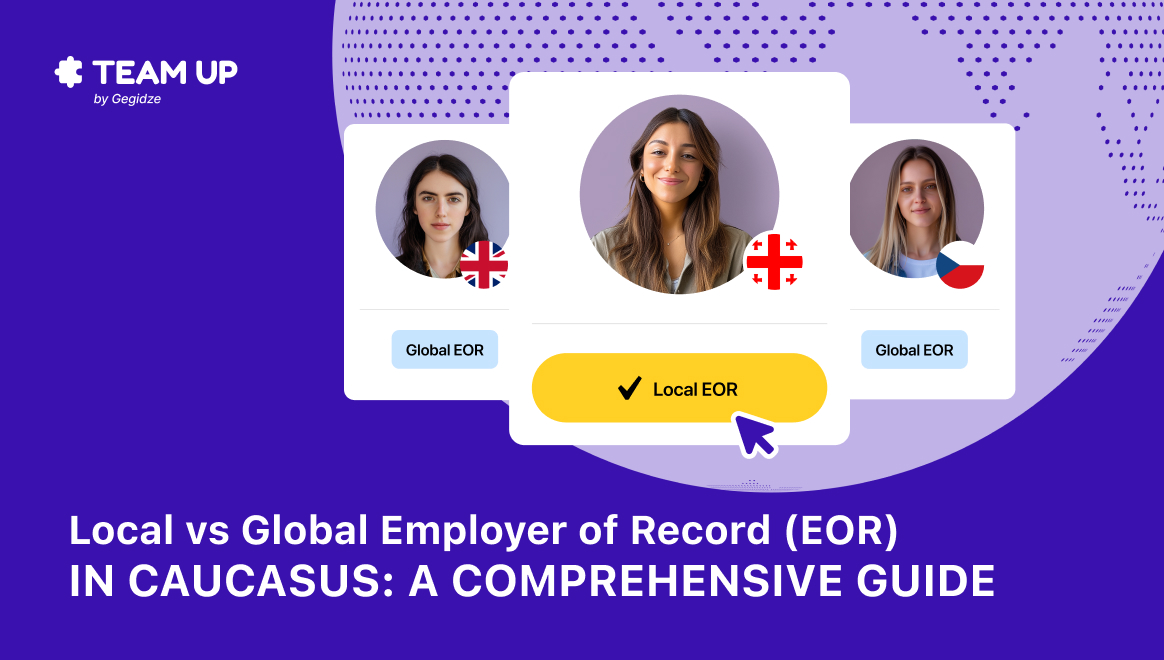
Not all EOR services are created equal.
The Caucasus is a prime example where choosing a local vs global EOR provider can make a big difference in experience and cost.
Let’s break down how each model operates in this region:

Local EOR Model (Country-Specialist or Regional Provider)
A local EOR in the Caucasus is typically a company that runs its own entities in Georgia, Armenia, and/or Azerbaijan.
They are on the ground in those countries – meaning they’re intimately familiar with local labor code, tax quirks, and bureaucratic processes.
When you use a local EOR, your employee is hired through that provider’s in-country subsidiary.
For example, a Georgian EOR will have a Georgian LLC that appears as the employer in the Revenue Service system, or an Armenian EOR will have an Armenian entity handling all contracts.
There’s no middleman.
Compliance control and customization
This often leads to better compliance control and customization: local EORs issue bilingual contracts in English and the local language (Georgian, Armenian, or Azerbaijani) that are tailored to local law (covering required clauses on notice, termination, IP, etc.).
They’ll usually have local HR or legal staff to advise on tricky situations (like how to handle a tricky termination or a maternity leave request under local rules).
Another big plus, local EORs in the Caucasus tend to use transparent flat pricing designed for the local market.
They know the local salary levels and cost of compliance, so they price a service fee accordingly – often much lower than a generic global rate.
(Case in point: many global EORs charge a flat $599+ per employee/month even in Georgia, whereas a local-focused EOR like TeamUp charges around €199 per employee/month in Georgia, reflecting local cost realities).
Despite the lower fee, local EORs often include more services – they handle everything from tax filings to benefits enrollment without nickel-and-diming.
Global EOR Model (One-Size-Fits-All Platform)
Global EOR providers (the “big names” that operate in 100+ countries) approach the Caucasus as one tiny piece of a large puzzle.
They sell a unified platform where you can hire anywhere through a single dashboard.
The trade-off is that these providers usually do not have their own fully-owned entities in every small market.
In practice, a global EOR might partner with a local firm or law group in Georgia, Armenia, or Azerbaijan to employ people on their behalf.
So when you hire via a global EOR, there’s a chance your employee is actually being employed by a subcontracted local entity anyway – adding an extra link in the chain.
(Some companies hide this fact; as noted in one Caucasus hiring guide, “Some ‘partners’ claim to cover Azerbaijan, Armenia, or Georgia but behind the scenes, they’re outsourcing to third-party... umbrella setups.”).
The implication is that you might not get the same level of direct expertise or agility.
If a labor law changes or a payroll hiccup occurs, the global EOR’s support team has to liaise with their local partner, which can slow down responses.
Global EORs also often use standardized processes globally that may not account for local nuances.
For example, they might have a one-size contract in English and a translated appendix, which might miss some local flavors or formal registration steps.
A local provider, by contrast, knows that in Azerbaijan every employment contract must be digitally registered and signed with an e-signature at the government portal, or that in Armenia every new hire needs a tax ID and enrollment in the funded pension system.
A global EOR will ensure compliance, too, but it might feel more “black box” – you trust that behind the scenes, they and their partner did it, but you’re less in the loop on the process.
Cost difference
The cost difference is significant.
Global EORs either charge a high flat fee (the same in, say, France and Georgia despite Georgia’s simpler payroll) or use a percentage-of-salary model.
Percentage fees (common range 10–15% of gross salary) can inflate your costs for senior hires – e.g., a 15% fee on a $3,000/month developer is $450/month, which is easily double a flat local fee.
Some global providers advertise a lower percentage (even ~8%), but then often exclude things (you might still pay extra for benefit administration or have FX fees).
Local EORs in the Caucasus, conversely, are built to be cost-effective for that region’s salary levels; a flat €199 in Georgia covers a senior or junior alike, so you’re not penalized for paying your talent well.
Service and flexibility
With a local EOR, you typically get more personalized support.
Need a tweak in the contract for a specific bonus clause? They can probably adjust it.
Need advice on whether to offer net or gross salary to attract candidates? They know the local expectations.

A global EOR will have a polished platform and global knowledge, but you might be just one ticket in a queue for a generalized support team.
When each model makes sense
If you’re hiring exclusively (or primarily) in the Caucasus, a local EOR provider will give you more bang for your buck and deeper assurance that all local details are handled.
They are literally in-country employers, so their entire business is making sure Georgia/Armenia/Azerbaijan compliance is 100% correct.
If you’re adding the Caucasus as one of many regions in a big expansion, and you value having one single dashboard for 20 countries, a global EOR can be convenient – just know you’ll pay a premium for that convenience, and you might not get the same local touch.
Some companies start with a global EOR for speed, then switch to local EORs or entities once they realize the ongoing cost.
Others do the reverse: begin local to prove the model, then migrate under the global for consolidation.
Either way, understanding these differences will help you choose the model that aligns with your hiring strategy and budget.
EOR on the Ground: Inside Government Platforms (RS.ge, SRC, EMAS)

One big question for any company hiring abroad is: how do we stay compliant with local government filings and paperwork? In the Caucasus, much of this happens on official online platforms run by tax or labor authorities. A quality EOR will operate within these systems on your behalf, essentially acting as your “local HR department” in the eyes of the government. Here’s how that works in each country:
Employer of Record Georgia
RS.ge (Revenue Service Portal): Georgia has a highly digitized tax system.
Every employer must declare salaries, income tax, and pension contributions monthly to the Revenue Service (through the RS.ge portal).
When you hire via an EOR in Georgia, that EOR’s local entity registers your employee in the RS system and includes their payroll in the monthly tax filings. Practically, the EOR will file a monthly combined report listing the employee’s gross salary, the 20% income tax withheld, and the 2% pension contribution (if applicable) paid.
They also remit the payments to the government electronically. This means your worker is fully visible to Georgian authorities as a legally employed person – no hidden arrangements. Georgia’s tax portal will quickly flag any discrepancies (it’s known to automatically calculate penalties for late filings, etc.), so having an EOR diligently handle RS.ge filings shields you from that risk.
You never have to log into RS.ge yourself; the EOR does it all and can even provide you with copies of payslips or tax reports for your records. In short, the EOR becomes your interface to Georgia’s government, ensuring all i’s are dotted, and t’s crossed in the local e-government system.
Employer of Record Armenia
SRC Portal (State Revenue Committee): Armenia’s compliance flow is similar in spirit. Employers must report and pay all payroll taxes and social contributions to the SRC on a consistent schedule (typically by the 20th of the following month).
An EOR in Armenia will take care of registering your employee with the tax authorities – including obtaining an Armenian Tax Identification Number (if the employee or the employer entity is new). Every month, the EOR provider files the required report of the employee’s income and withholdings.
They’ll deduct the flat 20% income tax, plus the employee’s 5% (up to 10%) pension contribution, plus the small military stamp duty from the salary, and submit those to the SRC. The process is all electronic now, and the EOR’s accounting team typically uses the government’s online system to ensure nothing is missed.
Armenia is known to enforce deadlines strictly; even a day late can incur a daily interest penalty of 0.075%. So the EOR basically babysits the calendar and calculations for you, making sure filings go in by the 20th, and payments are timely.
If the SRC has any questions or audits, the EOR stands in as the employer of record to handle those. You, as the foreign client, remain at arm’s length from Armenian authorities, which is exactly where you want to be.
Employer of Record Azerbaijan
E-gov “EIS”/EMAS: Azerbaijan’s government systems are a bit unique in that every employment contract must be registered through a Unified Employment system, often referred to as EMAS (Employment Monitoring Automated System).
Essentially, when an EOR hires someone in Azerbaijan, they must log into this government portal, upload or digitally create the employment contract, and sign it with a government-issued electronic signature. This registration notifies the government of the hire and is a legal requirement; if you don’t register, the contract is not recognized, and the employment is unlawful.
A local EOR handles this step seamlessly: they have staff with the e-signature credentials authorized to sign contracts on behalf of their entity. So your developer in Baku gets a properly registered contract and is on the government’s radar as an employee from day one.
Then comes ongoing compliance: Azerbaijan’s State Tax Service has online filing for payroll taxes and social contributions. The EOR computes the progressive income tax for the employee (e.g., 0% on the lower portion, 14% on anything above the threshold, up to 25% for very high earners or certain sectors), withholds it, and files the monthly return.
The employer contributions (22% social security, 0.5% unemployment) are calculated and remitted by the EOR as well. All these filings are done through the electronic tax system on the required schedule.
Importantly, because Azerbaijan’s labor market is heavily regulated, the EOR’s presence in these systems protects you: if anyone ever investigates, they would see that all proper filings, registrations, and payments have been made under the EOR’s name.
There’s no ambiguity about the worker’s status. If you tried to pay someone in Azerbaijan under the table or as a “contractor” through a platform without doing this, it would be only a matter of time before alarms go off. As an EOR guide bluntly put it, “You can’t ‘just pay them as a contractor’ and hope for the best. Misclassification leads to backpay liabilities, fines, and worst-case scenarios.” Using an EOR means everything is above board in the eyes of AZ’s government systems.
In summary, a local or regional EOR essentially plugs into each country’s official employment infrastructure on your behalf. They take care of the accounts, registrations, digital signatures, and monthly reports. You don’t have to learn what RS.ge or EMAS even stand for – but you can sleep at night knowing your hires are fully legal in the government’s eyes. By 2026, all three Caucasus countries will be highly digital in enforcement, which is great news if you’re compliant (easy filing, clear records) and terrible news if you’re not (easy to catch problems). An EOR ensures you’re in the first camp.
2026 Tax Enforcement and Payroll: Country-by-Country Realities
One thing founders and CFOs cannot afford to get wrong in 2026 is understanding local tax and payroll obligations.
The Caucasus countries may have relatively low tax rates, but they are serious about compliance and have updated their laws in recent years to tighten enforcement.
Here’s what you need to know per country – and how a good EOR keeps you on the right side of the law:
Tax Enforcement and Payroll inGeorgia
Georgia’s tax system is straightforward – a flat 20% personal income tax on wages, deducted at source.
Additionally, Georgia has a mandatory pension scheme: both employer and employee contribute 2% of salary (and the government adds another 2% for local citizens) to a pension fund, unless the employee is older or has formally opted out.
In practice, this is the only “social” cost on top of salary, and it’s relatively small (4% of payroll, split between employer/employee).
There are no other employer payroll taxes – no social security tax, no Medicare-type tax, etc.
Georgia wants to attract business, so they keep it simple.
However, “simple” doesn’t mean “lax.”
The Revenue Service (RS) in Georgia uses an automated online system and issues fines for even minor infractions.
Late filing of the monthly tax return can trigger an immediate monetary penalty; underreporting income can flag you for an audit.
Enforcement is increasingly data-driven – by 2026, the RS system cross-checks payments and declarations rigorously (all salaries must be paid through bank transfers in Georgia, which the RS can monitor).
Also, there’s growing awareness of employee misclassification: if you try to label a full-time Georgian developer as an “independent contractor” to skip taxes, you risk the RS reclassifying them as your employee and slapping you with back taxes and fines.
An EOR protects you here: they employ the person properly and pay those taxes, so you won’t face a nightmare scenario of a Georgian tax audit in a language you don’t speak (to borrow a humor from TeamUp’s style).
Tax Enforcement and Payroll inArmenia
Armenia has undergone tax reforms to simplify and encourage tech growth.
As of 2023, it’s a flat 20% income tax for individuals.
On top of that, there’s the mandatory funded pension contribution: effectively 5% of gross salary (capped for high earners, with the government co-financing an additional 5%).
Uniquely, Armenian employers themselves do not pay a separate social security tax – the system instead relies on those employee contributions plus state funds.
Armenia does have a quirk: the “military stamp duty”, a small fixed monthly fee each employee pays (ranging from AMD 1500–15000, ~$4–$40, depending on salary level) to support a national defense fund.
It’s essentially an extra tax withheld alongside income tax.
Compliance-wise, Armenia is very strict about paperwork and timing.
All taxes must be withheld and remitted by the 20th of the next month.
If you’re late or if you fail to register an employee properly, penalties accumulate daily and can even lead to administrative or criminal liability for serious breaches.
By 2026, Armenian authorities are modernizing their audit capabilities and ensuring employers aren’t abusing “contractor” status to avoid these contributions (similar to Georgia, the law clearly says if someone works for you like an employee, you must employ them).
Using an EOR in Armenia means these nuances (like obtaining the employee’s social services number, adhering to the exact filing formats, etc.) are all handled.
The EOR also keeps up with any new incentives – for instance, Armenia introduced a 10% income tax rate for certain qualified high-tech workers.
A local EOR will know if your hire’s role qualifies and ensure the correct (lower) tax is applied, whereas a DIY approach might miss out or misapply it.
In short, Armenia’s tax system is predictable and not high, but it demands precision – exactly what an EOR is there to guarantee.
Tax Enforcement and Payroll inAzerbaijan
Azerbaijan’s tax and payroll rules are the most complex of the three, reflecting its historically more state-regulated labor market.
For several years, Azerbaijan offered special income tax exemptions to encourage private sector employment (0% tax up to a certain salary for qualifying non-oil jobs).
These incentives are set to evolve by 2026.
Broadly, expect a progressive income tax structure.
Currently, it’s 0% on income up to 8,000 AZN per month and 14% on the portion above 8,000 AZN (for most IT/non-oil employees).
High earners or those in the oil/gas sector face a flat 25% in many cases.
This means a mid-level developer making, say, 5,000 AZN (~$3k) might pay no income tax under the incentive, whereas a very senior one making 10,000 AZN would pay ~14% on 2,000 AZN of that (about 280 AZN tax).
It’s a bit counterintuitive (very low tax for moderate salaries), and these rules can change once the incentive period lapses.
An EOR’s job is to always apply the current correct rate and handle the somewhat heavy social contributions on top.
Employers must contribute 22% of gross salary to social security (capped at certain thresholds, then 15% on amounts above the cap).
Employees contribute an additional small percentage (around 3%) from their pay.
There’s also 0.5% unemployment insurance from the employer side.
As of 2024, there are mandatory health insurance payments (the specifics of which the EOR incorporates into payroll).
Azerbaijan’s tax enforcement is tightly interwoven with its electronic systems: if an employer doesn’t register a contract or fails to pay social insurance, it’s very visible.
The country has been clear that “payroll, tax, and benefits are not optional here… Azerbaijan doesn’t mess around with employer obligations”.
By 2026, we anticipate Azerbaijan phasing out some tax holidays and moving to a slightly higher tax on lower incomes (possibly a flat 10–14% on all wages in the private sector).
If and when that happens, an EOR will seamlessly update the withholdings so you remain compliant from day zero of the new law.
The Pattern Across the Caucasus
In all three countries, the pattern is: low to moderate tax rates, but uncompromising enforcement.
Each has modernized its tax collection and labor oversight to encourage legitimate employment.
The message is clear: if you hire local talent, you must do it by the book – or eventually face back taxes, penalties, or legal action.
Founders sometimes assume these smaller markets might be lax or “nobody will notice a contractor paid overseas.”
That era is over.
Georgia, Armenia, and Azerbaijan in 2026 have digitized systems that make non-compliance easy to spot.
The EOR model exists to keep you far away from trouble: they handle calculations, filings, payments, and stay current on law changes, so you never have to personally tangle with a tax inspector in Baku or a confusing new pension rule in Yerevan.
Termination and Labor Inspections: Playbooks for Each Country
Hiring is only half the equation – you also need to know how separation works to avoid nasty surprises.
Labor laws in the Caucasus protect employees by mandating notice periods, valid termination grounds, and sometimes severance pay.
They also have labor inspectorates that can investigate compliance (usually if a complaint arises).
Here’s a quick country-by-country on ending employment and staying out of trouble, and how EORs help you navigate this.
Termination and Labor Inspections inGeorgia
Georgian labor law is relatively flexible compared to its neighbors, but it still has rules.
Terminations in Georgia require a minimum of 30 calendar days’ notice to the employee in most cases.
If an employer wants to terminate immediately (no notice), they are generally required to pay at least one month’s salary as severance.
There are recognized “just causes” for firing (like gross misconduct, dishonesty, etc.), in which case you can terminate with cause – but you'd better have documentation and follow due procedure (typically a warning process), or the employee could dispute it.
If an employee is let go due to reasons like role incompatibility or long-term illness, Georgian law explicitly expects either notice or severance as mentioned.
An EOR in Georgia will ensure that any termination you need to carry out follows these rules to the letter.
They’ll usually advise you on the valid grounds (so you don’t state an illegal reason), draft the notice letters in Georgian, calculate the final payout (including any unused vacation that must be paid out), and even issue the government-required separation documents.
This is crucial – mishandling a termination can lead to labor disputes or even court cases.
But with the EOR’s HR/legal team handling it, you get a clean break.
Georgia also has a Labor Inspection Office that can conduct inspections, especially related to safety, working hours, or if an employee files a complaint about unfair dismissal or unpaid wages.
While random inspections are not extremely common in IT/office settings, they can happen.
For example, if an employee claims they were fired without the 30-day notice or that their overtime was never paid, inspectors could investigate the employer.
In an EOR scenario, the EOR is the employer on record, which means they would be the ones interfacing with any inspector, not you.
A strong local EOR will have all documentation ready (contracts, payslips, tax records) to demonstrate compliance.
In essence, they act as a shield – any labor inspection looks at the EOR’s practices (which are solid and by-the-book) rather than dragging your company into a legal mess.
Termination and Labor Inspections inArmenia
Armenia’s labor code is more detailed and can be relatively employee-friendly.
You generally cannot terminate an Armenian employee at will – it must fall under one of the permitted grounds in the Labor Code.
These include things like documented non-performance, redundancy due to downsizing, or other specific reasons (somewhat formal, like “loss of confidence” in an employee for certain job types, etc.).
If none of those apply and you still need to let someone go, typically it has to be by mutual agreement or by providing significant notice/severance.
Notice periods in Armenia vary with tenure and scenario.
For instance, if you’re ending a contract early due to organizational changes, you might owe anywhere from 14 to 60 days' notic,e depending on how long the person worked.
Probationary employees need just 3 days notice, whereas someone on a fixed-term contract requires 10 days notice if you’re not renewing.
For layoffs (position eliminated) or redundancies, severance pay is typically one month’s salary for that employee.
In other termination cases (like mutual separation), a smaller severance of two weeks’ pay is common, unless a different amount was agreed in the contract.
What all this means is: in Armenia, you must plan an exit carefully and calculate what’s owed.
Skipping the notice or not paying due severance can lead to immediate legal liability – the employee can file a complaint with the authorities or sue for reinstatement plus back pay.
Armenia’s Health and Labor Inspection Body (the labor inspectorate) is active in responding to complaints.
If an employee alleges unfair dismissal or non-payment of something like the pension contributions or unused vacation, inspectors can audit the employer.
They’ll check if proper notice was given, if termination was for a lawful reason, etc.
Here again, the EOR takes on this responsibility.
A good EOR will have a “termination playbook” for Armenia: ensure the reason meets legal criteria, give written notice as required, pay all final compensation on the last day or within the legally required timeframe (which is usually very prompt in Armenia, often the last working day).
They’ll also handle any mandatory filings – for example, informing the Social Security fund if needed.
So if anyone comes knocking, the EOR can demonstrate that the termination was done correctly (or often, avoid disputes entirely by doing it humanely and legally).
An EOR essentially makes what could be a legal minefield into a routine, compliant process.
Termination and Labor Inspections inAzerbaijan
Azerbaijan has a highly structured termination process.
Contracts can be terminated for a list of reasons specified by law (similar to Armenia, you need a valid reason or mutual agreement) – these range from gross misconduct to staff reduction.
If you have an indefinite contract, terminating without cause is tough; usually, it’s easier at the end of a fixed-term contract (but remember, if you keep extending a fixed-ter contract, after 5 years it becomes indefinite by law).
For layoffs or role eliminations, notice and severance are tied to tenure.
Generally, the Labor Code of Azerbaijan mandates that if an employee is dismissed due to staff reduction or similar, they get notice (typically at least 2 weeks to 1 month) and severance pay that increases with years of service (for example, one common rule: 2 months’ salary for 5–10 years of service, 3 months’ for 10+ years, etc.).
Even if an employee is terminated for performance (“incompatibility with work responsibilities” as Remote.com phrased it), the customary approach is to give notice and/or one month severance as a goodwill (and partially legal) measure.
Additionally, unused vacation must be paid out, and any other accrued benefits must be settled on termination.
Azerbaijan requires that every termination (like hiring) be logged in the EMAS system – the employer (EOR) must formally register the termination notice in the government portal as well.
The country’s labor inspectors can be quite strict.
They might investigate if, say, an employee complains they were fired without cause or not given proper compensation.
Fines for unfair termination or failure to pay due severance can be substantial.
Here’s where having the EOR is invaluable: “Offboarding isn’t a guessing game”, as one guide says – letting someone go in Azerbaijan requires proper notice, final payroll calculation, and HR documentation filed.
The EOR handles all of this “start to finish”.
If you tell the EOR, “We need to terminate X”, they will walk you through the allowed reasons and timelines.
They’ll produce the termination order in Azerbaijani, ensure it’s signed and delivered, register the notice in the government system, and pay out the final paycheck, including any mandated severance or unused leave, within the legal deadline.
By doing everything “by the book”, they essentially bulletproof you from labor disputes.
And if an inspection ever occurs or the employee files a complaint, it’s the EOR’s local entity that will respond with evidence that all obligations were met.
You remain out of the fray.
Bottom line
In summary, each Caucasus country has its own labor law wrinkles, but a common theme is: follow procedure and treat employees fairly.
The days of “firing at will” or bypassing payouts are gone (if they ever existed here).
An EOR is extremely useful not just in making hiring easy, but in making parting ways clean and compliant.
They ensure that you won’t inadvertently violate a local labor code article when ending employment.
As a bonus, this also means your reputation stays intact – you won’t develop a name in the local market as the company that mistreats employees.
The EOR’s structured approach means even offboarding is done with professionalism and legality.
In the words of a TeamUp Caucasus guide: “Terminations follow local law; final payouts and documents are filed properly; you move on – no legal drama.”
That’s exactly what you want when operating remotely in a new region.
Costs and Pricing Breakdown: The Hidden Scaling Tax

Pricing is where the divergence between local and global models becomes most apparent. Many companies realize too late that they optimized for initial convenience at the expense of long-term sustainability.
How Local EOR Pricing Works
Local providers price based on actual in-country execution. This typically involves a flat monthly fee per employee that reflects local complexity.
- Average Range: €199 to €500 per employee/month.
- Structure: Flat fee with no percentage-of-salary markup.
- Predictability: Fees remain stable even if salaries increase or bonuses are paid.
How Global EOR Pricing Works
Global platforms' price for reach and brand. They often charge high flat fees or a percentage of the gross salary.
- Average Range: $600 to $700+ per employee/month.
- Structure: Often includes percentage-based markups ($10-15\%$) or add-ons for local adjustments.
- The Scaling Trap: As the organization grows and hires senior talent, the cost of the EOR service increases without delivering more value.
| Cost Factor over 3 Years | Local EOR (Team Up) | Global EOR Platform |
| Monthly Fee | €199 | $650 |
| Annual Cost | €2,388 | $7,800 |
| 3-Year Total per Hire | €7,164 | $23,400 |
| Difference | Base Savings | +€16,000 Markup |
For a team of 10 developers, the "Global Tax" can reach €160,000 over three years, capital that is better spent on R&D than on a dashboard subscription.
Flat Fee EOR (typically local providers)
A flat fee model means you pay a fixed amount per employee per month for the EOR service, regardless of the employee’s salary.
In the Caucasus, local EORs tend to use this approach because salaries here are relatively lower than in the West, and they want to offer a compelling value.
For example, TeamUp (a regional EOR) advertises €199 per employee/month in Georgia for full EOR service.
That flat fee usually covers all the admin: employment contract, onboarding, monthly payroll processing, tax filings, benefits administration, offboarding – essentially everything except the salary and statutory contributions (those go to the employee and government).
Flat fees are great for predictability.
If you plan to hire 3 people, you know exactly what the service fees will be (3 × flat fee), no matter if one is a senior architect and another a junior tester.
Flat fees in the Caucasus are generally much lower than in Western Europe or the US because the providers have lower operating costs.
(Global EORs that charge $600+ in France might charge the same $600 in Georgia out of habit, whereas a local can do it for a third of that and still profit.)
Percentage of Payroll Fee (sometimes global providers or legacy firms)
A percentage model ties the fee to the employee’s salary (or total cost).
For instance, an EOR might say, “Our fee is 10% of gross payroll.”
If your developer’s gross monthly salary is $2,000, you’d pay $200/month for the service.
If you later raise that salary to $3,000, the fee becomes $300.
At first glance, percentages can seem appealing for lower-paid staff (10% of a small number is small), but in tech, salaries skew high.
You might start as a mid-level engineer at a modest pay, but in a year or two, after raises, that percentage fee keeps creeping up.
And if you hire a couple of senior folks at $4K–5K, a 10% fee means $400–$500 each per month – suddenly you’re paying more than a flat $199 option by a wide margin.
Some global EORs effectively use a percentage even if they don’t say so explicitly.
For example, they may advertise different flat fees by country that loosely correlate to average wages there (charging more in high-wage countries).
But in smaller markets, they just stick a high flat fee, which is akin to a huge percentage.
Hidden EOR costs to watch out for
Unfortunately, not every EOR provider is transparent.
Here are some common hidden or add-on costs in the industry. Make sure to ask about these when comparing options:
Currency Exchange Markups
If you’re paying the EOR in USD/EUR but they’re disbursing salaries in Georgian Lari, Armenian Dram, or Azerbaijani Manat, there’s currency conversion involved.
Some providers sneak in a markup on the exchange rate (e.g., they budget a 2–3% worse rate than the market).
Over a year, this FX fee can add a few hundred dollars per employee.
Look for providers that either charge in local currency or use mid-market FX rates with no or low markup.
Setup or Onboarding Fees
A few EORs charge a one-time setup fee per employee or per country, ostensibly for the contract setup or initial admin.
This could be a flat amount like $500 or more.
Others charge offboarding fees when an employee is terminated.
Ideally, you want a provider that has no setup or exit fees, only the monthly service charge.
Always clarify this upfront (some hide it in the contract's small print).
Security Deposit or Pre-funding
This is less obvious until you get into contract talks.
Some providers require a deposit or a few months of pre-paid salary as a security measure.
For example, they might ask for 1 to 1.5 months of gross payroll as a deposit, held in escrow in case you default on payments.
This ties up capital you could use elsewhere.
Local EORs in stable markets like Georgia often don’t require this.
TeamUp explicitly advertises “no retainers, you only pay when someone is hired and active”.
Global ones sometimes do, especially if you’re a smaller client – so check the payment terms carefully.
Mandatory Benefits and Extras
Sometimes the monthly fee doesn’t include managing things like health insurance or other benefits.
For instance, a provider might say health insurance administration is an add-on of $50 per person, or they simply pass the cost to you.
If the local market expects benefits (like private health insurance is common in Georgia’s tech scene), see if the EOR fee covers facilitating that or if it’s extra.
A transparent EOR will say, “Our fee covers compliance and payroll; any actual benefit premiums are separate”.
A hidden approach would be to quietly mark up the cost of a benefit premium or require you to buy a package through them.
Volume or Minimum Commitments
Some global EORs have pricing that assumes a certain headcount.
If you only have 1 employee, they might charge more or have a minimum monthly spend.
Also, watch for contract clauses that lock you in for a year of fees even if you terminate the employee sooner.
Ideally, you want the freedom to stop paying when the employee leaves, without penalties.
Limited Support or “Premium” Support Fees
A subtle cost is the time or quality of support.
If a provider is very cheap but never answers your questions promptly, that’s a cost on your time.
Some large EORs offer a premium tier service for dedicated support.
With a local EOR, you often get direct access to their team anyway as part of the flat fee, an advantage not reflected in sticker price but in value.
Doing the all-in math
When comparing, do the all-in math: salary + employer contributions + EOR fee + any extras.
For example, suppose you hire an engineer in Baku at $2,000 monthly gross.
Employer contributions ~22% = $440.
If you use a global EOR at 10%, that’s $200.
If they have a $500 setup fee and you plan 12 months, that’s another ~$42/month equivalent.
Add maybe 2% FX ($40).
Your effective monthly cost might be:
$2,000 + $440 + $200 + $40 + $42 = $2,722.
If a local EOR charges flat $250 with everything included and better FX, your cost would be:
$2,000 + $440 + $250 ≈ $2,690.
And if the global was a flat $600 fee, it’d be $3,080 – a big difference.
In the Caucasus, where gross salaries are modest relative to US/EU, a high flat global fee can sometimes be as much as 20–25% extra anyway.
Local flat fees are generally the best value here.
Final considerations
A note of caution: “cheapest isn’t always best” – you want a reputable EOR that truly handles compliance.
But in this region, you don’t have to pay through the nose for quality.
There are efficient providers with fair pricing.
The key is transparency.
As one industry source notes, many EORs claim flat pricing but then “include surprise charges for setup, termination, or FX”.
Don’t be afraid to ask for a breakdown:
Is this fee all I pay? Are there any other fees if X or Y happens?
A final thought: if your plan is to scale a large team (say 20–50 hires) in these countries long-term, at some point you might evaluate setting up your own entity.
But even then, EOR fees here are low enough that many companies happily pay them for the convenience and risk mitigation.
€199/month is trivial compared to the headache of managing payroll, legal, and HR in-house for a few people.
It becomes a rounding error in the grand scheme – especially compared to the cost of a mistake.
As one founder-friendly insight put it, “You’re not paying for an ‘EOR service.’ You’re paying for not being the one who has to explain to tax authorities why your contractor was really an employee.”
In other words, the fee buys peace of mind.
So evaluate cost, but also value.
And always read the fine print on pricing to avoid any “gotchas” later.
2026 Tech Salary Benchmarks: Caucasus Regional Comparison
Hiring remote employees in the Caucasus remains a viable option for US and EU companies looking for a deep talent pool with lower costs. However, 2026 has seen a notable increase in the demand for specialized skills like AI, Cloud Architecture, and Cybersecurity.
| Role | Georgia (Annual USD) | Armenia (Annual USD) | Azerbaijan (Annual USD) |
| Senior Software Engineer | $56,728 – $70,190 | $50,000 – $75,000 | $52,000 – $78,000 |
| AI/ML Specialist | $60,000 – $80,000 | $55,000 – $90,000 | $58,000 – $92,000 |
| Full-Stack Developer | $40,000 – $65,000 | $38,000 – $60,000 | $40,000 – $62,000 |
| QA Engineer | $28,000 – $40,000 | $25,000 – $38,000 | $30,000 – $42,000 |
Insight: Armenia leads the region in high-tech exports and innovation capacity, having invested $425 million in infrastructure upgrades to support its tech hub status. Consequently, senior Armenian developers often command a premium in R&D roles compared to the more service-oriented tech pools in Georgia.
The 2026 strategic outlook: A connected region
The Caucasus is undergoing a "reset" from a region of frozen conflicts to a vital Eurasian transit hub known as the Middle Corridor.
- The Zangezur Corridor: As peace efforts between Armenia and Azerbaijan materialize, the opening of regional transport routes is expected to rise from 160,000 TEU to 865,000 TEU by 2040.
- Customs Integration: Georgia has launched joint customs checkpoints with Armenia and Azerbaijan, institutionalizing its role as a transit intermediary.
- Digital Nomad Strategy: Georgia is positioning itself as a regulated destination for high-earning remote professionals with a new Digital Nomad Residency Program launched in late 2025.
For HR professionals, this means the region is becoming more economically integrated, facilitating the movement of talent and services across borders. However, this integration also brings higher reporting standards and complex regulations.
Decision matrix: Which model should you sign?
Operators should avoid treating this as a simple scorecard. Instead, they must map the choice to their intended growth trajectory.
| Decision Factor | Local EOR Specialist | Global EOR Platform |
| Speed to Hire | Fast (onboarding in 3-5 days). | Fast for single hires across many countries. |
| Scaling (3+ Hires) | High efficiency and predictable flat fees. | High cost creep due to percentage-based markups. |
| Compliance Depth | High (native integration with SRC/EIS). | Moderate (reliant on partner "middlemen"). |
| Support Model | Direct access to local legal/tax experts. | Tiered global queues and chatbots. |
| IP Protection | Local-court enforceable bilingual contracts. | Generic global templates; jurisdictional ambiguity. |
Summary Recommendation
Choose a Local EOR if building a strategic team or hub in the Caucasus. The local specialist provides the legal shield and tax optimization (like the $10\%$ Armenian tech tax) that global providers miss.
Choose a Global EOR only if hiring 1 person with no plans to expand, where speed and a single global invoice for a scattered team matter more than localized legal nuance.
FAQ
Which countries are best served by local EORs?
Local EORs are essential in countries with nuanced labor laws and active enforcement, such as Georgia, Armenia, and Azerbaijan. In these markets, the 20% flat tax or tiered pension rules (2+2+2) require specialized execution to avoid audits.
What are the key compliance risks with global providers?
The biggest risk is indirect accountability. Many global providers rely on partners in Tbilisi or Yerevan, introducing communication lag during audits and termination disputes. This fragmentation of liability can be spotted by inspectors.
How do benefits differ between models?
Local EORs align benefits with local expectations, such as private health insurance tiers that are highly valued in the Georgian tech market. Global EORs tend to standardize regional minimums, which can lead to under-delivering on the perks that actually win talent wars.
Why do CFOs care if the EOR owns the local entity?
Because liability follows the legal employer. If the EOR owns the entity, the organization has a single point of accountability for payroll, contracts, and taxes. If they use a subcontractor, the responsibility is fragmented.
Is it difficult to terminate a remote employee in Armenia?
Yes. The Labor Code is protective, and as of 2026, all terminations must be registered in the SRC digital portal. Any mismatch in timing or legal basis is visible to the state immediately.
Is Azerbaijan’s income tax holiday still in effect?
No. As of January 1, 2026, the holiday has expired and been replaced by a progressive tax schedule (3%,10%,14%). This rate is scheduled to increase annually until 2028.
.svg)