


PEO services for small businesses in the Caucasus: What you should know
Introduction
If you are running a small team across Georgia, Armenia or Azerbaijan, you already know this. Nothing about payroll or HR in the Caucasus is plug and play.
Different tax rules. Different social contributions. Different ways government portals decide they are not in the mood to cooperate that day.
That is why founders and HR leaders start searching for PEO services for small businesses in the Caucasus. Not because they love outsourcing. Because they want to stop betting the company on half-remembered labour rules and homemade spreadsheets.
This guide walks through what a PEO actually does in this region, how PEO payroll really works in Georgia, Armenia and Azerbaijan, where the legal limits sit, and when an Employer of Record is a better tool. Team Up sits there. As the regional EOR partner that lives inside this complexity, you do not have to.

Why PEO services are on every Caucasus expansion checklist
Small businesses do not wake up one day and say. Let us bring in a PEO just for fun. They get pushed there by three very real problems.
Three countries. Three payroll systems. Zero margin for error
The Caucasus is one region on the map. It is three different realities in payroll.
In Georgia, employment income is taxed at a flat 20%. No progressive brackets. Nice and simple on paper. The complexity sits in the funded pension system. Employers contribute 2% of the salary. Employees contribute 2%. The state adds another 2% for eligible workers. Total: 6% that must be tracked and reported accurately each month accurately.
In Armenia, salary income is taxed at 20% as well. On top of that, employees pay 5 to 10% social contributions depending on income level. So net pay depends not only on tax but also on which contribution tier applies.
In Azerbaijan, tax is a moving target. Rates differ by sector and income level. Private non-oil sector employees can enjoy reduced rates for a defined period. Others face progressive rates up to 25%, with separate rules for residents and non-residents.
There is no single formula you can drag across your spreadsheet and call it a day.
Social insurance that punishes guesswork
On top of taxes, each country runs its own contribution logic.
- Georgia: 2% pension from the employer and 2% from the employee, plus the state match.
- Armenia: Tiered 5 to 10% social contributions.
- Azerbaijan: Roughly 3% employee and 22% employer contributions for many roles, with exceptions and thresholds.
If your internal HR generalist is “doing this on the side, you are not saving money. You are banking future penalties.
Documentation-heavy labour systems
All three countries share one habit. They care about documentation.
You need:
- written contracts that match local law
- clear tracking of working time and leave
- Payslips employees can understand, and inspectors can trust
- correct documentation around probation, performance and termination
If something reaches a labour inspector or court and you cannot show the documents, the story you tell later does not matter.
This is the moment where smart founders say. We need professional help. That is where PEO services appear on the radar.

What a PEO for small businesses really does in the Caucasus
Forget the glossy marketing. Let us define PEO in a way that matches how the model actually works in Georgia, Armenia and Azerbaijan.
A Professional Employer Organisation provides operational HR and payroll support. It runs the machinery. It does not replace your company as the employer.
Payroll execution across three different tax systems
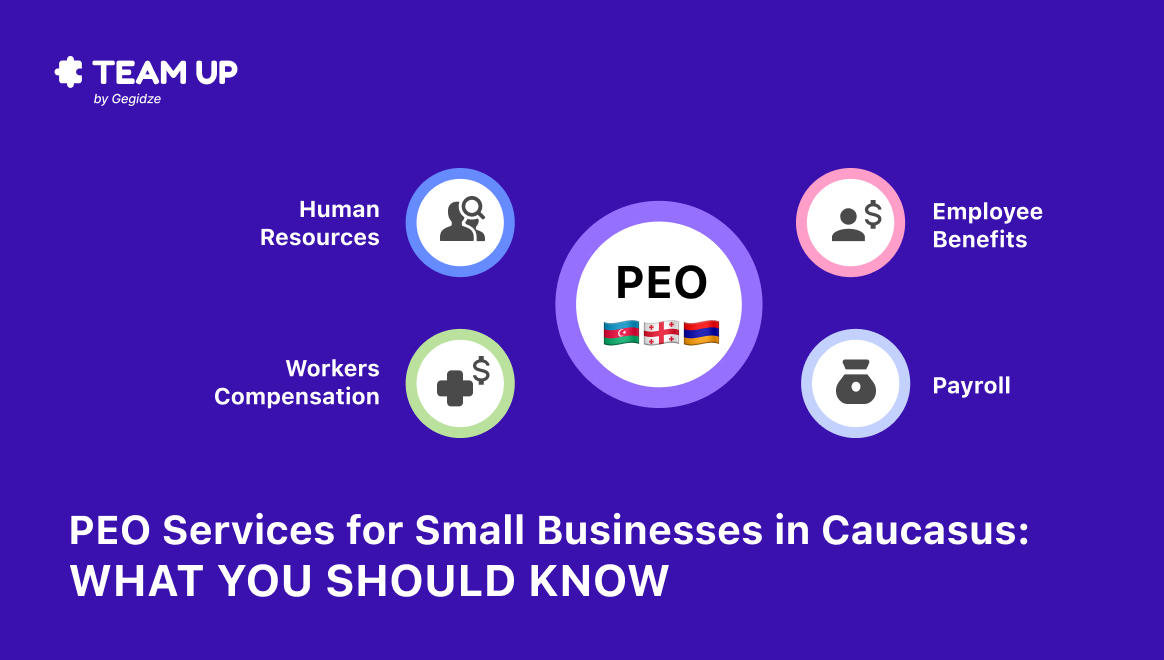
A regional PEO will usually handle:
- monthly gross-to-net calculations
- application of local tax rules
- Withholding pension or social insurance contributions
- payslip generation
- preparation of finance and audit reports
On the surface, this looks boring. Behind the scenes, it is often the difference between clean audits and years of retro corrections.
HR admin that respects local reality
PEO services typically cover:
- drafting locally compliant employment contracts
- onboarding and document collection
- leave and absence tracking
- probation and HR lifecycle management
- standard HR letters. employment confirmations, salary statements and more
You still decide who to hire, promote or exit. The PEO turns those decisions into documents, records and system updates that hold up under scrutiny.
Compliance monitoring instead of permanent firefighting
Tax and labour rules in this region move. A PEO should:
- Monitor legal updates
- Adjust payroll formulas correctly
- flag offside practices
- help you respond to routine queries from authorities
They do not replace legal counsel. But they stop small mistakes from turning into big problems.
Benefits and allowances aligned with local expectations
Compensation in the Caucasus is not just based on salary. It often includes:
- allowances
- bonuses
- travel support
- private health options
Tax treatment differs by item and by country. A PEO aligns the structure so it is fair to staff and predictable for finance.
How PEO payroll works in Georgia, Armenia and Azerbaijan
Most “global payroll” articles get vague here. This one does not.
PEO payroll in Georgia. Flat tax is simple. The rest is not
Key points:
- 20% flat tax on employment income
- 2% employer pension contribution
- 2% employee contribution
- State adds 2% for eligible workers
A PEO calculates tax and pension, updates rates when laws change, and files correctly.
PEO payroll in Armenia. Flat tax plus tiered social contributions

Core structure:
- 20% flat income tax
- 5 to 10% social contribution, depending on income
A PEO ensures the right tier applies and all reports go to the correct agency on time.
PEO payroll in Azerbaijan. Sector rules and social insurance complexity

Tax complexity here is no joke.
- Reduced tax rates for private non-oil employees during incentive periods
- progressive rates up to 25% for others
- different treatment for residents and non-residents
Social insurance runs around:
- 3% employee share
- 22% employer share
- special rules above certain salary thresholds
A good PEO keeps this straight. A spreadsheet does not.
The hard limit. You need entities in every country
This is non-negotiable.
A PEO does not become your employer. It does not take on employer liability. It cannot legally hire staff for you.
To use PEO services in the Caucasus, you must already have:
- a legal entity in Georgia for Georgian staff
- a legal entity in Armenia for Armenian staff
- a legal entity in Azerbaijan for Azerbaijani staff
No entity. No compliant PEO relationship.
If someone tells you otherwise, they are either misusing the term or inviting you into a structure that collapses under inspection.
This is exactly why Employer of Record (EOR) exists.
An EOR:
- becomes the legal employer
- issues local contracts
- registers employees with tax and social authorities
- runs payroll under its own entity
- carries employer-level risk
You direct the work. The EOR carries the burden.
This is the role Team Up plays. The regional EOR partner that understands how Georgia, Armenia and Azerbaijan actually work, not how they look on PowerPoint slides.
PEO vs EOR in the Caucasus. Which one fits your plan
When PEO makes sense
PEO is a fit when:
- You already have a local entity
- You plan to stay in that market
- Your internal HR cannot keep up
- You are comfortable carrying employer liability
When EOR is the smarter tool
EOR is the right choice when:
- You want to hire without setting up entities
- You are testing new markets
- You want to limit legal exposure
- Your team is distributed across multiple Caucasus countries
In those scenarios, building three entities plus three PEO setups is not lean. It is delayed.
EOR provider lets you hire fast and clean while you decide which markets deserve a full legal footprint. And when you are ready, transitioning from EOR to direct employment is simple.
Team Up enables exactly that. With one partner, one model and one regional compliance framework.
Hidden PEO costs in the Caucasus that no one advertises
PEO pricing decks always look clean. The invoices rarely do.
If you plan to use PEO services for small businesses in the Caucasus, you need to know where the money actually leaks out.
Setup and onboarding fees
Most regional PEOs charge you just to get started. That can show up as
- one time implementation fees
- per employee onboarding fees
- separate charges to “clean up” your current payroll data
Questions to ask
- “Is there any setup fee for Georgia, Armenia or Azerbaijan.”
- “Do you charge per employee onboarding, or is it included.”
- “Is migration of existing staff into your system part of the base fee.”
If they cannot answer in one sentence, expect a surprise line item later.
Minimum monthly fees and headcount floors
This is where small teams across the Caucasus get burned.
Many PEOs quietly require
- a minimum invoice amount every month
- a minimum number of active employees per country
- a base fee that applies even if your team shrinks
So you think you are paying 40 or 60 per employee, then discover there is a 1,000 a month minimum hidden in the contract.
Questions to ask
- “What is the minimum we will pay per month, even if we have three employees.”
- “Is there a minimum headcount per country.”
If you are building lean in Georgia, testing one role in Armenia and one in Azerbaijan, these floors matter more than the per employee rate.
Off cycle payroll and corrections
In real life you will
- hire mid month
- pay bonuses
- correct mistakes
- fix tax or contribution issues in prior months
Some PEOs treat all of this as “extra work” that sits outside the standard fee.
They may charge for
- extra payroll runs
- reissued payslips
- corrected filings
- amended social contribution reports
Questions to ask
- “Are off cycle payroll runs included in the monthly fee.”
- “How do you charge for corrections to earlier months.”
If every adjustment triggers a fee, your cost is not stable.
Benefits markups and hidden margin
Once you start offering health cover or other benefits in Tbilisi, Yerevan or Baku, the PEO might
- bundle group plans
- negotiate discounts
- pass access to you
All fine. Unless they stack hidden margin on top without telling you.
Questions to ask
- “What is the underlying premium from the insurer?”
- “How much of what we pay is your admin fee or margin?”
- “Can we see a simple cost breakdown for benefits?”
If they resist that last question, assume you are subsidising someone else’s deal.
Extra fees for handling authorities
The more you operate, the more likely you are to receive
- tax notices
- social fund queries
- pension authority questions
Strong PEOs handle these as part of their responsibility. Weak ones treat every letter from an authority as billable “consulting”.
Questions to ask
- “If the tax or social authority sends a notice about filings you handled, who leads the response.”
- “Is this included in the monthly fee, or charged separately.”
If they avoid a straight answer, you already know the answer.
Document and HR letter charges
Across the Caucasus, employees constantly ask for
- Salary certificates for banks
- employment letters for visas
- confirmation letters for landlords
Some PEOs include these. Some quietly invoice each one.
Questions to ask
- “Are standard HR letters included, or billed per document?”
It seems small. Multiply by 20 employees over a year, and it is not small.
Terminations and complex cases
Terminations are where labour law in Georgia, Armenia and Azerbaijan gets real. You must get notice periods, documentation and settlements right.
Many PEOs charge extra for
- drafting settlement paperwork
- supporting performance-related exits
- coaching on high-risk terminations
Questions to ask
- “Is support for standard terminations included?”
- “At what point does termination support become a billable legal service?”
If everything is “out of scope, your risk and your cost both go up.
Exit fees and contract traps
Last one. The traps you only see when you try to leave.
Watch for
- one or two-year lock-in terms
- penalties for early exit
- three months or longer notice periods
You do not want to discover that your PEO relationship outlives your entire market strategy.
Questions to ask
- “What is the minimum contract term?”
- “Is there any penalty if we terminate early?”
- “How much notice do you require to stop services per country?”
If they cannot fit the answer into a short email, be careful.
When PEO is a smart move for small businesses in the Caucasus
PEO is not the enemy. In the right situation, it is exactly what a serious employer in the region should use.
Here is when PEO actually works in your favour.
You already have local entities, and you are staying
This is the first filter.
PEO makes sense when
- You have an LLC or equivalent in Georgia, Armenia or Azerbaijan
- You plan to keep that entity active
- You intend to employ people directly under that entity for the long term
In that world, you do not need help “being an employer. You need help running the machinery. PEO is a match.
You have grown past “spreadsheet payroll”
If any of these sound too familiar
- payroll lives in a single Excel file
- Tax or contribution changes are tracked by asking your accountant, “Did anything change this year?”
- Payslips are manually built in Word or not issued at all
- Nobody could reconstruct your last 12 months of payroll cleanly if a regulator asked
Then a PEO is not a luxury. It is risk reduction.
A good PEO gives you
- consistent gross to net logic
- standardised processes across locations
- audit-ready payroll reports
- less key person risk inside your team
Your HR people should focus on people, not portals
HR in the Caucasus already has enough to handle
- sourcing talent across three small but competitive markets
- onboarding remote and hybrid team members
- managing performance and culture
If they also have to master every tax and social portal, you are wasting talent.
PEO lets HR send one clean set of inputs. New salaries, changes, hires, exits. The PEO does the compliance heavy lifting.
Your headcount justifies structured operations
If you have
- 15 or more people in one country
- or 25 plus across Georgia, Armenia and Azerbaijan
You have reached the stage where ad hoc payroll is not just fragile. It is irresponsible.
At that point, PEO is often the cheaper option compared with a full internal payroll and compliance hire in each market.
When PEO becomes a liability in the Caucasus
There are also scenarios where forcing PEO into your setup creates more problems than it solves.
You do not have entities in all the countries where people sit
If you have
- one entity in Georgia
- zero entities in Armenia and Azerbaijan
- people already there or plans to hire there
PEO cannot fix that.
PEO assumes your entity is the employer. It cannot legally host employees in a country where you do not exist as a legal person.
In that cross-border structure, leaning on PEO alone means you either
- misclassify people in “creative” ways
- Or hope nobody pays attention to what you are doing
Neither is a strategy. That is exactly where EOR belongs, not PEO.
You are still testing the region
If your plan for the Caucasus looks like
- One senior hire in Tbilisi
- One engineer in Yerevan
- a salesperson in Baku
And you do not yet know which market will justify real investment, then
- registering three entities
- Then, layering three PEO relationships
is overkill.
An EOR provider in the Caucasus lets you hire those three people cleanly, see where traction is real, then commit to entities later.
Your board or investors care deeply about risk
Under a PEO model
- Your entity is the legal employer
- Your name appears on the contracts
- Your company is accountable to the tax, pension and labour authorities
The PEO reduces operational mistakes. The liability remains yours.
If your board is already nervous about country risk, or your investors keep asking “what happens if something goes wrong there, PEO alone does not answer that. EOR does.
You want one model across multiple regions
If the Caucasus is just one part of your expansion story, and you are also hiring in places like Eastern Europe, Central Asia or the Middle East, then
- separate entities per country
- separate PEOs per country
quickly turns into a tangle of contracts, logins and rules.
EOR lets you
- Use one hiring and compliance model
- work with one regional partner
- See a combined cost view across markets
PEO cannot do that. It can only tidy up markets where you already went “all in”.
How to choose a PEO in the Caucasus without regretting it later
If you still conclude that PEO is right for some part of your footprint, the next risk is picking the wrong one.
Here is how to evaluate PEOs in the Caucasus like someone who has already survived one bad provider.
Test real local knowledge, not generic HR talk
Do not ask, “Do you know Georgian law?” Everyone will say yes.
Ask things like
- “How do you handle pension contributions when an employee’s salary changes mid-year in Georgia?”
- “What are the current social contribution tiers in Armenia, and how often do they change?”
- “How do you treat a resident foreigner working for our Azerbaijani entity from outside Azerbaijan for tax purposes?”
You are looking for concrete answers, not vague comments about “staying compliant.
Demand pricing that fits on one page
Ask for
- the per-employee or percentage of payroll rate
- Everything is included in that rate
- a list of extra billable items
- minimum monthly fees
- minimum contract term and notice period
If your CFO cannot explain the pricing model in five minutes, it is too messy.
Check the tech your team will actually use
Ask them to show you
- the employer dashboard
- employee self-service portal
- sample payslips for each country
- Typical monthly reports for finance
If it looks like it was built for accountants in 2009, your people will avoid it, and your HR inbox will explode.
Test support before signing anything
Before you sign, send them three realistic tickets. For example
- “We want to promote someone in Armenia and increase their salary. What changes in tax and contributions?”
- “We need to terminate a poor performer in Georgia. What steps do we follow and what do we owe?”
- “We plan to add a small team in Azerbaijan next quarter. What will you need from us to set up payroll?”
Watch
- How fast they respond
- How clear they are
- How confident they sound
- How specific are they to each country
That is the support quality you will live with when things are urgent.
Clarify who pays for mistakes
Ask directly
- “If a filing you handle creates a penalty, who covers it?”
- “Will you correct your own errors at your cost?”
- “Do you carry any liability insurance for your work?”
If everything is “case by case”, read that as “you pay”.
Check proof, not promises
Look for
- clients of similar size or model already operating in the Caucasus
- references who actually have staff in Georgia, Armenia or Azerbaijan
- any experience they have had with inspections or audits
If they cannot show any organisations like yours doing what you plan to do, you are the pilot project.
Final guidance. PEO vs EOR in the Caucasus and where Team Up fits
So where does this leave you?
PEO in the Caucasus is a good fit when
- You are already all in on a country
- You have a real local entity
- Your team is big enough to justify structured operations
- You are comfortable owning employer risk in that jurisdiction
In that scenario, PEO gives you cleaner processes and fewer internal headaches.
PEO becomes a liability when
- You do not have entities in all the countries where you want to hire
- You are still testing markets
- You care about limiting risk
- Your team spans several countries, and you do not want a different setup in each
In that world, what you need is not more payroll outsourcing. You need a different employer model.
You need an Employer of Record in the Caucasus.
That is exactly the space Team Up occupies.
With Team Up as your regional EOR partner you get
- fully compliant employment in Georgia, Armenia and Azerbaijan without opening local entities
- local contracts that match each labour code
- correct tax, pension and social contributions every month
- full handling of registrations and filings with authorities
- one contract structure instead of three
- one predictable invoice instead of scattered local costs
You stay focused on building product, sales and culture.
We carry the legal employer role and the payroll burden in the Caucasus.
Use PEO where you are already fully committed and structurally present.
Use EOR where you want agility, speed and protection.
If the Caucasus is on your roadmap and you want to move without guesswork, you do not need twenty vendors and three new entities.
You need one partner who already knows this region inside out.
You need Team Up.
FAQ
1. What do PEO services for small businesses in the Caucasus include?
PEO services in the Caucasus cover payroll administration, tax and social contribution calculations, contract management, HR documentation, onboarding, and day-to-day support for employees in Georgia, Armenia and Azerbaijan.
2. Do I need a local entity to use a PEO in the Caucasus?
Yes. A PEO requires your company to already have a registered entity in the specific country. Without a local entity, you cannot legally employ staff through a PEO. In that case, the compliant alternative is an Employer of Record.
3. How is PEO different from an Employer of Record in the Caucasus?
A PEO supports HR and payroll, but your company remains the legal employer. An Employer of Record becomes the official employer on paper, handles all compliance, and allows you to hire without setting up entities in Georgia, Armenia or Azerbaijan.
4. How does payroll work under a PEO in the Caucasus?
The PEO calculates salaries, tax withholding and pension or social contributions based on each country’s laws. It processes monthly payroll, issues payslips, manages updates, and prepares statutory reports for finance teams.
5. Are PEO services cost-effective for small teams in the Caucasus?
Yes, when you already have a local entity and want structured payroll without hiring in-house HR staff. For companies testing the region or hiring one or two people per country, an Employer of Record is usually more cost-efficient.
6. What hidden costs should companies expect from PEO providers?
Typical hidden costs include onboarding fees, minimum monthly charges, off-cycle payroll fees, benefits markups, document request charges, correction fees and extra billing for termination support or government notices.
7. Can a PEO ensure labour law compliance in the Caucasus?
A PEO can support compliance by drafting contracts, applying correct leave rules and calculating contributions. But your entity remains legally responsible for all filings, documentation and potential penalties.
8. When is a PEO the right solution for hiring in the Caucasus?
A PEO is the right fit when your company already has entities in Georgia, Armenia or Azerbaijan, expects long-term operations and needs a reliable partner to manage payroll and HR processes.
9. When is an Employer of Record better than a PEO?
An Employer of Record is better when you do not have local entities, want to hire quickly, want to reduce risk, or plan to test the market before committing to company formation.
10. How do I choose the best PEO provider in the Caucasus?
Evaluate a provider based on local legal expertise, transparent pricing, quality of payroll systems, support responsiveness, references from companies operating in the Caucasus and clarity on who covers compliance errors.
.svg)


